THYROID DISORDERS: HYPOTHYROIDISM
REFERENCES Practice Guidelines for Thyroid Disorders The Malaysian Consensus 2000 Ministry of Health Malaysia Oxford Handbook of Endocrinology & Diabetes Helen E. Turner, and John A.H. Wass 1 st  edition, 2003 Update on the management of hyperthyroidism and hypothyroidism, Kenneth A. Woeber,, Arch Fam Med (2000) 9; 743-747
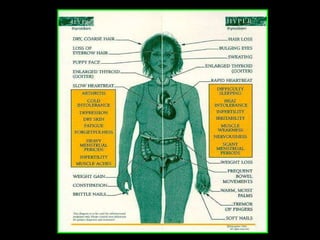
INTRODUCTION Hypometabolic state due to deficiency of thyroid hormones  Accumulation of GAGs (mucopolysaccharides) in the SC tissue Incidence : mid-50s   : male:female ratio -> 1:10
ETIOLOGY PRIMARY : THYROID FAILURE  ( 95%) SECONDARY : PITUITARY TSH DEFICIT TERTIARY : HYPOTHALAMIC DEFICIENCY OF TSH PERIPHERAL RESISTANCE TO THE ACTIONS OF THYROID HORMONES
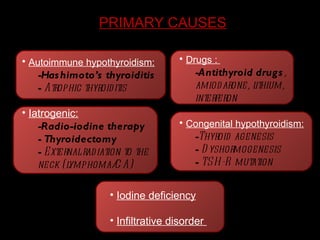
Autoimmune hypothyroidism: Hashimoto’s thyroiditis Atrophic thyroiditis Iatrogenic: Radio-iodine therapy Thyroidectomy External radiation to the neck (lymphoma/CA)  Drugs :  Antithyroid drugs , amiodarone, lithium, interferon Congenital hypothyroidism: Thyroid agenesis Dyshormogenesis TSH-R mutation PRIMARY CAUSES Iodine deficiency Infiltrative disorder
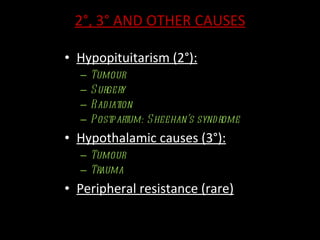
2°, 3° AND OTHER CAUSES Hypopituitarism (2°): Tumour Surgery Radiation  Postpartum: Sheehan’s syndrome Hypothalamic causes (3°): Tumour Trauma Peripheral resistance (rare)


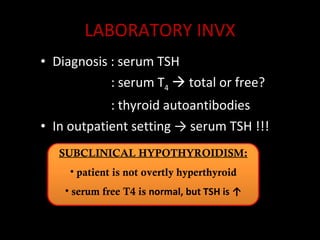
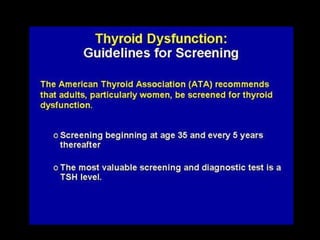
LABORATORY INVX Diagnosis : serum TSH   : serum T 4     total or free?   : thyroid autoantibodies In outpatient setting -> serum TSH !!! SUBCLINICAL HYPOTHYROIDISM: patient is not overtly hyperthyroid serum free T4 is  normal, but TSH is ↑
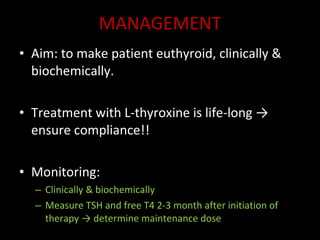
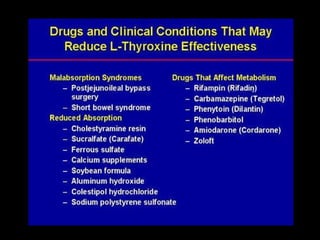
MANAGEMENT Aim: to make patient euthyroid, clinically & biochemically. Treatment with L-thyroxine is life-long -> ensure compliance!! Monitoring: Clinically & biochemically Measure TSH and free T4 2-3 month after initiation of therapy -> determine maintenance dose
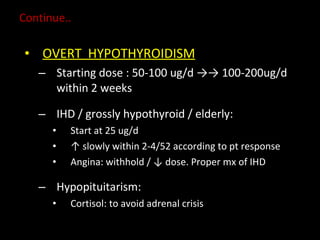
Continue.. OVERT  HYPOTHYROIDISM Starting dose : 50-100 ug/d ->-> 100-200ug/d within 2 weeks IHD / grossly hypothyroid / elderly: Start at 25 ug/d ↑  slowly within 2-4/52 according to pt response Angina: withhold / ↓ dose. Proper mx of IHD Hypopituitarism: Cortisol: to avoid adrenal crisis
SUBCLINICAL  HYPOTHYROIDISM: L-thyroxine to ↓ risk of CAD 50-100 ug/d ->-> adjust to maintain TSH at normal level PREGNANCY: ↑  dose, especially in 2 nd  / 3 rd  trimester
EMERGENCY: MYXEDEMA  COMA
Severe, uncompensated form of prolonged hypoTH Precipitated by stress / infection / drug  Complication: Hypoventilation Cardiac failure Fluid & electrolyte imbalance coma
PLAN OF MANAGEMENT Treat precipitating cause Gradual rewarming -> blanket Accurate core T° -> rectal thermometer Aim for slow  ↑ in core T° : 0.5 °C/hr Cardiac monitoring Correction of electrolyte abnormalities Adequate hydration & nutrition (dextrose) L-thyroxine (300-400 ug oral/iv) &  tri-iodothyronine 10 ug 8 hrly 8.  Hydrocortisone : blood cortisol
CONGENITAL HYPOTHYROIDISM
Incidence : 1 in 4000-5000 live births Importance of TH hormones: Normal development of nervous system !! Features:  Prolonged jaundice Poor feeding Constipation Unusually quite baby
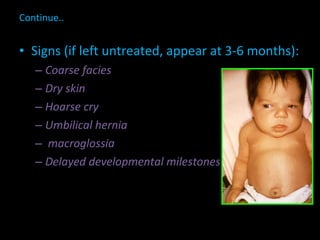
Continue.. Signs (if left untreated, appear at 3-6 months): Coarse facies Dry skin Hoarse cry Umbilical hernia  macroglossia Delayed developmental milestones
MANAGEMENT Newborn screening Diagnosis confirmed -> treat ASAP  Dose: start at 10-12 ug/kg/day Aim : maintain TSH at normal level   : maintain free T4 at upper limit of        normal range Life-long treatment: if transient hypoTH is suspected, re-evaluate at 2 years old. Monitoring: antropometry/milestones/bone age progression
THANK YOU


Hypothyroidism

  • 1.
  • 2.
    REFERENCES Practice Guidelinesfor Thyroid Disorders The Malaysian Consensus 2000 Ministry of Health Malaysia Oxford Handbook of Endocrinology & Diabetes Helen E. Turner, and John A.H. Wass 1 st edition, 2003 Update on the management of hyperthyroidism and hypothyroidism, Kenneth A. Woeber,, Arch Fam Med (2000) 9; 743-747
  • 3.
    INTRODUCTION Hypometabolic statedue to deficiency of thyroid hormones Accumulation of GAGs (mucopolysaccharides) in the SC tissue Incidence : mid-50s : male:female ratio -> 1:10
  • 4.
    ETIOLOGY PRIMARY :THYROID FAILURE ( 95%) SECONDARY : PITUITARY TSH DEFICIT TERTIARY : HYPOTHALAMIC DEFICIENCY OF TSH PERIPHERAL RESISTANCE TO THE ACTIONS OF THYROID HORMONES
  • 5.
    Autoimmune hypothyroidism: Hashimoto’sthyroiditis Atrophic thyroiditis Iatrogenic: Radio-iodine therapy Thyroidectomy External radiation to the neck (lymphoma/CA) Drugs : Antithyroid drugs , amiodarone, lithium, interferon Congenital hypothyroidism: Thyroid agenesis Dyshormogenesis TSH-R mutation PRIMARY CAUSES Iodine deficiency Infiltrative disorder
  • 6.
    2°, 3° ANDOTHER CAUSES Hypopituitarism (2°): Tumour Surgery Radiation Postpartum: Sheehan’s syndrome Hypothalamic causes (3°): Tumour Trauma Peripheral resistance (rare)
  • 7.
  • 8.
  • 9.
  • 10.
    LABORATORY INVX Diagnosis: serum TSH : serum T 4  total or free? : thyroid autoantibodies In outpatient setting -> serum TSH !!! SUBCLINICAL HYPOTHYROIDISM: patient is not overtly hyperthyroid serum free T4 is normal, but TSH is ↑
  • 11.
    MANAGEMENT Aim: tomake patient euthyroid, clinically & biochemically. Treatment with L-thyroxine is life-long -> ensure compliance!! Monitoring: Clinically & biochemically Measure TSH and free T4 2-3 month after initiation of therapy -> determine maintenance dose
  • 12.
    Continue.. OVERT HYPOTHYROIDISM Starting dose : 50-100 ug/d ->-> 100-200ug/d within 2 weeks IHD / grossly hypothyroid / elderly: Start at 25 ug/d ↑ slowly within 2-4/52 according to pt response Angina: withhold / ↓ dose. Proper mx of IHD Hypopituitarism: Cortisol: to avoid adrenal crisis
  • 13.
    SUBCLINICAL HYPOTHYROIDISM:L-thyroxine to ↓ risk of CAD 50-100 ug/d ->-> adjust to maintain TSH at normal level PREGNANCY: ↑ dose, especially in 2 nd / 3 rd trimester
  • 14.
  • 15.
    Severe, uncompensated formof prolonged hypoTH Precipitated by stress / infection / drug Complication: Hypoventilation Cardiac failure Fluid & electrolyte imbalance coma
  • 16.
    PLAN OF MANAGEMENTTreat precipitating cause Gradual rewarming -> blanket Accurate core T° -> rectal thermometer Aim for slow ↑ in core T° : 0.5 °C/hr Cardiac monitoring Correction of electrolyte abnormalities Adequate hydration & nutrition (dextrose) L-thyroxine (300-400 ug oral/iv) & tri-iodothyronine 10 ug 8 hrly 8. Hydrocortisone : blood cortisol
  • 17.
  • 18.
    Incidence : 1in 4000-5000 live births Importance of TH hormones: Normal development of nervous system !! Features: Prolonged jaundice Poor feeding Constipation Unusually quite baby
  • 19.
    Continue.. Signs (ifleft untreated, appear at 3-6 months): Coarse facies Dry skin Hoarse cry Umbilical hernia macroglossia Delayed developmental milestones
  • 20.
    MANAGEMENT Newborn screeningDiagnosis confirmed -> treat ASAP Dose: start at 10-12 ug/kg/day Aim : maintain TSH at normal level : maintain free T4 at upper limit of normal range Life-long treatment: if transient hypoTH is suspected, re-evaluate at 2 years old. Monitoring: antropometry/milestones/bone age progression
  • 21.
  • 22.
  • 23.

Editor's Notes

  • #21 screening: heel prick blood at 2-5/7 of life : cord blood is accepted now: if TSH increased, take venous blood and test for TSH and free T4 at day 7-10 of life.