http://www.fitango.com/categories.php?id=238
Fitango Education
Health Topics
Hyperthyroidism
1
Overview
Hyperthyroidism is a disorder that occurs when the
thyroid gland makes more thyroid hormone than
the body needs. Hyperthyroidism is sometimes
called thyrotoxicosis, the technical term for too
much thyroid hormone in the blood. Thyroid
hormones circulate throughout the body in the
bloodstream and act on virtually every tissue and
cell in the body. Hyperthyroidism causes many of
the body’s functions to speed up.
2
Symptoms
Hyperthyroidism has many symptoms that can vary
from person to person. Some common symptoms
of hyperthyroidism are:
-- nervousness or irritability
-- fatigue or muscle weakness
-- heat intolerance
3
Symptoms
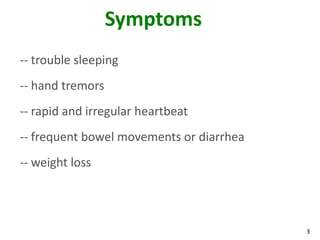
-- trouble sleeping
-- hand tremors
-- rapid and irregular heartbeat
-- frequent bowel movements or diarrhea
-- weight loss
4
Symptoms
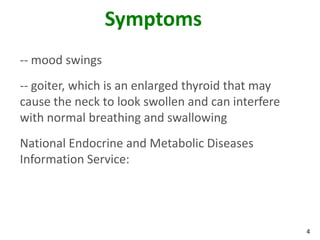
-- mood swings
-- goiter, which is an enlarged thyroid that may
cause the neck to look swollen and can interfere
with normal breathing and swallowing
National Endocrine and Metabolic Diseases
Information Service:
5
Diagnosis
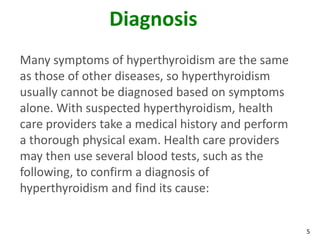
Many symptoms of hyperthyroidism are the same
as those of other diseases, so hyperthyroidism
usually cannot be diagnosed based on symptoms
alone. With suspected hyperthyroidism, health
care providers take a medical history and perform
a thorough physical exam. Health care providers
may then use several blood tests, such as the
following, to confirm a diagnosis of
hyperthyroidism and find its cause:
6
Diagnosis
**TSH test**
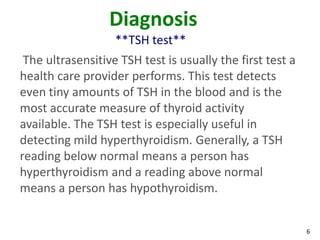
The ultrasensitive TSH test is usually the first test a
health care provider performs. This test detects
even tiny amounts of TSH in the blood and is the
most accurate measure of thyroid activity
available. The TSH test is especially useful in
detecting mild hyperthyroidism. Generally, a TSH
reading below normal means a person has
hyperthyroidism and a reading above normal
means a person has hypothyroidism.
7
Diagnosis
**TSH test**
Health care providers may conduct additional tests
to help confirm the diagnosis or determine the
cause of hyperthyroidism.
**T3 and T4 test**
This test shows the levels of T3 and T4 in the
blood. With hyperthyroidism, the levels of one or
both of these hormones in the blood are higher
than normal.
8
Diagnosis
**Thyroid-stimulating immunoglobulin (TSI) test**
This test, also called a thyroidstimulating antibody
test, measures the level of TSI in the blood. Most
people with Graves’ disease have this antibody, but
people whose hyperthyroidism is caused by other
conditions do not.
9
Diagnosis
**Radioactive iodine uptake test**
The radioactive iodine uptake test measures the
amount of iodine the thyroid collects from the
bloodstream. Measuring the amount of iodine in a
person’s thyroid helps the health care provider
determine what is causing a person’s
hyperthyroidism. For example, low levels of iodine
uptake might be a sign of thyroiditis, whereas high
levels could indicate Graves’ disease.
10
Diagnosis
**Thyroid scan**
A thyroid scan shows how and where iodine is
distributed in the thyroid. The images of nodules
and other possible irregularities help the health
care provider diagnose the cause of a person’s
hyperthyroidism.
National Endocrine and Metabolic Diseases
Information Service:
11
Treatment
Health care providers treat hyperthyroidism with
medications, radioiodine therapy, or thyroid
surgery. The aim of treatment is to bring thyroid
hormone levels to a normal state, thus preventing
long-term complications, and to relieve
uncomfortable symptoms. No single treatment
works for everyone.
12
Treatment
Treatment depends on the cause of
hyperthyroidism and how severe it is. When
choosing a treatment, health care providers
consider a patient’s age, possible allergies to or
side effects of the medications, other conditions
such as pregnancy or heart disease, and the
availability of an experienced thyroid surgeon.
**Medications**
13
Treatment
**Beta blockers**
Health care providers may prescribe a medication
called a beta blocker to reduce symptoms until
other treatments take effect. Beta blockers act
quickly to relieve many of the symptoms of
hyperthyroidism, such as tremors, rapid heartbeat,
and nervousness, but do not stop thyroid hormone
production. Most people feel better within hours
of taking these medications.
14
Treatment
**Beta blockers**
Antithyroid medications. Antithyroid therapy is the
easiest way to treat hyperthyroidism. Antithyroid
medications interfere with thyroid hormone
production but don’t usually have permanent
results. Antithyroid medications are not used to
treat thyroiditis.
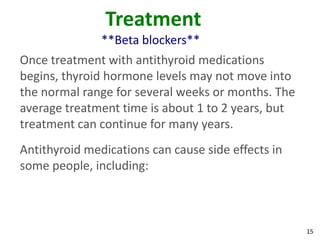
15
Treatment
**Beta blockers**
Once treatment with antithyroid medications
begins, thyroid hormone levels may not move into
the normal range for several weeks or months. The
average treatment time is about 1 to 2 years, but
treatment can continue for many years.
Antithyroid medications can cause side effects in
some people, including:
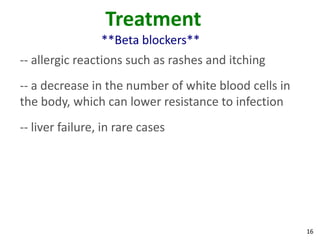
16
Treatment
**Beta blockers**
-- allergic reactions such as rashes and itching
-- a decrease in the number of white blood cells in
the body, which can lower resistance to infection
-- liver failure, in rare cases
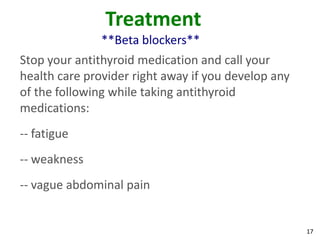
17
Treatment
**Beta blockers**
Stop your antithyroid medication and call your
health care provider right away if you develop any
of the following while taking antithyroid
medications:
-- fatigue
-- weakness
-- vague abdominal pain
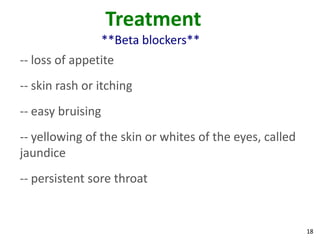
18
Treatment
**Beta blockers**
-- loss of appetite
-- skin rash or itching
-- easy bruising
-- yellowing of the skin or whites of the eyes, called
jaundice
-- persistent sore throat
19
Treatment
**Beta blockers**
-- fever
In the United States, health care providers
prescribe the antithyroid medication methimazole
(Tapazole, Northyx) for most types of
hyperthyroidism.
20
Treatment
**Antithyroid medications and pregnancy**
Because pregnant and breastfeeding women
cannot receive radioiodine therapy, they are
usually treated with an antithyroid medication
instead. However, experts agree that women in
their first trimester of pregnancy should not take
methimazole due to the rare occurrence of
damage to the fetus. Another antithyroid
medication, propylthiouracil (PTU), is available for
women in this stage of pregnancy or for women
who are allergic to or intolerant of methimazole
and have no other treatment options.
21
Treatment
**Antithyroid medications and pregnancy**
Health care providers may prescribe PTU for the
first trimester of pregnancy and switch to
methimazole for the second and third trimesters.
Some women are able to stop taking antithyroid
medications in the last 4 to 8 weeks of pregnancy
due to the remission of hyperthyroidism that
occurs during pregnancy. However these women
should continue to be monitored for recurrence of
thyroid problems following delivery.
22
Treatment
**Radioiodine Therapy
Radioactive iodine-131 is a common and effective
treatment for hyperthyroidism. In radioiodine
therapy, patients take radioactive iodine-131 by
mouth. Because the thyroid gland collects iodine
to make thyroid hormone, it will collect the
radioactive iodine from the bloodstream in the
same way. The radioactive iodine gradually
destroys the cells that make up the thyroid gland
but does not affect other body tissues.
23
Treatment
**Radioiodine Therapy
More than one round of radioiodine therapy may
be needed to bring thyroid hormone production
into the normal range. In the meantime, treatment
with beta blockers can control symptoms.
24
Treatment
**Radioiodine Therapy
Almost everyone who receives radioactive iodine
treatment eventually develops hypothyroidism.
But health care providers consider this an
acceptable outcome because hypothyroidism is
easier to treat and has fewer long-term
complications than hyperthyroidism. People who
develop hypothyroidism must take synthetic
thyroid hormone.
**Radioiodine and pregnancy**
25
Treatment
**Radioiodine Therapy
. Although iodine-131 is not known to cause birth
defects or infertility, radioiodine therapy is not
used in pregnant women or women who are
breastfeeding. Radioactive iodine can be harmful
to the fetus’ thyroid and can be passed from
mother to child in breast milk. Experts recommend
that women wait a year after treatment before
becoming pregnant.
**Thyroid Surgery**
26
Treatment
**Radioiodine Therapy
The least-used treatment is surgery to remove part
or most of the thyroid gland.
Sometimes surgery may be used to treat:
-- pregnant women who cannot tolerate
antithyroid medications
-- people with large goiters
27
Treatment
**Radioiodine Therapy
-- people who have cancerous thyroid
nodules, though hyperthyroidism does not cause
cancer
28
Treatment
**Radioiodine Therapy
Before surgery, the health care provider may
prescribe antithyroid medications to temporarily
bring a patient’s thyroid hormone levels into the
normal range. This presurgical treatment prevents
a condition called thyroid storm—a sudden, severe
worsening of symptoms—that can occur when
hyperthyroid patients have general anesthesia.
29
Treatment
**Radioiodine Therapy
When part of the thyroid is removed—as a
treatment for toxic nodules, for example—thyroid
hormone levels may return to normal. But some
surgical patients may still develop hypothyroidism
and need to take synthetic thyroxine, a medication
that is identical to the hormone, T4, made by the
thyroid. If the entire thyroid is removed, lifelong
thyroid hormone medication is necessary. After
surgery, health care providers will continue to
monitor patients’ thyroid hormone levels.
30
Treatment
**Radioiodine Therapy
National Endocrine and Metabolic Diseases
Information Service:
http://www.endocrine.niddk.nih.gov/pubs/Hypert
hyroidism/
31
Causes
Hyperthyroidism has several causes, including:
-- Graves’ disease
-- thyroid nodules
-- thyroiditis, or inflammation of the thyroid
32
Causes
-- consuming too much iodine
-- overmedicating with synthetic thyroid hormone,
which is used to treat underactive thyroid
Rarely, hyperthyroidism is caused by a pituitary
adenoma, which is a noncancerous tumor of the
pituitary gland. In this case, hyperthyroidism is due
to too much TSH.
33
Causes
National Endocrine and Metabolic Diseases
Information Service:
34
Facts
-- Hyperthyroidism is a disorder that occurs when
the thyroid gland makes more thyroid hormone
than the body needs.
-- Hyperthyroidism is most often caused by Graves’
disease, an autoimmune disorder. Other causes
include thyroid nodules, thyroiditis, consuming too
much iodine, and overmedicating with synthetic
thyroid hormone.
35
Facts
-- Some symptoms of hyperthyroidism are
nervousness or irritability, fatigue or muscle
weakness, heat intolerance, trouble sleeping, hand
tremors, rapid and irregular heartbeat, frequent
bowel movements or diarrhea, weight loss, mood
swings, and goiter.
-- Hyperthyroidism is much more common in
women than men.
36
Facts
-- Hyperthyroidism is also more common in people
older than age 60 and is often caused by thyroid
nodules. Hyperthyroidism in this age group is
sometimes misdiagnosed as depression or
dementia. For people older than age 60, subclinical
hyperthyroidism increases their chance of
developing atrial fibrillation.
37
Facts
-- Women with hyperthyroidism should discuss
their condition with their health care provider
before becoming pregnant.
-- Hyperthyroidism is treated with
medications, radioiodine therapy, or thyroid
surgery. No single treatment works for everyone.
National Endocrine and Metabolic Diseases
Information Service:
Hyperthyroidism

Hyperthyroidism

  • 1.
  • 2.
    1 Overview Hyperthyroidism is adisorder that occurs when the thyroid gland makes more thyroid hormone than the body needs. Hyperthyroidism is sometimes called thyrotoxicosis, the technical term for too much thyroid hormone in the blood. Thyroid hormones circulate throughout the body in the bloodstream and act on virtually every tissue and cell in the body. Hyperthyroidism causes many of the body’s functions to speed up.
  • 3.
    2 Symptoms Hyperthyroidism has manysymptoms that can vary from person to person. Some common symptoms of hyperthyroidism are: -- nervousness or irritability -- fatigue or muscle weakness -- heat intolerance
  • 4.
    3 Symptoms -- trouble sleeping --hand tremors -- rapid and irregular heartbeat -- frequent bowel movements or diarrhea -- weight loss
  • 5.
    4 Symptoms -- mood swings --goiter, which is an enlarged thyroid that may cause the neck to look swollen and can interfere with normal breathing and swallowing National Endocrine and Metabolic Diseases Information Service:
  • 6.
    5 Diagnosis Many symptoms ofhyperthyroidism are the same as those of other diseases, so hyperthyroidism usually cannot be diagnosed based on symptoms alone. With suspected hyperthyroidism, health care providers take a medical history and perform a thorough physical exam. Health care providers may then use several blood tests, such as the following, to confirm a diagnosis of hyperthyroidism and find its cause:
  • 7.
    6 Diagnosis **TSH test** The ultrasensitiveTSH test is usually the first test a health care provider performs. This test detects even tiny amounts of TSH in the blood and is the most accurate measure of thyroid activity available. The TSH test is especially useful in detecting mild hyperthyroidism. Generally, a TSH reading below normal means a person has hyperthyroidism and a reading above normal means a person has hypothyroidism.
  • 8.
    7 Diagnosis **TSH test** Health careproviders may conduct additional tests to help confirm the diagnosis or determine the cause of hyperthyroidism. **T3 and T4 test** This test shows the levels of T3 and T4 in the blood. With hyperthyroidism, the levels of one or both of these hormones in the blood are higher than normal.
  • 9.
    8 Diagnosis **Thyroid-stimulating immunoglobulin (TSI)test** This test, also called a thyroidstimulating antibody test, measures the level of TSI in the blood. Most people with Graves’ disease have this antibody, but people whose hyperthyroidism is caused by other conditions do not.
  • 10.
    9 Diagnosis **Radioactive iodine uptaketest** The radioactive iodine uptake test measures the amount of iodine the thyroid collects from the bloodstream. Measuring the amount of iodine in a person’s thyroid helps the health care provider determine what is causing a person’s hyperthyroidism. For example, low levels of iodine uptake might be a sign of thyroiditis, whereas high levels could indicate Graves’ disease.
  • 11.
    10 Diagnosis **Thyroid scan** A thyroidscan shows how and where iodine is distributed in the thyroid. The images of nodules and other possible irregularities help the health care provider diagnose the cause of a person’s hyperthyroidism. National Endocrine and Metabolic Diseases Information Service:
  • 12.
    11 Treatment Health care providerstreat hyperthyroidism with medications, radioiodine therapy, or thyroid surgery. The aim of treatment is to bring thyroid hormone levels to a normal state, thus preventing long-term complications, and to relieve uncomfortable symptoms. No single treatment works for everyone.
  • 13.
    12 Treatment Treatment depends onthe cause of hyperthyroidism and how severe it is. When choosing a treatment, health care providers consider a patient’s age, possible allergies to or side effects of the medications, other conditions such as pregnancy or heart disease, and the availability of an experienced thyroid surgeon. **Medications**
  • 14.
    13 Treatment **Beta blockers** Health careproviders may prescribe a medication called a beta blocker to reduce symptoms until other treatments take effect. Beta blockers act quickly to relieve many of the symptoms of hyperthyroidism, such as tremors, rapid heartbeat, and nervousness, but do not stop thyroid hormone production. Most people feel better within hours of taking these medications.
  • 15.
    14 Treatment **Beta blockers** Antithyroid medications.Antithyroid therapy is the easiest way to treat hyperthyroidism. Antithyroid medications interfere with thyroid hormone production but don’t usually have permanent results. Antithyroid medications are not used to treat thyroiditis.
  • 16.
    15 Treatment **Beta blockers** Once treatmentwith antithyroid medications begins, thyroid hormone levels may not move into the normal range for several weeks or months. The average treatment time is about 1 to 2 years, but treatment can continue for many years. Antithyroid medications can cause side effects in some people, including:
  • 17.
    16 Treatment **Beta blockers** -- allergicreactions such as rashes and itching -- a decrease in the number of white blood cells in the body, which can lower resistance to infection -- liver failure, in rare cases
  • 18.
    17 Treatment **Beta blockers** Stop yourantithyroid medication and call your health care provider right away if you develop any of the following while taking antithyroid medications: -- fatigue -- weakness -- vague abdominal pain
  • 19.
    18 Treatment **Beta blockers** -- lossof appetite -- skin rash or itching -- easy bruising -- yellowing of the skin or whites of the eyes, called jaundice -- persistent sore throat
  • 20.
    19 Treatment **Beta blockers** -- fever Inthe United States, health care providers prescribe the antithyroid medication methimazole (Tapazole, Northyx) for most types of hyperthyroidism.
  • 21.
    20 Treatment **Antithyroid medications andpregnancy** Because pregnant and breastfeeding women cannot receive radioiodine therapy, they are usually treated with an antithyroid medication instead. However, experts agree that women in their first trimester of pregnancy should not take methimazole due to the rare occurrence of damage to the fetus. Another antithyroid medication, propylthiouracil (PTU), is available for women in this stage of pregnancy or for women who are allergic to or intolerant of methimazole and have no other treatment options.
  • 22.
    21 Treatment **Antithyroid medications andpregnancy** Health care providers may prescribe PTU for the first trimester of pregnancy and switch to methimazole for the second and third trimesters. Some women are able to stop taking antithyroid medications in the last 4 to 8 weeks of pregnancy due to the remission of hyperthyroidism that occurs during pregnancy. However these women should continue to be monitored for recurrence of thyroid problems following delivery.
  • 23.
    22 Treatment **Radioiodine Therapy Radioactive iodine-131is a common and effective treatment for hyperthyroidism. In radioiodine therapy, patients take radioactive iodine-131 by mouth. Because the thyroid gland collects iodine to make thyroid hormone, it will collect the radioactive iodine from the bloodstream in the same way. The radioactive iodine gradually destroys the cells that make up the thyroid gland but does not affect other body tissues.
  • 24.
    23 Treatment **Radioiodine Therapy More thanone round of radioiodine therapy may be needed to bring thyroid hormone production into the normal range. In the meantime, treatment with beta blockers can control symptoms.
  • 25.
    24 Treatment **Radioiodine Therapy Almost everyonewho receives radioactive iodine treatment eventually develops hypothyroidism. But health care providers consider this an acceptable outcome because hypothyroidism is easier to treat and has fewer long-term complications than hyperthyroidism. People who develop hypothyroidism must take synthetic thyroid hormone. **Radioiodine and pregnancy**
  • 26.
    25 Treatment **Radioiodine Therapy . Althoughiodine-131 is not known to cause birth defects or infertility, radioiodine therapy is not used in pregnant women or women who are breastfeeding. Radioactive iodine can be harmful to the fetus’ thyroid and can be passed from mother to child in breast milk. Experts recommend that women wait a year after treatment before becoming pregnant. **Thyroid Surgery**
  • 27.
    26 Treatment **Radioiodine Therapy The least-usedtreatment is surgery to remove part or most of the thyroid gland. Sometimes surgery may be used to treat: -- pregnant women who cannot tolerate antithyroid medications -- people with large goiters
  • 28.
    27 Treatment **Radioiodine Therapy -- peoplewho have cancerous thyroid nodules, though hyperthyroidism does not cause cancer
  • 29.
    28 Treatment **Radioiodine Therapy Before surgery,the health care provider may prescribe antithyroid medications to temporarily bring a patient’s thyroid hormone levels into the normal range. This presurgical treatment prevents a condition called thyroid storm—a sudden, severe worsening of symptoms—that can occur when hyperthyroid patients have general anesthesia.
  • 30.
    29 Treatment **Radioiodine Therapy When partof the thyroid is removed—as a treatment for toxic nodules, for example—thyroid hormone levels may return to normal. But some surgical patients may still develop hypothyroidism and need to take synthetic thyroxine, a medication that is identical to the hormone, T4, made by the thyroid. If the entire thyroid is removed, lifelong thyroid hormone medication is necessary. After surgery, health care providers will continue to monitor patients’ thyroid hormone levels.
  • 31.
    30 Treatment **Radioiodine Therapy National Endocrineand Metabolic Diseases Information Service: http://www.endocrine.niddk.nih.gov/pubs/Hypert hyroidism/
  • 32.
    31 Causes Hyperthyroidism has severalcauses, including: -- Graves’ disease -- thyroid nodules -- thyroiditis, or inflammation of the thyroid
  • 33.
    32 Causes -- consuming toomuch iodine -- overmedicating with synthetic thyroid hormone, which is used to treat underactive thyroid Rarely, hyperthyroidism is caused by a pituitary adenoma, which is a noncancerous tumor of the pituitary gland. In this case, hyperthyroidism is due to too much TSH.
  • 34.
    33 Causes National Endocrine andMetabolic Diseases Information Service:
  • 35.
    34 Facts -- Hyperthyroidism isa disorder that occurs when the thyroid gland makes more thyroid hormone than the body needs. -- Hyperthyroidism is most often caused by Graves’ disease, an autoimmune disorder. Other causes include thyroid nodules, thyroiditis, consuming too much iodine, and overmedicating with synthetic thyroid hormone.
  • 36.
    35 Facts -- Some symptomsof hyperthyroidism are nervousness or irritability, fatigue or muscle weakness, heat intolerance, trouble sleeping, hand tremors, rapid and irregular heartbeat, frequent bowel movements or diarrhea, weight loss, mood swings, and goiter. -- Hyperthyroidism is much more common in women than men.
  • 37.
    36 Facts -- Hyperthyroidism isalso more common in people older than age 60 and is often caused by thyroid nodules. Hyperthyroidism in this age group is sometimes misdiagnosed as depression or dementia. For people older than age 60, subclinical hyperthyroidism increases their chance of developing atrial fibrillation.
  • 38.
    37 Facts -- Women withhyperthyroidism should discuss their condition with their health care provider before becoming pregnant. -- Hyperthyroidism is treated with medications, radioiodine therapy, or thyroid surgery. No single treatment works for everyone. National Endocrine and Metabolic Diseases Information Service: