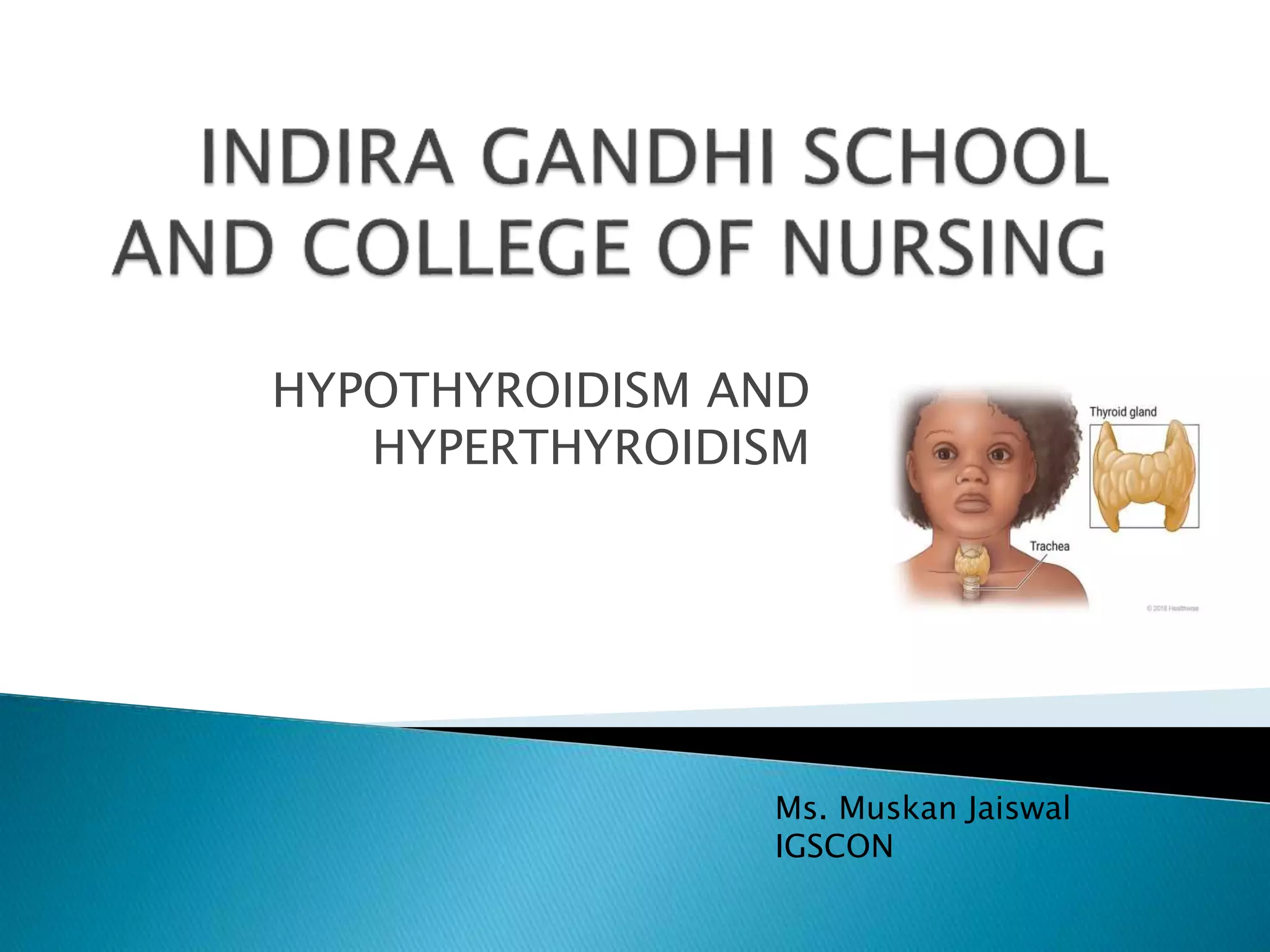
HYPOTHYROIDISM AND
HYPERTHYROIDISM
Ms. Muskan Jaiswal
IGSCON
• Thyroid gland is one of the seven major
glands that makes up the endocrine system.
• Endocrine glands produce hormones that are
transported by the blood system to all parts
of the body.
• Thyroid glands scretes thyroxin (T4),
triiodothyronine (T3) and calcitonin. These
hormones promote cellular growth,
metabolism and mental development.
• Disorders of thyroid gland are broadly
classified as HYPOTHROIDISM and
HYPERTHYROIDISM.
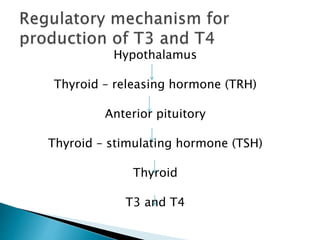
Hypothalamus
Thyroid – releasing hormone (TRH)
Anterior pituitory
Thyroid – stimulating hormone (TSH)
Thyroid
T3 and T4
HYPOTHYROIDISM HYPERTHYROIDISM
 Hypothyroidism results
from suboptimal levels
of thyroid hormone.
 It is a condition in which
there is an inadequate
amount of
triiodothyronine (T3)
and thyroxine (T4),
leading to decrease in
metabolic rate
 Other name of
hypothyroidism in child
: (Cretinism) and in
adults : ( mysedema)
 Hyperthyroidism is a set
of disorders that involve
excess synthesis and
secretion of thyroid
hormone (T3 and T4) by
the thyroid gland, which
leads to the
hypermetabolic condition
of thyrotoxicosis.
 Other name of
hyperthyroidism is (
grave’s disease )
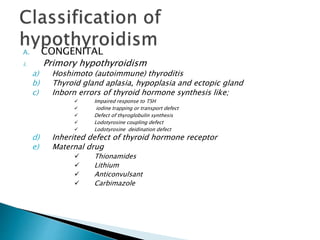
A. CONGENITAL
i. Primory hypothyroidism
a) Hoshimoto (autoimmune) thyroditis
b) Thyroid gland aplasia, hypoplasia and ectopic gland
c) Inborn errors of thyroid hormone synthesis like;
 Impaired response to TSH
 iodine trapping or transport defect
 Defect of thyroglobulin synthesis
 Lodotyrosine coupling defect
 Lodotyrosine deidination defect
d) Inherited defect of thyroid hormone receptor
e) Maternal drug
 Thionamides
 Lithium
 Anticonvulsant
 Carbimazole
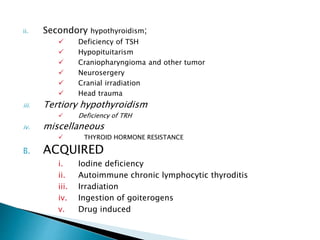
ii. Secondory hypothyroidism;
 Deficiency of TSH
 Hypopituitarism
 Craniopharyngioma and other tumor
 Neurosergery
 Cranial irradiation
 Head trauma
iii. Tertiory hypothyroidism
 Deficiency of TRH
iv. miscellaneous
 THYROID HORMONE RESISTANCE
B. ACQUIRED
i. Iodine deficiency
ii. Autoimmune chronic lymphocytic thyroditis
iii. Irradiation
iv. Ingestion of goiterogens
v. Drug induced
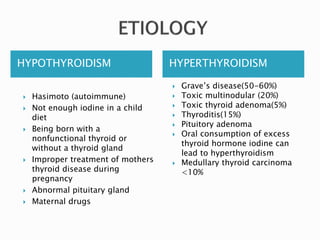
HYPOTHYROIDISM HYPERTHYROIDISM
 Hasimoto (autoimmune)
 Not enough iodine in a child
diet
 Being born with a
nonfunctional thyroid or
without a thyroid gland
 Improper treatment of mothers
thyroid disease during
pregnancy
 Abnormal pituitary gland
 Maternal drugs
 Grave’s disease(50-60%)
 Toxic multinodular (20%)
 Toxic thyroid adenoma(5%)
 Thyroditis(15%)
 Pituitory adenoma
 Oral consumption of excess
thyroid hormone iodine can
lead to hyperthyroidism
 Medullary thyroid carcinoma
<10%
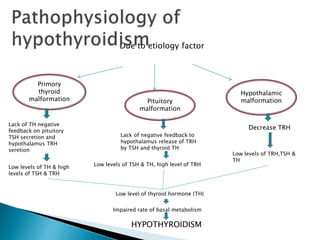
Due to etiology factor
Primory
thyroid
malformation Pituitory
malformation
Hypothalamic
malformation
Lack of TH negative
feedback on pituitory
TSH secretion and
hypothalamus TRH
seretion
Lack of negative feedback to
hypothalamus release of TRH
by TSH and thyroid TH
Decrease TRH
Low levels of TH & high
levels of TSH & TRH
Low levels of TSH & TH, high level of TRH
Low levels of TRH,TSH &
TH
Low level of thyroid hormone (TH)
Impaired rate of basal metabolism
HYPOTHYROIDISM
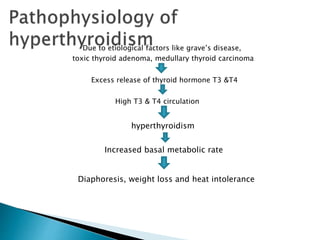
Due to etiological factors like grave’s disease,
toxic thyroid adenoma, medullary thyroid carcinoma
Excess release of thyroid hormone T3 &T4
High T3 & T4 circulation
hyperthyroidism
Increased basal metabolic rate
Diaphoresis, weight loss and heat intolerance
HYPOTHYROIDISM HYPERTHYROIDISM
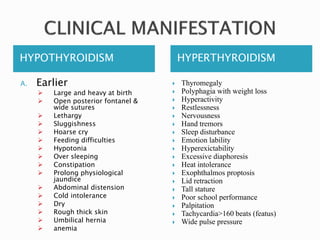
A. Earlier
 Large and heavy at birth
 Open posterior fontanel &
wide sutures
 Lethargy
 Sluggishness
 Hoarse cry
 Feeding difficulties
 Hypotonia
 Over sleeping
 Constipation
 Prolong physiological
jaundice
 Abdominal distension
 Cold intolerance
 Dry
 Rough thick skin
 Umbilical hernia
 anemia
 Thyromegaly
 Polyphagia with weight loss
 Hyperactivity
 Restlessness
 Nervousness
 Hand tremors
 Sleep disturbance
 Emotion lability
 Hyperexictability
 Excessive diaphoresis
 Heat intolerance
 Exophthalmos proptosis
 Lid retraction
 Tall stature
 Poor school performance
 Palpitation
 Tachycardia>160 beats (featus)
 Wide pulse pressure
HYPOTHYROIDISM HYPERTHYROIDISM
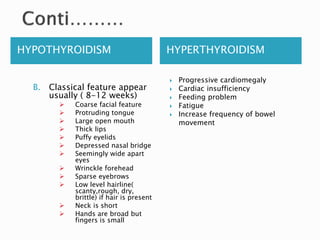
B. Classical feature appear
usually ( 8-12 weeks)
 Coarse facial feature
 Protruding tongue
 Large open mouth
 Thick lips
 Puffy eyelids
 Depressed nasal bridge
 Seemingly wide apart
eyes
 Wrinckle forehead
 Sparse eyebrows
 Low level hairline(
scanty,rough, dry,
brittle) if hair is present
 Neck is short
 Hands are broad but
fingers is small
 Progressive cardiomegaly
 Cardiac insufficiency
 Feeding problem
 Fatigue
 Increase frequency of bowel
movement
HYPOTHYROIDISM HYPERTHYROIDISM
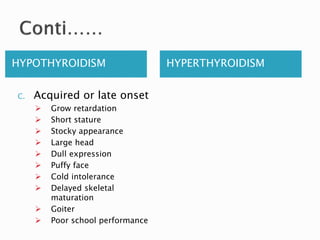
C. Acquired or late onset
 Grow retardation
 Short stature
 Stocky appearance
 Large head
 Dull expression
 Puffy face
 Cold intolerance
 Delayed skeletal
maturation
 Goiter
 Poor school performance
HYPOTHYROIDISM HYPERTHYROIDISM
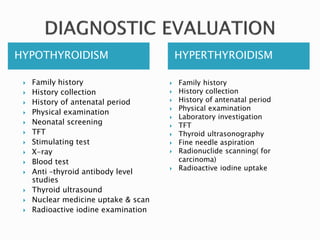
 Family history
 History collection
 History of antenatal period
 Physical examination
 Neonatal screening
 TFT
 Stimulating test
 X-ray
 Blood test
 Anti –thyroid antibody level
studies
 Thyroid ultrasound
 Nuclear medicine uptake & scan
 Radioactive iodine examination
 Family history
 History collection
 History of antenatal period
 Physical examination
 Laboratory investigation
 TFT
 Thyroid ultrasonography
 Fine needle aspiration
 Radionuclide scanning( for
carcinoma)
 Radioactive iodine uptake
HYPOTHYROIDISM HYPERTHYROIDISM
1. levothyroxine: 10 to 15 mcg/kg orally
once day, must be started immediately
& be closely monitored.
this dosages is intended to rapidaly
within (2week) bring the serumT4 level
into the upper half of normal range for
age ( between 10 mcg/dl [129nmol/l]
and 15mcg/dl [193nmol/l] and
promptly ( within 4 week) reduce the
TSH.
2. In acquired hypothyroidism :
usual starting dosages of
levothyroxine is based on body
surface area (100mcg/m2 orally once
a day)
 For age 1 to 3 years : 4 to 6 mcg/kg once a
day
 For age 3 to 10 years : 3 to 5 mcg/kg once a
day
1. Antithyroid drugs :
 propylthiouracil:
6 year child ; 50mg orally daily in
3 equally divided doses
approximately
( carefully titrate based on TSH &
free T4 levels)
6 to 10 year of age ;
50 to 150 mg orally 8 hr.
10 years or older; 150 to 300 mg
orally
 Methimazole ;
0.17 to 0.33 mg/kg orally 3
times a day
2. Beta blocker:
 Propranolol – 0.8 mg/kg
orally 3 times a day
 Atenolol- 0.5-1.2 mg/kg
orally 1 to 2 times a day
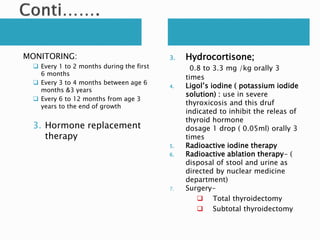
MONITORING:
 Every 1 to 2 months during the first
6 months
 Every 3 to 4 months between age 6
months &3 years
 Every 6 to 12 months from age 3
years to the end of growth
3. Hormone replacement
therapy
3. Hydrocortisone;
0.8 to 3.3 mg /kg orally 3
times
4. Ligol’s iodine ( potassium iodide
solution) : use in severe
thyroxicosis and this druf
indicated to inhibit the releas of
thyroid hormone
dosage 1 drop ( 0.05ml) orally 3
times
5. Radioactive iodine therapy
6. Radioactive ablation therapy- (
disposal of stool and urine as
directed by nuclear medicine
department)
7. Surgery-
 Total thyroidectomy
 Subtotal thyroidectomy
 Early identification
 Collecting history
 Assist laboratory test
 Drug should administer
 Teach and educate the parent about the condition
 Symptomatic treatment
 Follow up care
1. Sharma rimple , essential of pediatric nursing 2nd edition the
health sciences publishers, page no. – 323-326
2. Datta parul pediatric nursing ( as per INC syllabus ) fourth edition
the health sciences publishers page no. – 364-366
3. Sudhakar a essential of pediatric nursing (as per INC syllabus ) the
health science publishers page no . 1273-1276
4. https://www.hopkinsmedicine.org/health/condition-and-
diseases/hypothyroidism-in-children
5. https:/www.msdmanuals.com/en-
in/professional/pediatrics/endocrine-disorders-in-
children/hypothyroidism-in-infants-and-children
6. https:/images.app.goo.gl/GZHt9pb8YgMztrV48
7. https://images.app.goo.gl/QdgYQJLv8Um8j5bC9
8. https://www.drugs.com/dosage/propylthiouracil.html#Usual_Pedi
atric_Dose_For_Hyperthroidism
9. https://www.msdmanuals.com/en-
in/professional/pediatrics/endocrine-disorders-in-
children/hyperthyroidism-in-infants-and-children
hyperthyroidism & hypothyroidism

hyperthyroidism & hypothyroidism

  • 1.
  • 2.
    • Thyroid glandis one of the seven major glands that makes up the endocrine system. • Endocrine glands produce hormones that are transported by the blood system to all parts of the body. • Thyroid glands scretes thyroxin (T4), triiodothyronine (T3) and calcitonin. These hormones promote cellular growth, metabolism and mental development. • Disorders of thyroid gland are broadly classified as HYPOTHROIDISM and HYPERTHYROIDISM.
  • 3.
    Hypothalamus Thyroid – releasinghormone (TRH) Anterior pituitory Thyroid – stimulating hormone (TSH) Thyroid T3 and T4
  • 4.
    HYPOTHYROIDISM HYPERTHYROIDISM  Hypothyroidismresults from suboptimal levels of thyroid hormone.  It is a condition in which there is an inadequate amount of triiodothyronine (T3) and thyroxine (T4), leading to decrease in metabolic rate  Other name of hypothyroidism in child : (Cretinism) and in adults : ( mysedema)  Hyperthyroidism is a set of disorders that involve excess synthesis and secretion of thyroid hormone (T3 and T4) by the thyroid gland, which leads to the hypermetabolic condition of thyrotoxicosis.  Other name of hyperthyroidism is ( grave’s disease )
  • 5.
    A. CONGENITAL i. Primoryhypothyroidism a) Hoshimoto (autoimmune) thyroditis b) Thyroid gland aplasia, hypoplasia and ectopic gland c) Inborn errors of thyroid hormone synthesis like;  Impaired response to TSH  iodine trapping or transport defect  Defect of thyroglobulin synthesis  Lodotyrosine coupling defect  Lodotyrosine deidination defect d) Inherited defect of thyroid hormone receptor e) Maternal drug  Thionamides  Lithium  Anticonvulsant  Carbimazole
  • 6.
    ii. Secondory hypothyroidism; Deficiency of TSH  Hypopituitarism  Craniopharyngioma and other tumor  Neurosergery  Cranial irradiation  Head trauma iii. Tertiory hypothyroidism  Deficiency of TRH iv. miscellaneous  THYROID HORMONE RESISTANCE B. ACQUIRED i. Iodine deficiency ii. Autoimmune chronic lymphocytic thyroditis iii. Irradiation iv. Ingestion of goiterogens v. Drug induced
  • 7.
    HYPOTHYROIDISM HYPERTHYROIDISM  Hasimoto(autoimmune)  Not enough iodine in a child diet  Being born with a nonfunctional thyroid or without a thyroid gland  Improper treatment of mothers thyroid disease during pregnancy  Abnormal pituitary gland  Maternal drugs  Grave’s disease(50-60%)  Toxic multinodular (20%)  Toxic thyroid adenoma(5%)  Thyroditis(15%)  Pituitory adenoma  Oral consumption of excess thyroid hormone iodine can lead to hyperthyroidism  Medullary thyroid carcinoma <10%
  • 8.
    Due to etiologyfactor Primory thyroid malformation Pituitory malformation Hypothalamic malformation Lack of TH negative feedback on pituitory TSH secretion and hypothalamus TRH seretion Lack of negative feedback to hypothalamus release of TRH by TSH and thyroid TH Decrease TRH Low levels of TH & high levels of TSH & TRH Low levels of TSH & TH, high level of TRH Low levels of TRH,TSH & TH Low level of thyroid hormone (TH) Impaired rate of basal metabolism HYPOTHYROIDISM
  • 9.
    Due to etiologicalfactors like grave’s disease, toxic thyroid adenoma, medullary thyroid carcinoma Excess release of thyroid hormone T3 &T4 High T3 & T4 circulation hyperthyroidism Increased basal metabolic rate Diaphoresis, weight loss and heat intolerance
  • 10.
    HYPOTHYROIDISM HYPERTHYROIDISM A. Earlier Large and heavy at birth  Open posterior fontanel & wide sutures  Lethargy  Sluggishness  Hoarse cry  Feeding difficulties  Hypotonia  Over sleeping  Constipation  Prolong physiological jaundice  Abdominal distension  Cold intolerance  Dry  Rough thick skin  Umbilical hernia  anemia  Thyromegaly  Polyphagia with weight loss  Hyperactivity  Restlessness  Nervousness  Hand tremors  Sleep disturbance  Emotion lability  Hyperexictability  Excessive diaphoresis  Heat intolerance  Exophthalmos proptosis  Lid retraction  Tall stature  Poor school performance  Palpitation  Tachycardia>160 beats (featus)  Wide pulse pressure
  • 11.
    HYPOTHYROIDISM HYPERTHYROIDISM B. Classicalfeature appear usually ( 8-12 weeks)  Coarse facial feature  Protruding tongue  Large open mouth  Thick lips  Puffy eyelids  Depressed nasal bridge  Seemingly wide apart eyes  Wrinckle forehead  Sparse eyebrows  Low level hairline( scanty,rough, dry, brittle) if hair is present  Neck is short  Hands are broad but fingers is small  Progressive cardiomegaly  Cardiac insufficiency  Feeding problem  Fatigue  Increase frequency of bowel movement
  • 12.
    HYPOTHYROIDISM HYPERTHYROIDISM C. Acquiredor late onset  Grow retardation  Short stature  Stocky appearance  Large head  Dull expression  Puffy face  Cold intolerance  Delayed skeletal maturation  Goiter  Poor school performance
  • 13.
    HYPOTHYROIDISM HYPERTHYROIDISM  Familyhistory  History collection  History of antenatal period  Physical examination  Neonatal screening  TFT  Stimulating test  X-ray  Blood test  Anti –thyroid antibody level studies  Thyroid ultrasound  Nuclear medicine uptake & scan  Radioactive iodine examination  Family history  History collection  History of antenatal period  Physical examination  Laboratory investigation  TFT  Thyroid ultrasonography  Fine needle aspiration  Radionuclide scanning( for carcinoma)  Radioactive iodine uptake
  • 14.
    HYPOTHYROIDISM HYPERTHYROIDISM 1. levothyroxine:10 to 15 mcg/kg orally once day, must be started immediately & be closely monitored. this dosages is intended to rapidaly within (2week) bring the serumT4 level into the upper half of normal range for age ( between 10 mcg/dl [129nmol/l] and 15mcg/dl [193nmol/l] and promptly ( within 4 week) reduce the TSH. 2. In acquired hypothyroidism : usual starting dosages of levothyroxine is based on body surface area (100mcg/m2 orally once a day)  For age 1 to 3 years : 4 to 6 mcg/kg once a day  For age 3 to 10 years : 3 to 5 mcg/kg once a day 1. Antithyroid drugs :  propylthiouracil: 6 year child ; 50mg orally daily in 3 equally divided doses approximately ( carefully titrate based on TSH & free T4 levels) 6 to 10 year of age ; 50 to 150 mg orally 8 hr. 10 years or older; 150 to 300 mg orally  Methimazole ; 0.17 to 0.33 mg/kg orally 3 times a day 2. Beta blocker:  Propranolol – 0.8 mg/kg orally 3 times a day  Atenolol- 0.5-1.2 mg/kg orally 1 to 2 times a day
  • 15.
    MONITORING:  Every 1to 2 months during the first 6 months  Every 3 to 4 months between age 6 months &3 years  Every 6 to 12 months from age 3 years to the end of growth 3. Hormone replacement therapy 3. Hydrocortisone; 0.8 to 3.3 mg /kg orally 3 times 4. Ligol’s iodine ( potassium iodide solution) : use in severe thyroxicosis and this druf indicated to inhibit the releas of thyroid hormone dosage 1 drop ( 0.05ml) orally 3 times 5. Radioactive iodine therapy 6. Radioactive ablation therapy- ( disposal of stool and urine as directed by nuclear medicine department) 7. Surgery-  Total thyroidectomy  Subtotal thyroidectomy
  • 16.
     Early identification Collecting history  Assist laboratory test  Drug should administer  Teach and educate the parent about the condition  Symptomatic treatment  Follow up care
  • 17.
    1. Sharma rimple, essential of pediatric nursing 2nd edition the health sciences publishers, page no. – 323-326 2. Datta parul pediatric nursing ( as per INC syllabus ) fourth edition the health sciences publishers page no. – 364-366 3. Sudhakar a essential of pediatric nursing (as per INC syllabus ) the health science publishers page no . 1273-1276 4. https://www.hopkinsmedicine.org/health/condition-and- diseases/hypothyroidism-in-children 5. https:/www.msdmanuals.com/en- in/professional/pediatrics/endocrine-disorders-in- children/hypothyroidism-in-infants-and-children 6. https:/images.app.goo.gl/GZHt9pb8YgMztrV48 7. https://images.app.goo.gl/QdgYQJLv8Um8j5bC9 8. https://www.drugs.com/dosage/propylthiouracil.html#Usual_Pedi atric_Dose_For_Hyperthroidism 9. https://www.msdmanuals.com/en- in/professional/pediatrics/endocrine-disorders-in- children/hyperthyroidism-in-infants-and-children