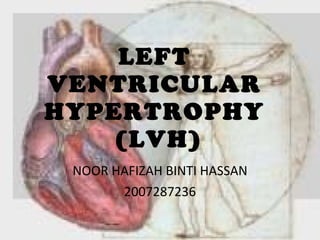
LEFT  VENTRICULAR  HYPERTROPHY  (LVH) NOOR HAFIZAH BINTI HASSAN 2007287236
INTRODUCTION Changes in the heart following uncontrolled HT: Myocardial structure Coronary vasculature Conduction system of the heart Increase BP change cardiac structure: ↑  afterload (directly) Neurohormonal & vascular changes (indirectly)
Progression From Hypertension to Heart Failure LVH, left ventricular hypertrophy; MI, myocardial infarction; CHF, chronic heart failure. Vasan RS and Levy D.  Arch Intern Med.  1996;156:1789-1796. Hypertension Smoking Dyslipidemia Diabetes Obesity Diabetes MI LVH LVF Normal LV Structure and Function LV Remodeling Subclinical LV Dysfunction Overt Heart Failure Diastolic Dysfunction Systolic Dysfunction
Adaptive response to maintain pump performance in the  ↑ of afterload ↓ Concentric hypertrophy: thickening of intraventricular septum & free wall of LV Cardiac myocyte hypertrophy Deposition of extracellular matrix PATHOPHYSIOLOGY OF LVH IN HT
Continue.. Cardiac myocyte hypertrophy ↓ Frank-Starling’s law ↓ Hypertrophy can no longer compensate for ↑ afterload ↓ LV dilatation (eccentric LVH) Deposition of ECM around the hypertrophied myocyte ↓ Inhibit the heart from contracting and relaxing normally The Normal Heart, Left Ventricular Hypertrophy in Hypertension, and Heart Failure in Hypertension Douglas L. Mann, MD, James L. Pool, MD, and Addison A. Taylor, MD, PhD Hypertensiononline.org.
Harrison’s Principle of Internal Medicine 16 th  ed, page 1369
NEJM 15 MAY 2003
CLINICAL PRESENTATION ASYMPTOMATIC  UNTIL THEY DEVELOP LV DIASTOLIC DYSFUNCTION AND HEART FAILURE PHYSICAL SIGNS: Abnormal apical impulse : sustained + diffuse (>3 cm diameter)  +  displaced from midclavicular line S4 gallop:  best heard with the bell of stethoscope in left lateral    position. Palpable occasionally.    : decrease elasticity of the hypertrophied ventricle  during late diastole
INVESTIGATION ECG: Provide information on rhythm disturbance, hyperkalemia, PR interval, and QT interval  Suggest a diagnosis or alteration of treatment ECHOCARDIOGRAPHY:  LV wall thickness LA size LV function Wall motion abnormalities
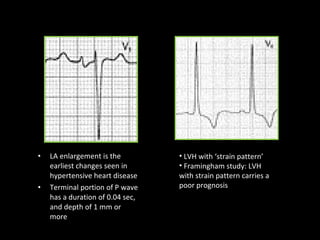
LA enlargement is the earliest changes seen in hypertensive heart disease  Terminal portion of P wave has a duration of 0.04 sec, and depth of 1 mm or more  LVH with ‘strain pattern’ Framingham study: LVH with strain pattern carries a poor prognosis
OTHER MODALITIES CARDIAC MRI CT  ABPM  White coat HT Resistant HT (140/90 mmHg) on more than 3 anti-HT regimens, one of which is diuretics Evaluation of suspected hypotension s/sx Establishing the D.O.A of new drugs in clinical trial
PHARMACOLOGICAL MX Treatment of HT will lead to regression of LVH, improvement of LV function and reduction of cardiovascular morbidity. All classes of antihypertensive agents have been shown to cause regression of LVH. MOH CPG on Management of Hypertension, 3 rd  ed, 2008
NON PHARMALOGICAL MX ↓  weight ↓  sodium intake Avoidance of alcohol intake Regular physical exercise Healthy eating Cessation of smoking Others: stress mx, micronutrient alteration, supplementation with fish oil, K + , Ca 2+ ,Mg 2+ , and fibre MOH CPG on Management of Hypertension, 3 rd  ed 2008
Progression From Hypertension to Heart Failure LVH, left ventricular hypertrophy; MI, myocardial infarction; CHF, chronic heart failure. Vasan RS and Levy D.  Arch Intern Med.  1996;156:1789-1796. Hypertension Smoking Dyslipidemia Diabetes Obesity Diabetes MI LVH CHF Normal LV Structure and Function LV Remodeling Subclinical LV Dysfunction Overt Heart Failure Diastolic Dysfunction Systolic Dysfunction

Lvh

  • 1.
    LEFT VENTRICULAR HYPERTROPHY (LVH) NOOR HAFIZAH BINTI HASSAN 2007287236
  • 2.
    INTRODUCTION Changes inthe heart following uncontrolled HT: Myocardial structure Coronary vasculature Conduction system of the heart Increase BP change cardiac structure: ↑ afterload (directly) Neurohormonal & vascular changes (indirectly)
  • 3.
    Progression From Hypertensionto Heart Failure LVH, left ventricular hypertrophy; MI, myocardial infarction; CHF, chronic heart failure. Vasan RS and Levy D. Arch Intern Med. 1996;156:1789-1796. Hypertension Smoking Dyslipidemia Diabetes Obesity Diabetes MI LVH LVF Normal LV Structure and Function LV Remodeling Subclinical LV Dysfunction Overt Heart Failure Diastolic Dysfunction Systolic Dysfunction
  • 4.
    Adaptive response tomaintain pump performance in the ↑ of afterload ↓ Concentric hypertrophy: thickening of intraventricular septum & free wall of LV Cardiac myocyte hypertrophy Deposition of extracellular matrix PATHOPHYSIOLOGY OF LVH IN HT
  • 5.
    Continue.. Cardiac myocytehypertrophy ↓ Frank-Starling’s law ↓ Hypertrophy can no longer compensate for ↑ afterload ↓ LV dilatation (eccentric LVH) Deposition of ECM around the hypertrophied myocyte ↓ Inhibit the heart from contracting and relaxing normally The Normal Heart, Left Ventricular Hypertrophy in Hypertension, and Heart Failure in Hypertension Douglas L. Mann, MD, James L. Pool, MD, and Addison A. Taylor, MD, PhD Hypertensiononline.org.
  • 6.
    Harrison’s Principle ofInternal Medicine 16 th ed, page 1369
  • 7.
  • 8.
    CLINICAL PRESENTATION ASYMPTOMATIC UNTIL THEY DEVELOP LV DIASTOLIC DYSFUNCTION AND HEART FAILURE PHYSICAL SIGNS: Abnormal apical impulse : sustained + diffuse (>3 cm diameter) + displaced from midclavicular line S4 gallop: best heard with the bell of stethoscope in left lateral position. Palpable occasionally. : decrease elasticity of the hypertrophied ventricle during late diastole
  • 9.
    INVESTIGATION ECG: Provideinformation on rhythm disturbance, hyperkalemia, PR interval, and QT interval Suggest a diagnosis or alteration of treatment ECHOCARDIOGRAPHY: LV wall thickness LA size LV function Wall motion abnormalities
  • 10.
    LA enlargement isthe earliest changes seen in hypertensive heart disease Terminal portion of P wave has a duration of 0.04 sec, and depth of 1 mm or more LVH with ‘strain pattern’ Framingham study: LVH with strain pattern carries a poor prognosis
  • 11.
    OTHER MODALITIES CARDIACMRI CT ABPM White coat HT Resistant HT (140/90 mmHg) on more than 3 anti-HT regimens, one of which is diuretics Evaluation of suspected hypotension s/sx Establishing the D.O.A of new drugs in clinical trial
  • 12.
    PHARMACOLOGICAL MX Treatmentof HT will lead to regression of LVH, improvement of LV function and reduction of cardiovascular morbidity. All classes of antihypertensive agents have been shown to cause regression of LVH. MOH CPG on Management of Hypertension, 3 rd ed, 2008
  • 13.
    NON PHARMALOGICAL MX↓ weight ↓ sodium intake Avoidance of alcohol intake Regular physical exercise Healthy eating Cessation of smoking Others: stress mx, micronutrient alteration, supplementation with fish oil, K + , Ca 2+ ,Mg 2+ , and fibre MOH CPG on Management of Hypertension, 3 rd ed 2008
  • 14.
    Progression From Hypertensionto Heart Failure LVH, left ventricular hypertrophy; MI, myocardial infarction; CHF, chronic heart failure. Vasan RS and Levy D. Arch Intern Med. 1996;156:1789-1796. Hypertension Smoking Dyslipidemia Diabetes Obesity Diabetes MI LVH CHF Normal LV Structure and Function LV Remodeling Subclinical LV Dysfunction Overt Heart Failure Diastolic Dysfunction Systolic Dysfunction

Editor's Notes

  • #4 Hypertension can lead to LVH, diastolic or systolic dysfunction and heart failure. Progression from hypertension to LVH is due to the macro and micro changes in the ventricle (LV remodeling). This remodeling can lead to diastolic dysfunction without clinical signs or symptoms of heart failure. This emphasizes the importance of treatment in some patients prior to development of overt heart failure. Hypertension, in conjunction with other risk factors for atherosclerosis may lead to myocardial infarction. LV remodeling again takes place, but does so differently, leading to systolic dysfunction. Again, remodeling is taking place within the ventricle in response to the injury but may not lead to overt heart failure. Progression will lead to heart failure, with decreasing ejection fractions.
  • #15 Hypertension can lead to LVH, diastolic or systolic dysfunction and heart failure. Progression from hypertension to LVH is due to the macro and micro changes in the ventricle (LV remodeling). This remodeling can lead to diastolic dysfunction without clinical signs or symptoms of heart failure. This emphasizes the importance of treatment in some patients prior to development of overt heart failure. Hypertension, in conjunction with other risk factors for atherosclerosis may lead to myocardial infarction. LV remodeling again takes place, but does so differently, leading to systolic dysfunction. Again, remodeling is taking place within the ventricle in response to the injury but may not lead to overt heart failure. Progression will lead to heart failure, with decreasing ejection fractions.