‫الرحیم‬ ‫الرحمن‬ ‫هللا‬ ‫بسم‬
BY DR.LAILMAAH HABIBI 3RD year of KABUL RBH (AFG)
2017
1
2
Objectives
1. Definition
2. Classification
3. Clinical manifestation
4. Lab evaluation
5. Complication
6. Medication
3
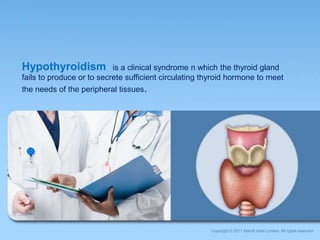
Hypothyroidism is a clinical syndrome n which the thyroid gland
fails to produce or to secrete sufficient circulating thyroid hormone to meet
the needs of the peripheral tissues.
Copyright © 2011 Abbott India Limited. All rights reserved
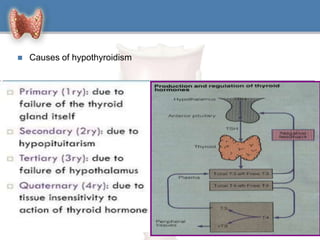
 Causes of hypothyroidism
5
Primary hypothyroidism
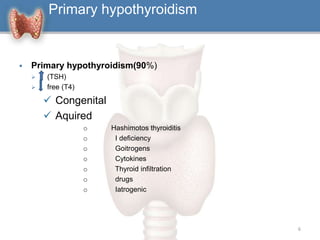
 Primary hypothyroidism(90%)
 (TSH)
 free (T4)
 Congenital
 Aquired
o Hashimotos thyroiditis
o I deficiency
o Goitrogens
o Cytokines
o Thyroid infiltration
o drugs
o Iatrogenic
6
Central Hypothyroidism or 2ndry
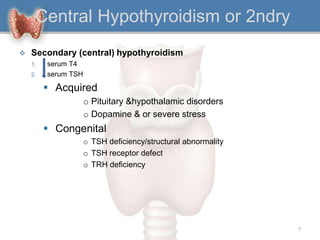
 Secondary (central) hypothyroidism
1. serum T4
2. serum TSH
 Acquired
o Pituitary &hypothalamic disorders
o Dopamine & or severe stress
 Congenital
o TSH deficiency/structural abnormality
o TSH receptor defect
o TRH deficiency
7
Other types
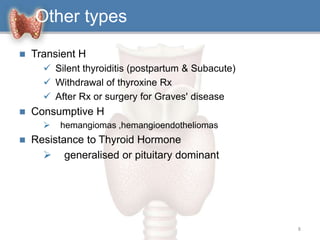
 Transient H
 Silent thyroiditis (postpartum & Subacute)
 Withdrawal of thyroxine Rx
 After Rx or surgery for Graves' disease
 Consumptive H
 hemangiomas ,hemangioendotheliomas
 Resistance to Thyroid Hormone
 generalised or pituitary dominant
8
Other types con..
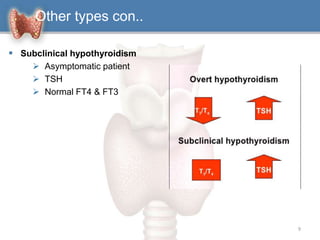
 Subclinical hypothyroidism
 Asymptomatic patient
 TSH
 Normal FT4 & FT3
9
 Clinical (overt) H
o Symptomatic patient
o Elevated TSH level
o low levels of FT4 and FT3
Euthyroid sick syndrome
o Pts without known thyroid disease
o FT4
o TSH not elevated.
 severe illness, caloric deprivation, or major surgery.
 Serum TSH tends to be suppressed in severe nonthyroidal illness
10
Myxedema crisis
• A life-threatening state with
• Impaired cognition {confusion to somnolence to coma
(myxedema)}
• Elderly women (stroke or stopped taking thyroxine)
• Convulsions & CNS signs
11
Precipitating events
1. Infection, sepsis
(pneumonia)
2. Cold exp
3. CVA
4. Drug effect
5. MI
6. GI bleeding
7. Trauma
8. burns
9. CHF
10. Hypoxia
11. Na
12. Capnea
13. Glycemia
14. Ca
15. DKA
12
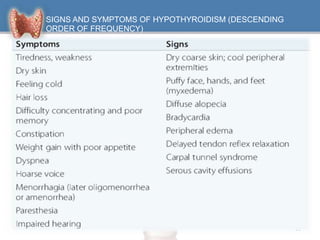
SIGNS AND SYMPTOMS OF HYPOTHYROIDISM (DESCENDING
ORDER OF FREQUENCY)
13
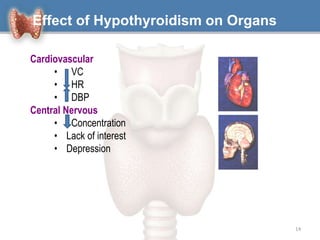
Effect of Hypothyroidism on Organs
Cardiovascular
• VC
• HR
• DBP
Central Nervous
• Concentration
• Lack of interest
• Depression
14
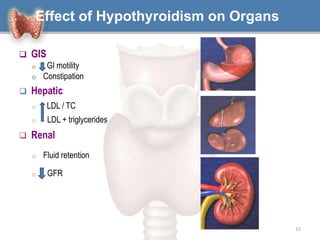
Effect of Hypothyroidism on Organs
 GIS
o GI motility
o Constipation
 Hepatic
o LDL / TC
o LDL + triglycerides
 Renal
o Fluid retention
o GFR
15
16
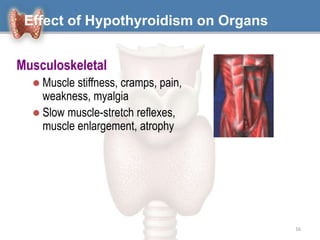
Effect of Hypothyroidism on Organs
Musculoskeletal
 Muscle stiffness, cramps, pain,
weakness, myalgia
 Slow muscle-stretch reflexes,
muscle enlargement, atrophy
Reproductive
o Arrest of pubertal development
o Reduced growth velocity
o Menorrhagia, Amenorrhea
o Anovulation, Infertility
17
Effect of Hypothyroidism on Organs
18
Effect of Hypothyroidism on Organs
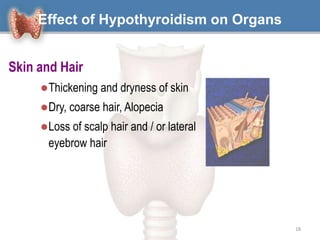
Skin and Hair
Thickening and dryness of skin
Dry, coarse hair, Alopecia
Loss of scalp hair and / or lateral
eyebrow hair
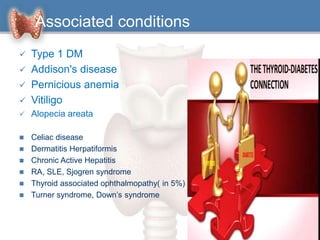
Associated conditions
 Type 1 DM
 Addison's disease
 Pernicious anemia
 Vitiligo
 Alopecia areata
 Celiac disease
 Dermatitis Herpatiformis
 Chronic Active Hepatitis
 RA, SLE, Sjogren syndrome
 Thyroid associated ophthalmopathy( in 5%)
 Turner syndrome, Down’s syndrome
19
20
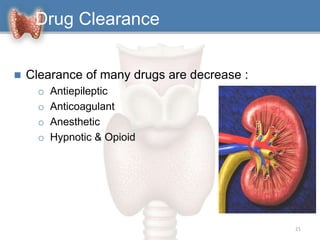
Drug Clearance
 Clearance of many drugs are decrease :
o Antiepileptic
o Anticoagulant
o Anesthetic
o Hypnotic & Opioid
21
Hashimoto's encephalopathy
 A steroid-responsive syndrome associated with:
o TPO antibodies
o myoclonus & slow-wave activity on EEG
o An immunemediated rather than effect of an altered
thyroid state on the CNS
22
23
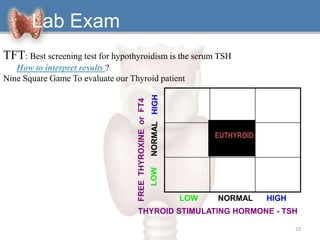
FREETHYROXINEorFT4
EUTHYROID
LOW NORMAL HIGH
THYROID STIMULATING HORMONE - TSH
TFT: Best screening test for hypothyroidism is the serum TSH
How to interpret results ?
Nine Square Game To evaluate our Thyroid patient
Lab Exam
24
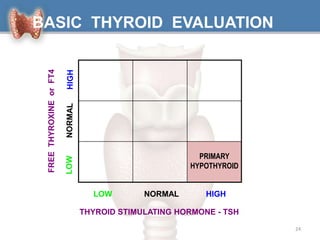
FREETHYROXINEorFT4
PRIMARY
HYPOTHYROID
LOW NORMAL HIGH
THYROID STIMULATING HORMONE - TSH
BASIC THYROID EVALUATION
25
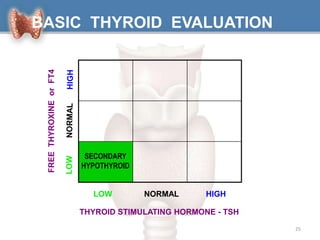
FREETHYROXINEorFT4
SECONDARY
HYPOTHYROID
LOW NORMAL HIGH
THYROID STIMULATING HORMONE - TSH
BASIC THYROID EVALUATION
26
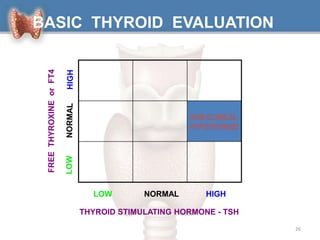
FREETHYROXINEorFT4
SUB-CLINICAL
HYPOTHYROID
LOW NORMAL HIGH
THYROID STIMULATING HORMONE - TSH
BASIC THYROID EVALUATION
 Hyponatremia, Hypoglycemia & Anemia
 levels of LDL,TG, LP, liver enzymes, CK &
Prolactin
 Semen analysis
 FNA biopsy
 Ab against TPO and TG are high
27
Other Abnormalities:
The Dx of Myxedema Coma
 Abn TSH & FT4 + nonpitting edema
 Hypoventilation , Hypothermia & Stupor
 Hyponatremia , Hypoglycemia , Hypotension and Infection
are confirmatory
Complications
 CAD & HF
 Bacterial pneumonia , Megacolon
 Adrenal crisis
 Infertility
 Miscarriage
 Myxedema crisis
29
 Goal is to normalize TSH (lower half of the reference
range)
 Levothyroxine (HL 7 days) on empty stomach
 Levothyroxine dosage according to:
o Clinical response
o TSH
 Keep TSH (0.4 and 2.0 milli- units/L)
30
Treatment
 Clinical assessment for adrenal insufficiency and
angina
 Levothyroxine doses
o Healthy young and middle aged adults 25–75 mcg/d
o Lower doses for very mild hypothyroidism
o Treat pregnant women with higher doses of 100–150
mcg/d
31
Treatment con..
Determinants of Thyroxine Requirements
 Age
 Severity and duration
 Weight
 Malabsorption
 Pregnancy
 Presence of CVD
 Concomitant drug therapy
32
 Smaller doses (25–50 mcg /d):
o CAD
o 60 y
 Higher initial doses:
o severely hypothyroid
 The dose can be increased by 25 mcg every 1–3 weeks
until the pts is euthyroid
33
 Larger initial IV doses of levothyroxine
o 400 mcg as a loading dose
o followed by 50–100 mcg IV/d
 IV liothyronine (T3, Triostat) 5–10 mcg /8 h /48 h
 Blankets warming for hypothermia
 Intubation & MV for hypercapnia
 Infections
 hydrocortisone
34
Myxedema Crisis Rx
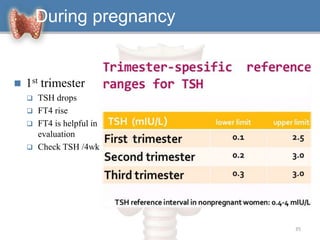
During pregnancy
 1st trimester
 TSH drops
 FT4 rise
 FT4 is helpful in
evaluation
 Check TSH /4wk
35
36

Hypothyroidism

  • 1.
    ‫الرحیم‬ ‫الرحمن‬ ‫هللا‬‫بسم‬ BY DR.LAILMAAH HABIBI 3RD year of KABUL RBH (AFG) 2017 1
  • 2.
  • 3.
    Objectives 1. Definition 2. Classification 3.Clinical manifestation 4. Lab evaluation 5. Complication 6. Medication 3
  • 4.
    Hypothyroidism is aclinical syndrome n which the thyroid gland fails to produce or to secrete sufficient circulating thyroid hormone to meet the needs of the peripheral tissues. Copyright © 2011 Abbott India Limited. All rights reserved
  • 5.
     Causes ofhypothyroidism 5
  • 6.
    Primary hypothyroidism  Primaryhypothyroidism(90%)  (TSH)  free (T4)  Congenital  Aquired o Hashimotos thyroiditis o I deficiency o Goitrogens o Cytokines o Thyroid infiltration o drugs o Iatrogenic 6
  • 7.
    Central Hypothyroidism or2ndry  Secondary (central) hypothyroidism 1. serum T4 2. serum TSH  Acquired o Pituitary &hypothalamic disorders o Dopamine & or severe stress  Congenital o TSH deficiency/structural abnormality o TSH receptor defect o TRH deficiency 7
  • 8.
    Other types  TransientH  Silent thyroiditis (postpartum & Subacute)  Withdrawal of thyroxine Rx  After Rx or surgery for Graves' disease  Consumptive H  hemangiomas ,hemangioendotheliomas  Resistance to Thyroid Hormone  generalised or pituitary dominant 8
  • 9.
    Other types con.. Subclinical hypothyroidism  Asymptomatic patient  TSH  Normal FT4 & FT3 9
  • 10.
     Clinical (overt)H o Symptomatic patient o Elevated TSH level o low levels of FT4 and FT3 Euthyroid sick syndrome o Pts without known thyroid disease o FT4 o TSH not elevated.  severe illness, caloric deprivation, or major surgery.  Serum TSH tends to be suppressed in severe nonthyroidal illness 10
  • 11.
    Myxedema crisis • Alife-threatening state with • Impaired cognition {confusion to somnolence to coma (myxedema)} • Elderly women (stroke or stopped taking thyroxine) • Convulsions & CNS signs 11
  • 12.
    Precipitating events 1. Infection,sepsis (pneumonia) 2. Cold exp 3. CVA 4. Drug effect 5. MI 6. GI bleeding 7. Trauma 8. burns 9. CHF 10. Hypoxia 11. Na 12. Capnea 13. Glycemia 14. Ca 15. DKA 12
  • 13.
    SIGNS AND SYMPTOMSOF HYPOTHYROIDISM (DESCENDING ORDER OF FREQUENCY) 13
  • 14.
    Effect of Hypothyroidismon Organs Cardiovascular • VC • HR • DBP Central Nervous • Concentration • Lack of interest • Depression 14
  • 15.
    Effect of Hypothyroidismon Organs  GIS o GI motility o Constipation  Hepatic o LDL / TC o LDL + triglycerides  Renal o Fluid retention o GFR 15
  • 16.
    16 Effect of Hypothyroidismon Organs Musculoskeletal  Muscle stiffness, cramps, pain, weakness, myalgia  Slow muscle-stretch reflexes, muscle enlargement, atrophy
  • 17.
    Reproductive o Arrest ofpubertal development o Reduced growth velocity o Menorrhagia, Amenorrhea o Anovulation, Infertility 17 Effect of Hypothyroidism on Organs
  • 18.
    18 Effect of Hypothyroidismon Organs Skin and Hair Thickening and dryness of skin Dry, coarse hair, Alopecia Loss of scalp hair and / or lateral eyebrow hair
  • 19.
    Associated conditions  Type1 DM  Addison's disease  Pernicious anemia  Vitiligo  Alopecia areata  Celiac disease  Dermatitis Herpatiformis  Chronic Active Hepatitis  RA, SLE, Sjogren syndrome  Thyroid associated ophthalmopathy( in 5%)  Turner syndrome, Down’s syndrome 19
  • 20.
  • 21.
    Drug Clearance  Clearanceof many drugs are decrease : o Antiepileptic o Anticoagulant o Anesthetic o Hypnotic & Opioid 21
  • 22.
    Hashimoto's encephalopathy  Asteroid-responsive syndrome associated with: o TPO antibodies o myoclonus & slow-wave activity on EEG o An immunemediated rather than effect of an altered thyroid state on the CNS 22
  • 23.
    23 FREETHYROXINEorFT4 EUTHYROID LOW NORMAL HIGH THYROIDSTIMULATING HORMONE - TSH TFT: Best screening test for hypothyroidism is the serum TSH How to interpret results ? Nine Square Game To evaluate our Thyroid patient Lab Exam
  • 24.
    24 FREETHYROXINEorFT4 PRIMARY HYPOTHYROID LOW NORMAL HIGH THYROIDSTIMULATING HORMONE - TSH BASIC THYROID EVALUATION
  • 25.
    25 FREETHYROXINEorFT4 SECONDARY HYPOTHYROID LOW NORMAL HIGH THYROIDSTIMULATING HORMONE - TSH BASIC THYROID EVALUATION
  • 26.
    26 FREETHYROXINEorFT4 SUB-CLINICAL HYPOTHYROID LOW NORMAL HIGH THYROIDSTIMULATING HORMONE - TSH BASIC THYROID EVALUATION
  • 27.
     Hyponatremia, Hypoglycemia& Anemia  levels of LDL,TG, LP, liver enzymes, CK & Prolactin  Semen analysis  FNA biopsy  Ab against TPO and TG are high 27 Other Abnormalities:
  • 28.
    The Dx ofMyxedema Coma  Abn TSH & FT4 + nonpitting edema  Hypoventilation , Hypothermia & Stupor  Hyponatremia , Hypoglycemia , Hypotension and Infection are confirmatory
  • 29.
    Complications  CAD &HF  Bacterial pneumonia , Megacolon  Adrenal crisis  Infertility  Miscarriage  Myxedema crisis 29
  • 30.
     Goal isto normalize TSH (lower half of the reference range)  Levothyroxine (HL 7 days) on empty stomach  Levothyroxine dosage according to: o Clinical response o TSH  Keep TSH (0.4 and 2.0 milli- units/L) 30 Treatment
  • 31.
     Clinical assessmentfor adrenal insufficiency and angina  Levothyroxine doses o Healthy young and middle aged adults 25–75 mcg/d o Lower doses for very mild hypothyroidism o Treat pregnant women with higher doses of 100–150 mcg/d 31 Treatment con..
  • 32.
    Determinants of ThyroxineRequirements  Age  Severity and duration  Weight  Malabsorption  Pregnancy  Presence of CVD  Concomitant drug therapy 32
  • 33.
     Smaller doses(25–50 mcg /d): o CAD o 60 y  Higher initial doses: o severely hypothyroid  The dose can be increased by 25 mcg every 1–3 weeks until the pts is euthyroid 33
  • 34.
     Larger initialIV doses of levothyroxine o 400 mcg as a loading dose o followed by 50–100 mcg IV/d  IV liothyronine (T3, Triostat) 5–10 mcg /8 h /48 h  Blankets warming for hypothermia  Intubation & MV for hypercapnia  Infections  hydrocortisone 34 Myxedema Crisis Rx
  • 35.
    During pregnancy  1sttrimester  TSH drops  FT4 rise  FT4 is helpful in evaluation  Check TSH /4wk 35
  • 36.