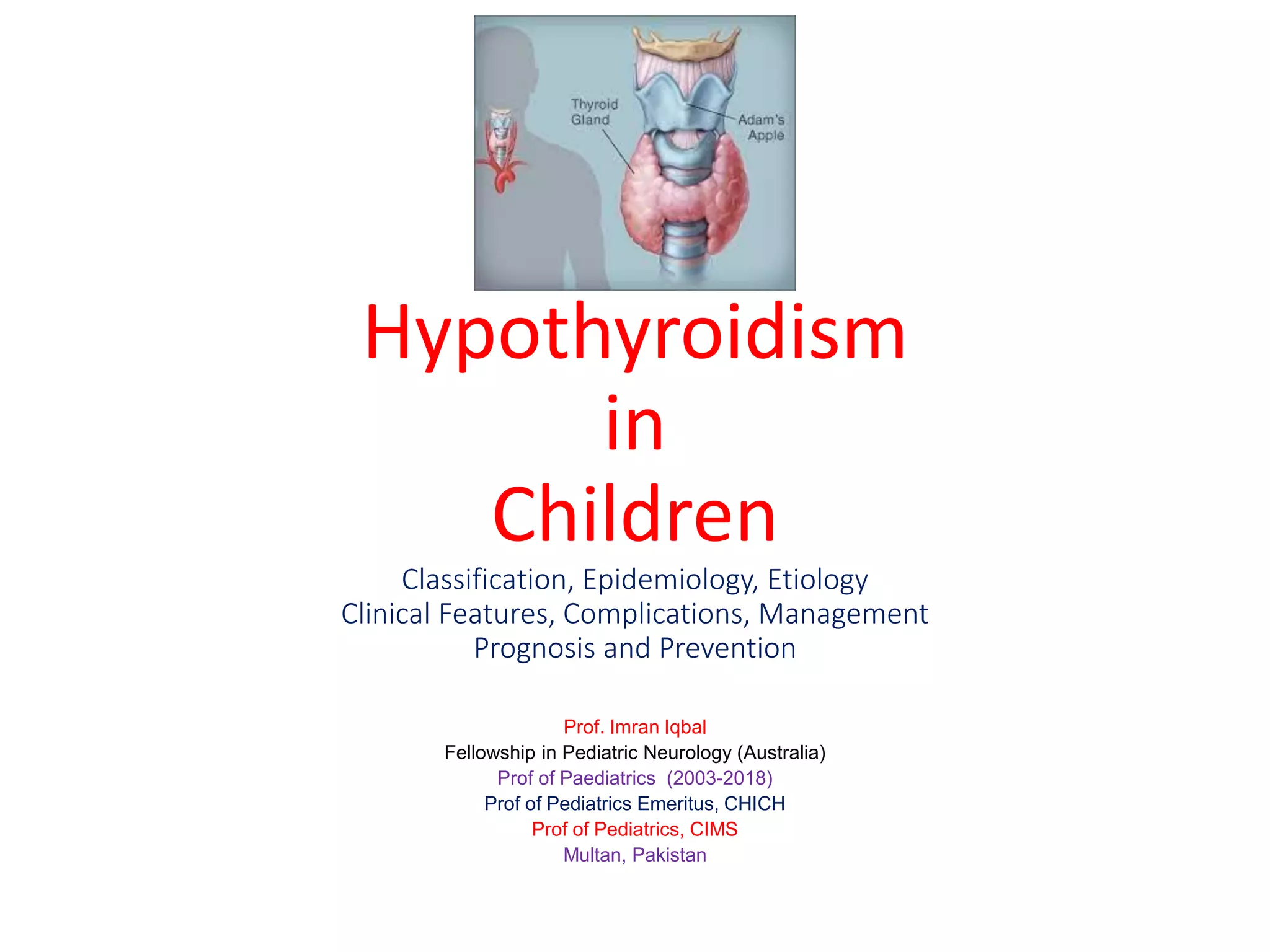
Hypothyroidism
in
Children
Classification, Epidemiology, Etiology
Clinical Features, Complications, Management
Prognosis and Prevention
Prof. Imran Iqbal
Fellowship in Pediatric Neurology (Australia)
Prof of Paediatrics (2003-2018)
Prof of Pediatrics Emeritus, CHICH
Prof of Pediatrics, CIMS
Multan, Pakistan
(God speaking to Prophet Muhammad (PBUH)
So, remember ME, and I will Remember you;
and be thankful to ME and be you not ungrateful towards Me
The Holy Quran; surah Baqara 2:152
In the name of Our Creator Allah,
the most Gracious, the most Merciful
Thyroid Gland – Fetal Development
• Thyroid hormones are needed in fetal life for the
development of Fetal neurons and Brain
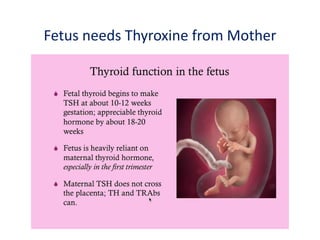
• Maternal thyroid hormones cross the placenta and provide
Thyroid hormones required for the brain development of
fetus
• Thyroid gland develops early in fetal life
• In fetus, TSH is secreted in first trimester of fetal life
• Thyroxine secretions start in second trimester
Fetus needs Thyroxine from Mother
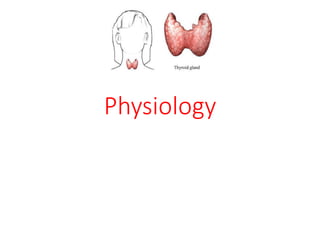
Physiology
Thyroid Hormones
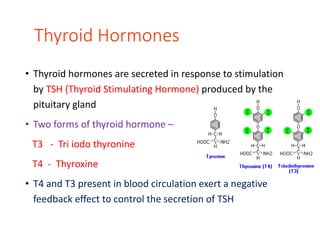
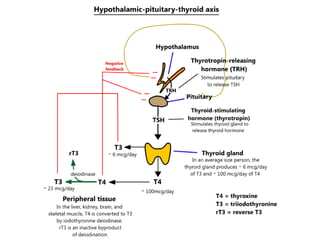
• Thyroid hormones are secreted in response to stimulation
by TSH (Thyroid Stimulating Hormone) produced by the
pituitary gland
• Two forms of thyroid hormone –
T3 - Tri iodo thyronine
T4 - Thyroxine
• T4 and T3 present in blood circulation exert a negative
feedback effect to control the secretion of TSH
Synthesis of T4 and T3 requires Iodine
• Thyroid gland produces daily T4 – (100 ug) and T3 – (20 ug)
in minute amounts
• Most of the thyroid hormone in the blood is T4.
• Enzymes in Liver kidney and other tissues in the body
convert T4 to T3.
• T3 is the physiologically more active form
• Iodine is required for the synthesis of Thyroid hormones
Physiologic Effects of Thyroid Hormones
• Growth: Thyroid hormones are necessary for normal
somatic growth (increase in height) of child
• Development: Thyroid hormones are important for Brain
maturation, development and function
• Metabolism: Thyroid hormones stimulate diverse metabolic
activities and increase the BMR (basal metabolic rate)
Metabolic Effects of Thyroid Hormones
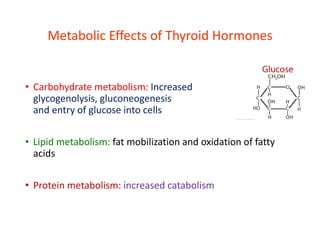
• Carbohydrate metabolism: Increased
glycogenolysis, gluconeogenesis
and entry of glucose into cells
• Lipid metabolism: fat mobilization and oxidation of fatty
acids
• Protein metabolism: increased catabolism
Effects of Thyroid Hormones on Body Systems
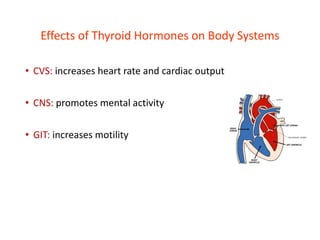
• CVS: increases heart rate and cardiac output
• CNS: promotes mental activity
• GIT: increases motility
Goiter (enlargement of Thyroid gland)
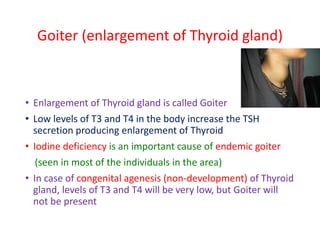
• Enlargement of Thyroid gland is called Goiter
• Low levels of T3 and T4 in the body increase the TSH
secretion producing enlargement of Thyroid
• Iodine deficiency is an important cause of endemic goiter
(seen in most of the individuals in the area)
• In case of congenital agenesis (non-development) of Thyroid
gland, levels of T3 and T4 will be very low, but Goiter will
not be present
IDD
Iodine Deficiency Disorders
Role of Iodine
• Iodine is essential for the synthesis of Thyroid Hormones
• Daily Requirement of Iodine - RDA 100 ug / day
• Iodine deficiency causes enlarged thyroid (endemic goiter)
• Iodine deficiency impairs Brain development
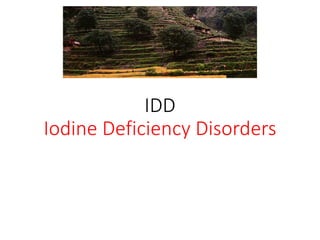
• Iodine deficiency is common in hilly areas worldwide
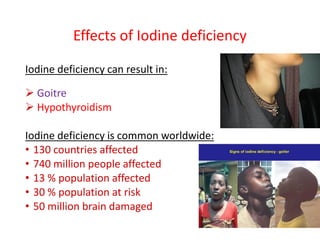
Effects of Iodine deficiency
Iodine deficiency can result in:
 Goitre
 Hypothyroidism
Iodine deficiency is common worldwide:
• 130 countries affected
• 740 million people affected
• 13 % population affected
• 30 % population at risk
• 50 million brain damaged
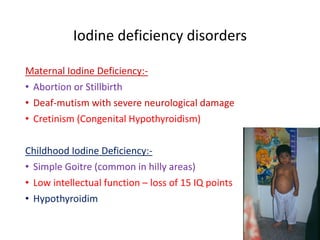
Iodine deficiency disorders
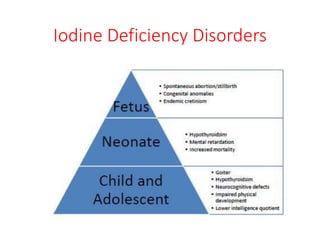
Maternal Iodine Deficiency:-
• Abortion or Stillbirth
• Deaf-mutism with severe neurological damage
• Cretinism (Congenital Hypothyroidism)
Childhood Iodine Deficiency:-
• Simple Goitre (common in hilly areas)
• Low intellectual function – loss of 15 IQ points
• Hypothyroidim
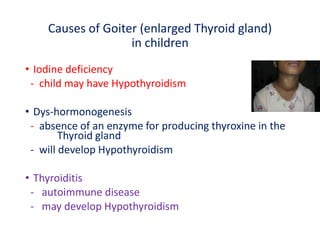
Causes of Goiter (enlarged Thyroid gland)
in children
• Iodine deficiency
- child may have Hypothyroidism
• Dys-hormonogenesis
- absence of an enzyme for producing thyroxine in the
Thyroid gland
- will develop Hypothyroidism
• Thyroiditis
- autoimmune disease
- may develop Hypothyroidism
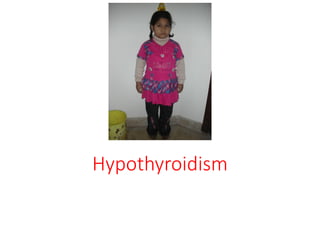
Hypothyroidism
Types of Hypothyroidism
• Congenital Hypothyroidism (Cretinism) –
- Hypothyroidism is present from Birth
- Seen in 1: 2000 births
- Mostly caused by agenesis of thyroid gland
- Cretinism may present in infancy or later in childhood (in
children with partial thyroxine secretion and less severe
disease )
• Acquired Hypothyroidism – seen in older children
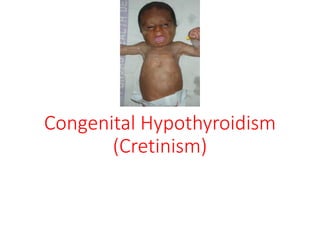
Congenital Hypothyroidism
(Cretinism)
Case scenario
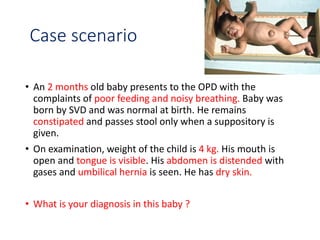
• An 2 months old baby presents to the OPD with the
complaints of poor feeding and noisy breathing. Baby was
born by SVD and was normal at birth. He remains
constipated and passes stool only when a suppository is
given.
• On examination, weight of the child is 4 kg. His mouth is
open and tongue is visible. His abdomen is distended with
gases and umbilical hernia is seen. He has dry skin.
• What is your diagnosis in this baby ?
Causes of Congenital Hypothyroidism
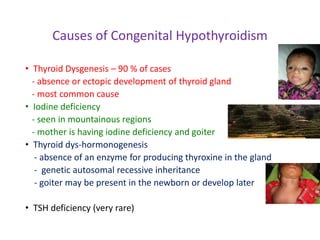
• Thyroid Dysgenesis – 90 % of cases
- absence or ectopic development of thyroid gland
- most common cause
• Iodine deficiency
- seen in mountainous regions
- mother is having iodine deficiency and goiter
• Thyroid dys-hormonogenesis
- absence of an enzyme for producing thyroxine in the gland
- genetic autosomal recessive inheritance
- goiter may be present in the newborn or develop later
• TSH deficiency (very rare)
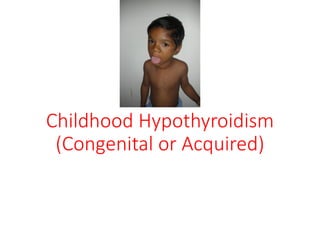
Childhood Hypothyroidism
(Congenital or Acquired)
Case scenario
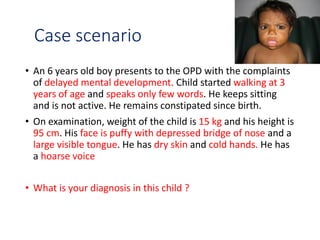
• An 6 years old boy presents to the OPD with the complaints
of delayed mental development. Child started walking at 3
years of age and speaks only few words. He keeps sitting
and is not active. He remains constipated since birth.
• On examination, weight of the child is 15 kg and his height is
95 cm. His face is puffy with depressed bridge of nose and a
large visible tongue. He has dry skin and cold hands. He has
a hoarse voice
• What is your diagnosis in this child ?
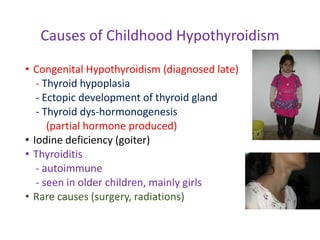
Causes of Childhood Hypothyroidism
• Congenital Hypothyroidism (diagnosed late)
- Thyroid hypoplasia
- Ectopic development of thyroid gland
- Thyroid dys-hormonogenesis
(partial hormone produced)
• Iodine deficiency (goiter)
• Thyroiditis
- autoimmune
- seen in older children, mainly girls
• Rare causes (surgery, radiations)
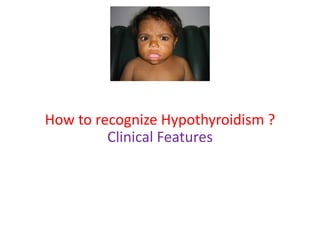
How to recognize Hypothyroidism ?
Clinical Features
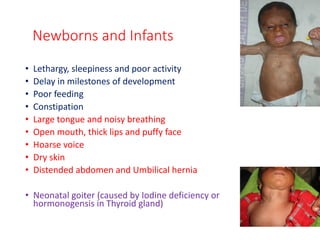
Newborns and Infants
• Lethargy, sleepiness and poor activity
• Delay in milestones of development
• Poor feeding
• Constipation
• Large tongue and noisy breathing
• Open mouth, thick lips and puffy face
• Hoarse voice
• Dry skin
• Distended abdomen and Umbilical hernia
• Neonatal goiter (caused by Iodine deficiency or dys-
hormonogensis in Thyroid gland)
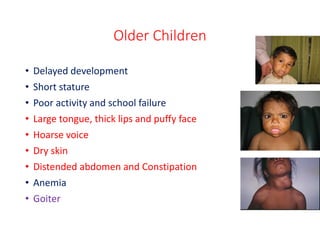
Older Children
• Delayed development
• Short stature
• Poor activity and school failure
• Large tongue, thick lips and puffy face
• Hoarse voice
• Dry skin
• Distended abdomen and Constipation
• Anemia
• Goiter
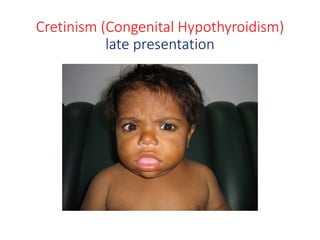
Cretinism (Congenital Hypothyroidism)
late presentation
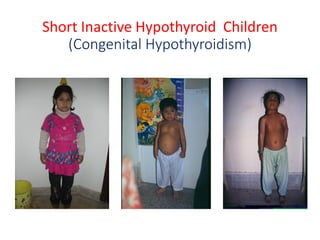
Short Inactive Hypothyroid Children
(Congenital Hypothyroidism)
How to confirm Hypothyroidism ?
Lab Diagnosis
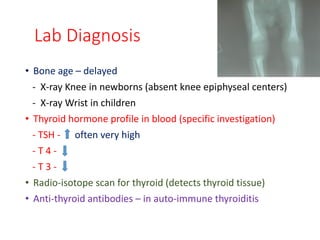
Lab Diagnosis
• Bone age – delayed
- X-ray Knee in newborns (absent knee epiphyseal centers)
- X-ray Wrist in children
• Thyroid hormone profile in blood (specific investigation)
- TSH - often very high
- T 4 -
- T 3 -
• Radio-isotope scan for thyroid (detects thyroid tissue)
• Anti-thyroid antibodies – in auto-immune thyroiditis
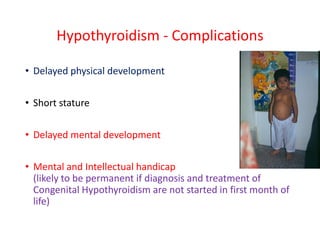
Hypothyroidism - Complications
• Delayed physical development
• Short stature
• Delayed mental development
• Mental and Intellectual handicap
(likely to be permanent if diagnosis and treatment of
Congenital Hypothyroidism are not started in first month of
life)
How to treat Hypothyroidism ?
Thyroxine replacement therapy
Hypothyroidism
• Treatment must be started in first 2 weeks of life to prevent
brain damage
• Thyroxine tablets are given orally
• Treatment with Thyroxine is life-long
• Drug is given empty stomach usually in the morning
• Daily dose should not be missed
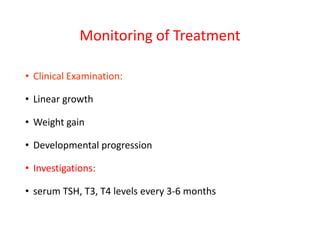
Thyroxine – daily dose
• Neonate: 10-15mcg/kg
• 6-12mo : 6-8mcg/kg
• 1-6 yrs : 5-6 mcg/kg
• 6-12 yrs : 4-5 mcg/kg
• Adults : 100-150 mcg
Monitoring of Treatment
• Clinical Examination:
• Linear growth
• Weight gain
• Developmental progression
• Investigations:
• serum TSH, T3, T4 levels every 3-6 months
How to prevent Hypothyroidism ?
Prevention saves from mental handicap
Iodine Deficiency Disorders
Prevention of Hypothyroidism
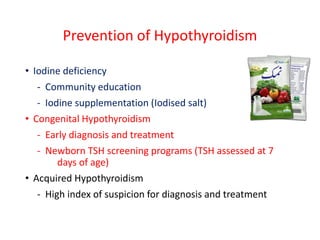
• Iodine deficiency
- Community education
- Iodine supplementation (Iodised salt)
• Congenital Hypothyroidism
- Early diagnosis and treatment
- Newborn TSH screening programs (TSH assessed at 7
days of age)
• Acquired Hypothyroidism
- High index of suspicion for diagnosis and treatment
Hypothyroidism – Take Home Message
• Hypothyroidism is most important preventable cause of
mental and intellectual handicap
• Iodine deficiency is a preventable cause of Hypothyroidism
• Early diagnosis and treatment after birth is important for
normal mental development
Protect Yourself
Face mask – Social distancing – Hand washing

Hypothyroidism in children 2021

  • 1.
    Hypothyroidism in Children Classification, Epidemiology, Etiology ClinicalFeatures, Complications, Management Prognosis and Prevention Prof. Imran Iqbal Fellowship in Pediatric Neurology (Australia) Prof of Paediatrics (2003-2018) Prof of Pediatrics Emeritus, CHICH Prof of Pediatrics, CIMS Multan, Pakistan
  • 2.
    (God speaking toProphet Muhammad (PBUH) So, remember ME, and I will Remember you; and be thankful to ME and be you not ungrateful towards Me The Holy Quran; surah Baqara 2:152 In the name of Our Creator Allah, the most Gracious, the most Merciful
  • 3.
    Thyroid Gland –Fetal Development • Thyroid hormones are needed in fetal life for the development of Fetal neurons and Brain • Maternal thyroid hormones cross the placenta and provide Thyroid hormones required for the brain development of fetus • Thyroid gland develops early in fetal life • In fetus, TSH is secreted in first trimester of fetal life • Thyroxine secretions start in second trimester
  • 4.
  • 5.
  • 6.
    Thyroid Hormones • Thyroidhormones are secreted in response to stimulation by TSH (Thyroid Stimulating Hormone) produced by the pituitary gland • Two forms of thyroid hormone – T3 - Tri iodo thyronine T4 - Thyroxine • T4 and T3 present in blood circulation exert a negative feedback effect to control the secretion of TSH
  • 8.
    Synthesis of T4and T3 requires Iodine • Thyroid gland produces daily T4 – (100 ug) and T3 – (20 ug) in minute amounts • Most of the thyroid hormone in the blood is T4. • Enzymes in Liver kidney and other tissues in the body convert T4 to T3. • T3 is the physiologically more active form • Iodine is required for the synthesis of Thyroid hormones
  • 9.
    Physiologic Effects ofThyroid Hormones • Growth: Thyroid hormones are necessary for normal somatic growth (increase in height) of child • Development: Thyroid hormones are important for Brain maturation, development and function • Metabolism: Thyroid hormones stimulate diverse metabolic activities and increase the BMR (basal metabolic rate)
  • 10.
    Metabolic Effects ofThyroid Hormones • Carbohydrate metabolism: Increased glycogenolysis, gluconeogenesis and entry of glucose into cells • Lipid metabolism: fat mobilization and oxidation of fatty acids • Protein metabolism: increased catabolism
  • 11.
    Effects of ThyroidHormones on Body Systems • CVS: increases heart rate and cardiac output • CNS: promotes mental activity • GIT: increases motility
  • 12.
    Goiter (enlargement ofThyroid gland) • Enlargement of Thyroid gland is called Goiter • Low levels of T3 and T4 in the body increase the TSH secretion producing enlargement of Thyroid • Iodine deficiency is an important cause of endemic goiter (seen in most of the individuals in the area) • In case of congenital agenesis (non-development) of Thyroid gland, levels of T3 and T4 will be very low, but Goiter will not be present
  • 13.
  • 14.
    Role of Iodine •Iodine is essential for the synthesis of Thyroid Hormones • Daily Requirement of Iodine - RDA 100 ug / day • Iodine deficiency causes enlarged thyroid (endemic goiter) • Iodine deficiency impairs Brain development • Iodine deficiency is common in hilly areas worldwide
  • 15.
    Effects of Iodinedeficiency Iodine deficiency can result in:  Goitre  Hypothyroidism Iodine deficiency is common worldwide: • 130 countries affected • 740 million people affected • 13 % population affected • 30 % population at risk • 50 million brain damaged
  • 16.
    Iodine deficiency disorders MaternalIodine Deficiency:- • Abortion or Stillbirth • Deaf-mutism with severe neurological damage • Cretinism (Congenital Hypothyroidism) Childhood Iodine Deficiency:- • Simple Goitre (common in hilly areas) • Low intellectual function – loss of 15 IQ points • Hypothyroidim
  • 17.
    Causes of Goiter(enlarged Thyroid gland) in children • Iodine deficiency - child may have Hypothyroidism • Dys-hormonogenesis - absence of an enzyme for producing thyroxine in the Thyroid gland - will develop Hypothyroidism • Thyroiditis - autoimmune disease - may develop Hypothyroidism
  • 18.
  • 19.
    Types of Hypothyroidism •Congenital Hypothyroidism (Cretinism) – - Hypothyroidism is present from Birth - Seen in 1: 2000 births - Mostly caused by agenesis of thyroid gland - Cretinism may present in infancy or later in childhood (in children with partial thyroxine secretion and less severe disease ) • Acquired Hypothyroidism – seen in older children
  • 20.
  • 21.
    Case scenario • An2 months old baby presents to the OPD with the complaints of poor feeding and noisy breathing. Baby was born by SVD and was normal at birth. He remains constipated and passes stool only when a suppository is given. • On examination, weight of the child is 4 kg. His mouth is open and tongue is visible. His abdomen is distended with gases and umbilical hernia is seen. He has dry skin. • What is your diagnosis in this baby ?
  • 22.
    Causes of CongenitalHypothyroidism • Thyroid Dysgenesis – 90 % of cases - absence or ectopic development of thyroid gland - most common cause • Iodine deficiency - seen in mountainous regions - mother is having iodine deficiency and goiter • Thyroid dys-hormonogenesis - absence of an enzyme for producing thyroxine in the gland - genetic autosomal recessive inheritance - goiter may be present in the newborn or develop later • TSH deficiency (very rare)
  • 23.
  • 24.
    Case scenario • An6 years old boy presents to the OPD with the complaints of delayed mental development. Child started walking at 3 years of age and speaks only few words. He keeps sitting and is not active. He remains constipated since birth. • On examination, weight of the child is 15 kg and his height is 95 cm. His face is puffy with depressed bridge of nose and a large visible tongue. He has dry skin and cold hands. He has a hoarse voice • What is your diagnosis in this child ?
  • 25.
    Causes of ChildhoodHypothyroidism • Congenital Hypothyroidism (diagnosed late) - Thyroid hypoplasia - Ectopic development of thyroid gland - Thyroid dys-hormonogenesis (partial hormone produced) • Iodine deficiency (goiter) • Thyroiditis - autoimmune - seen in older children, mainly girls • Rare causes (surgery, radiations)
  • 26.
    How to recognizeHypothyroidism ? Clinical Features
  • 27.
    Newborns and Infants •Lethargy, sleepiness and poor activity • Delay in milestones of development • Poor feeding • Constipation • Large tongue and noisy breathing • Open mouth, thick lips and puffy face • Hoarse voice • Dry skin • Distended abdomen and Umbilical hernia • Neonatal goiter (caused by Iodine deficiency or dys- hormonogensis in Thyroid gland)
  • 28.
    Older Children • Delayeddevelopment • Short stature • Poor activity and school failure • Large tongue, thick lips and puffy face • Hoarse voice • Dry skin • Distended abdomen and Constipation • Anemia • Goiter
  • 29.
  • 30.
    Short Inactive HypothyroidChildren (Congenital Hypothyroidism)
  • 31.
    How to confirmHypothyroidism ? Lab Diagnosis
  • 32.
    Lab Diagnosis • Boneage – delayed - X-ray Knee in newborns (absent knee epiphyseal centers) - X-ray Wrist in children • Thyroid hormone profile in blood (specific investigation) - TSH - often very high - T 4 - - T 3 - • Radio-isotope scan for thyroid (detects thyroid tissue) • Anti-thyroid antibodies – in auto-immune thyroiditis
  • 33.
    Hypothyroidism - Complications •Delayed physical development • Short stature • Delayed mental development • Mental and Intellectual handicap (likely to be permanent if diagnosis and treatment of Congenital Hypothyroidism are not started in first month of life)
  • 34.
    How to treatHypothyroidism ? Thyroxine replacement therapy
  • 35.
    Hypothyroidism • Treatment mustbe started in first 2 weeks of life to prevent brain damage • Thyroxine tablets are given orally • Treatment with Thyroxine is life-long • Drug is given empty stomach usually in the morning • Daily dose should not be missed
  • 36.
    Thyroxine – dailydose • Neonate: 10-15mcg/kg • 6-12mo : 6-8mcg/kg • 1-6 yrs : 5-6 mcg/kg • 6-12 yrs : 4-5 mcg/kg • Adults : 100-150 mcg
  • 37.
    Monitoring of Treatment •Clinical Examination: • Linear growth • Weight gain • Developmental progression • Investigations: • serum TSH, T3, T4 levels every 3-6 months
  • 38.
    How to preventHypothyroidism ? Prevention saves from mental handicap
  • 39.
  • 40.
    Prevention of Hypothyroidism •Iodine deficiency - Community education - Iodine supplementation (Iodised salt) • Congenital Hypothyroidism - Early diagnosis and treatment - Newborn TSH screening programs (TSH assessed at 7 days of age) • Acquired Hypothyroidism - High index of suspicion for diagnosis and treatment
  • 41.
    Hypothyroidism – TakeHome Message • Hypothyroidism is most important preventable cause of mental and intellectual handicap • Iodine deficiency is a preventable cause of Hypothyroidism • Early diagnosis and treatment after birth is important for normal mental development
  • 42.
    Protect Yourself Face mask– Social distancing – Hand washing