Presented By
Dr. Manisha Yadav (PT)
MPT (Neuro)
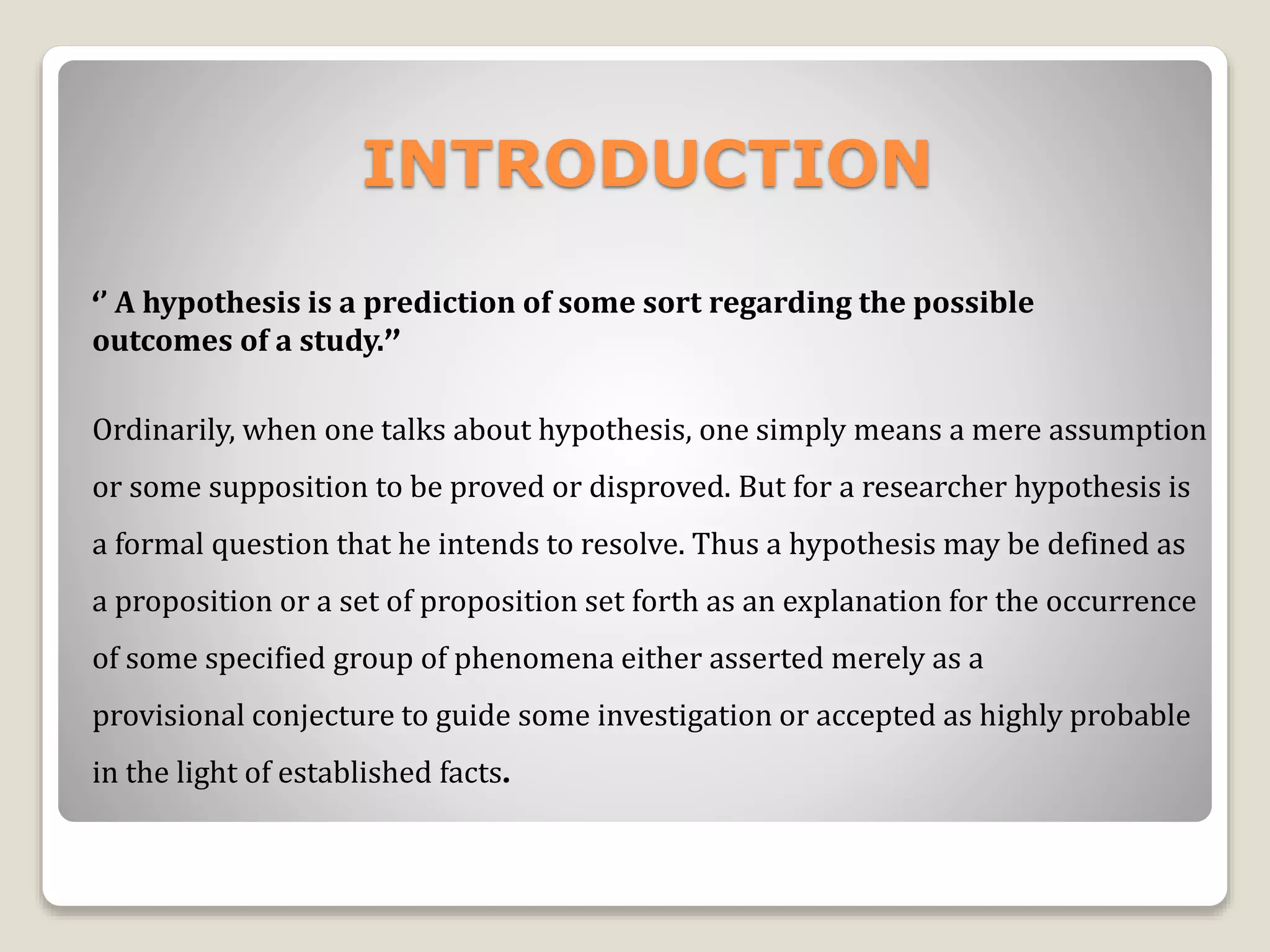
INTRODUCTION
‘’ A hypothesis is a prediction of some sort regarding the possible
outcomes of a study.’’
Ordinarily, when one talks about hypothesis, one simply means a mere assumption
or some supposition to be proved or disproved. But for a researcher hypothesis is
a formal question that he intends to resolve. Thus a hypothesis may be defined as
a proposition or a set of proposition set forth as an explanation for the occurrence
of some specified group of phenomena either asserted merely as a
provisional conjecture to guide some investigation or accepted as highly probable
in the light of established facts.
An example:
Research question:
Does training staff in change management help staff to cope with change in their
organizations?
Hypothesis: Staff trained in change management copes easily with change in their
organizations.
Explain This hypothesis predicts that the staffs that undergo training in change
management can easily cope with changes that might occur in their organizations
than perhaps the staff that have not been trained in change management.
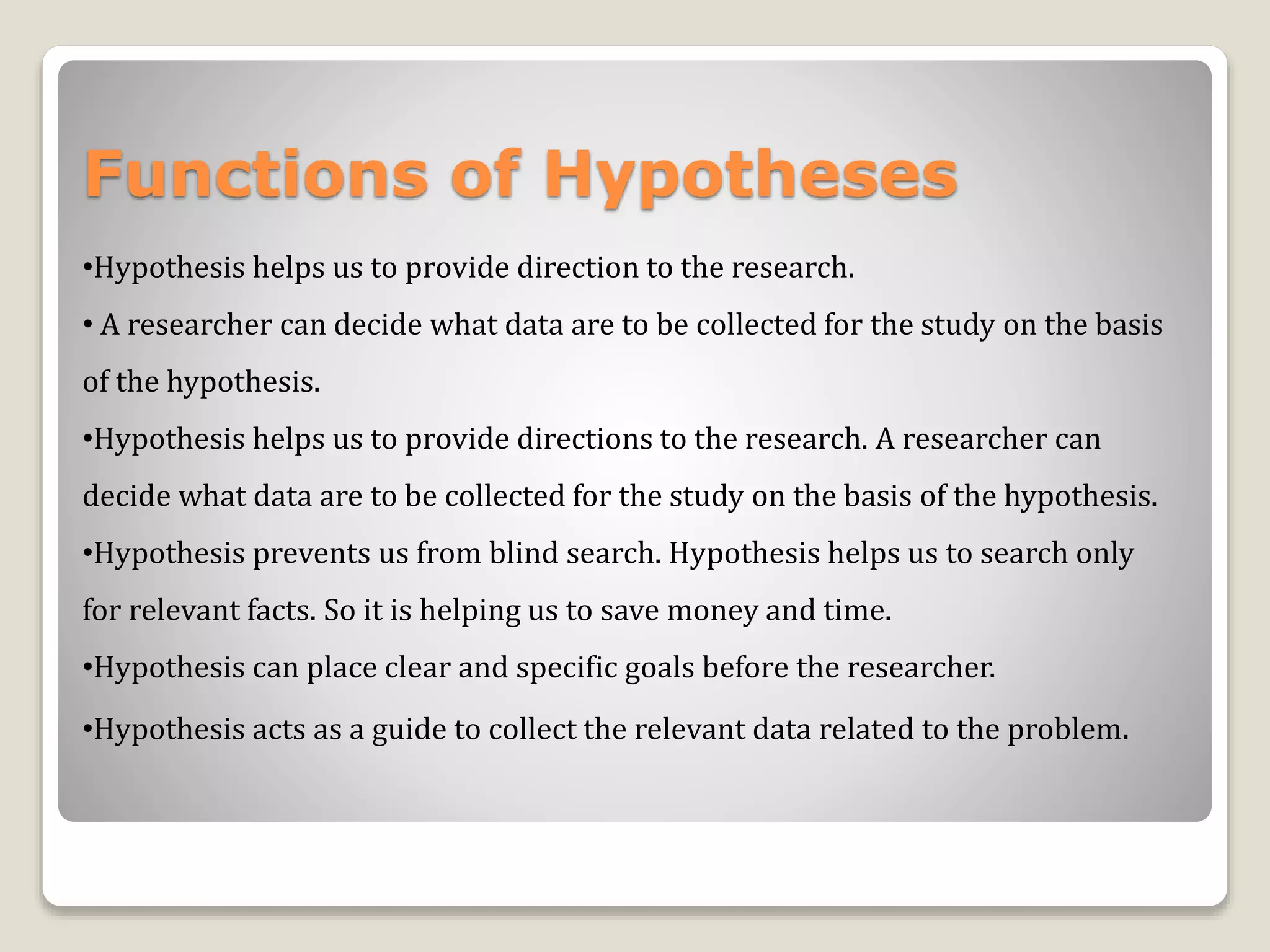
Functions of Hypotheses
•Hypothesis helps us to provide direction to the research.
• A researcher can decide what data are to be collected for the study on the basis
of the hypothesis.
•Hypothesis helps us to provide directions to the research. A researcher can
decide what data are to be collected for the study on the basis of the hypothesis.
•Hypothesis prevents us from blind search. Hypothesis helps us to search only
for relevant facts. So it is helping us to save money and time.
•Hypothesis can place clear and specific goals before the researcher.
•Hypothesis acts as a guide to collect the relevant data related to the problem.
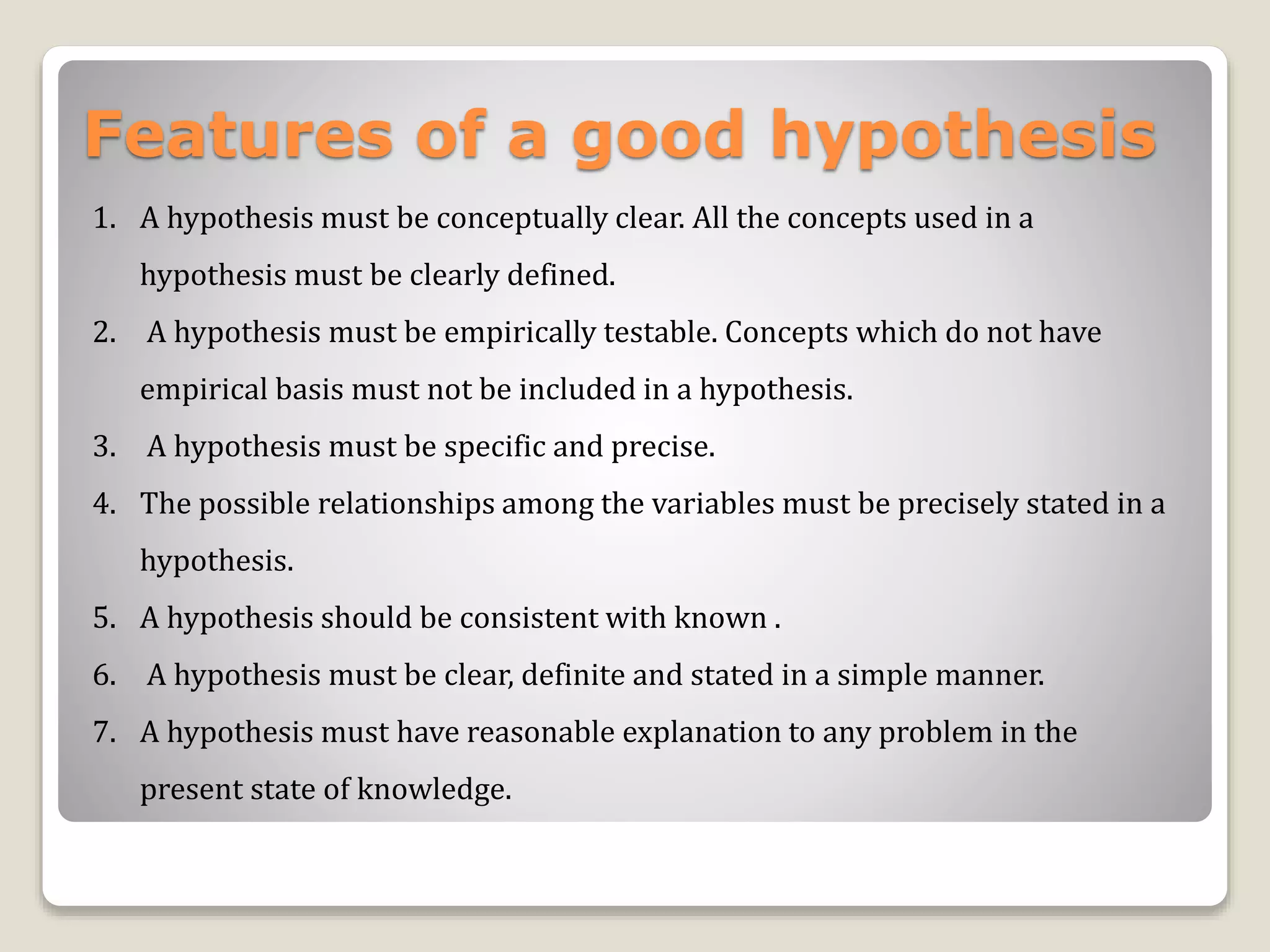
Features of a good hypothesis
1. A hypothesis must be conceptually clear. All the concepts used in a
hypothesis must be clearly defined.
2. A hypothesis must be empirically testable. Concepts which do not have
empirical basis must not be included in a hypothesis.
3. A hypothesis must be specific and precise.
4. The possible relationships among the variables must be precisely stated in a
hypothesis.
5. A hypothesis should be consistent with known .
6. A hypothesis must be clear, definite and stated in a simple manner.
7. A hypothesis must have reasonable explanation to any problem in the
present state of knowledge.
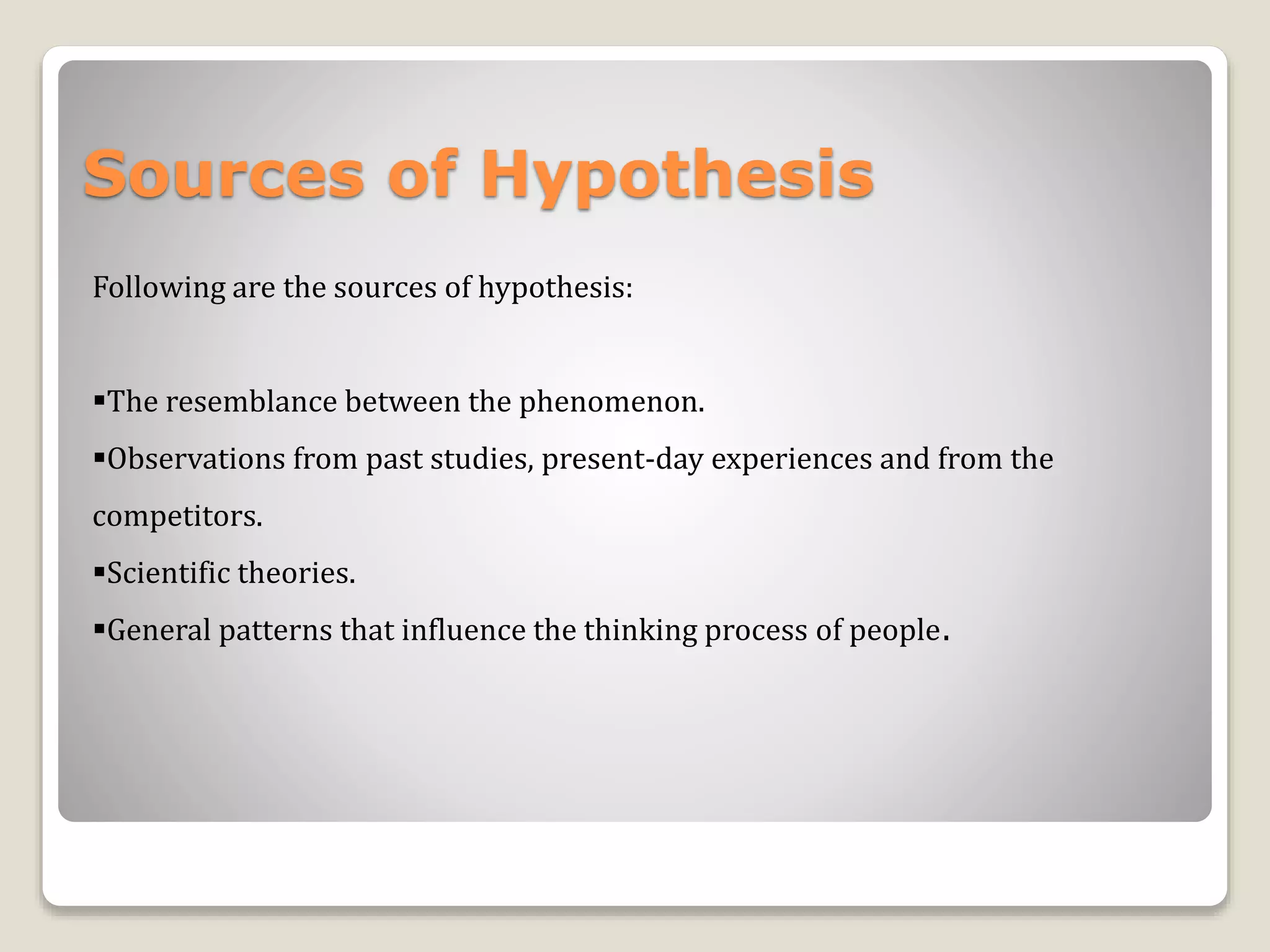
Sources of Hypothesis
Following are the sources of hypothesis:
The resemblance between the phenomenon.
Observations from past studies, present-day experiences and from the
competitors.
Scientific theories.
General patterns that influence the thinking process of people.
Types of Hypothesis
There are six forms of hypothesis and they are:
I. Alternative hypothesis
II. Null hypothesis
III. Directional hypothesis
IV. Non-directional hypothesis
V. Complex hypothesis
VI. Associative and casual hypothesis
 Alternative Hypothesis
‘’The alternative hypothesis states your research prediction of an
effect or relationship.’’
The symbol is denoted by “Ha”.
For example –
If you eat more vegetables, you will lose weight faster. Here, eating more
vegetables is an independent variable, while losing weight is the
dependent variable.
 Null Hypothesis
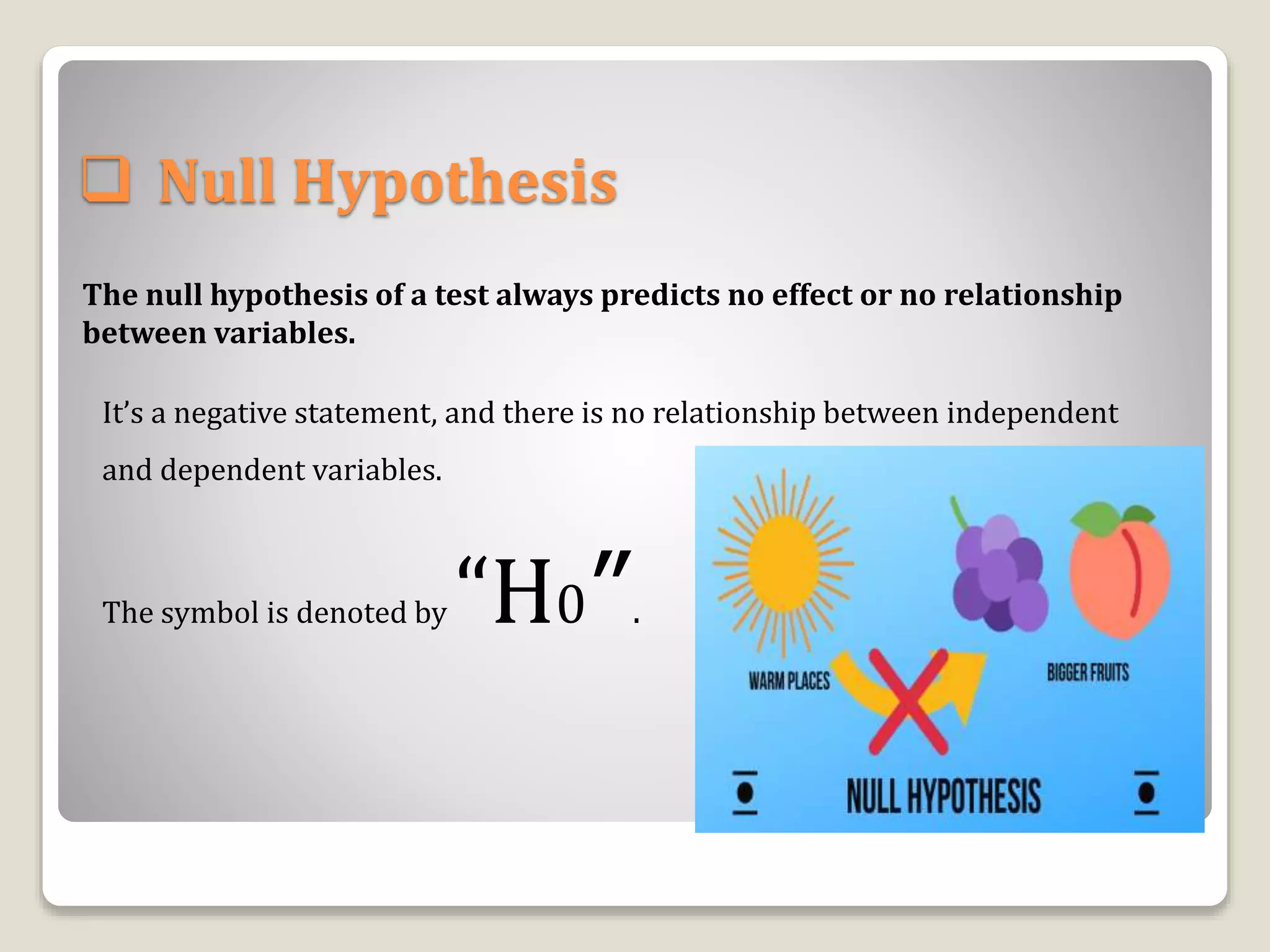
The null hypothesis of a test always predicts no effect or no relationship
between variables.
It’s a negative statement, and there is no relationship between independent
and dependent variables.
The symbol is denoted by “H0”.
 Complex Hypothesis
It shows the relationship between two or more dependent variables and
two or more independent variables. Eating more vegetables and fruits
leads to weight loss, glowing skin, and reduces the risk of many diseases
such as heart disease.
 Directional Hypothesis
It shows how a researcher is intellectual and committed to a particular outcome.
The relationship between the variables can also predict its nature.
For example-
children aged four years eating proper food over a five-year period are having
higher IQ levels than children not having a proper meal. This shows the effect and
direction of the effect.
Non-directional Hypothesis
It is used when there is no theory involved. It is a statement that a
relationship exists between two variables, without predicting the exact
nature (direction) of the relationship.
 Associative and Causal
Hypothesis
Associative hypothesis occurs when there is a change in one variable
resulting in a change in the other variable.
Whereas, the causal hypothesis proposes a cause and effect interaction
between two or more variables.
Advantages
1. A hypothesis forces us to think more deeply and specifically about
the possible outcomes of a study. It enables us to understand what
the question implies and exactly what variables are involved.
2. If one is attempting to build a body of knowledge in addition to
answering a specific question, then stating hypothesis is a good
strategy because it enables one to make specific predictions based
on prior evidence or theoretical argument.
3. Hypothesis stating helps us to see if we are or are not
investigating a relationship.
HYPOTHESIS.pptx

HYPOTHESIS.pptx

  • 1.
    Presented By Dr. ManishaYadav (PT) MPT (Neuro)
  • 2.
    INTRODUCTION ‘’ A hypothesisis a prediction of some sort regarding the possible outcomes of a study.’’ Ordinarily, when one talks about hypothesis, one simply means a mere assumption or some supposition to be proved or disproved. But for a researcher hypothesis is a formal question that he intends to resolve. Thus a hypothesis may be defined as a proposition or a set of proposition set forth as an explanation for the occurrence of some specified group of phenomena either asserted merely as a provisional conjecture to guide some investigation or accepted as highly probable in the light of established facts.
  • 3.
    An example: Research question: Doestraining staff in change management help staff to cope with change in their organizations? Hypothesis: Staff trained in change management copes easily with change in their organizations. Explain This hypothesis predicts that the staffs that undergo training in change management can easily cope with changes that might occur in their organizations than perhaps the staff that have not been trained in change management.
  • 4.
    Functions of Hypotheses •Hypothesishelps us to provide direction to the research. • A researcher can decide what data are to be collected for the study on the basis of the hypothesis. •Hypothesis helps us to provide directions to the research. A researcher can decide what data are to be collected for the study on the basis of the hypothesis. •Hypothesis prevents us from blind search. Hypothesis helps us to search only for relevant facts. So it is helping us to save money and time. •Hypothesis can place clear and specific goals before the researcher. •Hypothesis acts as a guide to collect the relevant data related to the problem.
  • 5.
    Features of agood hypothesis 1. A hypothesis must be conceptually clear. All the concepts used in a hypothesis must be clearly defined. 2. A hypothesis must be empirically testable. Concepts which do not have empirical basis must not be included in a hypothesis. 3. A hypothesis must be specific and precise. 4. The possible relationships among the variables must be precisely stated in a hypothesis. 5. A hypothesis should be consistent with known . 6. A hypothesis must be clear, definite and stated in a simple manner. 7. A hypothesis must have reasonable explanation to any problem in the present state of knowledge.
  • 6.
    Sources of Hypothesis Followingare the sources of hypothesis: The resemblance between the phenomenon. Observations from past studies, present-day experiences and from the competitors. Scientific theories. General patterns that influence the thinking process of people.
  • 7.
    Types of Hypothesis Thereare six forms of hypothesis and they are: I. Alternative hypothesis II. Null hypothesis III. Directional hypothesis IV. Non-directional hypothesis V. Complex hypothesis VI. Associative and casual hypothesis
  • 8.
     Alternative Hypothesis ‘’Thealternative hypothesis states your research prediction of an effect or relationship.’’ The symbol is denoted by “Ha”. For example – If you eat more vegetables, you will lose weight faster. Here, eating more vegetables is an independent variable, while losing weight is the dependent variable.
  • 9.
     Null Hypothesis Thenull hypothesis of a test always predicts no effect or no relationship between variables. It’s a negative statement, and there is no relationship between independent and dependent variables. The symbol is denoted by “H0”.
  • 10.
     Complex Hypothesis Itshows the relationship between two or more dependent variables and two or more independent variables. Eating more vegetables and fruits leads to weight loss, glowing skin, and reduces the risk of many diseases such as heart disease.
  • 11.
     Directional Hypothesis Itshows how a researcher is intellectual and committed to a particular outcome. The relationship between the variables can also predict its nature. For example- children aged four years eating proper food over a five-year period are having higher IQ levels than children not having a proper meal. This shows the effect and direction of the effect.
  • 12.
    Non-directional Hypothesis It isused when there is no theory involved. It is a statement that a relationship exists between two variables, without predicting the exact nature (direction) of the relationship.
  • 13.
     Associative andCausal Hypothesis Associative hypothesis occurs when there is a change in one variable resulting in a change in the other variable. Whereas, the causal hypothesis proposes a cause and effect interaction between two or more variables.
  • 14.
    Advantages 1. A hypothesisforces us to think more deeply and specifically about the possible outcomes of a study. It enables us to understand what the question implies and exactly what variables are involved. 2. If one is attempting to build a body of knowledge in addition to answering a specific question, then stating hypothesis is a good strategy because it enables one to make specific predictions based on prior evidence or theoretical argument. 3. Hypothesis stating helps us to see if we are or are not investigating a relationship.