RESEACH HYPOTHESIS
AND ITS TYPE
☺SHALU THAKUR
☺Dayalbagh Educational Institute
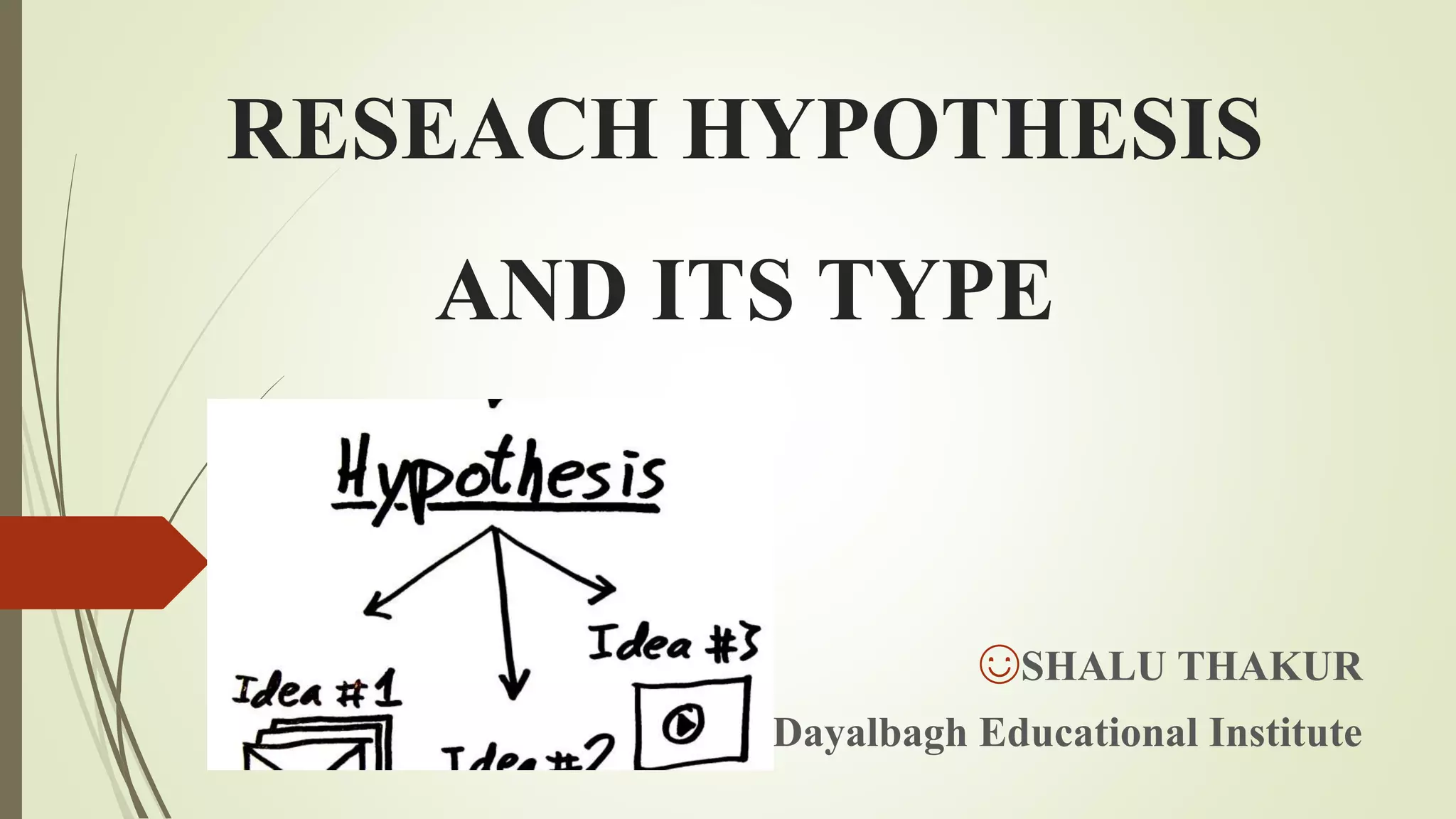
HYPOTHESIS
It is the tentative solution of a research problem
OR OR
HYPO THESIS
POSSIBLE Statement
Status of the
Variable
 A hypothesis is a tentative relationship between two or more variables which
directs the research activity to test it.
 A hypothesis is a testable prediction which is expected to occur. It can be a false
or a true statement that is tested in the research to check its authenticity.
For instance, a researcher, working on a topic ‘Discrimination against
women in a rural society’, will construct the following hypotheses:
 Higher the illiteracy in a society, higher will be the discrimination against
women.
 Higher the patriarchy in a society, higher will be the discrimination
against women.
 Higher the traditional practices in a society, higher will be discrimination
against the women.
Characteristics of hypothesis
 Hypothesis should be clear and precise.
 Hypothesis should be capable of being tested.
 It should be limited in scope and must be specific.
 It must have close contact with observable things.
 It should be related to available techniques.
 It should be testable.
 It should be very much comprehensive.
 It should maintain the balance with the objectives.
Nature of Hypotheses
It is in statement form
It is accepted or rejected, it should be tested on the basis of proofs
It is empirical in nature
Nature is futuristic based
It is the foundation of any kind of research
It try to explore the cause and effect of tow or more variables.
It the basis for planning and action in the research for new
idea/truth.
According to Bruce W. Tuckman, there are four types
of hypothesis:-
1. Question Form Hypothesis
2. Declarative Hypothesis
3. Directional Hypothesis
4. Non-Directional or Null Hypothesis
1. Question form Hypothesis
A hypothesis states as a question represents the simplest level of empirical observation. It
fails to fit the most definition of hypothesis. There are cases of simple investigation which can be
adequately implemented by raising a question, rather than dichotomizing the hypothesis forms
into acceptable/ reject able categories.
 It is also called as Interrogative hypothesis.
 Researcher having finalized their problem of research raises certain questions which must be
answered through their research.
 Research questions are generally called interrogative hypothesis.
 In present time, there is no significant acceptance of these hypotheses.
 EXAMPLE-
1.Will gender difference affect the mathematical ability of students?
2.Will Reinforcement affects the performance of students?
2. Declarative Hypothesis
A hypothesis developed as a declarative statement provides anticipated
relationship or difference between variable. Such a hypothesis developer has
examine existing evidence which led him to believe that a difference may be
anticipated as additional variable effects on the criterion variable.
 It generally states a relationship between the variables concerned.
 When the researcher makes a positive statement about the outcome if the study,
the hypothesis takes the declarative form.
 When the researcher makes a positive statement about the outcome if the study,
the hypothesis takes the declarative form..
 It is a directional hypothesis which gives direction to researcher for his research.
EXAMPLES
1.Reinforcement improves the performance of students.
3.Directional Hypothesis
A directional hypothesis connotes an expected direction in the relationship or
difference between variables. This type of hypothesis developer appears more certain of
anticipated evidence.
 If seeking a tenable hypothesis is the general interest of the researcher, this hypothesis is
less safe than the problem of seeking relationship between variable is so obvious that
additional evidence is scarcely needed. Secondly, researcher has examined the variables
very thoroughly and the available evidences supports the statement of a particular
anticipated outcome.
 The hypothesis which stipulates the direction of the expected differences or relationship.
 Directional hypothesis is a statement of conjuncture where the two variables of the
study are expressed as having some relationship in a certain direction.
EXAMPLE-
1. Reinforcement positively affects the performance of students.
4. Null or Non-Directional Hypothesis
This hypothesis is states in the null form which is an assertion that no
relationship or no difference or no relationship exists between or among the
variables. A null hypothesis tentatively states that in the basis of evidences testes
there in no differences. If the null hypothesis is rejected, there is a difference but
we do not know the alternative or the differences.
 Non-Directional hypothesis also known as Null hypothesis.
 A research hypothesis which does not specify the direction of expected
difference or relationships is a non directional research hypothesis
 These are neutral hypothesis.
 It states that no significant difference exists between the variables concerned.
EXAMPLE
1.Reinforcement has no effect on performance of students.
2.Gender has no effect on mathematical ability.
Research Hypotheses and its type

Research Hypotheses and its type

  • 1.
    RESEACH HYPOTHESIS AND ITSTYPE ☺SHALU THAKUR ☺Dayalbagh Educational Institute
  • 2.
    HYPOTHESIS It is thetentative solution of a research problem OR OR HYPO THESIS POSSIBLE Statement Status of the Variable
  • 3.
     A hypothesisis a tentative relationship between two or more variables which directs the research activity to test it.  A hypothesis is a testable prediction which is expected to occur. It can be a false or a true statement that is tested in the research to check its authenticity. For instance, a researcher, working on a topic ‘Discrimination against women in a rural society’, will construct the following hypotheses:  Higher the illiteracy in a society, higher will be the discrimination against women.  Higher the patriarchy in a society, higher will be the discrimination against women.  Higher the traditional practices in a society, higher will be discrimination against the women.
  • 4.
    Characteristics of hypothesis Hypothesis should be clear and precise.  Hypothesis should be capable of being tested.  It should be limited in scope and must be specific.  It must have close contact with observable things.  It should be related to available techniques.  It should be testable.  It should be very much comprehensive.  It should maintain the balance with the objectives.
  • 5.
    Nature of Hypotheses Itis in statement form It is accepted or rejected, it should be tested on the basis of proofs It is empirical in nature Nature is futuristic based It is the foundation of any kind of research It try to explore the cause and effect of tow or more variables. It the basis for planning and action in the research for new idea/truth.
  • 6.
    According to BruceW. Tuckman, there are four types of hypothesis:- 1. Question Form Hypothesis 2. Declarative Hypothesis 3. Directional Hypothesis 4. Non-Directional or Null Hypothesis
  • 7.
    1. Question formHypothesis A hypothesis states as a question represents the simplest level of empirical observation. It fails to fit the most definition of hypothesis. There are cases of simple investigation which can be adequately implemented by raising a question, rather than dichotomizing the hypothesis forms into acceptable/ reject able categories.  It is also called as Interrogative hypothesis.  Researcher having finalized their problem of research raises certain questions which must be answered through their research.  Research questions are generally called interrogative hypothesis.  In present time, there is no significant acceptance of these hypotheses.  EXAMPLE- 1.Will gender difference affect the mathematical ability of students? 2.Will Reinforcement affects the performance of students?
  • 8.
    2. Declarative Hypothesis Ahypothesis developed as a declarative statement provides anticipated relationship or difference between variable. Such a hypothesis developer has examine existing evidence which led him to believe that a difference may be anticipated as additional variable effects on the criterion variable.  It generally states a relationship between the variables concerned.  When the researcher makes a positive statement about the outcome if the study, the hypothesis takes the declarative form.  When the researcher makes a positive statement about the outcome if the study, the hypothesis takes the declarative form..  It is a directional hypothesis which gives direction to researcher for his research. EXAMPLES 1.Reinforcement improves the performance of students.
  • 9.
    3.Directional Hypothesis A directionalhypothesis connotes an expected direction in the relationship or difference between variables. This type of hypothesis developer appears more certain of anticipated evidence.  If seeking a tenable hypothesis is the general interest of the researcher, this hypothesis is less safe than the problem of seeking relationship between variable is so obvious that additional evidence is scarcely needed. Secondly, researcher has examined the variables very thoroughly and the available evidences supports the statement of a particular anticipated outcome.  The hypothesis which stipulates the direction of the expected differences or relationship.  Directional hypothesis is a statement of conjuncture where the two variables of the study are expressed as having some relationship in a certain direction. EXAMPLE- 1. Reinforcement positively affects the performance of students.
  • 10.
    4. Null orNon-Directional Hypothesis This hypothesis is states in the null form which is an assertion that no relationship or no difference or no relationship exists between or among the variables. A null hypothesis tentatively states that in the basis of evidences testes there in no differences. If the null hypothesis is rejected, there is a difference but we do not know the alternative or the differences.  Non-Directional hypothesis also known as Null hypothesis.  A research hypothesis which does not specify the direction of expected difference or relationships is a non directional research hypothesis  These are neutral hypothesis.  It states that no significant difference exists between the variables concerned. EXAMPLE 1.Reinforcement has no effect on performance of students. 2.Gender has no effect on mathematical ability.