PRECOCIOUS PUBERTY

  DR SANTOSH MOGALI
INTRODUCTION-
• onset of secondary sexual characters before the age of 8
  years in girls and 9 years in boys.
• Two types-central-gonadotropin dependent or true. Is
  always isosexual and stems from hypothalamic-pituitary-
  gonadal activation with ensuing sex hormone secretion and
  progressive sexual maturation.
• Peripheral- gonadotropin independent or pseudo. some of
  the secondary sex characters appear, but no activation of
  the normal hypothalamic-pituitary-gonadal interplay. May
  be isosexual or heterosexual (contrasexual)
Causes of central precocious puberty-

• Idiopathic
  Organic brain lesions- Hypothalamic hamartoma
  Brain tumors, hydrocephalus, severe head
  trauma, myelomeningocele

 Hypothyroidism, prolonged and untreated
CENTRAL PRECOCIOUS PUBERTY-
• Defined by the onset of breast development before the age of 8
  years in girls and by the onset of testicular development
  (volume ≥ 4 mL) before the age of 9 years in boys, as a result of
  the early activation of the HPG axis.
• 5- to 10-fold more often in girls than in boys and is usually
  sporadic.
• A high prevalence of idiopathic central precocious puberty has
  been reported in girls adopted from developing countries, with
  the limitation that the exact date of birth may be uncertain.
• 90% of girls have an idiopathic form,
• 75% of boys have structural central nervous system (CNS)
  abnormality. Beyond its etiology, which thus needs to be
  specifically addressed, central precocious puberty can affect
  linear growth and the child's growth potential.
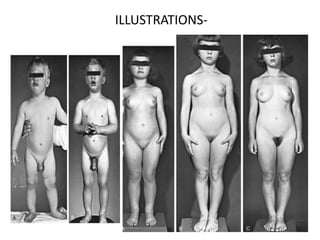
ILLUSTRATIONS-
CLINICAL FEATURES-
• Sexual development begins at any age and generally in
  normal sequence.
• In girls- early menstrual cycles are more irregular and
  anovulatory. Pregnancy is reported as early as 5.5 years.
• In boys, testicular biopsies have shown stimulation of all
  elements of the testes, and spermatogenesis as early as 5-6
  years.
• In affected girls and boys, height, weight, and osseous
  maturation are advanced. The increased rate of bone
  maturation results in early closure of the epiphyses, and
  the ultimate stature is < normal
• In hypothalamic hamartoma remain static in size or grow
  slowly, - no signs other than precocious puberty.
• For symptomatic , manifestations may be present for 1-2
  yr before the tumor can be detected radiologically.
• Include diabetes
  insipidus, adipsia, hyperthermia, unnatural crying or
  laughing (gelastic seizures), obesity, and cachexia.
• Visual signs (proptosis, decreased visual acuity, visual field
  defects) may be the first manifestation of an optic glioma.
• Mental development is usually compatible with
  chronological age. Emotional behavior and mood swings
  are common, but serious psychological problems are rare.
• Natural course- rapid- most common pattern.
  characterized by rapid physical and osseous
  maturation, leading to a loss of height potential.
• Slow-this pattern characterized by parallel advancement
  of osseous maturation and linear growth, with preserved
  height potential.
• spontaneously regressive or unsustained central
  precocious puberty – marks the need for longitudinal
  observation
LAB. INVESTIGATIONS-
• With sensitive assays, serum LH concentrations are
  undetectable in prepubertal children but become
  detectable in 50-75% of girls and a higher percentage of
  boys with central sexual precocity.
• Measurement during sleep increases diagnostic power and
  reveals the pulsatile LH secretion.
• GnRH stimulation test. Predominant LH response over FSH
  after iv administration of GnRH or agonist like Leuprolide.
  However in girls, LH:FSH ratio can remain low until mid-
  puberty. In such girls with “low” LH response, the central
  nature of sexual precocity can be proved by detecting
  pubertal levels of estradiol (>50 pg/mL), 20-24 hr after
  stimulation with leuprolide.
• Pelvic ultrasound reveals progressive enlargement of
  ovaries followed by uterus to pubertal size.
• Osseous maturation advances.
• An MRI scan usually shows normal enlargement of the
  pituitary gland, during puberty; it may also reveal CNS
  pathology.
TREATMENT-
• Long term GnRH agonists In the USA, the most commonly
  used preparation is leuprolide acetate (Lupron Depot Ped),
  in a dose of 0.25-0.3 mg/kg (minimum, 7.5 mg) i.m. once
  every 4 wk. Other preparations (D-Trp6-GnRH [Decapeptyl],
  goserelin acetate [Zoladex]) are approved for treatment of
  precocious puberty in other countries.
• Alternatively, histrelin (Supprelin LA), a subcutaneous 50
  mg implant with effects lasting 12 mo, is approved by the
  FDA .
• Intranasal and subcutaneous injection formulae are also
  available.
• IUGR at greater risk of short stature as adults and require
  more-aggressive treatment of precocious puberty, possibly
  in conjunction with human growth hormone (hGH) therapy.
PERIPHERAL PUBERTY-ETIOLOGY
• PERIPHERAL (GONADOTROPIN INDEPENDENT, PRECOCIOUS
  PSEUDOPUBERTY) Girls Isosexual (feminizing) conditions- McCune-
  Albright syndrome
  Autonomous ovarian cysts
  Ovarian tumors-Granulosa-theca cell tumor with Ollier disease
  Teratoma, chorionepithelioma
  SCTAT associated with Peutz-Jeghers syndrome
  Feminizing adrenocortical tumor
  Exogenous estrogens

  Heterosexual (masculinizing) conditions- Congenital adrenal
  hyperplasia
  Adrenal tumors
  Ovarian tumors
  Glucocorticoid receptor defect
  Exogenous androgens
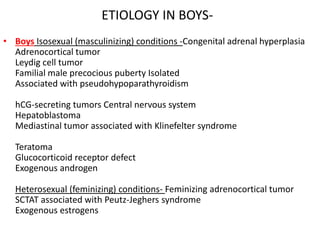
ETIOLOGY IN BOYS-
• Boys Isosexual (masculinizing) conditions -Congenital adrenal hyperplasia
  Adrenocortical tumor
  Leydig cell tumor
  Familial male precocious puberty Isolated
  Associated with pseudohypoparathyroidism

  hCG-secreting tumors Central nervous system
  Hepatoblastoma
  Mediastinal tumor associated with Klinefelter syndrome

  Teratoma
  Glucocorticoid receptor defect
  Exogenous androgen

  Heterosexual (feminizing) conditions- Feminizing adrenocortical tumor
  SCTAT associated with Peutz-Jeghers syndrome
  Exogenous estrogens
MAC CUNE ALBRIGHT SYNDROME-
• A rare disorder prevalence 1 in 100000 to 1000000. Is
  associated with patchy cutaneous pigmentation and fibrous
  dysplasia of the skeletal system.
• a missense mutation in the gene encoding the α-subunit of
  GS, the G protein that stimulates cAMP formation, resulting
  in the formation of the putative gsp oncoprotein. Activation
  of receptors (corticotropin [ACTH], TSH, FSH, and LH
  receptors) that operate via a cAMP-dependent
  mechanism, as well as cell proliferation, ensue.
• expressed differently in different tissues, accounts for
  variability of clinical expression.
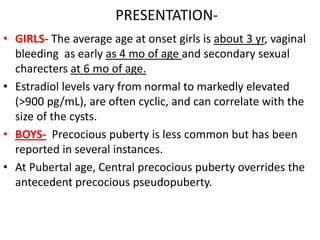
PRESENTATION-
• GIRLS- The average age at onset girls is about 3 yr, vaginal
  bleeding as early as 4 mo of age and secondary sexual
  charecters at 6 mo of age.
• Estradiol levels vary from normal to markedly elevated
  (>900 pg/mL), are often cyclic, and can correlate with the
  size of the cysts.
• BOYS- Precocious puberty is less common but has been
  reported in several instances.
• At Pubertal age, Central precocious puberty overrides the
  antecedent precocious pseudopuberty.
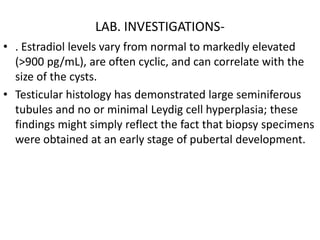
LAB. INVESTIGATIONS-
• . Estradiol levels vary from normal to markedly elevated
  (>900 pg/mL), are often cyclic, and can correlate with the
  size of the cysts.
• Testicular histology has demonstrated large seminiferous
  tubules and no or minimal Leydig cell hyperplasia; these
  findings might simply reflect the fact that biopsy specimens
  were obtained at an early stage of pubertal development.
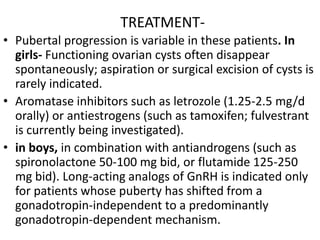
TREATMENT-
• Pubertal progression is variable in these patients. In
  girls- Functioning ovarian cysts often disappear
  spontaneously; aspiration or surgical excision of cysts is
  rarely indicated.
• Aromatase inhibitors such as letrozole (1.25-2.5 mg/d
  orally) or antiestrogens (such as tamoxifen; fulvestrant
  is currently being investigated).
• in boys, in combination with antiandrogens (such as
  spironolactone 50-100 mg bid, or flutamide 125-250
  mg bid). Long-acting analogs of GnRH is indicated only
  for patients whose puberty has shifted from a
  gonadotropin-independent to a predominantly
  gonadotropin-dependent mechanism.
INCOMPLETE(PARTIAL) VARIANTS-
•
  Isolated manifestations of precocity without development
  of other signs of puberty.
• Premature thelarche- isolated breast development that
  most often appears < 2 yr of life. Sporadic and asymmetric.
  ; activating mutations of the GNAS1 gene encoding the α-
  subunit of the GS protein have been described in some
  patients without other signs of McCune-Albright syndrome.
• Menarche occurs at the expected age, and reproduction is
  normal. Basal serum levels of FSH and the FSH response to
  GnRH stimulation >normal girls
  Plasma LH and estradiol are consistently < limits of
  detection. Ultrasound examination of ovaries show a few
  small (<9 mm) cysts.
• However, In some girls, breast development is associated
  with definite evidence of systemic estrogen effects, such
  as growth acceleration or bone age advancement. Pelvic
  sonography shows enlarged ovaries or uterus. This
  condition, referred to as exaggerated or atypical
  thelarche, differs from central precocious puberty
  because it spontaneously regresses.
• PREMATURE PUBARCHE(ADRENARCHE)-appearance of
  sexual hair before the age of 8 yr in girls or 9 yr in boys
  without other evidence of maturation.
• Girls >boys. Associated with reduced 3β-hydroxysteroid
  dehydrogenase activity, and an increase in C-17,20-lyase
  activity. Leads to increased DHEA, androstenedione and
  17HOP
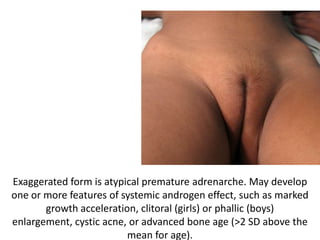
Exaggerated form is atypical premature adrenarche. May develop
one or more features of systemic androgen effect, such as marked
       growth acceleration, clitoral (girls) or phallic (boys)
enlargement, cystic acne, or advanced bone age (>2 SD above the
                         mean for age).
• Although it has been considered a benign
  condition, longitudinal observations suggest that approximately
  50% of girls with premature adrenarche are at high risk for
  hyperandrogenism and polycystic ovary syndrome, alone or
  more often in combination with other components of the
  metabolic syndrome (insulin resistance possibly progressing to
  type 2 diabetes mellitus, dyslipidemia, hypertension, increased
  abdominal fat) as adults.
• Premature Menarche-is a diagnosis of exclusion. In girls with
  isolated vaginal bleeding in the absence of other secondary
  sexual characters, more common causes such as
  vulvovaginitis, a foreign body, or sexual abuse, and uncommon
  causes such as urethral prolapse and sarcoma botryoides must
  be carefully excluded.
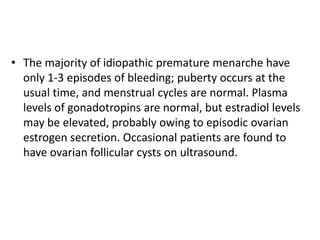
• The majority of idiopathic premature menarche have
  only 1-3 episodes of bleeding; puberty occurs at the
  usual time, and menstrual cycles are normal. Plasma
  levels of gonadotropins are normal, but estradiol levels
  may be elevated, probably owing to episodic ovarian
  estrogen secretion. Occasional patients are found to
  have ovarian follicular cysts on ultrasound.
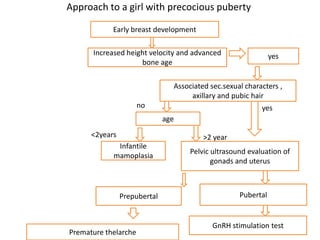
Approach to a girl with precocious puberty

            Early breast development

      Increased height velocity and advanced                   yes
                    bone age

                                Associated sec.sexual characters ,
                                     axillary and pubic hair
                      no                                   yes
                              age
      <2years                            >2 year
             Infantile
                                     Pelvic ultrasound evaluation of
            mamoplasia
                                            gonads and uterus


                Prepubertal                         Pubertal


                                            GnRH stimulation test
Premature thelarche
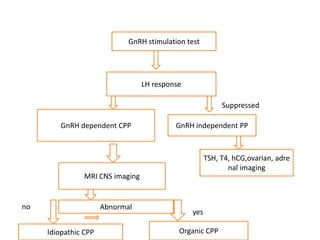
GnRH stimulation test


                                  LH response

                                                           Suppressed

         GnRH dependent CPP                GnRH independent PP


                                                      TSH, T4, hCG,ovarian, adre
                                                             nal imaging
                MRI CNS imaging


no                    Abnormal
                                                yes

     Idiopathic CPP                         Organic CPP
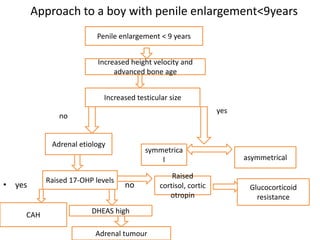
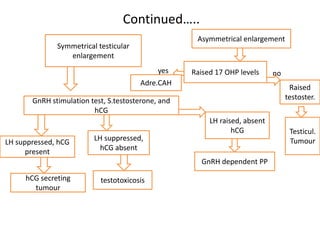
Approach to a boy with penile enlargement<9years
                         Penile enlargement < 9 years


                         Increased height velocity and
                              advanced bone age


                           Increased testicular size
                                                                yes
             no


           Adrenal etiology
                                        symmetrica
                                            l                         asymmetrical

                                                 Raised
          Raised 17-OHP levels
• yes                            no          cortisol, cortic          Glucocorticoid
                                                otropin                  resistance
                       DHEAS high
    CAH

                        Adrenal tumour
Continued…..
                                                     Asymmetrical enlargement
              Symmetrical testicular
                 enlargement
                                             yes    Raised 17 OHP levels     no
                                       Adre.CAH
                                                                                   Raised
       GnRH stimulation test, S.testosterone, and                                 testoster.
                         hCG
                                                         LH raised, absent
                                                                hCG                Testicul.
LH suppressed, hCG       LH suppressed,                                            Tumour
                           hCG absent
      present
                                                      GnRH dependent PP

     hCG secreting         testotoxicosis
       tumour
Precocious puberty

Precocious puberty

  • 1.
    PRECOCIOUS PUBERTY DR SANTOSH MOGALI
  • 2.
    INTRODUCTION- • onset ofsecondary sexual characters before the age of 8 years in girls and 9 years in boys. • Two types-central-gonadotropin dependent or true. Is always isosexual and stems from hypothalamic-pituitary- gonadal activation with ensuing sex hormone secretion and progressive sexual maturation. • Peripheral- gonadotropin independent or pseudo. some of the secondary sex characters appear, but no activation of the normal hypothalamic-pituitary-gonadal interplay. May be isosexual or heterosexual (contrasexual)
  • 3.
    Causes of centralprecocious puberty- • Idiopathic Organic brain lesions- Hypothalamic hamartoma Brain tumors, hydrocephalus, severe head trauma, myelomeningocele Hypothyroidism, prolonged and untreated
  • 4.
    CENTRAL PRECOCIOUS PUBERTY- •Defined by the onset of breast development before the age of 8 years in girls and by the onset of testicular development (volume ≥ 4 mL) before the age of 9 years in boys, as a result of the early activation of the HPG axis. • 5- to 10-fold more often in girls than in boys and is usually sporadic. • A high prevalence of idiopathic central precocious puberty has been reported in girls adopted from developing countries, with the limitation that the exact date of birth may be uncertain. • 90% of girls have an idiopathic form, • 75% of boys have structural central nervous system (CNS) abnormality. Beyond its etiology, which thus needs to be specifically addressed, central precocious puberty can affect linear growth and the child's growth potential.
  • 5.
  • 6.
    CLINICAL FEATURES- • Sexualdevelopment begins at any age and generally in normal sequence. • In girls- early menstrual cycles are more irregular and anovulatory. Pregnancy is reported as early as 5.5 years. • In boys, testicular biopsies have shown stimulation of all elements of the testes, and spermatogenesis as early as 5-6 years. • In affected girls and boys, height, weight, and osseous maturation are advanced. The increased rate of bone maturation results in early closure of the epiphyses, and the ultimate stature is < normal
  • 7.
    • In hypothalamichamartoma remain static in size or grow slowly, - no signs other than precocious puberty. • For symptomatic , manifestations may be present for 1-2 yr before the tumor can be detected radiologically. • Include diabetes insipidus, adipsia, hyperthermia, unnatural crying or laughing (gelastic seizures), obesity, and cachexia. • Visual signs (proptosis, decreased visual acuity, visual field defects) may be the first manifestation of an optic glioma.
  • 8.
    • Mental developmentis usually compatible with chronological age. Emotional behavior and mood swings are common, but serious psychological problems are rare. • Natural course- rapid- most common pattern. characterized by rapid physical and osseous maturation, leading to a loss of height potential. • Slow-this pattern characterized by parallel advancement of osseous maturation and linear growth, with preserved height potential. • spontaneously regressive or unsustained central precocious puberty – marks the need for longitudinal observation
  • 9.
    LAB. INVESTIGATIONS- • Withsensitive assays, serum LH concentrations are undetectable in prepubertal children but become detectable in 50-75% of girls and a higher percentage of boys with central sexual precocity. • Measurement during sleep increases diagnostic power and reveals the pulsatile LH secretion. • GnRH stimulation test. Predominant LH response over FSH after iv administration of GnRH or agonist like Leuprolide. However in girls, LH:FSH ratio can remain low until mid- puberty. In such girls with “low” LH response, the central nature of sexual precocity can be proved by detecting pubertal levels of estradiol (>50 pg/mL), 20-24 hr after stimulation with leuprolide.
  • 10.
    • Pelvic ultrasoundreveals progressive enlargement of ovaries followed by uterus to pubertal size. • Osseous maturation advances. • An MRI scan usually shows normal enlargement of the pituitary gland, during puberty; it may also reveal CNS pathology.
  • 11.
    TREATMENT- • Long termGnRH agonists In the USA, the most commonly used preparation is leuprolide acetate (Lupron Depot Ped), in a dose of 0.25-0.3 mg/kg (minimum, 7.5 mg) i.m. once every 4 wk. Other preparations (D-Trp6-GnRH [Decapeptyl], goserelin acetate [Zoladex]) are approved for treatment of precocious puberty in other countries. • Alternatively, histrelin (Supprelin LA), a subcutaneous 50 mg implant with effects lasting 12 mo, is approved by the FDA . • Intranasal and subcutaneous injection formulae are also available. • IUGR at greater risk of short stature as adults and require more-aggressive treatment of precocious puberty, possibly in conjunction with human growth hormone (hGH) therapy.
  • 12.
    PERIPHERAL PUBERTY-ETIOLOGY • PERIPHERAL(GONADOTROPIN INDEPENDENT, PRECOCIOUS PSEUDOPUBERTY) Girls Isosexual (feminizing) conditions- McCune- Albright syndrome Autonomous ovarian cysts Ovarian tumors-Granulosa-theca cell tumor with Ollier disease Teratoma, chorionepithelioma SCTAT associated with Peutz-Jeghers syndrome Feminizing adrenocortical tumor Exogenous estrogens Heterosexual (masculinizing) conditions- Congenital adrenal hyperplasia Adrenal tumors Ovarian tumors Glucocorticoid receptor defect Exogenous androgens
  • 13.
    ETIOLOGY IN BOYS- •Boys Isosexual (masculinizing) conditions -Congenital adrenal hyperplasia Adrenocortical tumor Leydig cell tumor Familial male precocious puberty Isolated Associated with pseudohypoparathyroidism hCG-secreting tumors Central nervous system Hepatoblastoma Mediastinal tumor associated with Klinefelter syndrome Teratoma Glucocorticoid receptor defect Exogenous androgen Heterosexual (feminizing) conditions- Feminizing adrenocortical tumor SCTAT associated with Peutz-Jeghers syndrome Exogenous estrogens
  • 14.
    MAC CUNE ALBRIGHTSYNDROME- • A rare disorder prevalence 1 in 100000 to 1000000. Is associated with patchy cutaneous pigmentation and fibrous dysplasia of the skeletal system. • a missense mutation in the gene encoding the α-subunit of GS, the G protein that stimulates cAMP formation, resulting in the formation of the putative gsp oncoprotein. Activation of receptors (corticotropin [ACTH], TSH, FSH, and LH receptors) that operate via a cAMP-dependent mechanism, as well as cell proliferation, ensue. • expressed differently in different tissues, accounts for variability of clinical expression.
  • 15.
    PRESENTATION- • GIRLS- Theaverage age at onset girls is about 3 yr, vaginal bleeding as early as 4 mo of age and secondary sexual charecters at 6 mo of age. • Estradiol levels vary from normal to markedly elevated (>900 pg/mL), are often cyclic, and can correlate with the size of the cysts. • BOYS- Precocious puberty is less common but has been reported in several instances. • At Pubertal age, Central precocious puberty overrides the antecedent precocious pseudopuberty.
  • 16.
    LAB. INVESTIGATIONS- • .Estradiol levels vary from normal to markedly elevated (>900 pg/mL), are often cyclic, and can correlate with the size of the cysts. • Testicular histology has demonstrated large seminiferous tubules and no or minimal Leydig cell hyperplasia; these findings might simply reflect the fact that biopsy specimens were obtained at an early stage of pubertal development.
  • 17.
    TREATMENT- • Pubertal progressionis variable in these patients. In girls- Functioning ovarian cysts often disappear spontaneously; aspiration or surgical excision of cysts is rarely indicated. • Aromatase inhibitors such as letrozole (1.25-2.5 mg/d orally) or antiestrogens (such as tamoxifen; fulvestrant is currently being investigated). • in boys, in combination with antiandrogens (such as spironolactone 50-100 mg bid, or flutamide 125-250 mg bid). Long-acting analogs of GnRH is indicated only for patients whose puberty has shifted from a gonadotropin-independent to a predominantly gonadotropin-dependent mechanism.
  • 18.
    INCOMPLETE(PARTIAL) VARIANTS- • Isolated manifestations of precocity without development of other signs of puberty. • Premature thelarche- isolated breast development that most often appears < 2 yr of life. Sporadic and asymmetric. ; activating mutations of the GNAS1 gene encoding the α- subunit of the GS protein have been described in some patients without other signs of McCune-Albright syndrome. • Menarche occurs at the expected age, and reproduction is normal. Basal serum levels of FSH and the FSH response to GnRH stimulation >normal girls Plasma LH and estradiol are consistently < limits of detection. Ultrasound examination of ovaries show a few small (<9 mm) cysts.
  • 19.
    • However, Insome girls, breast development is associated with definite evidence of systemic estrogen effects, such as growth acceleration or bone age advancement. Pelvic sonography shows enlarged ovaries or uterus. This condition, referred to as exaggerated or atypical thelarche, differs from central precocious puberty because it spontaneously regresses. • PREMATURE PUBARCHE(ADRENARCHE)-appearance of sexual hair before the age of 8 yr in girls or 9 yr in boys without other evidence of maturation. • Girls >boys. Associated with reduced 3β-hydroxysteroid dehydrogenase activity, and an increase in C-17,20-lyase activity. Leads to increased DHEA, androstenedione and 17HOP
  • 20.
    Exaggerated form isatypical premature adrenarche. May develop one or more features of systemic androgen effect, such as marked growth acceleration, clitoral (girls) or phallic (boys) enlargement, cystic acne, or advanced bone age (>2 SD above the mean for age).
  • 21.
    • Although ithas been considered a benign condition, longitudinal observations suggest that approximately 50% of girls with premature adrenarche are at high risk for hyperandrogenism and polycystic ovary syndrome, alone or more often in combination with other components of the metabolic syndrome (insulin resistance possibly progressing to type 2 diabetes mellitus, dyslipidemia, hypertension, increased abdominal fat) as adults. • Premature Menarche-is a diagnosis of exclusion. In girls with isolated vaginal bleeding in the absence of other secondary sexual characters, more common causes such as vulvovaginitis, a foreign body, or sexual abuse, and uncommon causes such as urethral prolapse and sarcoma botryoides must be carefully excluded.
  • 22.
    • The majorityof idiopathic premature menarche have only 1-3 episodes of bleeding; puberty occurs at the usual time, and menstrual cycles are normal. Plasma levels of gonadotropins are normal, but estradiol levels may be elevated, probably owing to episodic ovarian estrogen secretion. Occasional patients are found to have ovarian follicular cysts on ultrasound.
  • 23.
    Approach to agirl with precocious puberty Early breast development Increased height velocity and advanced yes bone age Associated sec.sexual characters , axillary and pubic hair no yes age <2years >2 year Infantile Pelvic ultrasound evaluation of mamoplasia gonads and uterus Prepubertal Pubertal GnRH stimulation test Premature thelarche
  • 24.
    GnRH stimulation test LH response Suppressed GnRH dependent CPP GnRH independent PP TSH, T4, hCG,ovarian, adre nal imaging MRI CNS imaging no Abnormal yes Idiopathic CPP Organic CPP
  • 25.
    Approach to aboy with penile enlargement<9years Penile enlargement < 9 years Increased height velocity and advanced bone age Increased testicular size yes no Adrenal etiology symmetrica l asymmetrical Raised Raised 17-OHP levels • yes no cortisol, cortic Glucocorticoid otropin resistance DHEAS high CAH Adrenal tumour
  • 26.
    Continued….. Asymmetrical enlargement Symmetrical testicular enlargement yes Raised 17 OHP levels no Adre.CAH Raised GnRH stimulation test, S.testosterone, and testoster. hCG LH raised, absent hCG Testicul. LH suppressed, hCG LH suppressed, Tumour hCG absent present GnRH dependent PP hCG secreting testotoxicosis tumour