 Acromegaly is a disorder that results from
excess growth hormone (GH) after the
growth plates have closed
 •Acr/o = extremities.
 •-megaly= enlargement.
 •Rare disease of the pituitary gland in the
brain.
 •Caused by a benign tumor.
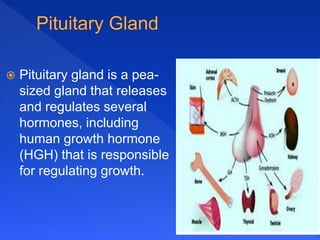
 Pituitary gland is a pea-
sized gland that releases
and regulates several
hormones, including
human growth hormone
(HGH) that is responsible
for regulating growth.
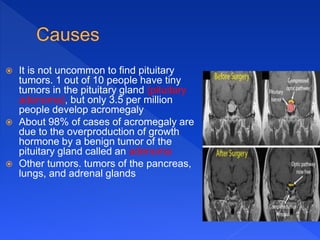
 It is not uncommon to find pituitary
tumors. 1 out of 10 people have tiny
tumors in the pituitary gland (pituitary
adenoma), but only 3.5 per million
people develop acromegaly
 About 98% of cases of acromegaly are
due to the overproduction of growth
hormone by a benign tumor of the
pituitary gland called an adenoma
 Other tumors. tumors of the pancreas,
lungs, and adrenal glands
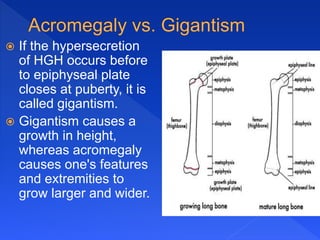
 If the hypersecretion
of HGH occurs before
to epiphyseal plate
closes at puberty, it is
called gigantism.
 Gigantism causes a
growth in height,
whereas acromegaly
causes one's features
and extremities to
grow larger and wider.
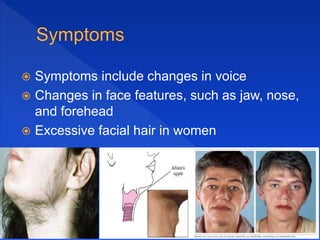
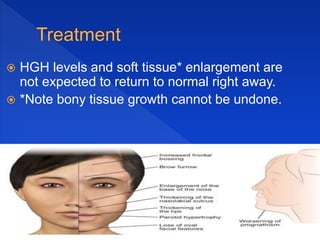
 Symptoms include changes in voice
 Changes in face features, such as jaw, nose,
and forehead
 Excessive facial hair in women
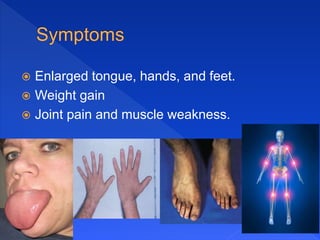
 Enlarged tongue, hands, and feet.
 Weight gain
 Joint pain and muscle weakness.
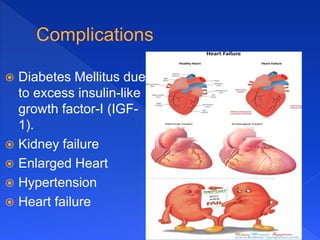
 Diabetes Mellitus due
to excess insulin-like
growth factor-I (IGF-
1).
 Kidney failure
 Enlarged Heart
 Hypertension
 Heart failure
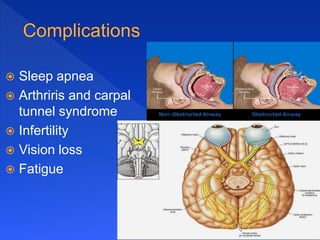
 Sleep apnea
 Arthriris and carpal
tunnel syndrome
 Infertility
 Vision loss
 Fatigue
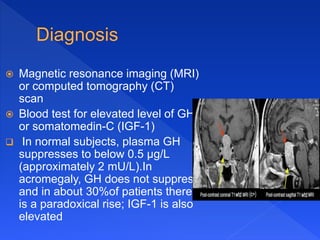
 Magnetic resonance imaging (MRI)
or computed tomography (CT)
scan
 Blood test for elevated level of GH
or somatomedin-C (IGF-1)
 In normal subjects, plasma GH
suppresses to below 0.5 µg/L
(approximately 2 mU/L).In
acromegaly, GH does not suppress
and in about 30%of patients there
is a paradoxical rise; IGF-1 is also
elevated
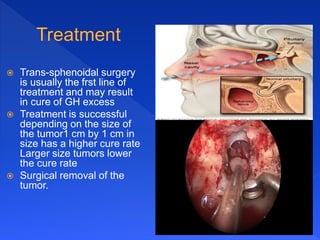
 Trans-sphenoidal surgery
is usually the frst line of
treatment and may result
in cure of GH excess
 Treatment is successful
depending on the size of
the tumor1 cm by 1 cm in
size has a higher cure rate
Larger size tumors lower
the cure rate
 Surgical removal of the
tumor.
 Gamma Knife cobalt
 Cyber Knife
 Hormone-regulating therapy
 Somatostatin analogues (such
as octreotide or lanreotide)
 Pegvisomant is a peptide GH
receptor antagonist administered
by daily self-injection and may be
indicated in some patients whose
GH and IGF-1 concentrations fail
to suppress suffciently following
somatostatin analogue therapy
 Dopamine agonists are less
effective at lowering GH but may
sometimes be helpful
 HGH levels and soft tissue* enlargement are
not expected to return to normal right away.
 *Note bony tissue growth cannot be undone.
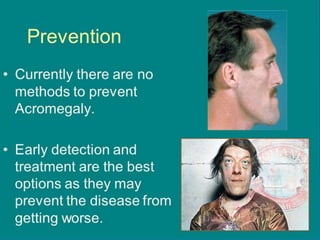
 There is no way to prevent acromegaly.
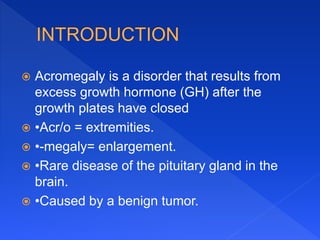
Acromegaly

Acromegaly

  • 2.
     Acromegaly isa disorder that results from excess growth hormone (GH) after the growth plates have closed  •Acr/o = extremities.  •-megaly= enlargement.  •Rare disease of the pituitary gland in the brain.  •Caused by a benign tumor.
  • 3.
     Pituitary glandis a pea- sized gland that releases and regulates several hormones, including human growth hormone (HGH) that is responsible for regulating growth.
  • 4.
     It isnot uncommon to find pituitary tumors. 1 out of 10 people have tiny tumors in the pituitary gland (pituitary adenoma), but only 3.5 per million people develop acromegaly  About 98% of cases of acromegaly are due to the overproduction of growth hormone by a benign tumor of the pituitary gland called an adenoma  Other tumors. tumors of the pancreas, lungs, and adrenal glands
  • 5.
     If thehypersecretion of HGH occurs before to epiphyseal plate closes at puberty, it is called gigantism.  Gigantism causes a growth in height, whereas acromegaly causes one's features and extremities to grow larger and wider.
  • 6.
     Symptoms includechanges in voice  Changes in face features, such as jaw, nose, and forehead  Excessive facial hair in women
  • 8.
     Enlarged tongue,hands, and feet.  Weight gain  Joint pain and muscle weakness.
  • 9.
     Diabetes Mellitusdue to excess insulin-like growth factor-I (IGF- 1).  Kidney failure  Enlarged Heart  Hypertension  Heart failure
  • 10.
     Sleep apnea Arthriris and carpal tunnel syndrome  Infertility  Vision loss  Fatigue
  • 11.
     Magnetic resonanceimaging (MRI) or computed tomography (CT) scan  Blood test for elevated level of GH or somatomedin-C (IGF-1)  In normal subjects, plasma GH suppresses to below 0.5 µg/L (approximately 2 mU/L).In acromegaly, GH does not suppress and in about 30%of patients there is a paradoxical rise; IGF-1 is also elevated
  • 12.
     Trans-sphenoidal surgery isusually the frst line of treatment and may result in cure of GH excess  Treatment is successful depending on the size of the tumor1 cm by 1 cm in size has a higher cure rate Larger size tumors lower the cure rate  Surgical removal of the tumor.
  • 13.
     Gamma Knifecobalt  Cyber Knife  Hormone-regulating therapy  Somatostatin analogues (such as octreotide or lanreotide)
  • 14.
     Pegvisomant isa peptide GH receptor antagonist administered by daily self-injection and may be indicated in some patients whose GH and IGF-1 concentrations fail to suppress suffciently following somatostatin analogue therapy  Dopamine agonists are less effective at lowering GH but may sometimes be helpful
  • 15.
     HGH levelsand soft tissue* enlargement are not expected to return to normal right away.  *Note bony tissue growth cannot be undone.
  • 16.
     There isno way to prevent acromegaly.