ADRENAL
DISORDERS
Addison’s disease & Cushing’s Syndrome
1Prof. Dr. RS Mehta
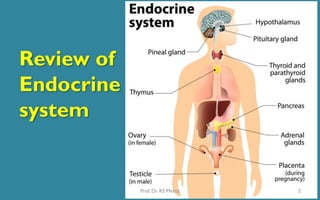
Review of
Endocrine
system
2Prof. Dr. RS Mehta
3Prof. Dr. RS Mehta
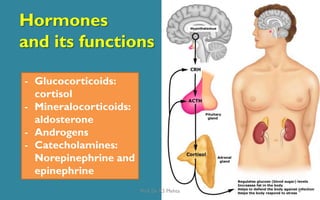
Hormones
and its functions
- Glucocorticoids:
cortisol
- Mineralocorticoids:
aldosterone
- Androgens
- Catecholamines:
Norepinephrine and
epinephrine
4Prof. Dr. RS Mehta
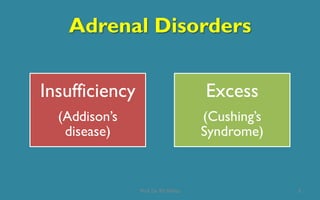
Adrenal Disorders
Insufficiency
(Addison’s
disease)
Excess
(Cushing’s
Syndrome)
5Prof. Dr. RS Mehta
ADDISON’S DISEASE
6Prof. Dr. RS Mehta
Introduction
• Also called chronic adrenal
insufficiency, hypocortisolism,hypoadren
alism)
• is a rare, chronic endocrine system disorder in
which the adrenal glands do not produce
sufficient steroid hormones.
7Prof. Dr. RS Mehta
Introduction
• Thomas Addison (1793-1860) first described
the syndrome in 1855.
• Age- can affect people of any age, most
common between the ages of 30 and 50.
• Sex- more common in women than men.
8Prof. Dr. RS Mehta
Etiology
• Anatomic destruction of gland (chronic or acute)
• Autoimmune or idiopathic atrophy
• Surgical removal of both adrenal glands
• Infections (tuberculosis, fungal, viral—especially in
AIDS)
• Invasion: metastatic
• Congenital adrenal hyperplasia
• Inadequate secretion of ACTH from pitutary gland.
9Prof. Dr. RS Mehta
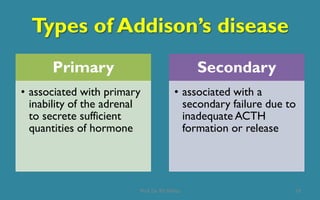
Types of Addison’s disease
Primary
• associated with primary
inability of the adrenal
to secrete sufficient
quantities of hormone
Secondary
• associated with a
secondary failure due to
inadequate ACTH
formation or release
10Prof. Dr. RS Mehta
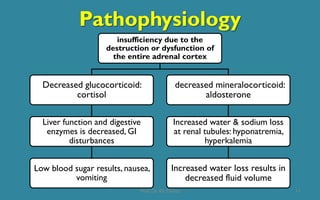
Pathophysiology
insufficiency due to the
destruction or dysfunction of
the entire adrenal cortex
Decreased glucocorticoid:
cortisol
Liver function and digestive
enzymes is decreased, GI
disturbances
Low blood sugar results, nausea,
vomiting
decreased mineralocorticoid:
aldosterone
Increased water & sodium loss
at renal tubules: hyponatremia,
hyperkalemia
Increased water loss results in
decreased fluid volume
11Prof. Dr. RS Mehta
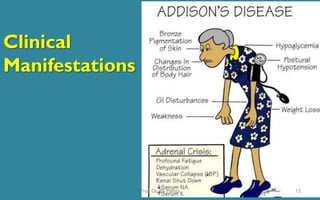
Clinical
Manifestations
12Prof. Dr. RS Mehta
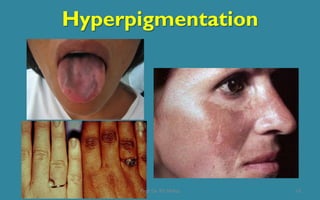
Hyperpigmentation
13Prof. Dr. RS Mehta
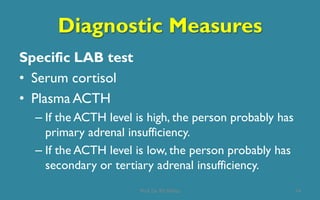
Diagnostic Measures
Specific LAB test
• Serum cortisol
• Plasma ACTH
– If the ACTH level is high, the person probably has
primary adrenal insufficiency.
– If the ACTH level is low, the person probably has
secondary or tertiary adrenal insufficiency.
14Prof. Dr. RS Mehta
Diagnostic measures.
• Serum glucose
• Serum electrolytes level
• Complete blood count
• CT, MRI:To rule out pituitary and adrenal mass
15Prof. Dr. RS Mehta
Complications
16
• Adrenal crisis(addisonian crisis): sudden
pain in back, abdomen, legs, cyanosis and the
classic signs of circulatory shock: pallor,
apprehension, rapid and weak pulse, rapid
respirations, and low blood pressure.
• Osteoporosis
Prof. Dr. RS Mehta
Management
• 1. Correct fluid and electrolyte imbalances:
Directed primarily toward repletion of circulating
glucocorticoids and replacement of the sodium and
water deficits.
• 2. Correct Hypoglycemia: An IV infusion of 5%
glucose in normal saline solution(DNS) or 25%
dextrose bolus.
17Prof. Dr. RS Mehta
Management
3. Replace Steroids: a bolus iv infusion of 100
mg hydrocortisone.
– Maintenance100-mg bolus of hydrocortisone IV
every 6 h.
• Lifelong replacement of corticosteroids and
mineralocorticoids
• Mineralocorticoid supplementation - 0.05–0.1
mg fludrocortisone per day PO. 18Prof. Dr. RS Mehta
NURSING MANAGEMENT
19Prof. Dr. RS Mehta
Nursing assessment
• Patient’s level of stress.
• Vital signs
• Assesses the skin color and turgor
• Weight changes, muscle weakness, and fatigue
20Prof. Dr. RS Mehta
Nursing Diagnosis
• Activity intolerance related to fatigue
• Risk for Deficient FluidVolume
• Risk for Imbalanced Nutrition: Less Than Body
Requirements
21Prof. Dr. RS Mehta
Monitoring and managing addisonian
crisis
• Physical and psychological stressors must be
avoided like exposure to cold, overexertion,
infection, and emotional distress.
• Intravenous administration of fluid, glucose,
and electrolytes, especially sodium;
replacement of missing steroid hormones; and
vasopressors.
22Prof. Dr. RS Mehta
Restoring fluid balance
• Assesses the patient’s skin turgor, mucous
membranes, weight.
• Encourages the patient to consume foods and
fluids and select foods high in sodium
• Administer hormone replacement as
prescribed and to modify the dosage during
illness and other stressful occasions.
23Prof. Dr. RS Mehta
Others
• Reliving fatigue
• Maintaining optimal nutrition
24Prof. Dr. RS Mehta
Prognosis
25
• Treatment of Addison's disease is lifelong.
• The prognosis depend on the underlying
cause.
Prof. Dr. RS Mehta
CUSHING’S SYNDROME
26Prof. Dr. RS Mehta
Introduction
• Cushing’s syndrome (Hypercortisolism,
Adrenal Hyperfunction) :
is a cluster of clinical abnormalities caused by
excessive levels of adrenocortical hormones
(particularly cortisol)
• 1st described by Harvey Cushing in 1932.
27Prof. Dr. RS Mehta
Incidence
• Cushing’s syndrome affects 13 of every 1
million people.
• It is more common in women than in men
and occurs primarily between ages 25 and 40.
28Prof. Dr. RS Mehta
Etiology
• Excess. In approximately 70% of patients,
Cushing’s syndrome results from excessive
production of corticotropin and consequent
hyperplasia of the adrenal cortex.
• Pituitary hypersecretion and pituitary tumors
29Prof. Dr. RS Mehta
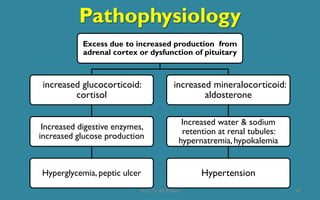
Pathophysiology
Excess due to increased production from
adrenal cortex or dysfunction of pituitary
increased glucocorticoid:
cortisol
Increased digestive enzymes,
increased glucose production
Hyperglycemia, peptic ulcer
increased mineralocorticoid:
aldosterone
Increased water & sodium
retention at renal tubules:
hypernatremia, hypokalemia
Hypertension
30Prof. Dr. RS Mehta
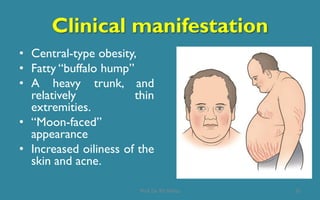
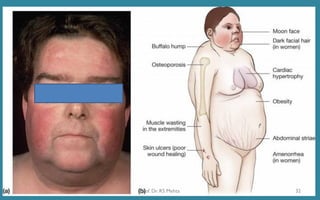
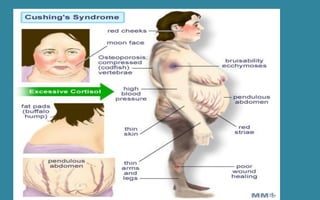
Clinical manifestation
• Central-type obesity,
• Fatty “buffalo hump”
• A heavy trunk, and
relatively thin
extremities.
• “Moon-faced”
appearance
• Increased oiliness of the
skin and acne.
31Prof. Dr. RS Mehta
32Prof. Dr. RS Mehta
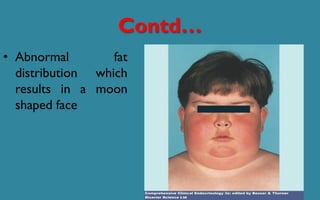
Contd…
• Abnormal fat
distribution which
results in a moon
shaped face
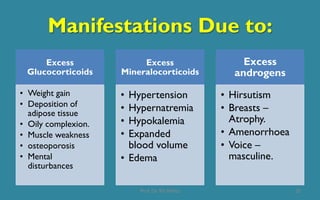
Manifestations Due to:
Excess
Glucocorticoids
• Weight gain
• Deposition of
adipose tissue
• Oily complexion.
• Muscle weakness
• osteoporosis
• Mental
disturbances
Excess
Mineralocorticoids
• Hypertension
• Hypernatremia
• Hypokalemia
• Expanded
blood volume
• Edema
Excess
androgens
• Hirsutism
• Breasts –
Atrophy.
• Amenorrhoea
• Voice –
masculine.
35Prof. Dr. RS Mehta
Diagnosis
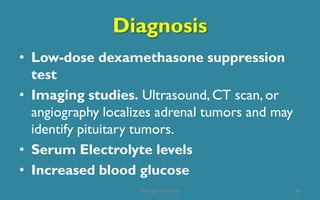
• Low-dose dexamethasone suppression
test
• Imaging studies. Ultrasound, CT scan, or
angiography localizes adrenal tumors and may
identify pituitary tumors.
• Serum Electrolyte levels
• Increased blood glucose
36Prof. Dr. RS Mehta
Diagnosis
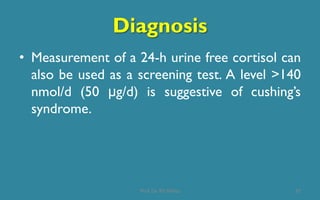
• Measurement of a 24-h urine free cortisol can
also be used as a screening test. A level >140
nmol/d (50 μg/d) is suggestive of cushing’s
syndrome.
37Prof. Dr. RS Mehta
Management
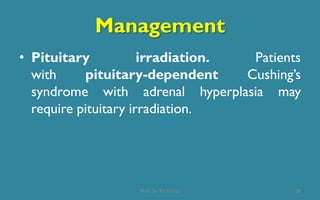
• Pituitary irradiation. Patients
with pituitary-dependent Cushing’s
syndrome with adrenal hyperplasia may
require pituitary irradiation.
38Prof. Dr. RS Mehta
Drug therapy
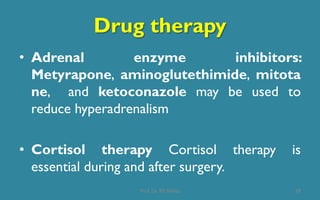
• Adrenal enzyme inhibitors:
Metyrapone, aminoglutethimide, mitota
ne, and ketoconazole may be used to
reduce hyperadrenalism
• Cortisol therapy Cortisol therapy is
essential during and after surgery.
39Prof. Dr. RS Mehta
Management
• Diabetes mellitus and peptic ulcer common in
the patient with Cushing’s syndrome.
Therefore, insulin therapy and medication to
treat peptic ulcer may be initiated if needed.
40Prof. Dr. RS Mehta
Surgical Management
• Transsphenoidal hypophysectomy:
Surgical removal of the tumor by
transsphenoidal hypophysectomy .
• Adrenalectomy
41Prof. Dr. RS Mehta
NURSING MANAGEMENT
42Prof. Dr. RS Mehta
Nursing assessment
• Health history. The history includes information
about the patient’s level of activity and ability to carry
out routine and self-care activities.
• Physical exam. The skin is observed and assessed for
trauma, infection, breakdown, bruising, and edema.
• Mental function. The nurse assesses the patient’s
mental function including mood, responses to
questions, awareness of environment, and level of
43Prof. Dr. RS Mehta
Nursing diagnosis
• Self-care deficit related to weakness, fatigue,
muscle wasting, and altered sleep patterns
• Impaired skin integrity related to edema,
impaired healing, and thin and fragile skin
• Disturbed body image related to altered
physical appearance, impaired sexual
functioning, and decreased activity level
44Prof. Dr. RS Mehta
Nursing Diagnosis
• Disturbed thought processes related to mood
swings, irritability, and depression.
• Risk for injury related to weakness
• Risk for infection related to suppression of
inflammatory response
45Prof. Dr. RS Mehta
Nursing Interventions
• Decreasing Risk for injury
• Decreasing risk for infection
• Preparing patient for surgery
• Encouraging rest and activity
• Promoting Skin integrity
• Improving Body image
• Improving thought process
46Prof. Dr. RS Mehta
Prognosis
• Without treatment, hypercortisolism persists and in
many patients worsens.
• Untreated disease carries a dismal survival rate of
50% at 5 years.
• Despite improvement of complications in most
patients, cardiovascular risk, hypertension, obesity,
and decreased quality of life may persist in some
patients.
47Prof. Dr. RS Mehta
Thank you so much
48Prof. Dr. RS Mehta

4. adrenal disorders

  • 1.
    ADRENAL DISORDERS Addison’s disease &Cushing’s Syndrome 1Prof. Dr. RS Mehta
  • 2.
  • 3.
  • 4.
    Hormones and its functions -Glucocorticoids: cortisol - Mineralocorticoids: aldosterone - Androgens - Catecholamines: Norepinephrine and epinephrine 4Prof. Dr. RS Mehta
  • 5.
  • 6.
  • 7.
    Introduction • Also calledchronic adrenal insufficiency, hypocortisolism,hypoadren alism) • is a rare, chronic endocrine system disorder in which the adrenal glands do not produce sufficient steroid hormones. 7Prof. Dr. RS Mehta
  • 8.
    Introduction • Thomas Addison(1793-1860) first described the syndrome in 1855. • Age- can affect people of any age, most common between the ages of 30 and 50. • Sex- more common in women than men. 8Prof. Dr. RS Mehta
  • 9.
    Etiology • Anatomic destructionof gland (chronic or acute) • Autoimmune or idiopathic atrophy • Surgical removal of both adrenal glands • Infections (tuberculosis, fungal, viral—especially in AIDS) • Invasion: metastatic • Congenital adrenal hyperplasia • Inadequate secretion of ACTH from pitutary gland. 9Prof. Dr. RS Mehta
  • 10.
    Types of Addison’sdisease Primary • associated with primary inability of the adrenal to secrete sufficient quantities of hormone Secondary • associated with a secondary failure due to inadequate ACTH formation or release 10Prof. Dr. RS Mehta
  • 11.
    Pathophysiology insufficiency due tothe destruction or dysfunction of the entire adrenal cortex Decreased glucocorticoid: cortisol Liver function and digestive enzymes is decreased, GI disturbances Low blood sugar results, nausea, vomiting decreased mineralocorticoid: aldosterone Increased water & sodium loss at renal tubules: hyponatremia, hyperkalemia Increased water loss results in decreased fluid volume 11Prof. Dr. RS Mehta
  • 12.
  • 13.
  • 14.
    Diagnostic Measures Specific LABtest • Serum cortisol • Plasma ACTH – If the ACTH level is high, the person probably has primary adrenal insufficiency. – If the ACTH level is low, the person probably has secondary or tertiary adrenal insufficiency. 14Prof. Dr. RS Mehta
  • 15.
    Diagnostic measures. • Serumglucose • Serum electrolytes level • Complete blood count • CT, MRI:To rule out pituitary and adrenal mass 15Prof. Dr. RS Mehta
  • 16.
    Complications 16 • Adrenal crisis(addisoniancrisis): sudden pain in back, abdomen, legs, cyanosis and the classic signs of circulatory shock: pallor, apprehension, rapid and weak pulse, rapid respirations, and low blood pressure. • Osteoporosis Prof. Dr. RS Mehta
  • 17.
    Management • 1. Correctfluid and electrolyte imbalances: Directed primarily toward repletion of circulating glucocorticoids and replacement of the sodium and water deficits. • 2. Correct Hypoglycemia: An IV infusion of 5% glucose in normal saline solution(DNS) or 25% dextrose bolus. 17Prof. Dr. RS Mehta
  • 18.
    Management 3. Replace Steroids:a bolus iv infusion of 100 mg hydrocortisone. – Maintenance100-mg bolus of hydrocortisone IV every 6 h. • Lifelong replacement of corticosteroids and mineralocorticoids • Mineralocorticoid supplementation - 0.05–0.1 mg fludrocortisone per day PO. 18Prof. Dr. RS Mehta
  • 19.
  • 20.
    Nursing assessment • Patient’slevel of stress. • Vital signs • Assesses the skin color and turgor • Weight changes, muscle weakness, and fatigue 20Prof. Dr. RS Mehta
  • 21.
    Nursing Diagnosis • Activityintolerance related to fatigue • Risk for Deficient FluidVolume • Risk for Imbalanced Nutrition: Less Than Body Requirements 21Prof. Dr. RS Mehta
  • 22.
    Monitoring and managingaddisonian crisis • Physical and psychological stressors must be avoided like exposure to cold, overexertion, infection, and emotional distress. • Intravenous administration of fluid, glucose, and electrolytes, especially sodium; replacement of missing steroid hormones; and vasopressors. 22Prof. Dr. RS Mehta
  • 23.
    Restoring fluid balance •Assesses the patient’s skin turgor, mucous membranes, weight. • Encourages the patient to consume foods and fluids and select foods high in sodium • Administer hormone replacement as prescribed and to modify the dosage during illness and other stressful occasions. 23Prof. Dr. RS Mehta
  • 24.
    Others • Reliving fatigue •Maintaining optimal nutrition 24Prof. Dr. RS Mehta
  • 25.
    Prognosis 25 • Treatment ofAddison's disease is lifelong. • The prognosis depend on the underlying cause. Prof. Dr. RS Mehta
  • 26.
  • 27.
    Introduction • Cushing’s syndrome(Hypercortisolism, Adrenal Hyperfunction) : is a cluster of clinical abnormalities caused by excessive levels of adrenocortical hormones (particularly cortisol) • 1st described by Harvey Cushing in 1932. 27Prof. Dr. RS Mehta
  • 28.
    Incidence • Cushing’s syndromeaffects 13 of every 1 million people. • It is more common in women than in men and occurs primarily between ages 25 and 40. 28Prof. Dr. RS Mehta
  • 29.
    Etiology • Excess. Inapproximately 70% of patients, Cushing’s syndrome results from excessive production of corticotropin and consequent hyperplasia of the adrenal cortex. • Pituitary hypersecretion and pituitary tumors 29Prof. Dr. RS Mehta
  • 30.
    Pathophysiology Excess due toincreased production from adrenal cortex or dysfunction of pituitary increased glucocorticoid: cortisol Increased digestive enzymes, increased glucose production Hyperglycemia, peptic ulcer increased mineralocorticoid: aldosterone Increased water & sodium retention at renal tubules: hypernatremia, hypokalemia Hypertension 30Prof. Dr. RS Mehta
  • 31.
    Clinical manifestation • Central-typeobesity, • Fatty “buffalo hump” • A heavy trunk, and relatively thin extremities. • “Moon-faced” appearance • Increased oiliness of the skin and acne. 31Prof. Dr. RS Mehta
  • 32.
  • 34.
    Contd… • Abnormal fat distributionwhich results in a moon shaped face
  • 35.
    Manifestations Due to: Excess Glucocorticoids •Weight gain • Deposition of adipose tissue • Oily complexion. • Muscle weakness • osteoporosis • Mental disturbances Excess Mineralocorticoids • Hypertension • Hypernatremia • Hypokalemia • Expanded blood volume • Edema Excess androgens • Hirsutism • Breasts – Atrophy. • Amenorrhoea • Voice – masculine. 35Prof. Dr. RS Mehta
  • 36.
    Diagnosis • Low-dose dexamethasonesuppression test • Imaging studies. Ultrasound, CT scan, or angiography localizes adrenal tumors and may identify pituitary tumors. • Serum Electrolyte levels • Increased blood glucose 36Prof. Dr. RS Mehta
  • 37.
    Diagnosis • Measurement ofa 24-h urine free cortisol can also be used as a screening test. A level >140 nmol/d (50 μg/d) is suggestive of cushing’s syndrome. 37Prof. Dr. RS Mehta
  • 38.
    Management • Pituitary irradiation.Patients with pituitary-dependent Cushing’s syndrome with adrenal hyperplasia may require pituitary irradiation. 38Prof. Dr. RS Mehta
  • 39.
    Drug therapy • Adrenalenzyme inhibitors: Metyrapone, aminoglutethimide, mitota ne, and ketoconazole may be used to reduce hyperadrenalism • Cortisol therapy Cortisol therapy is essential during and after surgery. 39Prof. Dr. RS Mehta
  • 40.
    Management • Diabetes mellitusand peptic ulcer common in the patient with Cushing’s syndrome. Therefore, insulin therapy and medication to treat peptic ulcer may be initiated if needed. 40Prof. Dr. RS Mehta
  • 41.
    Surgical Management • Transsphenoidalhypophysectomy: Surgical removal of the tumor by transsphenoidal hypophysectomy . • Adrenalectomy 41Prof. Dr. RS Mehta
  • 42.
  • 43.
    Nursing assessment • Healthhistory. The history includes information about the patient’s level of activity and ability to carry out routine and self-care activities. • Physical exam. The skin is observed and assessed for trauma, infection, breakdown, bruising, and edema. • Mental function. The nurse assesses the patient’s mental function including mood, responses to questions, awareness of environment, and level of 43Prof. Dr. RS Mehta
  • 44.
    Nursing diagnosis • Self-caredeficit related to weakness, fatigue, muscle wasting, and altered sleep patterns • Impaired skin integrity related to edema, impaired healing, and thin and fragile skin • Disturbed body image related to altered physical appearance, impaired sexual functioning, and decreased activity level 44Prof. Dr. RS Mehta
  • 45.
    Nursing Diagnosis • Disturbedthought processes related to mood swings, irritability, and depression. • Risk for injury related to weakness • Risk for infection related to suppression of inflammatory response 45Prof. Dr. RS Mehta
  • 46.
    Nursing Interventions • DecreasingRisk for injury • Decreasing risk for infection • Preparing patient for surgery • Encouraging rest and activity • Promoting Skin integrity • Improving Body image • Improving thought process 46Prof. Dr. RS Mehta
  • 47.
    Prognosis • Without treatment,hypercortisolism persists and in many patients worsens. • Untreated disease carries a dismal survival rate of 50% at 5 years. • Despite improvement of complications in most patients, cardiovascular risk, hypertension, obesity, and decreased quality of life may persist in some patients. 47Prof. Dr. RS Mehta
  • 48.
    Thank you somuch 48Prof. Dr. RS Mehta