ACROMEGALY
     &
 GIGANTISM


      BY : RITWAN BIN TAPENG
A
C   DEFINITION
R
O   Chronic metabolic disorder in which there is
M   too much growth hormone and the body
E
    tissue gradually enlarge
G
A
L
Y
PATHOPHYSIOLOGY

Acromegaly is characterized by hypersecretion of growth hormone (GH),
which is caused by the existence of a secreting pituitary tumor in more than
95% of acromegaly cases. Pituitary tumors are benign adenomas and can be
classified according to size (microadenomas being less than 10 mm in
diameter and macroadenomas being greater than 10 mm in diameter).3,4 In
rare instances, elevated GH levels are caused by extra pituitary disorders. In
either situation, hypersecretion of GH in turn causes subsequent hepatic
stimulation of insulin-like growth factor-1 (IGF-1).1
SYMPTOMS
   Body odor
   Carpal tunnel syndrome
   Decrease muscle strength ( weakness )
   Easy fatique
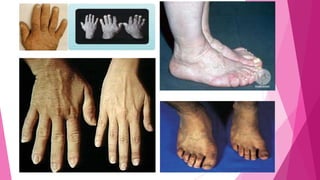
   Enlarge feet
   Enlarge hands
   Enlarge glands in the skin ( sebaceous glands )
   Enlarge jaw and tongue
   Excessive height
   Excessive sweating
SYMPTOMS ( cont… )
   Headdache
   Hoarseness
   Joint pain
   Limited joint movement
   Sleep apnea
   Swelling of bony areas around a joint
   Thickening of skin, skin tags
   Widely spaced teeth
   Excess hair growth in females
   Weight gain
DIFFERENTIAL DIAGNOSIS

   Pseudoacromegaly
        Presence of similar acromegaloid features in the absence of elevated GH or IGF-I
         levels
   Physiologic growth spurt during puberty
   Familial tall stature or large hands and feet
   Myxedema
INVESTIGATION

   Visual field tests
   Assessment of other pituitary hormones: prolactin, adrenal, thyroid, and
    gonadal hormones
   MRI scan of pituitary and hypothalamus: more sensitive than CT scan
   CT scan: for lung, pancreatic, adrenal or ovarian tumours that may secrete
    ectopic growth hormone or GHRH
   Total body scintigraphy with radio-labelled OctreoScan® (somatostatin) to aid
    localisation of the tumour
   Cardiac assessment: electrocardiogram, echocardiogram
PROGNOSIS

   Pituitary surgery is successful in most patient, depending on the size of the
    tumor and the experience of the surgeon
   Without treatment the symptoms will get worse,and the risk of cardiovascular
    disease increase
COMPLICATIONS

   Arthritis
   Cardiovacular disease
   Carpal tunnel syndrome
   Colonic polyps
   Glucose intolerance or diabetes
   High blood pressure
   Sleep apnea
   Spinal cord compression
   Uterine fibroids
   Vision abnormalities
REFERENCES

   http://onlinelibrary.wiley.co
   http://www.harrisonspractice.com/practice/ub/view/Harrisons%20Practice/1
    41312/2.0/acromegaly
   http://www.patient.co.uk/doctor/Acromegaly.htm
   http://www.acromegalyinfo.com/health-care-professional/epidemiology-
    pathophysiology.jsp
G
I
    DEFINITION
G   Abnormally large growth due to an excess of
A   growth hormone during childhood, before the
N   bone growth plates have closed.
T
I
S
M
CAUSES

The most common cause of too much growth hormone release is a noncancerous
(benign) tumor of the pituitary gland. Other causes include:
   Carney complex
   McCune-Albright syndrome (MAS)
   Multiple endocrine neoplasia type 1 (MEN-1)
   Neurofibromatosis
If excess growth hormone occurs after normal bone growth has stopped, the
condition is known as acromegaly.
SYMPTOMS
   Delayed puberty
   Double vision or difficulty with side (peripheral) vision
   Frontal bossing and a prominent jaw
   Headache
   Increased sweating
   Irregular periods (menstruation)
   Large hands and feet with thick fingers and toes
   Release of breast milk
   Thickening of the facial features
   Weakness
EXAMS & TESTS
   CT or MRI scan of the head showing pituitary tumor
   Failure to suppress serum growth hormone (GH) levels after an oral glucose
    challenge (maximum 75g)
   High prolactin levels
   Increased insulin growth factor-I (IGF-I) levels


Damage to the pituitary may lead to low levels of other hormones, including:
     Cortisol
     Estradiol (girls)
     Testosterone (boys)
     Thyroid hormone
TREATMENT

Medical treatments of gigantism


   Medications may be used to reduce GH release, block the effects of GH, or prevent
    growth in stature. They include:
   Dopamine agonists, such as bromocriptine mesylate (Cycloset, Parlodel) and cabergoline
    (Dostinex), which reduce GH release
   GH antagonist, pegvisomant (Somavert), which blocks the effects of GH
   Sex hormone therapy, such as estrogen and testosterone, which may inhibit the growth of
    long bones
   Somatostatin analogs, such as octreotide (Sandostatin) and long-acting lanreotide
    (Somatuline Depot), which reduce GH release
TREATMENT ( cont… )

Other treatments of gigantism


   Radiation of the pituitary gland to regulate GH. This is generally
    considered the least desirable treatment option because of its limited
    effectiveness and side effects that can include obesity, emotional
    impairment, and learning disabilities
   Surgery to remove a pituitary tumor, which is the treatment of choice
    for well-defined pituitary tumors
PROGNOSIS


Pituitary surgery is usually successful in limiting growth
hormone production.
COMPLICATIONS

   Delayed puberty
   Difficulty functioning in everyday life due to large size and unusual features
   Diminished vision or total vision loss
   Embarrassment, isolation, difficulties with relationships, and other social
    problems
   Hypothyroidism
   Severe chronic headaches
   Sleep apnea
REFERENCES

   http://health.nytimes.com/health/guides/disease/gigantism/overview.html
   http://www.localhealth.com/article/gigantism/treatments
   http://emedicine.medscape.com/article/925446-overview
   http://www.scientificamerican.com/article.cfm?id=what-causes-gigantism-
    sandy-allen
   http://www.yourhormones.info/endocrine_conditions/gigantism.aspx
Acromegaly & gigantism

Acromegaly & gigantism

  • 1.
    ACROMEGALY & GIGANTISM BY : RITWAN BIN TAPENG
  • 2.
    A C DEFINITION R O Chronic metabolic disorder in which there is M too much growth hormone and the body E tissue gradually enlarge G A L Y
  • 4.
    PATHOPHYSIOLOGY Acromegaly is characterizedby hypersecretion of growth hormone (GH), which is caused by the existence of a secreting pituitary tumor in more than 95% of acromegaly cases. Pituitary tumors are benign adenomas and can be classified according to size (microadenomas being less than 10 mm in diameter and macroadenomas being greater than 10 mm in diameter).3,4 In rare instances, elevated GH levels are caused by extra pituitary disorders. In either situation, hypersecretion of GH in turn causes subsequent hepatic stimulation of insulin-like growth factor-1 (IGF-1).1
  • 5.
    SYMPTOMS  Body odor  Carpal tunnel syndrome  Decrease muscle strength ( weakness )  Easy fatique  Enlarge feet  Enlarge hands  Enlarge glands in the skin ( sebaceous glands )  Enlarge jaw and tongue  Excessive height  Excessive sweating
  • 6.
    SYMPTOMS ( cont…)  Headdache  Hoarseness  Joint pain  Limited joint movement  Sleep apnea  Swelling of bony areas around a joint  Thickening of skin, skin tags  Widely spaced teeth  Excess hair growth in females  Weight gain
  • 7.
    DIFFERENTIAL DIAGNOSIS  Pseudoacromegaly  Presence of similar acromegaloid features in the absence of elevated GH or IGF-I levels  Physiologic growth spurt during puberty  Familial tall stature or large hands and feet  Myxedema
  • 8.
    INVESTIGATION  Visual field tests  Assessment of other pituitary hormones: prolactin, adrenal, thyroid, and gonadal hormones  MRI scan of pituitary and hypothalamus: more sensitive than CT scan  CT scan: for lung, pancreatic, adrenal or ovarian tumours that may secrete ectopic growth hormone or GHRH  Total body scintigraphy with radio-labelled OctreoScan® (somatostatin) to aid localisation of the tumour  Cardiac assessment: electrocardiogram, echocardiogram
  • 9.
    PROGNOSIS  Pituitary surgery is successful in most patient, depending on the size of the tumor and the experience of the surgeon  Without treatment the symptoms will get worse,and the risk of cardiovascular disease increase
  • 10.
    COMPLICATIONS  Arthritis  Cardiovacular disease  Carpal tunnel syndrome  Colonic polyps  Glucose intolerance or diabetes  High blood pressure  Sleep apnea  Spinal cord compression  Uterine fibroids  Vision abnormalities
  • 11.
    REFERENCES  http://onlinelibrary.wiley.co  http://www.harrisonspractice.com/practice/ub/view/Harrisons%20Practice/1 41312/2.0/acromegaly  http://www.patient.co.uk/doctor/Acromegaly.htm  http://www.acromegalyinfo.com/health-care-professional/epidemiology- pathophysiology.jsp
  • 12.
    G I DEFINITION G Abnormally large growth due to an excess of A growth hormone during childhood, before the N bone growth plates have closed. T I S M
  • 14.
    CAUSES The most commoncause of too much growth hormone release is a noncancerous (benign) tumor of the pituitary gland. Other causes include:  Carney complex  McCune-Albright syndrome (MAS)  Multiple endocrine neoplasia type 1 (MEN-1)  Neurofibromatosis If excess growth hormone occurs after normal bone growth has stopped, the condition is known as acromegaly.
  • 15.
    SYMPTOMS  Delayed puberty  Double vision or difficulty with side (peripheral) vision  Frontal bossing and a prominent jaw  Headache  Increased sweating  Irregular periods (menstruation)  Large hands and feet with thick fingers and toes  Release of breast milk  Thickening of the facial features  Weakness
  • 16.
    EXAMS & TESTS  CT or MRI scan of the head showing pituitary tumor  Failure to suppress serum growth hormone (GH) levels after an oral glucose challenge (maximum 75g)  High prolactin levels  Increased insulin growth factor-I (IGF-I) levels Damage to the pituitary may lead to low levels of other hormones, including:  Cortisol  Estradiol (girls)  Testosterone (boys)  Thyroid hormone
  • 17.
    TREATMENT Medical treatments ofgigantism  Medications may be used to reduce GH release, block the effects of GH, or prevent growth in stature. They include:  Dopamine agonists, such as bromocriptine mesylate (Cycloset, Parlodel) and cabergoline (Dostinex), which reduce GH release  GH antagonist, pegvisomant (Somavert), which blocks the effects of GH  Sex hormone therapy, such as estrogen and testosterone, which may inhibit the growth of long bones  Somatostatin analogs, such as octreotide (Sandostatin) and long-acting lanreotide (Somatuline Depot), which reduce GH release
  • 18.
    TREATMENT ( cont…) Other treatments of gigantism  Radiation of the pituitary gland to regulate GH. This is generally considered the least desirable treatment option because of its limited effectiveness and side effects that can include obesity, emotional impairment, and learning disabilities  Surgery to remove a pituitary tumor, which is the treatment of choice for well-defined pituitary tumors
  • 19.
    PROGNOSIS Pituitary surgery isusually successful in limiting growth hormone production.
  • 20.
    COMPLICATIONS  Delayed puberty  Difficulty functioning in everyday life due to large size and unusual features  Diminished vision or total vision loss  Embarrassment, isolation, difficulties with relationships, and other social problems  Hypothyroidism  Severe chronic headaches  Sleep apnea
  • 21.
    REFERENCES  http://health.nytimes.com/health/guides/disease/gigantism/overview.html  http://www.localhealth.com/article/gigantism/treatments  http://emedicine.medscape.com/article/925446-overview  http://www.scientificamerican.com/article.cfm?id=what-causes-gigantism- sandy-allen  http://www.yourhormones.info/endocrine_conditions/gigantism.aspx