Side by Side: vSphere™ and Hyper-V™
                            March 21, 2012
About the Speakers
Scott Lowe
•18 years experience in the IT industry
•Prolific author of thousands of articles and 3 books
•Top virtualization blogger
•Founder and Managing Consultant, The 1610 Group

 Follow me on Twitter @otherscottlowe


Jonathan Reeve
• SolarWinds, Senior Director of Product Management
• Previously ran product management at Hyper9™
• Multiple successful start-ups in the IT space


Side by Side: vSphere™ and Hyper-V™   - Slide 2 -
Agenda
   Why Should You Learn About Hyper-V™?
   Hypervisor Types and Footprints
   Kernel Variances
   A Similarity: CPU Scheduling Controls
   vSphere Memory Handling
   Hyper-V™ Dynamic Memory
   Product Storage Options
   vSphere™ Storage Capabilities
   Networking
   Workload migrations
Side by Side: vSphere™ and Hyper-V™   - Slide 3 -
Why Should You Learn About Hyper-V?
 You may not always be working with Vmware®
 With Windows® 8, Microsoft® will release a new
  version of Hyper-V with new features
 For many organizations, Hyper-V has proven to
  be “good enough” for their needs
 For those with existing Microsoft infrastructures,
  Hyper-V may be the best fit


Side by Side: vSphere™ and Hyper-V™   - Slide 4 -
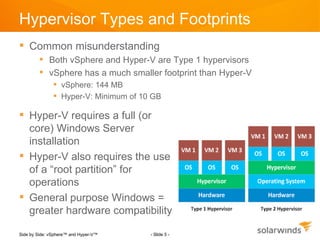
Hypervisor Types and Footprints
 Common misunderstanding
         Both vSphere and Hyper-V are Type 1 hypervisors
         vSphere has a much smaller footprint than Hyper-V
                vSphere: 144 MB
                Hyper-V: Minimum of 10 GB

 Hyper-V requires a full (or
  core) Windows Server
  installation
 Hyper-V also requires the use
  of a “root partition” for
  operations
 General purpose Windows =
  greater hardware compatibility

Side by Side: vSphere™ and Hyper-V™    - Slide 5 -
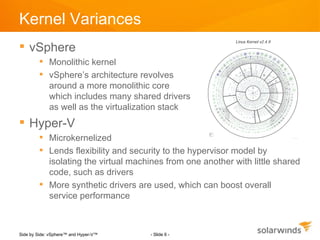
Kernel Variances
 vSphere
         Monolithic kernel
         vSphere’s architecture revolves
          around a more monolithic core
          which includes many shared drivers
          as well as the virtualization stack
 Hyper-V
         Microkernelized
         Lends flexibility and security to the hypervisor model by
          isolating the virtual machines from one another with little shared
          code, such as drivers
         More synthetic drivers are used, which can boost overall
          service performance


Side by Side: vSphere™ and Hyper-V™   - Slide 6 -
High Level Overview
 Operating system support
     vSphere enjoys far broader operating system support
 Licensing limitations
     vSphere imposes stricter hardware-based licensing
      limits
     Hyper-V provided significant Windows licensing
      benefits
 Scalability
     vSphere scales fay beyond Hyper-V
        vSphere vCPU per VM: 32
        Hyper-V vCPU per VM: 4


Side by Side: vSphere™ and Hyper-V™   - Slide 7 -
A Similarity: CPU Scheduling Controls
 vSphere
        Shares. If a VM has a share value that is half
         of another, it’s entitled to only half the CPU
         resources.
        Reservation. A guarantee that a virtual
         machine will receive at least some level of
         resourcing.
        Limit. Limits the ability of the virtual machine to
         consume unlimited resources.
        vSphere has a powerful CPU scheduling
         mechanism in place that ensures that virtual
         machines receive attention from the system.
         VMware has produced a white paper that goes
         into great technical depth for how this
         scheduling is achieved.

Side by Side: vSphere™ and Hyper-V™   - Slide 8 -
A Similarity: CPU Scheduling Controls
 Hyper-V
        Virtual machine reserve (percentage). Allows the reservation
         of a portion of the server’s total processing resources for this
         virtual machine.
        Virtual machine limit (percentage). Limit how much of a host’s
         processing resources can be consumed by a single virtual
         machine.
        Relative weight. allows the weighting of this virtual machine
         against others.


Side by Side: vSphere™ and Hyper-V™   - Slide 9 -
Automated Resource Scheduling
 vSphere
        Distributed Resource Scheduler
              Aggregates cluster resources into a single resource pool
              Provides both initial placement services and continuous optimization
              Enables affinity rules to ensure that workload placement meets
               business and availability rules
              Supports clusters of up to 32 hosts and 1,280 virtual machines
 Hyper-V
       » Resource placement
             • Current VMM provides initial placement services only
                    » One-off service only
             • VMM 2012 will provide Dynamic Optimization
                    » Will provide cluster-level workload balancing for VMs


Side by Side: vSphere™ and Hyper-V™           - Slide 10 -
vSphere Memory Handling
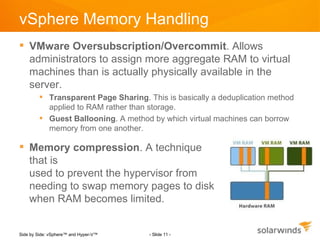
 VMware Oversubscription/Overcommit. Allows
  administrators to assign more aggregate RAM to virtual
  machines than is actually physically available in the
  server.
         Transparent Page Sharing. This is basically a deduplication method
          applied to RAM rather than storage.
         Guest Ballooning. A method by which virtual machines can borrow
          memory from one another.

 Memory compression. A technique
  that is
  used to prevent the hypervisor from
  needing to swap memory pages to disk
  when RAM becomes limited.


Side by Side: vSphere™ and Hyper-V™   - Slide 11 -
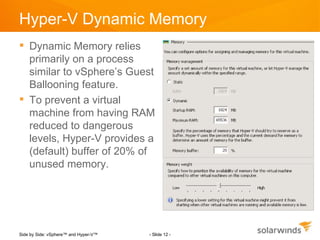
Hyper-V Dynamic Memory
 Dynamic Memory relies
  primarily on a process
  similar to vSphere’s Guest
  Ballooning feature.
 To prevent a virtual
  machine from having RAM
  reduced to dangerous
  levels, Hyper-V provides a
  (default) buffer of 20% of
  unused memory.


Side by Side: vSphere™ and Hyper-V™   - Slide 12 -
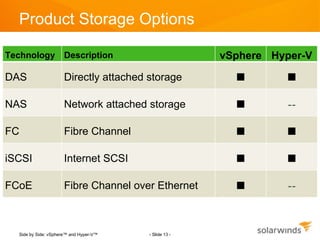
Product Storage Options

Technology           Description                       vSphere Hyper-V

DAS                  Directly attached storage                  

NAS                  Network attached storage                    --

FC                   Fibre Channel                              

iSCSI                Internet SCSI                              

FCoE                 Fibre Channel over Ethernet                 --


  Side by Side: vSphere™ and Hyper-V™   - Slide 13 -
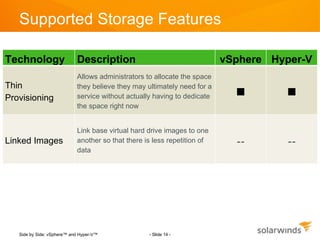
Supported Storage Features

Technology                  Description                                   vSphere Hyper-V
                            Allows administrators to allocate the space
Thin                        they believe they may ultimately need for a
Provisioning                service without actually having to dedicate            
                            the space right now


                            Link base virtual hard drive images to one
Linked Images               another so that there is less repetition of     --       --
                            data


   Side by Side: vSphere™ and Hyper-V™             - Slide 14 -
VMFS vs. VHD
 Both VMware and Microsoft provide clustering
  mechanisms
 VHD relies on MS CSV
         Much more complicated than vSphere’s clustering
 Both MS and VMware provide
  direct access to storage
         vSphere: Raw Device
          Mapping (RDM)
         Hyper-V: Pass-through disks


Side by Side: vSphere™ and Hyper-V™   - Slide 15 -
vSphere Storage Capabilities
 Centralized management of datastores. A
  single location in which all data stores can be
  managed in order to provide more visibility into
  the environment.
 Storage Management Initiative Specification
  (SMI-S) support. Standardized monitoring of
  storage.
 Caching. Improves performance.
 Storage DRS. A way to automatically place VMs
  to load balance Storage IO demands.


Side by Side: vSphere™ and Hyper-V™   - Slide 16 -
Power Management
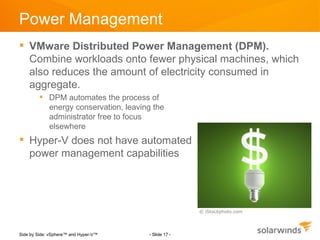
 VMware Distributed Power Management (DPM).
  Combine workloads onto fewer physical machines, which
  also reduces the amount of electricity consumed in
  aggregate.
         DPM automates the process of
          energy conservation, leaving the
          administrator free to focus
          elsewhere
 Hyper-V does not have automated
  power management capabilities


                                                     © iStockphoto.com


Side by Side: vSphere™ and Hyper-V™   - Slide 17 -
vSphere Network Features
 vSphere
         TCP Segmentation Offload. The TCP/IP stack can submit
          frames of up to 64 KB to the NIC -- the NIC then repackages
          these frames into sizes that fit inside the network’s maximum
          transmission unit (MTU) size.
         NetQueue. Enables the system to process multiple network
          receive requests simultaneously across multiple CPUs.
         iSCSI. iSCSI traffic results in a “double hit” from a CPU
          overhead perspective.
         Distributed Virtual Switch. A virtual device that spans multiple
          vSphere hosts.


Side by Side: vSphere™ and Hyper-V™   - Slide 18 -
Hyper-V Network Features
 Chimney (TCP offload). Offloads to the NIC significant
  portions of the CPU workload normally associated with
  TCP/IP functionality
 Large Send Offload (LSO). Provides Hyper-V hosts with
  the ability to submit larger frames – in
  this case up to 256KB in size – to the
  network adapter for further processing
 Virtual Machine Queue (VMQ). Creates
  multiple virtual network queues for each
  virtual machine. Network packets
  destined for these virtual machines are
  then sent directly to the VM, reducing
  some overhead

Side by Side: vSphere™ and Hyper-V™   - Slide 19 -
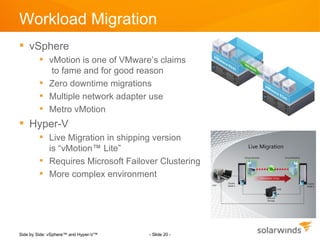
Workload Migration
 vSphere
         vMotion is one of VMware’s claims
           to fame and for good reason
         Zero downtime migrations
         Multiple network adapter use
         Metro vMotion
 Hyper-V
         Live Migration in shipping version
          is “vMotion™ Lite”
         Requires Microsoft Failover Clustering
         More complex environment


Side by Side: vSphere™ and Hyper-V™   - Slide 20 -
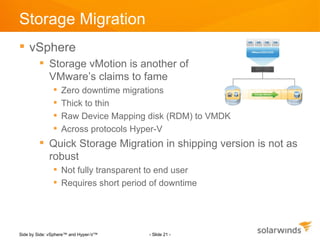
Storage Migration
 vSphere
         Storage vMotion is another of
          VMware’s claims to fame
                  Zero downtime migrations
                  Thick to thin
                  Raw Device Mapping disk (RDM) to VMDK
                  Across protocols Hyper-V
         Quick Storage Migration in shipping version is not as
          robust
                Not fully transparent to end user
                Requires short period of downtime


Side by Side: vSphere™ and Hyper-V™   - Slide 21 -
Availability
 vSphere
         VMware High Availability
                Monitors virtual machines to detect operating system and
                 hardware failures and moves workloads to other hosts
         VMware Fault Tolerance
                Continuous protection for mission critical workloads by
                 running a shadow copy of a protected VM

 Hyper-V
         Much more complex
         Relies on MSCS


Side by Side: vSphere™ and Hyper-V™    - Slide 22 -
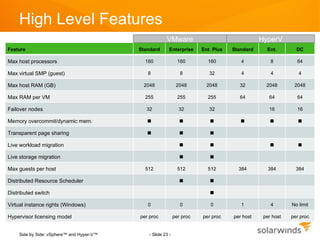
High Level Features
                                                      VMware                                  HyperV
Feature                                   Standard      Enterprise     Ent. Plus   Standard     Ent.        DC

Max host processors                         160               160        160          4           8         64

Max virtual SMP (guest)                      8                 8          32          4           4          4

Max host RAM (GB)                          2048              2048        2048        32         2048       2048

Max RAM per VM                              255               255        255         64          64         64

Failover nodes                              32                32          32                     16         16

Memory overcommit/dynamic mem.                                                                          

Transparent page sharing                                                

Live workload migration                                                                                   

Live storage migration                                                   

Max guests per host                         512               512        512         384         384        384

Distributed Resource Scheduler                                           

Distributed switch                                                        

Virtual instance rights (Windows)            0                 0          0           1           4       No limit

Hypervisor licensing model                per proc          per proc   per proc    per host    per host   per proc


    Side by Side: vSphere™ and Hyper-V™      - Slide 23 -
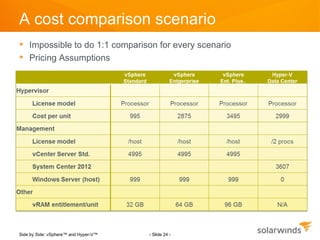
A cost comparison scenario
 Impossible to do 1:1 comparison for every scenario
 Pricing Assumptions


Side by Side: vSphere™ and Hyper-V™   - Slide 24 -
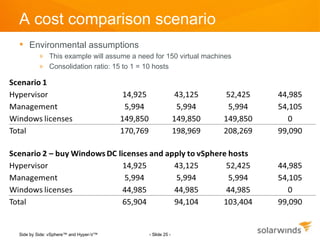
A cost comparison scenario
 Environmental assumptions
        » This example will assume a need for 150 virtual machines
        » Consolidation ratio: 15 to 1 = 10 hosts


Side by Side: vSphere™ and Hyper-V™      - Slide 25 -
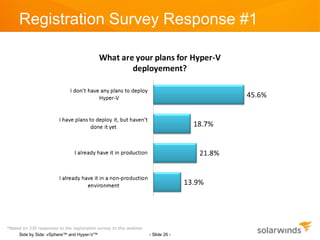
Registration Survey Response #1


*Based on 330 responses to the registration survey to this webinar
      Side by Side: vSphere™ and Hyper-V™                            - Slide 26 -
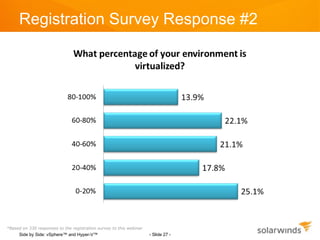
Registration Survey Response #2


*Based on 330 responses to the registration survey to this webinar
      Side by Side: vSphere™ and Hyper-V™                            - Slide 27 -
The Future of Hyper-V
 Hyper-V 3.0 will bring a lot to the table
         Fast provisioning of virtual machines.
         V2V conversion of VMware-based virtual machines
          to Hyper-V.
         Conversion of physical servers to virtual ones (P2V).
         Template-based virtual machine creation.
         Automatic placement of new virtual machines to aid
          in load balancing.
         Centralized management of multiple Hyper-V hosts.


Side by Side: vSphere™ and Hyper-V™   - Slide 28 -
Summary
 VMware remains significantly in front of
  Microsoft on a feature-by-feature basis
 For mission critical needs, vSphere is still
  the obvious choice
 Microsoft ‘s Hyper-V does, in fact, provide
  a good enough solution for many
 Hyper-V 3.0 will bring a lot more to the
  table and give VMware a true challnges


Side by Side: vSphere™ and Hyper-V™   - Slide 29 -
The SolarWinds Story
 Easy to find
        » www.solarwinds.com
        » Partner websites, and Internet Search

 Easy to buy
        » Downloadable from the website for evaluation and purchase
        » Affordable price points

 Easy to install
        » Products can be downloaded, installed, and configured in less than 1
          hour
        » No Professional Services needed for deployment

 Easy to use
        » Windows-based products
        » Intuitive user interfaces and graphical tools


Side by Side: vSphere™ and Hyper-V™     - Slide 30 -
Thank You

Hyper-V vs. vSphere: Understanding the Differences

  • 1.
    Side by Side:vSphere™ and Hyper-V™ March 21, 2012
  • 2.
    About the Speakers ScottLowe •18 years experience in the IT industry •Prolific author of thousands of articles and 3 books •Top virtualization blogger •Founder and Managing Consultant, The 1610 Group Follow me on Twitter @otherscottlowe Jonathan Reeve • SolarWinds, Senior Director of Product Management • Previously ran product management at Hyper9™ • Multiple successful start-ups in the IT space Side by Side: vSphere™ and Hyper-V™ - Slide 2 -
  • 3.
    Agenda  Why Should You Learn About Hyper-V™?  Hypervisor Types and Footprints  Kernel Variances  A Similarity: CPU Scheduling Controls  vSphere Memory Handling  Hyper-V™ Dynamic Memory  Product Storage Options  vSphere™ Storage Capabilities  Networking  Workload migrations Side by Side: vSphere™ and Hyper-V™ - Slide 3 -
  • 4.
    Why Should YouLearn About Hyper-V?  You may not always be working with Vmware®  With Windows® 8, Microsoft® will release a new version of Hyper-V with new features  For many organizations, Hyper-V has proven to be “good enough” for their needs  For those with existing Microsoft infrastructures, Hyper-V may be the best fit Side by Side: vSphere™ and Hyper-V™ - Slide 4 -
  • 5.
    Hypervisor Types andFootprints  Common misunderstanding  Both vSphere and Hyper-V are Type 1 hypervisors  vSphere has a much smaller footprint than Hyper-V  vSphere: 144 MB  Hyper-V: Minimum of 10 GB  Hyper-V requires a full (or core) Windows Server installation  Hyper-V also requires the use of a “root partition” for operations  General purpose Windows = greater hardware compatibility Side by Side: vSphere™ and Hyper-V™ - Slide 5 -
  • 6.
    Kernel Variances  vSphere  Monolithic kernel  vSphere’s architecture revolves around a more monolithic core which includes many shared drivers as well as the virtualization stack  Hyper-V  Microkernelized  Lends flexibility and security to the hypervisor model by isolating the virtual machines from one another with little shared code, such as drivers  More synthetic drivers are used, which can boost overall service performance Side by Side: vSphere™ and Hyper-V™ - Slide 6 -
  • 7.
    High Level Overview Operating system support  vSphere enjoys far broader operating system support  Licensing limitations  vSphere imposes stricter hardware-based licensing limits  Hyper-V provided significant Windows licensing benefits  Scalability  vSphere scales fay beyond Hyper-V  vSphere vCPU per VM: 32  Hyper-V vCPU per VM: 4 Side by Side: vSphere™ and Hyper-V™ - Slide 7 -
  • 8.
    A Similarity: CPUScheduling Controls  vSphere  Shares. If a VM has a share value that is half of another, it’s entitled to only half the CPU resources.  Reservation. A guarantee that a virtual machine will receive at least some level of resourcing.  Limit. Limits the ability of the virtual machine to consume unlimited resources.  vSphere has a powerful CPU scheduling mechanism in place that ensures that virtual machines receive attention from the system. VMware has produced a white paper that goes into great technical depth for how this scheduling is achieved. Side by Side: vSphere™ and Hyper-V™ - Slide 8 -
  • 9.
    A Similarity: CPUScheduling Controls  Hyper-V  Virtual machine reserve (percentage). Allows the reservation of a portion of the server’s total processing resources for this virtual machine.  Virtual machine limit (percentage). Limit how much of a host’s processing resources can be consumed by a single virtual machine.  Relative weight. allows the weighting of this virtual machine against others. Side by Side: vSphere™ and Hyper-V™ - Slide 9 -
  • 10.
    Automated Resource Scheduling vSphere  Distributed Resource Scheduler  Aggregates cluster resources into a single resource pool  Provides both initial placement services and continuous optimization  Enables affinity rules to ensure that workload placement meets business and availability rules  Supports clusters of up to 32 hosts and 1,280 virtual machines  Hyper-V » Resource placement • Current VMM provides initial placement services only » One-off service only • VMM 2012 will provide Dynamic Optimization » Will provide cluster-level workload balancing for VMs Side by Side: vSphere™ and Hyper-V™ - Slide 10 -
  • 11.
    vSphere Memory Handling VMware Oversubscription/Overcommit. Allows administrators to assign more aggregate RAM to virtual machines than is actually physically available in the server.  Transparent Page Sharing. This is basically a deduplication method applied to RAM rather than storage.  Guest Ballooning. A method by which virtual machines can borrow memory from one another.  Memory compression. A technique that is used to prevent the hypervisor from needing to swap memory pages to disk when RAM becomes limited. Side by Side: vSphere™ and Hyper-V™ - Slide 11 -
  • 12.
    Hyper-V Dynamic Memory Dynamic Memory relies primarily on a process similar to vSphere’s Guest Ballooning feature.  To prevent a virtual machine from having RAM reduced to dangerous levels, Hyper-V provides a (default) buffer of 20% of unused memory. Side by Side: vSphere™ and Hyper-V™ - Slide 12 -
  • 13.
    Product Storage Options Technology Description vSphere Hyper-V DAS Directly attached storage   NAS Network attached storage  -- FC Fibre Channel   iSCSI Internet SCSI   FCoE Fibre Channel over Ethernet  -- Side by Side: vSphere™ and Hyper-V™ - Slide 13 -
  • 14.
    Supported Storage Features Technology Description vSphere Hyper-V Allows administrators to allocate the space Thin they believe they may ultimately need for a Provisioning service without actually having to dedicate   the space right now Link base virtual hard drive images to one Linked Images another so that there is less repetition of -- -- data Side by Side: vSphere™ and Hyper-V™ - Slide 14 -
  • 15.
    VMFS vs. VHD Both VMware and Microsoft provide clustering mechanisms  VHD relies on MS CSV  Much more complicated than vSphere’s clustering  Both MS and VMware provide direct access to storage  vSphere: Raw Device Mapping (RDM)  Hyper-V: Pass-through disks Side by Side: vSphere™ and Hyper-V™ - Slide 15 -
  • 16.
    vSphere Storage Capabilities Centralized management of datastores. A single location in which all data stores can be managed in order to provide more visibility into the environment.  Storage Management Initiative Specification (SMI-S) support. Standardized monitoring of storage.  Caching. Improves performance.  Storage DRS. A way to automatically place VMs to load balance Storage IO demands. Side by Side: vSphere™ and Hyper-V™ - Slide 16 -
  • 17.
    Power Management  VMwareDistributed Power Management (DPM). Combine workloads onto fewer physical machines, which also reduces the amount of electricity consumed in aggregate.  DPM automates the process of energy conservation, leaving the administrator free to focus elsewhere  Hyper-V does not have automated power management capabilities © iStockphoto.com Side by Side: vSphere™ and Hyper-V™ - Slide 17 -
  • 18.
    vSphere Network Features vSphere  TCP Segmentation Offload. The TCP/IP stack can submit frames of up to 64 KB to the NIC -- the NIC then repackages these frames into sizes that fit inside the network’s maximum transmission unit (MTU) size.  NetQueue. Enables the system to process multiple network receive requests simultaneously across multiple CPUs.  iSCSI. iSCSI traffic results in a “double hit” from a CPU overhead perspective.  Distributed Virtual Switch. A virtual device that spans multiple vSphere hosts. Side by Side: vSphere™ and Hyper-V™ - Slide 18 -
  • 19.
    Hyper-V Network Features Chimney (TCP offload). Offloads to the NIC significant portions of the CPU workload normally associated with TCP/IP functionality  Large Send Offload (LSO). Provides Hyper-V hosts with the ability to submit larger frames – in this case up to 256KB in size – to the network adapter for further processing  Virtual Machine Queue (VMQ). Creates multiple virtual network queues for each virtual machine. Network packets destined for these virtual machines are then sent directly to the VM, reducing some overhead Side by Side: vSphere™ and Hyper-V™ - Slide 19 -
  • 20.
    Workload Migration  vSphere  vMotion is one of VMware’s claims to fame and for good reason  Zero downtime migrations  Multiple network adapter use  Metro vMotion  Hyper-V  Live Migration in shipping version is “vMotion™ Lite”  Requires Microsoft Failover Clustering  More complex environment Side by Side: vSphere™ and Hyper-V™ - Slide 20 -
  • 21.
    Storage Migration  vSphere  Storage vMotion is another of VMware’s claims to fame  Zero downtime migrations  Thick to thin  Raw Device Mapping disk (RDM) to VMDK  Across protocols Hyper-V  Quick Storage Migration in shipping version is not as robust  Not fully transparent to end user  Requires short period of downtime Side by Side: vSphere™ and Hyper-V™ - Slide 21 -
  • 22.
    Availability  vSphere  VMware High Availability  Monitors virtual machines to detect operating system and hardware failures and moves workloads to other hosts  VMware Fault Tolerance  Continuous protection for mission critical workloads by running a shadow copy of a protected VM  Hyper-V  Much more complex  Relies on MSCS Side by Side: vSphere™ and Hyper-V™ - Slide 22 -
  • 23.
    High Level Features VMware HyperV Feature Standard Enterprise Ent. Plus Standard Ent. DC Max host processors 160 160 160 4 8 64 Max virtual SMP (guest) 8 8 32 4 4 4 Max host RAM (GB) 2048 2048 2048 32 2048 2048 Max RAM per VM 255 255 255 64 64 64 Failover nodes 32 32 32 16 16 Memory overcommit/dynamic mem.       Transparent page sharing    Live workload migration     Live storage migration   Max guests per host 512 512 512 384 384 384 Distributed Resource Scheduler   Distributed switch  Virtual instance rights (Windows) 0 0 0 1 4 No limit Hypervisor licensing model per proc per proc per proc per host per host per proc Side by Side: vSphere™ and Hyper-V™ - Slide 23 -
  • 24.
    A cost comparisonscenario  Impossible to do 1:1 comparison for every scenario  Pricing Assumptions Side by Side: vSphere™ and Hyper-V™ - Slide 24 -
  • 25.
    A cost comparisonscenario  Environmental assumptions » This example will assume a need for 150 virtual machines » Consolidation ratio: 15 to 1 = 10 hosts Side by Side: vSphere™ and Hyper-V™ - Slide 25 -
  • 26.
    Registration Survey Response#1 *Based on 330 responses to the registration survey to this webinar Side by Side: vSphere™ and Hyper-V™ - Slide 26 -
  • 27.
    Registration Survey Response#2 *Based on 330 responses to the registration survey to this webinar Side by Side: vSphere™ and Hyper-V™ - Slide 27 -
  • 28.
    The Future ofHyper-V  Hyper-V 3.0 will bring a lot to the table  Fast provisioning of virtual machines.  V2V conversion of VMware-based virtual machines to Hyper-V.  Conversion of physical servers to virtual ones (P2V).  Template-based virtual machine creation.  Automatic placement of new virtual machines to aid in load balancing.  Centralized management of multiple Hyper-V hosts. Side by Side: vSphere™ and Hyper-V™ - Slide 28 -
  • 29.
    Summary  VMware remainssignificantly in front of Microsoft on a feature-by-feature basis  For mission critical needs, vSphere is still the obvious choice  Microsoft ‘s Hyper-V does, in fact, provide a good enough solution for many  Hyper-V 3.0 will bring a lot more to the table and give VMware a true challnges Side by Side: vSphere™ and Hyper-V™ - Slide 29 -
  • 30.
    The SolarWinds Story Easy to find » www.solarwinds.com » Partner websites, and Internet Search  Easy to buy » Downloadable from the website for evaluation and purchase » Affordable price points  Easy to install » Products can be downloaded, installed, and configured in less than 1 hour » No Professional Services needed for deployment  Easy to use » Windows-based products » Intuitive user interfaces and graphical tools Side by Side: vSphere™ and Hyper-V™ - Slide 30 -
  • 31.