Maximum Vsphere Tips Howtos And Best Practices
For Working With Vmware Vsphere 4 Siebert
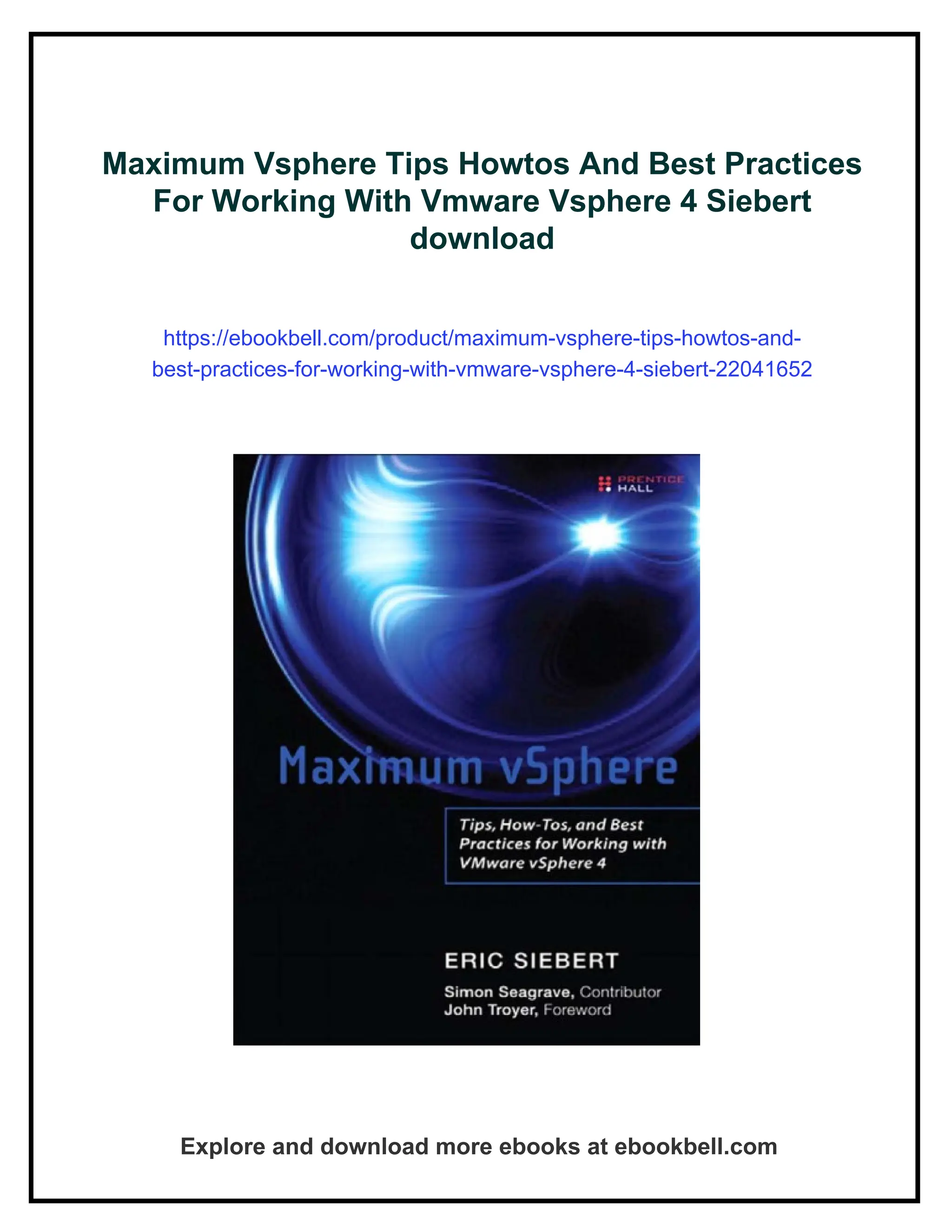
download
https://ebookbell.com/product/maximum-vsphere-tips-howtos-and-
best-practices-for-working-with-vmware-vsphere-4-siebert-22041652
Explore and download more ebooks at ebookbell.com
Here are some recommended products that we believe you will be
interested in. You can click the link to download.
Maximumentropy Sampling Algorithms And Application Marcia Fampa
https://ebookbell.com/product/maximumentropy-sampling-algorithms-and-
application-marcia-fampa-46885568
Maximum Malpractice Protection Charles Theisler
https://ebookbell.com/product/maximum-malpractice-protection-charles-
theisler-46956522
Maximum Trading Gains With Anchored Vwap The Perfect Combination Of
Price Time Volume Brian Shannon
https://ebookbell.com/product/maximum-trading-gains-with-anchored-
vwap-the-perfect-combination-of-price-time-volume-brian-
shannon-48304824
Maximum Fitness Stewart Smith
https://ebookbell.com/product/maximum-fitness-stewart-smith-48747502
Maximum Life Span 1st Edition Roy L Walford
https://ebookbell.com/product/maximum-life-span-1st-edition-roy-l-
walford-49179998
Maximum Penalized Likelihood Estimation Volume I Density Estimation P
P B Eggermont V N Lariccia
https://ebookbell.com/product/maximum-penalized-likelihood-estimation-
volume-i-density-estimation-p-p-b-eggermont-v-n-lariccia-49451632
Maximum Trading Gains With Anchored Vwap The Perfect Combination Of
Price Time And Volume 1st Edition Brian Shannon
https://ebookbell.com/product/maximum-trading-gains-with-anchored-
vwap-the-perfect-combination-of-price-time-and-volume-1st-edition-
brian-shannon-49456652
Maximum Power Point Tracking Background Implementation And
Classification Maurice Hbert
https://ebookbell.com/product/maximum-power-point-tracking-background-
implementation-and-classification-maurice-hbert-50782924
Maximum Moviespulp Fictions Film Culture And The Worlds Of Samuel
Fuller Mickey Spillane And Jim Thompson Peter Stanfield
https://ebookbell.com/product/maximum-moviespulp-fictions-film-
culture-and-the-worlds-of-samuel-fuller-mickey-spillane-and-jim-
thompson-peter-stanfield-51048960
MAXIMUM VSPHERE™
This page intentionally left blank
Maximum vSphere™
TIPS, HOW-TOS,AND BEST PRACTICES FOR
WORKING WITH VMWARE VSPHERE™ 4
Eric Siebert
Simon Seagrave
Upper Saddle River, NJ • Boston • Indianapolis • San Francisco
New York • Toronto • Montreal • London • Munich • Paris • Madrid
Capetown • Sydney • Tokyo • Singapore • Mexico City
Many of the designations used by manufacturers and sellers to distinguish
their products are claimed as trademarks. Where those designations appear in
this book, and the publisher was aware of a trademark claim, the designations
have been printed with initial capital letters or in all capitals.
The authors and publisher have taken care in the preparation of this book, but
make no expressed or implied warranty of any kind and assume no responsi-
bility for errors or omissions. No liability is assumed for incidental or conse-
quential damages in connection with or arising out of the use of the informa-
tion or programs contained herein.
The publisher offers excellent discounts on this book when ordered in quanti-
ty for bulk purchases or special sales, which may include electronic versions
and/or custom covers and content particular to your business, training goals,
marketing focus, and branding interests. For more information, please contact:
U.S. Corporate and Government Sales
(800) 382-3419
corpsales@pearsontechgroup.com
For sales outside the United States please contact:
International Sales
international@pearson.com
Visit us on the Web: informit.com/ph
Library of Congress Cataloging-in-Publication Data
Siebert, Eric, 1966-
Maximum vSphere : tips, how-tos, and best practices for working with
VMware vSphere 4 / Eric Siebert ; Simon Seagrave, contributor.
p. cm.
Includes index.
ISBN 978-0-13-704474-0 (pbk. : alk. paper)
1. VMware vSphere. 2. Virtual computer systems. I. Title.
QA76.9.V5S47 2010
005.4'3—dc22
2010021366
Copyright © 2011 Pearson Education, Inc.
All rights reserved. Printed in the United States of America. This publication is
protected by copyright, and permission must be obtained from the publisher
prior to any prohibited reproduction, storage in a retrieval system, or trans-
mission in any form or by any means, electronic, mechanical, photocopying,
recording, or likewise. For information regarding permissions, write to:
Pearson Education, Inc.
Rights and Contracts Department
501 Boylston Street, Suite 900
Boston, MA 02116
Fax: (617) 671-3447
ISBN-13: 978-0-13-704474-0
ISBN-10: 0-13-704474-7
Text printed in the United States on recycled paper at printed at Courier in
Stoughton, Massachusetts.
First printing, August 2010
Editor-in-Chief
Mark Taub
Acquisitions Editor
Trina MacDonald
Development Editor
Michael Thurston
Managing Editor
John Fuller
Project Editor
Anna Popick
Project Management
Techne Group
Copy Editor
Audrey Doyle
Indexer
Larry Sweazy
Proofreader
Beth Roberts
Editorial Assistant
Olivia Basegio
Technical Reviewers
Ken Cline
George Vish
Cover Designer
Chuti Prasertsith
Compositor
Techne Group
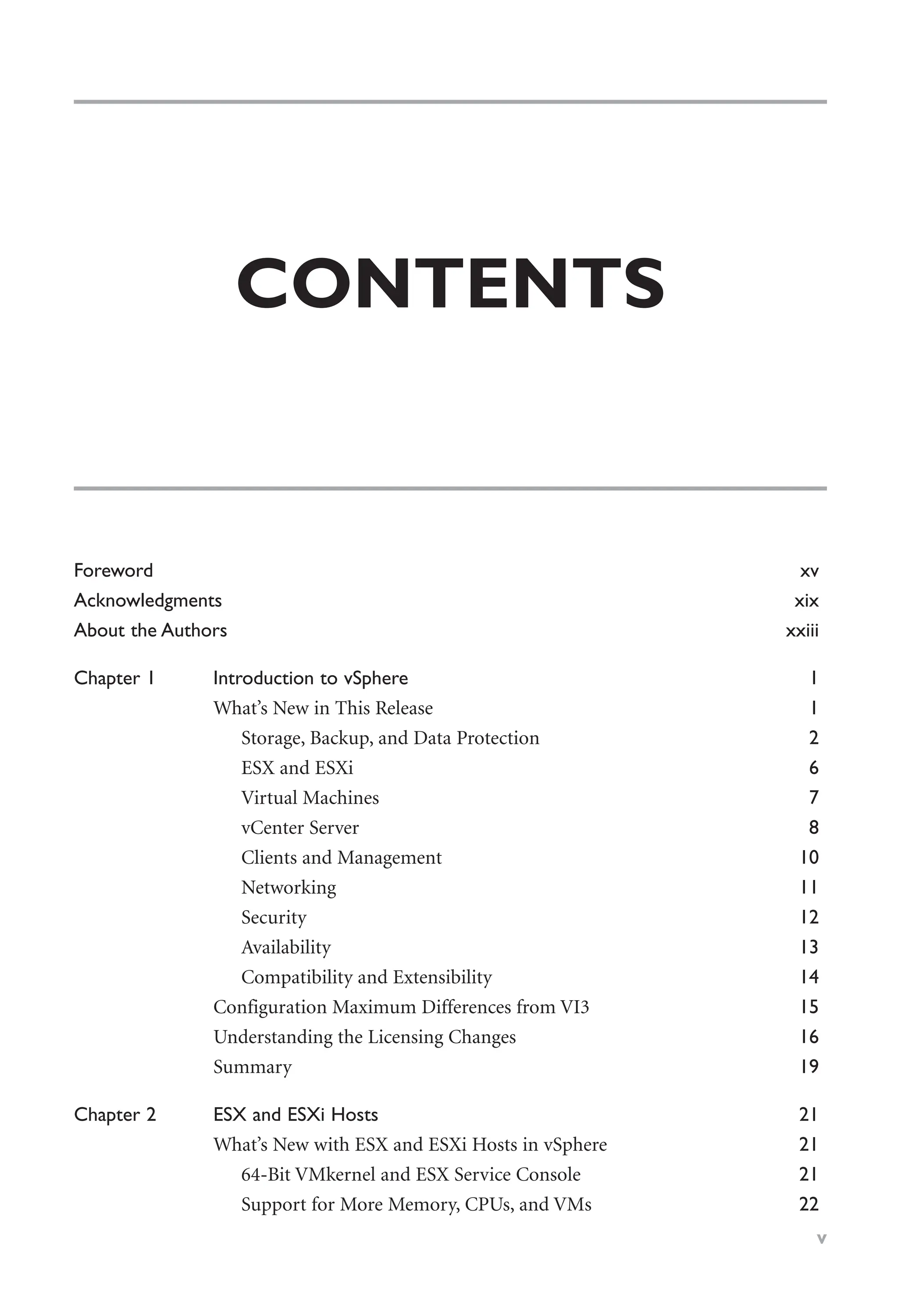
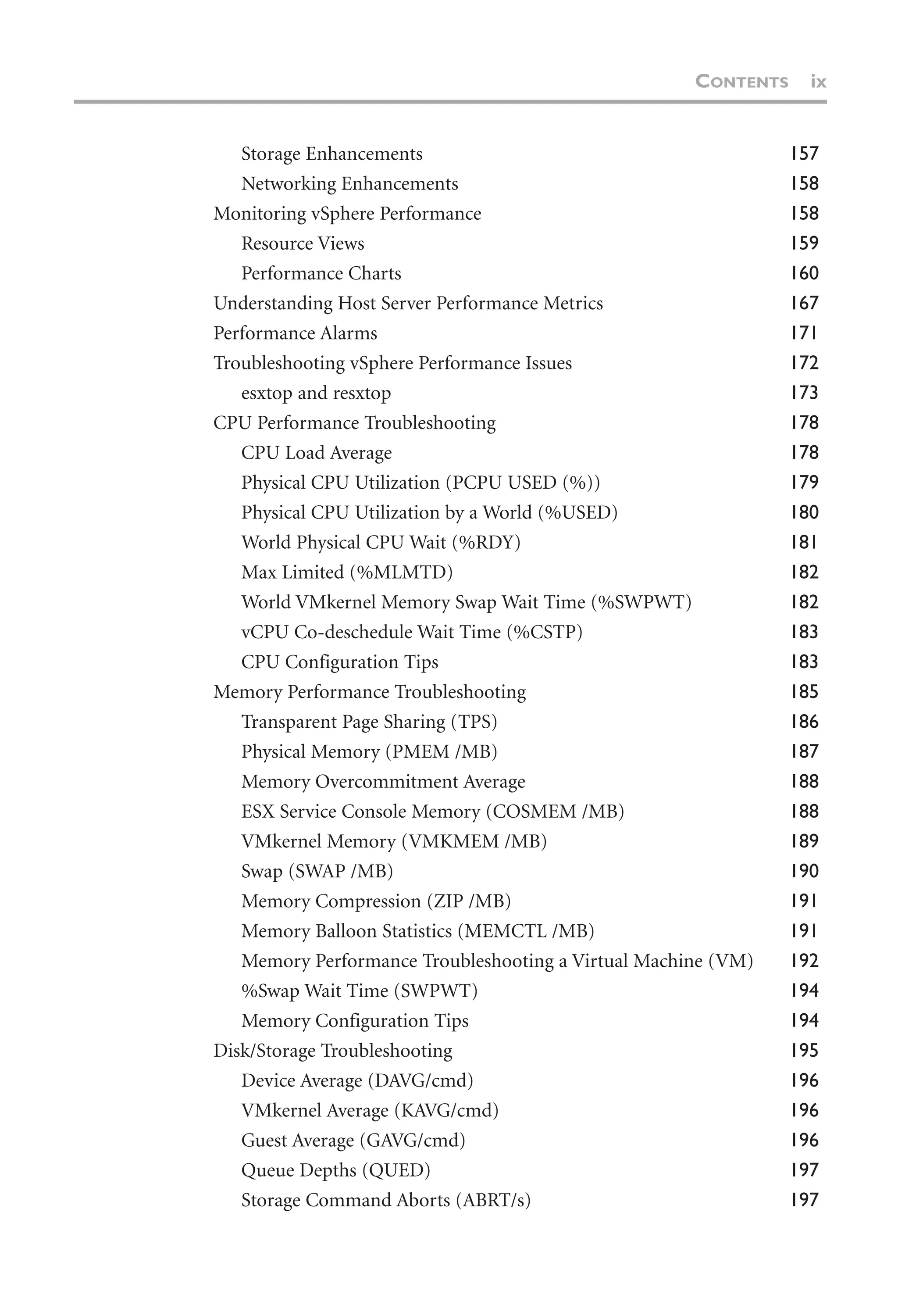
CONTENTS
Foreword xv
Acknowledgments xix
About the Authors xxiii
Chapter 1 Introduction to vSphere 1
What’s New in This Release 1
Storage, Backup, and Data Protection 2
ESX and ESXi 6
Virtual Machines 7
vCenter Server 8
Clients and Management 10
Networking 11
Security 12
Availability 13
Compatibility and Extensibility 14
Configuration Maximum Differences from VI3 15
Understanding the Licensing Changes 16
Summary 19
Chapter 2 ESX and ESXi Hosts 21
What’s New with ESX and ESXi Hosts in vSphere 21
64-Bit VMkernel and ESX Service Console 21
Support for More Memory, CPUs, and VMs 22
v
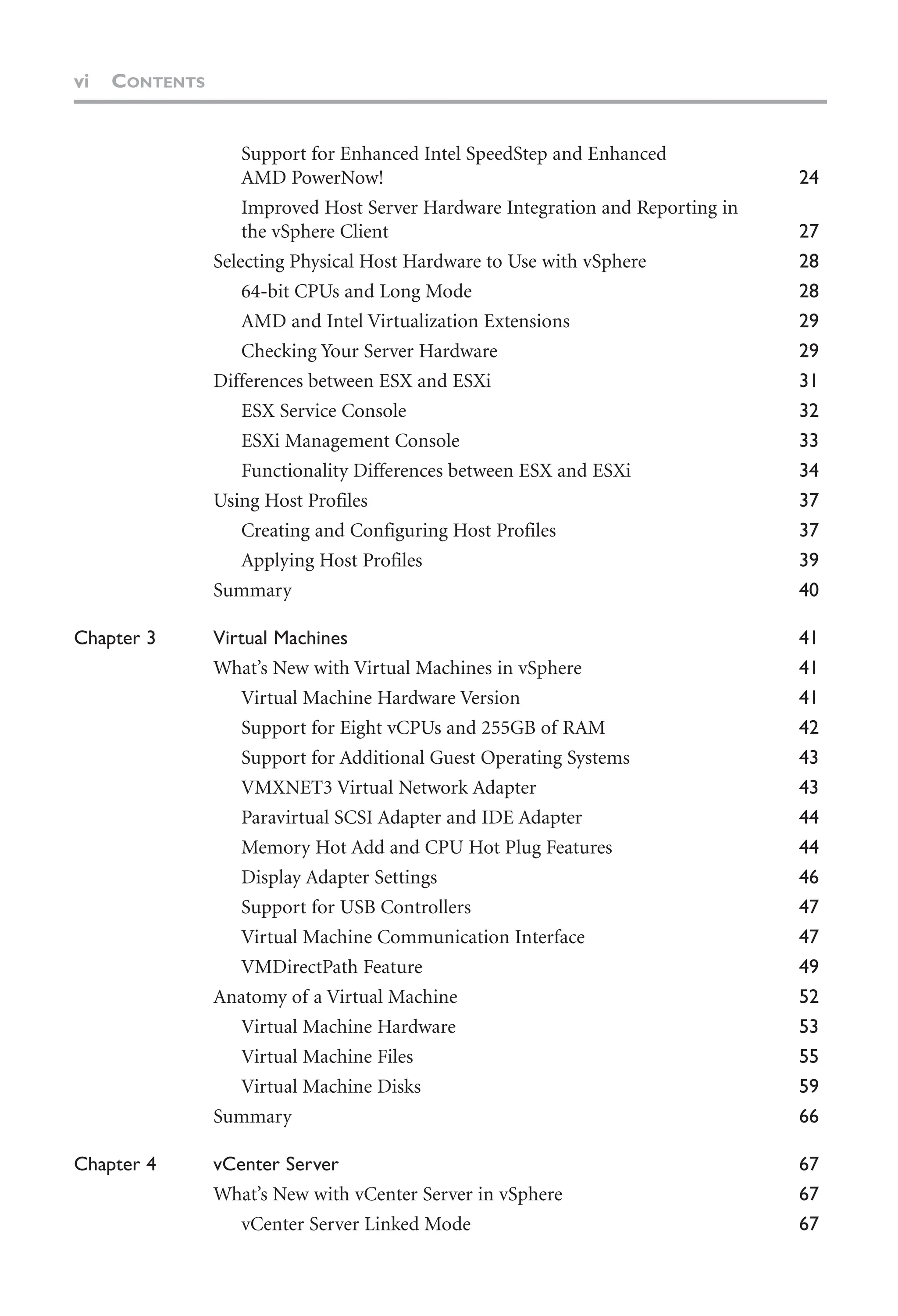
vi CONTENTS
Support for Enhanced Intel SpeedStep and Enhanced
AMD PowerNow! 24
Improved Host Server Hardware Integration and Reporting in
the vSphere Client 27
Selecting Physical Host Hardware to Use with vSphere 28
64-bit CPUs and Long Mode 28
AMD and Intel Virtualization Extensions 29
Checking Your Server Hardware 29
Differences between ESX and ESXi 31
ESX Service Console 32
ESXi Management Console 33
Functionality Differences between ESX and ESXi 34
Using Host Profiles 37
Creating and Configuring Host Profiles 37
Applying Host Profiles 39
Summary 40
Chapter 3 Virtual Machines 41
What’s New with Virtual Machines in vSphere 41
Virtual Machine Hardware Version 41
Support for Eight vCPUs and 255GB of RAM 42
Support for Additional Guest Operating Systems 43
VMXNET3 Virtual Network Adapter 43
Paravirtual SCSI Adapter and IDE Adapter 44
Memory Hot Add and CPU Hot Plug Features 44
Display Adapter Settings 46
Support for USB Controllers 47
Virtual Machine Communication Interface 47
VMDirectPath Feature 49
Anatomy of a Virtual Machine 52
Virtual Machine Hardware 53
Virtual Machine Files 55
Virtual Machine Disks 59
Summary 66
Chapter 4 vCenter Server 67
What’s New with vCenter Server in vSphere 67
vCenter Server Linked Mode 67
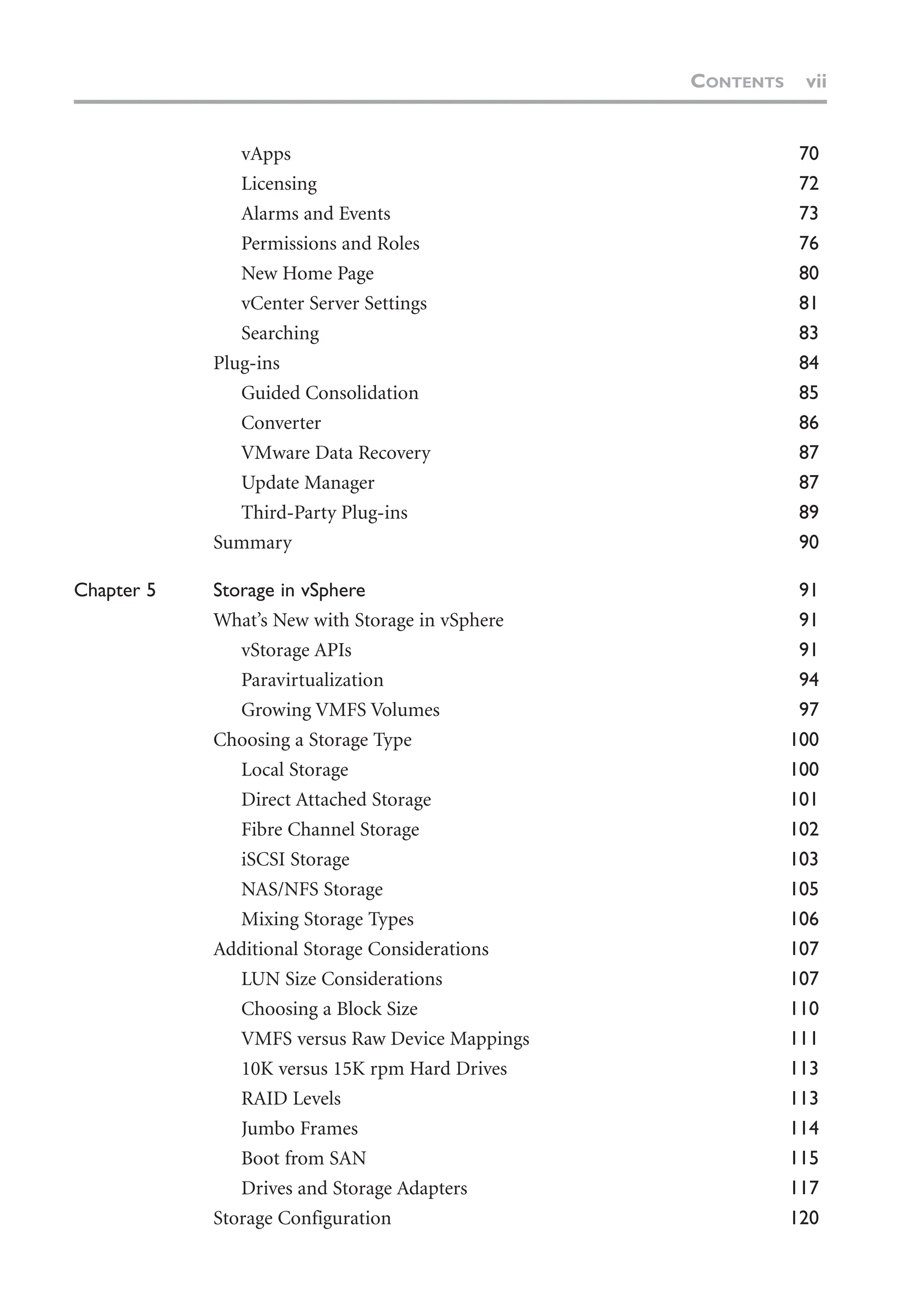
vApps 70
Licensing 72
Alarms and Events 73
Permissions and Roles 76
New Home Page 80
vCenter Server Settings 81
Searching 83
Plug-ins 84
Guided Consolidation 85
Converter 86
VMware Data Recovery 87
Update Manager 87
Third-Party Plug-ins 89
Summary 90
Chapter 5 Storage in vSphere 91
What’s New with Storage in vSphere 91
vStorage APIs 91
Paravirtualization 94
Growing VMFS Volumes 97
Choosing a Storage Type 100
Local Storage 100
Direct Attached Storage 101
Fibre Channel Storage 102
iSCSI Storage 103
NAS/NFS Storage 105
Mixing Storage Types 106
Additional Storage Considerations 107
LUN Size Considerations 107
Choosing a Block Size 110
VMFS versus Raw Device Mappings 111
10K versus 15K rpm Hard Drives 113
RAID Levels 113
Jumbo Frames 114
Boot from SAN 115
Drives and Storage Adapters 117
Storage Configuration 120
CONTENTS vii
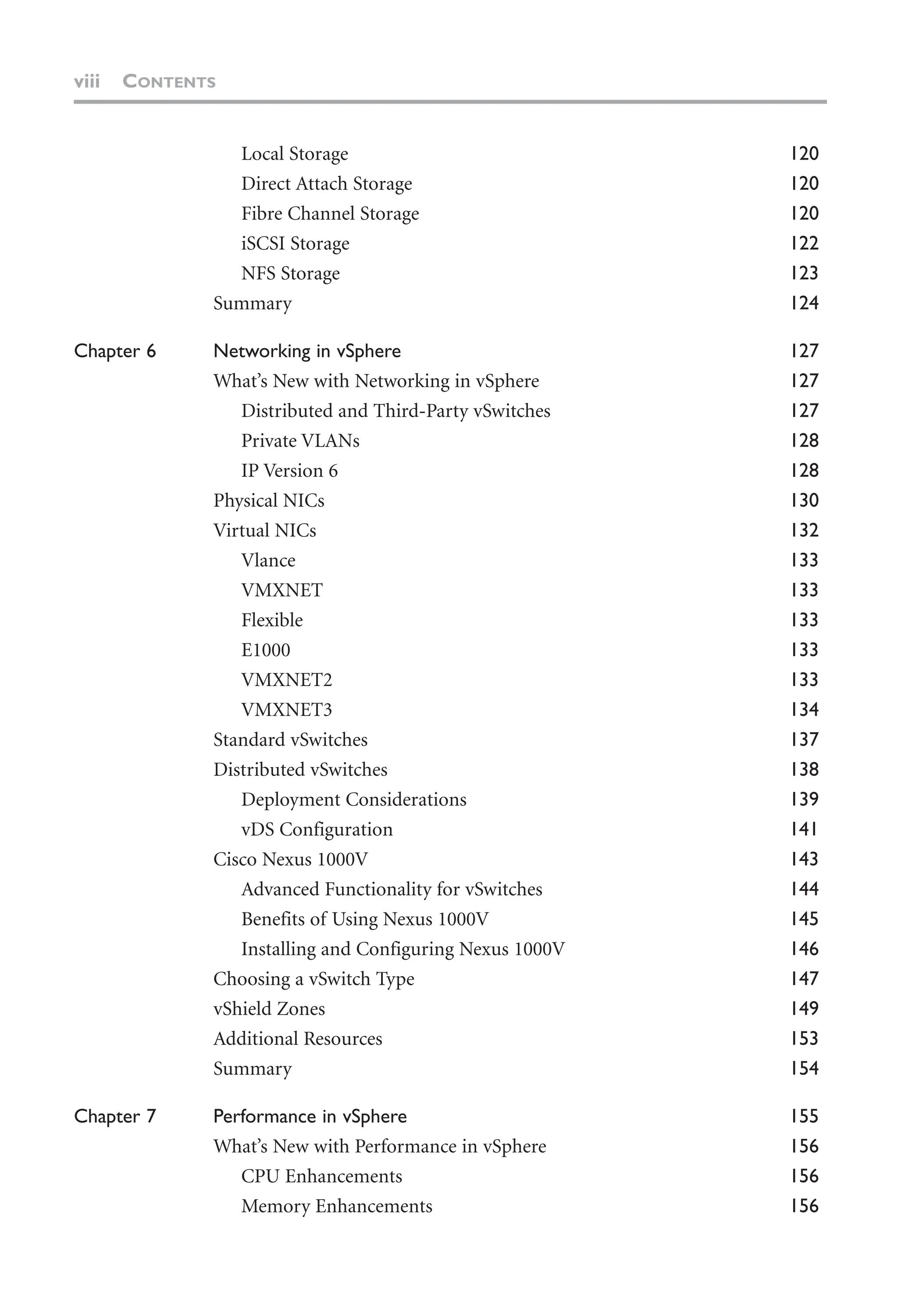
viii CONTENTS
Local Storage 120
Direct Attach Storage 120
Fibre Channel Storage 120
iSCSI Storage 122
NFS Storage 123
Summary 124
Chapter 6 Networking in vSphere 127
What’s New with Networking in vSphere 127
Distributed and Third-Party vSwitches 127
Private VLANs 128
IP Version 6 128
Physical NICs 130
Virtual NICs 132
Vlance 133
VMXNET 133
Flexible 133
E1000 133
VMXNET2 133
VMXNET3 134
Standard vSwitches 137
Distributed vSwitches 138
Deployment Considerations 139
vDS Configuration 141
Cisco Nexus 1000V 143
Advanced Functionality for vSwitches 144
Benefits of Using Nexus 1000V 145
Installing and Configuring Nexus 1000V 146
Choosing a vSwitch Type 147
vShield Zones 149
Additional Resources 153
Summary 154
Chapter 7 Performance in vSphere 155
What’s New with Performance in vSphere 156
CPU Enhancements 156
Memory Enhancements 156
Storage Enhancements 157
Networking Enhancements 158
Monitoring vSphere Performance 158
Resource Views 159
Performance Charts 160
Understanding Host Server Performance Metrics 167
Performance Alarms 171
Troubleshooting vSphere Performance Issues 172
esxtop and resxtop 173
CPU Performance Troubleshooting 178
CPU Load Average 178
Physical CPU Utilization (PCPU USED (%)) 179
Physical CPU Utilization by a World (%USED) 180
World Physical CPU Wait (%RDY) 181
Max Limited (%MLMTD) 182
World VMkernel Memory Swap Wait Time (%SWPWT) 182
vCPU Co-deschedule Wait Time (%CSTP) 183
CPU Configuration Tips 183
Memory Performance Troubleshooting 185
Transparent Page Sharing (TPS) 186
Physical Memory (PMEM /MB) 187
Memory Overcommitment Average 188
ESX Service Console Memory (COSMEM /MB) 188
VMkernel Memory (VMKMEM /MB) 189
Swap (SWAP /MB) 190
Memory Compression (ZIP /MB) 191
Memory Balloon Statistics (MEMCTL /MB) 191
Memory Performance Troubleshooting a Virtual Machine (VM) 192
%Swap Wait Time (SWPWT) 194
Memory Configuration Tips 194
Disk/Storage Troubleshooting 195
Device Average (DAVG/cmd) 196
VMkernel Average (KAVG/cmd) 196
Guest Average (GAVG/cmd) 196
Queue Depths (QUED) 197
Storage Command Aborts (ABRT/s) 197
CONTENTS ix
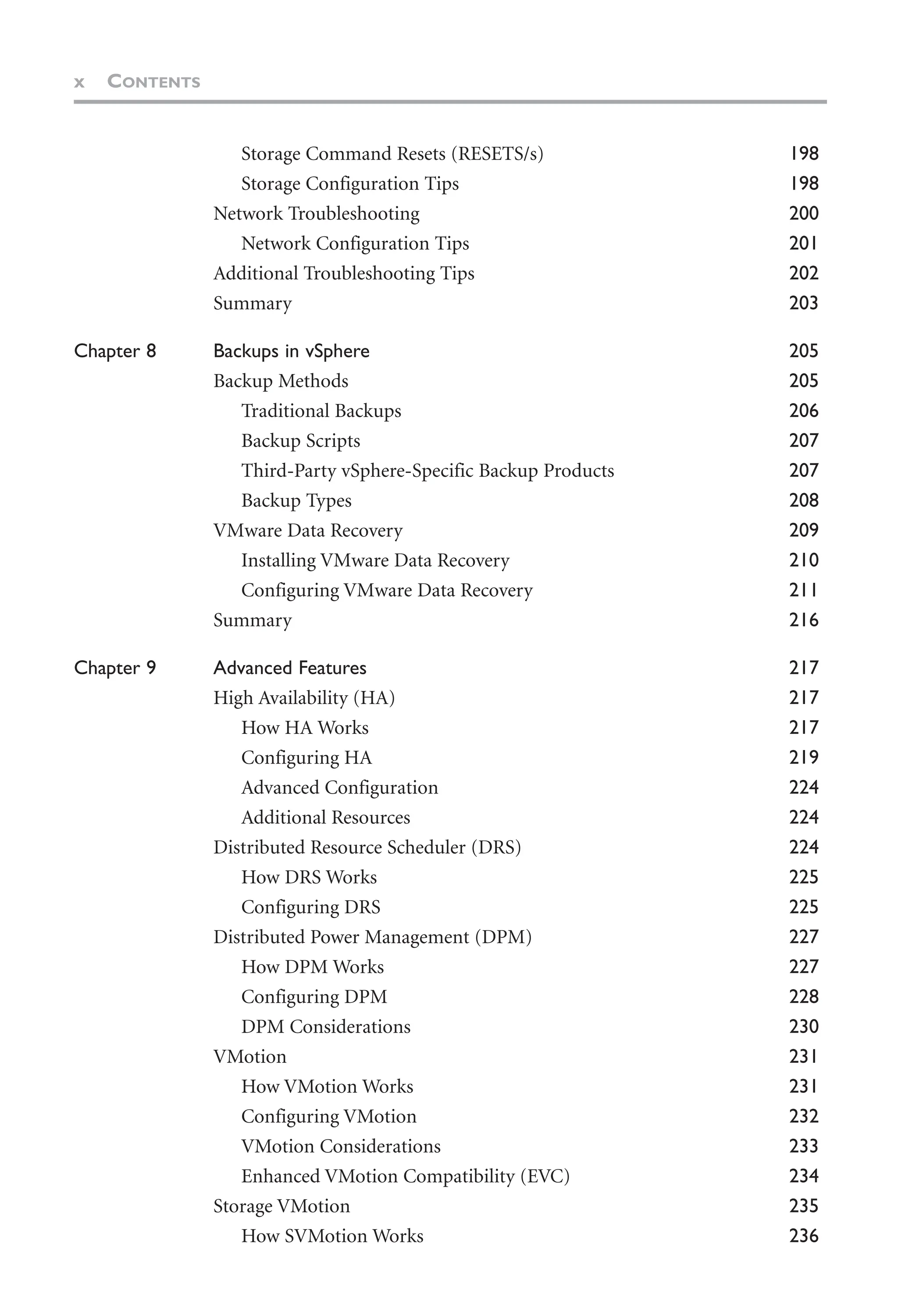
x CONTENTS
Storage Command Resets (RESETS/s) 198
Storage Configuration Tips 198
Network Troubleshooting 200
Network Configuration Tips 201
Additional Troubleshooting Tips 202
Summary 203
Chapter 8 Backups in vSphere 205
Backup Methods 205
Traditional Backups 206
Backup Scripts 207
Third-Party vSphere-Specific Backup Products 207
Backup Types 208
VMware Data Recovery 209
Installing VMware Data Recovery 210
Configuring VMware Data Recovery 211
Summary 216
Chapter 9 Advanced Features 217
High Availability (HA) 217
How HA Works 217
Configuring HA 219
Advanced Configuration 224
Additional Resources 224
Distributed Resource Scheduler (DRS) 224
How DRS Works 225
Configuring DRS 225
Distributed Power Management (DPM) 227
How DPM Works 227
Configuring DPM 228
DPM Considerations 230
VMotion 231
How VMotion Works 231
Configuring VMotion 232
VMotion Considerations 233
Enhanced VMotion Compatibility (EVC) 234
Storage VMotion 235
How SVMotion Works 236
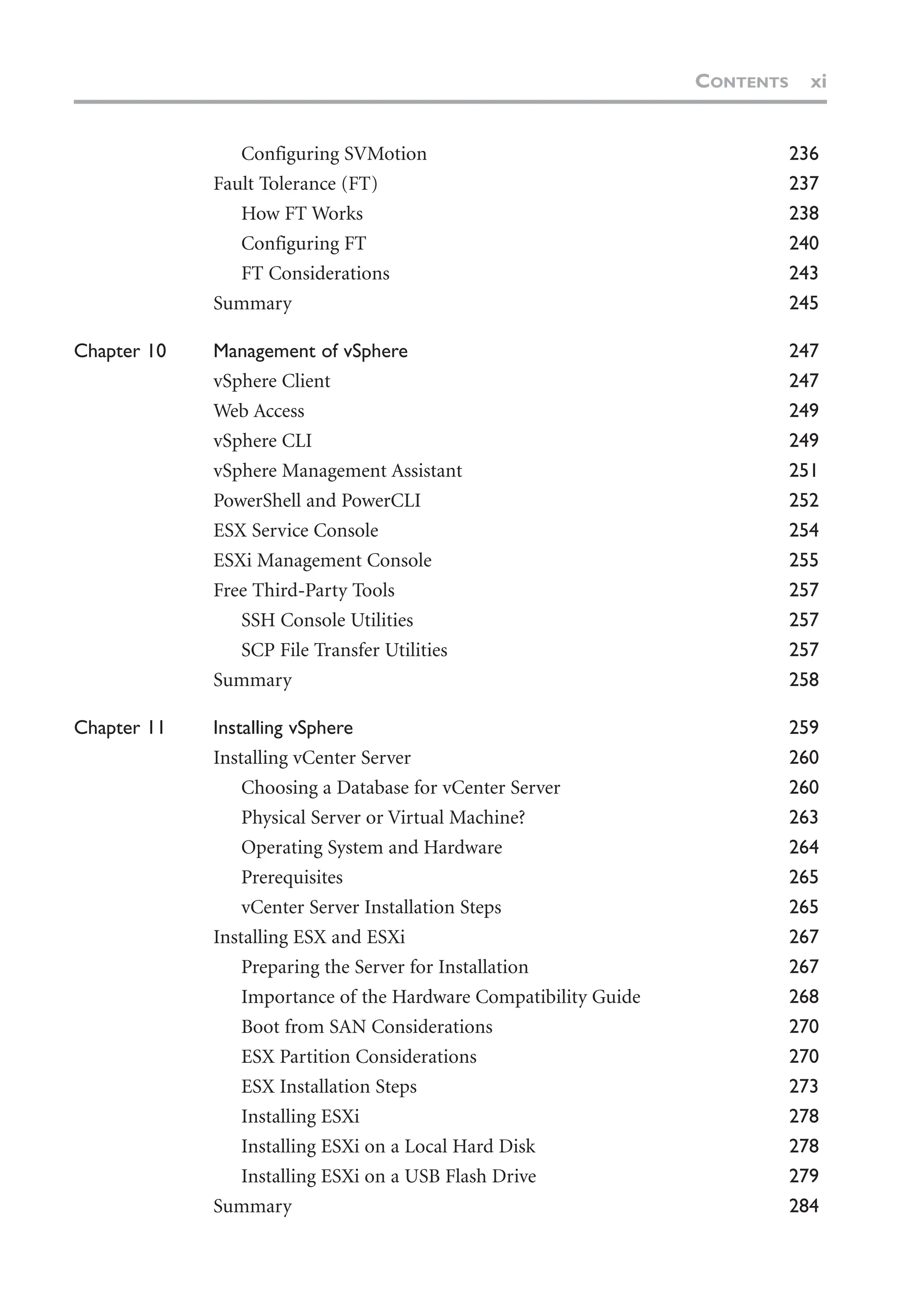
Configuring SVMotion 236
Fault Tolerance (FT) 237
How FT Works 238
Configuring FT 240
FT Considerations 243
Summary 245
Chapter 10 Management of vSphere 247
vSphere Client 247
Web Access 249
vSphere CLI 249
vSphere Management Assistant 251
PowerShell and PowerCLI 252
ESX Service Console 254
ESXi Management Console 255
Free Third-Party Tools 257
SSH Console Utilities 257
SCP File Transfer Utilities 257
Summary 258
Chapter 11 Installing vSphere 259
Installing vCenter Server 260
Choosing a Database for vCenter Server 260
Physical Server or Virtual Machine? 263
Operating System and Hardware 264
Prerequisites 265
vCenter Server Installation Steps 265
Installing ESX and ESXi 267
Preparing the Server for Installation 267
Importance of the Hardware Compatibility Guide 268
Boot from SAN Considerations 270
ESX Partition Considerations 270
ESX Installation Steps 273
Installing ESXi 278
Installing ESXi on a Local Hard Disk 278
Installing ESXi on a USB Flash Drive 279
Summary 284
CONTENTS xi
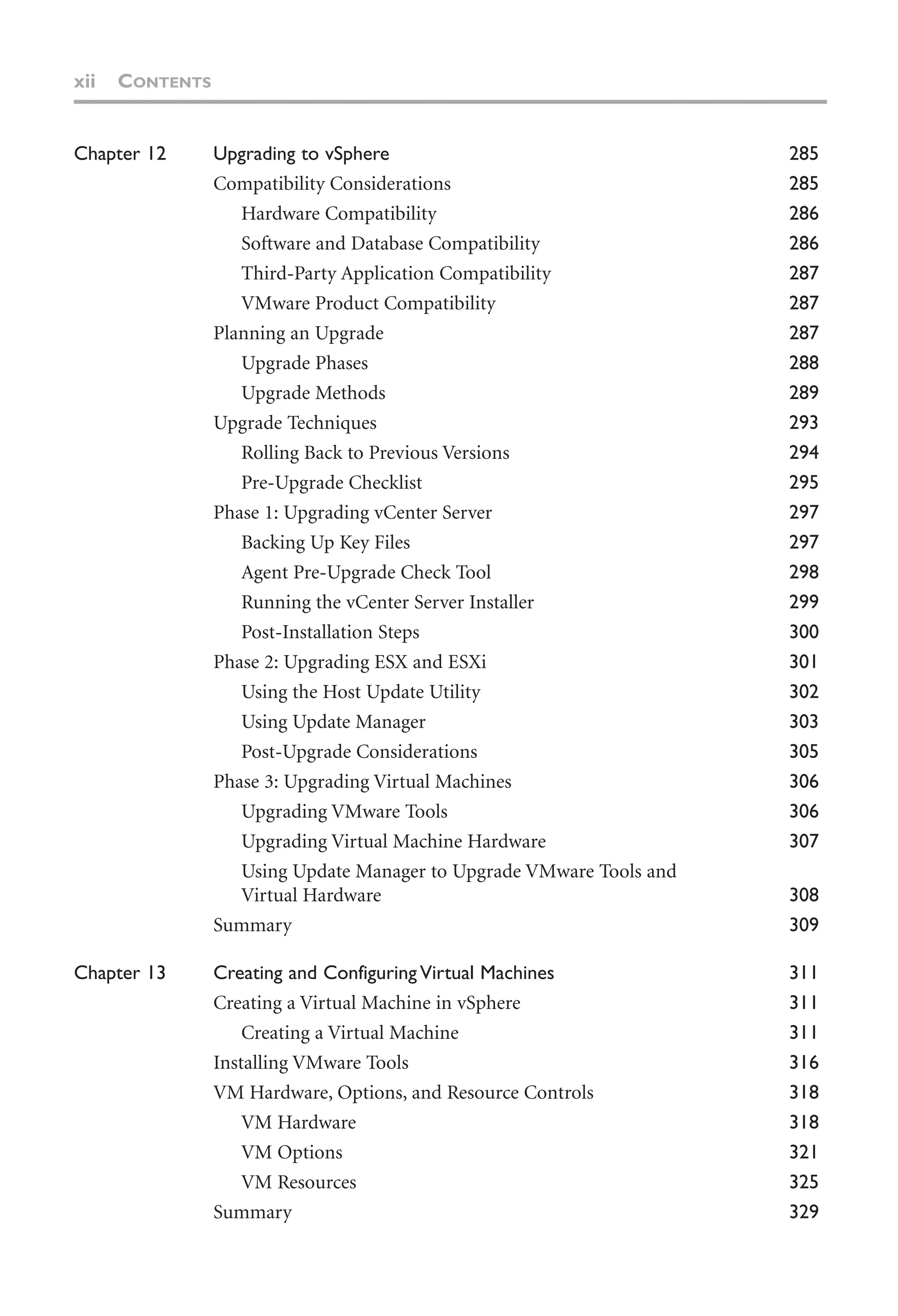
xii CONTENTS
Chapter 12 Upgrading to vSphere 285
Compatibility Considerations 285
Hardware Compatibility 286
Software and Database Compatibility 286
Third-Party Application Compatibility 287
VMware Product Compatibility 287
Planning an Upgrade 287
Upgrade Phases 288
Upgrade Methods 289
Upgrade Techniques 293
Rolling Back to Previous Versions 294
Pre-Upgrade Checklist 295
Phase 1: Upgrading vCenter Server 297
Backing Up Key Files 297
Agent Pre-Upgrade Check Tool 298
Running the vCenter Server Installer 299
Post-Installation Steps 300
Phase 2: Upgrading ESX and ESXi 301
Using the Host Update Utility 302
Using Update Manager 303
Post-Upgrade Considerations 305
Phase 3: Upgrading Virtual Machines 306
Upgrading VMware Tools 306
Upgrading Virtual Machine Hardware 307
Using Update Manager to Upgrade VMware Tools and
Virtual Hardware 308
Summary 309
Chapter 13 Creating and Configuring Virtual Machines 311
Creating a Virtual Machine in vSphere 311
Creating a Virtual Machine 311
Installing VMware Tools 316
VM Hardware, Options, and Resource Controls 318
VM Hardware 318
VM Options 321
VM Resources 325
Summary 329
Chapter 14 Building Your Own vSphere Lab 331
Why Build a vSphere Lab? 331
What Do You Want from a vSphere Lab? 333
What You Need to Build Your Own vSphere Lab 334
Hardware 334
Software 335
Environment 335
Support: The “Official” Line 335
Hardware 336
Server 337
CPU 338
Memory 341
Network Controller 343
Disk Array Controller 345
Shared Storage 347
Network Switches 353
Software Components 356
Environmental and Other Lab Considerations 357
Running Nested VMs 358
VMware ESX/ESXi on VMware Workstation 7 359
Virtual ESX/ESXi Instances on a Physical ESX/ESXi Host 360
Summary 363
Index 365
CONTENTS xiii
This page intentionally left blank
FOREWORD
First of all, I’d like to get this out of the way. If you are standing in a bricks-
and-mortar bookstore or even sitting on your couch browsing online and flip-
ping through the first pages of this book, wondering if you need yet another
book on virtualization and VMware vSphere, let me reassure you: Yes, you
should buy this book.
This book is not an introduction and not a tutorial. It is an in-depth reference
manual from a hands-on expert and experienced technology writer. It lays out
the principles for understanding and operating VMware vSphere and the new
features introduced in vSphere 4. The author, Eric Siebert, didn’t just kick this
out the door; he spent a year gathering tips, tricks, and best practices specific to
the new version of vSphere, both from his own experience and from his con-
nections to a wide breadth of other virtualization practitioners, and he has
included that wisdom in this book. As an example, the “Building Your Own
vSphere Lab” chapter is very useful, comes from this kind of collaboration, and
seems to be unique among vSphere books.
I’m not going to buy my kids an encyclopedia. Let them walk to school
like I did.
—Yogi Berra
Maximum vSphere™ isn’t quite an encyclopedia, but it is a reference book that
will spare you from feeling like you’ve got a long slog each day in your data-
center. Eric Siebert is an active virtualization practitioner and IT professional.
xv
xvi FOREWORD
For years, he has also been very active in the online virtualization community,
which is how I met him in my role on VMware’s social media and community
team. Eric is well known for being available to help people in the online world.
Eric’s main website is called vSphere-land, and Eric is truly the Diderot to this
online encyclopédie, tirelessly gathering and organizing a taxonomy of virtual-
ization best practices, although unlike his eighteenth century counterparts, it
hasn’t taken him 20 years to finish.
Writing a book is never easy for the author or the author’s family. This is Eric’s
second book and his commitment to delivering high-quality technical material
has never wavered. Eric is known for going both deep and broad on technology.
One week Eric might be doing original research for articles on vStorage APIs,
and the next he’ll be pulling together an omnibus of links from across all
VMworld blog and press coverage. Eric’s articles in the trade press are always
informative. His vSphere-land links and “vLaunchpad” are always a great choice
to start investigating a VMware-related topic. This book should act as a great
launchpad for your VMware work as well.
We’re at an interesting place in the evolution of IT. One of the fascinating
effects of virtualization in the datacenter is the blurring of boundaries and
breaking down of the specialty silos that have developed in the past few
decades—the separate teams for storage, networking, servers, apps, security, and
more. All these disciplines are blurring as virtualization upends the traditional
datacenter architectures and breaks the correspondence between physical device
and function. The virtualization expert needs to bridge all these areas. As one
VMware administrator told me, “We’re the virtualization team because we
already know how to do everything else.”
Whether the IT industry is called “cloud computing” or something else entirely
once we get there, all signs point to it being a very interesting place indeed.
Virtualization is an enabler technology of the cloud, but cloud computing also
implies a consumption model and an operations model in the datacenter. In a few
years, your datacenter will be delivering a higher level of service and business
value in your organization. Although much of the complexity of the technology
stack will be abstracted at that point, IT professionals still will need a solid
grounding in the concepts of virtualization and the techniques to design and
manage the VMware platform.
The VMware admins I know are a smart, savvy bunch. And I might be biased, but
I think their eyes are brighter, their teeth are whiter, and their paychecks are fatter
than the average IT professional’s. It’s a good place to be at the moment. Enjoy the
book, and remember to give back to others when they need information as well.
—John Troyer
El Granada, CA
FOREWORD xvii
This page intentionally left blank
ACKNOWLEDGMENTS
It’s been a wild ride these past couple of years trying to keep up with the fast
pace at which virtualization has been moving. The blogging community has
really exploded in the past year with many new bloggers coming on the scene
sharing their knowledge and experience. Social networking websites like Twitter
have brought a lot of us together in ways that were previously not possible. As a
result, I have made many new friends in virtualization and look forward to
making many more.
First and foremost, I would like to acknowledge some of my closest friends in the
virtualization community. This includes Ken Cline, a technical reviewer on this
book whose vast knowledge and experience continually make me feel like a new-
bie. Also, some other members of the vBrat Pack, including Edward Haletky, Steve
Beaver, Jason Boche, Jase McCarty, and last but definitely not least, John Troyer,
who is VMware’s head blogger and virtualization evangelist. Special thanks to
Vaughn Stewart from NetApp and Greg Schulz from storageioblog.com for
reviewing my storage chapter, and to George Vish, who was also a technical
reviewer on this book.
I’d also like to acknowledge a few fellow bloggers from the thriving VMware
user community who inspire me on a daily basis to help others and be the
best that I can be, including Eric Sloof from ntpro.nl, Scott Lowe from
blog.scottlowe.org, Duncan Epping from yellowbricks.com, Rich Brambley
from vmetc.com, and my fellow bloggers at Tech Target. There are many
xix
xx ACKNOWLEDGMENTS
other bloggers and members of the VMTN community who I haven’t men-
tioned, but you know who you are and you are all an inspiration to me also.
I’d also like to thank the guys and gals that I work with from Tech Target,
where I got started with writing, including Hannah Drake, Colin Steele,
Heather Darcy, Jo Maitland, and Rich Castagna.
Special thanks to Simon Seagrave, who signed on to contribute to this book.
Simon is a joy to work with and his knowledge and skills are top-notch. I’d also
like to thank my editor at Pearson, Trina McDonald, who stuck with me again
on this second book. Trina is a wonderful person to work with and I enjoyed
having her guide me through writing this book.
Finally, I’d like to thank my family: my mother and father, Yolanda and Edward;
my siblings, Jason, Elizabeth, and Jennifer; my wife, Kimberly; my boys, Logan
and Zecheriah; and my precious daughter, Sophia.
—Eric Siebert
I’m very grateful to Eric for the opportunity to contribute to this book. After
reading and enjoying his VMware® VI3 Implementation and Administration, it is
fantastic to be able to be part of the book you now hold in your hands. To work
with someone of Eric’s technical caliber and who shares the same passion
toward virtualization has been a real privilege. Thank you very much to the
VMware VI3 and vSphere Performance Guru, Scott Drummond (vpivot.com),
and to VMware aficionados Ken Cline and Eric Sloof (ntpro.nl), for their time
and excellent feedback. It was much appreciated.
I’d like to give a big shout-out to all my fellow virtualization, server, and storage
bloggers who tirelessly keep producing brilliant content, many of whom I have
had the privilege of meeting or corresponding with over the past couple of
years. I would try mentioning names, but the list is far too long, though you
know who you are. Keep blogging! Thanks to John Troyer for keeping the
vExpert and VMware virtualization community running as well as it does. A
sincere thank you to my valued TechHead (techhead.co.uk) readers who spur
me on to keep writing content. I really appreciate your comments, emails, and
feedback—keep it coming.
Special thanks to my other half, Sarah, whose patience and understanding
know no bounds in putting up with all my IT equipment around our home
and the significant amount of time I dedicate to attending IT events, working
in my virtualization lab, and blogging. I am one lucky guy!
Lastly, I couldn’t have my name in a book and not say... Thanks Mum!
—Simon Seagrave
ACKNOWLEDGMENTS xxi
This page intentionally left blank
ABOUT THE AUTHORS
Eric Siebert has been working with computers for more than 25 years. For the
past 15 years, his main focus has been the administration of Windows server
environments and supporting enterprise applications such as web, email, and
database servers. Five years ago he discovered virtualization technology in the
form of VMware ESX and has been hooked ever since, spending countless
hours learning the product inside and out. He now spends much of his time
helping others in VMware’s community support forums, having achieved
Guru status and become one of the forum’s moderators. His own website,
http://vsphere-land.com, is where he shares his tips and experiences as well as
hundreds of links to technical information and top ten lists on a variety of
subjects. Additionally, Eric writes tips and blogs for Tech Target on sites such
as http://searchvmware.com, http://searchservervirtualization.com, and
http://searchdatabackup.com. He is one of the 300 vExperts named by
VMware for 2009 and 2010, author of the book VMware® VI3 Implementation
and Administration, past VMworld speaker, and frequent Best of VMworld
awards judge. Follow Eric on Twitter at http://twitter.com/ericsiebert.
Contributor Simon Seagrave has been working in the IT industry for the past
15 years. He is a VMware vExpert, holds various IT accreditations including a
VMware VCP, and has worked for variously sized companies ranging from large
corporations to small and medium-size businesses. He has been working with
VMware products since the early days of VMware GSX and is passionate about
xxiii
xxiv ABOUT THE AUTHORS
virtualization and the many benefits it can provide. Along with virtualization,
he particularly enjoys working with server and storage-related technologies,
which are subjects that make up a large portion of the content you can find on
his blog site, TechHead (http://techhead.co.uk).
1
INTRODUCTION TO
VSPHERE
1
VMware released the successor to Virtual Infrastructure 3 (VI3) in May 2009
with a new name, vSphere, and a new version number, 4.0. This release intro-
duces many new features, both small and large, which we will cover in this
chapter. However, don’t be intimidated by all the new features. Overall, the core
product is basically the same, so many of the things you know from VI3 will
also apply to vSphere.
WHAT’S NEW IN THIS RELEASE
When it came time to release the successor to its VI3 datacenter virtualization
product, VMware chose to change the name of the product family from VI3 to
vSphere. In addition, VMware took the opportunity to sync up the version
numbers between its ESX and ESXi products with that of its vCenter Server
product to be more consistent and to avoid confusion. With VI3, vCenter Server
was at version 2.x and ESX and ESXi were known as version 3.x. Now with
vSphere, ESX, ESXi, and vCenter Server are at version 4.x, with the initial
release of vSphere being 4.0. In this section, we will cover what is new in each
major area and detail each new feature and enhancement so that you can
understand the benefits and how to take advantage of them.
2 CHAPTER 1 INTRODUCTION TO VSPHERE
STORAGE, BACKUP, AND DATA PROTECTION
vSphere offers many enhancements and new features related to storage, back-
ups, and data protection, which is a compelling reason in and of itself to
upgrade from VI3 to vSphere. From thin provisioning to Storage VMotion to
the vStorage APIs, this area has greatly improved in terms of performance,
usability, and vendor integration.
Thin Provisioning Enhancements
Thin provisioned disks are not new to vSphere, as they also existed in VI3; how-
ever, numerous changes have made them more usable in vSphere. The changes
made to thin disks in vSphere include the following.
● In VI3, thin disks could only be created manually using the vmkfstools
command-line utility. In vSphere, thin disks can be created using the
vSphere client at the time a virtual machine (VM) is created.
● In VI3, thick disks could only be converted to thin disks using vmkfstools
and only when a VM was powered off. In vSphere, existing thick disks can
be easily converted to thin disks using the Storage VMotion feature while a
VM is powered on.
● In VI3, the only way to see the actual current size of a thin disk was to use
the command line. In vSphere, new storage views are available in the
vSphere client that use a plug-in which provides the ability to see the actual
size of thin disks.
● In VI3, there are no alarms to report datastores. In vSphere, configurable
alarms are built into vCenter Server that allow you to monitor datastore
overallocation and space usage percentages.
● In VI3, if a thin disk could no longer grow because of insufficient datastore
space, the VM would crash and possibly corrupt. In vSphere, a new safety
feature automatically suspends VMs with thin disks when datastore free
space is critically low to prevent corruption and OS crashes.
These new improvements make thin disks more manageable and much easier to
use in vSphere compared to VI3. We will cover thin disks in more detail in
Chapter 3.
iSCSI Improvements
iSCSI storage arrays have become an increasingly popular storage choice for
virtual hosts due to their lower cost (compared to Fibre Channel storage area
networks [FC SANs]) and decent performance. Use of iSCSI software initiators
has always resulted in a slight performance penalty compared to hardware ini-
tiators with TCP offload engines, as the host CPU is utilized for TCP/IP opera-
tions. In vSphere, VMware rewrote the entire iSCSI software initiator stack to
make more efficient use of CPU cycles, resulting in significant efficiency (from
7% to 52%) and throughput improvements compared to VI3.
VMware did this by enhancing the VMkernel TCP/IP stack, optimizing the
cache affinity, and improving internal lock efficiency. Other improvements to
iSCSI include easier provisioning and configuration, as well as support for bidi-
rectional CHAP authentication, which provides better security by requiring
both the initiator and the target to authenticate each other.
Storage VMotion Enhancements
Storage VMotion was introduced in version 3.5, but it was difficult to use
because it could only be run using a command-line utility. VMware fixed this in
vSphere and integrated it into the vSphere Client so that you can quickly and
easily perform SVMotions. In addition to providing a GUI for SVMotion in
vSphere, VMware also enhanced SVMotion to allow conversion of thick disks to
thin disks and thin disks to thick disks. VMware also made some under-the-
covers enhancements to SVMotion to make the migration process much more
efficient. In VI3, SVMotion relied on snapshots when copying the disk to its
new location, and then committing those when the operation was complete. In
vSphere, SVMotion uses the new Changed Block Tracking (CBT) feature to
keep track of blocks that were changed after the copy process started, and copies
them after it completes. We will cover Storage VMotion in more detail in
Chapter 9.
Support for Fibre Channel over Ethernet and Jumbo Frames
vSphere adds support for newer storage and networking technologies which
include the following.
● Fibre Channel over Ethernet (FCoE)—vSphere now supports FCoE on
Converged Network Adapters (CNAs) which encapsulates Fibre Channel
frames over Ethernet and allows for additional storage configuration options.
● Jumbo frames—Conventional Ethernet frames are 1,518 bytes in length.
Jumbo frames are typically 9,000 bytes in length, which can improve net-
work throughput and CPU efficiency. VMware added support for jumbo
frames in ESX 3.5 but did not officially support jumbo frames for use with
WHAT’S NEW IN THIS RELEASE 3
4 CHAPTER 1 INTRODUCTION TO VSPHERE
storage protocols. With the vSphere release, the company officially supports
the use of jumbo frames with software iSCSI and NFS storage devices, with
both 1Gbit and 10Gbit NICs to help improve their efficiency.
Both of these technologies can provide great increases in performance when
using network-based storage devices such as iSCSI and NFS, and can bring
them closer to the level of performance that the more expensive Fibre Channel
storage provides.
Ability to Hot-Extend Virtual Disks
Previously in VI3 you had to power down a VM before you could increase the
size of its virtual disk. With vSphere you can increase the size of an existing vir-
tual disk (vmdk file) while it is powered on as long as the guest operating sys-
tem supports it. Once you increase the size of a virtual disk, the guest OS can
then begin to use it to create new disk partitions or to extend existing ones.
Supported operating systems include Windows Server 2008, Windows Server
2003 Enterprise and Datacenter editions, and certain Linux distributions.
Ability to Grow VMFS Volumes
With vSphere you can increase the size of Virtual Machine File System (VMFS)
volumes without using extents and without disrupting VMs. In VI3, the only
way to grow volumes was to join a separate LUN to the VMFS volume as an
extent, which had some disadvantages. Now, with vSphere, you can grow the
LUN of an existing VMFS volume using your SAN configuration tools and then
expand the VMFS volume so that it uses the additional space.
Pluggable Storage Architecture
In vSphere, VMware has created a new modular storage architecture that allows
third-party vendors to interface with certain storage functionality. The plug-
gable storage architecture allows vendors to create plug-ins for controlling stor-
age I/O-specific functions such as multipathing. vSphere has built-in function-
ality that allows for fixed or round-robin path selection when multiple paths to
a storage device are available. Vendors can expand on this and develop their
own plug-in modules that allow for optimal performance through load balanc-
ing, and also provide more intelligent path selection. The PSA leverages the new
capabilities provided by the vStorage APIs for multipathing to achieve this.
Paravirtualized SCSI Adapters
Paravirtualization is a technology that is available for certain Windows and
Linux operating systems that utilize a special driver to communicate directly
with the hypervisor. Without paravirtualization, the guest OS does not know
about the virtualization layer and privileged calls are trapped by the hypervisor
using binary translation. Paravirtualization allows for greater throughput and
lower CPU utilization for VMs and is useful for disk I/O-intensive applications.
Paravirtualized SCSI adapters are separate storage adapters that can be used for
nonprimary OS partitions and can be enabled by editing a VM’s settings and
enabling the paravirtualization feature. This may sound similar to the
VMDirectPath feature, but the key difference is that paravirtualized SCSI
adapters can be shared by multiple VMs on host servers and do not require that
a single adapter be dedicated to a single VM. We will cover paravirtualization in
more detail in Chapter 5.
VMDirectPath for Storage I/O Devices
VMDirectPath is similar to paravirtualized SCSI adapters in which a VM can
directly access host adapters and bypass the virtualization layer to achieve
better throughput and reduced CPU utilization. It is different from paravir-
tualized SCSI adapters in that with VMDirectPath, you must dedicate an
adapter to a VM and it cannot be used by any other VMs on that host.
VMDirectPath is available for specific models of both network and storage
adapters; however, currently only network adapters are fully supported in
vSphere, and storage adapters have only experimental support (i.e., they are
not ready for production use). Like pvSCSI adapters, VMDirectPath can be
used for VMs that have very high storage or network I/O requirements, such
as database servers. VMDirectPath enables virtualization of workloads that
you previously might have kept physical. We will cover VMDirectPath in
more detail in Chapter 3.
vStorage APIs
VMware introduced the vStorage APIs in vSphere, and they consist of a collec-
tion of interfaces that third-party vendors can leverage to seamlessly interact
with storage in vSphere. They allow vSphere and its storage devices to come
together for improved efficiency and better management. We will discuss the
vStorage APIs in more detail in Chapter 5.
WHAT’S NEW IN THIS RELEASE 5
6 CHAPTER 1 INTRODUCTION TO VSPHERE
Storage Views and Alarms in vCenter Server
The storage view has selectable columns that will display various information,
including the total amount of disk space that a VM is taking up (including
snapshots, swap files, etc.), the total amount of disk space used by snapshots,
the total amount of space used by virtual disks (showing the actual thin disk
size), the total amount of space used by other files (logs, NVRAM, and config
and suspend files), and much more. This is an invaluable view that will quickly
show you how much space is being used in your environment for each compo-
nent, as well as enable you to easily monitor snapshot space usage. The storage
view also includes a map view so that you can see relationships among VMs,
hosts, and storage components.
In VI3, alarms were very limited, and the only storage alarm in VI3 was for host
or VM disk usage (in Kbps). With vSphere, VMware added hundreds of new
alarms, many of them related to storage. Perhaps the most important alarm
relates to percentage of datastore disk space used. This alarm will actually alert
you when a datastore is close to running out of free space. This is very impor-
tant when you have a double threat from both snapshots and thin disks that can
grow and use up all the free space on a datastore. Also, alarms in vSphere
appear in the status column in red, so they are more easily noticeable.
ESX AND ESXI
The core architecture of ESX and ESXi has not changed much in vSphere. In
fact, the biggest change was moving to a 64-bit architecture for the VMkernel.
When ESXi was introduced in VI3, VMware announced that it would be its
future architecture and that it would be retiring ESX and its Service Console in
a future release. That didn’t happen with vSphere, but this is still VMware’s plan
and it may unfold in a future major release. ESX and ESXi do feature a few
changes and improvements in vSphere, though, and they include the following.
● Both the VMkernel and the Linux-based ESX Service Console are now 64-
bit; in VI3, they were both 32-bit. VMware did this to provide better per-
formance and greater physical memory capacity for the host server.
Whereas many older servers only supported 32-bit hardware, most modern
servers support 64-bit hardware, so this should no longer be an issue.
Additionally, the ESX Service Console was updated in vSphere to a more
current version of Red Hat Linux.
● Up to 1TB of physical memory is now supported in ESX and ESXi hosts,
whereas previously in VI3, only 256GB of memory was supported. In
addition, vSphere now supports 64 logical CPUs and a total of 320 VMs
per host, with up to 512 virtual CPUs. This greatly increases the potential
density of VMs on a host server.
● In VI3, VMware introduced a feature called Distributed Power
Management (DPM) which enabled workloads to be redistributed so that
host servers could be shut down during periods of inactivity to save power.
However, in VI3, this feature was considered experimental and was not
intended for production use, as it relied on the less reliable Wake on LAN
technology. In vSphere, VMware added the Intelligent Platform
Management Interface (IPMI) and iLO (HP’s Integrated Lights-Out) as
alternative, more reliable remote power-on methods, and as a result, DPM
is now fully supported in vSphere.
● vSphere supports new CPU power management technologies called
Enhanced SpeedStep by Intel and Enhanced PowerNow! by AMD. These
technologies enable the host to dynamically switch CPU frequencies based
on workload demands, which enables the processors to draw less power and
create less heat, thereby allowing the fans to spin more slowly. This tech-
nique is called Dynamic Voltage and Frequency Scaling (DVFS), and is
essentially CPU throttling; for example, a 2.6GHz CPU might be reduced to
1.2GHz because that is all that is needed to meet the current load require-
ments on a host. The use of DVFS with DPM can result in substantial ener-
gy savings in a datacenter. We will cover this feature in detail in Chapter 2.
The new 64-bit architecture that vSphere uses means that older 32-bit server
hardware will not be able to run vSphere. We will cover this in detail in Chapter 2.
VIRTUAL MACHINES
VMs received many enhancements in vSphere as the virtual hardware version
went from version 4 (used in VI3) to version 7. These enhancements allow VMs
to handle larger workloads than what they previously handled in VI3, and allow
vSphere to handle almost any workload to help companies achieve higher virtu-
alization percentages. The changes to VMs in vSphere include the following.
● Version 4 was the virtual hardware type used for VMs in VI3, and version 7
is the updated version that was introduced in vSphere. We’ll cover virtual
hardware in more detail in Chapter 3.
● In VI3, you could only assign up to four vCPUs and 64GB to a VM. In
vSphere, you can assign up to eight vCPUs and 255GB of RAM to a VM.
WHAT’S NEW IN THIS RELEASE 7
8 CHAPTER 1 INTRODUCTION TO VSPHERE
● Many more guest operating systems are supported in vSphere compared to
VI3, including more Linux distributions and Windows versions as well as
new selections for Solaris, FreeBSD, and more.
● vSphere introduced a new virtual network adapter type called VMXNET3,
which is the third generation of its homegrown virtual NIC (vNIC). This
new adapter provides better performance and reduced I/O virtualization
overhead than the previous VMXNET2 virtual network adapter.
● In VI3, only BusLogic and LSI Logic parallel SCSI storage adapter types were
available. In vSphere, you have additional choices, including an LSI Logic
SAS (serial attached SCSI) and a Paravirtual SCSI adapter. Additionally, you
can optionally use an IDE adapter, which was not available in VI3.
● You can now add memory or additional vCPUs to a VM while it is powered
on, as long as the guest operating system running on the VM supports this
feature.
● In VI3, the display adapter of a VM was hidden and had no settings that
could be modified. In vSphere, the display adapter is shown and has a num-
ber of settings that can be changed, including the memory size and the
maximum number of displays.
● You can now add a USB controller to your VM, which allows it to access
USB devices connected to the host server. However, although this option
exists in vSphere, it is not supported yet, and is currently intended for host-
ed products such as VMware Workstation. VMware may decide to enable
this support in vSphere in a future release as it is a much requested feature.
● vSphere introduced a new virtual device called Virtual Machine
Communication Interface (VMCI) which enables high-speed communica-
tion between the VM and the hypervisor, as well as between VMs that reside
on the same host. This is an alternative and much quicker communication
method than using vNICs, and it improves the performance of applications
that are integrated and running on separate VMs (i.e., web, application, and
database servers).
As you can see, VMs are much more powerful and robust in vSphere. We will
cover their many enhancements in detail in Chapter 3.
VCENTER SERVER
vCenter Server has received numerous enhancements in vSphere that have made
this management application for ESX and ESXi hosts much more usable and
powerful. In addition to receiving a major overhaul, vCenter Server also has a
simplified licensing scheme so that a separate license server is no longer required.
Enhancements were made throughout the product, from alarms and performance
monitoring, to configuration, reporting, and much more. Additionally, vCenter
Server can scale better due to the addition of a new linked mode. The new fea-
tures and enhancements to vCenter Server include the following.
● Host profiles enable centralized host configuration management using poli-
cies to specify the configuration of a host. Host profiles are almost like tem-
plates that you can apply to a host to easily change its configuration all at
once, without having to manually change each setting one by one. This
allows you to quickly configure a brand-new host and ensure that its set-
tings are consistent with other hosts in the environment. You can use host
profiles to configure network, storage, and security settings, and you can
create many more from scratch or copy them from an existing host that is
already configured. Host profiles greatly simplify host deployment and can
help to ensure compliance to datacenter standards. This feature is available
only in the Enterprise Plus edition of vSphere.
● vCenter Server has limitations to the number of hosts and VMs that it
can manage; therefore, multiple vCenter Servers are sometimes required.
The new linked mode enables multiple vCenter Servers to be linked
together so that they can be managed from a single vSphere client ses-
sion, which enables easier and more centralized administration.
Additionally, linked mode allows roles and licenses to be shared among
multiple vCenter Servers.
● vApps create a resource container for multiple VMs that work together as
part of a multitier application. vApps provide methods for setting power
on options, IP address allocation, and resource allocation, and provide
application-level customization for all the VMs in the vApp. vApps greatly
simplify the management of an application that spans multiple VMs, and
ensure that the interdependencies of the application are always met. vApps
can be created in vCenter Server as well as imported and exported in the
OVF format.
● A new licensing model was introduced in vSphere to greatly simplify license
management. In VI3, you had a license server that ran as a separate applica-
tion from vCenter Server and used long text files for license management.
In vSphere, licensing is integrated into vCenter Server and all product and
feature licenses are encapsulated in a 25-character license key that is gener-
ated by VMware’s licensing portal.
WHAT’S NEW IN THIS RELEASE 9
10 CHAPTER 1 INTRODUCTION TO VSPHERE
● Alarms in vSphere are much more robust, and offer more than 100 triggers.
In addition, a new Condition Length field can be defined when you are set-
ting up triggers to help eliminate false alarms.
● More granular permissions can now be set when defining roles to grant
users access to specific functionality in vSphere. This gives you much
greater control and protection of your environment. You have many more
permissions on datastores and networks as well, so you can control such
actions as vSwitch configuration and datastore browser file controls.
● Performance reporting in vCenter Server using the built-in charts and sta-
tistics has improved so that you can look at all resources at once in a single
overview screen. In addition, VM-specific performance counters are inte-
grated into the Windows Perfmon utility when VMware Tools is installed to
provide more accurate VM performance analysis.
● The Guided Consolidation feature which analyzes physical servers in prepa-
ration for converting them to VMs is now a plug-in to vCenter Server. This
allows you to run the feature on servers other than the vCenter Server to
reduce the resource load on the vCenter Server.
vCenter Server has many enhancements in vSphere that make it much more
robust and scalable, and improve the administration and management of VMs.
Also, many add-ons and plug-ins are available for vCenter Server that expand
and improve its functionality. We will cover vCenter Server in more detail in
Chapter 4.
CLIENTS AND MANAGEMENT
There are many different ways to manage and administer a VI3 environment,
and VMware continued to improve and refine them in vSphere. Whether it is
through the GUI client, web browser, command-line utilities, or scripting and
APIs, vSphere offers many different ways to manage your virtual environment.
Enhancements to management utilities in vSphere include the following.
● The VI3 Client is now called the vSphere Client and continues to be a
Windows-only client developed using Microsoft’s .NET Framework. The
client is essentially the same in vSphere as it was in VI3, but it adds support
for some of the latest Windows operating systems. The vSphere Client is
backward compatible and can also be used to manage VI3 hosts.
● The Remote Command-Line Interface (RCLI) in VI3, which was introduced
to manage ESXi hosts (but which can also manage ESX hosts), is now called
the vSphere CLI and features a few new commands. The vSphere CLI is
backward compatible and can also manage ESX and ESXi hosts at version
3.5 Update 2 or later.
● VMware introduced a command-line management virtual appliance in VI3,
called the Virtual Infrastructure Management Assistant (VIMA), as a way to
centrally manage multiple hosts at once. In vSphere, it goes by the name of
vSphere Management Assistant (vMA). Where the vSphere CLI is the com-
mand-line version of the vSphere Client, the vMA is essentially the com-
mand-line version of vCenter Server. Most of the functionality of the vMA
in vSphere is the same as in the previous release.
● VMware renamed its PowerShell API from VI Toolkit 1.5 in VI3 to
PowerCLI 4.0 in vSphere. The PowerCLI is largely unchanged from the pre-
vious version, but it does include some bug fixes plus new cmdlets to inter-
face with the new host profiles feature in vSphere.
● The web browser access method to connect to hosts or vCenter Server to
manage VMs is essentially the same in vSphere. VMware did include official
support for Firefox in vSphere, and made some cosmetic changes to the
web interface, but not much else.
We will cover all of these features in more detail in Chapter 10.
NETWORKING
Although networking in vSphere has not undergone substantial changes,
VMware did make a few significant changes in terms of virtual switches
(vSwitches). The most significant new networking features in vSphere are the
introduction of the distributed vSwitch and support for third-party vSwitches.
The new networking features in vSphere include the following.
● A new centrally managed vSwitch called the vNetwork Distributed Switch
(vDS) was introduced in vSphere to simplify management of vSwitches
across hosts. A vDS spans multiple hosts, and it needs to be configured and
set up only once and then assigned to each host. Besides being a big time-
saver, this can help to eliminate configuration inconsistencies that can make
vMotion fail to work. Additionally, the vDS allows the network state of a
VM to travel with it as it moves from host to host.
● VMware provided the means for third-party vendors to create vSwitches in
vSphere. The first to be launched with vSphere is the Cisco Nexus 1000v. In
VI3, the vSwitch was essentially a dumb, nonmanageable vSwitch with little
WHAT’S NEW IN THIS RELEASE 11
12 CHAPTER 1 INTRODUCTION TO VSPHERE
integration with the physical network infrastructure. By allowing vendors
such as Cisco to create vSwitches, VMware has improved the manageability
of the vSwitch and helped to integrate it with traditional physical network
management tools.
● Support for Private VLANs was introduced in vSphere to allow communi-
cation between VMs on the same VLAN to be controlled and restricted.
● As mentioned earlier, VMware also introduced a new third-generation vNIC,
called the VMXNET3, which includes the following new features: VLAN
offloading, large TX/RX ring sizes, IPv6 checksum and TSO over IPv6,
receive-side scaling (supported in Windows 2008), and MSI/MSI-X support.
● Support for IP version 6 (IPv6) was enabled in vSphere; this includes the
networking in the VMkernel, Service Console, and vCenter Server. Support
for using IPv6 for network storage protocols is considered experimental
(not recommended for production use). Mixed environments of IPv4 and
IPv6 are also supported.
The networking enhancements in vSphere greatly improve networking per-
formance and manageability, and by allowing third-party vendors to develop
vSwitches, VMware can allow network vendors to continue to offer more robust
and manageable alternatives to VMware’s default vSwitch. We will cover the new
networking features in more detail in Chapter 6.
SECURITY
Security is always a concern in any environment, and VMware made some sig-
nificant enhancements to an already pretty secure platform in vSphere. The
biggest new feature is the new VMsafe API that allows third-party vendors to
better integrate into the hypervisor to provide better protection and less over-
head. The new security features in vSphere include the following.
● VMware created the VMsafe APIs as a means for third-party vendors to
integrate with the hypervisor to gain better access to the virtualization layer
so that they would not have to use less-efficient traditional methods to
secure the virtual environment. For example, many virtual firewalls have to
sit inline between vSwitches to be able to protect the VMs running on the
vSwitch. All traffic must pass through the virtual firewall to get to the VM;
this is both a bottleneck and a single point of failure. Using the VMsafe
APIs you no longer have to do this, as a virtual firewall can leverage the
hypervisor integration to listen in right at the VM’s NIC and to set rules as
needed to protect the VM.
● vShield Zones is a virtual firewall that can use rules to block or allow specif-
ic ports and IP addresses. It also does monitoring and reporting and can
learn the traffic patterns of a VM to provide a basic rule set. Although not
as robust as some of the third-party virtual firewalls available today, it does
provide a good integrated method of protecting VMs. We will discuss
vShield Zones in more detail in Chapter 6.
The security enhancements in vSphere are significant and make an already safe
product even more secure. Protection of the hypervisor in any virtual environ-
ment is critical, and vSphere provides the comfort you need to know that your
environment is well protected.
AVAILABILITY
Availability is critical in virtual environments, and in VI3, VMware introduced
some new features, such as High Availability (HA), that made recovery from
host failures an easy and automated process. Many people are leery of putting a
large number of VMs on a host because a failure can affect so many servers
running on that host, so the HA feature was a good recovery method. However,
HA is not continuous availability, and there is a period of downtime while VMs
are restarted on other hosts. VMware took HA to the next level in vSphere with
the new Fault Tolerance (FT) feature, which provides zero downtime for a VM
in case a host fails. The new features available in vSphere include the following.
● FT provides true continuous availability for VMs that HA could not pro-
vide. FT uses a CPU technology called Lockstep that is built into certain
newer models of Intel and AMD processors. It works by keeping a second-
ary copy of a VM running on another host server which stays in sync with
the primary copy by utilizing a process called Record/Replay that was first
introduced in VMware Workstation. Record/Replay works by recording the
computer execution of the primary VM and saving it into a log file; it can
then replay that recorded information on a secondary VM to have a replica
copy that is a duplicate of the original VM. In case of a host failure, the sec-
ondary VM becomes the primary VM and a new secondary is created on
another host. We will cover the FT feature in more detail in Chapter 9.
● VMware introduced another new product as part of vSphere, called
VMware Data Recovery (VDR). Unlike vShield Zones, which was a product
VMware acquired, VDR was developed entirely by VMware to provide a
means of performing backup and recovery of VMs without requiring a
third-party product. VDR creates hot backups of VMs to any virtual disk
WHAT’S NEW IN THIS RELEASE 13
14 CHAPTER 1 INTRODUCTION TO VSPHERE
storage attached to an ESX/ESXi host or to any NFS/CIFS network storage
server or device. An additional feature of VDR is its ability to provide data
de-duplication to reduce storage requirements using block-based in-line
destination de-duplication technology that VMware developed. VDR is
built to leverage the new vStorage APIs in vSphere and is not compatible
with VI3 hosts and VMs. VDR can only do backups at the VM level (VM
image) and does not do file-level backups; full backups are initially per-
formed and subsequent backups are incremental. It does have individual
file-level restore (FLR) capability that is for both Windows (GUI) and
Linux (CLI). We will cover VDR in more detail in Chapter 8.
● VMware made some improvements to HA in vSphere, and they include an
improved admission control policy whereby you can specify the number of
host failures that a cluster can tolerate, the percentage of cluster resources to
reserve as failover capacity, and a specific failover host. Additionally, a new
option is available to disable the host monitoring feature (heartbeat) when
doing network maintenance to avoid triggering HA when hosts become iso-
lated. We will cover HA in more detail in Chapter 9.
The FT feature is a big step forward for VMware in providing better availability
for VMs. While FT is a great feature, it does have some strict limitations and
requirements that restrict its use. We will cover the details in Chapter 10.
COMPATIBILITY AND EXTENSIBILITY
VMware continually expands its support for devices, operating systems, and
databases, as well as its API mechanisms that allow its products to integrate bet-
ter with other software and hardware. With vSphere, VMware has done this
again by way of the following new compatibility and extensibility features.
● In VI3, ESX and ESXi only supported the use of internal SCSI disks.
vSphere now also supports the use of internal SATA disks to provide more
cost-effective storage options.
● In addition to supporting more guest operating systems, vSphere also sup-
ports the ability to customize additional guest operating systems such as
Windows Server 2008, Ubuntu 8, and Debian 4.
● vCenter Server supports additional operating systems and databases includ-
ing Windows Server 2008, Oracle 11g, and Microsoft SQL Server 2008.
● vSphere Client is now supported on more Windows platforms, including
Windows 7 and Windows Server 2008.
● As mentioned previously, the vStorage APIs allow for much better integra-
tion with storage, backup, and data protection applications.
● A new Virtual Machine Communication Interface (VMCI) API allows
application vendors to take advantage of the fast communication channel
between VMs that VMCI provides.
● A new Common Information Model (CIM)/Systems Management
Architecture for Server Hardware (SMASH) API allows hardware vendors
to integrate directly into the vSphere Client so that hardware information
can be monitored and managed without requiring that special hardware
drivers be installed on the host server. In addition, a new CIM interface for
storage based on the Storage Management Initiative-Specification (SMI-S)
is also supported in vSphere.
As you can see, the enhancements and improvements VMware has made in
vSphere are compelling reasons to upgrade to it. From better performance to
new features and applications, vSphere is much improved compared to VI3 and
is a worthy successor to an already great virtualization platform.
CONFIGURATION MAXIMUM DIFFERENCES FROM VI3
We already covered many of the features and enhancements in vSphere and how
they differ from VI3, but there are also many maximum configuration differ-
ences that you should be aware of. VMware publishes a configuration maxi-
mum document for each version that lists the maximums for VMs, hosts, and
vCenter Servers. vSphere saw a number of these maximums increase, which
really made a big difference in how well it could scale and the workloads it
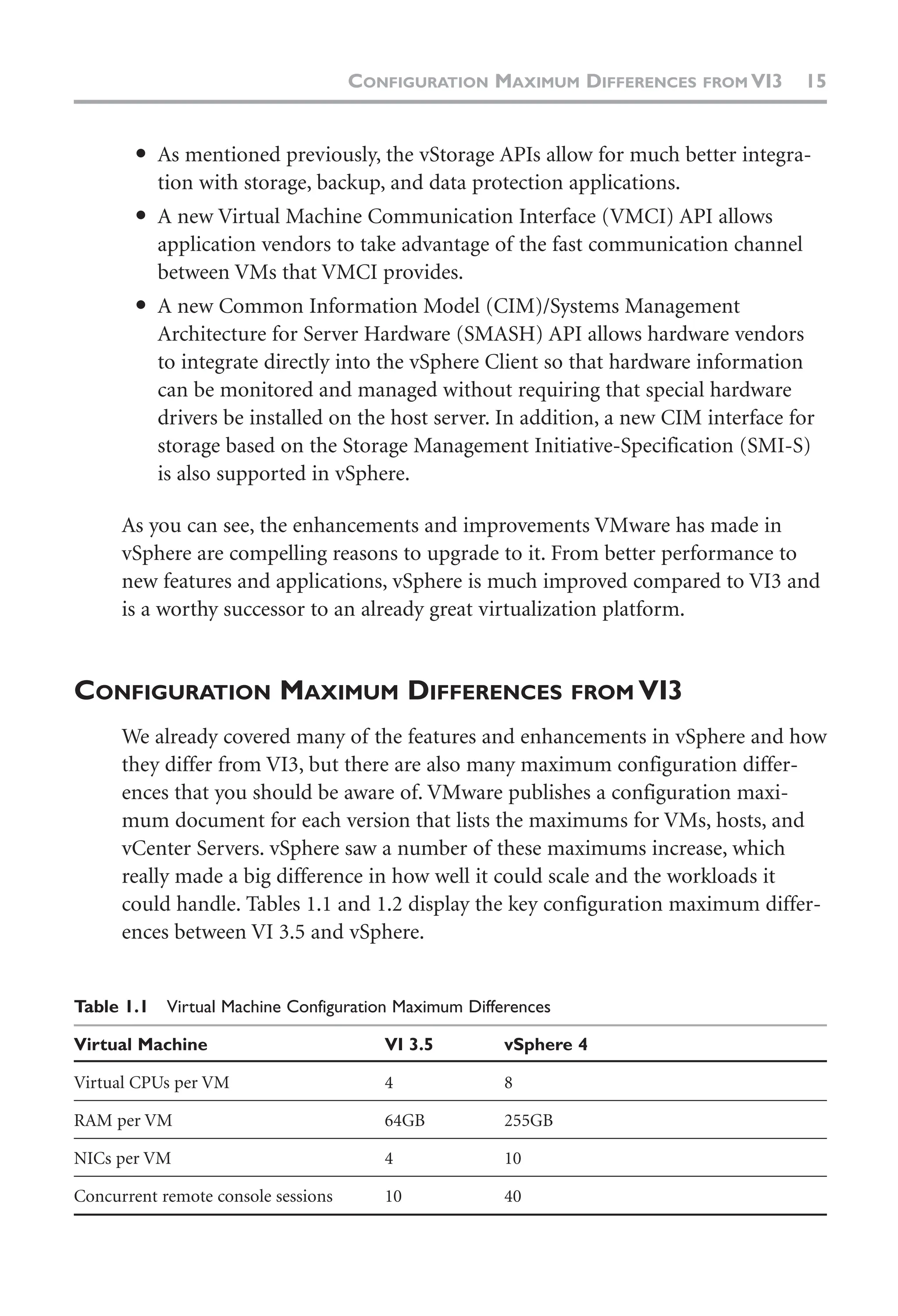
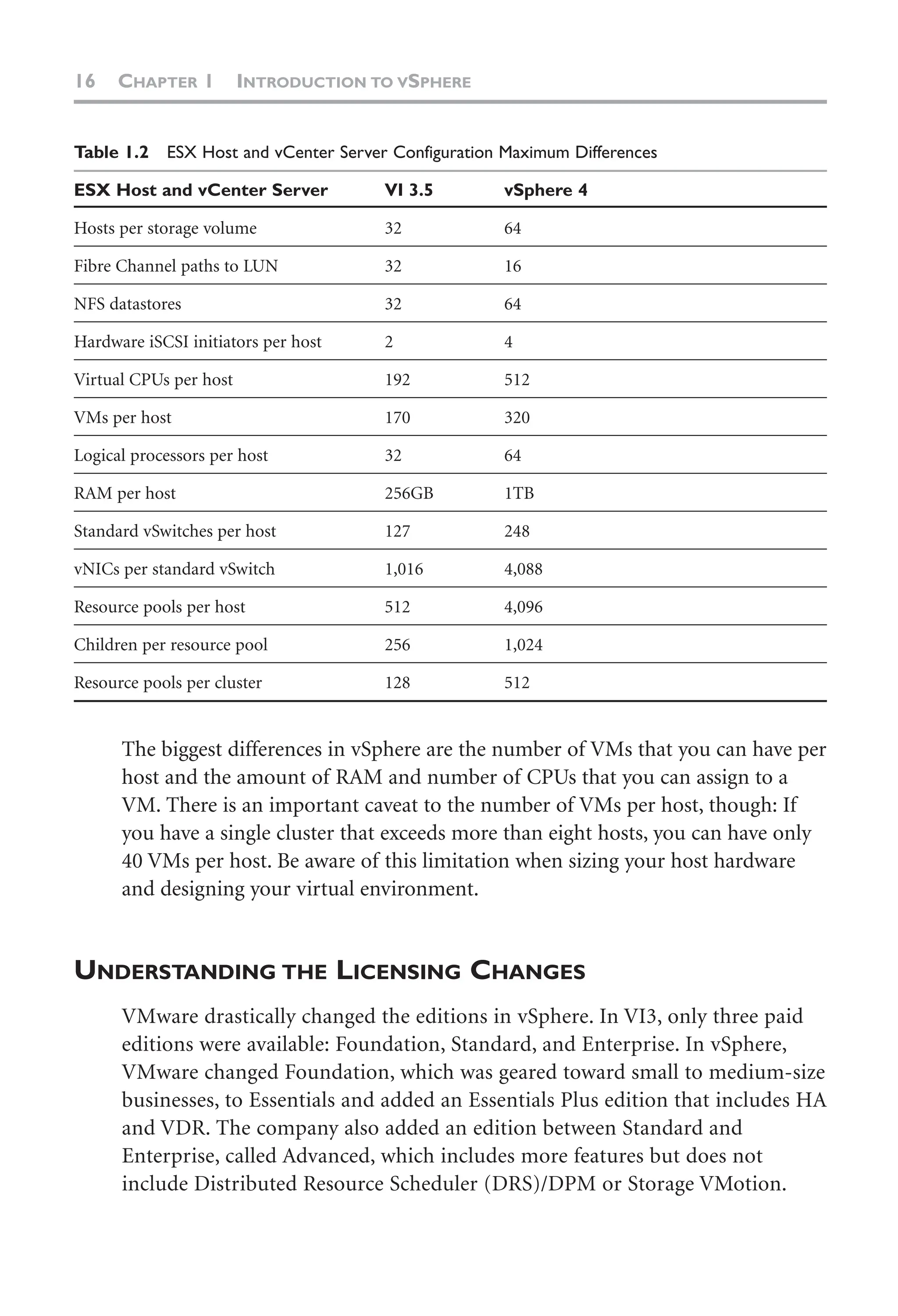
could handle. Tables 1.1 and 1.2 display the key configuration maximum differ-
ences between VI 3.5 and vSphere.
Table 1.1 Virtual Machine Configuration Maximum Differences
Virtual Machine VI 3.5 vSphere 4
Virtual CPUs per VM 4 8
RAM per VM 64GB 255GB
NICs per VM 4 10
Concurrent remote console sessions 10 40
CONFIGURATION MAXIMUM DIFFERENCES FROM VI3 15
16 CHAPTER 1 INTRODUCTION TO VSPHERE
Table 1.2 ESX Host and vCenter Server Configuration Maximum Differences
ESX Host and vCenter Server VI 3.5 vSphere 4
Hosts per storage volume 32 64
Fibre Channel paths to LUN 32 16
NFS datastores 32 64
Hardware iSCSI initiators per host 2 4
Virtual CPUs per host 192 512
VMs per host 170 320
Logical processors per host 32 64
RAM per host 256GB 1TB
Standard vSwitches per host 127 248
vNICs per standard vSwitch 1,016 4,088
Resource pools per host 512 4,096
Children per resource pool 256 1,024
Resource pools per cluster 128 512
The biggest differences in vSphere are the number of VMs that you can have per
host and the amount of RAM and number of CPUs that you can assign to a
VM. There is an important caveat to the number of VMs per host, though: If
you have a single cluster that exceeds more than eight hosts, you can have only
40 VMs per host. Be aware of this limitation when sizing your host hardware
and designing your virtual environment.
UNDERSTANDING THE LICENSING CHANGES
VMware drastically changed the editions in vSphere. In VI3, only three paid
editions were available: Foundation, Standard, and Enterprise. In vSphere,
VMware changed Foundation, which was geared toward small to medium-size
businesses, to Essentials and added an Essentials Plus edition that includes HA
and VDR. The company also added an edition between Standard and
Enterprise, called Advanced, which includes more features but does not
include Distributed Resource Scheduler (DRS)/DPM or Storage VMotion.
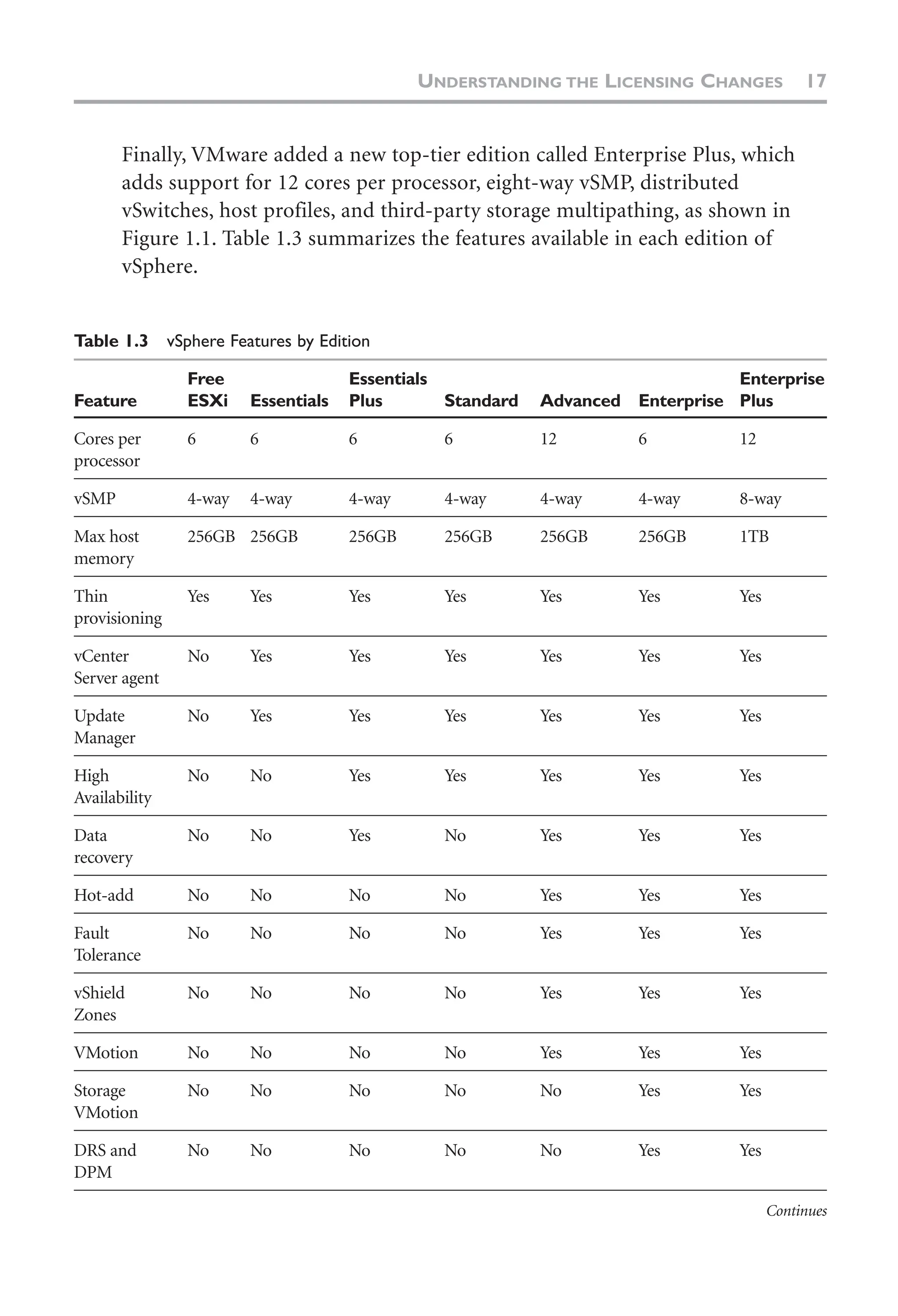
Finally, VMware added a new top-tier edition called Enterprise Plus, which
adds support for 12 cores per processor, eight-way vSMP, distributed
vSwitches, host profiles, and third-party storage multipathing, as shown in
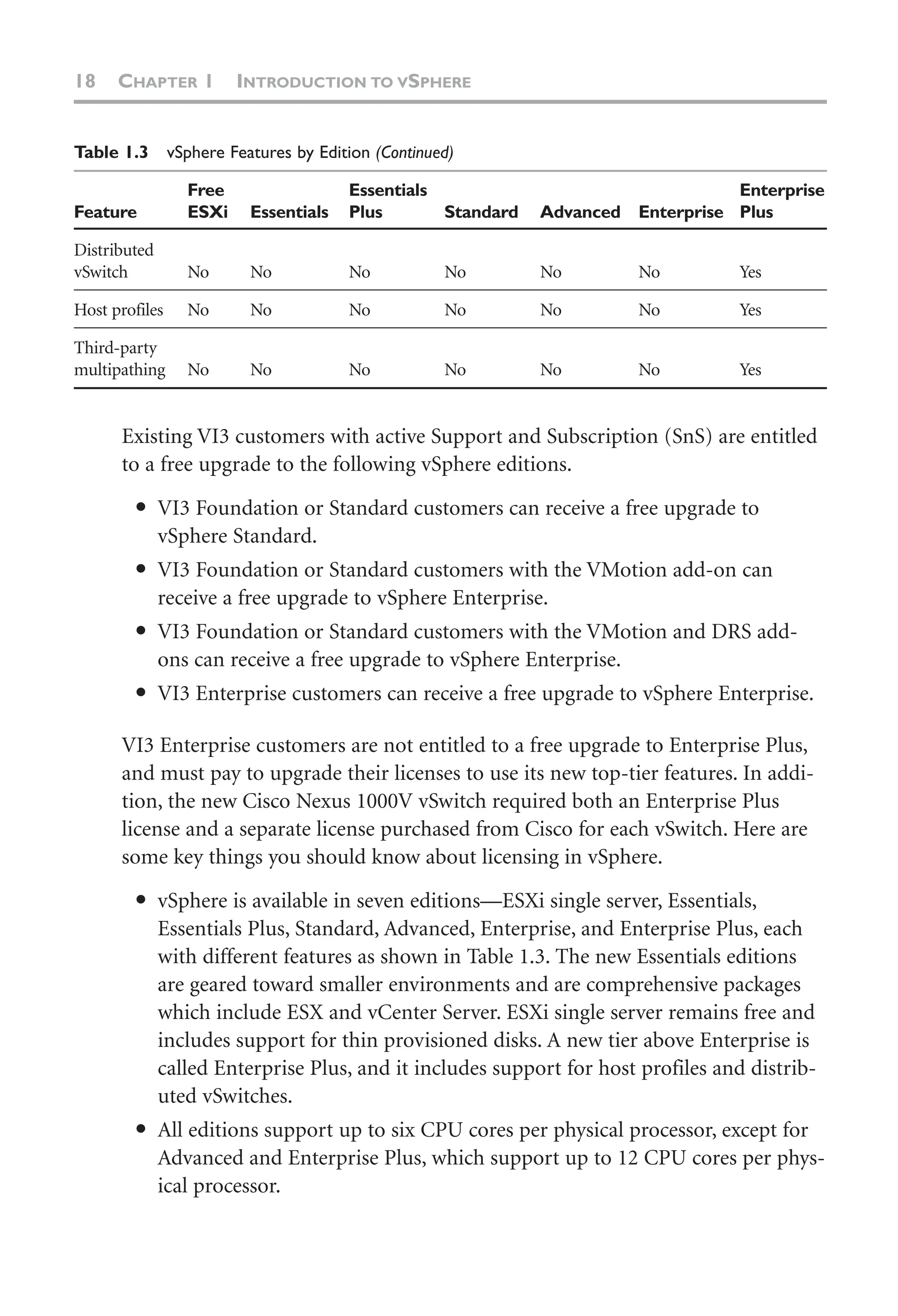
Figure 1.1. Table 1.3 summarizes the features available in each edition of
vSphere.
Table 1.3 vSphere Features by Edition
Free Essentials Enterprise
Feature ESXi Essentials Plus Standard Advanced Enterprise Plus
Cores per 6 6 6 6 12 6 12
processor
vSMP 4-way 4-way 4-way 4-way 4-way 4-way 8-way
Max host 256GB 256GB 256GB 256GB 256GB 256GB 1TB
memory
Thin Yes Yes Yes Yes Yes Yes Yes
provisioning
vCenter No Yes Yes Yes Yes Yes Yes
Server agent
Update No Yes Yes Yes Yes Yes Yes
Manager
High No No Yes Yes Yes Yes Yes
Availability
Data No No Yes No Yes Yes Yes
recovery
Hot-add No No No No Yes Yes Yes
Fault No No No No Yes Yes Yes
Tolerance
vShield No No No No Yes Yes Yes
Zones
VMotion No No No No Yes Yes Yes
Storage No No No No No Yes Yes
VMotion
DRS and No No No No No Yes Yes
DPM
Continues
UNDERSTANDING THE LICENSING CHANGES 17
18 CHAPTER 1 INTRODUCTION TO VSPHERE
Table 1.3 vSphere Features by Edition (Continued)
Free Essentials Enterprise
Feature ESXi Essentials Plus Standard Advanced Enterprise Plus
Distributed
vSwitch No No No No No No Yes
Host profiles No No No No No No Yes
Third-party
multipathing No No No No No No Yes
Existing VI3 customers with active Support and Subscription (SnS) are entitled
to a free upgrade to the following vSphere editions.
● VI3 Foundation or Standard customers can receive a free upgrade to
vSphere Standard.
● VI3 Foundation or Standard customers with the VMotion add-on can
receive a free upgrade to vSphere Enterprise.
● VI3 Foundation or Standard customers with the VMotion and DRS add-
ons can receive a free upgrade to vSphere Enterprise.
● VI3 Enterprise customers can receive a free upgrade to vSphere Enterprise.
VI3 Enterprise customers are not entitled to a free upgrade to Enterprise Plus,
and must pay to upgrade their licenses to use its new top-tier features. In addi-
tion, the new Cisco Nexus 1000V vSwitch required both an Enterprise Plus
license and a separate license purchased from Cisco for each vSwitch. Here are
some key things you should know about licensing in vSphere.
● vSphere is available in seven editions—ESXi single server, Essentials,
Essentials Plus, Standard, Advanced, Enterprise, and Enterprise Plus, each
with different features as shown in Table 1.3. The new Essentials editions
are geared toward smaller environments and are comprehensive packages
which include ESX and vCenter Server. ESXi single server remains free and
includes support for thin provisioned disks. A new tier above Enterprise is
called Enterprise Plus, and it includes support for host profiles and distrib-
uted vSwitches.
● All editions support up to six CPU cores per physical processor, except for
Advanced and Enterprise Plus, which support up to 12 CPU cores per phys-
ical processor.
● You can upgrade your edition of vSphere if you want more features. The
prices for this vary based on the edition you currently own and the edition
you plan to upgrade to. Here are the upgrade path options.
● Essentials can be upgraded to Essentials Plus.
● Standard can be upgraded to Advanced and Enterprise Plus.
● Advanced can be upgraded to Enterprise Plus.
● Enterprise can be upgraded to Enterprise Plus.
● The Essentials and Essentials Plus editions include licenses for up to three
physical servers (up to two 6-core processors) and a vCenter Server. Both
editions are self-contained solutions and may not be decoupled or com-
bined with other vSphere editions. vSphere Essentials includes a one-year
subscription; however, support is optional and available on a per-incident
basis. vSphere Essentials Plus does not include SnS; instead, it is sold sepa-
rately, and a minimum of one year of SnS is required.
VMware tried to phase out the Enterprise license and highly encouraged cus-
tomers with existing Enterprise licenses to upgrade to Enterprise Plus. After
receiving much customer outrage over this, VMware had a change of heart and
decided to keep the Enterprise license around past 2009. However, this may
change in the future, and VMware may eventually try to phase it out again.
SUMMARY
When VMware released vSphere it really raised the bar and further distanced
itself from the competition. The performance improvements we will cover in
Chapter 7 allow applications that previously may not have been good virtualiza-
tion candidates because of their intense workloads to now be virtualized. The
increased scalability allows for greater density of VMs on hosts, which allows for
greater cost savings. Additionally, the power management features can save dat-
acenters a great deal of money in cooling and power expenses. However,
although there are many compelling reasons to upgrade to vSphere, there are
also some reasons that an upgrade may not be right for you, and we will cover
them in Chapter 12.
SUMMARY 19
This page intentionally left blank
2
ESX AND ESXI HOSTS
21
ESX and ESXi are the two versions of the hypervisor that you have to choose
from in vSphere. At their core they are identical, as they both use the exact same
VMkernel, but their management consoles are distinctly different. Each version
has its pros and cons, and for many users it comes down to personal preference
when choosing between the two. In this chapter, we will cover the differences
between ESX and ESXi as well as some of the new features and enhancements
that VMware added to them in vSphere.
WHAT’S NEW WITH ESX AND ESXI HOSTS IN VSPHERE
In Chapter 1, we briefly covered some of the new things pertaining to ESX and
ESXi in vSphere. In this chapter, we will go over them in more detail. The
improvements in ESX and ESXi in vSphere really increase the density and scala-
bility that you can achieve, which means you can use fewer hosts than you may
have needed in order to support similar workloads in VI3. Let’s cover in more
detail the enhancements to the ESX and ESXi hosts in vSphere.
64-BIT VMKERNEL AND ESX SERVICE CONSOLE
The VMkernel is VMware’s proprietary hypervisor code that is the core compo-
nent of both ESX and ESXi. The ESX Service Console is a privileged virtual
machine (VM) that runs a modified version of Red Hat Linux and is used as a
22 CHAPTER 2 ESX AND ESXI HOSTS
management application for ESX. In VI3, the ESX Service Console used version
2.4.21 of the Linux kernel. In vSphere, it uses version 2.6.18. As the Linux kernel
is always improving, VMware updated the ESX Service Console to the newer
2.6.18 version to take advantage of bug fixes and improvements that were made
to it. You can check the Linux version of the ESX Service Console by logging in
to it and typing the command uname -a.
In VI3, both the VMkernel and the ESX Service Console were 32-bit applica-
tions/operating systems; they could run on 64-bit hardware, but they could only
address memory using 32-bit addresses. In vSphere, they are 64-bit applications,
which prevents vSphere from being able to run on hardware that is only 32-bit.
To better understand this, a bit (binary digit) is the smallest unit of information
in computing, and can have a value of 1 or 0. A 32-bit processor uses 32 bits to
reference memory locations (2^32 or 2 to the power of 32), and therefore is
limited to 4,294,967,296 unique locations (hence the 4GB limit in 32-bit
Windows). A 64-bit processor uses 64 bits to reference memory locations
(2^64) and is limited to 18,446,744,073,709,551,616 unique locations, which is
measured in exabytes and is much larger than the amount of memory that a
server can handle. As a result, applications that are written to take advantage of
64 bits typically run faster than 32-bit applications, as they can utilize the larger
64-bit address space and wider 64-bit registers and data paths.
The VMkernel and ESX Service Console being 64-bit in vSphere means that
older server hardware with 32 processors cannot run vSphere. However, most
server hardware built in the past several years contains 64-bit processors from
Intel and AMD, so this won’t be a problem for many users. Later in this chapter
we will cover this in more detail.
SUPPORT FOR MORE MEMORY, CPUS,AND VMS
Memory is almost always the first resource to be used up on virtual hosts from
the many memory-hungry applications running on VMs. In VI3, only 256GB of
physical host memory was supported, which limited the number of VMs that a
host could support. You can always use memory overcommitment to allocate
more memory to VMs, but this is only good up to a point, and must be closely
monitored. Now with vSphere, a host can have up to 1TB of memory, which
greatly expands the memory available to VMs. Many servers currently support
up to 512GB of memory, which is still plenty of memory to assign to VMs. This
new limit makes it easier to virtualize applications such as database and email
servers that can use a very large amount of RAM. In addition to the increased
host memory support of 1TB, the amount of RAM that can be assigned to a
VM was increased from 64GB to 255GB in vSphere.
VI3 only supported 32 logical CPUs per host. In vSphere, this has increased to
64 logical CPUs. A logical CPU takes into account the number of cores and
threads that a physical CPU has. The formula to compute logical CPUs is: CPU
Sockets × Cores per Socket × Threads per Core. A socket simply refers to a sin-
gle physical CPU. The term socket comes from the socket on the motherboard
that a CPU is plugged into, and it started to be used once multicore processors
were released to distinguish between cores and physical CPUs. Cores are the
number of CPU cores that a single processor supports; a multicore processor is
composed of two or more independent cores that are interconnected and share
a single processor die, and perhaps cache and other interfaces. Most editions of
vSphere support up to six cores per processor, except for the Advanced and
Enterprise Plus editions, which support up to 12 cores per processor. Finally,
threads take into account hyperthreading, which some CPUs support and which
makes one physical CPU or core look like two. Hyperthreading also simulates
multiple processors per socket, but unlike cores that have their own hardware,
hyperthreading works by duplicating the architectural state of a processor and
not the main execution resources. Hyperthreading basically simulates another
processor, which allows the operating system to schedule two threads simulta-
neously. It takes advantage of the unused execution resources of a processor to
handle the two threads at once.
Here are some examples of logical CPU counts:
● 1 socket, 4 cores per CPU with hyperthreading = 8 logical CPUs
● 2 sockets, 6 cores per CPU without hyperthreading = 12 logical CPUs
● 8 sockets, 6 cores per CPU without hyperthreading = 48 logical CPUs
The 64-logical-CPU limit is enforced regardless of how many logical CPUs a
single host may have. The same is true of the current core licensing per edition:
If your vSphere edition supports only six cores per processor and you have
more than that, vSphere simply ignores the rest and does not use them.
Most processors these days are multicore, and the advantage to using them is
that vSphere is licensed by the socket, not the core, so you can get more bang
for your buck. vSphere is even licensed by single sockets now instead of in two-
socket increments, so you can use a single-socket six-core server that will sup-
port many VMs at an affordable price.
WHAT’S NEW WITH ESX AND ESXI HOSTS IN VSPHERE 23
24 CHAPTER 2 ESX AND ESXI HOSTS
The total number of VMs and the virtual CPUs that can be assigned to them has
also increased in vSphere. VI3 supported up to 170 VMs with a total of up to 192
virtual CPUs per host. In vSphere, that increased to 320 VMs per host with a
total of up to 512 virtual CPUs per host. Having 320 VMs on a host might seem
unlikely in most cases, except for virtual desktop solutions that have lots of low-
workload VMs running on them. There is a caveat to that number, though: If
you have a single cluster that exceeds eight hosts, you can have only 40 VMs per
host (this is a supported limit, not a hard limit). Be aware of this limitation when
sizing your host hardware and designing your virtual environment.
SUPPORT FOR ENHANCED INTEL SPEEDSTEP AND ENHANCED AMD
POWERNOW!
In addition to Distributed Power Management (DPM), vSphere also supports a
new CPU power management technology called Enhanced SpeedStep by Intel and
Enhanced PowerNow! by AMD. These technologies enable a server to dynamically
switch CPU frequencies and voltages (referred to as Dynamic Voltage & Frequency
Scaling or DVFS) based on workload demands, which enables the processors to
draw less power and create less heat, thereby allowing the fans to spin more slowly.
Earlier versions of SpeedStep and PowerNow! only supported switching between
high and low frequencies. The Enhanced versions also add support for varying the
voltage of the processor as well. This is accomplished by an interface that allows a
system to change the performance states (P-states) of a CPU. P-states are defined
by fixed operating frequencies and voltages that allow a CPU to operate at different
power levels. A CPU can operate in several different P-states, depending on the
processor, with the lowest level defined as P-min and the highest level defined as
P-max. For example, a 3GHz processor will have a P-max of 3GHz and might have
a P-min of 2GHz, along with several in-between P-states such as 2.3GHz, 2.5GHz,
and 2.7GHz.
Processor P-states can be controlled by either the system ROM or an operating
system. In vSphere, they are controlled by the VMkernel which optimizes each
CPU’s frequency to match demand in order to improve power efficiency but
not affect performance. Before you can use this feature, though, you need to
enable it in the server’s BIOS. The tool for doing this will vary among servers,
but it will typically be labeled Power Regulator, Demand Based Switching,
PowerNow, or SpeedStep. For HP servers, it is labeled Power Regulator for
ProLiant, and it is listed under System Options in the BIOS. Using an HP
ProLiant DL385 G6 as an example, you will see there are four modes listed in
the BIOS for Power Regulator for ProLiant, as described by HP.
● HP Dynamic Power Savings Mode—This uses a ROM-based algorithm
developed by HP to monitor processor activity. It adjusts processor power
use to match performance levels to the application load.
● HP Static Low Power Mode—The system’s processors operate continuously
at the lowest power state (P-min). In this mode, Power Regulator programs
the processors to run continuously in the low-power state to allow the serv-
er to run at a guaranteed lower maximum power level.
● HP Static High Performance Mode—The system’s processors operate con-
tinuously at the highest power and performance state (P-max). In this
mode, neither the system’s firmware nor the operating system will ever pro-
gram the processors to run in a lower power or performance state.
● OS Control Mode—Dynamic power management for the system is man-
aged by the operating system through its policy mechanism. For this mode,
system administrators must configure the operating system to activate the
OS-based power management feature.
The option you want to use for vSphere to enable your hosts to take advantage
of the power management feature is the OS Control Mode. This allows the
VMkernel to change P-states on the CPUs in a host to conserve power whenever
possible. In vSphere, you configure this feature on each host by selecting the
host in the vSphere Client, and then choosing Configuration
tab→Hardware→Processors. If you disable the feature in the BIOS or set it to
Static, the processor configuration in the vSphere Client will show that Power
Management Technology is not available. Once the power management feature
in the server’s BIOS is set to OS Control mode, you will see this change to
reflect whichever technology is being used (PowerNow! or SpeedStep), as shown
in Figure 2.1.
WHAT’S NEW WITH ESX AND ESXI HOSTS IN VSPHERE 25
Figure 2.1 Power Management Technology enabled when OS Control Mode is selected
Exploring the Variety of Random
Documents with Different Content
The probability is, that whenever Mr. Spence read in Burke's Landed
Gentry that Mr. A. or Mr. B., in preference to being considered as the
founder of a new family, supposed himself, or wished to be
supposed by others, to be descended from an old stock of the same
name, he kindly offered to supply the desired information, and was
ready to execute a pedigree to order.
G. A. C.
[The Editor has been informed by a person on whose accuracy he can rely, that a
lady who received a letter from Mr. Spence offering certain information respecting
his family taken from the Cotgreave pedigree, and who imprudently sent money
for the same, got nothing but the most absurd rubbish in return, and having been
induced to make inquiries into the subject, was fully satisfied that the whole thing
was a fraud.]
LICENCES TO CRENELLATE.
(Vol. ix., p. 220.)
The subjoined list of names and places will supply Mr. Parker with
the counties of all the places named in his inquiry, except two in
which I suspect some error. If farther references to authorities are
desired, they will be given with pleasure in reply to a private
application, but would crowd your pages inconveniently.
1. Cokefield for Melton—Cokefeud for Moulton, Suffolk.
2. Grisnak for Molun—Query this?
3. Langeton for Newton in Makerfield.—L. for Newton Hall or
Castle, the head of the Palatine Barony of Newton, in
Lancashire.
4. Esselynton for Esselynton—E. in Northumberland.
5. Trussel for Cubleston—C. in Staffordshire.
6. De la Beche for De la Beche—De la Beche Castle. Aldworth,
Berks.
7. The same for Beaumes—Beaumys Castle, Shinfield, Berks.
8. Cobham for Pringham—P. alias Sterborough Castle, Surrey.
9. The same for Orkesdene—O. in Kent.
10. "Burghchier" for Stanstede—Bourchier for Stansted, Essex.
11. Dalham for "Credonio"—"Fortalicium in loco de Crodonio."
Printed Cal. Rot. Pat. p. 143.
12. Lengleys for Heyheved—Highhead Castle, in Cumberland.
13. Aeton for Chevelyngham—Heton for Chillingham,
Northumberland.
Geo. O.
Sedbury Park, Chepstow.
There can, I think, be little doubt that Stansstede, in Mr. J. H.
Parker's list, is Stanstead Hall, near Halstead in Essex. I have never
seen Stanstead Hall, but about a month since I was in company with
the late occupant; from whom I learned, in casual conversations,
that it was an ancient house, with moat and fortifications. In
addition to this I may state, that there are monuments in the old
church (St. Andrew) of Halstead to some of the Bourchier family.
These facts, taken together, seem to fix the locality with sufficient
precision. One of the monuments just referred to is a brass,
commemorating Sir Bartholomew Bourchier and his two wives;
which, when I copied it in 1847, was under the flooring of a pew in
the south aisle. He died May 8, 1409; and was previously the
possessor of Stanstead Hall: so I learn from my own MS. Catalogue
of brass rubbings in my collection, but I am not able to give any
better reference to authenticate the statement.
W. Sparrow Simpson.
Heyheved, mentioned in Mr. Parker's list, is Highhead Castle in
Cumberland. In the reign of Edward II. it was a peel house (pelum
de Heyheved) possessed by Harcla, Earl of Carlisle. In modern times
it became the property of a family named Richmond, one of whom
erected the present house, after a plan by Inigo Jones. But he died
before it was finished, leaving co-heirs, who quarrelled about the
partition of the estate, and actually put a hedge through the centre
of the house. Eventually one-half came into the hands of Lord
Brougham, who is understood to have purchased the other, and will
probably restore the whole.
K.
NEWSPAPER FOLK LORE.
(Vol. vi., pp. 221. 338. 466.; Vol. ix., pp. 29. 84.)
It may be instructive to collate the four stories recorded in the above
references, and compare them with a case that was brought before
Mr. Jardine at Bow Street Police Court; and which was reported in
The Times for February 22, 1854. Let the following extract suffice: it
is descriptive of the operations of extracting a worm from the body
of one Harriet Gunton, by a female quack of the name of Jane
Browning:
"I laid myself on the bed as she desired, and she told Mrs.
Jones to hold my mouth to prevent my breathing. Mrs. Jones
held me from behind, and nearly suffocated me. She kept me
down, while the prisoner tried to get the worms out of my body
with her hands. This lasted for about a quarter of an hour, and
caused me dreadful pain. The prisoner told me that one of the
worms had bit her finger, and slipped away again, and she could
not get at it. She tried a second time, and said the worm had bit
her again. I then begged her to leave off, if she could not
succeed in getting it away; for I believed I should die under the
operation. She tried a third time, and said she had broken two
skins of it, which would prevent it getting up my body. ... She
then put her hand under the clothes. I felt something touch me
like a cloth, and she drew away her hand; throwing something
into the pan, which sounded with a heavy splash. She said she
had been trying at it all night, and had got it away at last."
Mr. Robert Biggs, the medical attendant, pronounced the "reptile" to
be a fine conger eel, which he believed had often done duty in the
same way.
C. Mansfield Ingleby.
Birmingham.
It would be well if every popular error were hunted down, as your
correspondents have done in the case of the snake-vomiting at
Portsmouth. The public need to be told, that no animal can live in
the alimentary canal but the parasites which belong to that part of
the animal economy. Of these the Lumbricus intestinalis is the
largest, and is discharged by children even of the size mentioned in
the case of Jonathan Smith.
Two years ago I met with a curious illustration of the popular
ignorance of that branch of natural history which treats of our own
reptiles, as well as of the mode of growth of a popular marvel.
During the hot weather of the summer before last, I was asked by a
respectable farmer, if I had seen the "serpent" which was lately
killed in an adjoining parish. "Serpent!" I replied; "I suppose you
mean some overgrown common snake—perhaps a female full of
eggs?" "Well, it might have been a snake at first, but it was grown
into a serpent; and pursued a boy through the hedge, but was
fortunately encountered and killed by the father."
It is a moot point, whether the parasites of animals are engendered
or not within the body. In the case of the bots of horses, they are
known to be the larvæ of a fly which deposits its eggs on the skin;
from whence they are licked off, and conveyed into the animal's
stomach, where they are hatched and prepared for their other
metamorphoses.
I believe the only parasite taken in with water in tropical climates is
the Guinea Worm; an animal which burrows under the skin of the
arms or legs, and is extremely difficult of extraction, and often
productive of great inconvenience. But whether the egg of this worm
be taken into the stomach, and conveyed by the blood into the
limbs, there to be hatched into life, or whether it enter through the
pores of the skin, I believe is not determined.
The popular delusion respecting the swallowing of young snakes,
and of their continuance in the stomach, is a very old one, and is still
frequent. A medical friend of mine, not long since, was called on to
treat a poor hysterical woman, who had exhausted the skill of many
medical men (as she asserted) to rid her of "a snake or some such
living creature, which she felt confident was and had been for a long
time gnawing in her stomach." I suggested the expediency of
working on the imagination of this poor hypochondriac, as was done
in the well-known facetious story of the man who fancied he had
swallowed a cobbler; and who was cured by the apparent discharge
first of the awls and strap, then of the lapstone, and, finally, of
Crispin himself.
M. (2)
FRENCH SEASON RHYMES AND WEATHER
RHYMES.
(Vol. ix., p. 9.)
The following weather rules are taken from a work which is probably
but little known to the generality of English readers. It is entitled:
"Contes populaires, Préjugés, Patois, Proverbes, Noms de Lieux,
de l'Arrondissement de Bayeux, recueillis et publiés par Frédéric
Pluquet, &c.: Rouen, 1834."
Where saints' days are mentioned, I have added the day of the
month on which they fall, as far as I have been able to ascertain it;
but as it sometimes happens that there is more than one saint of the
same name, and that their feasts fall on different days, I may
perhaps, in some cases, have fixed on the wrong one:
"Année venteuse,
Année pommeuse."
"Année hannetonneuse,
Année pommeuse."
"L'hiver est dans un bissac; s'il n'est dans un bout, il est dans
l'autre."
"Pluie du matin
N'arrête pas le pélerin."
"À Noël au balcon,
À Pàques au tison."
"À Noël les moucherons,
À Pàques les glaçons."
"Pàques pluvieux,
An fromenteux."
"Le propre jour des Rameaux
Sème oignons et poreaux."
"Après Pàques et les Rogations,
Fi de prêtres et d'oignons."
"Fêves fleuries
Temps de folies."
"Rouge rosée au matin,
C'est beau temps pour le pélerin."
"Pluie de Février
Vaut jus de fumier."
"Février qui donne neige
Bel été nous plège."
"Février
L'anelier" [anneau].
This saying has probably originated in the number of marriages
celebrated in this month; the season of Lent which follows being
a time in which it is not usual, in Roman Catholic countries, to
contract marriage.
"Février emplit les fosses;
Mars les sèche."
"Mars martelle,
Avril coutelle."
An allusion to the boisterous winds of March, and the sharp,
cutting, easterly winds which frequently prevail in April.
"Nul Avril
Sans épi."
"Avril le doux,
Quand il se fàche, le pis de tout."
"Bonne ou mauvaise poirette,
Il faut que Mars a trouve faite."
Poirette, in the dialect of Bayeux, means a leek.
"Froid Mai et chaud Juin
Donnent pain et vin."
"En Juignet [Juillet],
La faucille au poignet."
"À la Saint-Vincent [Jan. 22],
Tout dégèle, ou tout fend."
"Saint-Julien brise glace [Jan. 27],
S'il ne la brise, il l'embrasse."
"À la Chandeleur [Feb. 2],
La grande douleur."
Meaning the greatest cold.
"À la Chandeleur,
Où toutes bêtes sont en horreur."
Probably alluding to the rough state of their coats at this
season.
"À la Saint-George [April 23],
Sème ton orge."
"Quand il pleut le jour Saint-Marc [April 25],
Il ne faut ni pouque ni sac."
"À la Saint-Catherine [April 29],
Tout bois prend racine."
"À la Saint-Urbain [May 25],
Le froment porte grain."
"À la Saint-Loup [May 28?],
La lampe au clou."
"S'il pleut le jour Saint-Médard [June 8],
Il pleuvra quarante jours plus tard."
"À la Saint-Barnabé [June 11]
La faux au pré."
"À la Saint-Sacrement [this year, June 15]
L'épi est au froment."
"Quand il pleut à la Saint-Gervais [June 19],
Il pleut quarante jours après."
"À la Madeleine [July 22],
Les noix sont pleines."
"À la Saint-Laurent [Aug. 10],
La faucille au froment."
"Passé la Saint-Clément [Nov. 23?],
Ne sème plus le froment."
"Si le soleil rit le jour Sainte-Eulalie [Dec. 10],
Il y aura pommes et cidre à folie."
"À la Sainte-Luce [Dec. 13?],
Les jours croissent du saut d'une puce."
"À la Saint-Thomas [Dec. 21],
Les jours sont au plus bas."
Edgar MacCulloch.
Guernsey.
VAULT INTERMENTS (Vol. ii., p. 21.): BURIAL
IN AN ERECT POSTURE (Vol. viii., pp. 329.
630.):
INTERMENT OF THE TROGLODITÆ (Vol. ii., p.
187.).
In the 4th book of Evelyn's Sylva there is much interesting matter on
this subject, besides what has been quoted above; and, to those
herein interested, the following extract from Burn's History of Parish
Registers in England will doubtless be acceptable:
"Many great and good men have entertained scruples on the
practice of interment in churches. The example of the virtuous
and primitive confessor, Archbishop Sancroft, who ordered
himself to be buried in the churchyard of Fresingfield in Suffolk,
thinking it improper that the house of God should be made the
repository of sinful man, ought to command the imitation of less
deserving persons: perhaps it had an influence over the mind of
his successor, Archbishop Secker, who ordered himself to be
buried in the churchyard of Lambeth. The Bishops of London in
succession, from Bishop Compton to Bishop Hayter, who died in
1762, inclusive, have been buried in Fulham Churchyard."[1]
Of the same opinion were Dr. Edward Rainbow, Bishop of Carlisle; Sir
Matthew Hale, who used to say that churches were for the living and
to churchyards for the dead[2]; Joseph Hall, Bishop of Norwich, who
"did not hold God's house a meet repository for the greatest saint;"
and William Bedell, Bishop of Kilmore, who made a canon in his
synod to the following effect:
"IX. Ut corpora defunctorum deinceps in Ecclesiis non humentur,
sed nec intra quintum pedem a pariete extrorsum."
Sir Thomas Latymer, of Braibroke in Northamptonshire, by his will
directed thus:
I, Thomas Latymer of Braybroke, a fals knyghte to God, &c., my
wrecchyd body to be buried where that ever I die in the next
chirche yerde, God vouchsafe, and naut in the chirche, but in
the utterist corner, as he that is unworthy to lyn therein, save
the merci of God."
Dr. Isaac Barrow, Bishop of St. Asaph, was buried in a churchyard,
although, from his having generously repaired and endowed his
cathedral, he might be considered to have a claim of interment
within its walls; and Baldwin, the great civilian, severely censures
this indecent liberty, and questions whether he shall call it a
superstition or an impudent ambition. Lanfranc, Archbishop of
Canterbury, was the first who made vaults under the chancel, and
even under the altar, when he rebuilt the choir of Canterbury, about
1075.[3]
"The Irish long retained an attachment to their ancient customs
and pagan superstitions; and the custom of burying in
consecrated ground was not universal in Ireland in the twelfth
century on the arrival of the English, as we find it enjoined in
the Council of Cashel, held in 1172, mentioned by Cambrensis.
A short time since some small earthen tumuli were opened on
the Curragh of Kildare, under which skeletons were found
standing upright on their feet, and in their hands, or near them,
spears with iron heads. The custom of placing their dead erect
was general among all the northern nations, and is still retained
in Lapland and some parts of Norway; and the natives of North
America bury their dead sitting in holes in the ground, and cover
them with a mound of earth."—Transactions of the R. Irish
Academy, vol. iii.
A Query I proposed (Vol. ii., p. 187.) in reference to the Trogloditæ
never having been answered, I shall, perhaps, be allowed to use this
opportunity myself to furnish an apposite and explanatory quotation,
viz.—
"Troglodytæ mortui cervicem pedibus alligabant et raptim cum
risu et jocis efferebant, nullaque loci habita cura mandabant
terræ; ac ad caput cornu caprinum affigebant."—Cœlii
Rhodigini, Lectiones Antiquæ, p. 792.
I shall conclude with the rationale of the erect posture, as illustrated
by Staveley in his History of Churches in England:
"It is storied to be a custom among the people of Megara in
Greece, to be buried with their faces downwards; Diogenes
gave this reason why he should be buried after the same way,
that seeing all things were (according to his opinion) to be
turned upside down in succeeding times, he, by this posture,
would at last be found with his face upwards, and looking
towards heaven."
Bibliothecar. Chetham.
Footnote 1:(return)
Cole's MSS. vol. iv. p. 100.
Footnote 2:(return)
The Assembly at Edinburgh, in 1588, prohibited the burying in kirks.
Footnote 3:(return)
Cole's MSS., vol. iv.
In Much Ado about Nothing, Act III. Sc. 2., Don Pedro says:
"She shall be buried with her face upwards."
Theobald, Johnson, and Steevens have left notes upon this line. The
following passage is part of Steevens' note:
"Dr. Johnson's explanation may likewise be countenanced by a
passage in an old black-letter book, without date, intitled, 'A
merye Jest of a Man that was called Howleglas, &c.: How
Howleglas was buryed:
"'Thus as Howleglas was deade, then they brought him to be
buryed. And as they would have put the coffyn into the pytte
with 2 cordes, the corde at the fete brake, so that the fote of
the coffyn fell into the botome of the pyt, and the coffyn stood
bolt upryght in the middes of the grave. Then desired ye
people
that stode about the grave that tyme, to let the coffyn to stande
bolt upryght. For in his lyfe tyme he was a very marvelous man,
&c., and shall be buryed as marvailously. And in this maner they
left Howleglas,' &c.
"Were not the Claphams and Mauleverers buried marvailously,
because they were marvelous men?"—Johnson and Steevens'
Shakspeare, vol. ii. p. 310.
J. W. Farrer.
"In Oliver Heywood's Register is the following entry [Oct. 28, 1684]:
'Capt. Taylor's wife of Brig House, buried in her garden with
head upwards, standing upright, by her husband, daughter, &c.
Quakers.'"—Watson's History of Halifax, p. 233.
Cervus.
"Some Christians [Russians?] decline the figure of rest, and
make choice of an erect posture in burial."—Browne's
Hydriotaphia, ch. iv. p. 246.
Query, With the desire of meeting the Judge, face to face, when He
cometh?
Mackenzie Walcott, M.A.
DO CONJUNCTIONS JOIN PROPOSITIONS
ONLY?
(Vol. ix., p. 180.)
Professor Boole's communication on the above question reminds me
of some remarks of mine, published in an article on Sir John
Stoddart's Philosophy of Language, in the North British Review for
November, 1850. In reference to the opinion maintained by Sir John
Stoddart and Dr. Latham, that the conjunction always connects
sentences, the preposition words, it is observed:
"It does not apply to cases where the conjunction unites
portions of the predicate, instead of the subject, of a
proposition. If I assert that a gentleman of my acquaintance
drinks brandy and water, he might not relish the imputation of
imbibing separate potations of the neat spirit and the pure
element. Stradling versus Stiles is a case in point: 'Out of the
kind love and respect I bear to my much honoured and good
friend, Mr. Matthew Stradling, Gent., I do bequeath unto the
said Matthew Stradling, Gent., all my black and white horses.'
The testator had six black horses, six white horses, and six pied
horses. The whole point at issue turns upon the question
whether the copulative and joins sentences or words. If the
former, the plaintiff is entitled to the black horses, and also to
the white, but not to the pied. If the latter he has a right to the
pied horses but must forego his claim to the rest. And if the
latter interpretation be adopted, must we say that and is a
preposition, not a conjunction, or must we modify the
definitions of these two parts of speech?"
The following definitions are finally proposed in place of the ordinary
ones:
"A preposition is a part of speech annexed to a noun or verb in
a proposition, and serving to connect it with a noun or pronoun
by which it is limited, as the subject or predicate of that
proposition."
"A conjunction is a part of speech serving to unite two
propositions as parts of the same complex assertion, or two
words as similar parts of the subject or predicate of one
proposition. By similar parts it is meant that the words so united
stand in similar relations to the term to which they belong. For
example, 1. As attributes, both qualifying a subject, 'Sic bonus
et sapiens dignis ait esse paratus.' 2. As prepositions, both
introducing limiting nouns 'without money and without price.' 3.
As substantives, both forming parts of a collective subject, 'two
and three are five.' Whereas with the preposition, the words
united are not similar, but opposed, the limiting and the limited
notion."
While differing from some of Professor Boole's views on the relation
of logic to mathematics, I fully agree with him that the true
functions of the several parts of speech must be determined by an
analysis of the laws of thought. Both grammar and logic might be
considerably improved by an accurate development on psychological
principles.
H. L. Mansel, B.D.
St. John's College, Oxford.
Has not your correspondent G. Boole fallen into an inaccuracy whilst
contending about the accuracy of another's logic? He seems to
employ the proposition, all trees are endogens or exogens, as an
example of an accurate proposition.
I forget the technicalities in which the objection to such a
proposition would be properly expressed; but it cannot well be
denied that all comprehends the whole genus, and expresses that
whole collectively. If so, the proposition affirms that the whole genus
of trees must either be acknowledged to be endogens, or else to be
all exogens. Does not such an affirmation require the word every to
clear it from ambiguity? Will it be cleared of ambiguity by saying,
"Every tree is endogen or exogen?" Or must we say "Every tree is
either endogen or exogen?"
If your correspondents should happen to take down the second
volume of Locke on Human Understanding, b. III. ch. iii. § 11., on
"Universals," his note will supply them with another knot to unravel,
of which I would gladly see their solution. For he has there said,
"Three Bobaques are all true and real Bobaques, supposing the
name of that species of animals belongs to them." Is this name
formed in jest? For the philosopher sometimes puts on an awkward
affectation of humour in his replies to Bishop Stillingfleet, to whom
this note is addressed.
H. W.
HAS EXECUTION BY HANGING BEEN
SURVIVED?
(Vol. ix., p. 174.)
Two instances of criminals being restored to life after having been
hanged are recorded, on good authority, to have occurred in this
town. Henry of Knighton (who was a Canon of Leicester Abbey)
relates in his Chronicle (col. 2627), under the year 1363, that—
"One Walter Wynkeburn having been hanged at Leicester, on
the prosecution of Brother John Dingley, Master of Dalby, of the
order of Knights Hospitallers, after having been taken down
from the gallows as a dead man, was being carried to the
cemetery of the Holy Sepulchre of Leicester, to be buried, began
to revive in the cart, and was taken into the church of the Holy
Sepulchre by an ecclesiastic, and there diligently guarded by
this Leicester ecclesiastic to prevent his being seized for the
purpose of being hanged a second time. To this man King
Edward granted pardon in Leicester Abbey, and gave him a
charter of pardon, thus saying in my hearing, 'Deus tibi dedit
vitam, et nos dabimus tibi Cartam?"
We learn, on the authority of a cotemporary record, preserved in the
archives of this borough, and quoted in Thompson's History of
Leicester, p. 110., that in June, 1313, Matthew of Enderby, a thief,
was apprehended and imprisoned in the king's gaol at Leicester; and
that being afterwards convicted, he was sentenced by Sir John Digby
and Sir John Daungervill, the king's justices, to be hanged; that he
was led to the gallows by the frankpledges of Birstall and Belgrave,
and by them suspended; but on his body being taken down, and
carried to the cemetery of St. John's Hospital for interment, he
revived and was subsequently exiled. Three instances are narrated in
Wanley's Wonders of Man, vol. i. pp. 125, 126., and another will be
found in Seward's Spirit of Anecdote and Wit, vol. iii. p. 88., quoted
from Gamble's Views of Society, &c. in the North of Ireland; whilst in
vol. ii. p. 220. of the same work, another restoration to life is stated
to have taken place in the dissecting-room of Professor Junker, of
Halle: but I know not how far these last-mentioned anecdotes are
susceptible of proof.
William Kelly.
Leicester.
There appears to be no reason to doubt the truth of individuals
having survived execution by hanging.
Margaret Dickson was tried, convicted, and executed in Edinburgh,
in the year 1728. After the sentence had been accomplished, her
body was cut down and delivered to her friends, who placed it in a
coffin, and conveyed the same in a cart towards her native place for
the purpose of interment. On her journey the dead came to life
again, sat up in her coffin, and alarmed her attendants. She was,
however, promptly bled, and by the next morning had perfectly
recovered. She lived for twenty-five years afterwards, and had
several children.
In 1705 one John Smith was executed at Tyburn; after he had hung
fifteen minutes a reprieve arrived. He was cut down and bled, and is
said to have recovered. (Paris and Fonblanque, Med. Jur., vol. ii. p.
92.)
When it is considered that death takes place after hanging, in most
cases by asphyxia, in very rare instances by dislocation of the spine,
we can understand the possibility of recovery within certain limits.
That artificial means have been adopted to ensure recovery, the case
of Gordon, which occurred in the early part of the seventeenth
century, satisfactorily establishes.
This evil-doer had been condemned for highway robbery, and with a
view to escape from his penalty, succeeded in obtaining the
following friendly assistance.
A young surgeon named Chovell (concerning whose motives we will
not inquire too curiously) introduced a small tube through an
opening which he made in the windpipe. The hangman, having
accomplished his part of the tragedy, Gordon's body was handed
over to his friends. Chovell bled him, and the highwayman sighed
deeply, but subsequently fainted and died. The want of success was
attributed to the great weight of the culprit, who consequently
dropped with unusual violence. (Memoirs of the Royal Academy of
Surgery in France, Sydenham Society Publications, p. 227.)
How far the mechanical contrivance by which Bouthron, in Scott's
Fair Maid of Perth, was kept alive after hanging, was founded on
successful experience, I know not. Nor do I know whether Hook, in
his Maxwell, had any farther authority than his imagination for his
story of resuscitation, though I have heard it said to be founded on
the supposed recovery of a distinguished forger, who had paid the
last penalty for his offences, and who was said to have really died
only a short time since.
Oliver Pemberton.
Birmingham.
The Cork Remembrancer, a chronicle of local events, which I
recollect seeing among my late father's (a Cork man) books, relates
the fact of a men who was hanged in that city, and on the evening
of the same day appeared, not in the spirit, but in body, in the
theatre. I regret I have not the book, but it is to be had somewhere.
Undoubtedly your late venerable correspondent, James Roche, Esq.,
could have authenticated my statement, and with fuller particulars,
as I only relate the record of it from memory, after a lapse of many
years. I think the occurrence, of which there is no doubt, took place
somewhere about the year 1782 or 1784; and after all there is
nothing very extraordinary about it, for the mode of execution by
hanging at that time presented many chances to the culprit of
escaping death; he ascended a ladder, upon which he stood until all
the arrangements were completed, and then was quietly turned off,
commonly in such a manner as not to break the neck or hurt the
spinal marrow. It was most likely so in the case I relate and the man
having been suspended the usual time, and not having been a
murderer, was handed over to his friends, who took prompt
measures, and successfully, to restore animation, and so effectually,
that the man, upon whom such little impression by the frightful
ordeal he had passed was made, mixed in the world again, and was
at the theatre that evening.
Little chance is there of escaping death by the present mode of
executing.
Umbra.
Dublin.
The Gentleman's Magazine, vol. x. p. 570., after giving the names of
those executed on Nov. 24, says:
"And William Duell, for ravishing, robbing, and murdering Sarah
Griffin at Acton. The body of this last was brought to Surgeons'
Hall to be anatomised; but after it was stripped and laid on the
board, and one of the servants was washing him in order to be
cut, he perceived life in him, and found his breath to come
quicker and quicker; on which a surgeon took some ounces of
blood from him: in two hours he was able to sit up in his chair,
and in the evening was again committed to Newgate."
And at p. 621. of the same volume,—
"Dec. 9th. Wm. Duell (p. 570.) ordered to be transported for
life."
Other instances will be found in the Gentleman's Magazine, vol. i. p.
172., and vol. xxxvii. p. 90; and in vol. lxx. pt. i. p. 107. is the very
curious case of Anne Green of Oxford, quoted from Dr. Plot's Natural
History of Oxfordshire, p. 197., which is well worth reading. Also, in
vol. lvii. pt. i. p. 33., is a letter, containing the two following
quotations from Cardan, in explanation of the phenomenon of
surviving death by hanging:
"Is qui diu suspensus Bononiæ jacuit, vivus inventus est, quod
asperam arteriam non cartilagineam sed osseam habuit."—
Cardanus, lib. ii. tr. 2. contr. 7.
"Constat quendam bis suspensum servatum miraculi specie;
inde cum tertio Judicis solertiâ periisset, inventam osseam
asperam arteriam."—Cardanus, lib. xiv., De rerum variet., cap.
76.
In the Newgate Calendar, or Malefactors' Bloody Register, vol. ii. p.
233., is the account of Margaret Dickson, who was executed for
child-murder at Edinburgh, June 19, 1728, with an engraving of her
"rising from her coffin near Edinburgh, as she was carrying from the
place of execution in order for interment."
"By the Scottish law," says the author, "every person on whom
the judgment of the court has been executed has no more to
suffer, but must be for ever discharged; and the executed
person is dead at law, so that the marriage is dissolved. This
was exactly the case with Margaret Dickson, for the king's
advocate could not pursue her any farther, but filed a bill in the
High Court of Justiciary against the sheriff for not seeing the
judgment executed. And her husband being a good-natured
man, was publicly married to her within a few days after the
affair happened."
Zeus.
For the information of your correspondent I send an extract from the
Gentleman's Magazine for February, 1767:
"Saturday 24th (Jan.).—One Patrick Redmond having been
condemned at Cork, in Ireland, to be hanged for a street
robbery, he was accordingly executed, and hung upwards of
twenty-eight minutes, when the mob carried off the body to a
place appointed, where he was, after five or six hours, actually
recovered by a surgeon, and who made the incision in his
windpipe called bronchotomy, which produced the desired
effect. The poor fellow has since received his pardon, and a
genteel collection has been made for him."
C. R.
I would refer your correspondent Σ., who has put a Query whether
persons who have suffered execution by hanging have outlived the
infliction, to a case of a woman named Anne Green, which appears
to be authenticated upon the most unequivocal testimony of two
very estimable authors. The event to which I allude is described in
Dr. Robert Plot's History of Oxfordshire, folio, Oxford, 1705, p. 201.;
and also in the Physico-Theology of Rev. W. Derham, F.R.S., 3rd
edit., 8vo., London, 1714, p. 157. The above-mentioned Anne Green
was executed at Oxford, December 14, 1650.
I will not trespass upon your space, which appears pretty well
occupied, with a lengthened detail from the authors pointed out, as
their works are to be found in most libraries; and thinking Polonius's
observation that "brevity is the soul of wit" may be more extensively
applied than to what relates to fancy and imagination. I would,
however, crave one word, which is, that you would suggest to your
correspondents generally that in referring to works they would give,
as distinctly as possible, the heads of the title, the name of the
author, the edition, if more than one, the place of publication, date,
and page. I have experienced much loss of time from incorrect and
imperfect references, not to mention complete disappointment in
many instances, which I trust may plead my apology for this remark.
[4]
Γ.
Footnote 4:(return)
As our pages are frequently consulted for literary purposes, the suggestion of Γ is
extremely valuable, and we trust his hints will be adopted by our numerous
correspondents.—Ed.
PHOTOGRAPHIC CORRESPONDENCE.
A Stereoscopic Note.—I possess a small volume entitled A
Disquisition about the Final Causes of Natural Things, by T. H., B.B.,
Fellow of the Royal Society, 1688. "To which are subjoined, by way
of Appendix, some uncommon observations about vitiated sight." In
this strange appendix, one of the uncommon observations is worth
the notice of your correspondents who write on stereoscopic
subjects. I give you an extract from it:
"It has been of late the opinion of very learned men, that though
both our eyes are open, and turned towards an object, yet 'tis but
one of them at a time that is effectually employed in giving us the
representation of it: which opinion, in this place where I am writing
but observations, it were not proper to discuss, especially because
what is suppos'd to be observed will not always uniformly happen,
but may vary in particular persons according to their several
customs, and the constitution of their eyes: for I have, by an
experiment purposely made, several times found, that my two eyes
together see an object in another situation than either of them apart
would do." And in giving instances for and against binocular vision,
the author says: "A yet more considerable instance of such mistakes
I afterwards had from a noble person, who, having in a fight, where
he play'd the hero, had one of his eyes strangely shot out by a
musquet bullet, that came out at his mouth, answered me, that not
only he could not well pour drink out of one vessel into another, but
had broken many glasses by letting them fall out of his hand, when
he thought he had put them into another's, or set them down upon
a table." The whole book is a very curious one, and I should be
obliged if the Editor of "N. & Q." could tell me who T. H. was?[5]
J. Lawson Sisson.
Edingthorpe.
Footnote 5:(return)
The Hon. Robert Boyle.
Photographic Query.—I think many amateur photographers would be
thankful for plain and simple directions how to mount their positives
on cardboard. Would the Editor of "N. & Q." assist us in this?
J. L. S.
Deepening Collodion Negatives.—I have lately been trying a method
of deepening collodion negatives, so as to render instantaneous
impressions capable of being printed from, which I have found to
answer admirably; and although it is but a slight modification of Mr.
Lyte's process described in "N. & Q.," it is a very important one, and
will be found to produce far better results. The picture having been
developed in the usual way, with a solution of pyrogallic acid, is
whitened by means of Mr. Archer's solution of bichloride of mercury.
The plate is then washed with water and a solution of iodide of
cadmium poured on. This converts the white chloride of mercury,
which constitutes the picture, into the yellow iodide, in the same
manner as the solution of iodide of potassium recommended by Mr.
Lyte; but is much to be preferred, as it produces a more uniform
deposit. The solution of iodide of potassium dissolves the iodide of
mercury as soon as it is formed, and therefore cannot be left on the
plate until the decomposition of the chloride is complete, without
injury resulting to the picture, as the half-tones are thereby lost, and
those parts over which the solution first flows become bleached
before the other parts have attained their highest tone; whereas the
solution of iodide of cadmium may be allowed to remain for any
length of time on the plate, without any fear of its injuring the
negative.
J. Leachman.
Caution to Photographers.—About six months since, I procured some
gun cotton from a chemist which appeared very good, being quite
soluble, and the collodion produced by it was excellent. That which I
did not use I placed in what I believed to be a clean dry-stopped
bottle, and put the bottle in a dark cupboard. I was much surprised
the other day, upon going to the cupboard, to find the stopper blown
out, and the cotton giving out dense red fumes of nitrous acid. It
appears to me to be almost upon the point of combustion, and I
have, accordingly, placed it under a bell-glass in a porcelain dish to
watch the result. I feel satisfied, however, that there is some risk,
and, as it may often be near ether, spirits of wine, or other
inflammable chemicals, that caution is necessary not only in
preserving it at home, but especially in its transmission abroad,
which is now done to some extent.
An Amateur.
Replies to Minor Queries.
Artesian Wells (Vol. ix., p.222.).—Wells are often so called without
just pretence to a similarity with those in Artois, whence this name is
derived. There are some natural springs in the northern slope of the
chalk in Lincolnshire, near the Humber, called blow-wells, which may
be considered naturally Artesian. The particular character by which
an Artesian well may be known is, that the water, if admitted into a
tube, will rise above the level of the ground in its immediate vicinity
up to the level of its sources in the basin of the district; this basin
being usually gravel, lying betwixt two strata impervious to water,
formed the surrounding hills, and extending often over many miles
of the earth's surface. If we conceive the figure of a large bowl,
inclosing a somewhat smaller one, the interstice being filled with
gravel, and the rain falling on the earth being collected within such
interstice, then this interstice being tapped by boring a well, the
water will rise up from the well to the same height as it stands in the
interstice, or rim of the natural basin. Such is an Artesian well.
Supposing this huge mineral double bowl to be broken by a
geological fault, the same hydrostatic principle will act similarly.
The question of preferable put by Stylites must be governed by the
cui bono. Universal adoption is forbidden, first, by the absence of a
gravelly stratum betwixt two strata impervious to water; and
secondly, by the excessive expense of boring to such great depths.
Where expense is not in excess of the object to be attained, and
where the district is geologically favourable, the Artesian wells are
preferable to common ones derived from natural tanks or water
caverns, first, for the superabundant supply; secondly, for the height
to which the water naturally rises above the ground; and thirdly,
because boring Artesian wells, properly so called, does not rob a
neighbour's well for your own benefit, afterwards to be lost when
any neighbour chooses to dig a little deeper than you. This is a
matter with which London brewers are familiar.
T. J. Buckton.
Lichfield.
Prior's Epitaph on Himself (Vol. i., p. 482.).—Mr. Singer quotes an
epitaph on "John Carnegie," and says it is the prototype of Prior's
epitaph on himself. I have looked among Prior's poems for this
epitaph, and have not been able to discover anything that can be
said to answer Mr. Singer's description of it. Would your
correspondent oblige me with a copy of the epitaph to which he
alludes? My edition of Prior is a very old one; and this may account
for the omission, if such it be.
Henry H. Breen.
St. Lucia.
[The following is a copy of the epitaph:
"Nobles and heralds, by your leave,
Here lies what once was Matthew Prior,
The son of Adam and of Eve;
Can Bourbon or Nassau claim higher?"]
Handwriting (Vol. viii., p. 639.).—In your concluding Number of last
year, E. B. requested information as to any work in English, French,
German, or Spanish, giving a standard alphabet for the various kinds
of writing now in use, with directions for teaching the same. I fear I
shall not satisfy all your correspondent's inquiries; but the following
may be of some service. I have in my possession a German work,
nearly of the kind he requires. The title is, Gründliche Anweisung
zum Schönschreiben, by Martin Schüssler, Wiesbaden, 1820. It is of
an oblong shape, and consists entirely of engraved plates, in number
thirty-two. It begins with some directions for the form and inclination
of letters; then follows an explanation of five rules for writing, which
are given in the German handwriting. After exhausting the German,
the author proceeds to English letters and handwriting, followed by
engrossing hand. Then he gives the fractur, or black-letter
characters, with some elaborate and beautiful capitals. He next gives
specimens of French handwriting, and ends with Greek current
hand, and plates of large capitals of ornamental patterns; all
different.
If this work would at all answer the purpose of E. B., and he would
wish to see it, it shall be sent to him by post on his giving his
address to the writer, whose card is enclosed.
F. C. H.
I have in my possession for sale, a scarce old work, folio, a good
clean copy of Geo. Bickman's Universal Penman, 1733; with
numerous engravings.
D. H. Strahan.
10. Winsly Street, Oxford Street.
"Begging the Question" (Vol. viii., p. 640.; Vol. ix., p. 136.).—It may
interest your logical readers to be informed of the fact that this
fallacy was called the petition of the principle, this being, of course,
a literal rendering of the Latin phrase. The earliest English work on
logic in which I have found this Latinism is, The Arte of Logike,
plainelie set foorth in our English Tongue, easie both to be
understoode and practised, 1584. Here occurs the following
passage:
"Now of the default of Logike, called Sophisme. It is eyther
{ Generall. } / { Speciall. } The generall are those which cannot
be referred to any part of Logike. They are eyther { Begging of
the question, called the petition of the principle. } / { Bragging
of no proof. } Begging of the question is when nothing is
brought to prooue, but the question, or that which is as
doubtfull."
C. Mansfield Ingleby.
Birmingham.
Welcome to our website – the perfect destination for book lovers and
knowledge seekers. We believe that every book holds a new world,
offering opportunities for learning, discovery, and personal growth.
That’s why we are dedicated to bringing you a diverse collection of
books, ranging from classic literature and specialized publications to
self-development guides and children's books.
More than just a book-buying platform, we strive to be a bridge
connecting you with timeless cultural and intellectual values. With an
elegant, user-friendly interface and a smart search system, you can
quickly find the books that best suit your interests. Additionally,
our special promotions and home delivery services help you save time
and fully enjoy the joy of reading.
Join us on a journey of knowledge exploration, passion nurturing, and
personal growth every day!
ebookbell.com

Maximum Vsphere Tips Howtos And Best Practices For Working With Vmware Vsphere 4 Siebert
  • 1.
    Maximum Vsphere TipsHowtos And Best Practices For Working With Vmware Vsphere 4 Siebert download https://ebookbell.com/product/maximum-vsphere-tips-howtos-and- best-practices-for-working-with-vmware-vsphere-4-siebert-22041652 Explore and download more ebooks at ebookbell.com
  • 2.
    Here are somerecommended products that we believe you will be interested in. You can click the link to download. Maximumentropy Sampling Algorithms And Application Marcia Fampa https://ebookbell.com/product/maximumentropy-sampling-algorithms-and- application-marcia-fampa-46885568 Maximum Malpractice Protection Charles Theisler https://ebookbell.com/product/maximum-malpractice-protection-charles- theisler-46956522 Maximum Trading Gains With Anchored Vwap The Perfect Combination Of Price Time Volume Brian Shannon https://ebookbell.com/product/maximum-trading-gains-with-anchored- vwap-the-perfect-combination-of-price-time-volume-brian- shannon-48304824 Maximum Fitness Stewart Smith https://ebookbell.com/product/maximum-fitness-stewart-smith-48747502
  • 3.
    Maximum Life Span1st Edition Roy L Walford https://ebookbell.com/product/maximum-life-span-1st-edition-roy-l- walford-49179998 Maximum Penalized Likelihood Estimation Volume I Density Estimation P P B Eggermont V N Lariccia https://ebookbell.com/product/maximum-penalized-likelihood-estimation- volume-i-density-estimation-p-p-b-eggermont-v-n-lariccia-49451632 Maximum Trading Gains With Anchored Vwap The Perfect Combination Of Price Time And Volume 1st Edition Brian Shannon https://ebookbell.com/product/maximum-trading-gains-with-anchored- vwap-the-perfect-combination-of-price-time-and-volume-1st-edition- brian-shannon-49456652 Maximum Power Point Tracking Background Implementation And Classification Maurice Hbert https://ebookbell.com/product/maximum-power-point-tracking-background- implementation-and-classification-maurice-hbert-50782924 Maximum Moviespulp Fictions Film Culture And The Worlds Of Samuel Fuller Mickey Spillane And Jim Thompson Peter Stanfield https://ebookbell.com/product/maximum-moviespulp-fictions-film- culture-and-the-worlds-of-samuel-fuller-mickey-spillane-and-jim- thompson-peter-stanfield-51048960
  • 6.
  • 7.
  • 8.
    Maximum vSphere™ TIPS, HOW-TOS,ANDBEST PRACTICES FOR WORKING WITH VMWARE VSPHERE™ 4 Eric Siebert Simon Seagrave Upper Saddle River, NJ • Boston • Indianapolis • San Francisco New York • Toronto • Montreal • London • Munich • Paris • Madrid Capetown • Sydney • Tokyo • Singapore • Mexico City
  • 9.
    Many of thedesignations used by manufacturers and sellers to distinguish their products are claimed as trademarks. Where those designations appear in this book, and the publisher was aware of a trademark claim, the designations have been printed with initial capital letters or in all capitals. The authors and publisher have taken care in the preparation of this book, but make no expressed or implied warranty of any kind and assume no responsi- bility for errors or omissions. No liability is assumed for incidental or conse- quential damages in connection with or arising out of the use of the informa- tion or programs contained herein. The publisher offers excellent discounts on this book when ordered in quanti- ty for bulk purchases or special sales, which may include electronic versions and/or custom covers and content particular to your business, training goals, marketing focus, and branding interests. For more information, please contact: U.S. Corporate and Government Sales (800) 382-3419 corpsales@pearsontechgroup.com For sales outside the United States please contact: International Sales international@pearson.com Visit us on the Web: informit.com/ph Library of Congress Cataloging-in-Publication Data Siebert, Eric, 1966- Maximum vSphere : tips, how-tos, and best practices for working with VMware vSphere 4 / Eric Siebert ; Simon Seagrave, contributor. p. cm. Includes index. ISBN 978-0-13-704474-0 (pbk. : alk. paper) 1. VMware vSphere. 2. Virtual computer systems. I. Title. QA76.9.V5S47 2010 005.4'3—dc22 2010021366 Copyright © 2011 Pearson Education, Inc. All rights reserved. Printed in the United States of America. This publication is protected by copyright, and permission must be obtained from the publisher prior to any prohibited reproduction, storage in a retrieval system, or trans- mission in any form or by any means, electronic, mechanical, photocopying, recording, or likewise. For information regarding permissions, write to: Pearson Education, Inc. Rights and Contracts Department 501 Boylston Street, Suite 900 Boston, MA 02116 Fax: (617) 671-3447 ISBN-13: 978-0-13-704474-0 ISBN-10: 0-13-704474-7 Text printed in the United States on recycled paper at printed at Courier in Stoughton, Massachusetts. First printing, August 2010 Editor-in-Chief Mark Taub Acquisitions Editor Trina MacDonald Development Editor Michael Thurston Managing Editor John Fuller Project Editor Anna Popick Project Management Techne Group Copy Editor Audrey Doyle Indexer Larry Sweazy Proofreader Beth Roberts Editorial Assistant Olivia Basegio Technical Reviewers Ken Cline George Vish Cover Designer Chuti Prasertsith Compositor Techne Group
  • 10.
    CONTENTS Foreword xv Acknowledgments xix Aboutthe Authors xxiii Chapter 1 Introduction to vSphere 1 What’s New in This Release 1 Storage, Backup, and Data Protection 2 ESX and ESXi 6 Virtual Machines 7 vCenter Server 8 Clients and Management 10 Networking 11 Security 12 Availability 13 Compatibility and Extensibility 14 Configuration Maximum Differences from VI3 15 Understanding the Licensing Changes 16 Summary 19 Chapter 2 ESX and ESXi Hosts 21 What’s New with ESX and ESXi Hosts in vSphere 21 64-Bit VMkernel and ESX Service Console 21 Support for More Memory, CPUs, and VMs 22 v
  • 11.
    vi CONTENTS Support forEnhanced Intel SpeedStep and Enhanced AMD PowerNow! 24 Improved Host Server Hardware Integration and Reporting in the vSphere Client 27 Selecting Physical Host Hardware to Use with vSphere 28 64-bit CPUs and Long Mode 28 AMD and Intel Virtualization Extensions 29 Checking Your Server Hardware 29 Differences between ESX and ESXi 31 ESX Service Console 32 ESXi Management Console 33 Functionality Differences between ESX and ESXi 34 Using Host Profiles 37 Creating and Configuring Host Profiles 37 Applying Host Profiles 39 Summary 40 Chapter 3 Virtual Machines 41 What’s New with Virtual Machines in vSphere 41 Virtual Machine Hardware Version 41 Support for Eight vCPUs and 255GB of RAM 42 Support for Additional Guest Operating Systems 43 VMXNET3 Virtual Network Adapter 43 Paravirtual SCSI Adapter and IDE Adapter 44 Memory Hot Add and CPU Hot Plug Features 44 Display Adapter Settings 46 Support for USB Controllers 47 Virtual Machine Communication Interface 47 VMDirectPath Feature 49 Anatomy of a Virtual Machine 52 Virtual Machine Hardware 53 Virtual Machine Files 55 Virtual Machine Disks 59 Summary 66 Chapter 4 vCenter Server 67 What’s New with vCenter Server in vSphere 67 vCenter Server Linked Mode 67
  • 12.
    vApps 70 Licensing 72 Alarmsand Events 73 Permissions and Roles 76 New Home Page 80 vCenter Server Settings 81 Searching 83 Plug-ins 84 Guided Consolidation 85 Converter 86 VMware Data Recovery 87 Update Manager 87 Third-Party Plug-ins 89 Summary 90 Chapter 5 Storage in vSphere 91 What’s New with Storage in vSphere 91 vStorage APIs 91 Paravirtualization 94 Growing VMFS Volumes 97 Choosing a Storage Type 100 Local Storage 100 Direct Attached Storage 101 Fibre Channel Storage 102 iSCSI Storage 103 NAS/NFS Storage 105 Mixing Storage Types 106 Additional Storage Considerations 107 LUN Size Considerations 107 Choosing a Block Size 110 VMFS versus Raw Device Mappings 111 10K versus 15K rpm Hard Drives 113 RAID Levels 113 Jumbo Frames 114 Boot from SAN 115 Drives and Storage Adapters 117 Storage Configuration 120 CONTENTS vii
  • 13.
    viii CONTENTS Local Storage120 Direct Attach Storage 120 Fibre Channel Storage 120 iSCSI Storage 122 NFS Storage 123 Summary 124 Chapter 6 Networking in vSphere 127 What’s New with Networking in vSphere 127 Distributed and Third-Party vSwitches 127 Private VLANs 128 IP Version 6 128 Physical NICs 130 Virtual NICs 132 Vlance 133 VMXNET 133 Flexible 133 E1000 133 VMXNET2 133 VMXNET3 134 Standard vSwitches 137 Distributed vSwitches 138 Deployment Considerations 139 vDS Configuration 141 Cisco Nexus 1000V 143 Advanced Functionality for vSwitches 144 Benefits of Using Nexus 1000V 145 Installing and Configuring Nexus 1000V 146 Choosing a vSwitch Type 147 vShield Zones 149 Additional Resources 153 Summary 154 Chapter 7 Performance in vSphere 155 What’s New with Performance in vSphere 156 CPU Enhancements 156 Memory Enhancements 156
  • 14.
    Storage Enhancements 157 NetworkingEnhancements 158 Monitoring vSphere Performance 158 Resource Views 159 Performance Charts 160 Understanding Host Server Performance Metrics 167 Performance Alarms 171 Troubleshooting vSphere Performance Issues 172 esxtop and resxtop 173 CPU Performance Troubleshooting 178 CPU Load Average 178 Physical CPU Utilization (PCPU USED (%)) 179 Physical CPU Utilization by a World (%USED) 180 World Physical CPU Wait (%RDY) 181 Max Limited (%MLMTD) 182 World VMkernel Memory Swap Wait Time (%SWPWT) 182 vCPU Co-deschedule Wait Time (%CSTP) 183 CPU Configuration Tips 183 Memory Performance Troubleshooting 185 Transparent Page Sharing (TPS) 186 Physical Memory (PMEM /MB) 187 Memory Overcommitment Average 188 ESX Service Console Memory (COSMEM /MB) 188 VMkernel Memory (VMKMEM /MB) 189 Swap (SWAP /MB) 190 Memory Compression (ZIP /MB) 191 Memory Balloon Statistics (MEMCTL /MB) 191 Memory Performance Troubleshooting a Virtual Machine (VM) 192 %Swap Wait Time (SWPWT) 194 Memory Configuration Tips 194 Disk/Storage Troubleshooting 195 Device Average (DAVG/cmd) 196 VMkernel Average (KAVG/cmd) 196 Guest Average (GAVG/cmd) 196 Queue Depths (QUED) 197 Storage Command Aborts (ABRT/s) 197 CONTENTS ix
  • 15.
    x CONTENTS Storage CommandResets (RESETS/s) 198 Storage Configuration Tips 198 Network Troubleshooting 200 Network Configuration Tips 201 Additional Troubleshooting Tips 202 Summary 203 Chapter 8 Backups in vSphere 205 Backup Methods 205 Traditional Backups 206 Backup Scripts 207 Third-Party vSphere-Specific Backup Products 207 Backup Types 208 VMware Data Recovery 209 Installing VMware Data Recovery 210 Configuring VMware Data Recovery 211 Summary 216 Chapter 9 Advanced Features 217 High Availability (HA) 217 How HA Works 217 Configuring HA 219 Advanced Configuration 224 Additional Resources 224 Distributed Resource Scheduler (DRS) 224 How DRS Works 225 Configuring DRS 225 Distributed Power Management (DPM) 227 How DPM Works 227 Configuring DPM 228 DPM Considerations 230 VMotion 231 How VMotion Works 231 Configuring VMotion 232 VMotion Considerations 233 Enhanced VMotion Compatibility (EVC) 234 Storage VMotion 235 How SVMotion Works 236
  • 16.
    Configuring SVMotion 236 FaultTolerance (FT) 237 How FT Works 238 Configuring FT 240 FT Considerations 243 Summary 245 Chapter 10 Management of vSphere 247 vSphere Client 247 Web Access 249 vSphere CLI 249 vSphere Management Assistant 251 PowerShell and PowerCLI 252 ESX Service Console 254 ESXi Management Console 255 Free Third-Party Tools 257 SSH Console Utilities 257 SCP File Transfer Utilities 257 Summary 258 Chapter 11 Installing vSphere 259 Installing vCenter Server 260 Choosing a Database for vCenter Server 260 Physical Server or Virtual Machine? 263 Operating System and Hardware 264 Prerequisites 265 vCenter Server Installation Steps 265 Installing ESX and ESXi 267 Preparing the Server for Installation 267 Importance of the Hardware Compatibility Guide 268 Boot from SAN Considerations 270 ESX Partition Considerations 270 ESX Installation Steps 273 Installing ESXi 278 Installing ESXi on a Local Hard Disk 278 Installing ESXi on a USB Flash Drive 279 Summary 284 CONTENTS xi
  • 17.
    xii CONTENTS Chapter 12Upgrading to vSphere 285 Compatibility Considerations 285 Hardware Compatibility 286 Software and Database Compatibility 286 Third-Party Application Compatibility 287 VMware Product Compatibility 287 Planning an Upgrade 287 Upgrade Phases 288 Upgrade Methods 289 Upgrade Techniques 293 Rolling Back to Previous Versions 294 Pre-Upgrade Checklist 295 Phase 1: Upgrading vCenter Server 297 Backing Up Key Files 297 Agent Pre-Upgrade Check Tool 298 Running the vCenter Server Installer 299 Post-Installation Steps 300 Phase 2: Upgrading ESX and ESXi 301 Using the Host Update Utility 302 Using Update Manager 303 Post-Upgrade Considerations 305 Phase 3: Upgrading Virtual Machines 306 Upgrading VMware Tools 306 Upgrading Virtual Machine Hardware 307 Using Update Manager to Upgrade VMware Tools and Virtual Hardware 308 Summary 309 Chapter 13 Creating and Configuring Virtual Machines 311 Creating a Virtual Machine in vSphere 311 Creating a Virtual Machine 311 Installing VMware Tools 316 VM Hardware, Options, and Resource Controls 318 VM Hardware 318 VM Options 321 VM Resources 325 Summary 329
  • 18.
    Chapter 14 BuildingYour Own vSphere Lab 331 Why Build a vSphere Lab? 331 What Do You Want from a vSphere Lab? 333 What You Need to Build Your Own vSphere Lab 334 Hardware 334 Software 335 Environment 335 Support: The “Official” Line 335 Hardware 336 Server 337 CPU 338 Memory 341 Network Controller 343 Disk Array Controller 345 Shared Storage 347 Network Switches 353 Software Components 356 Environmental and Other Lab Considerations 357 Running Nested VMs 358 VMware ESX/ESXi on VMware Workstation 7 359 Virtual ESX/ESXi Instances on a Physical ESX/ESXi Host 360 Summary 363 Index 365 CONTENTS xiii
  • 19.
  • 20.
    FOREWORD First of all,I’d like to get this out of the way. If you are standing in a bricks- and-mortar bookstore or even sitting on your couch browsing online and flip- ping through the first pages of this book, wondering if you need yet another book on virtualization and VMware vSphere, let me reassure you: Yes, you should buy this book. This book is not an introduction and not a tutorial. It is an in-depth reference manual from a hands-on expert and experienced technology writer. It lays out the principles for understanding and operating VMware vSphere and the new features introduced in vSphere 4. The author, Eric Siebert, didn’t just kick this out the door; he spent a year gathering tips, tricks, and best practices specific to the new version of vSphere, both from his own experience and from his con- nections to a wide breadth of other virtualization practitioners, and he has included that wisdom in this book. As an example, the “Building Your Own vSphere Lab” chapter is very useful, comes from this kind of collaboration, and seems to be unique among vSphere books. I’m not going to buy my kids an encyclopedia. Let them walk to school like I did. —Yogi Berra Maximum vSphere™ isn’t quite an encyclopedia, but it is a reference book that will spare you from feeling like you’ve got a long slog each day in your data- center. Eric Siebert is an active virtualization practitioner and IT professional. xv
  • 21.
    xvi FOREWORD For years,he has also been very active in the online virtualization community, which is how I met him in my role on VMware’s social media and community team. Eric is well known for being available to help people in the online world. Eric’s main website is called vSphere-land, and Eric is truly the Diderot to this online encyclopédie, tirelessly gathering and organizing a taxonomy of virtual- ization best practices, although unlike his eighteenth century counterparts, it hasn’t taken him 20 years to finish. Writing a book is never easy for the author or the author’s family. This is Eric’s second book and his commitment to delivering high-quality technical material has never wavered. Eric is known for going both deep and broad on technology. One week Eric might be doing original research for articles on vStorage APIs, and the next he’ll be pulling together an omnibus of links from across all VMworld blog and press coverage. Eric’s articles in the trade press are always informative. His vSphere-land links and “vLaunchpad” are always a great choice to start investigating a VMware-related topic. This book should act as a great launchpad for your VMware work as well. We’re at an interesting place in the evolution of IT. One of the fascinating effects of virtualization in the datacenter is the blurring of boundaries and breaking down of the specialty silos that have developed in the past few decades—the separate teams for storage, networking, servers, apps, security, and more. All these disciplines are blurring as virtualization upends the traditional datacenter architectures and breaks the correspondence between physical device and function. The virtualization expert needs to bridge all these areas. As one VMware administrator told me, “We’re the virtualization team because we already know how to do everything else.” Whether the IT industry is called “cloud computing” or something else entirely once we get there, all signs point to it being a very interesting place indeed. Virtualization is an enabler technology of the cloud, but cloud computing also implies a consumption model and an operations model in the datacenter. In a few years, your datacenter will be delivering a higher level of service and business value in your organization. Although much of the complexity of the technology stack will be abstracted at that point, IT professionals still will need a solid grounding in the concepts of virtualization and the techniques to design and manage the VMware platform.
  • 22.
    The VMware adminsI know are a smart, savvy bunch. And I might be biased, but I think their eyes are brighter, their teeth are whiter, and their paychecks are fatter than the average IT professional’s. It’s a good place to be at the moment. Enjoy the book, and remember to give back to others when they need information as well. —John Troyer El Granada, CA FOREWORD xvii
  • 23.
  • 24.
    ACKNOWLEDGMENTS It’s been awild ride these past couple of years trying to keep up with the fast pace at which virtualization has been moving. The blogging community has really exploded in the past year with many new bloggers coming on the scene sharing their knowledge and experience. Social networking websites like Twitter have brought a lot of us together in ways that were previously not possible. As a result, I have made many new friends in virtualization and look forward to making many more. First and foremost, I would like to acknowledge some of my closest friends in the virtualization community. This includes Ken Cline, a technical reviewer on this book whose vast knowledge and experience continually make me feel like a new- bie. Also, some other members of the vBrat Pack, including Edward Haletky, Steve Beaver, Jason Boche, Jase McCarty, and last but definitely not least, John Troyer, who is VMware’s head blogger and virtualization evangelist. Special thanks to Vaughn Stewart from NetApp and Greg Schulz from storageioblog.com for reviewing my storage chapter, and to George Vish, who was also a technical reviewer on this book. I’d also like to acknowledge a few fellow bloggers from the thriving VMware user community who inspire me on a daily basis to help others and be the best that I can be, including Eric Sloof from ntpro.nl, Scott Lowe from blog.scottlowe.org, Duncan Epping from yellowbricks.com, Rich Brambley from vmetc.com, and my fellow bloggers at Tech Target. There are many xix
  • 25.
    xx ACKNOWLEDGMENTS other bloggersand members of the VMTN community who I haven’t men- tioned, but you know who you are and you are all an inspiration to me also. I’d also like to thank the guys and gals that I work with from Tech Target, where I got started with writing, including Hannah Drake, Colin Steele, Heather Darcy, Jo Maitland, and Rich Castagna. Special thanks to Simon Seagrave, who signed on to contribute to this book. Simon is a joy to work with and his knowledge and skills are top-notch. I’d also like to thank my editor at Pearson, Trina McDonald, who stuck with me again on this second book. Trina is a wonderful person to work with and I enjoyed having her guide me through writing this book. Finally, I’d like to thank my family: my mother and father, Yolanda and Edward; my siblings, Jason, Elizabeth, and Jennifer; my wife, Kimberly; my boys, Logan and Zecheriah; and my precious daughter, Sophia. —Eric Siebert I’m very grateful to Eric for the opportunity to contribute to this book. After reading and enjoying his VMware® VI3 Implementation and Administration, it is fantastic to be able to be part of the book you now hold in your hands. To work with someone of Eric’s technical caliber and who shares the same passion toward virtualization has been a real privilege. Thank you very much to the VMware VI3 and vSphere Performance Guru, Scott Drummond (vpivot.com), and to VMware aficionados Ken Cline and Eric Sloof (ntpro.nl), for their time and excellent feedback. It was much appreciated. I’d like to give a big shout-out to all my fellow virtualization, server, and storage bloggers who tirelessly keep producing brilliant content, many of whom I have had the privilege of meeting or corresponding with over the past couple of years. I would try mentioning names, but the list is far too long, though you know who you are. Keep blogging! Thanks to John Troyer for keeping the vExpert and VMware virtualization community running as well as it does. A sincere thank you to my valued TechHead (techhead.co.uk) readers who spur me on to keep writing content. I really appreciate your comments, emails, and feedback—keep it coming.
  • 26.
    Special thanks tomy other half, Sarah, whose patience and understanding know no bounds in putting up with all my IT equipment around our home and the significant amount of time I dedicate to attending IT events, working in my virtualization lab, and blogging. I am one lucky guy! Lastly, I couldn’t have my name in a book and not say... Thanks Mum! —Simon Seagrave ACKNOWLEDGMENTS xxi
  • 27.
  • 28.
    ABOUT THE AUTHORS EricSiebert has been working with computers for more than 25 years. For the past 15 years, his main focus has been the administration of Windows server environments and supporting enterprise applications such as web, email, and database servers. Five years ago he discovered virtualization technology in the form of VMware ESX and has been hooked ever since, spending countless hours learning the product inside and out. He now spends much of his time helping others in VMware’s community support forums, having achieved Guru status and become one of the forum’s moderators. His own website, http://vsphere-land.com, is where he shares his tips and experiences as well as hundreds of links to technical information and top ten lists on a variety of subjects. Additionally, Eric writes tips and blogs for Tech Target on sites such as http://searchvmware.com, http://searchservervirtualization.com, and http://searchdatabackup.com. He is one of the 300 vExperts named by VMware for 2009 and 2010, author of the book VMware® VI3 Implementation and Administration, past VMworld speaker, and frequent Best of VMworld awards judge. Follow Eric on Twitter at http://twitter.com/ericsiebert. Contributor Simon Seagrave has been working in the IT industry for the past 15 years. He is a VMware vExpert, holds various IT accreditations including a VMware VCP, and has worked for variously sized companies ranging from large corporations to small and medium-size businesses. He has been working with VMware products since the early days of VMware GSX and is passionate about xxiii
  • 29.
    xxiv ABOUT THEAUTHORS virtualization and the many benefits it can provide. Along with virtualization, he particularly enjoys working with server and storage-related technologies, which are subjects that make up a large portion of the content you can find on his blog site, TechHead (http://techhead.co.uk).
  • 30.
    1 INTRODUCTION TO VSPHERE 1 VMware releasedthe successor to Virtual Infrastructure 3 (VI3) in May 2009 with a new name, vSphere, and a new version number, 4.0. This release intro- duces many new features, both small and large, which we will cover in this chapter. However, don’t be intimidated by all the new features. Overall, the core product is basically the same, so many of the things you know from VI3 will also apply to vSphere. WHAT’S NEW IN THIS RELEASE When it came time to release the successor to its VI3 datacenter virtualization product, VMware chose to change the name of the product family from VI3 to vSphere. In addition, VMware took the opportunity to sync up the version numbers between its ESX and ESXi products with that of its vCenter Server product to be more consistent and to avoid confusion. With VI3, vCenter Server was at version 2.x and ESX and ESXi were known as version 3.x. Now with vSphere, ESX, ESXi, and vCenter Server are at version 4.x, with the initial release of vSphere being 4.0. In this section, we will cover what is new in each major area and detail each new feature and enhancement so that you can understand the benefits and how to take advantage of them.
  • 31.
    2 CHAPTER 1INTRODUCTION TO VSPHERE STORAGE, BACKUP, AND DATA PROTECTION vSphere offers many enhancements and new features related to storage, back- ups, and data protection, which is a compelling reason in and of itself to upgrade from VI3 to vSphere. From thin provisioning to Storage VMotion to the vStorage APIs, this area has greatly improved in terms of performance, usability, and vendor integration. Thin Provisioning Enhancements Thin provisioned disks are not new to vSphere, as they also existed in VI3; how- ever, numerous changes have made them more usable in vSphere. The changes made to thin disks in vSphere include the following. ● In VI3, thin disks could only be created manually using the vmkfstools command-line utility. In vSphere, thin disks can be created using the vSphere client at the time a virtual machine (VM) is created. ● In VI3, thick disks could only be converted to thin disks using vmkfstools and only when a VM was powered off. In vSphere, existing thick disks can be easily converted to thin disks using the Storage VMotion feature while a VM is powered on. ● In VI3, the only way to see the actual current size of a thin disk was to use the command line. In vSphere, new storage views are available in the vSphere client that use a plug-in which provides the ability to see the actual size of thin disks. ● In VI3, there are no alarms to report datastores. In vSphere, configurable alarms are built into vCenter Server that allow you to monitor datastore overallocation and space usage percentages. ● In VI3, if a thin disk could no longer grow because of insufficient datastore space, the VM would crash and possibly corrupt. In vSphere, a new safety feature automatically suspends VMs with thin disks when datastore free space is critically low to prevent corruption and OS crashes. These new improvements make thin disks more manageable and much easier to use in vSphere compared to VI3. We will cover thin disks in more detail in Chapter 3. iSCSI Improvements iSCSI storage arrays have become an increasingly popular storage choice for virtual hosts due to their lower cost (compared to Fibre Channel storage area
  • 32.
    networks [FC SANs])and decent performance. Use of iSCSI software initiators has always resulted in a slight performance penalty compared to hardware ini- tiators with TCP offload engines, as the host CPU is utilized for TCP/IP opera- tions. In vSphere, VMware rewrote the entire iSCSI software initiator stack to make more efficient use of CPU cycles, resulting in significant efficiency (from 7% to 52%) and throughput improvements compared to VI3. VMware did this by enhancing the VMkernel TCP/IP stack, optimizing the cache affinity, and improving internal lock efficiency. Other improvements to iSCSI include easier provisioning and configuration, as well as support for bidi- rectional CHAP authentication, which provides better security by requiring both the initiator and the target to authenticate each other. Storage VMotion Enhancements Storage VMotion was introduced in version 3.5, but it was difficult to use because it could only be run using a command-line utility. VMware fixed this in vSphere and integrated it into the vSphere Client so that you can quickly and easily perform SVMotions. In addition to providing a GUI for SVMotion in vSphere, VMware also enhanced SVMotion to allow conversion of thick disks to thin disks and thin disks to thick disks. VMware also made some under-the- covers enhancements to SVMotion to make the migration process much more efficient. In VI3, SVMotion relied on snapshots when copying the disk to its new location, and then committing those when the operation was complete. In vSphere, SVMotion uses the new Changed Block Tracking (CBT) feature to keep track of blocks that were changed after the copy process started, and copies them after it completes. We will cover Storage VMotion in more detail in Chapter 9. Support for Fibre Channel over Ethernet and Jumbo Frames vSphere adds support for newer storage and networking technologies which include the following. ● Fibre Channel over Ethernet (FCoE)—vSphere now supports FCoE on Converged Network Adapters (CNAs) which encapsulates Fibre Channel frames over Ethernet and allows for additional storage configuration options. ● Jumbo frames—Conventional Ethernet frames are 1,518 bytes in length. Jumbo frames are typically 9,000 bytes in length, which can improve net- work throughput and CPU efficiency. VMware added support for jumbo frames in ESX 3.5 but did not officially support jumbo frames for use with WHAT’S NEW IN THIS RELEASE 3
  • 33.
    4 CHAPTER 1INTRODUCTION TO VSPHERE storage protocols. With the vSphere release, the company officially supports the use of jumbo frames with software iSCSI and NFS storage devices, with both 1Gbit and 10Gbit NICs to help improve their efficiency. Both of these technologies can provide great increases in performance when using network-based storage devices such as iSCSI and NFS, and can bring them closer to the level of performance that the more expensive Fibre Channel storage provides. Ability to Hot-Extend Virtual Disks Previously in VI3 you had to power down a VM before you could increase the size of its virtual disk. With vSphere you can increase the size of an existing vir- tual disk (vmdk file) while it is powered on as long as the guest operating sys- tem supports it. Once you increase the size of a virtual disk, the guest OS can then begin to use it to create new disk partitions or to extend existing ones. Supported operating systems include Windows Server 2008, Windows Server 2003 Enterprise and Datacenter editions, and certain Linux distributions. Ability to Grow VMFS Volumes With vSphere you can increase the size of Virtual Machine File System (VMFS) volumes without using extents and without disrupting VMs. In VI3, the only way to grow volumes was to join a separate LUN to the VMFS volume as an extent, which had some disadvantages. Now, with vSphere, you can grow the LUN of an existing VMFS volume using your SAN configuration tools and then expand the VMFS volume so that it uses the additional space. Pluggable Storage Architecture In vSphere, VMware has created a new modular storage architecture that allows third-party vendors to interface with certain storage functionality. The plug- gable storage architecture allows vendors to create plug-ins for controlling stor- age I/O-specific functions such as multipathing. vSphere has built-in function- ality that allows for fixed or round-robin path selection when multiple paths to a storage device are available. Vendors can expand on this and develop their own plug-in modules that allow for optimal performance through load balanc- ing, and also provide more intelligent path selection. The PSA leverages the new capabilities provided by the vStorage APIs for multipathing to achieve this.
  • 34.
    Paravirtualized SCSI Adapters Paravirtualizationis a technology that is available for certain Windows and Linux operating systems that utilize a special driver to communicate directly with the hypervisor. Without paravirtualization, the guest OS does not know about the virtualization layer and privileged calls are trapped by the hypervisor using binary translation. Paravirtualization allows for greater throughput and lower CPU utilization for VMs and is useful for disk I/O-intensive applications. Paravirtualized SCSI adapters are separate storage adapters that can be used for nonprimary OS partitions and can be enabled by editing a VM’s settings and enabling the paravirtualization feature. This may sound similar to the VMDirectPath feature, but the key difference is that paravirtualized SCSI adapters can be shared by multiple VMs on host servers and do not require that a single adapter be dedicated to a single VM. We will cover paravirtualization in more detail in Chapter 5. VMDirectPath for Storage I/O Devices VMDirectPath is similar to paravirtualized SCSI adapters in which a VM can directly access host adapters and bypass the virtualization layer to achieve better throughput and reduced CPU utilization. It is different from paravir- tualized SCSI adapters in that with VMDirectPath, you must dedicate an adapter to a VM and it cannot be used by any other VMs on that host. VMDirectPath is available for specific models of both network and storage adapters; however, currently only network adapters are fully supported in vSphere, and storage adapters have only experimental support (i.e., they are not ready for production use). Like pvSCSI adapters, VMDirectPath can be used for VMs that have very high storage or network I/O requirements, such as database servers. VMDirectPath enables virtualization of workloads that you previously might have kept physical. We will cover VMDirectPath in more detail in Chapter 3. vStorage APIs VMware introduced the vStorage APIs in vSphere, and they consist of a collec- tion of interfaces that third-party vendors can leverage to seamlessly interact with storage in vSphere. They allow vSphere and its storage devices to come together for improved efficiency and better management. We will discuss the vStorage APIs in more detail in Chapter 5. WHAT’S NEW IN THIS RELEASE 5
  • 35.
    6 CHAPTER 1INTRODUCTION TO VSPHERE Storage Views and Alarms in vCenter Server The storage view has selectable columns that will display various information, including the total amount of disk space that a VM is taking up (including snapshots, swap files, etc.), the total amount of disk space used by snapshots, the total amount of space used by virtual disks (showing the actual thin disk size), the total amount of space used by other files (logs, NVRAM, and config and suspend files), and much more. This is an invaluable view that will quickly show you how much space is being used in your environment for each compo- nent, as well as enable you to easily monitor snapshot space usage. The storage view also includes a map view so that you can see relationships among VMs, hosts, and storage components. In VI3, alarms were very limited, and the only storage alarm in VI3 was for host or VM disk usage (in Kbps). With vSphere, VMware added hundreds of new alarms, many of them related to storage. Perhaps the most important alarm relates to percentage of datastore disk space used. This alarm will actually alert you when a datastore is close to running out of free space. This is very impor- tant when you have a double threat from both snapshots and thin disks that can grow and use up all the free space on a datastore. Also, alarms in vSphere appear in the status column in red, so they are more easily noticeable. ESX AND ESXI The core architecture of ESX and ESXi has not changed much in vSphere. In fact, the biggest change was moving to a 64-bit architecture for the VMkernel. When ESXi was introduced in VI3, VMware announced that it would be its future architecture and that it would be retiring ESX and its Service Console in a future release. That didn’t happen with vSphere, but this is still VMware’s plan and it may unfold in a future major release. ESX and ESXi do feature a few changes and improvements in vSphere, though, and they include the following. ● Both the VMkernel and the Linux-based ESX Service Console are now 64- bit; in VI3, they were both 32-bit. VMware did this to provide better per- formance and greater physical memory capacity for the host server. Whereas many older servers only supported 32-bit hardware, most modern servers support 64-bit hardware, so this should no longer be an issue. Additionally, the ESX Service Console was updated in vSphere to a more current version of Red Hat Linux. ● Up to 1TB of physical memory is now supported in ESX and ESXi hosts, whereas previously in VI3, only 256GB of memory was supported. In
  • 36.
    addition, vSphere nowsupports 64 logical CPUs and a total of 320 VMs per host, with up to 512 virtual CPUs. This greatly increases the potential density of VMs on a host server. ● In VI3, VMware introduced a feature called Distributed Power Management (DPM) which enabled workloads to be redistributed so that host servers could be shut down during periods of inactivity to save power. However, in VI3, this feature was considered experimental and was not intended for production use, as it relied on the less reliable Wake on LAN technology. In vSphere, VMware added the Intelligent Platform Management Interface (IPMI) and iLO (HP’s Integrated Lights-Out) as alternative, more reliable remote power-on methods, and as a result, DPM is now fully supported in vSphere. ● vSphere supports new CPU power management technologies called Enhanced SpeedStep by Intel and Enhanced PowerNow! by AMD. These technologies enable the host to dynamically switch CPU frequencies based on workload demands, which enables the processors to draw less power and create less heat, thereby allowing the fans to spin more slowly. This tech- nique is called Dynamic Voltage and Frequency Scaling (DVFS), and is essentially CPU throttling; for example, a 2.6GHz CPU might be reduced to 1.2GHz because that is all that is needed to meet the current load require- ments on a host. The use of DVFS with DPM can result in substantial ener- gy savings in a datacenter. We will cover this feature in detail in Chapter 2. The new 64-bit architecture that vSphere uses means that older 32-bit server hardware will not be able to run vSphere. We will cover this in detail in Chapter 2. VIRTUAL MACHINES VMs received many enhancements in vSphere as the virtual hardware version went from version 4 (used in VI3) to version 7. These enhancements allow VMs to handle larger workloads than what they previously handled in VI3, and allow vSphere to handle almost any workload to help companies achieve higher virtu- alization percentages. The changes to VMs in vSphere include the following. ● Version 4 was the virtual hardware type used for VMs in VI3, and version 7 is the updated version that was introduced in vSphere. We’ll cover virtual hardware in more detail in Chapter 3. ● In VI3, you could only assign up to four vCPUs and 64GB to a VM. In vSphere, you can assign up to eight vCPUs and 255GB of RAM to a VM. WHAT’S NEW IN THIS RELEASE 7
  • 37.
    8 CHAPTER 1INTRODUCTION TO VSPHERE ● Many more guest operating systems are supported in vSphere compared to VI3, including more Linux distributions and Windows versions as well as new selections for Solaris, FreeBSD, and more. ● vSphere introduced a new virtual network adapter type called VMXNET3, which is the third generation of its homegrown virtual NIC (vNIC). This new adapter provides better performance and reduced I/O virtualization overhead than the previous VMXNET2 virtual network adapter. ● In VI3, only BusLogic and LSI Logic parallel SCSI storage adapter types were available. In vSphere, you have additional choices, including an LSI Logic SAS (serial attached SCSI) and a Paravirtual SCSI adapter. Additionally, you can optionally use an IDE adapter, which was not available in VI3. ● You can now add memory or additional vCPUs to a VM while it is powered on, as long as the guest operating system running on the VM supports this feature. ● In VI3, the display adapter of a VM was hidden and had no settings that could be modified. In vSphere, the display adapter is shown and has a num- ber of settings that can be changed, including the memory size and the maximum number of displays. ● You can now add a USB controller to your VM, which allows it to access USB devices connected to the host server. However, although this option exists in vSphere, it is not supported yet, and is currently intended for host- ed products such as VMware Workstation. VMware may decide to enable this support in vSphere in a future release as it is a much requested feature. ● vSphere introduced a new virtual device called Virtual Machine Communication Interface (VMCI) which enables high-speed communica- tion between the VM and the hypervisor, as well as between VMs that reside on the same host. This is an alternative and much quicker communication method than using vNICs, and it improves the performance of applications that are integrated and running on separate VMs (i.e., web, application, and database servers). As you can see, VMs are much more powerful and robust in vSphere. We will cover their many enhancements in detail in Chapter 3. VCENTER SERVER vCenter Server has received numerous enhancements in vSphere that have made this management application for ESX and ESXi hosts much more usable and
  • 38.
    powerful. In additionto receiving a major overhaul, vCenter Server also has a simplified licensing scheme so that a separate license server is no longer required. Enhancements were made throughout the product, from alarms and performance monitoring, to configuration, reporting, and much more. Additionally, vCenter Server can scale better due to the addition of a new linked mode. The new fea- tures and enhancements to vCenter Server include the following. ● Host profiles enable centralized host configuration management using poli- cies to specify the configuration of a host. Host profiles are almost like tem- plates that you can apply to a host to easily change its configuration all at once, without having to manually change each setting one by one. This allows you to quickly configure a brand-new host and ensure that its set- tings are consistent with other hosts in the environment. You can use host profiles to configure network, storage, and security settings, and you can create many more from scratch or copy them from an existing host that is already configured. Host profiles greatly simplify host deployment and can help to ensure compliance to datacenter standards. This feature is available only in the Enterprise Plus edition of vSphere. ● vCenter Server has limitations to the number of hosts and VMs that it can manage; therefore, multiple vCenter Servers are sometimes required. The new linked mode enables multiple vCenter Servers to be linked together so that they can be managed from a single vSphere client ses- sion, which enables easier and more centralized administration. Additionally, linked mode allows roles and licenses to be shared among multiple vCenter Servers. ● vApps create a resource container for multiple VMs that work together as part of a multitier application. vApps provide methods for setting power on options, IP address allocation, and resource allocation, and provide application-level customization for all the VMs in the vApp. vApps greatly simplify the management of an application that spans multiple VMs, and ensure that the interdependencies of the application are always met. vApps can be created in vCenter Server as well as imported and exported in the OVF format. ● A new licensing model was introduced in vSphere to greatly simplify license management. In VI3, you had a license server that ran as a separate applica- tion from vCenter Server and used long text files for license management. In vSphere, licensing is integrated into vCenter Server and all product and feature licenses are encapsulated in a 25-character license key that is gener- ated by VMware’s licensing portal. WHAT’S NEW IN THIS RELEASE 9
  • 39.
    10 CHAPTER 1INTRODUCTION TO VSPHERE ● Alarms in vSphere are much more robust, and offer more than 100 triggers. In addition, a new Condition Length field can be defined when you are set- ting up triggers to help eliminate false alarms. ● More granular permissions can now be set when defining roles to grant users access to specific functionality in vSphere. This gives you much greater control and protection of your environment. You have many more permissions on datastores and networks as well, so you can control such actions as vSwitch configuration and datastore browser file controls. ● Performance reporting in vCenter Server using the built-in charts and sta- tistics has improved so that you can look at all resources at once in a single overview screen. In addition, VM-specific performance counters are inte- grated into the Windows Perfmon utility when VMware Tools is installed to provide more accurate VM performance analysis. ● The Guided Consolidation feature which analyzes physical servers in prepa- ration for converting them to VMs is now a plug-in to vCenter Server. This allows you to run the feature on servers other than the vCenter Server to reduce the resource load on the vCenter Server. vCenter Server has many enhancements in vSphere that make it much more robust and scalable, and improve the administration and management of VMs. Also, many add-ons and plug-ins are available for vCenter Server that expand and improve its functionality. We will cover vCenter Server in more detail in Chapter 4. CLIENTS AND MANAGEMENT There are many different ways to manage and administer a VI3 environment, and VMware continued to improve and refine them in vSphere. Whether it is through the GUI client, web browser, command-line utilities, or scripting and APIs, vSphere offers many different ways to manage your virtual environment. Enhancements to management utilities in vSphere include the following. ● The VI3 Client is now called the vSphere Client and continues to be a Windows-only client developed using Microsoft’s .NET Framework. The client is essentially the same in vSphere as it was in VI3, but it adds support for some of the latest Windows operating systems. The vSphere Client is backward compatible and can also be used to manage VI3 hosts. ● The Remote Command-Line Interface (RCLI) in VI3, which was introduced to manage ESXi hosts (but which can also manage ESX hosts), is now called
  • 40.
    the vSphere CLIand features a few new commands. The vSphere CLI is backward compatible and can also manage ESX and ESXi hosts at version 3.5 Update 2 or later. ● VMware introduced a command-line management virtual appliance in VI3, called the Virtual Infrastructure Management Assistant (VIMA), as a way to centrally manage multiple hosts at once. In vSphere, it goes by the name of vSphere Management Assistant (vMA). Where the vSphere CLI is the com- mand-line version of the vSphere Client, the vMA is essentially the com- mand-line version of vCenter Server. Most of the functionality of the vMA in vSphere is the same as in the previous release. ● VMware renamed its PowerShell API from VI Toolkit 1.5 in VI3 to PowerCLI 4.0 in vSphere. The PowerCLI is largely unchanged from the pre- vious version, but it does include some bug fixes plus new cmdlets to inter- face with the new host profiles feature in vSphere. ● The web browser access method to connect to hosts or vCenter Server to manage VMs is essentially the same in vSphere. VMware did include official support for Firefox in vSphere, and made some cosmetic changes to the web interface, but not much else. We will cover all of these features in more detail in Chapter 10. NETWORKING Although networking in vSphere has not undergone substantial changes, VMware did make a few significant changes in terms of virtual switches (vSwitches). The most significant new networking features in vSphere are the introduction of the distributed vSwitch and support for third-party vSwitches. The new networking features in vSphere include the following. ● A new centrally managed vSwitch called the vNetwork Distributed Switch (vDS) was introduced in vSphere to simplify management of vSwitches across hosts. A vDS spans multiple hosts, and it needs to be configured and set up only once and then assigned to each host. Besides being a big time- saver, this can help to eliminate configuration inconsistencies that can make vMotion fail to work. Additionally, the vDS allows the network state of a VM to travel with it as it moves from host to host. ● VMware provided the means for third-party vendors to create vSwitches in vSphere. The first to be launched with vSphere is the Cisco Nexus 1000v. In VI3, the vSwitch was essentially a dumb, nonmanageable vSwitch with little WHAT’S NEW IN THIS RELEASE 11
  • 41.
    12 CHAPTER 1INTRODUCTION TO VSPHERE integration with the physical network infrastructure. By allowing vendors such as Cisco to create vSwitches, VMware has improved the manageability of the vSwitch and helped to integrate it with traditional physical network management tools. ● Support for Private VLANs was introduced in vSphere to allow communi- cation between VMs on the same VLAN to be controlled and restricted. ● As mentioned earlier, VMware also introduced a new third-generation vNIC, called the VMXNET3, which includes the following new features: VLAN offloading, large TX/RX ring sizes, IPv6 checksum and TSO over IPv6, receive-side scaling (supported in Windows 2008), and MSI/MSI-X support. ● Support for IP version 6 (IPv6) was enabled in vSphere; this includes the networking in the VMkernel, Service Console, and vCenter Server. Support for using IPv6 for network storage protocols is considered experimental (not recommended for production use). Mixed environments of IPv4 and IPv6 are also supported. The networking enhancements in vSphere greatly improve networking per- formance and manageability, and by allowing third-party vendors to develop vSwitches, VMware can allow network vendors to continue to offer more robust and manageable alternatives to VMware’s default vSwitch. We will cover the new networking features in more detail in Chapter 6. SECURITY Security is always a concern in any environment, and VMware made some sig- nificant enhancements to an already pretty secure platform in vSphere. The biggest new feature is the new VMsafe API that allows third-party vendors to better integrate into the hypervisor to provide better protection and less over- head. The new security features in vSphere include the following. ● VMware created the VMsafe APIs as a means for third-party vendors to integrate with the hypervisor to gain better access to the virtualization layer so that they would not have to use less-efficient traditional methods to secure the virtual environment. For example, many virtual firewalls have to sit inline between vSwitches to be able to protect the VMs running on the vSwitch. All traffic must pass through the virtual firewall to get to the VM; this is both a bottleneck and a single point of failure. Using the VMsafe APIs you no longer have to do this, as a virtual firewall can leverage the hypervisor integration to listen in right at the VM’s NIC and to set rules as needed to protect the VM.
  • 42.
    ● vShield Zonesis a virtual firewall that can use rules to block or allow specif- ic ports and IP addresses. It also does monitoring and reporting and can learn the traffic patterns of a VM to provide a basic rule set. Although not as robust as some of the third-party virtual firewalls available today, it does provide a good integrated method of protecting VMs. We will discuss vShield Zones in more detail in Chapter 6. The security enhancements in vSphere are significant and make an already safe product even more secure. Protection of the hypervisor in any virtual environ- ment is critical, and vSphere provides the comfort you need to know that your environment is well protected. AVAILABILITY Availability is critical in virtual environments, and in VI3, VMware introduced some new features, such as High Availability (HA), that made recovery from host failures an easy and automated process. Many people are leery of putting a large number of VMs on a host because a failure can affect so many servers running on that host, so the HA feature was a good recovery method. However, HA is not continuous availability, and there is a period of downtime while VMs are restarted on other hosts. VMware took HA to the next level in vSphere with the new Fault Tolerance (FT) feature, which provides zero downtime for a VM in case a host fails. The new features available in vSphere include the following. ● FT provides true continuous availability for VMs that HA could not pro- vide. FT uses a CPU technology called Lockstep that is built into certain newer models of Intel and AMD processors. It works by keeping a second- ary copy of a VM running on another host server which stays in sync with the primary copy by utilizing a process called Record/Replay that was first introduced in VMware Workstation. Record/Replay works by recording the computer execution of the primary VM and saving it into a log file; it can then replay that recorded information on a secondary VM to have a replica copy that is a duplicate of the original VM. In case of a host failure, the sec- ondary VM becomes the primary VM and a new secondary is created on another host. We will cover the FT feature in more detail in Chapter 9. ● VMware introduced another new product as part of vSphere, called VMware Data Recovery (VDR). Unlike vShield Zones, which was a product VMware acquired, VDR was developed entirely by VMware to provide a means of performing backup and recovery of VMs without requiring a third-party product. VDR creates hot backups of VMs to any virtual disk WHAT’S NEW IN THIS RELEASE 13
  • 43.
    14 CHAPTER 1INTRODUCTION TO VSPHERE storage attached to an ESX/ESXi host or to any NFS/CIFS network storage server or device. An additional feature of VDR is its ability to provide data de-duplication to reduce storage requirements using block-based in-line destination de-duplication technology that VMware developed. VDR is built to leverage the new vStorage APIs in vSphere and is not compatible with VI3 hosts and VMs. VDR can only do backups at the VM level (VM image) and does not do file-level backups; full backups are initially per- formed and subsequent backups are incremental. It does have individual file-level restore (FLR) capability that is for both Windows (GUI) and Linux (CLI). We will cover VDR in more detail in Chapter 8. ● VMware made some improvements to HA in vSphere, and they include an improved admission control policy whereby you can specify the number of host failures that a cluster can tolerate, the percentage of cluster resources to reserve as failover capacity, and a specific failover host. Additionally, a new option is available to disable the host monitoring feature (heartbeat) when doing network maintenance to avoid triggering HA when hosts become iso- lated. We will cover HA in more detail in Chapter 9. The FT feature is a big step forward for VMware in providing better availability for VMs. While FT is a great feature, it does have some strict limitations and requirements that restrict its use. We will cover the details in Chapter 10. COMPATIBILITY AND EXTENSIBILITY VMware continually expands its support for devices, operating systems, and databases, as well as its API mechanisms that allow its products to integrate bet- ter with other software and hardware. With vSphere, VMware has done this again by way of the following new compatibility and extensibility features. ● In VI3, ESX and ESXi only supported the use of internal SCSI disks. vSphere now also supports the use of internal SATA disks to provide more cost-effective storage options. ● In addition to supporting more guest operating systems, vSphere also sup- ports the ability to customize additional guest operating systems such as Windows Server 2008, Ubuntu 8, and Debian 4. ● vCenter Server supports additional operating systems and databases includ- ing Windows Server 2008, Oracle 11g, and Microsoft SQL Server 2008. ● vSphere Client is now supported on more Windows platforms, including Windows 7 and Windows Server 2008.
  • 44.
    ● As mentionedpreviously, the vStorage APIs allow for much better integra- tion with storage, backup, and data protection applications. ● A new Virtual Machine Communication Interface (VMCI) API allows application vendors to take advantage of the fast communication channel between VMs that VMCI provides. ● A new Common Information Model (CIM)/Systems Management Architecture for Server Hardware (SMASH) API allows hardware vendors to integrate directly into the vSphere Client so that hardware information can be monitored and managed without requiring that special hardware drivers be installed on the host server. In addition, a new CIM interface for storage based on the Storage Management Initiative-Specification (SMI-S) is also supported in vSphere. As you can see, the enhancements and improvements VMware has made in vSphere are compelling reasons to upgrade to it. From better performance to new features and applications, vSphere is much improved compared to VI3 and is a worthy successor to an already great virtualization platform. CONFIGURATION MAXIMUM DIFFERENCES FROM VI3 We already covered many of the features and enhancements in vSphere and how they differ from VI3, but there are also many maximum configuration differ- ences that you should be aware of. VMware publishes a configuration maxi- mum document for each version that lists the maximums for VMs, hosts, and vCenter Servers. vSphere saw a number of these maximums increase, which really made a big difference in how well it could scale and the workloads it could handle. Tables 1.1 and 1.2 display the key configuration maximum differ- ences between VI 3.5 and vSphere. Table 1.1 Virtual Machine Configuration Maximum Differences Virtual Machine VI 3.5 vSphere 4 Virtual CPUs per VM 4 8 RAM per VM 64GB 255GB NICs per VM 4 10 Concurrent remote console sessions 10 40 CONFIGURATION MAXIMUM DIFFERENCES FROM VI3 15
  • 45.
    16 CHAPTER 1INTRODUCTION TO VSPHERE Table 1.2 ESX Host and vCenter Server Configuration Maximum Differences ESX Host and vCenter Server VI 3.5 vSphere 4 Hosts per storage volume 32 64 Fibre Channel paths to LUN 32 16 NFS datastores 32 64 Hardware iSCSI initiators per host 2 4 Virtual CPUs per host 192 512 VMs per host 170 320 Logical processors per host 32 64 RAM per host 256GB 1TB Standard vSwitches per host 127 248 vNICs per standard vSwitch 1,016 4,088 Resource pools per host 512 4,096 Children per resource pool 256 1,024 Resource pools per cluster 128 512 The biggest differences in vSphere are the number of VMs that you can have per host and the amount of RAM and number of CPUs that you can assign to a VM. There is an important caveat to the number of VMs per host, though: If you have a single cluster that exceeds more than eight hosts, you can have only 40 VMs per host. Be aware of this limitation when sizing your host hardware and designing your virtual environment. UNDERSTANDING THE LICENSING CHANGES VMware drastically changed the editions in vSphere. In VI3, only three paid editions were available: Foundation, Standard, and Enterprise. In vSphere, VMware changed Foundation, which was geared toward small to medium-size businesses, to Essentials and added an Essentials Plus edition that includes HA and VDR. The company also added an edition between Standard and Enterprise, called Advanced, which includes more features but does not include Distributed Resource Scheduler (DRS)/DPM or Storage VMotion.
  • 46.
    Finally, VMware addeda new top-tier edition called Enterprise Plus, which adds support for 12 cores per processor, eight-way vSMP, distributed vSwitches, host profiles, and third-party storage multipathing, as shown in Figure 1.1. Table 1.3 summarizes the features available in each edition of vSphere. Table 1.3 vSphere Features by Edition Free Essentials Enterprise Feature ESXi Essentials Plus Standard Advanced Enterprise Plus Cores per 6 6 6 6 12 6 12 processor vSMP 4-way 4-way 4-way 4-way 4-way 4-way 8-way Max host 256GB 256GB 256GB 256GB 256GB 256GB 1TB memory Thin Yes Yes Yes Yes Yes Yes Yes provisioning vCenter No Yes Yes Yes Yes Yes Yes Server agent Update No Yes Yes Yes Yes Yes Yes Manager High No No Yes Yes Yes Yes Yes Availability Data No No Yes No Yes Yes Yes recovery Hot-add No No No No Yes Yes Yes Fault No No No No Yes Yes Yes Tolerance vShield No No No No Yes Yes Yes Zones VMotion No No No No Yes Yes Yes Storage No No No No No Yes Yes VMotion DRS and No No No No No Yes Yes DPM Continues UNDERSTANDING THE LICENSING CHANGES 17
  • 47.
    18 CHAPTER 1INTRODUCTION TO VSPHERE Table 1.3 vSphere Features by Edition (Continued) Free Essentials Enterprise Feature ESXi Essentials Plus Standard Advanced Enterprise Plus Distributed vSwitch No No No No No No Yes Host profiles No No No No No No Yes Third-party multipathing No No No No No No Yes Existing VI3 customers with active Support and Subscription (SnS) are entitled to a free upgrade to the following vSphere editions. ● VI3 Foundation or Standard customers can receive a free upgrade to vSphere Standard. ● VI3 Foundation or Standard customers with the VMotion add-on can receive a free upgrade to vSphere Enterprise. ● VI3 Foundation or Standard customers with the VMotion and DRS add- ons can receive a free upgrade to vSphere Enterprise. ● VI3 Enterprise customers can receive a free upgrade to vSphere Enterprise. VI3 Enterprise customers are not entitled to a free upgrade to Enterprise Plus, and must pay to upgrade their licenses to use its new top-tier features. In addi- tion, the new Cisco Nexus 1000V vSwitch required both an Enterprise Plus license and a separate license purchased from Cisco for each vSwitch. Here are some key things you should know about licensing in vSphere. ● vSphere is available in seven editions—ESXi single server, Essentials, Essentials Plus, Standard, Advanced, Enterprise, and Enterprise Plus, each with different features as shown in Table 1.3. The new Essentials editions are geared toward smaller environments and are comprehensive packages which include ESX and vCenter Server. ESXi single server remains free and includes support for thin provisioned disks. A new tier above Enterprise is called Enterprise Plus, and it includes support for host profiles and distrib- uted vSwitches. ● All editions support up to six CPU cores per physical processor, except for Advanced and Enterprise Plus, which support up to 12 CPU cores per phys- ical processor.
  • 48.
    ● You canupgrade your edition of vSphere if you want more features. The prices for this vary based on the edition you currently own and the edition you plan to upgrade to. Here are the upgrade path options. ● Essentials can be upgraded to Essentials Plus. ● Standard can be upgraded to Advanced and Enterprise Plus. ● Advanced can be upgraded to Enterprise Plus. ● Enterprise can be upgraded to Enterprise Plus. ● The Essentials and Essentials Plus editions include licenses for up to three physical servers (up to two 6-core processors) and a vCenter Server. Both editions are self-contained solutions and may not be decoupled or com- bined with other vSphere editions. vSphere Essentials includes a one-year subscription; however, support is optional and available on a per-incident basis. vSphere Essentials Plus does not include SnS; instead, it is sold sepa- rately, and a minimum of one year of SnS is required. VMware tried to phase out the Enterprise license and highly encouraged cus- tomers with existing Enterprise licenses to upgrade to Enterprise Plus. After receiving much customer outrage over this, VMware had a change of heart and decided to keep the Enterprise license around past 2009. However, this may change in the future, and VMware may eventually try to phase it out again. SUMMARY When VMware released vSphere it really raised the bar and further distanced itself from the competition. The performance improvements we will cover in Chapter 7 allow applications that previously may not have been good virtualiza- tion candidates because of their intense workloads to now be virtualized. The increased scalability allows for greater density of VMs on hosts, which allows for greater cost savings. Additionally, the power management features can save dat- acenters a great deal of money in cooling and power expenses. However, although there are many compelling reasons to upgrade to vSphere, there are also some reasons that an upgrade may not be right for you, and we will cover them in Chapter 12. SUMMARY 19
  • 49.
  • 50.
    2 ESX AND ESXIHOSTS 21 ESX and ESXi are the two versions of the hypervisor that you have to choose from in vSphere. At their core they are identical, as they both use the exact same VMkernel, but their management consoles are distinctly different. Each version has its pros and cons, and for many users it comes down to personal preference when choosing between the two. In this chapter, we will cover the differences between ESX and ESXi as well as some of the new features and enhancements that VMware added to them in vSphere. WHAT’S NEW WITH ESX AND ESXI HOSTS IN VSPHERE In Chapter 1, we briefly covered some of the new things pertaining to ESX and ESXi in vSphere. In this chapter, we will go over them in more detail. The improvements in ESX and ESXi in vSphere really increase the density and scala- bility that you can achieve, which means you can use fewer hosts than you may have needed in order to support similar workloads in VI3. Let’s cover in more detail the enhancements to the ESX and ESXi hosts in vSphere. 64-BIT VMKERNEL AND ESX SERVICE CONSOLE The VMkernel is VMware’s proprietary hypervisor code that is the core compo- nent of both ESX and ESXi. The ESX Service Console is a privileged virtual machine (VM) that runs a modified version of Red Hat Linux and is used as a
  • 51.
    22 CHAPTER 2ESX AND ESXI HOSTS management application for ESX. In VI3, the ESX Service Console used version 2.4.21 of the Linux kernel. In vSphere, it uses version 2.6.18. As the Linux kernel is always improving, VMware updated the ESX Service Console to the newer 2.6.18 version to take advantage of bug fixes and improvements that were made to it. You can check the Linux version of the ESX Service Console by logging in to it and typing the command uname -a. In VI3, both the VMkernel and the ESX Service Console were 32-bit applica- tions/operating systems; they could run on 64-bit hardware, but they could only address memory using 32-bit addresses. In vSphere, they are 64-bit applications, which prevents vSphere from being able to run on hardware that is only 32-bit. To better understand this, a bit (binary digit) is the smallest unit of information in computing, and can have a value of 1 or 0. A 32-bit processor uses 32 bits to reference memory locations (2^32 or 2 to the power of 32), and therefore is limited to 4,294,967,296 unique locations (hence the 4GB limit in 32-bit Windows). A 64-bit processor uses 64 bits to reference memory locations (2^64) and is limited to 18,446,744,073,709,551,616 unique locations, which is measured in exabytes and is much larger than the amount of memory that a server can handle. As a result, applications that are written to take advantage of 64 bits typically run faster than 32-bit applications, as they can utilize the larger 64-bit address space and wider 64-bit registers and data paths. The VMkernel and ESX Service Console being 64-bit in vSphere means that older server hardware with 32 processors cannot run vSphere. However, most server hardware built in the past several years contains 64-bit processors from Intel and AMD, so this won’t be a problem for many users. Later in this chapter we will cover this in more detail. SUPPORT FOR MORE MEMORY, CPUS,AND VMS Memory is almost always the first resource to be used up on virtual hosts from the many memory-hungry applications running on VMs. In VI3, only 256GB of physical host memory was supported, which limited the number of VMs that a host could support. You can always use memory overcommitment to allocate more memory to VMs, but this is only good up to a point, and must be closely monitored. Now with vSphere, a host can have up to 1TB of memory, which greatly expands the memory available to VMs. Many servers currently support up to 512GB of memory, which is still plenty of memory to assign to VMs. This new limit makes it easier to virtualize applications such as database and email servers that can use a very large amount of RAM. In addition to the increased
  • 52.
    host memory supportof 1TB, the amount of RAM that can be assigned to a VM was increased from 64GB to 255GB in vSphere. VI3 only supported 32 logical CPUs per host. In vSphere, this has increased to 64 logical CPUs. A logical CPU takes into account the number of cores and threads that a physical CPU has. The formula to compute logical CPUs is: CPU Sockets × Cores per Socket × Threads per Core. A socket simply refers to a sin- gle physical CPU. The term socket comes from the socket on the motherboard that a CPU is plugged into, and it started to be used once multicore processors were released to distinguish between cores and physical CPUs. Cores are the number of CPU cores that a single processor supports; a multicore processor is composed of two or more independent cores that are interconnected and share a single processor die, and perhaps cache and other interfaces. Most editions of vSphere support up to six cores per processor, except for the Advanced and Enterprise Plus editions, which support up to 12 cores per processor. Finally, threads take into account hyperthreading, which some CPUs support and which makes one physical CPU or core look like two. Hyperthreading also simulates multiple processors per socket, but unlike cores that have their own hardware, hyperthreading works by duplicating the architectural state of a processor and not the main execution resources. Hyperthreading basically simulates another processor, which allows the operating system to schedule two threads simulta- neously. It takes advantage of the unused execution resources of a processor to handle the two threads at once. Here are some examples of logical CPU counts: ● 1 socket, 4 cores per CPU with hyperthreading = 8 logical CPUs ● 2 sockets, 6 cores per CPU without hyperthreading = 12 logical CPUs ● 8 sockets, 6 cores per CPU without hyperthreading = 48 logical CPUs The 64-logical-CPU limit is enforced regardless of how many logical CPUs a single host may have. The same is true of the current core licensing per edition: If your vSphere edition supports only six cores per processor and you have more than that, vSphere simply ignores the rest and does not use them. Most processors these days are multicore, and the advantage to using them is that vSphere is licensed by the socket, not the core, so you can get more bang for your buck. vSphere is even licensed by single sockets now instead of in two- socket increments, so you can use a single-socket six-core server that will sup- port many VMs at an affordable price. WHAT’S NEW WITH ESX AND ESXI HOSTS IN VSPHERE 23
  • 53.
    24 CHAPTER 2ESX AND ESXI HOSTS The total number of VMs and the virtual CPUs that can be assigned to them has also increased in vSphere. VI3 supported up to 170 VMs with a total of up to 192 virtual CPUs per host. In vSphere, that increased to 320 VMs per host with a total of up to 512 virtual CPUs per host. Having 320 VMs on a host might seem unlikely in most cases, except for virtual desktop solutions that have lots of low- workload VMs running on them. There is a caveat to that number, though: If you have a single cluster that exceeds eight hosts, you can have only 40 VMs per host (this is a supported limit, not a hard limit). Be aware of this limitation when sizing your host hardware and designing your virtual environment. SUPPORT FOR ENHANCED INTEL SPEEDSTEP AND ENHANCED AMD POWERNOW! In addition to Distributed Power Management (DPM), vSphere also supports a new CPU power management technology called Enhanced SpeedStep by Intel and Enhanced PowerNow! by AMD. These technologies enable a server to dynamically switch CPU frequencies and voltages (referred to as Dynamic Voltage & Frequency Scaling or DVFS) based on workload demands, which enables the processors to draw less power and create less heat, thereby allowing the fans to spin more slowly. Earlier versions of SpeedStep and PowerNow! only supported switching between high and low frequencies. The Enhanced versions also add support for varying the voltage of the processor as well. This is accomplished by an interface that allows a system to change the performance states (P-states) of a CPU. P-states are defined by fixed operating frequencies and voltages that allow a CPU to operate at different power levels. A CPU can operate in several different P-states, depending on the processor, with the lowest level defined as P-min and the highest level defined as P-max. For example, a 3GHz processor will have a P-max of 3GHz and might have a P-min of 2GHz, along with several in-between P-states such as 2.3GHz, 2.5GHz, and 2.7GHz. Processor P-states can be controlled by either the system ROM or an operating system. In vSphere, they are controlled by the VMkernel which optimizes each CPU’s frequency to match demand in order to improve power efficiency but not affect performance. Before you can use this feature, though, you need to enable it in the server’s BIOS. The tool for doing this will vary among servers, but it will typically be labeled Power Regulator, Demand Based Switching, PowerNow, or SpeedStep. For HP servers, it is labeled Power Regulator for ProLiant, and it is listed under System Options in the BIOS. Using an HP ProLiant DL385 G6 as an example, you will see there are four modes listed in the BIOS for Power Regulator for ProLiant, as described by HP.
  • 54.
    ● HP DynamicPower Savings Mode—This uses a ROM-based algorithm developed by HP to monitor processor activity. It adjusts processor power use to match performance levels to the application load. ● HP Static Low Power Mode—The system’s processors operate continuously at the lowest power state (P-min). In this mode, Power Regulator programs the processors to run continuously in the low-power state to allow the serv- er to run at a guaranteed lower maximum power level. ● HP Static High Performance Mode—The system’s processors operate con- tinuously at the highest power and performance state (P-max). In this mode, neither the system’s firmware nor the operating system will ever pro- gram the processors to run in a lower power or performance state. ● OS Control Mode—Dynamic power management for the system is man- aged by the operating system through its policy mechanism. For this mode, system administrators must configure the operating system to activate the OS-based power management feature. The option you want to use for vSphere to enable your hosts to take advantage of the power management feature is the OS Control Mode. This allows the VMkernel to change P-states on the CPUs in a host to conserve power whenever possible. In vSphere, you configure this feature on each host by selecting the host in the vSphere Client, and then choosing Configuration tab→Hardware→Processors. If you disable the feature in the BIOS or set it to Static, the processor configuration in the vSphere Client will show that Power Management Technology is not available. Once the power management feature in the server’s BIOS is set to OS Control mode, you will see this change to reflect whichever technology is being used (PowerNow! or SpeedStep), as shown in Figure 2.1. WHAT’S NEW WITH ESX AND ESXI HOSTS IN VSPHERE 25 Figure 2.1 Power Management Technology enabled when OS Control Mode is selected
  • 55.
    Exploring the Varietyof Random Documents with Different Content
  • 56.
    The probability is,that whenever Mr. Spence read in Burke's Landed Gentry that Mr. A. or Mr. B., in preference to being considered as the founder of a new family, supposed himself, or wished to be supposed by others, to be descended from an old stock of the same name, he kindly offered to supply the desired information, and was ready to execute a pedigree to order. G. A. C. [The Editor has been informed by a person on whose accuracy he can rely, that a lady who received a letter from Mr. Spence offering certain information respecting his family taken from the Cotgreave pedigree, and who imprudently sent money for the same, got nothing but the most absurd rubbish in return, and having been induced to make inquiries into the subject, was fully satisfied that the whole thing was a fraud.] LICENCES TO CRENELLATE. (Vol. ix., p. 220.) The subjoined list of names and places will supply Mr. Parker with the counties of all the places named in his inquiry, except two in which I suspect some error. If farther references to authorities are desired, they will be given with pleasure in reply to a private application, but would crowd your pages inconveniently. 1. Cokefield for Melton—Cokefeud for Moulton, Suffolk. 2. Grisnak for Molun—Query this? 3. Langeton for Newton in Makerfield.—L. for Newton Hall or Castle, the head of the Palatine Barony of Newton, in Lancashire. 4. Esselynton for Esselynton—E. in Northumberland. 5. Trussel for Cubleston—C. in Staffordshire.
  • 57.
    6. De laBeche for De la Beche—De la Beche Castle. Aldworth, Berks. 7. The same for Beaumes—Beaumys Castle, Shinfield, Berks. 8. Cobham for Pringham—P. alias Sterborough Castle, Surrey. 9. The same for Orkesdene—O. in Kent. 10. "Burghchier" for Stanstede—Bourchier for Stansted, Essex. 11. Dalham for "Credonio"—"Fortalicium in loco de Crodonio." Printed Cal. Rot. Pat. p. 143. 12. Lengleys for Heyheved—Highhead Castle, in Cumberland. 13. Aeton for Chevelyngham—Heton for Chillingham, Northumberland. Geo. O. Sedbury Park, Chepstow. There can, I think, be little doubt that Stansstede, in Mr. J. H. Parker's list, is Stanstead Hall, near Halstead in Essex. I have never seen Stanstead Hall, but about a month since I was in company with the late occupant; from whom I learned, in casual conversations, that it was an ancient house, with moat and fortifications. In addition to this I may state, that there are monuments in the old church (St. Andrew) of Halstead to some of the Bourchier family. These facts, taken together, seem to fix the locality with sufficient precision. One of the monuments just referred to is a brass, commemorating Sir Bartholomew Bourchier and his two wives; which, when I copied it in 1847, was under the flooring of a pew in the south aisle. He died May 8, 1409; and was previously the possessor of Stanstead Hall: so I learn from my own MS. Catalogue of brass rubbings in my collection, but I am not able to give any better reference to authenticate the statement.
  • 58.
    W. Sparrow Simpson. Heyheved,mentioned in Mr. Parker's list, is Highhead Castle in Cumberland. In the reign of Edward II. it was a peel house (pelum de Heyheved) possessed by Harcla, Earl of Carlisle. In modern times it became the property of a family named Richmond, one of whom erected the present house, after a plan by Inigo Jones. But he died before it was finished, leaving co-heirs, who quarrelled about the partition of the estate, and actually put a hedge through the centre of the house. Eventually one-half came into the hands of Lord Brougham, who is understood to have purchased the other, and will probably restore the whole. K. NEWSPAPER FOLK LORE. (Vol. vi., pp. 221. 338. 466.; Vol. ix., pp. 29. 84.) It may be instructive to collate the four stories recorded in the above references, and compare them with a case that was brought before Mr. Jardine at Bow Street Police Court; and which was reported in The Times for February 22, 1854. Let the following extract suffice: it is descriptive of the operations of extracting a worm from the body of one Harriet Gunton, by a female quack of the name of Jane Browning: "I laid myself on the bed as she desired, and she told Mrs. Jones to hold my mouth to prevent my breathing. Mrs. Jones held me from behind, and nearly suffocated me. She kept me down, while the prisoner tried to get the worms out of my body with her hands. This lasted for about a quarter of an hour, and caused me dreadful pain. The prisoner told me that one of the worms had bit her finger, and slipped away again, and she could not get at it. She tried a second time, and said the worm had bit her again. I then begged her to leave off, if she could not
  • 59.
    succeed in gettingit away; for I believed I should die under the operation. She tried a third time, and said she had broken two skins of it, which would prevent it getting up my body. ... She then put her hand under the clothes. I felt something touch me like a cloth, and she drew away her hand; throwing something into the pan, which sounded with a heavy splash. She said she had been trying at it all night, and had got it away at last." Mr. Robert Biggs, the medical attendant, pronounced the "reptile" to be a fine conger eel, which he believed had often done duty in the same way. C. Mansfield Ingleby. Birmingham. It would be well if every popular error were hunted down, as your correspondents have done in the case of the snake-vomiting at Portsmouth. The public need to be told, that no animal can live in the alimentary canal but the parasites which belong to that part of the animal economy. Of these the Lumbricus intestinalis is the largest, and is discharged by children even of the size mentioned in the case of Jonathan Smith. Two years ago I met with a curious illustration of the popular ignorance of that branch of natural history which treats of our own reptiles, as well as of the mode of growth of a popular marvel. During the hot weather of the summer before last, I was asked by a respectable farmer, if I had seen the "serpent" which was lately killed in an adjoining parish. "Serpent!" I replied; "I suppose you mean some overgrown common snake—perhaps a female full of eggs?" "Well, it might have been a snake at first, but it was grown into a serpent; and pursued a boy through the hedge, but was fortunately encountered and killed by the father." It is a moot point, whether the parasites of animals are engendered or not within the body. In the case of the bots of horses, they are known to be the larvæ of a fly which deposits its eggs on the skin;
  • 60.
    from whence theyare licked off, and conveyed into the animal's stomach, where they are hatched and prepared for their other metamorphoses. I believe the only parasite taken in with water in tropical climates is the Guinea Worm; an animal which burrows under the skin of the arms or legs, and is extremely difficult of extraction, and often productive of great inconvenience. But whether the egg of this worm be taken into the stomach, and conveyed by the blood into the limbs, there to be hatched into life, or whether it enter through the pores of the skin, I believe is not determined. The popular delusion respecting the swallowing of young snakes, and of their continuance in the stomach, is a very old one, and is still frequent. A medical friend of mine, not long since, was called on to treat a poor hysterical woman, who had exhausted the skill of many medical men (as she asserted) to rid her of "a snake or some such living creature, which she felt confident was and had been for a long time gnawing in her stomach." I suggested the expediency of working on the imagination of this poor hypochondriac, as was done in the well-known facetious story of the man who fancied he had swallowed a cobbler; and who was cured by the apparent discharge first of the awls and strap, then of the lapstone, and, finally, of Crispin himself. M. (2) FRENCH SEASON RHYMES AND WEATHER RHYMES. (Vol. ix., p. 9.) The following weather rules are taken from a work which is probably but little known to the generality of English readers. It is entitled:
  • 61.
    "Contes populaires, Préjugés,Patois, Proverbes, Noms de Lieux, de l'Arrondissement de Bayeux, recueillis et publiés par Frédéric Pluquet, &c.: Rouen, 1834." Where saints' days are mentioned, I have added the day of the month on which they fall, as far as I have been able to ascertain it; but as it sometimes happens that there is more than one saint of the same name, and that their feasts fall on different days, I may perhaps, in some cases, have fixed on the wrong one: "Année venteuse, Année pommeuse." "Année hannetonneuse, Année pommeuse." "L'hiver est dans un bissac; s'il n'est dans un bout, il est dans l'autre." "Pluie du matin N'arrête pas le pélerin." "À Noël au balcon, À Pàques au tison." "À Noël les moucherons, À Pàques les glaçons." "Pàques pluvieux, An fromenteux." "Le propre jour des Rameaux Sème oignons et poreaux." "Après Pàques et les Rogations, Fi de prêtres et d'oignons."
  • 62.
    "Fêves fleuries Temps defolies." "Rouge rosée au matin, C'est beau temps pour le pélerin." "Pluie de Février Vaut jus de fumier." "Février qui donne neige Bel été nous plège." "Février L'anelier" [anneau]. This saying has probably originated in the number of marriages celebrated in this month; the season of Lent which follows being a time in which it is not usual, in Roman Catholic countries, to contract marriage. "Février emplit les fosses; Mars les sèche." "Mars martelle, Avril coutelle." An allusion to the boisterous winds of March, and the sharp, cutting, easterly winds which frequently prevail in April. "Nul Avril Sans épi." "Avril le doux, Quand il se fàche, le pis de tout." "Bonne ou mauvaise poirette, Il faut que Mars a trouve faite."
  • 63.
    Poirette, in thedialect of Bayeux, means a leek. "Froid Mai et chaud Juin Donnent pain et vin." "En Juignet [Juillet], La faucille au poignet." "À la Saint-Vincent [Jan. 22], Tout dégèle, ou tout fend." "Saint-Julien brise glace [Jan. 27], S'il ne la brise, il l'embrasse." "À la Chandeleur [Feb. 2], La grande douleur." Meaning the greatest cold. "À la Chandeleur, Où toutes bêtes sont en horreur." Probably alluding to the rough state of their coats at this season. "À la Saint-George [April 23], Sème ton orge." "Quand il pleut le jour Saint-Marc [April 25], Il ne faut ni pouque ni sac." "À la Saint-Catherine [April 29], Tout bois prend racine." "À la Saint-Urbain [May 25], Le froment porte grain." "À la Saint-Loup [May 28?],
  • 64.
    La lampe auclou." "S'il pleut le jour Saint-Médard [June 8], Il pleuvra quarante jours plus tard." "À la Saint-Barnabé [June 11] La faux au pré." "À la Saint-Sacrement [this year, June 15] L'épi est au froment." "Quand il pleut à la Saint-Gervais [June 19], Il pleut quarante jours après." "À la Madeleine [July 22], Les noix sont pleines." "À la Saint-Laurent [Aug. 10], La faucille au froment." "Passé la Saint-Clément [Nov. 23?], Ne sème plus le froment." "Si le soleil rit le jour Sainte-Eulalie [Dec. 10], Il y aura pommes et cidre à folie." "À la Sainte-Luce [Dec. 13?], Les jours croissent du saut d'une puce." "À la Saint-Thomas [Dec. 21], Les jours sont au plus bas." Edgar MacCulloch. Guernsey. VAULT INTERMENTS (Vol. ii., p. 21.): BURIAL IN AN ERECT POSTURE (Vol. viii., pp. 329.
  • 65.
    630.): INTERMENT OF THETROGLODITÆ (Vol. ii., p. 187.). In the 4th book of Evelyn's Sylva there is much interesting matter on this subject, besides what has been quoted above; and, to those herein interested, the following extract from Burn's History of Parish Registers in England will doubtless be acceptable: "Many great and good men have entertained scruples on the practice of interment in churches. The example of the virtuous and primitive confessor, Archbishop Sancroft, who ordered himself to be buried in the churchyard of Fresingfield in Suffolk, thinking it improper that the house of God should be made the repository of sinful man, ought to command the imitation of less deserving persons: perhaps it had an influence over the mind of his successor, Archbishop Secker, who ordered himself to be buried in the churchyard of Lambeth. The Bishops of London in succession, from Bishop Compton to Bishop Hayter, who died in 1762, inclusive, have been buried in Fulham Churchyard."[1] Of the same opinion were Dr. Edward Rainbow, Bishop of Carlisle; Sir Matthew Hale, who used to say that churches were for the living and to churchyards for the dead[2]; Joseph Hall, Bishop of Norwich, who "did not hold God's house a meet repository for the greatest saint;" and William Bedell, Bishop of Kilmore, who made a canon in his synod to the following effect: "IX. Ut corpora defunctorum deinceps in Ecclesiis non humentur, sed nec intra quintum pedem a pariete extrorsum." Sir Thomas Latymer, of Braibroke in Northamptonshire, by his will directed thus:
  • 66.
    I, Thomas Latymerof Braybroke, a fals knyghte to God, &c., my wrecchyd body to be buried where that ever I die in the next chirche yerde, God vouchsafe, and naut in the chirche, but in the utterist corner, as he that is unworthy to lyn therein, save the merci of God." Dr. Isaac Barrow, Bishop of St. Asaph, was buried in a churchyard, although, from his having generously repaired and endowed his cathedral, he might be considered to have a claim of interment within its walls; and Baldwin, the great civilian, severely censures this indecent liberty, and questions whether he shall call it a superstition or an impudent ambition. Lanfranc, Archbishop of Canterbury, was the first who made vaults under the chancel, and even under the altar, when he rebuilt the choir of Canterbury, about 1075.[3] "The Irish long retained an attachment to their ancient customs and pagan superstitions; and the custom of burying in consecrated ground was not universal in Ireland in the twelfth century on the arrival of the English, as we find it enjoined in the Council of Cashel, held in 1172, mentioned by Cambrensis. A short time since some small earthen tumuli were opened on the Curragh of Kildare, under which skeletons were found standing upright on their feet, and in their hands, or near them, spears with iron heads. The custom of placing their dead erect was general among all the northern nations, and is still retained in Lapland and some parts of Norway; and the natives of North America bury their dead sitting in holes in the ground, and cover them with a mound of earth."—Transactions of the R. Irish Academy, vol. iii. A Query I proposed (Vol. ii., p. 187.) in reference to the Trogloditæ never having been answered, I shall, perhaps, be allowed to use this opportunity myself to furnish an apposite and explanatory quotation, viz.—
  • 67.
    "Troglodytæ mortui cervicempedibus alligabant et raptim cum risu et jocis efferebant, nullaque loci habita cura mandabant terræ; ac ad caput cornu caprinum affigebant."—Cœlii Rhodigini, Lectiones Antiquæ, p. 792. I shall conclude with the rationale of the erect posture, as illustrated by Staveley in his History of Churches in England: "It is storied to be a custom among the people of Megara in Greece, to be buried with their faces downwards; Diogenes gave this reason why he should be buried after the same way, that seeing all things were (according to his opinion) to be turned upside down in succeeding times, he, by this posture, would at last be found with his face upwards, and looking towards heaven." Bibliothecar. Chetham. Footnote 1:(return) Cole's MSS. vol. iv. p. 100. Footnote 2:(return) The Assembly at Edinburgh, in 1588, prohibited the burying in kirks. Footnote 3:(return) Cole's MSS., vol. iv. In Much Ado about Nothing, Act III. Sc. 2., Don Pedro says: "She shall be buried with her face upwards." Theobald, Johnson, and Steevens have left notes upon this line. The following passage is part of Steevens' note: "Dr. Johnson's explanation may likewise be countenanced by a passage in an old black-letter book, without date, intitled, 'A
  • 68.
    merye Jest ofa Man that was called Howleglas, &c.: How Howleglas was buryed: "'Thus as Howleglas was deade, then they brought him to be buryed. And as they would have put the coffyn into the pytte with 2 cordes, the corde at the fete brake, so that the fote of the coffyn fell into the botome of the pyt, and the coffyn stood bolt upryght in the middes of the grave. Then desired ye people that stode about the grave that tyme, to let the coffyn to stande bolt upryght. For in his lyfe tyme he was a very marvelous man, &c., and shall be buryed as marvailously. And in this maner they left Howleglas,' &c. "Were not the Claphams and Mauleverers buried marvailously, because they were marvelous men?"—Johnson and Steevens' Shakspeare, vol. ii. p. 310. J. W. Farrer. "In Oliver Heywood's Register is the following entry [Oct. 28, 1684]: 'Capt. Taylor's wife of Brig House, buried in her garden with head upwards, standing upright, by her husband, daughter, &c. Quakers.'"—Watson's History of Halifax, p. 233. Cervus. "Some Christians [Russians?] decline the figure of rest, and make choice of an erect posture in burial."—Browne's Hydriotaphia, ch. iv. p. 246. Query, With the desire of meeting the Judge, face to face, when He cometh? Mackenzie Walcott, M.A. DO CONJUNCTIONS JOIN PROPOSITIONS ONLY?
  • 69.
    (Vol. ix., p.180.) Professor Boole's communication on the above question reminds me of some remarks of mine, published in an article on Sir John Stoddart's Philosophy of Language, in the North British Review for November, 1850. In reference to the opinion maintained by Sir John Stoddart and Dr. Latham, that the conjunction always connects sentences, the preposition words, it is observed: "It does not apply to cases where the conjunction unites portions of the predicate, instead of the subject, of a proposition. If I assert that a gentleman of my acquaintance drinks brandy and water, he might not relish the imputation of imbibing separate potations of the neat spirit and the pure element. Stradling versus Stiles is a case in point: 'Out of the kind love and respect I bear to my much honoured and good friend, Mr. Matthew Stradling, Gent., I do bequeath unto the said Matthew Stradling, Gent., all my black and white horses.' The testator had six black horses, six white horses, and six pied horses. The whole point at issue turns upon the question whether the copulative and joins sentences or words. If the former, the plaintiff is entitled to the black horses, and also to the white, but not to the pied. If the latter he has a right to the pied horses but must forego his claim to the rest. And if the latter interpretation be adopted, must we say that and is a preposition, not a conjunction, or must we modify the definitions of these two parts of speech?" The following definitions are finally proposed in place of the ordinary ones: "A preposition is a part of speech annexed to a noun or verb in a proposition, and serving to connect it with a noun or pronoun by which it is limited, as the subject or predicate of that proposition."
  • 70.
    "A conjunction isa part of speech serving to unite two propositions as parts of the same complex assertion, or two words as similar parts of the subject or predicate of one proposition. By similar parts it is meant that the words so united stand in similar relations to the term to which they belong. For example, 1. As attributes, both qualifying a subject, 'Sic bonus et sapiens dignis ait esse paratus.' 2. As prepositions, both introducing limiting nouns 'without money and without price.' 3. As substantives, both forming parts of a collective subject, 'two and three are five.' Whereas with the preposition, the words united are not similar, but opposed, the limiting and the limited notion." While differing from some of Professor Boole's views on the relation of logic to mathematics, I fully agree with him that the true functions of the several parts of speech must be determined by an analysis of the laws of thought. Both grammar and logic might be considerably improved by an accurate development on psychological principles. H. L. Mansel, B.D. St. John's College, Oxford. Has not your correspondent G. Boole fallen into an inaccuracy whilst contending about the accuracy of another's logic? He seems to employ the proposition, all trees are endogens or exogens, as an example of an accurate proposition. I forget the technicalities in which the objection to such a proposition would be properly expressed; but it cannot well be denied that all comprehends the whole genus, and expresses that whole collectively. If so, the proposition affirms that the whole genus of trees must either be acknowledged to be endogens, or else to be all exogens. Does not such an affirmation require the word every to clear it from ambiguity? Will it be cleared of ambiguity by saying, "Every tree is endogen or exogen?" Or must we say "Every tree is either endogen or exogen?"
  • 71.
    If your correspondentsshould happen to take down the second volume of Locke on Human Understanding, b. III. ch. iii. § 11., on "Universals," his note will supply them with another knot to unravel, of which I would gladly see their solution. For he has there said, "Three Bobaques are all true and real Bobaques, supposing the name of that species of animals belongs to them." Is this name formed in jest? For the philosopher sometimes puts on an awkward affectation of humour in his replies to Bishop Stillingfleet, to whom this note is addressed. H. W. HAS EXECUTION BY HANGING BEEN SURVIVED? (Vol. ix., p. 174.) Two instances of criminals being restored to life after having been hanged are recorded, on good authority, to have occurred in this town. Henry of Knighton (who was a Canon of Leicester Abbey) relates in his Chronicle (col. 2627), under the year 1363, that— "One Walter Wynkeburn having been hanged at Leicester, on the prosecution of Brother John Dingley, Master of Dalby, of the order of Knights Hospitallers, after having been taken down from the gallows as a dead man, was being carried to the cemetery of the Holy Sepulchre of Leicester, to be buried, began to revive in the cart, and was taken into the church of the Holy Sepulchre by an ecclesiastic, and there diligently guarded by this Leicester ecclesiastic to prevent his being seized for the purpose of being hanged a second time. To this man King Edward granted pardon in Leicester Abbey, and gave him a charter of pardon, thus saying in my hearing, 'Deus tibi dedit vitam, et nos dabimus tibi Cartam?"
  • 72.
    We learn, onthe authority of a cotemporary record, preserved in the archives of this borough, and quoted in Thompson's History of Leicester, p. 110., that in June, 1313, Matthew of Enderby, a thief, was apprehended and imprisoned in the king's gaol at Leicester; and that being afterwards convicted, he was sentenced by Sir John Digby and Sir John Daungervill, the king's justices, to be hanged; that he was led to the gallows by the frankpledges of Birstall and Belgrave, and by them suspended; but on his body being taken down, and carried to the cemetery of St. John's Hospital for interment, he revived and was subsequently exiled. Three instances are narrated in Wanley's Wonders of Man, vol. i. pp. 125, 126., and another will be found in Seward's Spirit of Anecdote and Wit, vol. iii. p. 88., quoted from Gamble's Views of Society, &c. in the North of Ireland; whilst in vol. ii. p. 220. of the same work, another restoration to life is stated to have taken place in the dissecting-room of Professor Junker, of Halle: but I know not how far these last-mentioned anecdotes are susceptible of proof. William Kelly. Leicester. There appears to be no reason to doubt the truth of individuals having survived execution by hanging. Margaret Dickson was tried, convicted, and executed in Edinburgh, in the year 1728. After the sentence had been accomplished, her body was cut down and delivered to her friends, who placed it in a coffin, and conveyed the same in a cart towards her native place for the purpose of interment. On her journey the dead came to life again, sat up in her coffin, and alarmed her attendants. She was, however, promptly bled, and by the next morning had perfectly recovered. She lived for twenty-five years afterwards, and had several children. In 1705 one John Smith was executed at Tyburn; after he had hung fifteen minutes a reprieve arrived. He was cut down and bled, and is
  • 73.
    said to haverecovered. (Paris and Fonblanque, Med. Jur., vol. ii. p. 92.) When it is considered that death takes place after hanging, in most cases by asphyxia, in very rare instances by dislocation of the spine, we can understand the possibility of recovery within certain limits. That artificial means have been adopted to ensure recovery, the case of Gordon, which occurred in the early part of the seventeenth century, satisfactorily establishes. This evil-doer had been condemned for highway robbery, and with a view to escape from his penalty, succeeded in obtaining the following friendly assistance. A young surgeon named Chovell (concerning whose motives we will not inquire too curiously) introduced a small tube through an opening which he made in the windpipe. The hangman, having accomplished his part of the tragedy, Gordon's body was handed over to his friends. Chovell bled him, and the highwayman sighed deeply, but subsequently fainted and died. The want of success was attributed to the great weight of the culprit, who consequently dropped with unusual violence. (Memoirs of the Royal Academy of Surgery in France, Sydenham Society Publications, p. 227.) How far the mechanical contrivance by which Bouthron, in Scott's Fair Maid of Perth, was kept alive after hanging, was founded on successful experience, I know not. Nor do I know whether Hook, in his Maxwell, had any farther authority than his imagination for his story of resuscitation, though I have heard it said to be founded on the supposed recovery of a distinguished forger, who had paid the last penalty for his offences, and who was said to have really died only a short time since. Oliver Pemberton. Birmingham.
  • 74.
    The Cork Remembrancer,a chronicle of local events, which I recollect seeing among my late father's (a Cork man) books, relates the fact of a men who was hanged in that city, and on the evening of the same day appeared, not in the spirit, but in body, in the theatre. I regret I have not the book, but it is to be had somewhere. Undoubtedly your late venerable correspondent, James Roche, Esq., could have authenticated my statement, and with fuller particulars, as I only relate the record of it from memory, after a lapse of many years. I think the occurrence, of which there is no doubt, took place somewhere about the year 1782 or 1784; and after all there is nothing very extraordinary about it, for the mode of execution by hanging at that time presented many chances to the culprit of escaping death; he ascended a ladder, upon which he stood until all the arrangements were completed, and then was quietly turned off, commonly in such a manner as not to break the neck or hurt the spinal marrow. It was most likely so in the case I relate and the man having been suspended the usual time, and not having been a murderer, was handed over to his friends, who took prompt measures, and successfully, to restore animation, and so effectually, that the man, upon whom such little impression by the frightful ordeal he had passed was made, mixed in the world again, and was at the theatre that evening. Little chance is there of escaping death by the present mode of executing. Umbra. Dublin. The Gentleman's Magazine, vol. x. p. 570., after giving the names of those executed on Nov. 24, says: "And William Duell, for ravishing, robbing, and murdering Sarah Griffin at Acton. The body of this last was brought to Surgeons' Hall to be anatomised; but after it was stripped and laid on the board, and one of the servants was washing him in order to be cut, he perceived life in him, and found his breath to come
  • 75.
    quicker and quicker;on which a surgeon took some ounces of blood from him: in two hours he was able to sit up in his chair, and in the evening was again committed to Newgate." And at p. 621. of the same volume,— "Dec. 9th. Wm. Duell (p. 570.) ordered to be transported for life." Other instances will be found in the Gentleman's Magazine, vol. i. p. 172., and vol. xxxvii. p. 90; and in vol. lxx. pt. i. p. 107. is the very curious case of Anne Green of Oxford, quoted from Dr. Plot's Natural History of Oxfordshire, p. 197., which is well worth reading. Also, in vol. lvii. pt. i. p. 33., is a letter, containing the two following quotations from Cardan, in explanation of the phenomenon of surviving death by hanging: "Is qui diu suspensus Bononiæ jacuit, vivus inventus est, quod asperam arteriam non cartilagineam sed osseam habuit."— Cardanus, lib. ii. tr. 2. contr. 7. "Constat quendam bis suspensum servatum miraculi specie; inde cum tertio Judicis solertiâ periisset, inventam osseam asperam arteriam."—Cardanus, lib. xiv., De rerum variet., cap. 76. In the Newgate Calendar, or Malefactors' Bloody Register, vol. ii. p. 233., is the account of Margaret Dickson, who was executed for child-murder at Edinburgh, June 19, 1728, with an engraving of her "rising from her coffin near Edinburgh, as she was carrying from the place of execution in order for interment." "By the Scottish law," says the author, "every person on whom the judgment of the court has been executed has no more to suffer, but must be for ever discharged; and the executed person is dead at law, so that the marriage is dissolved. This was exactly the case with Margaret Dickson, for the king's
  • 76.
    advocate could notpursue her any farther, but filed a bill in the High Court of Justiciary against the sheriff for not seeing the judgment executed. And her husband being a good-natured man, was publicly married to her within a few days after the affair happened." Zeus. For the information of your correspondent I send an extract from the Gentleman's Magazine for February, 1767: "Saturday 24th (Jan.).—One Patrick Redmond having been condemned at Cork, in Ireland, to be hanged for a street robbery, he was accordingly executed, and hung upwards of twenty-eight minutes, when the mob carried off the body to a place appointed, where he was, after five or six hours, actually recovered by a surgeon, and who made the incision in his windpipe called bronchotomy, which produced the desired effect. The poor fellow has since received his pardon, and a genteel collection has been made for him." C. R. I would refer your correspondent Σ., who has put a Query whether persons who have suffered execution by hanging have outlived the infliction, to a case of a woman named Anne Green, which appears to be authenticated upon the most unequivocal testimony of two very estimable authors. The event to which I allude is described in Dr. Robert Plot's History of Oxfordshire, folio, Oxford, 1705, p. 201.; and also in the Physico-Theology of Rev. W. Derham, F.R.S., 3rd edit., 8vo., London, 1714, p. 157. The above-mentioned Anne Green was executed at Oxford, December 14, 1650. I will not trespass upon your space, which appears pretty well occupied, with a lengthened detail from the authors pointed out, as their works are to be found in most libraries; and thinking Polonius's observation that "brevity is the soul of wit" may be more extensively applied than to what relates to fancy and imagination. I would,
  • 77.
    however, crave oneword, which is, that you would suggest to your correspondents generally that in referring to works they would give, as distinctly as possible, the heads of the title, the name of the author, the edition, if more than one, the place of publication, date, and page. I have experienced much loss of time from incorrect and imperfect references, not to mention complete disappointment in many instances, which I trust may plead my apology for this remark. [4] Γ.
  • 78.
    Footnote 4:(return) As ourpages are frequently consulted for literary purposes, the suggestion of Γ is extremely valuable, and we trust his hints will be adopted by our numerous correspondents.—Ed. PHOTOGRAPHIC CORRESPONDENCE. A Stereoscopic Note.—I possess a small volume entitled A Disquisition about the Final Causes of Natural Things, by T. H., B.B., Fellow of the Royal Society, 1688. "To which are subjoined, by way of Appendix, some uncommon observations about vitiated sight." In this strange appendix, one of the uncommon observations is worth the notice of your correspondents who write on stereoscopic subjects. I give you an extract from it: "It has been of late the opinion of very learned men, that though both our eyes are open, and turned towards an object, yet 'tis but one of them at a time that is effectually employed in giving us the representation of it: which opinion, in this place where I am writing but observations, it were not proper to discuss, especially because what is suppos'd to be observed will not always uniformly happen, but may vary in particular persons according to their several customs, and the constitution of their eyes: for I have, by an experiment purposely made, several times found, that my two eyes together see an object in another situation than either of them apart would do." And in giving instances for and against binocular vision, the author says: "A yet more considerable instance of such mistakes I afterwards had from a noble person, who, having in a fight, where he play'd the hero, had one of his eyes strangely shot out by a musquet bullet, that came out at his mouth, answered me, that not only he could not well pour drink out of one vessel into another, but had broken many glasses by letting them fall out of his hand, when he thought he had put them into another's, or set them down upon
  • 79.
    a table." Thewhole book is a very curious one, and I should be obliged if the Editor of "N. & Q." could tell me who T. H. was?[5] J. Lawson Sisson. Edingthorpe. Footnote 5:(return) The Hon. Robert Boyle. Photographic Query.—I think many amateur photographers would be thankful for plain and simple directions how to mount their positives on cardboard. Would the Editor of "N. & Q." assist us in this? J. L. S. Deepening Collodion Negatives.—I have lately been trying a method of deepening collodion negatives, so as to render instantaneous impressions capable of being printed from, which I have found to answer admirably; and although it is but a slight modification of Mr. Lyte's process described in "N. & Q.," it is a very important one, and will be found to produce far better results. The picture having been developed in the usual way, with a solution of pyrogallic acid, is whitened by means of Mr. Archer's solution of bichloride of mercury. The plate is then washed with water and a solution of iodide of cadmium poured on. This converts the white chloride of mercury, which constitutes the picture, into the yellow iodide, in the same manner as the solution of iodide of potassium recommended by Mr. Lyte; but is much to be preferred, as it produces a more uniform deposit. The solution of iodide of potassium dissolves the iodide of mercury as soon as it is formed, and therefore cannot be left on the plate until the decomposition of the chloride is complete, without injury resulting to the picture, as the half-tones are thereby lost, and those parts over which the solution first flows become bleached before the other parts have attained their highest tone; whereas the solution of iodide of cadmium may be allowed to remain for any length of time on the plate, without any fear of its injuring the negative.
  • 80.
    J. Leachman. Caution toPhotographers.—About six months since, I procured some gun cotton from a chemist which appeared very good, being quite soluble, and the collodion produced by it was excellent. That which I did not use I placed in what I believed to be a clean dry-stopped bottle, and put the bottle in a dark cupboard. I was much surprised the other day, upon going to the cupboard, to find the stopper blown out, and the cotton giving out dense red fumes of nitrous acid. It appears to me to be almost upon the point of combustion, and I have, accordingly, placed it under a bell-glass in a porcelain dish to watch the result. I feel satisfied, however, that there is some risk, and, as it may often be near ether, spirits of wine, or other inflammable chemicals, that caution is necessary not only in preserving it at home, but especially in its transmission abroad, which is now done to some extent. An Amateur.
  • 81.
    Replies to MinorQueries. Artesian Wells (Vol. ix., p.222.).—Wells are often so called without just pretence to a similarity with those in Artois, whence this name is derived. There are some natural springs in the northern slope of the chalk in Lincolnshire, near the Humber, called blow-wells, which may be considered naturally Artesian. The particular character by which an Artesian well may be known is, that the water, if admitted into a tube, will rise above the level of the ground in its immediate vicinity up to the level of its sources in the basin of the district; this basin being usually gravel, lying betwixt two strata impervious to water, formed the surrounding hills, and extending often over many miles of the earth's surface. If we conceive the figure of a large bowl, inclosing a somewhat smaller one, the interstice being filled with gravel, and the rain falling on the earth being collected within such interstice, then this interstice being tapped by boring a well, the water will rise up from the well to the same height as it stands in the interstice, or rim of the natural basin. Such is an Artesian well. Supposing this huge mineral double bowl to be broken by a geological fault, the same hydrostatic principle will act similarly. The question of preferable put by Stylites must be governed by the cui bono. Universal adoption is forbidden, first, by the absence of a gravelly stratum betwixt two strata impervious to water; and secondly, by the excessive expense of boring to such great depths. Where expense is not in excess of the object to be attained, and where the district is geologically favourable, the Artesian wells are preferable to common ones derived from natural tanks or water caverns, first, for the superabundant supply; secondly, for the height to which the water naturally rises above the ground; and thirdly, because boring Artesian wells, properly so called, does not rob a neighbour's well for your own benefit, afterwards to be lost when
  • 82.
    any neighbour choosesto dig a little deeper than you. This is a matter with which London brewers are familiar. T. J. Buckton. Lichfield. Prior's Epitaph on Himself (Vol. i., p. 482.).—Mr. Singer quotes an epitaph on "John Carnegie," and says it is the prototype of Prior's epitaph on himself. I have looked among Prior's poems for this epitaph, and have not been able to discover anything that can be said to answer Mr. Singer's description of it. Would your correspondent oblige me with a copy of the epitaph to which he alludes? My edition of Prior is a very old one; and this may account for the omission, if such it be. Henry H. Breen. St. Lucia. [The following is a copy of the epitaph: "Nobles and heralds, by your leave, Here lies what once was Matthew Prior, The son of Adam and of Eve; Can Bourbon or Nassau claim higher?"] Handwriting (Vol. viii., p. 639.).—In your concluding Number of last year, E. B. requested information as to any work in English, French, German, or Spanish, giving a standard alphabet for the various kinds of writing now in use, with directions for teaching the same. I fear I shall not satisfy all your correspondent's inquiries; but the following may be of some service. I have in my possession a German work, nearly of the kind he requires. The title is, Gründliche Anweisung zum Schönschreiben, by Martin Schüssler, Wiesbaden, 1820. It is of an oblong shape, and consists entirely of engraved plates, in number thirty-two. It begins with some directions for the form and inclination of letters; then follows an explanation of five rules for writing, which are given in the German handwriting. After exhausting the German, the author proceeds to English letters and handwriting, followed by
  • 83.
    engrossing hand. Thenhe gives the fractur, or black-letter characters, with some elaborate and beautiful capitals. He next gives specimens of French handwriting, and ends with Greek current hand, and plates of large capitals of ornamental patterns; all different. If this work would at all answer the purpose of E. B., and he would wish to see it, it shall be sent to him by post on his giving his address to the writer, whose card is enclosed. F. C. H. I have in my possession for sale, a scarce old work, folio, a good clean copy of Geo. Bickman's Universal Penman, 1733; with numerous engravings. D. H. Strahan. 10. Winsly Street, Oxford Street. "Begging the Question" (Vol. viii., p. 640.; Vol. ix., p. 136.).—It may interest your logical readers to be informed of the fact that this fallacy was called the petition of the principle, this being, of course, a literal rendering of the Latin phrase. The earliest English work on logic in which I have found this Latinism is, The Arte of Logike, plainelie set foorth in our English Tongue, easie both to be understoode and practised, 1584. Here occurs the following passage: "Now of the default of Logike, called Sophisme. It is eyther { Generall. } / { Speciall. } The generall are those which cannot be referred to any part of Logike. They are eyther { Begging of the question, called the petition of the principle. } / { Bragging of no proof. } Begging of the question is when nothing is brought to prooue, but the question, or that which is as doubtfull." C. Mansfield Ingleby. Birmingham.
  • 84.
    Welcome to ourwebsite – the perfect destination for book lovers and knowledge seekers. We believe that every book holds a new world, offering opportunities for learning, discovery, and personal growth. That’s why we are dedicated to bringing you a diverse collection of books, ranging from classic literature and specialized publications to self-development guides and children's books. More than just a book-buying platform, we strive to be a bridge connecting you with timeless cultural and intellectual values. With an elegant, user-friendly interface and a smart search system, you can quickly find the books that best suit your interests. Additionally, our special promotions and home delivery services help you save time and fully enjoy the joy of reading. Join us on a journey of knowledge exploration, passion nurturing, and personal growth every day! ebookbell.com