Hypersensitivity Reactions FE A. BARTOLOME, MD. FPASMAP  Department of Microbiology  Our Lady of Fatima University
Exaggerated or misdirected immune response  Results in tissue injury or other pathophysiological changes Occurs when an already sensitized individual is re-exposed to the same foreign substance May be immediate or delayed
Ensuing tissue injury may be caused by: Release of vasoactive substances Phagocytosis or lysis of cells Activation of inflammatory & cytolytic components of complement system Release of cytokines, proteolytic enzymes and other mediators of tissue injury or inflammation
Immediate/Anaphylactic type IgE-mediated Occur within minutes Provoked by re-exposure to the same antigen (by contact, inhalation, ingestion or injection) Local or systemic Type I Hypersensitivity
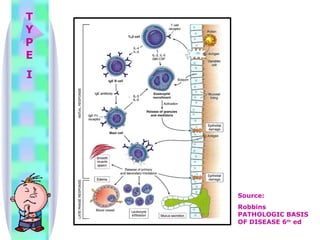
TYPE I Source: Robbins PATHOLOGIC BASIS OF DISEASE 6 th  ed
LOCAL ANAPHYLAXIS Atopy     genetically determined predisposition to develop localized anaphylactic reactions to inhaled or ingested allergens (+) family history    chr. 5q31 With higher serum IgE levels compared to general population Type I Hypersensitivity
LOCAL ANAPHYLAXIS Two phases: Initial response Vasodilation, vascular leakage, smooth muscle spasm or glandular secretions 5-30 min. after exposure    subside in 60 minutes Type I Hypersensitivity
LOCAL ANAPHYLAXIS Two phases: Late-phase reaction 2-8 hrs. later without additional exposure to antigen More intense infiltration of tissues with eosinophils, neutrophils, basophils, monocytes & CD4+ T cells With mucosal epithelial damage Type I Hypersensitivity
SYSTEMIC ANAPHYLAXIS Occur after administration of heterologous proteins (e.g. antisera), hormones, enzymes, polysaccharides & drugs Exposure    itching, hives & skin erythema    contraction of resp. bronchioles + resp. distress (+) laryngeal edema Type I Hypersensitivity
CLINICAL EXAMPLES: Atopic disorders Allergic rhinitis, hay fever, asthma, atopic dermatitis, urticaria Anaphylaxis Type I Hypersensitivity
PRIMARY MEDIATORS: BIOGENIC AMINES Histamine Adenosine – enhance mast cell mediator release CHEMOTACTIC MEDIATORS ENZYMES – proteases, acid hydrolases PROTEOGLYCANS – heparin, chondroitin sulfate    package & store other mediators in the granules Type I Hypersensitivity
SECONDARY MEDIATORS: LEUKOTRIENES – LTC 4  , LTD 4     most potent vasoactive & spasmogenic agents known; LTB 4  (chemotaxis) PROSTAGLANDIN D 2  – most abundant in mast cells PAF – release of histamine, bronchospasm, inc. vasc. permeability, vasodilation CYTOKINES – e.g. TNF  , IL-1, IL-3, IL-4, IL-5, IL-6 Type I Hypersensitivity
DIAGNOSIS: History Skin prick test – (+) wheal & flare Blood eosinophilia RAST (Radioallergosorbent assay) Type I Hypersensitivity
TREATMENT: Anti-histamine – acts on first phase only Corticosteroids – late phase reaction Desensitization – to induce tolerance; no IgE production    deplete already bound IgE  Type I Hypersensitivity
Mediated by antibodies directed toward antigens present on the surface of cells or other tissue components IgG and IgM Antigenic determinants – intrinsic or exogenous Type II Hypersensitivity
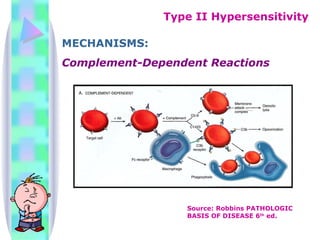
MECHANISMS: Complement-Dependent Reactions Antibody-Complement-mediated lysis Antibody (IgM/IgG) + antigen on cell surface    (+) activation of complement system    (+) MAC Type II Hypersensitivity
MECHANISMS: Complement-Dependent Reactions Type II Hypersensitivity Source: Robbins PATHOLOGIC BASIS OF DISEASE 6 th  ed.
MECHANISMS: Complement-Dependent Reactions Transfusion reactions Erythroblastosis fetalis Autoimmune hemolytic anemia, agranulocytosis, thrombocytopenia – (+) antibodies vs own blood cells Pemphigus vulgaris – Ab’s vs. desmosomes Drug reactions Type II Hypersensitivity
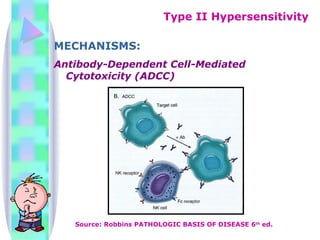
MECHANISMS: Antibody-Dependent Cell-Mediated Cytotoxicity (ADCC) due to NK activity    non-sensitized cells with Fc receptors Ab + Ag    activation of NK cells    bind to Fc fragment of IgG    cell lysis without phagocytosis Destruction of targets too large to be phagocytosed (parasites, tumor cells) + graft rejection Type II Hypersensitivity
MECHANISMS: Antibody-Dependent Cell-Mediated Cytotoxicity (ADCC) Type II Hypersensitivity Source: Robbins PATHOLOGIC BASIS OF DISEASE 6 th  ed.
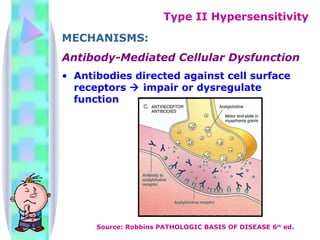
MECHANISMS: Antibody-Mediated Cellular Dysfunction Antibodies directed against cell surface receptors    impair or dysregulate function  Type II Hypersensitivity Source: Robbins PATHOLOGIC BASIS OF DISEASE 6 th  ed.
MECHANISMS: Antibody-Mediated Cellular Dysfunction Myasthenia gravis – acetylcholine receptors Goodpasture’s syndrome – type IV collagen Pernicious anemia – intrinsic factor Acute rheumatic fever – antibodies vs. Streptococcal antigens cross-react with heart Type II Hypersensitivity
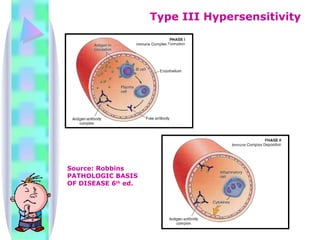
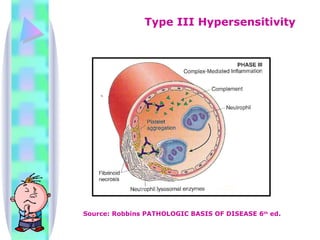
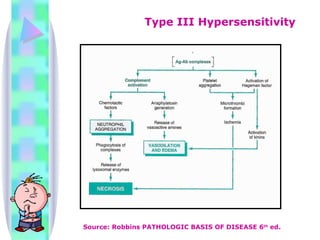
Immune Complex Mediated Formation of immune complexes in circulation    deposit in various tissues    trigger classical pathway of complement activation Produce damage as they localize within blood vessel walls or when trapped in filtering structures (e.g. renal glomeruli) Type III Hypersensitivity
Type III Hypersensitivity Source: Robbins PATHOLOGIC BASIS OF DISEASE 6 th  ed.
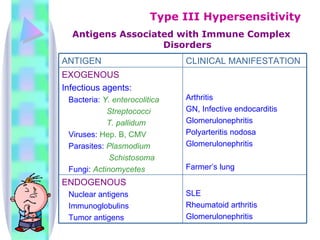
Antigens Associated with Immune Complex Disorders Type III Hypersensitivity SLE Rheumatoid arthritis Glomerulonephritis ENDOGENOUS Nuclear antigens Immunoglobulins Tumor antigens Arthritis GN, Infective endocarditis Glomerulonephritis Polyarteritis nodosa Glomerulonephritis Farmer’s lung EXOGENOUS Infectious agents: Bacteria:  Y. enterocolitica Streptococci T. pallidum Viruses:  Hep. B, CMV Parasites:  Plasmodium Schistosoma Fungi:  Actinomycetes CLINICAL MANIFESTATION ANTIGEN
SERUM SICKNESS Patient forms antibodies to xenogeneic Ig administered during passive immune therapy regimens ARTHUS REACTION Seen when boosters are administered to individuals who already possess high antibody titers to vaccine molecules Localized area to tissue necrosis    edema, hemorrhage, ulceration Develop over a few hours Type III Hypersensitivity
Cell-mediated hypersensitivity Initiated by sensitized T lymphocytes Principal pattern of immunologic response to intracellular microbiologic agents (particularly  Mycobacterium tuberculosis ) as well as viruses, fungi, protozoa & parasites Type IV Hypersensitivity
Two forms: Delayed-type hypersensitivity Mediated by CD4 T cells 1 st  exposure to Ag    CD4 T cells + class II MHC    differentiation of naïve CD4 T cells to T H 1 cells    release of IL-12, IFN-  , IL-2, TNF   & lymphotoxin Tuberculin skin test, contact dermatitis, granulomatous inflammation Type IV Hypersensitivity
Two forms: T Cell-Mediated Cytotoxicity Mediated by CD8+ T cells Sensitized CD8+ T cells kill antigen-bearing target cells Graft rejection, virus infections, tumor immunity Type IV Hypersensitivity
Two forms: T Cell-Mediated Cytotoxicity Two mechanisms: Perforin-granzyme-dependent killing    cause perforation of plasma membrane Fas-FasL-dependent killing    activation of apoptosis Type IV Hypersensitivity

Hypersensitivity

  • 1.
    Hypersensitivity Reactions FEA. BARTOLOME, MD. FPASMAP Department of Microbiology Our Lady of Fatima University
  • 2.
    Exaggerated or misdirectedimmune response Results in tissue injury or other pathophysiological changes Occurs when an already sensitized individual is re-exposed to the same foreign substance May be immediate or delayed
  • 3.
    Ensuing tissue injurymay be caused by: Release of vasoactive substances Phagocytosis or lysis of cells Activation of inflammatory & cytolytic components of complement system Release of cytokines, proteolytic enzymes and other mediators of tissue injury or inflammation
  • 4.
    Immediate/Anaphylactic type IgE-mediatedOccur within minutes Provoked by re-exposure to the same antigen (by contact, inhalation, ingestion or injection) Local or systemic Type I Hypersensitivity
  • 5.
    TYPE I Source:Robbins PATHOLOGIC BASIS OF DISEASE 6 th ed
  • 6.
    LOCAL ANAPHYLAXIS Atopy  genetically determined predisposition to develop localized anaphylactic reactions to inhaled or ingested allergens (+) family history  chr. 5q31 With higher serum IgE levels compared to general population Type I Hypersensitivity
  • 7.
    LOCAL ANAPHYLAXIS Twophases: Initial response Vasodilation, vascular leakage, smooth muscle spasm or glandular secretions 5-30 min. after exposure  subside in 60 minutes Type I Hypersensitivity
  • 8.
    LOCAL ANAPHYLAXIS Twophases: Late-phase reaction 2-8 hrs. later without additional exposure to antigen More intense infiltration of tissues with eosinophils, neutrophils, basophils, monocytes & CD4+ T cells With mucosal epithelial damage Type I Hypersensitivity
  • 9.
    SYSTEMIC ANAPHYLAXIS Occurafter administration of heterologous proteins (e.g. antisera), hormones, enzymes, polysaccharides & drugs Exposure  itching, hives & skin erythema  contraction of resp. bronchioles + resp. distress (+) laryngeal edema Type I Hypersensitivity
  • 10.
    CLINICAL EXAMPLES: Atopicdisorders Allergic rhinitis, hay fever, asthma, atopic dermatitis, urticaria Anaphylaxis Type I Hypersensitivity
  • 11.
    PRIMARY MEDIATORS: BIOGENICAMINES Histamine Adenosine – enhance mast cell mediator release CHEMOTACTIC MEDIATORS ENZYMES – proteases, acid hydrolases PROTEOGLYCANS – heparin, chondroitin sulfate  package & store other mediators in the granules Type I Hypersensitivity
  • 12.
    SECONDARY MEDIATORS: LEUKOTRIENES– LTC 4 , LTD 4  most potent vasoactive & spasmogenic agents known; LTB 4 (chemotaxis) PROSTAGLANDIN D 2 – most abundant in mast cells PAF – release of histamine, bronchospasm, inc. vasc. permeability, vasodilation CYTOKINES – e.g. TNF  , IL-1, IL-3, IL-4, IL-5, IL-6 Type I Hypersensitivity
  • 13.
    DIAGNOSIS: History Skinprick test – (+) wheal & flare Blood eosinophilia RAST (Radioallergosorbent assay) Type I Hypersensitivity
  • 14.
    TREATMENT: Anti-histamine –acts on first phase only Corticosteroids – late phase reaction Desensitization – to induce tolerance; no IgE production  deplete already bound IgE Type I Hypersensitivity
  • 15.
    Mediated by antibodiesdirected toward antigens present on the surface of cells or other tissue components IgG and IgM Antigenic determinants – intrinsic or exogenous Type II Hypersensitivity
  • 16.
    MECHANISMS: Complement-Dependent ReactionsAntibody-Complement-mediated lysis Antibody (IgM/IgG) + antigen on cell surface  (+) activation of complement system  (+) MAC Type II Hypersensitivity
  • 17.
    MECHANISMS: Complement-Dependent ReactionsType II Hypersensitivity Source: Robbins PATHOLOGIC BASIS OF DISEASE 6 th ed.
  • 18.
    MECHANISMS: Complement-Dependent ReactionsTransfusion reactions Erythroblastosis fetalis Autoimmune hemolytic anemia, agranulocytosis, thrombocytopenia – (+) antibodies vs own blood cells Pemphigus vulgaris – Ab’s vs. desmosomes Drug reactions Type II Hypersensitivity
  • 19.
    MECHANISMS: Antibody-Dependent Cell-MediatedCytotoxicity (ADCC) due to NK activity  non-sensitized cells with Fc receptors Ab + Ag  activation of NK cells  bind to Fc fragment of IgG  cell lysis without phagocytosis Destruction of targets too large to be phagocytosed (parasites, tumor cells) + graft rejection Type II Hypersensitivity
  • 20.
    MECHANISMS: Antibody-Dependent Cell-MediatedCytotoxicity (ADCC) Type II Hypersensitivity Source: Robbins PATHOLOGIC BASIS OF DISEASE 6 th ed.
  • 21.
    MECHANISMS: Antibody-Mediated CellularDysfunction Antibodies directed against cell surface receptors  impair or dysregulate function Type II Hypersensitivity Source: Robbins PATHOLOGIC BASIS OF DISEASE 6 th ed.
  • 22.
    MECHANISMS: Antibody-Mediated CellularDysfunction Myasthenia gravis – acetylcholine receptors Goodpasture’s syndrome – type IV collagen Pernicious anemia – intrinsic factor Acute rheumatic fever – antibodies vs. Streptococcal antigens cross-react with heart Type II Hypersensitivity
  • 23.
    Immune Complex MediatedFormation of immune complexes in circulation  deposit in various tissues  trigger classical pathway of complement activation Produce damage as they localize within blood vessel walls or when trapped in filtering structures (e.g. renal glomeruli) Type III Hypersensitivity
  • 24.
    Type III HypersensitivitySource: Robbins PATHOLOGIC BASIS OF DISEASE 6 th ed.
  • 25.
    Type III HypersensitivitySource: Robbins PATHOLOGIC BASIS OF DISEASE 6 th ed.
  • 26.
    Type III HypersensitivitySource: Robbins PATHOLOGIC BASIS OF DISEASE 6 th ed.
  • 27.
    Antigens Associated withImmune Complex Disorders Type III Hypersensitivity SLE Rheumatoid arthritis Glomerulonephritis ENDOGENOUS Nuclear antigens Immunoglobulins Tumor antigens Arthritis GN, Infective endocarditis Glomerulonephritis Polyarteritis nodosa Glomerulonephritis Farmer’s lung EXOGENOUS Infectious agents: Bacteria: Y. enterocolitica Streptococci T. pallidum Viruses: Hep. B, CMV Parasites: Plasmodium Schistosoma Fungi: Actinomycetes CLINICAL MANIFESTATION ANTIGEN
  • 28.
    SERUM SICKNESS Patientforms antibodies to xenogeneic Ig administered during passive immune therapy regimens ARTHUS REACTION Seen when boosters are administered to individuals who already possess high antibody titers to vaccine molecules Localized area to tissue necrosis  edema, hemorrhage, ulceration Develop over a few hours Type III Hypersensitivity
  • 29.
    Cell-mediated hypersensitivity Initiatedby sensitized T lymphocytes Principal pattern of immunologic response to intracellular microbiologic agents (particularly Mycobacterium tuberculosis ) as well as viruses, fungi, protozoa & parasites Type IV Hypersensitivity
  • 30.
    Two forms: Delayed-typehypersensitivity Mediated by CD4 T cells 1 st exposure to Ag  CD4 T cells + class II MHC  differentiation of naïve CD4 T cells to T H 1 cells  release of IL-12, IFN-  , IL-2, TNF  & lymphotoxin Tuberculin skin test, contact dermatitis, granulomatous inflammation Type IV Hypersensitivity
  • 31.
    Two forms: TCell-Mediated Cytotoxicity Mediated by CD8+ T cells Sensitized CD8+ T cells kill antigen-bearing target cells Graft rejection, virus infections, tumor immunity Type IV Hypersensitivity
  • 32.
    Two forms: TCell-Mediated Cytotoxicity Two mechanisms: Perforin-granzyme-dependent killing  cause perforation of plasma membrane Fas-FasL-dependent killing  activation of apoptosis Type IV Hypersensitivity