by
Hassaan Ali Gad
Assistant lecturer of urology
Aswan University
Diagnosis And Management Of
Hydronephrosis
Agenda
 DEFINITION
 ETIOLOGY
 PATHOLOGY
 CLINICAL FEATURES
 INVESTIGATIONS
 TREATMENT
hassan.ali@aswu.edu.eg
Definition
Aseptic progressive dilatation of the pelvi-calyceal
system resulting from the volume overload on the
upper urinary tract.
hassan.ali@aswu.edu.eg
Etiology
I) Obstructive causes :
II) Reflux causes :
UNILATERAL
 BILATERAL
hassan.ali@aswu.edu.eg
Any obstructive causes from PUJ to VUJ
intra-luminal ,luminal or extra-luminal
 CONGENITAL
 INFLAMMATORY
 NEOPLASTIC
 TRAUMATIC
 STONES
Obstructive causes
hassan.ali@aswu.edu.eg
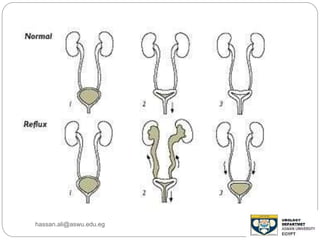
Reflux causes
Urine reflux through the UVJ into the ureter upwards the
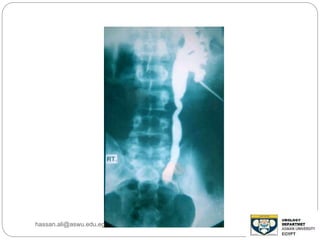
kidney
 Primary vesico-ureteral reflux:
 Secondary vesico-ureteral reflux:
infra-vesical obstructions from the bladder neck down to the
external urethral meatus.
 CONGENITAL
 INFLAMMATORY
 NEOPLASTIC
 TRAUMATIC
 STONES
• NEUROGENIC
hassan.ali@aswu.edu.eg
Pathogenesis :
Presence of obstruction or reflux will result in
a volume overload which leads to gradual
increase in the intracalyceal pressure which
will lead to compression of the blood supply
resulting in parenchymal ischemia that ends
by parenchymatous atrophy.
hassan.ali@aswu.edu.eg
course and stages
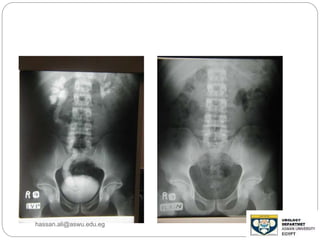
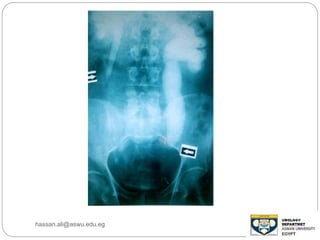
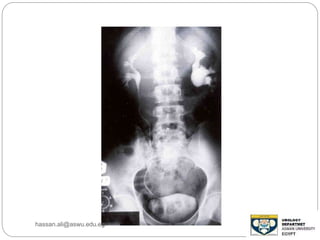
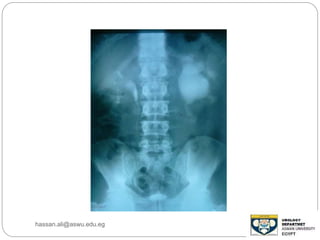
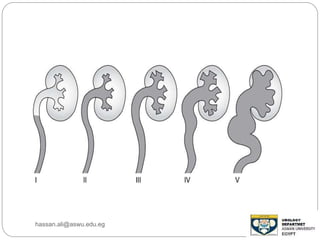
1. Mild hydronephrosis : Renal calyces become flat then clubbed
and lately become ballooned; the parenchyma between the
minor calyces are thinned out but is still present i.e. the
kidney still has minor and major calyces.
2. Moderate hydronephrosis : the parenchyma between the
calyces are eaten up so the kidney becomes with major
calyces without minor calyces.
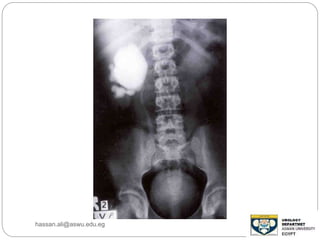
3. Advanced hydronephrosis : Both minor and major calyces are
lost and the kidney becomes as a sac of urine.
 Functioning.
 Non functioning.
hassan.ali@aswu.edu.eg
Terms according to extent of dilatation:
 Hydrocalyx : Dilatation of a renal calyx.
 Hydropelvis: Dilatation of the renal pelvis.
 Hydronephrosis: Dilatation of the pelvi-calyceal system.
 Hydroureter: Dilatation of the ureter.
 Hydro-uretero-nephrosis: Dilatation of both the ureter and
kidney
hassan.ali@aswu.edu.eg
Clinical manifestations
 Obstructive cases :
 Colicky pain:
 Renal pain:
 Renal swelling
 Gastro-intestinal manifestations : As dyspepsia.
 Manifestations of complications : e.g. ruptured kidney,
infections, hematonephrosis.
 Manifestations of chronic renal failure:
hassan.ali@aswu.edu.eg
Reflux cases
 LUTs /BPH
 Chronic retention : gradual increase in the
amount of residual urine inside the bladder
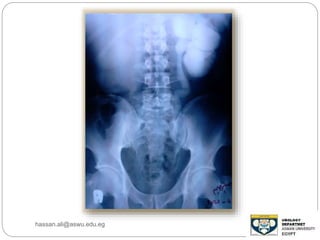
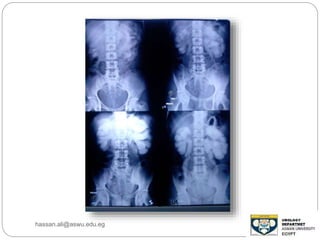
 Chronic retention with overflow incontinence.
 Renal pain.
 Renal infections.
 Renal swelling : The kidney size is normal or
slightly enlarged
 Chronic Renal Failure manifestation
hassan.ali@aswu.edu.eg
Characteristics of hydronephrotic swelling by
examination:
• Oblong lobulated surface cystic with
rounded borders.
• Felt in the loin, or can be pushed in
the loin.
• Directed downwards.
• The hand can be insinuated between
it and the costal margin
• ballotable mass
• renal contact.
hassan.ali@aswu.edu.eg
Investigations :
- RADIOLOGICAL
- LABORATORY
laboratory :
 Urine analysis and culture and sensitivity test
 Renal function testes
 Electrolytes( Na K Ph)
hassan.ali@aswu.edu.eg
Radiological
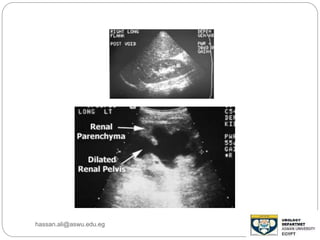
 Abdominal ultrasonography
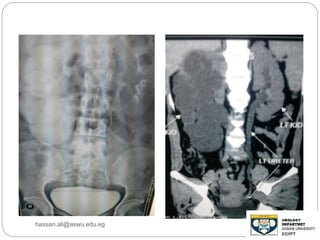
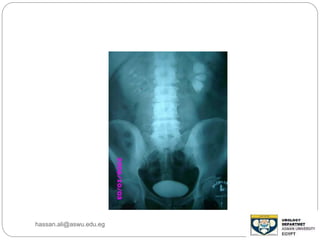
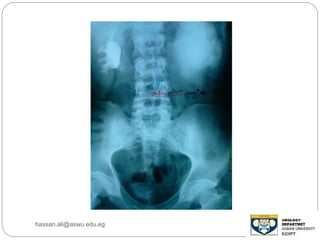
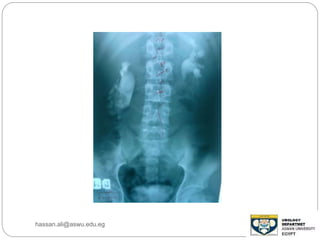
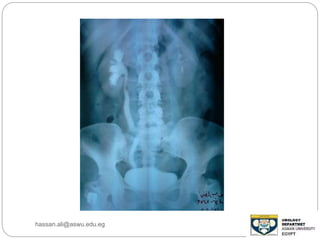
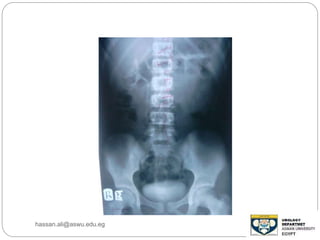
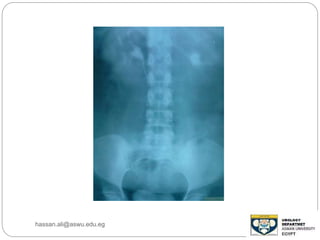
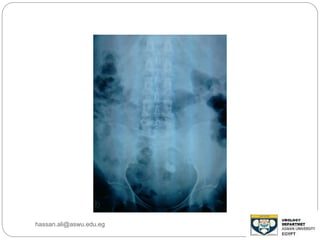
 Plain X-Ray urinary tract (KUB film)
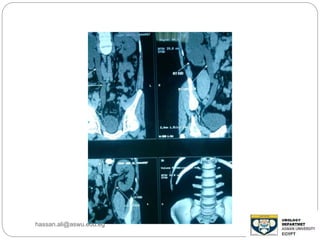
 CT-UT with or without contrast
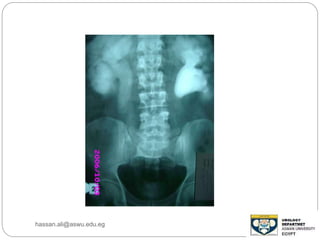
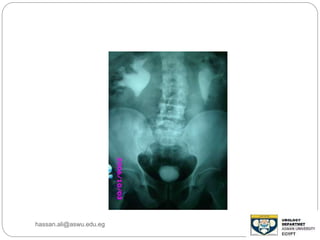
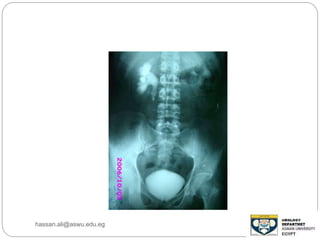
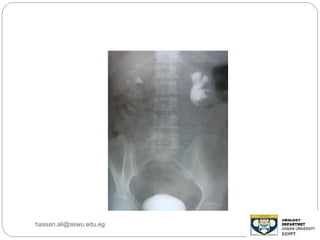
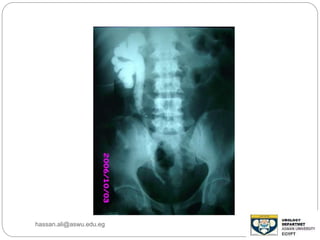
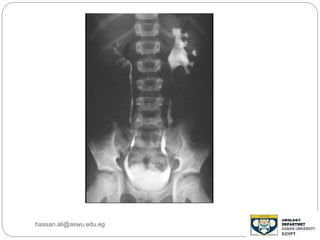
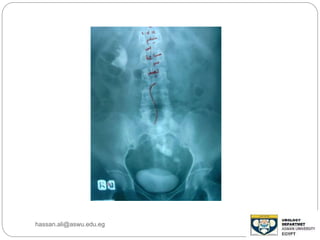
 Intravenous urography (IVU)
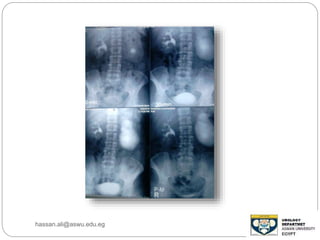
 Voiding cystourethrography(VCUG) :
 Antegrade nephrostography or Retro-grade
pyelography:
 MRU
 Renogram
hassan.ali@aswu.edu.eg
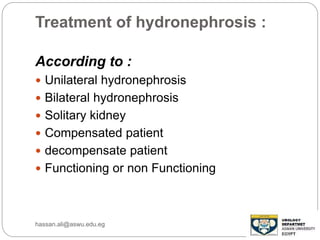
Treatment of hydronephrosis :
According to :
 Unilateral hydronephrosis
 Bilateral hydronephrosis
 Solitary kidney
 Compensated patient
 decompensate patient
 Functioning or non Functioning
hassan.ali@aswu.edu.eg
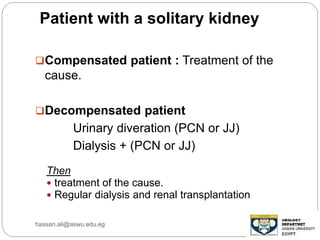
Patient with a solitary kidney
Compensated patient : Treatment of the
cause.
Decompensated patient
Urinary diveration (PCN or JJ)
Dialysis + (PCN or JJ)
Then
 treatment of the cause.
 Regular dialysis and renal transplantation
hassan.ali@aswu.edu.eg
Unilateral hydronephrosis :
 Functioning kidney:
Treatment of the cause.
 Non-functioning kidney :
± Nephrectomy
hassan.ali@aswu.edu.eg
Bilateral hydronephrosis :
 Decompensated patient :
 ± Dialysis + PCN treatment of the cause.
We can begin with ;
 The better side, if equally affected, begin with
 The painful side, if equally affected, begin with
 The infected side.
 Regular dialysis and renal transplantation
hassan.ali@aswu.edu.eg
Bilateral hydronephrosis :
 1. Compensated patient :
Treatment of the cause and we begin with ;
 The worst side, but if equally affected , we begin with
 The painful side, but if equally affected, we begin with
 The infected side.
hassan.ali@aswu.edu.eg
Any Questions ?
hassan.ali@aswu.edu.eg
Thank you
hassan.ali@aswu.edu.eg

Hydronehrosis