URINALYSIS
Practical View
Hassaan Ali Gad
Assistant lecturer of urology
Aswan University, Egypt
hassaan.ali@aswu.edu.eg
2020
TOPICS
 What is Urine
 Indication of UA
 Methods of collection of urine sample
 Types of urine sample
 Macroscopic examination of urine
 Chemical examination of urine
 Microscopic examination of urine
What is Urinalysis
• The ultrafiltration product of the plasma by the renal glomeruli.
urine is formed through a three phase process of filtration, reabsorption
,and secretion
– 180 L/day of blood filtered >80% reabsorbed
– 1-2 L/day urinary output composed of 96% water and 4% dissolved
Indication of urine analysis
• Diagnosis of disease of the kidneys or urinary
tract
• Diagnosis of other systemic disease that affect
kidney function
• Monitoring of patients with diabetes
• Screening for drug abuse
• General evaluation of health
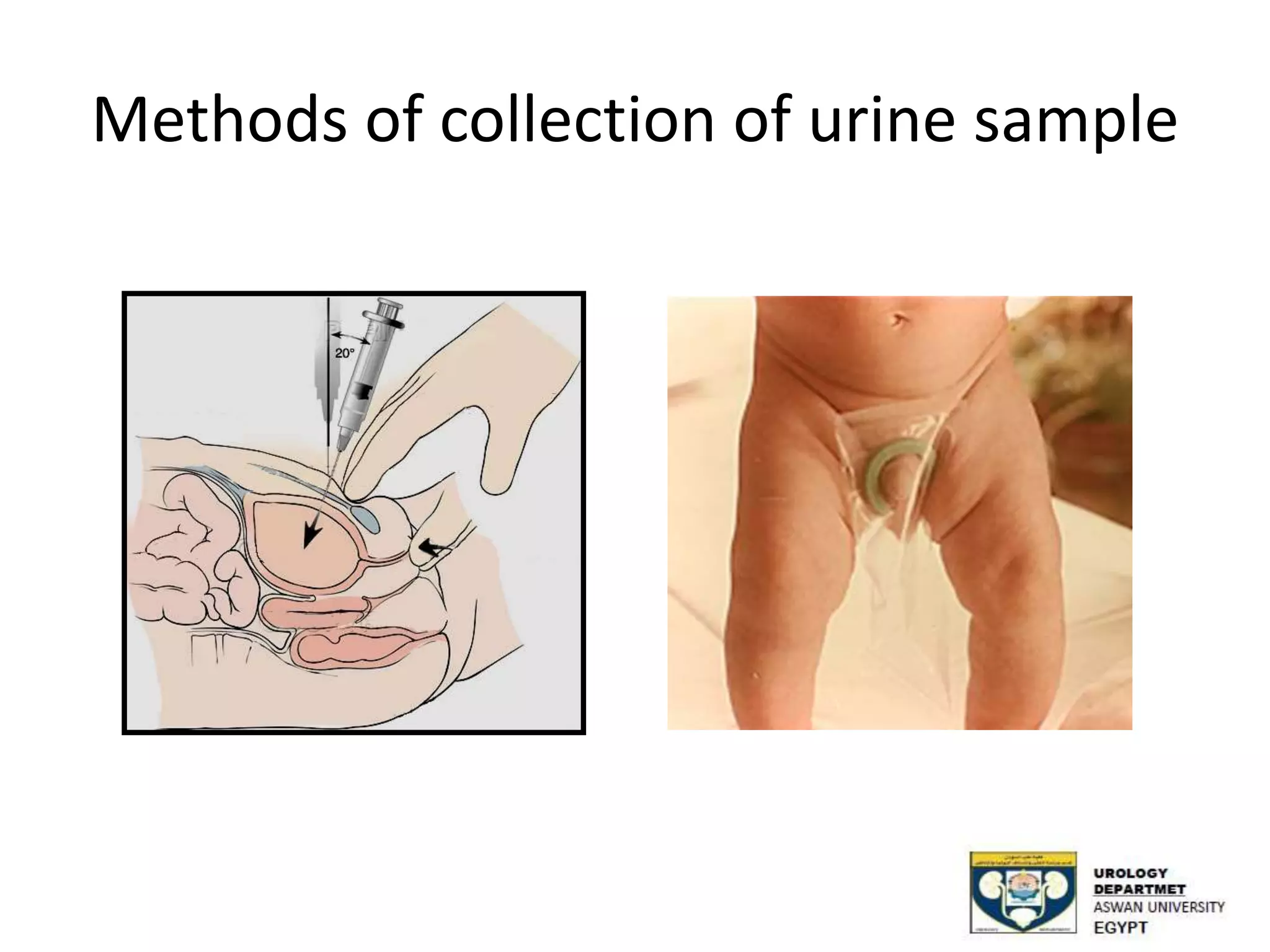
Methods of collection of urine sample
• Clean midstream voided sample
• via urethral catheter
• Suprapubic aspiration
Methods of collection of urine sample
Types of urine sample
• Random sample
• Early morning sample
• Fasting urine sample
• Post prandial sample-D.M
• 12 hour or 24 hour timed
Urine examination
• Macroscopic examination
• Chemical examination
• Microscopic examination
Macroscopic examination of urine
• Odor
• Color
• Aspect
Odor:
 Normal
aromatic due to the volatile fatty acids
 Abnormal
Ammonia-like: (Urea-splitting bacteria)
Foul, offensive: Old specimen, pus
Sweet: Glucose
Fruity: Ketones
Color
Normal:
pale yellow (amber)
Abnormal
Colorless Diluted urine/DM/DI
Deep Yellow Concentrated Urine,
Yellow-Green Bilirubin / Biliverdin
Red Blood / Hemoglobin
Brownish-red Acidified Blood (Actute GN)
Milky-purulent UTI, chyluria
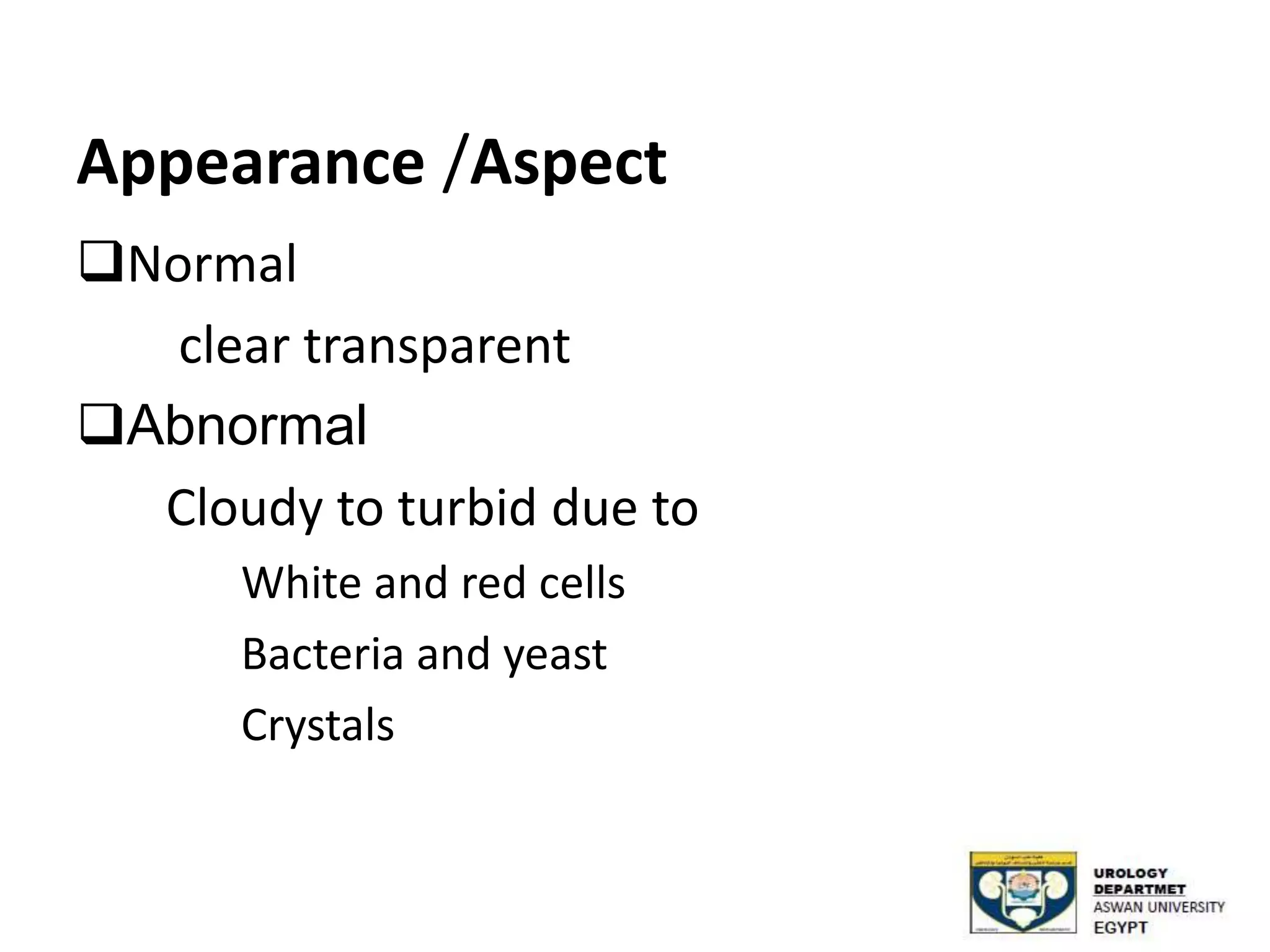
Appearance /Aspect
Normal
clear transparent
Abnormal
Cloudy to turbid due to
White and red cells
Bacteria and yeast
Crystals
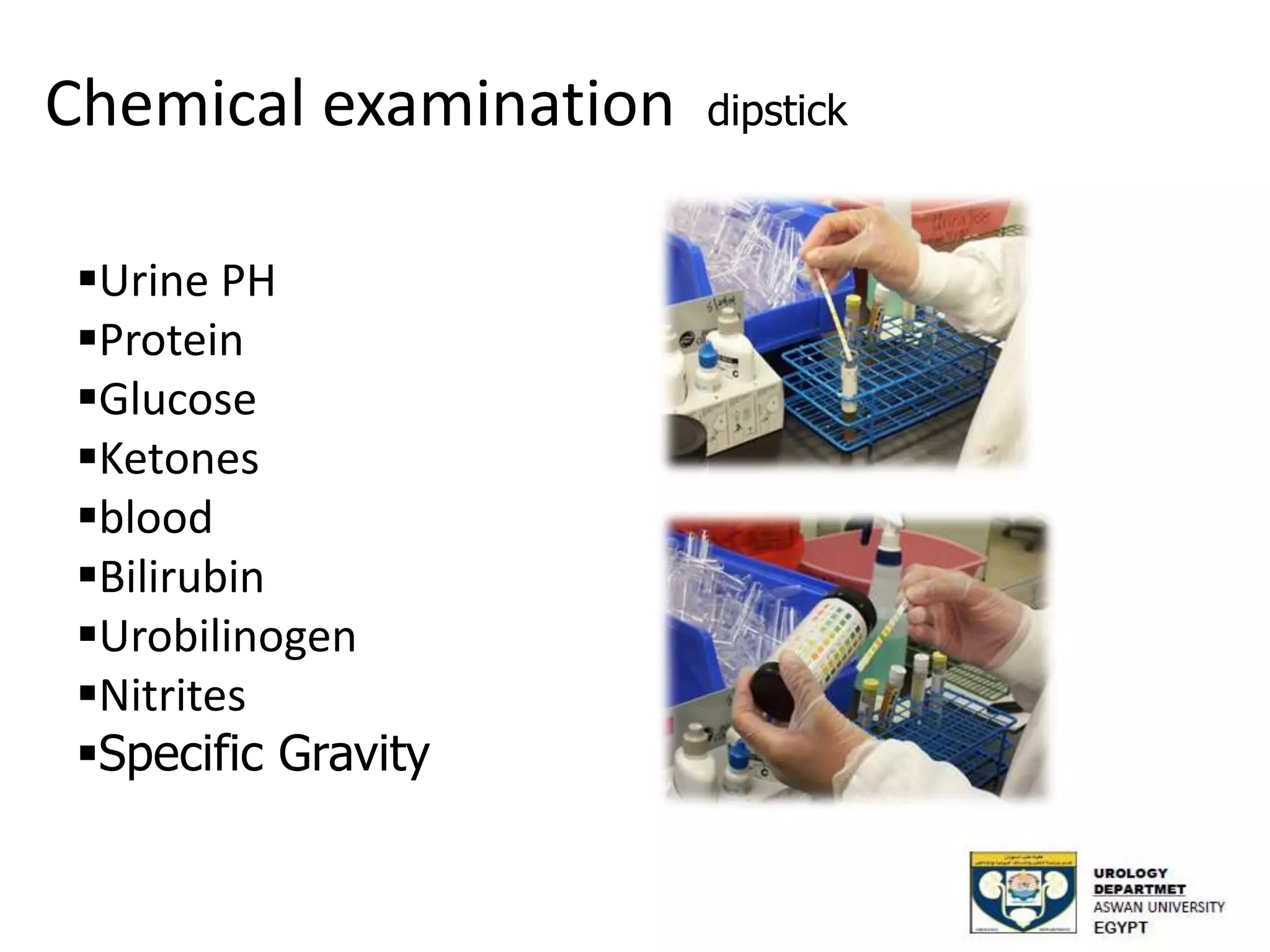
Chemical examination dipstick
Urine PH
Protein
Glucose
Ketones
blood
Bilirubin
Urobilinogen
Nitrites
Specific Gravity
Chemical examination dipstick
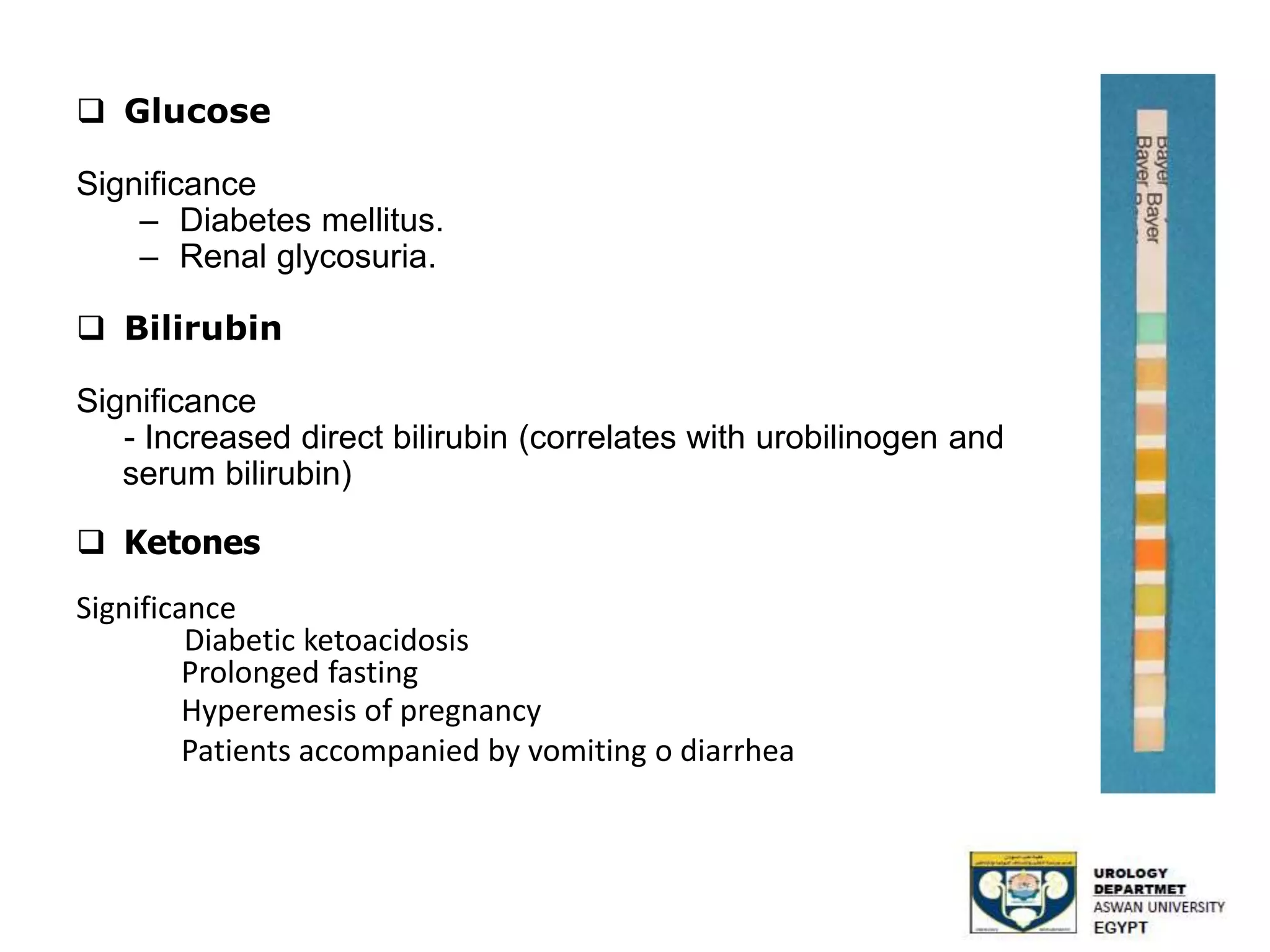
 Glucose
Significance
– Diabetes mellitus.
– Renal glycosuria.
 Bilirubin
Significance
- Increased direct bilirubin (correlates with urobilinogen and
serum bilirubin)
 Ketones
Significance
Diabetic ketoacidosis
Prolonged fasting
Hyperemesis of pregnancy
Patients accompanied by vomiting o diarrhea
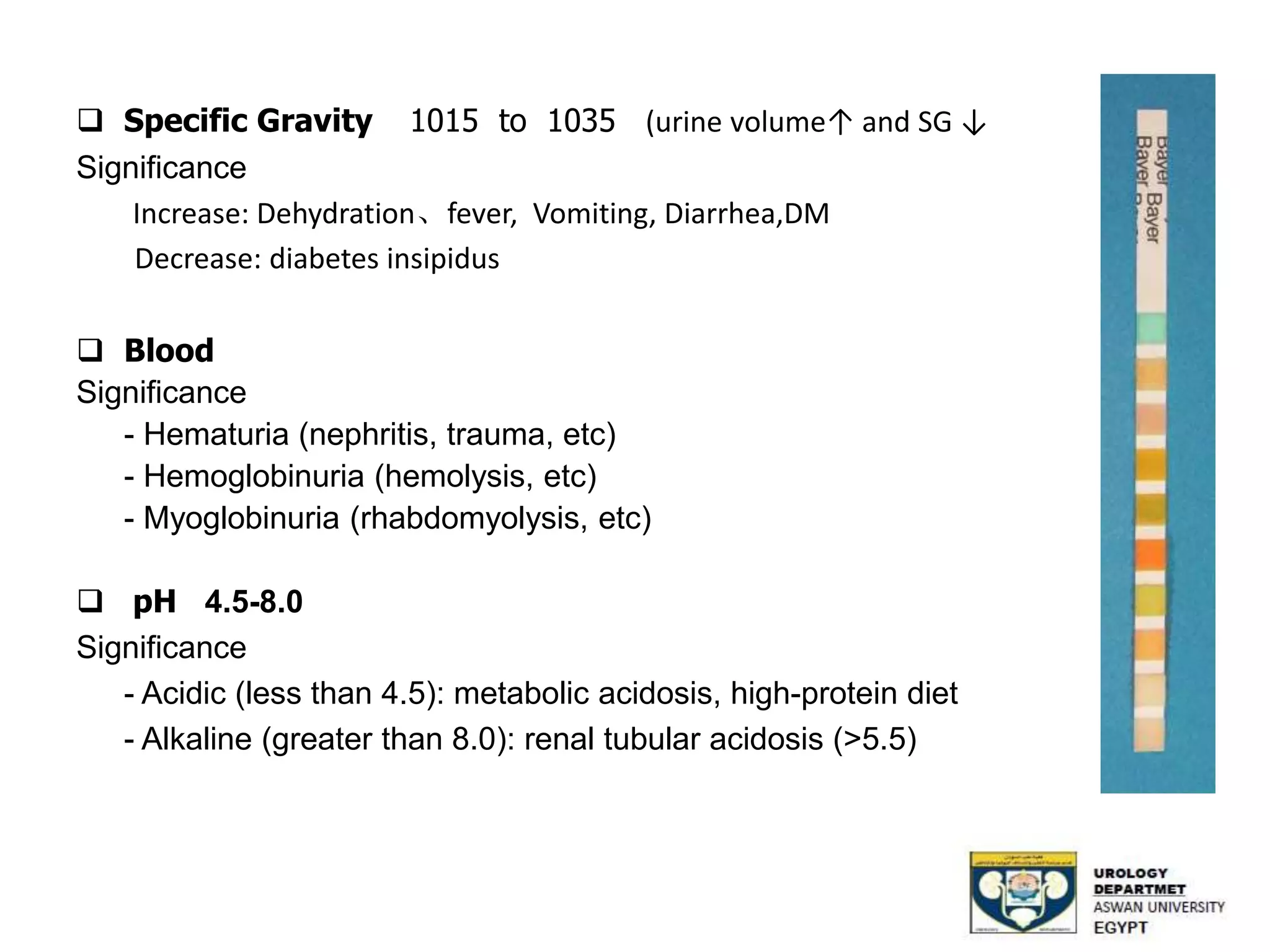
 Specific Gravity 1015 to 1035 (urine volume↑ and SG ↓
Significance
Increase: Dehydration、fever, Vomiting, Diarrhea,DM
Decrease: diabetes insipidus
 Blood
Significance
- Hematuria (nephritis, trauma, etc)
- Hemoglobinuria (hemolysis, etc)
- Myoglobinuria (rhabdomyolysis, etc)
 pH 4.5-8.0
Significance
- Acidic (less than 4.5): metabolic acidosis, high-protein diet
- Alkaline (greater than 8.0): renal tubular acidosis (>5.5)
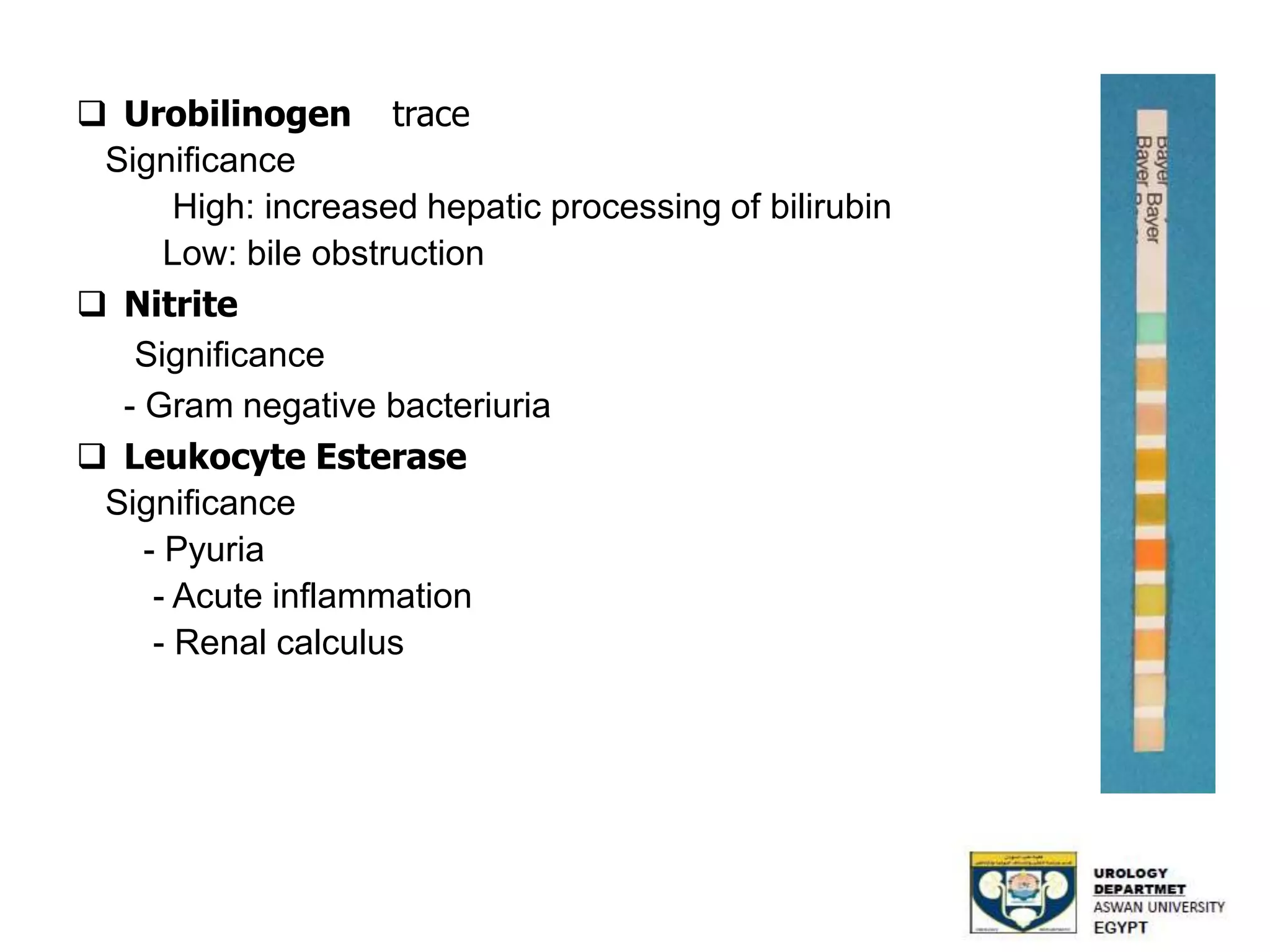
 Urobilinogen trace
Significance
High: increased hepatic processing of bilirubin
Low: bile obstruction
 Nitrite
Significance
- Gram negative bacteriuria
 Leukocyte Esterase
Significance
- Pyuria
- Acute inflammation
- Renal calculus
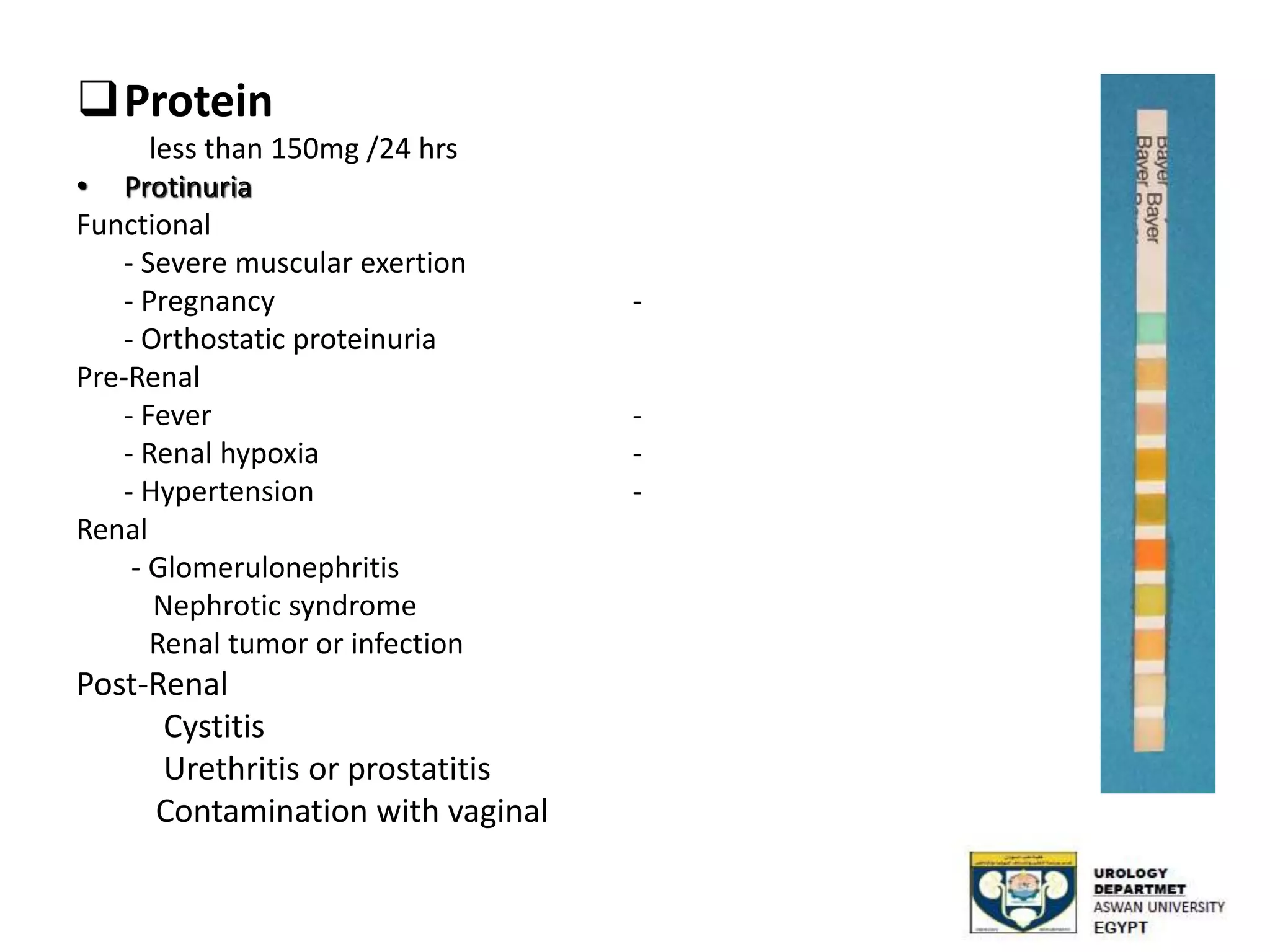
Protein
less than 150mg /24 hrs
• Protinuria
Functional
- Severe muscular exertion
- Pregnancy -
- Orthostatic proteinuria
Pre-Renal
- Fever -
- Renal hypoxia -
- Hypertension -
Renal
- Glomerulonephritis
Nephrotic syndrome
Renal tumor or infection
Post-Renal
Cystitis
Urethritis or prostatitis
Contamination with vaginal
Microscopic Examination
Urine sediment
Examination of The solid part which left in the bottom of the test tube
after centrifugation (the urine sediment)
– Erythrocytes RBC
– Leukocytes Pus cells
– Crystals
– Cast
– Renal Tubular Cells
– Bacteria
– Ova
– Parasite
– Fungi
 Red blood cells
Significant
hematuria is >3 RBCs/HPF
– presence of a few is normal
– higher numbers are indicator of renal disease
– result of bleeding at any point in urinary system
White blood cells
Pyuria is >5 WBCs/HPF
pyuria only is not diagnostic for UTI bacteria
should be present.
sterile pyuria :TB and, stones, foreign bodies
and tumors
Further assessment of UT is needed
Bacterurea
More than 10 per HPF
 Finding of even few number of bacteria in a well
collected urine sample indicated UTI
 Bacterial culture is necessary to confirm diagnosis
 Bacterial culture is specially important in recurrent
and persistent infection.
Epithelial cells:
More than 2cells
Squamous epithelium suggests contamination
from males urethra or vulva in females
Transitional epithelium may be normal in
urine
Abnormal transitional cells epithelium suggest
a urothelial tumor
Fungi
Candidiasis Most likely a contaminant
but should correlate with
clinical picture.
Viruses
CMV inclusions Probable viral cystitis.
Ova and Parasites
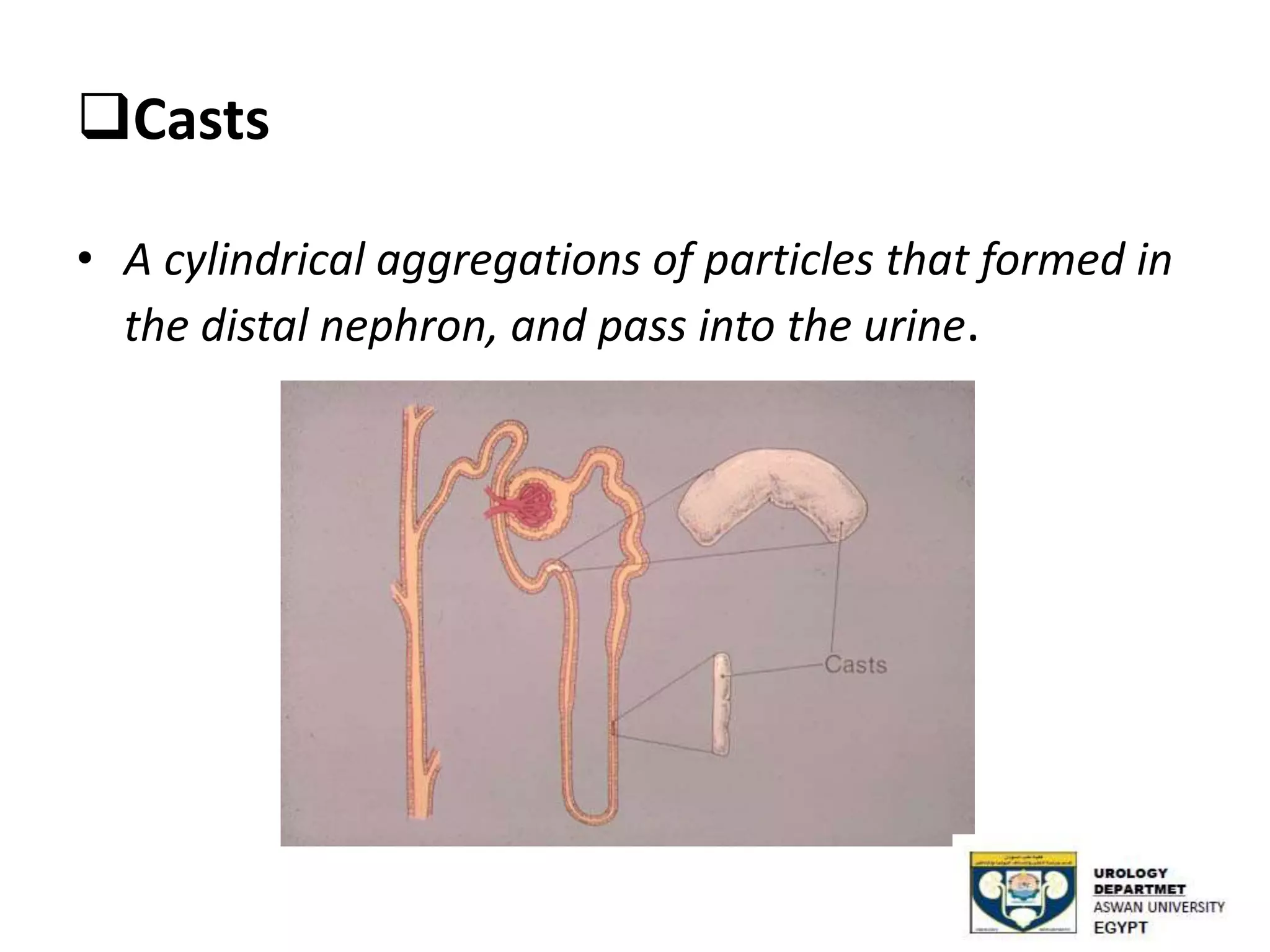
Casts
• A cylindrical aggregations of particles that formed in
the distal nephron, and pass into the urine.
Casts
Cellular
 Erythrocyte Casts: Glomerular diseases
 Leukocyte Casts: Pyuria, glomerular disease
 Epithelial cell cast ATN
Acellular
 Granular casts (Tamm-Horsfall protein) CRD
 Hyaline casts (Tamm-Horsfall protein)
 Waxy casts ESRD
 Fatty casts Nephrotic syndrome
 Crystal casts oxalates, urates
• Tamm-Horsfall mucoprotein which is secreted by renal tubule cells.
Crystals
Acidic urine
Uric acid
Calcium oxalate
Cystine
Leucine
Alkaline urine
Ammonium magnesium phosphates (triple phosphate )
Calcium carbonate
Calcium phosphate
Urinary volume
• Normal = 1ml/kg/hrs (500-1500ml)
• Polyuria- >2000ml
• Oliguria- <400ml
• Anuria- complete cessation of urine(<200ml
Any Questions ?
Thank you

urinalysis

  • 1.
    URINALYSIS Practical View Hassaan AliGad Assistant lecturer of urology Aswan University, Egypt hassaan.ali@aswu.edu.eg 2020
  • 2.
    TOPICS  What isUrine  Indication of UA  Methods of collection of urine sample  Types of urine sample  Macroscopic examination of urine  Chemical examination of urine  Microscopic examination of urine
  • 3.
    What is Urinalysis •The ultrafiltration product of the plasma by the renal glomeruli. urine is formed through a three phase process of filtration, reabsorption ,and secretion – 180 L/day of blood filtered >80% reabsorbed – 1-2 L/day urinary output composed of 96% water and 4% dissolved
  • 4.
    Indication of urineanalysis • Diagnosis of disease of the kidneys or urinary tract • Diagnosis of other systemic disease that affect kidney function • Monitoring of patients with diabetes • Screening for drug abuse • General evaluation of health
  • 5.
    Methods of collectionof urine sample • Clean midstream voided sample • via urethral catheter • Suprapubic aspiration
  • 6.
    Methods of collectionof urine sample
  • 7.
    Types of urinesample • Random sample • Early morning sample • Fasting urine sample • Post prandial sample-D.M • 12 hour or 24 hour timed
  • 8.
    Urine examination • Macroscopicexamination • Chemical examination • Microscopic examination
  • 9.
    Macroscopic examination ofurine • Odor • Color • Aspect
  • 10.
    Odor:  Normal aromatic dueto the volatile fatty acids  Abnormal Ammonia-like: (Urea-splitting bacteria) Foul, offensive: Old specimen, pus Sweet: Glucose Fruity: Ketones
  • 11.
    Color Normal: pale yellow (amber) Abnormal ColorlessDiluted urine/DM/DI Deep Yellow Concentrated Urine, Yellow-Green Bilirubin / Biliverdin Red Blood / Hemoglobin Brownish-red Acidified Blood (Actute GN) Milky-purulent UTI, chyluria
  • 12.
    Appearance /Aspect Normal clear transparent Abnormal Cloudyto turbid due to White and red cells Bacteria and yeast Crystals
  • 13.
    Chemical examination dipstick UrinePH Protein Glucose Ketones blood Bilirubin Urobilinogen Nitrites Specific Gravity
  • 14.
  • 15.
     Glucose Significance – Diabetesmellitus. – Renal glycosuria.  Bilirubin Significance - Increased direct bilirubin (correlates with urobilinogen and serum bilirubin)  Ketones Significance Diabetic ketoacidosis Prolonged fasting Hyperemesis of pregnancy Patients accompanied by vomiting o diarrhea
  • 16.
     Specific Gravity1015 to 1035 (urine volume↑ and SG ↓ Significance Increase: Dehydration、fever, Vomiting, Diarrhea,DM Decrease: diabetes insipidus  Blood Significance - Hematuria (nephritis, trauma, etc) - Hemoglobinuria (hemolysis, etc) - Myoglobinuria (rhabdomyolysis, etc)  pH 4.5-8.0 Significance - Acidic (less than 4.5): metabolic acidosis, high-protein diet - Alkaline (greater than 8.0): renal tubular acidosis (>5.5)
  • 17.
     Urobilinogen trace Significance High:increased hepatic processing of bilirubin Low: bile obstruction  Nitrite Significance - Gram negative bacteriuria  Leukocyte Esterase Significance - Pyuria - Acute inflammation - Renal calculus
  • 18.
    Protein less than 150mg/24 hrs • Protinuria Functional - Severe muscular exertion - Pregnancy - - Orthostatic proteinuria Pre-Renal - Fever - - Renal hypoxia - - Hypertension - Renal - Glomerulonephritis Nephrotic syndrome Renal tumor or infection Post-Renal Cystitis Urethritis or prostatitis Contamination with vaginal
  • 19.
    Microscopic Examination Urine sediment Examinationof The solid part which left in the bottom of the test tube after centrifugation (the urine sediment) – Erythrocytes RBC – Leukocytes Pus cells – Crystals – Cast – Renal Tubular Cells – Bacteria – Ova – Parasite – Fungi
  • 20.
     Red bloodcells Significant hematuria is >3 RBCs/HPF – presence of a few is normal – higher numbers are indicator of renal disease – result of bleeding at any point in urinary system
  • 21.
    White blood cells Pyuriais >5 WBCs/HPF pyuria only is not diagnostic for UTI bacteria should be present. sterile pyuria :TB and, stones, foreign bodies and tumors Further assessment of UT is needed
  • 22.
    Bacterurea More than 10per HPF  Finding of even few number of bacteria in a well collected urine sample indicated UTI  Bacterial culture is necessary to confirm diagnosis  Bacterial culture is specially important in recurrent and persistent infection.
  • 23.
    Epithelial cells: More than2cells Squamous epithelium suggests contamination from males urethra or vulva in females Transitional epithelium may be normal in urine Abnormal transitional cells epithelium suggest a urothelial tumor
  • 24.
    Fungi Candidiasis Most likelya contaminant but should correlate with clinical picture. Viruses CMV inclusions Probable viral cystitis. Ova and Parasites
  • 25.
    Casts • A cylindricalaggregations of particles that formed in the distal nephron, and pass into the urine.
  • 26.
    Casts Cellular  Erythrocyte Casts:Glomerular diseases  Leukocyte Casts: Pyuria, glomerular disease  Epithelial cell cast ATN Acellular  Granular casts (Tamm-Horsfall protein) CRD  Hyaline casts (Tamm-Horsfall protein)  Waxy casts ESRD  Fatty casts Nephrotic syndrome  Crystal casts oxalates, urates • Tamm-Horsfall mucoprotein which is secreted by renal tubule cells.
  • 27.
    Crystals Acidic urine Uric acid Calciumoxalate Cystine Leucine Alkaline urine Ammonium magnesium phosphates (triple phosphate ) Calcium carbonate Calcium phosphate
  • 30.
    Urinary volume • Normal= 1ml/kg/hrs (500-1500ml) • Polyuria- >2000ml • Oliguria- <400ml • Anuria- complete cessation of urine(<200ml
  • 32.
  • 33.