Tips on using my ppt.
1. You can freely download, edit, modify and put your
name etc.
2. Don’t be concerned about number of slides. Half the
slides are blanks except for the title.
3. First show the blank slides (eg. Aetiology ) > Ask
students what they already know about ethology of
today's topic. > Then show next slide which enumerates
aetiologies.
4. At the end rerun the show – show blank> ask questions >
show next slide.
5. This will be an ACTIVE LEARNING SESSION x
three revisions.
6. Good for self study also. Good for self study also.
Display blank slide> Think what you already know about
this > Read next slide.
Introduction
Introduction
• Hydronephrosis is defined as distention of
the renal calyces and pelvis with urine as a
result of obstruction of the outflow of urine

distal to the renal pelvis.
• Obstructive uropathy refers to the functional
or anatomic obstruction of urinary flow at
any level of the urinary tract. Obstructive
nephropathy is present when the obstruction
causes functional or anatomic renal damage.
• can be physiologic or pathologic. It may be
acute or chronic, unilateral or bilateral. It
can be secondary to obstruction of the
urinary tract, but it can also be present even
without obstruction.
Etiology
Etiology
• Congenital
• Traumatic
• Infections /Infestations
• Neoplastic (Benign/Malignant)
• Degenerative
Etiology
the level within the urinary tract
• intrinsic,
• extrinsic,
• functional.
Etiology intrinsic,
• Ureter
• Intrinsic ureter-level causes can be as
follows:
• Ureteropelvic junction stricture
• Ureterovesical junction obstruction
• Papillary necrosis
• Ureteral folds
•
Etiology intrinsic,
• Ureteral valves
• Ureterovesical reflux
• Ureteral stricture (iatrogenic)
• Blood clot
• Benign fibroepithelial polyps
• Ureteral tumor
• Fungus ball
• Ureteral calculus
• Neurogenic bladder
• Extrinsic ureter-level causes can be as
follows:
• Retroperitoneal lymphoma
• Retroperitoneal sarcoma
• Cervical cancer
• Prostate cancer
• Retroperitoneal fibrosis
• Aortic aneurysm
• Inflammatory bowel disease
• Ovarian vein syndrome
• Retrocaval ureter
• Uterine prolapse
• Pregnancy
• Iatrogenic ureteral ligation
• Ovarian cysts
• Diverticulitis
• Tuboovarian abscess
• Retroperitoneal hemorrhage
• Lymphocele
• Pelvic lipomatosis
• Radiation therapy
•
Etiology intrinsic,
• Ureterocele
• Endometriosis
• Tuberculosis
• Retrocaval ureter
• Functional ureter-level causes can be as
follows:
• Gram-negative infection
• Neurogenic bladder
•
•
Extrinsic ureter-level causes
• Retroperitoneal lymphoma
• Retroperitoneal sarcoma
• Cervical cancer
• Prostate cancer
• Retroperitoneal fibrosis
• Aortic aneurysm
• Inflammatory bowel disease
•
•
Extrinsic ureter-level causes
• Ovarian vein syndrome
• Retrocaval ureter
• Uterine prolapse
• Pregnancy
• Iatrogenic ureteral ligation
• Ovarian cysts
• Diverticulitis
Extrinsic ureter-level causes
• Tuboovarian abscess
• Retroperitoneal hemorrhage
• Lymphocele
• Pelvic lipomatosis
• Radiation therapy
Intrinsic bladder-level causes :
• Bladder carcinoma
• Bladder calculi
• Bladder neck contracture
• Cystocele
• Primary bladder neck hypertrophy
• Bladder diverticula
• Functional bladder-level causes can be as
follows:
• lipomatosis.
Intrinsic bladder-level causes :
• Neurogenic bladder
• Vesicoureteral reflux
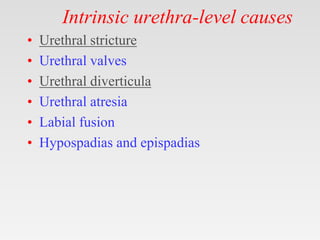
Intrinsic urethra-level causes
• Urethral stricture
• Urethral valves
• Urethral diverticula
• Urethral atresia
• Labial fusion
• Hypospadias and epispadias
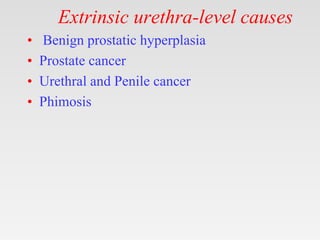
Extrinsic urethra-level causes
• Benign prostatic hyperplasia
• Prostate cancer
• Urethral and Penile cancer
• Phimosis
Clinical Features
Clinical Features
• Demography
• Symptoms
• Signs
• Complications
Clinical Features: Symptoms
Symptoms vary depending on whether the
hydronephrosis is acute or chronic.
Clinical Features: Symptoms
• Asymptomatic
• Pain ureteric colic flank pain no pain
• Site of pain – level of obstruction
• Anuria
• Hematuria
• Fever
Clinical Features: Signs
• lower extremity edema
• Costovertebral angle tenderness .
• an abdominal mass could represent an
enlarged kidney
• palpable bladder in a male infant, especially
after voiding,
Diagnostic Studies
Diagnostic Studies
• Lab works
• Imaging
Laboratory Studies
Laboratory Studies
• Urinalysis is
– Pyuria
– Microscopic hematuria
• Complete blood cell count - leukocytosis,
• Serum chemistry studies
– elevation of BUN and creatinine levels
– hyperkalemia
Imaging Studies
Imaging Studies
• Renal ultrasonography
• a plain film of the abdomen
• computed tomography (CT) scanning
• Intravenous pyelography (IVP)
• magnetic resonance imaging (MRI)
• A voiding cystourethrography (VCUG)
VUR
• Antegrade or retrograde pyelography
Differential Diagnosis
• Peripelvic cyst
• Congenital megacalices
• Calyceal diverticula
• Capacious extrarenal pelvis<>
• High urine flow
• Pyelonephritis
Non Operative Therapy
• pain control
• treatment or prevention of infection
Operative Therapy
Operative Therapy
• Minimally invasive
• Open Surgery
Management
Management
• Endoscopic stone removal
• extracorporeal shockwave lithotripsy
• Urethral catheterization
• Ureteral stent placement in cases of intrinsic
and extrinsic causes of hydronephrosis.
• cystoscopy
• retrograde pyelography.
• percutaneous nephrostomy
Operative Therapy
Operative Therapy
• Retroperitoneal fibrosis,
• retroperitoneal tumors, and aortic
aneurysms.
• Some stones
Questions
• Full question
• Short Note
• Long case
• Short case
• MCQs
Get this ppt in mobile
1. Download Microsoft
PowerPoint from play
store.
2. Open Google assistant
3. Open Google lens.
4. Scan qr code from
next slide.
Get my ppt collection
• https://www.slideshare.net/drpradeeppande/
edit_my_uploads
• https://www.dropbox.com/sh/x600md3cvj8
5woy/AACVMHuQtvHvl_K8ehc3ltkEa?dl
=0
• https://www.facebook.com/doctorpradeeppa
nde/?ref=pages_you_manage

Hydronephrosiis.pptx

  • 1.
    Tips on usingmy ppt. 1. You can freely download, edit, modify and put your name etc. 2. Don’t be concerned about number of slides. Half the slides are blanks except for the title. 3. First show the blank slides (eg. Aetiology ) > Ask students what they already know about ethology of today's topic. > Then show next slide which enumerates aetiologies. 4. At the end rerun the show – show blank> ask questions > show next slide. 5. This will be an ACTIVE LEARNING SESSION x three revisions. 6. Good for self study also. Good for self study also. Display blank slide> Think what you already know about this > Read next slide.
  • 2.
  • 3.
    Introduction • Hydronephrosis isdefined as distention of the renal calyces and pelvis with urine as a result of obstruction of the outflow of urine distal to the renal pelvis. • Obstructive uropathy refers to the functional or anatomic obstruction of urinary flow at any level of the urinary tract. Obstructive nephropathy is present when the obstruction causes functional or anatomic renal damage.
  • 4.
    • can bephysiologic or pathologic. It may be acute or chronic, unilateral or bilateral. It can be secondary to obstruction of the urinary tract, but it can also be present even without obstruction.
  • 5.
  • 6.
    Etiology • Congenital • Traumatic •Infections /Infestations • Neoplastic (Benign/Malignant) • Degenerative
  • 7.
    Etiology the level withinthe urinary tract • intrinsic, • extrinsic, • functional.
  • 8.
    Etiology intrinsic, • Ureter •Intrinsic ureter-level causes can be as follows: • Ureteropelvic junction stricture • Ureterovesical junction obstruction • Papillary necrosis • Ureteral folds •
  • 9.
    Etiology intrinsic, • Ureteralvalves • Ureterovesical reflux • Ureteral stricture (iatrogenic) • Blood clot • Benign fibroepithelial polyps • Ureteral tumor • Fungus ball • Ureteral calculus • Neurogenic bladder • Extrinsic ureter-level causes can be as follows:
  • 10.
    • Retroperitoneal lymphoma •Retroperitoneal sarcoma • Cervical cancer • Prostate cancer • Retroperitoneal fibrosis • Aortic aneurysm • Inflammatory bowel disease • Ovarian vein syndrome • Retrocaval ureter • Uterine prolapse • Pregnancy
  • 11.
    • Iatrogenic ureteralligation • Ovarian cysts • Diverticulitis • Tuboovarian abscess • Retroperitoneal hemorrhage • Lymphocele • Pelvic lipomatosis • Radiation therapy •
  • 12.
    Etiology intrinsic, • Ureterocele •Endometriosis • Tuberculosis • Retrocaval ureter • Functional ureter-level causes can be as follows: • Gram-negative infection • Neurogenic bladder • •
  • 13.
  • 14.
    Extrinsic ureter-level causes •Retroperitoneal lymphoma • Retroperitoneal sarcoma • Cervical cancer • Prostate cancer • Retroperitoneal fibrosis • Aortic aneurysm • Inflammatory bowel disease • •
  • 15.
    Extrinsic ureter-level causes •Ovarian vein syndrome • Retrocaval ureter • Uterine prolapse • Pregnancy • Iatrogenic ureteral ligation • Ovarian cysts • Diverticulitis
  • 16.
    Extrinsic ureter-level causes •Tuboovarian abscess • Retroperitoneal hemorrhage • Lymphocele • Pelvic lipomatosis • Radiation therapy
  • 17.
  • 18.
    Intrinsic bladder-level causes: • Bladder carcinoma • Bladder calculi • Bladder neck contracture • Cystocele • Primary bladder neck hypertrophy • Bladder diverticula • Functional bladder-level causes can be as follows: • lipomatosis.
  • 19.
    Intrinsic bladder-level causes: • Neurogenic bladder • Vesicoureteral reflux
  • 20.
  • 21.
    Intrinsic urethra-level causes •Urethral stricture • Urethral valves • Urethral diverticula • Urethral atresia • Labial fusion • Hypospadias and epispadias
  • 22.
  • 23.
    Extrinsic urethra-level causes •Benign prostatic hyperplasia • Prostate cancer • Urethral and Penile cancer • Phimosis
  • 24.
  • 25.
    Clinical Features • Demography •Symptoms • Signs • Complications
  • 26.
  • 27.
    Clinical Features: Symptoms Symptomsvary depending on whether the hydronephrosis is acute or chronic.
  • 28.
    Clinical Features: Symptoms •Asymptomatic • Pain ureteric colic flank pain no pain • Site of pain – level of obstruction • Anuria • Hematuria • Fever
  • 29.
  • 30.
    Clinical Features: Signs •lower extremity edema • Costovertebral angle tenderness . • an abdominal mass could represent an enlarged kidney • palpable bladder in a male infant, especially after voiding,
  • 31.
  • 32.
    Diagnostic Studies • Labworks • Imaging
  • 33.
  • 34.
    Laboratory Studies • Urinalysisis – Pyuria – Microscopic hematuria • Complete blood cell count - leukocytosis, • Serum chemistry studies – elevation of BUN and creatinine levels – hyperkalemia
  • 35.
  • 36.
    Imaging Studies • Renalultrasonography • a plain film of the abdomen • computed tomography (CT) scanning • Intravenous pyelography (IVP) • magnetic resonance imaging (MRI) • A voiding cystourethrography (VCUG) VUR • Antegrade or retrograde pyelography
  • 37.
  • 38.
    Differential Diagnosis • Peripelviccyst • Congenital megacalices • Calyceal diverticula • Capacious extrarenal pelvis<> • High urine flow • Pyelonephritis
  • 39.
  • 40.
    Non Operative Therapy •pain control • treatment or prevention of infection
  • 41.
  • 42.
    Operative Therapy • Minimallyinvasive • Open Surgery
  • 43.
  • 44.
    Management • Endoscopic stoneremoval • extracorporeal shockwave lithotripsy • Urethral catheterization • Ureteral stent placement in cases of intrinsic and extrinsic causes of hydronephrosis. • cystoscopy • retrograde pyelography. • percutaneous nephrostomy
  • 45.
  • 46.
    Operative Therapy • Retroperitonealfibrosis, • retroperitoneal tumors, and aortic aneurysms. • Some stones
  • 47.
    Questions • Full question •Short Note • Long case • Short case • MCQs
  • 48.
    Get this pptin mobile 1. Download Microsoft PowerPoint from play store. 2. Open Google assistant 3. Open Google lens. 4. Scan qr code from next slide.
  • 51.
    Get my pptcollection • https://www.slideshare.net/drpradeeppande/ edit_my_uploads • https://www.dropbox.com/sh/x600md3cvj8 5woy/AACVMHuQtvHvl_K8ehc3ltkEa?dl =0 • https://www.facebook.com/doctorpradeeppa nde/?ref=pages_you_manage

Editor's Notes

  • #2 drpradeeppande@gmail.com 7697305442
  • #51 drpradeeppande@gmail.com 7697305442