B.SC NURSING DEGREE COURSE
GENETICS
UNIT – IV
GENETIC CONDITIONS OF ADOLESCENTS
AND ADULTS
TOPIC : HUNTINGTON’S DISEASE
PRESENTED BY
Mrs. SOUMYA SUBRAMANI, M.Sc.(N)
LECTURER, MSN DEPARTMENT
CON- SRIPMS, COIMBATORE.
1
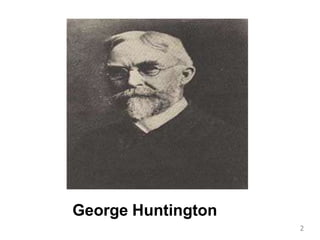
George Huntington
2
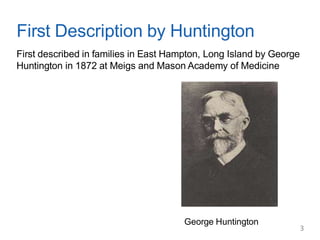
First Description by Huntington
First described in families in East Hampton, Long Island by George
Huntington in 1872 at Meigs and Mason Academy of Medicine
George Huntington
3
SYNONYM:
HUNTINGTON'S CHOREA
4
Huntington’s Disease: Overview
• Autosomal dominant
• Adult-onset (late 30’s-40’s)
– 6% present before the age of 20 (Juvenile HD)
• Prevalence 7-10 per 100,000
• Triad of clinical findings: Motor, Cognitive and
Psychiatric.
5
•
Huntington’s disease is a rapidly progressive
genetic neurodegenerative disease that leads to
dementia.
DEFENITION OF HUNTINGTON’S
DISEASE
6
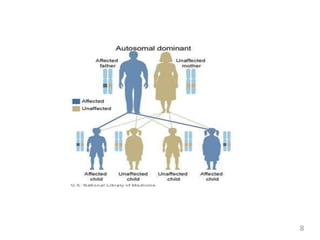
• Huntington’s is autosomal dominant.
• This means that anyone with ONE abnormal copy of the
gene will clinically have the disease.
• There are no carriers for Huntington’s.
• A parent with Huntington’s will have a 50%
chance of passing it on to their child.
7
8
Key points on autosomal dominant inheritance:
Autosomal- Both males and females can be affected with HD.
Both males and females can pass HD to their children.
Dominant- If a person has Huntington disease, there is a 50%
risk for each of their children.
If a person does not inherit HD from their parent, they cannot
pass it to their children.
Each child of a person with HD has an independent 50% risk.
(i.e. their risk is not changed by whether or not their brothers’
or sisters’ test results).
9
Discovering the HD Gene
• 1993: Identification of the gene, IT-15 Interesting
transcript-15 on short arm of chromosome 4 encoding
huntingtin.
10
*HD is caused by a faulty gene that runs in
family.
*Normal copy of gene produce a protein
contain 5 to 35 repeat of trinucleotides CAG
called huntingtin protein.
*Gene encoding reach more than 36 repeat CAG
cause HD.
*Faulty huntingtin protein interfere with nerve
function and damage nerve cell.
CAUSES AND RISK FACTORS
11
Mechanism of HD
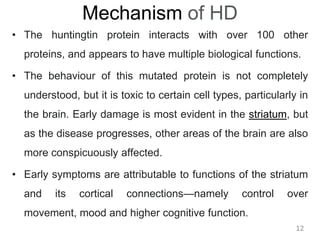
• The huntingtin protein interacts with over 100 other
proteins, and appears to have multiple biological functions.
• The behaviour of this mutated protein is not completely
understood, but it is toxic to certain cell types, particularly in
the brain. Early damage is most evident in the striatum, but
as the disease progresses, other areas of the brain are also
more conspicuously affected.
• Early symptoms are attributable to functions of the striatum
and its cortical connections—namely control over
movement, mood and higher cognitive function.
12
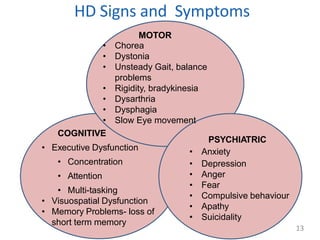
MOTOR
• Chorea
• Dystonia
• Unsteady Gait, balance
problems
• Rigidity, bradykinesia
• Dysarthria
• Dysphagia
• Slow Eye movement
COGNITIVE
• Executive Dysfunction
• Concentration
• Attention
• Multi-tasking
• Visuospatial Dysfunction
• Memory Problems- loss of
short term memory
PSYCHIATRIC
• Anxiety
• Depression
• Anger
• Fear
• Compulsive behaviour
• Apathy
• Suicidality
13
HD Signs and Symptoms
DIGNOSIS of HD
• History
Positive family history
• Clinical Findings-
Adult onset slowly progressive chorea
followed by progressive dementia.
• CT scan & MRI Scan- Ventricular dialatation
associated with Caudate nucleus atrophy
14
DIGNOSIS of HD
Genetic testing
• Predictive Genetic testing- Preimplantation genetic
diagnosis.
• Prenatal testing
• The genetic test for HD consists of a blood test which
counts the numbers of CAG repeats in each of
the HTT alleles. (Demonstration of trinucleotide CAG
expansion)
15
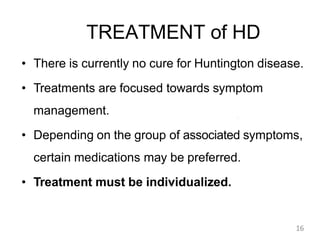
TREATMENT of HD
• There is currently no cure for Huntington disease.
• Treatments are focused towards symptom
management.
• Depending on the group of associated symptoms,
certain medications may be preferred.
• Treatment must be individualized.
16
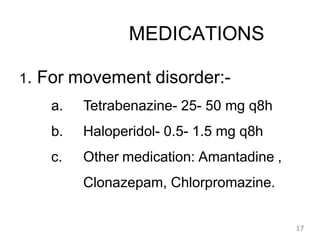
MEDICATIONS
1. For movement disorder:-
a. Tetrabenazine- 25- 50 mg q8h
b. Haloperidol- 0.5- 1.5 mg q8h
c. Other medication: Amantadine ,
Clonazepam, Chlorpromazine.
17
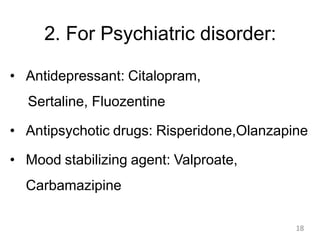
2. For Psychiatric disorder:
• Antidepressant: Citalopram,
Sertaline, Fluozentine
• Antipsychotic drugs: Risperidone,Olanzapine
• Mood stabilizing agent: Valproate,
Carbamazipine
18
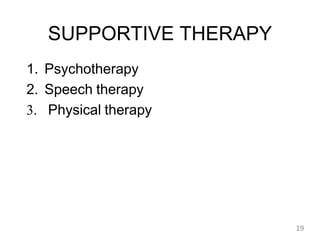
SUPPORTIVE THERAPY
1. Psychotherapy
2. Speech therapy
3. Physical therapy
19
Genetic Counseling
• Genetic counseling is the process of helping people
understand and adapt to the medical, psychological
and familial problems of the hereditary disease.
20
Genetic Counseling
• Obtain family history/establish rapport
• Information about HD
• Explanation of -Genetics of HD, juvenile onset HD
Timing of testing- CAG triplet repeats/ranges/age of
onset
• Discuss motivations for testing
• Sharing the experiences of patients with HD: living
with HD
21

Huntingtonsdisease

  • 1.
    B.SC NURSING DEGREECOURSE GENETICS UNIT – IV GENETIC CONDITIONS OF ADOLESCENTS AND ADULTS TOPIC : HUNTINGTON’S DISEASE PRESENTED BY Mrs. SOUMYA SUBRAMANI, M.Sc.(N) LECTURER, MSN DEPARTMENT CON- SRIPMS, COIMBATORE. 1
  • 2.
  • 3.
    First Description byHuntington First described in families in East Hampton, Long Island by George Huntington in 1872 at Meigs and Mason Academy of Medicine George Huntington 3
  • 4.
  • 5.
    Huntington’s Disease: Overview •Autosomal dominant • Adult-onset (late 30’s-40’s) – 6% present before the age of 20 (Juvenile HD) • Prevalence 7-10 per 100,000 • Triad of clinical findings: Motor, Cognitive and Psychiatric. 5
  • 6.
    • Huntington’s disease isa rapidly progressive genetic neurodegenerative disease that leads to dementia. DEFENITION OF HUNTINGTON’S DISEASE 6
  • 7.
    • Huntington’s isautosomal dominant. • This means that anyone with ONE abnormal copy of the gene will clinically have the disease. • There are no carriers for Huntington’s. • A parent with Huntington’s will have a 50% chance of passing it on to their child. 7
  • 8.
  • 9.
    Key points onautosomal dominant inheritance: Autosomal- Both males and females can be affected with HD. Both males and females can pass HD to their children. Dominant- If a person has Huntington disease, there is a 50% risk for each of their children. If a person does not inherit HD from their parent, they cannot pass it to their children. Each child of a person with HD has an independent 50% risk. (i.e. their risk is not changed by whether or not their brothers’ or sisters’ test results). 9
  • 10.
    Discovering the HDGene • 1993: Identification of the gene, IT-15 Interesting transcript-15 on short arm of chromosome 4 encoding huntingtin. 10
  • 11.
    *HD is causedby a faulty gene that runs in family. *Normal copy of gene produce a protein contain 5 to 35 repeat of trinucleotides CAG called huntingtin protein. *Gene encoding reach more than 36 repeat CAG cause HD. *Faulty huntingtin protein interfere with nerve function and damage nerve cell. CAUSES AND RISK FACTORS 11
  • 12.
    Mechanism of HD •The huntingtin protein interacts with over 100 other proteins, and appears to have multiple biological functions. • The behaviour of this mutated protein is not completely understood, but it is toxic to certain cell types, particularly in the brain. Early damage is most evident in the striatum, but as the disease progresses, other areas of the brain are also more conspicuously affected. • Early symptoms are attributable to functions of the striatum and its cortical connections—namely control over movement, mood and higher cognitive function. 12
  • 13.
    MOTOR • Chorea • Dystonia •Unsteady Gait, balance problems • Rigidity, bradykinesia • Dysarthria • Dysphagia • Slow Eye movement COGNITIVE • Executive Dysfunction • Concentration • Attention • Multi-tasking • Visuospatial Dysfunction • Memory Problems- loss of short term memory PSYCHIATRIC • Anxiety • Depression • Anger • Fear • Compulsive behaviour • Apathy • Suicidality 13 HD Signs and Symptoms
  • 14.
    DIGNOSIS of HD •History Positive family history • Clinical Findings- Adult onset slowly progressive chorea followed by progressive dementia. • CT scan & MRI Scan- Ventricular dialatation associated with Caudate nucleus atrophy 14
  • 15.
    DIGNOSIS of HD Genetictesting • Predictive Genetic testing- Preimplantation genetic diagnosis. • Prenatal testing • The genetic test for HD consists of a blood test which counts the numbers of CAG repeats in each of the HTT alleles. (Demonstration of trinucleotide CAG expansion) 15
  • 16.
    TREATMENT of HD •There is currently no cure for Huntington disease. • Treatments are focused towards symptom management. • Depending on the group of associated symptoms, certain medications may be preferred. • Treatment must be individualized. 16
  • 17.
    MEDICATIONS 1. For movementdisorder:- a. Tetrabenazine- 25- 50 mg q8h b. Haloperidol- 0.5- 1.5 mg q8h c. Other medication: Amantadine , Clonazepam, Chlorpromazine. 17
  • 18.
    2. For Psychiatricdisorder: • Antidepressant: Citalopram, Sertaline, Fluozentine • Antipsychotic drugs: Risperidone,Olanzapine • Mood stabilizing agent: Valproate, Carbamazipine 18
  • 19.
    SUPPORTIVE THERAPY 1. Psychotherapy 2.Speech therapy 3. Physical therapy 19
  • 20.
    Genetic Counseling • Geneticcounseling is the process of helping people understand and adapt to the medical, psychological and familial problems of the hereditary disease. 20
  • 21.
    Genetic Counseling • Obtainfamily history/establish rapport • Information about HD • Explanation of -Genetics of HD, juvenile onset HD Timing of testing- CAG triplet repeats/ranges/age of onset • Discuss motivations for testing • Sharing the experiences of patients with HD: living with HD 21