Huntington’s Disease
For final project of Understanding the Brain: the
Neurobiology of Everyday Life
Leo Xu
July, 2014
Definition
 Huntington's disease (HD) is a neurodegenerative genetic disorder
characterized by the gradual onset of defects in behavior, cognition, and
movement beginning in the fourth and fifth decades of life, with an
average life expectancy of about 10-20 years thereafter.
 The worldwide prevalence of HD is 5–10 cases per 100,000 persons.
 The hallmark of the disease is a movement
disorder consisting of rapid, jerky motions with
no clear purpose, which is why the disease used
to be called Huntington's chorea; these
choreiform movements may be confined to a
finger or may involve a whole extremity, the
facial musculature, or even the vocal apparatus.
 HD usually presents as an alternation in mood
(especially depression) or a change in
personality. Defects of memory and attention
may also occur.
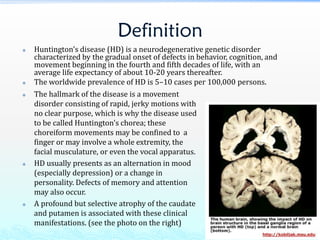
 A profound but selective atrophy of the caudate
and putamen is associated with these clinical
manifestations. (see the photo on the right)
Genetic Basis
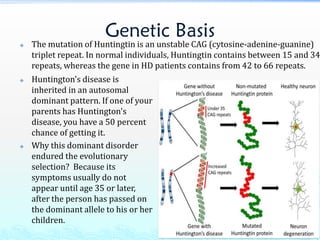
 The mutation of Huntingtin is an unstable CAG (cytosine-adenine-guanine)
triplet repeat. In normal individuals, Huntingtin contains between 15 and 34
repeats, whereas the gene in HD patients contains from 42 to 66 repeats.
 Huntington's disease is
inherited in an autosomal
dominant pattern. If one of your
parents has Huntington's
disease, you have a 50 percent
chance of getting it.
 Why this dominant disorder
endured the evolutionary
selection? Because its
symptoms usually do not
appear until age 35 or later,
after the person has passed on
the dominant allele to his or her
children.
Neurobiology
①
②
③
④
⑤⑥
⑦
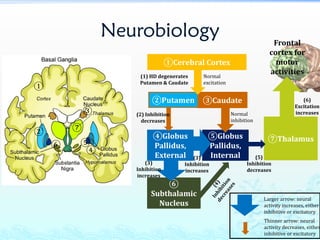
①Cerebral Cortex
②Putamen
④Globus
Pallidus,
External
⑤Globus
Pallidus,
Internal
⑥
Subthalamic
Nucleus
⑦Thalamus
Frontal
cortex for
motor
activities
③Caudate
(2) Inhibition
decreases
(3)
Inhibition
increases
(3)
Inhibition
increases
(5)
Inhibition
decreases
Normal
inhibition
Normal
excitation
(6)
Excitation
increases
(1) HD degenerates
Putamen & Caudate
Larger arrow: neural
activity increases, either
inhibitive or excitatory
Thinner arrow: neural
activity decreases, either
inhibitive or excitatory
Opinion & Treatment
 A blood test can tell you if have the HD gene and will
develop the disease. Genetic counseling can help you weigh
the risks and benefits of taking the test.
 There is no cure. Medicines can help manage some of the
symptoms, but cannot slow down or stop the disease
References
 Neuroscience 3rd edition, by Dale Purves et al
 Child Development 8th edition, by Laura E. Berk
 http://dailydiseasesanddisorders.tumblr.com/post/60401
94582/huntingtons-disease
 http://www.studyblue.com/notes/note/n/2-3-
13/deck/5374356
 http://www.eurostemcell.org/factsheet/huntington%E2%
80%99s-disease-how-could-stem-cells-help
 http://en.wikipedia.org/wiki/Huntington%27s_disease#R
esearch_directions

Huntington's Disease

  • 1.
    Huntington’s Disease For finalproject of Understanding the Brain: the Neurobiology of Everyday Life Leo Xu July, 2014
  • 2.
    Definition  Huntington's disease(HD) is a neurodegenerative genetic disorder characterized by the gradual onset of defects in behavior, cognition, and movement beginning in the fourth and fifth decades of life, with an average life expectancy of about 10-20 years thereafter.  The worldwide prevalence of HD is 5–10 cases per 100,000 persons.  The hallmark of the disease is a movement disorder consisting of rapid, jerky motions with no clear purpose, which is why the disease used to be called Huntington's chorea; these choreiform movements may be confined to a finger or may involve a whole extremity, the facial musculature, or even the vocal apparatus.  HD usually presents as an alternation in mood (especially depression) or a change in personality. Defects of memory and attention may also occur.  A profound but selective atrophy of the caudate and putamen is associated with these clinical manifestations. (see the photo on the right)
  • 3.
    Genetic Basis  Themutation of Huntingtin is an unstable CAG (cytosine-adenine-guanine) triplet repeat. In normal individuals, Huntingtin contains between 15 and 34 repeats, whereas the gene in HD patients contains from 42 to 66 repeats.  Huntington's disease is inherited in an autosomal dominant pattern. If one of your parents has Huntington's disease, you have a 50 percent chance of getting it.  Why this dominant disorder endured the evolutionary selection? Because its symptoms usually do not appear until age 35 or later, after the person has passed on the dominant allele to his or her children.
  • 4.
    Neurobiology ① ② ③ ④ ⑤⑥ ⑦ ①Cerebral Cortex ②Putamen ④Globus Pallidus, External ⑤Globus Pallidus, Internal ⑥ Subthalamic Nucleus ⑦Thalamus Frontal cortex for motor activities ③Caudate (2)Inhibition decreases (3) Inhibition increases (3) Inhibition increases (5) Inhibition decreases Normal inhibition Normal excitation (6) Excitation increases (1) HD degenerates Putamen & Caudate Larger arrow: neural activity increases, either inhibitive or excitatory Thinner arrow: neural activity decreases, either inhibitive or excitatory
  • 5.
    Opinion & Treatment A blood test can tell you if have the HD gene and will develop the disease. Genetic counseling can help you weigh the risks and benefits of taking the test.  There is no cure. Medicines can help manage some of the symptoms, but cannot slow down or stop the disease
  • 6.
    References  Neuroscience 3rdedition, by Dale Purves et al  Child Development 8th edition, by Laura E. Berk  http://dailydiseasesanddisorders.tumblr.com/post/60401 94582/huntingtons-disease  http://www.studyblue.com/notes/note/n/2-3- 13/deck/5374356  http://www.eurostemcell.org/factsheet/huntington%E2% 80%99s-disease-how-could-stem-cells-help  http://en.wikipedia.org/wiki/Huntington%27s_disease#R esearch_directions