
Sidra Akhtar
History
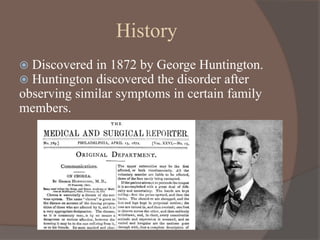
ļ‚ž Discovered in 1872 by George Huntington.
ļ‚ž Huntington discovered the disorder after
observing similar symptoms in certain family
members.
Huntington's Disease
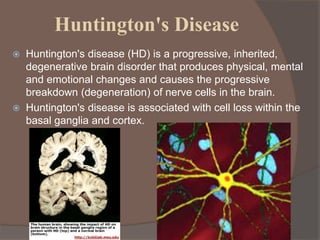
ļ‚ž Huntington's disease (HD) is a progressive, inherited,
degenerative brain disorder that produces physical, mental
and emotional changes and causes the progressive
breakdown (degeneration) of nerve cells in the brain.
ļ‚ž Huntington's disease is associated with cell loss within the
basal ganglia and cortex.
Cont…
ļ‚ž Huntington's disease was originally called
Huntington's chorea ("chorea" is the Greek
word for dancing).
ļ‚ž This is because the involuntary movements
associated with the condition can look like
jerky dancing.
ļ‚ž However, "disease" is now the preferred term,
because the condition involves a lot more
than just abnormal movements.
Diagnostic Criteria (DSM 5)
ļ‚ž The criteria are met for major or mild
neurocognitive disorder.
ļ‚ž There is insidious onset and gradual
progression.
ļ‚ž There is clinically established Huntington’s
disease, or risk for Huntington’s disease based
on family history or genetic testing.
ļ‚ž The neurocognitive disorder is not attributable
to another medical condition and is not better
explained by another mental disorder.
Diagnosing Huntington's Disease
ļ‚ž Every child of a parent who carries the HD
gene has a 50% chance of inheriting the
abnormal gene.
ļ‚ž A child who inherits the Huntington's gene
will eventually develop the illness. Genetic
testing can diagnose Huntington's at every
stage of the life cycle.
There are four categories
for testing:
1. Prenatal testing, either amniocentesis (a
sample of fluid from around the fetus), or
chorionic villus sampling (CVS—a sample of
fetal cells from the placenta), will indicate
whether the baby has inherited the gene for
Huntington's.
2. Pre-symptomatic testing's available to people
who are at risk of inheriting Huntington’s
Disease from a parent, but don’t have
symptoms and don’t know whether or not they
carry the gene.
Cont…
3. Confirmatory testing determines whether a
person showing what appear to be the symptoms
of HD, actually has the disease. Neurological and
psychological tests are also conducted.
4. Pre-symptomatic testing is usually requested or
recommended when a parent is known to have,
or is suspected of having, Huntington's Disease,
or an at-risk parent is still living, but doesn't know
whether they carry the Huntington's gene.
Signs and symptoms of
Huntington's Disease
ļ‚ž Huntington's Disease affects the mind,
body, and emotions, symptoms often mimic
other conditions. The general symptoms in
early stages can include: poor memory
difficulty making decisions mood changes
such as increased depression, anger or
irritability; a growing lack of coordination,
uncontrolled movements; difficulty walking,
speaking, and/or swallowing. The order in
which symptoms develop will vary from
person to person.
Physical symptoms
ļ‚ž Development of tics (involuntary movement) in
the fingers, feet, face, or trunk
ļ‚ž Increased clumsiness
ļ‚ž Loss of coordination and balance
ļ‚ž Slurred speech
ļ‚ž Jaw clenching or teeth grinding
ļ‚ž Difficulty swallowing or eating
ļ‚ž Continual muscular contractions
ļ‚ž Stumbling or falling
Mental symptoms
ļ‚ž Decreased concentration
ļ‚ž Forgetfulness and memory decline
ļ‚ž Poor judgment
ļ‚ž Difficulty making decisions or answering
questions
ļ‚ž Difficulty driving
ļ‚ž Over time, these symptoms may progress to
a stage where the person loses the ability to
recognize familiar objects, people and
places.
Emotional symptoms
Most common psychiatric symptom of
Huntington's Disease, will generally
manifest as:
ļ‚ž Irritability
ļ‚ž Lack of energy
ļ‚ž Ongoing disinterest in life (lack of pleasure
or joy)
ļ‚ž Bipolar disorder (manic-depression) in
some Huntington's patients.
A person with Huntington's Disease may
eventually begin to exhibit psychotic
behavior, such as:
ļ‚ž Delusions
ļ‚ž Hallucinations
ļ‚ž Inappropriate behavior (e.g., unprovoked
aggression).
Differential diagnosis
ļ‚ž About 99% of HD diagnoses based on the
typical symptoms and a family history of
the disease are confirmed by genetic
testing to have the expanded trinucleotide
repeat that causes HD. Most of the
remaining are called HD-like disorders.
Most of these other disorders are
collectively labeled HD-like (HDL). The
cause of most HDL diseases is unknown,
but those with known causes are due to
mutations in the prion protein gene (HDL1),
the junctophilin 3 gene (HDL2), a
recessively inherited HTT gene (HDL3).
Prevalence
ļ‚ž the worldwide prevalence is estimated to
be 2.7 per 100,000
ļ‚ž in North America, Europe, and Australia
is 5.7 per 100,000
ļ‚ž with a much lower prevalence of 0.40
per 100,000 in Asia
Development and Course
ļ‚ž The mean age at onset of symptoms is 30-50
years. In some cases symptoms start before the
age of 20 years with behavioral disturbances and
learning difficulties at school (juvenile Huntington's
disease)..
ļ‚ž The disease is gradually progressive, with median
survival approximately 15 years after motor
symptom diagnosis.
Diagnosis And Treatment
It can be diagnosed by a doctor using these methods:
1. Examination
2. Genetic Testing
3. Embryonic testing
ļ‚ž There is no cure for Huntington disease. There is no known
way to stop the disease from getting worse. The goal of
treatment is to slow the symptoms and help the person
function for as long as possible.
ļ‚ž Medicines can be prescribed, depending on the symptoms.
ļ‚ž Dopamine blockers may help reduce abnormal behaviors
and movements.
ļ‚ž Drugs such as amantadine are used to try to control extra
movements.
ļ‚ž Depression and suicide are common among persons with
Huntington disease. It is important for caregivers to monitor
for symptoms and seek medical help for the person right
away.
ļ‚ž As the disease progresses, the person will need assistance
and supervision, and may eventually need 24-hour care
ļ‚ž The emphasis today is on living positively with
Huntington's Disease. An integrated, multi-
disciplinary approach focuses on the triad of:
ļ‚ž diet and supplements
ļ‚ž exercise
ļ‚ž spiritual and psychosocial support
ļ‚ž This well-rounded program enhances quality of life
for people living with Huntington's Disease, as well
as for those at risk of developing HD, and may
very likely delay the onset of symptoms. Foods
known to nourish the brain, support memory and
build overall immunity are especially
recommended.
Huntington's Disease .ppt

Huntington's Disease .ppt

  • 1.
  • 2.
    History ļ‚ž Discovered in1872 by George Huntington. ļ‚ž Huntington discovered the disorder after observing similar symptoms in certain family members.
  • 3.
    Huntington's Disease ļ‚ž Huntington'sdisease (HD) is a progressive, inherited, degenerative brain disorder that produces physical, mental and emotional changes and causes the progressive breakdown (degeneration) of nerve cells in the brain. ļ‚ž Huntington's disease is associated with cell loss within the basal ganglia and cortex.
  • 4.
    Cont… ļ‚ž Huntington's diseasewas originally called Huntington's chorea ("chorea" is the Greek word for dancing). ļ‚ž This is because the involuntary movements associated with the condition can look like jerky dancing. ļ‚ž However, "disease" is now the preferred term, because the condition involves a lot more than just abnormal movements.
  • 5.
    Diagnostic Criteria (DSM5) ļ‚ž The criteria are met for major or mild neurocognitive disorder. ļ‚ž There is insidious onset and gradual progression. ļ‚ž There is clinically established Huntington’s disease, or risk for Huntington’s disease based on family history or genetic testing. ļ‚ž The neurocognitive disorder is not attributable to another medical condition and is not better explained by another mental disorder.
  • 6.
    Diagnosing Huntington's Disease ļ‚žEvery child of a parent who carries the HD gene has a 50% chance of inheriting the abnormal gene. ļ‚ž A child who inherits the Huntington's gene will eventually develop the illness. Genetic testing can diagnose Huntington's at every stage of the life cycle.
  • 7.
    There are fourcategories for testing: 1. Prenatal testing, either amniocentesis (a sample of fluid from around the fetus), or chorionic villus sampling (CVS—a sample of fetal cells from the placenta), will indicate whether the baby has inherited the gene for Huntington's. 2. Pre-symptomatic testing's available to people who are at risk of inheriting Huntington’s Disease from a parent, but don’t have symptoms and don’t know whether or not they carry the gene.
  • 8.
    Cont… 3. Confirmatory testingdetermines whether a person showing what appear to be the symptoms of HD, actually has the disease. Neurological and psychological tests are also conducted. 4. Pre-symptomatic testing is usually requested or recommended when a parent is known to have, or is suspected of having, Huntington's Disease, or an at-risk parent is still living, but doesn't know whether they carry the Huntington's gene.
  • 9.
    Signs and symptomsof Huntington's Disease ļ‚ž Huntington's Disease affects the mind, body, and emotions, symptoms often mimic other conditions. The general symptoms in early stages can include: poor memory difficulty making decisions mood changes such as increased depression, anger or irritability; a growing lack of coordination, uncontrolled movements; difficulty walking, speaking, and/or swallowing. The order in which symptoms develop will vary from person to person.
  • 10.
    Physical symptoms ļ‚ž Developmentof tics (involuntary movement) in the fingers, feet, face, or trunk ļ‚ž Increased clumsiness ļ‚ž Loss of coordination and balance ļ‚ž Slurred speech ļ‚ž Jaw clenching or teeth grinding ļ‚ž Difficulty swallowing or eating ļ‚ž Continual muscular contractions ļ‚ž Stumbling or falling
  • 11.
    Mental symptoms ļ‚ž Decreasedconcentration ļ‚ž Forgetfulness and memory decline ļ‚ž Poor judgment ļ‚ž Difficulty making decisions or answering questions ļ‚ž Difficulty driving ļ‚ž Over time, these symptoms may progress to a stage where the person loses the ability to recognize familiar objects, people and places.
  • 12.
    Emotional symptoms Most commonpsychiatric symptom of Huntington's Disease, will generally manifest as: ļ‚ž Irritability ļ‚ž Lack of energy ļ‚ž Ongoing disinterest in life (lack of pleasure or joy) ļ‚ž Bipolar disorder (manic-depression) in some Huntington's patients.
  • 13.
    A person withHuntington's Disease may eventually begin to exhibit psychotic behavior, such as: ļ‚ž Delusions ļ‚ž Hallucinations ļ‚ž Inappropriate behavior (e.g., unprovoked aggression).
  • 14.
    Differential diagnosis ļ‚ž About99% of HD diagnoses based on the typical symptoms and a family history of the disease are confirmed by genetic testing to have the expanded trinucleotide repeat that causes HD. Most of the remaining are called HD-like disorders. Most of these other disorders are collectively labeled HD-like (HDL). The cause of most HDL diseases is unknown, but those with known causes are due to mutations in the prion protein gene (HDL1), the junctophilin 3 gene (HDL2), a recessively inherited HTT gene (HDL3).
  • 15.
    Prevalence ļ‚ž the worldwideprevalence is estimated to be 2.7 per 100,000 ļ‚ž in North America, Europe, and Australia is 5.7 per 100,000 ļ‚ž with a much lower prevalence of 0.40 per 100,000 in Asia
  • 16.
    Development and Course ļ‚žThe mean age at onset of symptoms is 30-50 years. In some cases symptoms start before the age of 20 years with behavioral disturbances and learning difficulties at school (juvenile Huntington's disease).. ļ‚ž The disease is gradually progressive, with median survival approximately 15 years after motor symptom diagnosis.
  • 17.
    Diagnosis And Treatment Itcan be diagnosed by a doctor using these methods: 1. Examination 2. Genetic Testing 3. Embryonic testing
  • 18.
    ļ‚ž There isno cure for Huntington disease. There is no known way to stop the disease from getting worse. The goal of treatment is to slow the symptoms and help the person function for as long as possible. ļ‚ž Medicines can be prescribed, depending on the symptoms. ļ‚ž Dopamine blockers may help reduce abnormal behaviors and movements. ļ‚ž Drugs such as amantadine are used to try to control extra movements. ļ‚ž Depression and suicide are common among persons with Huntington disease. It is important for caregivers to monitor for symptoms and seek medical help for the person right away. ļ‚ž As the disease progresses, the person will need assistance and supervision, and may eventually need 24-hour care
  • 19.
    ļ‚ž The emphasistoday is on living positively with Huntington's Disease. An integrated, multi- disciplinary approach focuses on the triad of: ļ‚ž diet and supplements ļ‚ž exercise ļ‚ž spiritual and psychosocial support ļ‚ž This well-rounded program enhances quality of life for people living with Huntington's Disease, as well as for those at risk of developing HD, and may very likely delay the onset of symptoms. Foods known to nourish the brain, support memory and build overall immunity are especially recommended.