CONGENITAL
ABNORMALITI
ES
Presented by:
Manisha Thakur
Nursing Tutor
Child Health Nursing
INTRODUCTION
An estimated 240 000 newborns die worldwide within
28 days of birth every year due to birth defects. Birth
defects cause a further 170 000 deaths of children
between the ages of 1 month and 5 years.
Birth defects can contribute to long-term disability,
which takes a significant toll on individuals, families,
health care systems and societies.
Definition
Congenital anomalies are also known as birth
defects, congenital disorders or congenital
malformations. Congenital anomalies can be
defined as structural or functional anomalies (for
example, metabolic disorders) that occur during
intrauterine life and can be identified prenatally,
at birth, or sometimes may only be detected later
in infancy, such as hearing defects.
It is a condition, which is present at the time of
birth, which varies in the standard presentation.
Statistics
3% have major physical anomaly.
Brain anomalies – 10 per 1000 live births.
Heart anomalies – 8 per 1000 live births.
Kidney anomalies – 4 per 1000 live births.
Limbs anomalies – 1 per 1000 live births.
Types of congenital
abnormalities
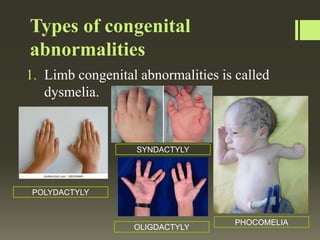
1. Limb congenital abnormalities is called
dysmelia.
POLYDACTYLY
SYNDACTYLY
PHOCOMELIA
OLIGDACTYLY
2. Cardiac congenital abnormalities :
a) Patent ductus arteriosus
b) Ventricular septal defect
c) Atrial septal defect
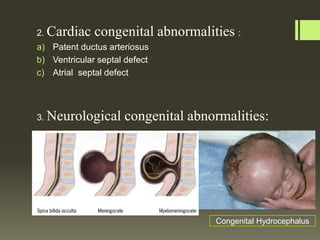
3. Neurological congenital abnormalities:
Congenital Hydrocephalus
4. Gastrointestinal congenital
abnormalities:
Atresia is a condition in which an orifice or passage in
the body is (usually abnormally) closed or absent.
Pyloric stenosis
Causes of congenital
abnormalities
GENETIC FACTORS: inheritance of abnormal genes
from the parents to offspring. Chromosomal
abnormalities-e.g. Down’s syndrome.
Consanguinity (when parents are related by blood) also
increases the prevalence of rare genetic congenital
anomalies and nearly doubles the risk for neonatal and
childhood death, intellectual disability, and other
anomalies.
Some ethnic communities (such as Ashkenazi Jews or
Finns) have a comparatively high prevalence of rare
genetic mutations such as Cystic Fibrosis and
B. ENVIRONMENTAL: Intra uterine infections –
TORCH,
Zika virus infection during pregnancy is a cause of
microcephaly and other congenital abnormalities in
the developing fetus and newborn.
 Drugs intake during pregnancy - Steroids, Anticonvulsants,
Cocaine, Lithium, etc.,
 X-Ray exposure during pregnancy
 Maternal diseases - DM, CF, endocrine abnormalities ,
 Improper nutrition: iodine deficiency, folic acid deficiency,
malnutrition.
 Abnormal intrauterine environment - bicornuate uterus,
septed uterus, polyhydramnios,etc.
 Maternal addiction - alcohol, tobacco & smoking.
C. SPORADIC OR UNKNOWN CAUSES: 40%-
60% of congenital anomalies are unknown. These are
referred to as sporadic.
D. SOCIO-ECONOMIC CAUSES:
Maternal age: risk factor for abnormal intrauterine
fetal development. Advanced maternal age increases
the risk of chromosomal abnormalities, including
Down syndrome.
Low socio economic group: An indirect determinant,
this higher risk relates to a possible lack of access to
sufficient nutritious foods by pregnant women, an
increased exposure to agents or factors such as
infection and alcohol, or poorer access to health care
and screening.
Screening/ testing
1. Maternal and family history : miscarriages,
consanguineous marriage, previous child with
deformity.
2. Physical examination: during examination structural
abnormalities can ruled out e.g. club foot
3. Amniocentesis at 14-16 weeks.
4. Chorionic villi sampling.
5. Maternal serum alpha-feto protein (high AFP suggests
spina bifida, low suggests down syndrome)
6. USG at 18 -20 weeks
7. Biochemical assay – used to study of enzymes or
proteins in the body that is unusual in the body. E.g.
phenylketonuria
8. Echocardiography (18-24 weeksa)
Management
SURGERY is required on the basis of system
affected and severity involve.
PREVENTION OF CONGENITAL
ABNORMALITIES
 Discourage consanguineous marriages.
Avoid late marriage and pregnancy > 35 years
Promotion of health of girl child and pre pregnant health status
of the females by prevention of malnutrition, anemia, folic
acid deficiency, iodine deficiency,etc.
Encourage the immunization of all female child by MMR.
Protection of individuals & whole communities against
mutagens (X-ray, drugs, alcohol)
Elimination of active and passive smoking of tobacco by
mothers.
Avoidance of drug intake without consulting
physician in the first trimester of pregnancy.
Prevention of intrauterine infections and promotion
of sexual hygiene.
Efficient antenatal care.
Promotion of therapeutic abortion after prenatal
diagnosis.
Discouraging reproduction after birth of a baby with
congenital anomalies.
Increasing public awareness about the risk factors
and etiological factors of congenital anomalies and
their preventive measures.

Congenital Abnormalities

  • 1.
  • 2.
    INTRODUCTION An estimated 240000 newborns die worldwide within 28 days of birth every year due to birth defects. Birth defects cause a further 170 000 deaths of children between the ages of 1 month and 5 years. Birth defects can contribute to long-term disability, which takes a significant toll on individuals, families, health care systems and societies.
  • 3.
    Definition Congenital anomalies arealso known as birth defects, congenital disorders or congenital malformations. Congenital anomalies can be defined as structural or functional anomalies (for example, metabolic disorders) that occur during intrauterine life and can be identified prenatally, at birth, or sometimes may only be detected later in infancy, such as hearing defects. It is a condition, which is present at the time of birth, which varies in the standard presentation.
  • 4.
    Statistics 3% have majorphysical anomaly. Brain anomalies – 10 per 1000 live births. Heart anomalies – 8 per 1000 live births. Kidney anomalies – 4 per 1000 live births. Limbs anomalies – 1 per 1000 live births.
  • 5.
    Types of congenital abnormalities 1.Limb congenital abnormalities is called dysmelia. POLYDACTYLY SYNDACTYLY PHOCOMELIA OLIGDACTYLY
  • 6.
    2. Cardiac congenitalabnormalities : a) Patent ductus arteriosus b) Ventricular septal defect c) Atrial septal defect 3. Neurological congenital abnormalities: Congenital Hydrocephalus
  • 7.
    4. Gastrointestinal congenital abnormalities: Atresiais a condition in which an orifice or passage in the body is (usually abnormally) closed or absent. Pyloric stenosis
  • 8.
    Causes of congenital abnormalities GENETICFACTORS: inheritance of abnormal genes from the parents to offspring. Chromosomal abnormalities-e.g. Down’s syndrome. Consanguinity (when parents are related by blood) also increases the prevalence of rare genetic congenital anomalies and nearly doubles the risk for neonatal and childhood death, intellectual disability, and other anomalies. Some ethnic communities (such as Ashkenazi Jews or Finns) have a comparatively high prevalence of rare genetic mutations such as Cystic Fibrosis and
  • 9.
    B. ENVIRONMENTAL: Intrauterine infections – TORCH, Zika virus infection during pregnancy is a cause of microcephaly and other congenital abnormalities in the developing fetus and newborn.  Drugs intake during pregnancy - Steroids, Anticonvulsants, Cocaine, Lithium, etc.,  X-Ray exposure during pregnancy  Maternal diseases - DM, CF, endocrine abnormalities ,  Improper nutrition: iodine deficiency, folic acid deficiency, malnutrition.  Abnormal intrauterine environment - bicornuate uterus, septed uterus, polyhydramnios,etc.  Maternal addiction - alcohol, tobacco & smoking.
  • 10.
    C. SPORADIC ORUNKNOWN CAUSES: 40%- 60% of congenital anomalies are unknown. These are referred to as sporadic. D. SOCIO-ECONOMIC CAUSES: Maternal age: risk factor for abnormal intrauterine fetal development. Advanced maternal age increases the risk of chromosomal abnormalities, including Down syndrome. Low socio economic group: An indirect determinant, this higher risk relates to a possible lack of access to sufficient nutritious foods by pregnant women, an increased exposure to agents or factors such as infection and alcohol, or poorer access to health care and screening.
  • 11.
    Screening/ testing 1. Maternaland family history : miscarriages, consanguineous marriage, previous child with deformity. 2. Physical examination: during examination structural abnormalities can ruled out e.g. club foot 3. Amniocentesis at 14-16 weeks. 4. Chorionic villi sampling. 5. Maternal serum alpha-feto protein (high AFP suggests spina bifida, low suggests down syndrome) 6. USG at 18 -20 weeks 7. Biochemical assay – used to study of enzymes or proteins in the body that is unusual in the body. E.g. phenylketonuria 8. Echocardiography (18-24 weeksa)
  • 12.
    Management SURGERY is requiredon the basis of system affected and severity involve.
  • 13.
    PREVENTION OF CONGENITAL ABNORMALITIES Discourage consanguineous marriages. Avoid late marriage and pregnancy > 35 years Promotion of health of girl child and pre pregnant health status of the females by prevention of malnutrition, anemia, folic acid deficiency, iodine deficiency,etc. Encourage the immunization of all female child by MMR. Protection of individuals & whole communities against mutagens (X-ray, drugs, alcohol) Elimination of active and passive smoking of tobacco by mothers.
  • 14.
    Avoidance of drugintake without consulting physician in the first trimester of pregnancy. Prevention of intrauterine infections and promotion of sexual hygiene. Efficient antenatal care. Promotion of therapeutic abortion after prenatal diagnosis. Discouraging reproduction after birth of a baby with congenital anomalies. Increasing public awareness about the risk factors and etiological factors of congenital anomalies and their preventive measures.