By:
Sachin Kumar
M.Pharm. (Pharmacology)
Dept. of pharma. sci.
M.D.U Rohtak Haryana
CONTENTS
• Introduction
• Signs and symptoms
• Stages of Huntington’s disease
• Causes and risk factors
• Pathophysiology
• Diagnosis
• Treatment of Huntington’s disease
• References
Clinical FeaturesClinical Features
• Huntington’s disease is a rapidly progressive
neurodegenerative disease that leads to
dementia.
• Typically presents with alterations in mood as
well as a change in character, defects in
memory and attention.
• Progresses to a movement disorder consisting
of involuntary, rapid motions.
• Usually not recognized until the patient is in their
early 30’s.
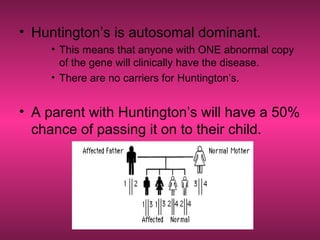
• Huntington’s is autosomal dominant.
• This means that anyone with ONE abnormal copy
of the gene will clinically have the disease.
• There are no carriers for Huntington’s.
• A parent with Huntington’s will have a 50%
chance of passing it on to their child.
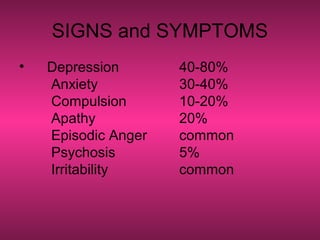
SIGNS and SYMPTOMS
• Depression 40-80%
Anxiety 30-40%
Compulsion 10-20%
Apathy 20%
Episodic Anger common
Psychosis 5%
Irritability common
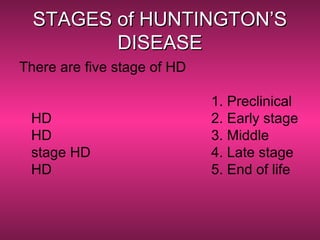
STAGES of HUNTINGTON’SSTAGES of HUNTINGTON’S
DISEASEDISEASE
There are five stage of HD
1. Preclinical
HD 2. Early stage
HD 3. Middle
stage HD 4. Late stage
HD 5. End of life
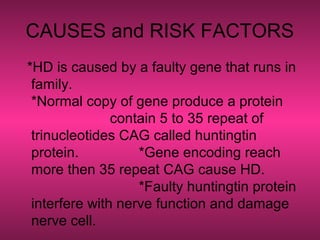
*HD is caused by a faulty gene that runs in
family.
*Normal copy of gene produce a protein
contain 5 to 35 repeat of
trinucleotides CAG called huntingtin
protein. *Gene encoding reach
more then 35 repeat CAG cause HD.
*Faulty huntingtin protein
interfere with nerve function and damage
nerve cell.
CAUSES and RISK FACTORS
PATHOPHYSOLOGYPATHOPHYSOLOGY
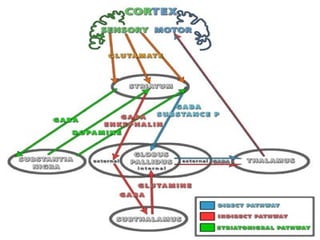
*Striatum(located in basal ganglia) is most
affected by HD
* Motor control operates through three
pathways:
1. Direct pathway
2. Indirect pathway
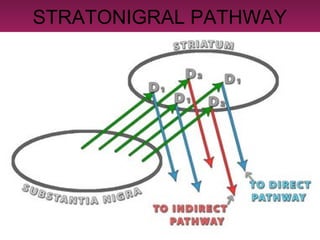
3. Striatonigral pathway
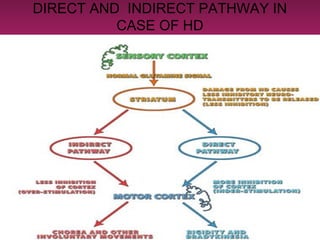
DIRECT AND INDIRECT PATHWAY IN
CASE OF HD
STRATONIGRAL PATHWAY
DIGNOSIS of HD
- CT scan (computer tromograhy)
- MRI (magnetic resonance imaging)
1. Genetic testing
2. Genetic testing in pregnancy
3. Preimplantation genetic dignosis.
TREATMENT of HD
HD is incurable. There is no current
treatment that can reverse its progression
or slow it down.
MEDICATION:
1.For movement disorder
2.For psychiatric disorder
3.Psychotherapy
4.Speech therapy
5.Physical therapy
MEDICATIONS
• For movement disorder:-
a. Tetrabenazine
b. Antipsychotic drugs: Haloperidol,
Chlorpromazine
c. Other medication: Amantadine ,
Clonazepam
2. For Psychiatric disorder:
a. Antidepressant: Citalopram, Sertaline,
Fluozentine
b. Antipsychotic drugs: Risperidone,
Olanzapine
c. Mood stabilizing agent: Valproate,
Carbamazipine
References
1: Goodman and Gilman, “The Pharmacological basics of
Therapeutics.” 1st
edition, page no.- 562-564
2: Huntington’s Disease Society of America centre of Excellence at UC
Davis. June 4, 2013. http://www.ucdmc.ucdavis.edu
3: National Center for Biotechnology Information – Entrez Gene
http://www.ncbi.nlm.nih.gov/ .
4: Bates, G., Harper, P., & Jones, L. Huntington’s Disease. New York:
Oxford University Press, 2002. pp. 28-37, 276-281.

Huntington’s disease

  • 1.
    By: Sachin Kumar M.Pharm. (Pharmacology) Dept.of pharma. sci. M.D.U Rohtak Haryana
  • 2.
    CONTENTS • Introduction • Signsand symptoms • Stages of Huntington’s disease • Causes and risk factors • Pathophysiology • Diagnosis • Treatment of Huntington’s disease • References
  • 3.
    Clinical FeaturesClinical Features •Huntington’s disease is a rapidly progressive neurodegenerative disease that leads to dementia. • Typically presents with alterations in mood as well as a change in character, defects in memory and attention. • Progresses to a movement disorder consisting of involuntary, rapid motions. • Usually not recognized until the patient is in their early 30’s.
  • 4.
    • Huntington’s isautosomal dominant. • This means that anyone with ONE abnormal copy of the gene will clinically have the disease. • There are no carriers for Huntington’s. • A parent with Huntington’s will have a 50% chance of passing it on to their child.
  • 5.
    SIGNS and SYMPTOMS •Depression 40-80% Anxiety 30-40% Compulsion 10-20% Apathy 20% Episodic Anger common Psychosis 5% Irritability common
  • 7.
    STAGES of HUNTINGTON’SSTAGESof HUNTINGTON’S DISEASEDISEASE There are five stage of HD 1. Preclinical HD 2. Early stage HD 3. Middle stage HD 4. Late stage HD 5. End of life
  • 8.
    *HD is causedby a faulty gene that runs in family. *Normal copy of gene produce a protein contain 5 to 35 repeat of trinucleotides CAG called huntingtin protein. *Gene encoding reach more then 35 repeat CAG cause HD. *Faulty huntingtin protein interfere with nerve function and damage nerve cell. CAUSES and RISK FACTORS
  • 9.
    PATHOPHYSOLOGYPATHOPHYSOLOGY *Striatum(located in basalganglia) is most affected by HD * Motor control operates through three pathways: 1. Direct pathway 2. Indirect pathway 3. Striatonigral pathway
  • 11.
    DIRECT AND INDIRECTPATHWAY IN CASE OF HD
  • 12.
  • 13.
    DIGNOSIS of HD -CT scan (computer tromograhy) - MRI (magnetic resonance imaging) 1. Genetic testing 2. Genetic testing in pregnancy 3. Preimplantation genetic dignosis.
  • 14.
    TREATMENT of HD HDis incurable. There is no current treatment that can reverse its progression or slow it down. MEDICATION: 1.For movement disorder 2.For psychiatric disorder 3.Psychotherapy 4.Speech therapy 5.Physical therapy
  • 15.
    MEDICATIONS • For movementdisorder:- a. Tetrabenazine b. Antipsychotic drugs: Haloperidol, Chlorpromazine c. Other medication: Amantadine , Clonazepam
  • 16.
    2. For Psychiatricdisorder: a. Antidepressant: Citalopram, Sertaline, Fluozentine b. Antipsychotic drugs: Risperidone, Olanzapine c. Mood stabilizing agent: Valproate, Carbamazipine
  • 17.
    References 1: Goodman andGilman, “The Pharmacological basics of Therapeutics.” 1st edition, page no.- 562-564 2: Huntington’s Disease Society of America centre of Excellence at UC Davis. June 4, 2013. http://www.ucdmc.ucdavis.edu 3: National Center for Biotechnology Information – Entrez Gene http://www.ncbi.nlm.nih.gov/ . 4: Bates, G., Harper, P., & Jones, L. Huntington’s Disease. New York: Oxford University Press, 2002. pp. 28-37, 276-281.