HISTORY
 Emil Kraepelin, an Eminent
Psychiatrist in 1896 formed the
concept of “Dementia praecox” –
Mental Deterioration In 1911
Eugen Bleuler coined the term
“Schizophrenia” Skhizo - Split ,
Phren - Mind
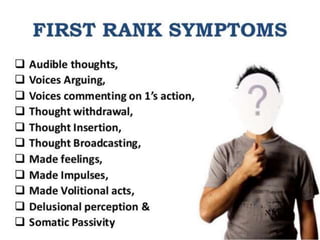
 Kurt Schneider described 11
symptoms, Collectively Called as
“First Rank Symptoms” (FRS)
whose presence / absence of
course of brain disease was
diagnostic of schizophrenia.
DEFINITION
1) The schizophrenic disorders are characterized
in general by fundamental & characteristic
distortions of thinking & perception, and by
inappropriate or blunted affect. The most
intimate thoughts, feelings & acts are often felt
to be known or shared by others, & Explanatory
delusions may develop, to the effect that natural
or supernatural forces are at work to influence
the afflicted individual’s thoughts & actions in
ways that are often Bizarre.
2) Schizophrenia is a psychotic condition
characterized by a disturbance in
thinking, Emotions, Volitions & Faculties
in the Presence of clear consciousness,
which usually leads to social
withdrawal.
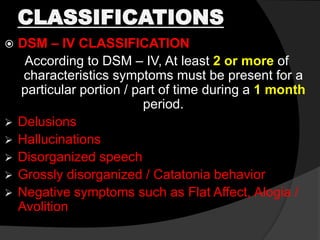
CLASSIFICATIONS
 DSM – IV CLASSIFICATION
According to DSM – IV, At least 2 or more of
characteristics symptoms must be present for a
particular portion / part of time during a 1 month
period.
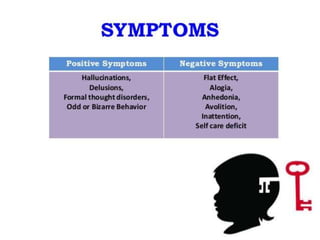
 Delusions
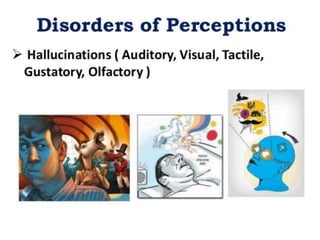
 Hallucinations
 Disorganized speech
 Grossly disorganized / Catatonia behavior
 Negative symptoms such as Flat Affect, Alogia /
Avolition
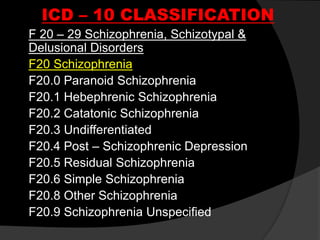
ICD – 10 CLASSIFICATION
F 20 – 29 Schizophrenia, Schizotypal &
Delusional Disorders
F20 Schizophrenia
F20.0 Paranoid Schizophrenia
F20.1 Hebephrenic Schizophrenia
F20.2 Catatonic Schizophrenia
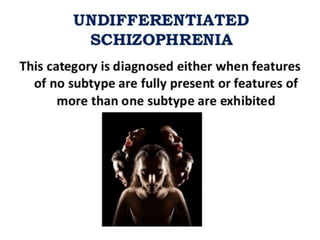
F20.3 Undifferentiated
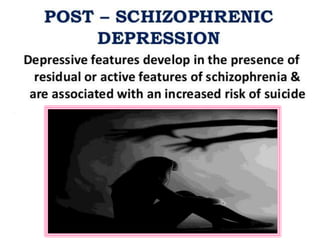
F20.4 Post – Schizophrenic Depression
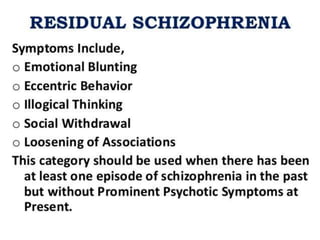
F20.5 Residual Schizophrenia
F20.6 Simple Schizophrenia
F20.8 Other Schizophrenia
F20.9 Schizophrenia Unspecified
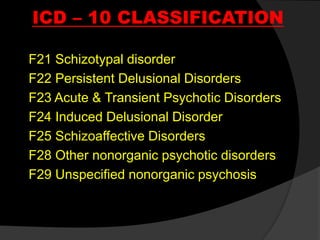
ICD – 10 CLASSIFICATION
F21 Schizotypal disorder
F22 Persistent Delusional Disorders
F23 Acute & Transient Psychotic Disorders
F24 Induced Delusional Disorder
F25 Schizoaffective Disorders
F28 Other nonorganic psychotic disorders
F29 Unspecified nonorganic psychosis
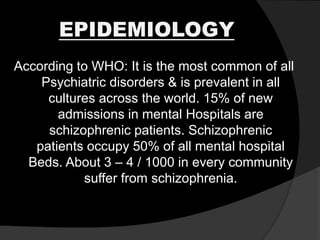
EPIDEMIOLOGY
According to WHO: It is the most common of all
Psychiatric disorders & is prevalent in all
cultures across the world. 15% of new
admissions in mental Hospitals are
schizophrenic patients. Schizophrenic
patients occupy 50% of all mental hospital
Beds. About 3 – 4 / 1000 in every community
suffer from schizophrenia.
 About 1% of the general population have the
risk of developing this disease in their life time
 Very common in lower Socio – economic
groups
 MEN Peak ages of onset are 15 – 25 years
 WOMEN Peak ages of onset are 25 – 35
years
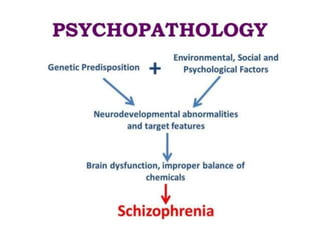
ETIOLOGY
1) BIOLOGICAL THEORIES
 Biochemical theories
Dopamine Hypotheses An excess of
Dopamine – Dependent neuronal activity in the
brain may cause schizophrenia
 Other Biochemical Hypotheses Abnormalities
in the Neuro - transmitters ( Nor epinephrine,
Serotonin, Acetylcholine & Gamma – amino
butyric acid [GABA] ).
2) NEURO STRUCTURAL THEORIES
Pre frontal Cortex & Limbic Cortex may
never fully develop in the brains of persons
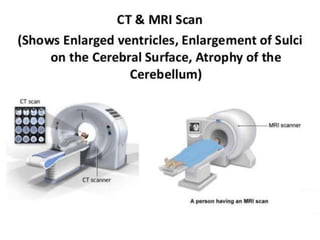
with schizophrenia CT & MRI studies of
brain structure shows
 Decreased brain volume
 Larger lateral & 3rd Ventricles
 Atrophy in the Frontal lobe, cerebellum &
limbic Structures
 Increased size of Sulci on the Surface of
brain
3) GENETIC THEORIES
8-10% in first degree relatives, 3% in second
degree relatives, 2% in third degree relatives.
monozygotic twins 46%, Dizygotic twins 14%
4) ENVIRONMENTAL & NEURO
DEVELOPMENTAL FACTORS:
There is a significant association between
the risk of developing schizophrenia and
the mothers contracted with viral infection
during their second trimesters.
5) STRESS- DIATHESIS MODEL:
This model postulates that a person may
have a specific vulnerability that, when acted
on by some stressful environmental
influence may develop symptoms of
schizophrenia.
6) PSYCHOANALYTIC THEORIES:
Sigmund freud postulated that schizophrenia
results from fixations in the development
that occurred earlier than those that result in
the development of neuroses.
7) PSYCHOSEXUAL THEORIES
Developmental theories According to Freud,
In Psychosexual Development Oral Stage –
Regression present along with that Denial,
Projection & Reaction Formation.
8) SOCIAL THEORIES:
Some social theories have suggested that
industrialization and urbanization are
involved in the cause of schizophrenia.
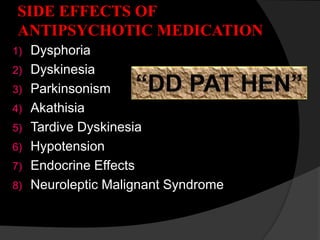
SIDE EFFECTS OF
ANTIPSYCHOTIC MEDICATION
1) Dysphoria
2) Dyskinesia
3) Parkinsonism
4) Akathisia
5) Tardive Dyskinesia
6) Hypotension
7) Endocrine Effects
8) Neuroleptic Malignant Syndrome
NURSING ASSESSMENT
1) Determine if the client is suffering from his/her
first psychotic episode or an acute
exacerbation of chronic disorders.
2) Assess the level of impairment in daily
functioning and self care.
3) Examine the existence and influence of
delusions, hallucination and paranoid or
disorganized thinking upon safety.
4) Assess self- care deficits in relation to physical
needs and safety.
5) Mental Status Examination (MSE)
NURSING CARE PLAN
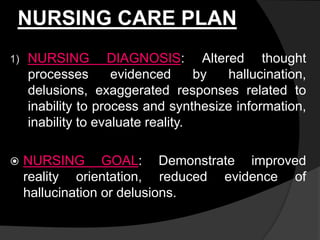
1) NURSING DIAGNOSIS: Altered thought
processes evidenced by hallucination,
delusions, exaggerated responses related to
inability to process and synthesize information,
inability to evaluate reality.
 NURSING GOAL: Demonstrate improved
reality orientation, reduced evidence of
hallucination or delusions.
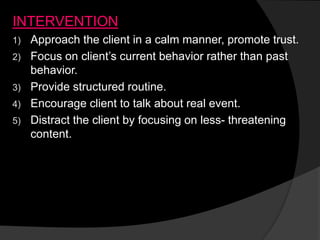
INTERVENTION
1) Approach the client in a calm manner, promote trust.
2) Focus on client’s current behavior rather than past
behavior.
3) Provide structured routine.
4) Encourage client to talk about real event.
5) Distract the client by focusing on less- threatening
content.
NURSING CARE PLAN
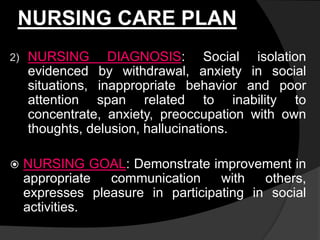
2) NURSING DIAGNOSIS: Social isolation
evidenced by withdrawal, anxiety in social
situations, inappropriate behavior and poor
attention span related to inability to
concentrate, anxiety, preoccupation with own
thoughts, delusion, hallucinations.
 NURSING GOAL: Demonstrate improvement in
appropriate communication with others,
expresses pleasure in participating in social
activities.
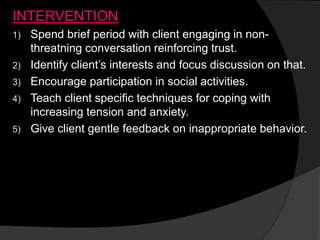
INTERVENTION
1) Spend brief period with client engaging in non-
threatning conversation reinforcing trust.
2) Identify client’s interests and focus discussion on that.
3) Encourage participation in social activities.
4) Teach client specific techniques for coping with
increasing tension and anxiety.
5) Give client gentle feedback on inappropriate behavior.
NURSING CARE PLAN
3) NURSING DIAGNOSIS: Self care deficit
evidenced by difficulty with grooming, nutrition,
hygiene related to regression, withdrawal, and
impaired thought processes.
 NURSING GOAL: Demonstrate increased
ability to care for self, report any need for
assistance with personal care.
INTERVENTION
1) Assess client’s ability to meet basic self-care needs
such as nutrition, hydration and elimination.
2) Provide assistance with self-care needs.
3) Encourage wearing appropriate clothes for the setting.
4) If client is not eating, offer food and fluids on a regular
schedule.
5) Encourage client for assistance.
NURSING CARE PLAN
4) NURSING DIAGNOSIS: Impaired verbal
communication evidenced by flight of ideas,
neologisms, word salad, echolalia related to
disordered thinking, withdrawal, regression and
impaired judgment.
 NURSING GOAL: Demonstrates improved
ability to express self, identifies factors that
influence inappropriate responses.
INTERVENTION
1) Assess client’s ability to meet basic self-care needs
such as nutrition, hydration and elimination.
2) Provide assistance with self-care needs.
3) Encourage wearing appropriate clothes for the setting.
4) If client is not eating, offer food and fluids on a regular
schedule.
5) Encourage client for assistance.
NURSING CARE PLAN
5) NURSING DIAGNOSIS: Disturbed personal
identity related to loss of ego boundaries,
disorganized illogical thinking, feeling of
anxiety, fear and aggressive behavior towards
others or property.
 NURSING GOAL: Remains free from injury,
establishes contact with reality, participates in
the therapeutic milieu.
INTERVENTION
1) Reassure the client that the environment is safe by
briefly and simply explaining routines.
2) Protect the client from harming himself or herself or
others.
3) Remove the client from the group if his or her
behaviour becomes too bizarre, disturbing or
dangerous to others.
4) Make only promises that you can realistically keep.
5) Be simple, direct and concise when speaking to the
client.
NURSING CARE PLAN
6) NURSING DIAGNOSIS: Disturbed Sensory
Perception (Specific Visual, Auditory,
Kinesthetic, Gustatory, Tactile and Olfactory)
related to inability to discriminate between real
and unreal perceptions, feeling of insecurity.
 NURSING GOAL: Demonstrates decreased
hallucinations, Interacts with others in the
external environment.
INTERVENTION
1) Be aware of all surrounding stimuli, including sounds
from other rooms.
2) Try to decrease stimuli or move the client to another
area.
3) Avoid conveying to the client the belief that
hallucinations are real.
4) Communicate with the client verbally in direct, concrete,
specific terms.
5) Encourage expression of any feelings of guilt, remorse
or embarrassment.
Schizophrenia

Schizophrenia

  • 2.
    HISTORY  Emil Kraepelin,an Eminent Psychiatrist in 1896 formed the concept of “Dementia praecox” – Mental Deterioration In 1911 Eugen Bleuler coined the term “Schizophrenia” Skhizo - Split , Phren - Mind
  • 3.
     Kurt Schneiderdescribed 11 symptoms, Collectively Called as “First Rank Symptoms” (FRS) whose presence / absence of course of brain disease was diagnostic of schizophrenia.
  • 4.
    DEFINITION 1) The schizophrenicdisorders are characterized in general by fundamental & characteristic distortions of thinking & perception, and by inappropriate or blunted affect. The most intimate thoughts, feelings & acts are often felt to be known or shared by others, & Explanatory delusions may develop, to the effect that natural or supernatural forces are at work to influence the afflicted individual’s thoughts & actions in ways that are often Bizarre.
  • 5.
    2) Schizophrenia isa psychotic condition characterized by a disturbance in thinking, Emotions, Volitions & Faculties in the Presence of clear consciousness, which usually leads to social withdrawal.
  • 6.
    CLASSIFICATIONS  DSM –IV CLASSIFICATION According to DSM – IV, At least 2 or more of characteristics symptoms must be present for a particular portion / part of time during a 1 month period.  Delusions  Hallucinations  Disorganized speech  Grossly disorganized / Catatonia behavior  Negative symptoms such as Flat Affect, Alogia / Avolition
  • 7.
    ICD – 10CLASSIFICATION F 20 – 29 Schizophrenia, Schizotypal & Delusional Disorders F20 Schizophrenia F20.0 Paranoid Schizophrenia F20.1 Hebephrenic Schizophrenia F20.2 Catatonic Schizophrenia F20.3 Undifferentiated F20.4 Post – Schizophrenic Depression F20.5 Residual Schizophrenia F20.6 Simple Schizophrenia F20.8 Other Schizophrenia F20.9 Schizophrenia Unspecified
  • 8.
    ICD – 10CLASSIFICATION F21 Schizotypal disorder F22 Persistent Delusional Disorders F23 Acute & Transient Psychotic Disorders F24 Induced Delusional Disorder F25 Schizoaffective Disorders F28 Other nonorganic psychotic disorders F29 Unspecified nonorganic psychosis
  • 9.
    EPIDEMIOLOGY According to WHO:It is the most common of all Psychiatric disorders & is prevalent in all cultures across the world. 15% of new admissions in mental Hospitals are schizophrenic patients. Schizophrenic patients occupy 50% of all mental hospital Beds. About 3 – 4 / 1000 in every community suffer from schizophrenia.
  • 10.
     About 1%of the general population have the risk of developing this disease in their life time  Very common in lower Socio – economic groups  MEN Peak ages of onset are 15 – 25 years  WOMEN Peak ages of onset are 25 – 35 years
  • 11.
    ETIOLOGY 1) BIOLOGICAL THEORIES Biochemical theories Dopamine Hypotheses An excess of Dopamine – Dependent neuronal activity in the brain may cause schizophrenia  Other Biochemical Hypotheses Abnormalities in the Neuro - transmitters ( Nor epinephrine, Serotonin, Acetylcholine & Gamma – amino butyric acid [GABA] ).
  • 12.
    2) NEURO STRUCTURALTHEORIES Pre frontal Cortex & Limbic Cortex may never fully develop in the brains of persons with schizophrenia CT & MRI studies of brain structure shows  Decreased brain volume  Larger lateral & 3rd Ventricles  Atrophy in the Frontal lobe, cerebellum & limbic Structures  Increased size of Sulci on the Surface of brain
  • 13.
    3) GENETIC THEORIES 8-10%in first degree relatives, 3% in second degree relatives, 2% in third degree relatives. monozygotic twins 46%, Dizygotic twins 14% 4) ENVIRONMENTAL & NEURO DEVELOPMENTAL FACTORS: There is a significant association between the risk of developing schizophrenia and the mothers contracted with viral infection during their second trimesters.
  • 14.
    5) STRESS- DIATHESISMODEL: This model postulates that a person may have a specific vulnerability that, when acted on by some stressful environmental influence may develop symptoms of schizophrenia. 6) PSYCHOANALYTIC THEORIES: Sigmund freud postulated that schizophrenia results from fixations in the development that occurred earlier than those that result in the development of neuroses.
  • 15.
    7) PSYCHOSEXUAL THEORIES Developmentaltheories According to Freud, In Psychosexual Development Oral Stage – Regression present along with that Denial, Projection & Reaction Formation. 8) SOCIAL THEORIES: Some social theories have suggested that industrialization and urbanization are involved in the cause of schizophrenia.
  • 39.
    SIDE EFFECTS OF ANTIPSYCHOTICMEDICATION 1) Dysphoria 2) Dyskinesia 3) Parkinsonism 4) Akathisia 5) Tardive Dyskinesia 6) Hypotension 7) Endocrine Effects 8) Neuroleptic Malignant Syndrome
  • 43.
    NURSING ASSESSMENT 1) Determineif the client is suffering from his/her first psychotic episode or an acute exacerbation of chronic disorders. 2) Assess the level of impairment in daily functioning and self care. 3) Examine the existence and influence of delusions, hallucination and paranoid or disorganized thinking upon safety. 4) Assess self- care deficits in relation to physical needs and safety. 5) Mental Status Examination (MSE)
  • 44.
    NURSING CARE PLAN 1)NURSING DIAGNOSIS: Altered thought processes evidenced by hallucination, delusions, exaggerated responses related to inability to process and synthesize information, inability to evaluate reality.  NURSING GOAL: Demonstrate improved reality orientation, reduced evidence of hallucination or delusions.
  • 45.
    INTERVENTION 1) Approach theclient in a calm manner, promote trust. 2) Focus on client’s current behavior rather than past behavior. 3) Provide structured routine. 4) Encourage client to talk about real event. 5) Distract the client by focusing on less- threatening content.
  • 46.
    NURSING CARE PLAN 2)NURSING DIAGNOSIS: Social isolation evidenced by withdrawal, anxiety in social situations, inappropriate behavior and poor attention span related to inability to concentrate, anxiety, preoccupation with own thoughts, delusion, hallucinations.  NURSING GOAL: Demonstrate improvement in appropriate communication with others, expresses pleasure in participating in social activities.
  • 47.
    INTERVENTION 1) Spend briefperiod with client engaging in non- threatning conversation reinforcing trust. 2) Identify client’s interests and focus discussion on that. 3) Encourage participation in social activities. 4) Teach client specific techniques for coping with increasing tension and anxiety. 5) Give client gentle feedback on inappropriate behavior.
  • 48.
    NURSING CARE PLAN 3)NURSING DIAGNOSIS: Self care deficit evidenced by difficulty with grooming, nutrition, hygiene related to regression, withdrawal, and impaired thought processes.  NURSING GOAL: Demonstrate increased ability to care for self, report any need for assistance with personal care.
  • 49.
    INTERVENTION 1) Assess client’sability to meet basic self-care needs such as nutrition, hydration and elimination. 2) Provide assistance with self-care needs. 3) Encourage wearing appropriate clothes for the setting. 4) If client is not eating, offer food and fluids on a regular schedule. 5) Encourage client for assistance.
  • 50.
    NURSING CARE PLAN 4)NURSING DIAGNOSIS: Impaired verbal communication evidenced by flight of ideas, neologisms, word salad, echolalia related to disordered thinking, withdrawal, regression and impaired judgment.  NURSING GOAL: Demonstrates improved ability to express self, identifies factors that influence inappropriate responses.
  • 51.
    INTERVENTION 1) Assess client’sability to meet basic self-care needs such as nutrition, hydration and elimination. 2) Provide assistance with self-care needs. 3) Encourage wearing appropriate clothes for the setting. 4) If client is not eating, offer food and fluids on a regular schedule. 5) Encourage client for assistance.
  • 52.
    NURSING CARE PLAN 5)NURSING DIAGNOSIS: Disturbed personal identity related to loss of ego boundaries, disorganized illogical thinking, feeling of anxiety, fear and aggressive behavior towards others or property.  NURSING GOAL: Remains free from injury, establishes contact with reality, participates in the therapeutic milieu.
  • 53.
    INTERVENTION 1) Reassure theclient that the environment is safe by briefly and simply explaining routines. 2) Protect the client from harming himself or herself or others. 3) Remove the client from the group if his or her behaviour becomes too bizarre, disturbing or dangerous to others. 4) Make only promises that you can realistically keep. 5) Be simple, direct and concise when speaking to the client.
  • 54.
    NURSING CARE PLAN 6)NURSING DIAGNOSIS: Disturbed Sensory Perception (Specific Visual, Auditory, Kinesthetic, Gustatory, Tactile and Olfactory) related to inability to discriminate between real and unreal perceptions, feeling of insecurity.  NURSING GOAL: Demonstrates decreased hallucinations, Interacts with others in the external environment.
  • 55.
    INTERVENTION 1) Be awareof all surrounding stimuli, including sounds from other rooms. 2) Try to decrease stimuli or move the client to another area. 3) Avoid conveying to the client the belief that hallucinations are real. 4) Communicate with the client verbally in direct, concrete, specific terms. 5) Encourage expression of any feelings of guilt, remorse or embarrassment.