
By:
Mrs. Keerthi Samuel,
Vijay Marie college of Nursing
Definition of HD
Huntington's disease is an inherited disease that causes
the progressive breakdown (degeneration) of nerve cells
in the brain. Huntington's disease has a broad impact on
a person's functional abilities and usually results in
movement, thinking (cognitive) and psychiatric disorders.
The Disease was first recognized in 1872 when a 22-year-
old American doctor, George Huntington, wrote a paper
called On Chorea ("Chorea" comes from the Latin and
Greek words and it means dance )
HD usually begins in
the age of 30 to 40
years.
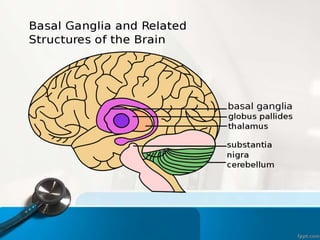
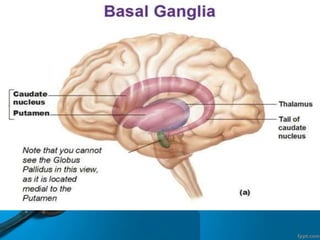
•Globus pallidus is a subcortical structure located within the cerebral
hemispheres, and is a major component of the basal ganglia.
•The basal ganglia are a group of subcortical nuclei (collection of
neuronal cell bodies located within the CNS) located at the base of the
forebrain.
he basal ganglia consist of the following main components:
Caudate nucleus
Putamen
Globus pallidus
Substantia nigra
Anatomy of basal Ganglia
Causes of Huntington's disease
Huntington's disease involves in
neurotransmitters* and it believed to be
caused by :
loss of cell bodies of GABA-secreting neurons in
the caudate nucleus and acetylcholine-
/secreting neurons in many parts of the brain.
Causes Of Huntington's Disease
•Intra genic expansion of CAG tri nucleotide repeat in
the gene.
•The HD gene is mapped on short arm of
chromosome 4.
• CAG is a genetic code for amino acid glutamine ,
thus multiple repetition of CAG forms long chains of
glutamine also known as poly Q.
•The poly Q more than 36 glutamine repeats leads to
HD
PATHOPHYSIOLOGY
•The HD gene encodes for a protein called huntingtin (Htt)
whose function is to regulate the production of brain derived
neuro factor (BDNF) which protects the neuron
•Due to mutations in Htt gene the amount of BDNF decreases
abruptly leading to death of striatal cells leading to selective
degeneration of basal ganglia
•Therefore signals sent from globus pallidus to thalamus
becomes weak leading to the loss of controlled movement
Symptoms of Huntington's disease
( Huntington’s chorea )
Huntington's disease usually causes
1.Movement disorders
2.Cognitive disorders
3.Psychiatric disorders
The Movement disorders
The movement disorders associated with Huntington's
disease can include both involuntary movements and
impairments in voluntary movements:
•Involuntary jerking or writhing movements (chorea)
•Muscle problems, such as rigidity or muscle
contracture (dystonia)
•Slow or abnormal eye movements
•Impaired gait, posture and balance
•Difficulty with the physical production of speech or
swallowing
Cognitive disorders
Cognitive impairments often associated with Huntington's
disease include
•Difficulty organizing, prioritizing or focusing on tasks
•Lack of flexibility or the tendency to get stuck on a thought,
behavior or action
•Lack of impulse control that can result in outbursts,
•Lack of awareness of one's own behaviors and abilities
•Slowness in processing thoughts or ''finding'' words
•Difficulty in learning new information
Psychiatric disorders
The most common psychiatric disorder associated with Huntington's
disease is depression. This isn't simply a reaction to receiving a
diagnosis of Huntington's disease. Instead, depression appears to
occur because of injury to the brain and subsequent changes in brain
function. Signs and symptoms may include:
•Feelings of irritability, sadness or apathy
•Social withdrawal
•Fatigue and loss of energy and Insomnia
•Frequent thoughts of death, dying or suicide
Other common psychiatric disorders include:
•Obsessive-compulsive disorder
•Mania, which can cause elevated mood, over
activity, impulsive behavior
•Bipolar disorder, or alternating episodes of
depression and mania
In addition to the above
symptoms, weight loss is
common in people with
Huntington's disease, especially
as the disease progresses.
DIAGNOSIS
•PRESYMPTOMATIC SCREENING FOR HD IN CHILDREN WITH FAMILY
HISTORY
•Genetic testing: demonstration of nucleotide CAG expansion is the
ultimate test
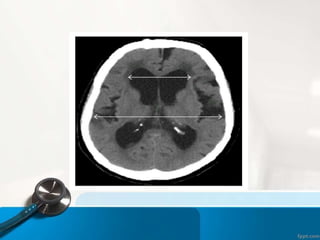
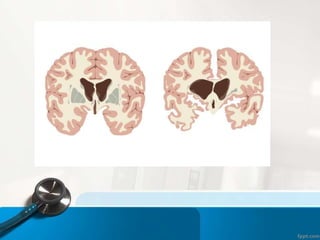
•Neurological Imaging: in advance cases where in ventricular
dilatation associated with reduced sizre of caudate nucleus and
increased bicaudate diameter
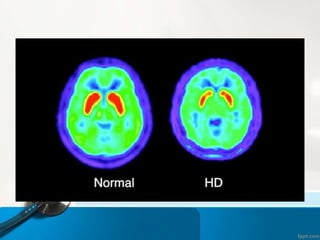
•PET scanning: no longer used
Treatment for Huntington's Disease
The emphasis today is on living positively with
Huntington's Disease. An integrated, multi-disciplinary
approach focuses on the triad of:
•diet and supplements
•exercise
•spiritual and psychosocial support

Huntingtons chorea- Genetics

  • 1.
    By: Mrs. Keerthi Samuel, VijayMarie college of Nursing
  • 2.
    Definition of HD Huntington'sdisease is an inherited disease that causes the progressive breakdown (degeneration) of nerve cells in the brain. Huntington's disease has a broad impact on a person's functional abilities and usually results in movement, thinking (cognitive) and psychiatric disorders. The Disease was first recognized in 1872 when a 22-year- old American doctor, George Huntington, wrote a paper called On Chorea ("Chorea" comes from the Latin and Greek words and it means dance ) HD usually begins in the age of 30 to 40 years.
  • 3.
    •Globus pallidus isa subcortical structure located within the cerebral hemispheres, and is a major component of the basal ganglia. •The basal ganglia are a group of subcortical nuclei (collection of neuronal cell bodies located within the CNS) located at the base of the forebrain. he basal ganglia consist of the following main components: Caudate nucleus Putamen Globus pallidus Substantia nigra Anatomy of basal Ganglia
  • 6.
    Causes of Huntington'sdisease Huntington's disease involves in neurotransmitters* and it believed to be caused by : loss of cell bodies of GABA-secreting neurons in the caudate nucleus and acetylcholine- /secreting neurons in many parts of the brain.
  • 7.
    Causes Of Huntington'sDisease •Intra genic expansion of CAG tri nucleotide repeat in the gene. •The HD gene is mapped on short arm of chromosome 4. • CAG is a genetic code for amino acid glutamine , thus multiple repetition of CAG forms long chains of glutamine also known as poly Q. •The poly Q more than 36 glutamine repeats leads to HD
  • 8.
    PATHOPHYSIOLOGY •The HD geneencodes for a protein called huntingtin (Htt) whose function is to regulate the production of brain derived neuro factor (BDNF) which protects the neuron •Due to mutations in Htt gene the amount of BDNF decreases abruptly leading to death of striatal cells leading to selective degeneration of basal ganglia •Therefore signals sent from globus pallidus to thalamus becomes weak leading to the loss of controlled movement
  • 9.
    Symptoms of Huntington'sdisease ( Huntington’s chorea ) Huntington's disease usually causes 1.Movement disorders 2.Cognitive disorders 3.Psychiatric disorders
  • 10.
    The Movement disorders Themovement disorders associated with Huntington's disease can include both involuntary movements and impairments in voluntary movements: •Involuntary jerking or writhing movements (chorea) •Muscle problems, such as rigidity or muscle contracture (dystonia) •Slow or abnormal eye movements •Impaired gait, posture and balance •Difficulty with the physical production of speech or swallowing
  • 11.
    Cognitive disorders Cognitive impairmentsoften associated with Huntington's disease include •Difficulty organizing, prioritizing or focusing on tasks •Lack of flexibility or the tendency to get stuck on a thought, behavior or action •Lack of impulse control that can result in outbursts, •Lack of awareness of one's own behaviors and abilities •Slowness in processing thoughts or ''finding'' words •Difficulty in learning new information
  • 12.
    Psychiatric disorders The mostcommon psychiatric disorder associated with Huntington's disease is depression. This isn't simply a reaction to receiving a diagnosis of Huntington's disease. Instead, depression appears to occur because of injury to the brain and subsequent changes in brain function. Signs and symptoms may include: •Feelings of irritability, sadness or apathy •Social withdrawal •Fatigue and loss of energy and Insomnia •Frequent thoughts of death, dying or suicide
  • 13.
    Other common psychiatricdisorders include: •Obsessive-compulsive disorder •Mania, which can cause elevated mood, over activity, impulsive behavior •Bipolar disorder, or alternating episodes of depression and mania In addition to the above symptoms, weight loss is common in people with Huntington's disease, especially as the disease progresses.
  • 14.
    DIAGNOSIS •PRESYMPTOMATIC SCREENING FORHD IN CHILDREN WITH FAMILY HISTORY •Genetic testing: demonstration of nucleotide CAG expansion is the ultimate test •Neurological Imaging: in advance cases where in ventricular dilatation associated with reduced sizre of caudate nucleus and increased bicaudate diameter •PET scanning: no longer used
  • 18.
    Treatment for Huntington'sDisease The emphasis today is on living positively with Huntington's Disease. An integrated, multi-disciplinary approach focuses on the triad of: •diet and supplements •exercise •spiritual and psychosocial support