CONSUMER BEHAVIOR
Sidra Akhtar
WHAT IS CONSUMER BEHAVIOR?
 “The study of individuals, groups, or organizations and
the processes they use to select, secure, use, and
dispose of products, services, experiences, or ideas to
satisfy needs and the impact that these processes have
on the consumer and society”
-- Hawkins, Best, and Coney 2004
 “The study of the cognitive, emotional, and physical
activities associated with the perception, evaluation,
choice, acquisition, use, and disposition of goods and
services.”
WHY STUDY CONSUMER BEHAVIOR?
 The Marketing Concept:
 Marketing is the process of planning and executing the
conception, pricing, promotion, and distribution of
ideas, goods, and services to create more satisfying
exchanges than the competition.
 Corollary:
 Success in the marketplace requires: knowing, then
attracting, satisfying, and retaining customers.
WHY STUDY CONSUMER BEHAVIOR?
 No brand/product can appeal to all people.
Firms must segment the market into groups with relatively
homogeneous preferences and target one or more groups.
Firms must position their offerings in the hearts and minds of
these individuals in a favorable way.
Firms must examine all of the touch points that shape how a
consumer will respond to their offering.
WHY STUDY CONSUMER BEHAVIOR?
 Our guesses about people are inaccurate.
 This is because human nature leads us to believe that other people
think like us
 false consensus
 People tend to perceive differences even when they don’t exist
 stereotyping
WHY STUDY CONSUMER BEHAVIOR?
 Therefore, we must strive to…
Identify customer needs and wants
Engage in research
Understand how customers will respond to different
messages and environments
Learn about and apply theories
Anticipate where preferences are headed
Staying informed
ESSENTIAL TOOLS:
 Consumer Decision Making
 Demographics / Trends
 Information Processing
 Social Influence
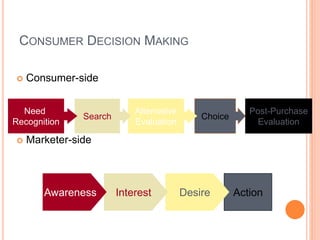
CONSUMER DECISION MAKING
 Consumer-side
 Marketer-side
Choice
Alternative
Evaluation
Search
Need
Recognition
Post-Purchase
Evaluation
Action
Desire
Interest
Awareness
ESSENTIAL TOOLS:
 Consumer Decision Making
 Demographics / Trends
 Information Processing
 Social Influence
DEMOGRAPHIC TRENDS:
 Aging population
 Cultural Diversity & Globalization
LIFESTYLE & SEGMENT TRENDS:
 Staying connected
 Cellular phones
 Instant messaging
 Health & Fitness
 Atkins
 Water
ESSENTIAL TOOLS:
 Consumer Decision Making
 Demographics / Trends
 Information Processing
 Social Influence
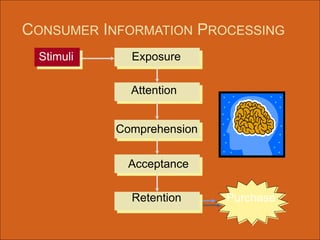
CONSUMER INFORMATION PROCESSING
Stimuli Exposure
Attention
Comprehension
Acceptance
Retention Purchase
ESSENTIAL TOOLS:
 Consumer Decision Making
 Demographics / Trends
 Information Processing
 Social Influence
SOCIAL INFLUENCE
 Creating “Buzz” through word of mouth
 Cultural and generational influence
 Family & Group Influence

Consumer Behavior.

  • 1.
  • 2.
    WHAT IS CONSUMERBEHAVIOR?  “The study of individuals, groups, or organizations and the processes they use to select, secure, use, and dispose of products, services, experiences, or ideas to satisfy needs and the impact that these processes have on the consumer and society” -- Hawkins, Best, and Coney 2004  “The study of the cognitive, emotional, and physical activities associated with the perception, evaluation, choice, acquisition, use, and disposition of goods and services.”
  • 4.
    WHY STUDY CONSUMERBEHAVIOR?  The Marketing Concept:  Marketing is the process of planning and executing the conception, pricing, promotion, and distribution of ideas, goods, and services to create more satisfying exchanges than the competition.  Corollary:  Success in the marketplace requires: knowing, then attracting, satisfying, and retaining customers.
  • 5.
    WHY STUDY CONSUMERBEHAVIOR?  No brand/product can appeal to all people. Firms must segment the market into groups with relatively homogeneous preferences and target one or more groups. Firms must position their offerings in the hearts and minds of these individuals in a favorable way. Firms must examine all of the touch points that shape how a consumer will respond to their offering.
  • 6.
    WHY STUDY CONSUMERBEHAVIOR?  Our guesses about people are inaccurate.  This is because human nature leads us to believe that other people think like us  false consensus  People tend to perceive differences even when they don’t exist  stereotyping
  • 7.
    WHY STUDY CONSUMERBEHAVIOR?  Therefore, we must strive to… Identify customer needs and wants Engage in research Understand how customers will respond to different messages and environments Learn about and apply theories Anticipate where preferences are headed Staying informed
  • 8.
    ESSENTIAL TOOLS:  ConsumerDecision Making  Demographics / Trends  Information Processing  Social Influence
  • 9.
    CONSUMER DECISION MAKING Consumer-side  Marketer-side Choice Alternative Evaluation Search Need Recognition Post-Purchase Evaluation Action Desire Interest Awareness
  • 10.
    ESSENTIAL TOOLS:  ConsumerDecision Making  Demographics / Trends  Information Processing  Social Influence
  • 11.
    DEMOGRAPHIC TRENDS:  Agingpopulation  Cultural Diversity & Globalization
  • 12.
    LIFESTYLE & SEGMENTTRENDS:  Staying connected  Cellular phones  Instant messaging  Health & Fitness  Atkins  Water
  • 13.
    ESSENTIAL TOOLS:  ConsumerDecision Making  Demographics / Trends  Information Processing  Social Influence
  • 14.
    CONSUMER INFORMATION PROCESSING StimuliExposure Attention Comprehension Acceptance Retention Purchase
  • 15.
    ESSENTIAL TOOLS:  ConsumerDecision Making  Demographics / Trends  Information Processing  Social Influence
  • 16.
    SOCIAL INFLUENCE  Creating“Buzz” through word of mouth  Cultural and generational influence  Family & Group Influence