WELCOME
HUNTINGTON’S DISEASE
•
•
Presented by
.
Introduction
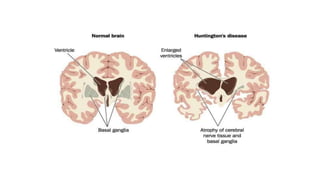
•Huntington’s disease is a
chronic progressive,
hereditary disease of
central nervous system in
which degeneration cause
progressive chorea
(involuntary and irregular
•Huntington’s disease is an
inherited Disease that
causes the progressive
breakdown of nervous cell
in the Brain.
•Huntington’s disease is
also called Huntington’s
chorea, chronic progressive
chorea and adult chorea.
•It was first describe in
1872 by American George
Huntington.
DEFINITION
•Huntington’s disease is
an chronic progressive
hereditary Disease of
central nervous system.
Or
•Huntington’s Disease marked
by degeneration of brain
cells and causing chorea
and progressive dementia.
ETIOLOGY AND RISK FACTOR
•Infection
•Family history of the
disease
•Genetic disorder
•Age: people between 25 to
55
•Gender: Affecting men and
ClINICAL
MANIFESTATIONS
•Mild tremor
•Clumsiness
•Lack of concentration
•Irritability
•Short term memory
•Mood changes
Later symptoms fall into
Three categories
•A) movement disorder:
movement disorder associated
with the huntington’s disease
•Involuntary Jerking or
writhing movement
•Involuntary, sustained
contracture of muscle
• Slow fine movement
• Abnormal eye movements
• Difficulty swallowing ( Dysphagia)
B) CONGNITIVE DISORDER
•Difficulty planning
organizing
•Difficulty in learning
•Lack of flexibility
•Lack of start a task or
conversation
PSYCHIATRIK DISORDER
• The most common Psychiatric disorder
associated with Huntington’s disease is
depression
• Feeling of sadness or unhappiness
• Insomnia
• Social Withdrawal
• Change in appetite
• Loss of memory
• Personality change
• Confusion
• Fatigue
EARLY FEATURES
•Stumbling
•Depression
•Irritability
•Clumsiness
LATE FEATURE
•A) CONGNITIVE CHANGES
•Disorientation
•Difficulty in concentration
B) EMOTION CHANGE
•Frustration
•Anger
•Apathy
•Abnormal eye movements
C) PSYCHIATRIK
ABNORMALITIES
•Insomnia
•Anorexia
•Confusion
•Social withdrawal
3 Stage of
Huntington’s disease
1. Early Stage
2. Middle stage
3. Late stage
1 Early Stage
•Depression
•Mood change
•Involuntary movement
•Irritability
•Lack of coordination
2 Middle stage
•Shakes
•More difficulty performing
Normal
•Activities
•Slurred speech
3 Late stage
Depending others
Struggles to sleep, chew Eat
and walk
DIAGNOSTIC EVALUATION
•History collection
•Physical examination
•CT- scan
•EEG(Electroencephalogram)
•Neurological Examination
•PET(Positron Emission
Tomography)
•MIR( magnetic reasons imaging)
3. Stage of Huntington's
disease
1.Early Stage
2.Middle stage
3.Late Stage
1 EARLY STAGE
•Depression
•Mood change
•Involuntary movement
•Irritability
•Lack of coordination
2. Middle stage
•Shakes
•More difficulty performing
Normal Activities
•Slurred speech
3) Late stage
•Depending on others
•Struggles to sleep, chew
Eat and walk
MANAGEMENT
•1) Medical management
•Administer tetrabenazine to
treat involuntary movement
jerky movement
•Mood stabilizer drug e.g.
Volproic acid
•Antidepressant drugs
•Antiparkinaonian
medication such as
levodopa
Nursing management
•Asses the level of anxiety
•Provide a calm quiet
Environment for the patient
•Provide psychological
support
•Administer drugs as
prescription
REHABILITATION
•1) PSYCHOTHERAPY
•A psychotherapist can
provide talk therapy
•To help person manage
behavior problems, Develop
coping strategies
•A speech therapist can help
improve ability to speak
clearly
2) Speech therapist
3 physics therapy
•A physical therapy can
teach appropriate and safe
exercise
4) Occupational
therapy
•An occupational therapy can
assist the person with
Huntington’s disease,
family members and
caregivers
COMPLICATIONS
•High blood pressure
•Heart failure
•Kidney Failure
•Thank you

Presentation (27).pptxhshbshhsjhhshhhhhhhh