Dysmorphism
1. an abnormality in morphologic
development.dysmorphic
2. allomorphism.
3. ability to appear in different
morphological forms.
What is Dysmorphism?
• Also called dysmorphia which in Greek

means badness of form; this refers to
the malformations or an abnormality in
the shape and size of the body.
• Dysmorphism can be facial or structural
What is body dysmorphic disorder or
feature?
• A dysmorphic feature is a difference of body
structure. It can be an isolated finding in an
otherwise normal individual, or it can be
related to a congenital
disorder, genetic syndrome, or birth defect.
• Dysmorphic features can vary from isolated,
mild anomalies such as clinodactyly
or synophrys to severe congenital anomalies
such as heart defects and holoprosencephaly
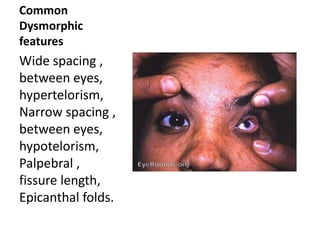
Common
Dysmorphic
features

Wide spacing ,
between eyes,
hypertelorism,
Narrow spacing ,
between eyes,
hypotelorism,
Palpebral ,
fissure length,
Epicanthal folds.
Common Dysmorphic
Features
Philtrum length
„ Upper lip
„ Shape of nose
Cause of Syndromes
•
•
•
•

„
„
„
„

Chromosomal aneuploidy
Single Gene abnormalities
Teratogen exposure
Environmental
Teratogens and
Dysmorphology
•
•
•
•
•
•
•

Medications or drugs the developing
fetus is exposed to can result in a
number of birth defects.
„ The timing of exposure and dose are
important in determining the extent
of the damage caused by a
particular teratogen.
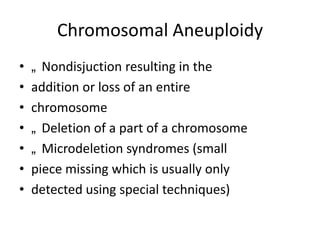
Chromosomal Aneuploidy
•
•
•
•
•
•
•

„ Nondisjuction resulting in the
addition or loss of an entire
chromosome
„ Deletion of a part of a chromosome
„ Microdeletion syndromes (small
piece missing which is usually only
detected using special techniques)
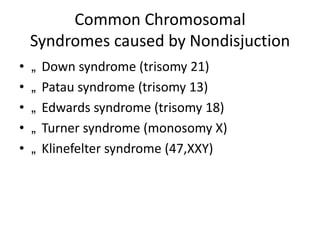
Common Chromosomal
Syndromes caused by Nondisjuction
•
•
•
•
•

„
„
„
„
„

Down syndrome (trisomy 21)
Patau syndrome (trisomy 13)
Edwards syndrome (trisomy 18)
Turner syndrome (monosomy X)
Klinefelter syndrome (47,XXY)
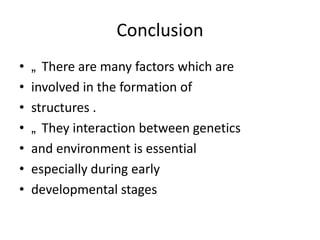
Conclusion
•
•
•
•
•
•
•

„ There are many factors which are
involved in the formation of
structures .
„ They interaction between genetics
and environment is essential
especially during early
developmental stages

Dysmorphism