Sidra akhtar
1
 To train students in writing reports according
to international standards.
 To expose students to American
Psychological Association (APA), 6th Edition
and its’ guidelines for report writing.
 To educate students in ethical issues in
conducting and publishing research.
 To prepare students in synopsis writing.
 To provide training in communication skills.
 To prepare students in writing qualitative and
quantitative research thesis.
2
 Module1: Writing for the Behavioral and Social
Sciences
 Academic Writing
 Critical Thinking
 Research
 Overview of Writing a Research Proposal
 Research Designs
 Structure of Scientific Research Article
 Types of Articles
 Ethical and Legal Standards in Publishing
 Ensuring the Accuracy of Scientific Knowledge
 Protecting the Rights and Welfare of Research
Participants
 Plagiarism
3
 “Anyone who wishes to become a good writer
should endeavour, before he allows himself
to be tempted by the more showy qualities,
to be direct, simple, brief, vigorous, and
lucid”.
(Fowler & Fowler, 1906, p. 11)
4
 Writing has four main recursive processes
such as planning, writing, editing and
reviewing.
 Characteristics of scientific writing: Precise,
Impersonal, Objective and problem solving
 Punctuation and grammar should be correct.
 Soft and formal style (not the style used in
newspapers, novels, magazines, or everyday
conversations, etc)
 Logical text and statement based on
reasoning
5
 A critical thinker is one who is able to think
through things to come up with a thoughtful
evaluation of circumstances.
Eg: Why should I vote for Party A rather than
Part B?
Why is cloning bad? Why should I believe in
God?
 Critical thinking helps in making justifications
for doing something or not doing something.
6
Benefits of Critical thinking
 Reflect (become rational)
 Exercise good rational judgment
 Think through things for ourselves
 Focus and learn to select important and
relevant matters; be reasonable and fair
 Believe or do things on the basis of reason
rather than emotion or prejudices
 Be open minded.
7
 It can be developed by adopting certain
practices
 To develop a questioning attitude
 To examine a problem following is the
guidelines
 S: state the problem
 E: Elaborate it
 E: Exemplify (give a good example)
 I: Illustrate (give an illustration such as
metaphor, a simile, an analogy, a diagram, a
concept map, etc)
8
"Research is a process of steps used to collect and analyze
information to increase our understanding of a topic or
issue". It consists of three steps: Pose a question, collect data
to answer the question, and present an answer to the question
(Creswell, 2008).
9
 It should be well-written
 Organized, with a logical flow, and concise.
 Highlight the background and the importance of your
research topic
 The proposal must reflect your thinking and design of an
original research
 It must be clearly highlight what do you want to achieve
and why it is important for you.
 Be enthusiastic about your idea – if you don’t sound
interested, why should anyone else be ?
 Follow the APA format
Introduction
 Statement of the topic
 Review of literature
 Significance of the study
 Statement of the hypothesis
 Operational definition
Method
 Participants
 Instruments
 Design
 Procedure
Data Analysis
References
 Topic must be of your interest or your area of
expertise.
 Topic must be narrowed to a more specific,
researchable one.
 Must have theoretical and practical
significance.
 Must be ethical.
 Topic must be manageable. It fits your level
of skill, available resources and time
restrictions.
12
Statement of the problem
 Answer the question: “What is the gap that needs to be filled?”
and/or “What is the problem that needs to be solved?”
 State the problem clearly early in a paragraph.
Review of Literature
 Review of literature should lead logically to a testable
hypothesis
 The review should conclude with a brief summary of the
literature and its implications.
13
 Rationale
◦ Reasons or justification for conducting the study
 Significance
◦ Addition in existing knowledge
◦ Implications for policy and practice
◦ Likely benefits for society at large
14
 Specify the outcome of your study, the end
product
 Keep your objectives SMART
◦ Specific: Indicate precisely what you intend to achieve
through your project
◦ Measurable: What you accept as proof of project success
◦ Attainable: Given the resources available
◦ Realistic: Given the local conditions
◦ Time bound: Can be achieved in the given time
15
 Examples
◦ To find out methods used for water treatment
◦ To determine the feeding habits of the under fives
◦ To assess the perception of the community
regarding care and support for people living with
HIV/AIDS
16
 A hypothesis is a researcher’s prediction of
the research findings
 Based on sound reasoning that is consistent
with theory or previous research.
 Provides a reasonable explanation for the
predicted outcome
 Clearly states the expected relation or
difference between defined variables.
 Testable within a reasonable time frame
 OPERATIONAL DEFINITION
 An operational definition describes exactly
what the variables are and how they are
measured within the context of your study
17
Statement of the Hypothesis
 Includes a description of the research participants.
 Indicate how the approach fits the overall research
design.
 Describe the specific methods of data collection.
 Explain how you intend to analyze and interpret your
results (i.e. statistical analysis, theoretical framework).
 References
 Follow the APA format for references.
 The research design refers to the overall
strategy that you choose to integrate the
different components of the study in a
coherent and logical way, thereby, ensuring
you will effectively address the research
problem; it constitutes the blueprint for the
collection, measurement, and analysis of data
(DE Vaus, 2001).
19
Case Study Design
 A case study is an in-depth study of a particular research
problem.
 A researcher using a case study design can apply a variety
of methodologies and rely on a variety of sources to
investigate a research problem.
 The design can provide detailed descriptions of specific
and rare cases.
Causal Design
 Explain “If X, then Y.”
 Used to measure what impact a specific change will have
on existing norms and assumptions.
 seek causal explanations that reflect tests of hypotheses
 It helps the researchers to understand why the world
works the way it does through the process of proving a
causal link between variables and eliminating other
possibilities.
 Replication is possible
20
Cross-Sectional Design
 The cross-sectional design can only measure
differences between or from among a variety
of people, subjects, or phenomena rather than
change.
 Make causal inferences based on findings.
 Groups are selected on the basis of
differences.
Descriptive Design
 Descriptive research designs help provide
answers to the questions of who, what, when,
where, and how associated with a particular
research problem
 Yield rich data that lead to important
recommendations in practice.
21
 Experimental research allows the researcher to control the
situation.
 To answer the question, “what causes something to occur?”
 To identify cause and effect relationships between variables
and to distinguish placebo effects from treatment effects.
 Experimental research designs support the ability to limit
alternative explanations and to infer direct causal
relationships in the study.
Exploratory Design
 Design is a useful approach for gaining background
information on a particular topic.
 Exploratory research is flexible and can address research
questions of all types (what, why, how).
 Provides an opportunity to define new terms and clarify
existing concepts.
 Exploratory research is often used to generate formal
hypotheses and develop more precise research problems.
 Exploratory studies help establish research priorities
22
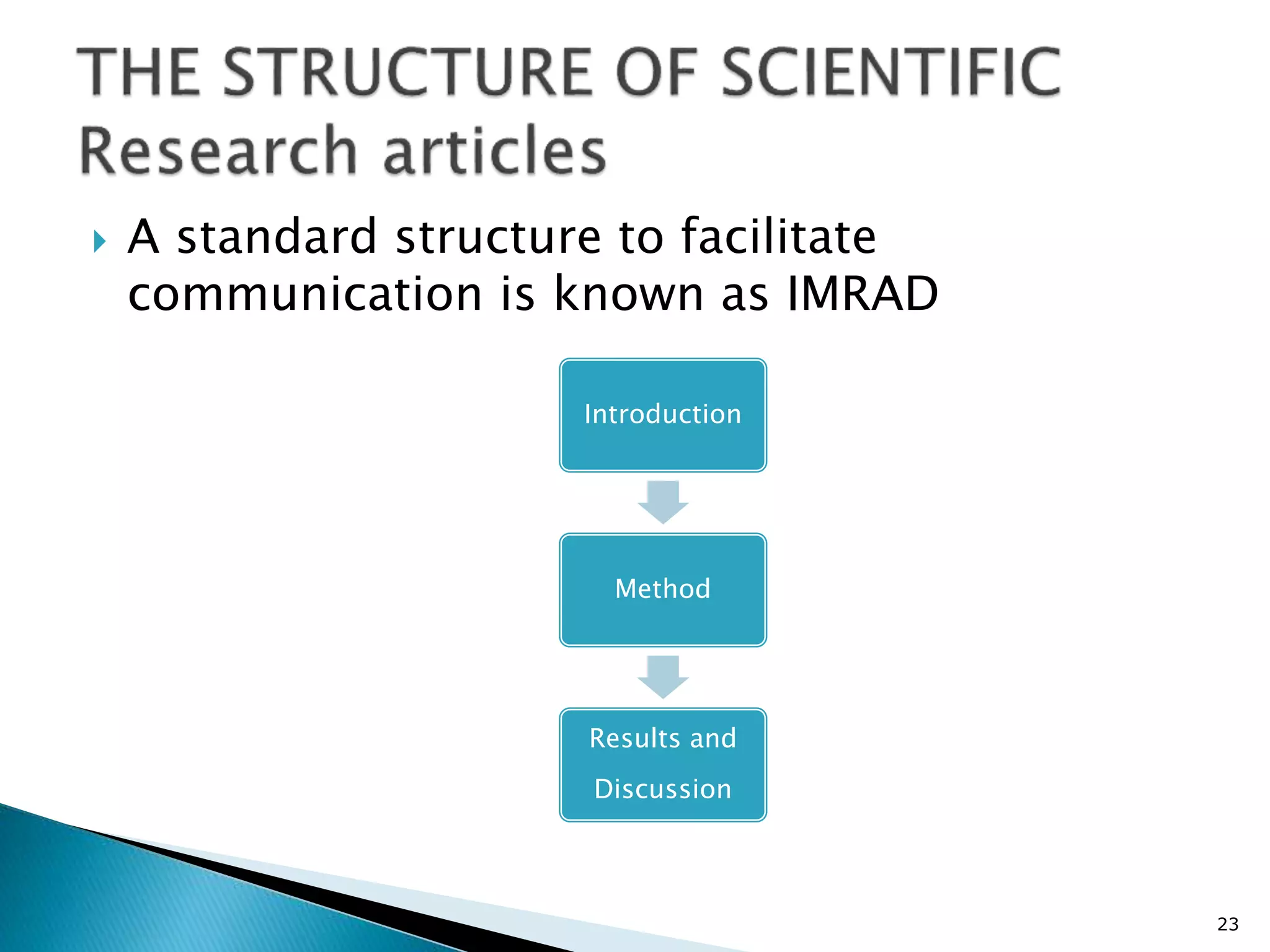
 A standard structure to facilitate
communication is known as IMRAD
23
Introduction
Method
Results and
Discussion
Empirical Studies are the reports of original research.
 Include secondary analyses by presenting novel analyses
of data not considered in previous reports. Following the
IMRAD.
Literature Reviews
 Summarizes the findings of others studies or experiments;
attempts to identify trends or draw broader conclusions.
 Define and clarify the problem
 Identify relations, contradictions, gaps, and
inconsistencies in the literature and suggest the further
steps in solving problems
Meta-Analysis
 A meta-analysis is a statistical synthesis of the results of
studies that addressed the same hypothesis in the same
way.
24
Theoretical Articles
 Draw on existing research literature to advance theory.
 Authors in theoretical articles summarize the development
of theory, refine the theoretical constructs, analyzing
existing theory, pointing out flaws and demonstrating the
advantage of one theory over another.
 Examine theory’s internal consistency and external validity.
Case Study
 Detailed account of clinically important cases of common
and rare conditions.
Methodological Articles
 Present new methodological approaches, modifications of
existing methods or discussions of quantitative and data
analytic approaches to the community of researches.
 Provide sufficient detail for researchers to assess the
applicability of the methodology to their research problem.
 It also help in comparing the proposed methods with those
in current use and the implementation of these methods.
25
Following are the three basic ethical and legal
principles underlie all scholarly research and writing.
These principles are designed to achieve three goals.
 Use to ensure the accuracy of scientific knowledge
 To protect the rights and welfare of research
participants and
 To protect intellectual property rights.
Ensuring the Accuracy of Scientific Knowledge
 Essence of the scientific method involves
observations that can be repeated and verified by
others.
 Psychologists must not Fabricate or Falsify the data
 Not to omit the troublesome observations from
reports in order to support the hypothesis.
 Must share the errors, if found the errors after
publication then first inform the editor and the
publisher so that a correction letter can be made.
26
Data Retention and Sharing
 Researchers must make their data available to the
editor at any time during the review and
publication process
 Must permit other qualified professional to
confirm the analyses and results
 After the publication authors are expected to
retain raw data for minimum five years
 APA encourages the open sharing of data among
qualified investigators on requests and written
agreement should be made.
 Agreement make it clear that shared data may
only use for verification of already published
results for inclusion in meta-analytic studies or
secondary analysis.
27
 Duplicate publication is the publication of the
same data or ideas in two separate sources
and piecemeal publication is the unnecessary
splitting of the findings from one research
effort into multiple articles.
 Previously published data cannot be used for
further publication.
 It’s the copyright violation
 Similarly previously published manuscript
cannot be published as a whole or its
substantial part like if your article is read in a
conference and published in its proceeding
then it would not published in a journal.
28
Acknowledging and citing previous work
 Authors can cite the substantial portion of their
previous work in their new article with accurate
citation.
 Any republished tables and figures must be clearly
marked as reprinted or adapted with proper
citation.
 Original research should be cited in references.
 Authors are obligated to present work completely
within the space constraints o journal publication.
 Piecemeal or fragmented publication of research
findings can be misleading.
 To draw one article from the whole study for the
publication must be informed to the editor.
29
 Data from the large scale, longitudinal or
multidisciplinary projects can be published
in multiple reports.
 Again prior published work should be cited.
 Altering the editor: if the publication of two
or more reports based on the same or
closely related research constitutes duplicate
publication is a matter of editorial judgment.
30
 Authors are required to certify that they have
followed the APA Ethics Code as a precondition of
publishing their articles in APA journals.
 This is mandatory for the authors to include such
certifications in the description of participants in the
text of manuscript, otherwise the manuscript will not
be accepted.
 In the case studies, researchers have the obligation to
maintain the confidentiality of the participants.
 Prohibited from disclosing the confidential,
personally identifiable information concerning their
patients, individual or organizational clients,
students, research participants, or other recipients of
their services.
31
 Publication credit
Authorship is reserved for persons who make a substantial
contribution to and who accept responsibility for a published
work. May include formulating the hypothesis, structuring the
experimental design, organizing and conducting the statistical
analysis, interpreting the results, or writing a major portion of
the paper.
 Determining authorship
In a research project, the collaborators should decide on which
tasks are necessary for the project’s completion, how the work
will be divided, which tasks or combination of tasks merits
authorship credit, and on what level credit should be given ( first
author, second author, etc).
 Order of authorship
Generally the name of the principal contributor should appear first,
with subsequent names in order of decreasing contribution.
32
 Reviewers
While editorial review of a manuscript which requires that the
editors and reviewers circulate and discuss the manuscript, it
should be confidential and privileged document.
It may not be misused.
If the reviewer wish to suggest any thing to the colleague about
some aspect of manuscript, then must take permission from the
editor.
 Author’s Copyright on an Unpublished Manuscript
An unpublished work is copyrighted from the moment it is fixed in
solid form for example, typed on page.
The unpublished paper can distribute on internet or post it on
website with proper date and a statement that the paper has not
(yet) been published.
 Planning for Ethical Compliance
 This is mandatory for the authors to submit a ethical compliance
form while submitting a manuscript to the APA journal including
issues related to institutional approval, informed consent,
deception in research and participant protections.
33
 The word plagiarize actually comes from the
Latin “plagi rere”—to kidnap.
 Taking and using the thoughts, writings, and
inventions of another person as one's own.
 Using someone’s ideas without citing or
quoting; thereby, receiving credit for someone
else’s intellectual effort.
 Researchers do not claim the words and ideas
of another as their own, they give credit
where credit is required.
Self-plagiarism
Researchers do not present their own previously
published work as a new without any citation.
34
 Creswell, J. W. (2008). Educational Research:
Planning, conducting, and evaluating quantitative
and qualitative research (3rd ed.). Upper Saddle
River: Pearson.
 Gay, L. R., Mills, G. E., & Airasian, P. (2006).
Educational research: Competencies for analysis
and applications (8th ed.). Upper Saddle River, NJ:
Pearson-Merrill Prentice Hall
 Publication Manual of the American Psychological
Association, (6th ed., 2nd printing).
 De Vaus, D. A., & de Vaus, D. (2001). Research
design in social research. Sage.
35

Writing a report - APA Style

  • 1.
  • 2.
     To trainstudents in writing reports according to international standards.  To expose students to American Psychological Association (APA), 6th Edition and its’ guidelines for report writing.  To educate students in ethical issues in conducting and publishing research.  To prepare students in synopsis writing.  To provide training in communication skills.  To prepare students in writing qualitative and quantitative research thesis. 2
  • 3.
     Module1: Writingfor the Behavioral and Social Sciences  Academic Writing  Critical Thinking  Research  Overview of Writing a Research Proposal  Research Designs  Structure of Scientific Research Article  Types of Articles  Ethical and Legal Standards in Publishing  Ensuring the Accuracy of Scientific Knowledge  Protecting the Rights and Welfare of Research Participants  Plagiarism 3
  • 4.
     “Anyone whowishes to become a good writer should endeavour, before he allows himself to be tempted by the more showy qualities, to be direct, simple, brief, vigorous, and lucid”. (Fowler & Fowler, 1906, p. 11) 4
  • 5.
     Writing hasfour main recursive processes such as planning, writing, editing and reviewing.  Characteristics of scientific writing: Precise, Impersonal, Objective and problem solving  Punctuation and grammar should be correct.  Soft and formal style (not the style used in newspapers, novels, magazines, or everyday conversations, etc)  Logical text and statement based on reasoning 5
  • 6.
     A criticalthinker is one who is able to think through things to come up with a thoughtful evaluation of circumstances. Eg: Why should I vote for Party A rather than Part B? Why is cloning bad? Why should I believe in God?  Critical thinking helps in making justifications for doing something or not doing something. 6
  • 7.
    Benefits of Criticalthinking  Reflect (become rational)  Exercise good rational judgment  Think through things for ourselves  Focus and learn to select important and relevant matters; be reasonable and fair  Believe or do things on the basis of reason rather than emotion or prejudices  Be open minded. 7
  • 8.
     It canbe developed by adopting certain practices  To develop a questioning attitude  To examine a problem following is the guidelines  S: state the problem  E: Elaborate it  E: Exemplify (give a good example)  I: Illustrate (give an illustration such as metaphor, a simile, an analogy, a diagram, a concept map, etc) 8
  • 9.
    "Research is aprocess of steps used to collect and analyze information to increase our understanding of a topic or issue". It consists of three steps: Pose a question, collect data to answer the question, and present an answer to the question (Creswell, 2008). 9
  • 10.
     It shouldbe well-written  Organized, with a logical flow, and concise.  Highlight the background and the importance of your research topic  The proposal must reflect your thinking and design of an original research  It must be clearly highlight what do you want to achieve and why it is important for you.  Be enthusiastic about your idea – if you don’t sound interested, why should anyone else be ?  Follow the APA format
  • 11.
    Introduction  Statement ofthe topic  Review of literature  Significance of the study  Statement of the hypothesis  Operational definition Method  Participants  Instruments  Design  Procedure Data Analysis References
  • 12.
     Topic mustbe of your interest or your area of expertise.  Topic must be narrowed to a more specific, researchable one.  Must have theoretical and practical significance.  Must be ethical.  Topic must be manageable. It fits your level of skill, available resources and time restrictions. 12
  • 13.
    Statement of theproblem  Answer the question: “What is the gap that needs to be filled?” and/or “What is the problem that needs to be solved?”  State the problem clearly early in a paragraph. Review of Literature  Review of literature should lead logically to a testable hypothesis  The review should conclude with a brief summary of the literature and its implications. 13
  • 14.
     Rationale ◦ Reasonsor justification for conducting the study  Significance ◦ Addition in existing knowledge ◦ Implications for policy and practice ◦ Likely benefits for society at large 14
  • 15.
     Specify theoutcome of your study, the end product  Keep your objectives SMART ◦ Specific: Indicate precisely what you intend to achieve through your project ◦ Measurable: What you accept as proof of project success ◦ Attainable: Given the resources available ◦ Realistic: Given the local conditions ◦ Time bound: Can be achieved in the given time 15
  • 16.
     Examples ◦ Tofind out methods used for water treatment ◦ To determine the feeding habits of the under fives ◦ To assess the perception of the community regarding care and support for people living with HIV/AIDS 16
  • 17.
     A hypothesisis a researcher’s prediction of the research findings  Based on sound reasoning that is consistent with theory or previous research.  Provides a reasonable explanation for the predicted outcome  Clearly states the expected relation or difference between defined variables.  Testable within a reasonable time frame  OPERATIONAL DEFINITION  An operational definition describes exactly what the variables are and how they are measured within the context of your study 17 Statement of the Hypothesis
  • 18.
     Includes adescription of the research participants.  Indicate how the approach fits the overall research design.  Describe the specific methods of data collection.  Explain how you intend to analyze and interpret your results (i.e. statistical analysis, theoretical framework).  References  Follow the APA format for references.
  • 19.
     The researchdesign refers to the overall strategy that you choose to integrate the different components of the study in a coherent and logical way, thereby, ensuring you will effectively address the research problem; it constitutes the blueprint for the collection, measurement, and analysis of data (DE Vaus, 2001). 19
  • 20.
    Case Study Design A case study is an in-depth study of a particular research problem.  A researcher using a case study design can apply a variety of methodologies and rely on a variety of sources to investigate a research problem.  The design can provide detailed descriptions of specific and rare cases. Causal Design  Explain “If X, then Y.”  Used to measure what impact a specific change will have on existing norms and assumptions.  seek causal explanations that reflect tests of hypotheses  It helps the researchers to understand why the world works the way it does through the process of proving a causal link between variables and eliminating other possibilities.  Replication is possible 20
  • 21.
    Cross-Sectional Design  Thecross-sectional design can only measure differences between or from among a variety of people, subjects, or phenomena rather than change.  Make causal inferences based on findings.  Groups are selected on the basis of differences. Descriptive Design  Descriptive research designs help provide answers to the questions of who, what, when, where, and how associated with a particular research problem  Yield rich data that lead to important recommendations in practice. 21
  • 22.
     Experimental researchallows the researcher to control the situation.  To answer the question, “what causes something to occur?”  To identify cause and effect relationships between variables and to distinguish placebo effects from treatment effects.  Experimental research designs support the ability to limit alternative explanations and to infer direct causal relationships in the study. Exploratory Design  Design is a useful approach for gaining background information on a particular topic.  Exploratory research is flexible and can address research questions of all types (what, why, how).  Provides an opportunity to define new terms and clarify existing concepts.  Exploratory research is often used to generate formal hypotheses and develop more precise research problems.  Exploratory studies help establish research priorities 22
  • 23.
     A standardstructure to facilitate communication is known as IMRAD 23 Introduction Method Results and Discussion
  • 24.
    Empirical Studies arethe reports of original research.  Include secondary analyses by presenting novel analyses of data not considered in previous reports. Following the IMRAD. Literature Reviews  Summarizes the findings of others studies or experiments; attempts to identify trends or draw broader conclusions.  Define and clarify the problem  Identify relations, contradictions, gaps, and inconsistencies in the literature and suggest the further steps in solving problems Meta-Analysis  A meta-analysis is a statistical synthesis of the results of studies that addressed the same hypothesis in the same way. 24
  • 25.
    Theoretical Articles  Drawon existing research literature to advance theory.  Authors in theoretical articles summarize the development of theory, refine the theoretical constructs, analyzing existing theory, pointing out flaws and demonstrating the advantage of one theory over another.  Examine theory’s internal consistency and external validity. Case Study  Detailed account of clinically important cases of common and rare conditions. Methodological Articles  Present new methodological approaches, modifications of existing methods or discussions of quantitative and data analytic approaches to the community of researches.  Provide sufficient detail for researchers to assess the applicability of the methodology to their research problem.  It also help in comparing the proposed methods with those in current use and the implementation of these methods. 25
  • 26.
    Following are thethree basic ethical and legal principles underlie all scholarly research and writing. These principles are designed to achieve three goals.  Use to ensure the accuracy of scientific knowledge  To protect the rights and welfare of research participants and  To protect intellectual property rights. Ensuring the Accuracy of Scientific Knowledge  Essence of the scientific method involves observations that can be repeated and verified by others.  Psychologists must not Fabricate or Falsify the data  Not to omit the troublesome observations from reports in order to support the hypothesis.  Must share the errors, if found the errors after publication then first inform the editor and the publisher so that a correction letter can be made. 26
  • 27.
    Data Retention andSharing  Researchers must make their data available to the editor at any time during the review and publication process  Must permit other qualified professional to confirm the analyses and results  After the publication authors are expected to retain raw data for minimum five years  APA encourages the open sharing of data among qualified investigators on requests and written agreement should be made.  Agreement make it clear that shared data may only use for verification of already published results for inclusion in meta-analytic studies or secondary analysis. 27
  • 28.
     Duplicate publicationis the publication of the same data or ideas in two separate sources and piecemeal publication is the unnecessary splitting of the findings from one research effort into multiple articles.  Previously published data cannot be used for further publication.  It’s the copyright violation  Similarly previously published manuscript cannot be published as a whole or its substantial part like if your article is read in a conference and published in its proceeding then it would not published in a journal. 28
  • 29.
    Acknowledging and citingprevious work  Authors can cite the substantial portion of their previous work in their new article with accurate citation.  Any republished tables and figures must be clearly marked as reprinted or adapted with proper citation.  Original research should be cited in references.  Authors are obligated to present work completely within the space constraints o journal publication.  Piecemeal or fragmented publication of research findings can be misleading.  To draw one article from the whole study for the publication must be informed to the editor. 29
  • 30.
     Data fromthe large scale, longitudinal or multidisciplinary projects can be published in multiple reports.  Again prior published work should be cited.  Altering the editor: if the publication of two or more reports based on the same or closely related research constitutes duplicate publication is a matter of editorial judgment. 30
  • 31.
     Authors arerequired to certify that they have followed the APA Ethics Code as a precondition of publishing their articles in APA journals.  This is mandatory for the authors to include such certifications in the description of participants in the text of manuscript, otherwise the manuscript will not be accepted.  In the case studies, researchers have the obligation to maintain the confidentiality of the participants.  Prohibited from disclosing the confidential, personally identifiable information concerning their patients, individual or organizational clients, students, research participants, or other recipients of their services. 31
  • 32.
     Publication credit Authorshipis reserved for persons who make a substantial contribution to and who accept responsibility for a published work. May include formulating the hypothesis, structuring the experimental design, organizing and conducting the statistical analysis, interpreting the results, or writing a major portion of the paper.  Determining authorship In a research project, the collaborators should decide on which tasks are necessary for the project’s completion, how the work will be divided, which tasks or combination of tasks merits authorship credit, and on what level credit should be given ( first author, second author, etc).  Order of authorship Generally the name of the principal contributor should appear first, with subsequent names in order of decreasing contribution. 32
  • 33.
     Reviewers While editorialreview of a manuscript which requires that the editors and reviewers circulate and discuss the manuscript, it should be confidential and privileged document. It may not be misused. If the reviewer wish to suggest any thing to the colleague about some aspect of manuscript, then must take permission from the editor.  Author’s Copyright on an Unpublished Manuscript An unpublished work is copyrighted from the moment it is fixed in solid form for example, typed on page. The unpublished paper can distribute on internet or post it on website with proper date and a statement that the paper has not (yet) been published.  Planning for Ethical Compliance  This is mandatory for the authors to submit a ethical compliance form while submitting a manuscript to the APA journal including issues related to institutional approval, informed consent, deception in research and participant protections. 33
  • 34.
     The wordplagiarize actually comes from the Latin “plagi rere”—to kidnap.  Taking and using the thoughts, writings, and inventions of another person as one's own.  Using someone’s ideas without citing or quoting; thereby, receiving credit for someone else’s intellectual effort.  Researchers do not claim the words and ideas of another as their own, they give credit where credit is required. Self-plagiarism Researchers do not present their own previously published work as a new without any citation. 34
  • 35.
     Creswell, J.W. (2008). Educational Research: Planning, conducting, and evaluating quantitative and qualitative research (3rd ed.). Upper Saddle River: Pearson.  Gay, L. R., Mills, G. E., & Airasian, P. (2006). Educational research: Competencies for analysis and applications (8th ed.). Upper Saddle River, NJ: Pearson-Merrill Prentice Hall  Publication Manual of the American Psychological Association, (6th ed., 2nd printing).  De Vaus, D. A., & de Vaus, D. (2001). Research design in social research. Sage. 35