HRIS
HR Accounting & Audit
Ms. Anubha Rastogi
Astt. Prof, Vidya School Of Business
2015-16
Human Resource Information Systems
(HRIS)
Virtually all HR management functions can be enhanced through the
use of an HRIS – any organized approach for obtaining relevant and
time information on which to base HR decisions
2
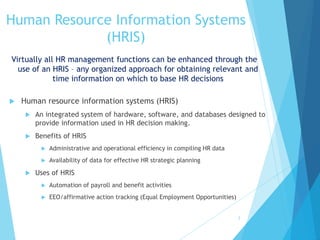
 Human resource information systems (HRIS)
 An integrated system of hardware, software, and databases designed to
provide information used in HR decision making.
 Benefits of HRIS
 Administrative and operational efficiency in compiling HR data
 Availability of data for effective HR strategic planning
 Uses of HRIS
 Automation of payroll and benefit activities
 EEO/affirmative action tracking (Equal Employment Opportunities)
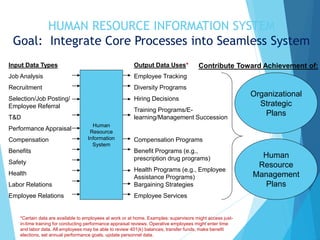
HUMAN RESOURCE INFORMATION SYSTEM
Goal: Integrate Core Processes into Seamless System
*Certain data are available to employees at work or at home. Examples: supervisors might access just-
in-time training for conducting performance appraisal reviews. Operative employees might enter time
and labor data. All employees may be able to review 401(k) balances, transfer funds, make benefit
elections, set annual performance goals, update personnel data.
Input Data Types
Job Analysis
Recruitment
Selection/Job Posting/
Employee Referral
T&D
Performance Appraisal
Compensation
Benefits
Safety
Health
Labor Relations
Employee Relations
Output Data Uses*
Employee Tracking
Diversity Programs
Hiring Decisions
Training Programs/E-
learning/Management Succession
Compensation Programs
Benefit Programs (e.g.,
prescription drug programs)
Health Programs (e.g., Employee
Assistance Programs)
Bargaining Strategies
Employee Services
Organizational
Strategic
Plans
Human
Resource
Management
Plans
Contribute Toward Achievement of:
Human
Resource
Information
System
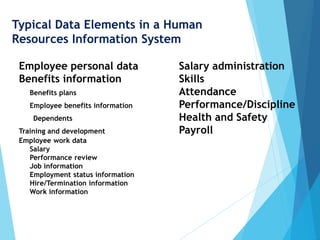
Typical Data Elements in a Human
Resources Information System
Employee personal data Salary administration
Benefits information Skills
Benefits plans Attendance
Employee benefits information Performance/Discipline
Dependents Health and Safety
Training and development Payroll
Employee work data
Salary
Performance review
Job information
Employment status information
Hire/Termination information
Work information
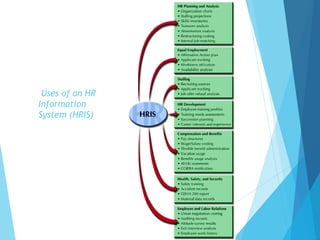
Uses of an HR
Information
System (HRIS)
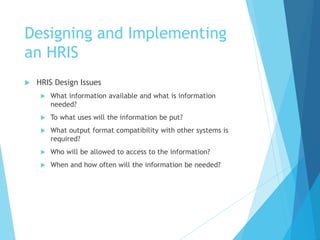
Designing and Implementing
an HRIS
 HRIS Design Issues
 What information available and what is information
needed?
 To what uses will the information be put?
 What output format compatibility with other systems is
required?
 Who will be allowed to access to the information?
 When and how often will the information be needed?
Accessing the HRIS
 Intranet
 An organizational (internal) network that operates over
the Internet.
 Extranet
 An Internet-linked network that allows employees access
to information provided by external entities.
 Web-based HRIS Uses
 Bulletin boards
 Data access
 Employee self-service
 Extended linkage
HR Accounting
‘HRA is a process of identifying and measuring data about
human resources and communicating this information to
interested parties’.
It involves measuring the costs incurred by organizations to
recruit, select, hire, train, and develop human assets. It also
involves measuring the economic value of people to the
organization’.
Calculating HR Cost
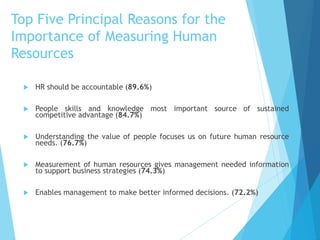
Top Five Principal Reasons for the
Importance of Measuring Human
Resources
 HR should be accountable (89.6%)
 People skills and knowledge most important source of sustained
competitive advantage (84.7%)
 Understanding the value of people focuses us on future human resource
needs. (76.7%)
 Measurement of human resources gives management needed information
to support business strategies (74.3%)
 Enables management to make better informed decisions. (72.2%)
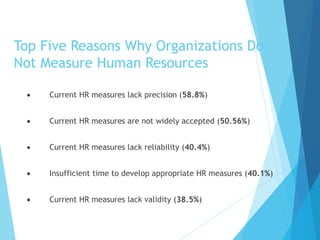
Top Five Reasons Why Organizations Do
Not Measure Human Resources
 Current HR measures lack precision (58.8%)
 Current HR measures are not widely accepted (50.56%)
 Current HR measures lack reliability (40.4%)
 Insufficient time to develop appropriate HR measures (40.1%)
 Current HR measures lack validity (38.5%)
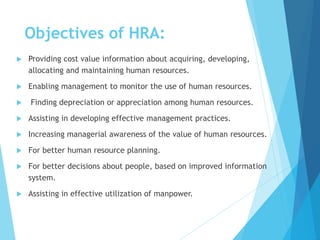
Objectives of HRA:
 Providing cost value information about acquiring, developing,
allocating and maintaining human resources.
 Enabling management to monitor the use of human resources.
 Finding depreciation or appreciation among human resources.
 Assisting in developing effective management practices.
 Increasing managerial awareness of the value of human resources.
 For better human resource planning.
 For better decisions about people, based on improved information
system.
 Assisting in effective utilization of manpower.
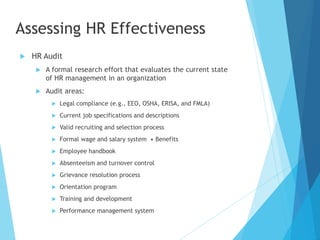
Assessing HR Effectiveness
 HR Audit
 A formal research effort that evaluates the current state
of HR management in an organization
 Audit areas:
 Legal compliance (e.g., EEO, OSHA, ERISA, and FMLA)
 Current job specifications and descriptions
 Valid recruiting and selection process
 Formal wage and salary system • Benefits
 Employee handbook
 Absenteeism and turnover control
 Grievance resolution process
 Orientation program
 Training and development
 Performance management system
HRM Auditing Model
 Strategic-Level HRM — determines the effectiveness of HRM functions in the
overall strategic plan of the organization
 Managerial-Level HRM — determines effectiveness of HRM functions within
departments and units
 Operational-Level HRM — determines the effectiveness of HRM functions
throughout the organization
 When labour costs are large or the largest component of total product or
service costs
 The personnel audit is used to justify the existence of budgets of staff and
programs
 The personnel audit provides valuable feedback from employees and line
managers
 The personnel audit may uncover problems such as unqualified HRM staff, lack
of HRM policy compliance, or low employee satisfaction
Reasons for Conducting HRM Audits
HR Performance and Benchmarking
 Benchmarking
 Comparing specific measures of performance against data on those measures
in other “best practice” organizations
 Common Benchmarks
 Total compensation as a percentage of net income before taxes
 Percent of management positions filled internally
 Dollar sales per employee
 Benefits as a percentage of payroll cost
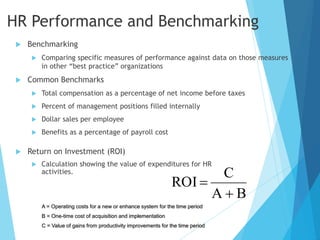
 Return on Investment (ROI)
 Calculation showing the value of expenditures for HR
activities.
A = Operating costs for a new or enhance system for the time period
B = One-time cost of acquisition and implementation
C = Value of gains from productivity improvements for the time period
BA
C
ROI



Human Resource Information System, Accounting and Audit.

  • 1.
    HRIS HR Accounting &Audit Ms. Anubha Rastogi Astt. Prof, Vidya School Of Business 2015-16
  • 2.
    Human Resource InformationSystems (HRIS) Virtually all HR management functions can be enhanced through the use of an HRIS – any organized approach for obtaining relevant and time information on which to base HR decisions 2  Human resource information systems (HRIS)  An integrated system of hardware, software, and databases designed to provide information used in HR decision making.  Benefits of HRIS  Administrative and operational efficiency in compiling HR data  Availability of data for effective HR strategic planning  Uses of HRIS  Automation of payroll and benefit activities  EEO/affirmative action tracking (Equal Employment Opportunities)
  • 3.
    HUMAN RESOURCE INFORMATIONSYSTEM Goal: Integrate Core Processes into Seamless System *Certain data are available to employees at work or at home. Examples: supervisors might access just- in-time training for conducting performance appraisal reviews. Operative employees might enter time and labor data. All employees may be able to review 401(k) balances, transfer funds, make benefit elections, set annual performance goals, update personnel data. Input Data Types Job Analysis Recruitment Selection/Job Posting/ Employee Referral T&D Performance Appraisal Compensation Benefits Safety Health Labor Relations Employee Relations Output Data Uses* Employee Tracking Diversity Programs Hiring Decisions Training Programs/E- learning/Management Succession Compensation Programs Benefit Programs (e.g., prescription drug programs) Health Programs (e.g., Employee Assistance Programs) Bargaining Strategies Employee Services Organizational Strategic Plans Human Resource Management Plans Contribute Toward Achievement of: Human Resource Information System
  • 4.
    Typical Data Elementsin a Human Resources Information System Employee personal data Salary administration Benefits information Skills Benefits plans Attendance Employee benefits information Performance/Discipline Dependents Health and Safety Training and development Payroll Employee work data Salary Performance review Job information Employment status information Hire/Termination information Work information
  • 5.
    Uses of anHR Information System (HRIS)
  • 6.
    Designing and Implementing anHRIS  HRIS Design Issues  What information available and what is information needed?  To what uses will the information be put?  What output format compatibility with other systems is required?  Who will be allowed to access to the information?  When and how often will the information be needed?
  • 7.
    Accessing the HRIS Intranet  An organizational (internal) network that operates over the Internet.  Extranet  An Internet-linked network that allows employees access to information provided by external entities.  Web-based HRIS Uses  Bulletin boards  Data access  Employee self-service  Extended linkage
  • 8.
    HR Accounting ‘HRA isa process of identifying and measuring data about human resources and communicating this information to interested parties’. It involves measuring the costs incurred by organizations to recruit, select, hire, train, and develop human assets. It also involves measuring the economic value of people to the organization’. Calculating HR Cost
  • 9.
    Top Five PrincipalReasons for the Importance of Measuring Human Resources  HR should be accountable (89.6%)  People skills and knowledge most important source of sustained competitive advantage (84.7%)  Understanding the value of people focuses us on future human resource needs. (76.7%)  Measurement of human resources gives management needed information to support business strategies (74.3%)  Enables management to make better informed decisions. (72.2%)
  • 10.
    Top Five ReasonsWhy Organizations Do Not Measure Human Resources  Current HR measures lack precision (58.8%)  Current HR measures are not widely accepted (50.56%)  Current HR measures lack reliability (40.4%)  Insufficient time to develop appropriate HR measures (40.1%)  Current HR measures lack validity (38.5%)
  • 11.
    Objectives of HRA: Providing cost value information about acquiring, developing, allocating and maintaining human resources.  Enabling management to monitor the use of human resources.  Finding depreciation or appreciation among human resources.  Assisting in developing effective management practices.  Increasing managerial awareness of the value of human resources.  For better human resource planning.  For better decisions about people, based on improved information system.  Assisting in effective utilization of manpower.
  • 12.
    Assessing HR Effectiveness HR Audit  A formal research effort that evaluates the current state of HR management in an organization  Audit areas:  Legal compliance (e.g., EEO, OSHA, ERISA, and FMLA)  Current job specifications and descriptions  Valid recruiting and selection process  Formal wage and salary system • Benefits  Employee handbook  Absenteeism and turnover control  Grievance resolution process  Orientation program  Training and development  Performance management system
  • 13.
    HRM Auditing Model Strategic-Level HRM — determines the effectiveness of HRM functions in the overall strategic plan of the organization  Managerial-Level HRM — determines effectiveness of HRM functions within departments and units  Operational-Level HRM — determines the effectiveness of HRM functions throughout the organization  When labour costs are large or the largest component of total product or service costs  The personnel audit is used to justify the existence of budgets of staff and programs  The personnel audit provides valuable feedback from employees and line managers  The personnel audit may uncover problems such as unqualified HRM staff, lack of HRM policy compliance, or low employee satisfaction Reasons for Conducting HRM Audits
  • 14.
    HR Performance andBenchmarking  Benchmarking  Comparing specific measures of performance against data on those measures in other “best practice” organizations  Common Benchmarks  Total compensation as a percentage of net income before taxes  Percent of management positions filled internally  Dollar sales per employee  Benefits as a percentage of payroll cost  Return on Investment (ROI)  Calculation showing the value of expenditures for HR activities. A = Operating costs for a new or enhance system for the time period B = One-time cost of acquisition and implementation C = Value of gains from productivity improvements for the time period BA C ROI  