HUMAN RESOURCES INFORMATION
SYSTEM (HRIS)
WHAT IS AN HRIS?
• HRIS stands for Human Resources Information System. The HRIS is a system that is
used to collect and store data on an organization’s employees.
• An HRIS is also known as HRIS software. This is a bit confusing as it implies that
different systems can have different software running on them. However, this is not
the case. The HRIS is, in essence, an HR software package.
• Other commonly used names are HRIS system and HRMS, or Human Resources
Management system. These are all different words for the same thing. Collectively,
these systems are also called Human Capital Management systems, or HCM. In this
article, we will use the terms HRIS and HRIS systems interchangeably.
• The HRIS can either run on the company’s own technical infrastructure, or, more
common nowadays, be cloud-based. This means that the HR software is running
outside of the company’s premises, making it much easier to update.
BENEFITS OF AN HRIS:
• Record-keeping - An HRIS is a record-keeping system that keeps track of changes
to anything related to employees. The HRIS can be seen as the single source of truth
when it comes to personnel data.
• Compliance - Some data is collected and stored for compliance reasons. This
includes material for the identification of employees in case of theft, fraud, or other
misbehaviors, first contact information in case of accidents, citizens identification
information for the tax office, and expiration dates for mandatory certification. All
this information can be stored in the HRIS. It is essential that data is stored safely
and securely.
• Efficiency - Having all this information stored in one place not only benefits accuracy
but also saves time. Some companies still keep a lot of data about employees as
physical paperwork. Finding the right folder, and locating the right sheet, can take
up a lot of staff time.
• HR strategy - The HRIS permits the tracking of data required to advance the HR and
business strategy. Depending on the priorities of the organization, different data will
be essential to track. This is where the HRIS shines.
• Self-Service HR - A final benefit is the ability to offer self-service HR to employees
and managers. This enables employees to manage their own affairs. When done
right, the HRIS can offer a good employee experience. Keep in mind that not all
HRIS systems offer this in a user-friendly manner.
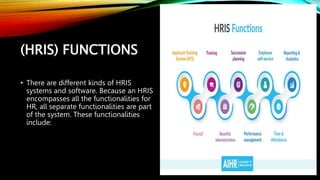
(HRIS) FUNCTIONS
• There are different kinds of HRIS
systems and software. Because an HRIS
encompasses all the functionalities for
HR, all separate functionalities are part
of the system. These functionalities
include:
• Applicant Tracking System (ATS) - This software handles all the company’s recruiting
needs. It tracks candidate information and resumes, enables recruiters to match job
openings to suitable candidates from the company’s application pool, and helps in
guiding the hiring process.
• Payroll - Payroll automates the pay process of employees. Contractual data and
information on new hires is often entered into this system – sometimes combined
with time & attendance data – and at the end of the month, payments orders are
created.
• Benefits administration - Another functionality of the HRIS is benefits management.
Employee benefits are an important aspect of compensation and are also managed
in this system. More advanced systems offer an employee self-service model for
employee benefits. In this case, employees can select the benefits they are looking
for themselves. One may want more paternity leave, the other one a more expensive
company car. This self-service approach to benefits is also called a cafeteria model.
• Time & Attendance - This module gathers time and attendance data from
employees. These are especially relevant for shift workers where employees clock in
and out. Back in the day, employees often wrote down their working hours on a
piece of paper. Then, the manager would manually enter the data into a time
tracking system. Based on this data, payment orders were generated and paid to all
employees. Nowadays, workers often check into work by fingerprint or a card that is
synced with an HRIS. This gives an exact time for arrival and departure. Any issues
with lateness are easily detected.
• Training - Learning and development is a key element when it comes to employee
management. This module allows HR to track qualification, certification, and skills of
the employees, as well as an outline of available courses for company employees.
This module is often referred to as an LMS, or Learning Management System, when
it’s a stand-alone. An LMS usually includes available e-learning and other courses to
be followed by employees.
• Performance management - Performance management is a key part of managing
people. Performance ratings are generated once or multiple times a year by the
direct manager or peers of the employee.
• Succession planning - Creating a talent pipeline and having replacements available
for key roles in the organization is another key component of an HRIS.
• Employee self-service - Employee self-service has already been mentioned.
Organizations are focusing increasingly on having employees and their direct
supervisors manage their own data. Requests like holidays can be asked for by the
employee him/herself. After approval, these are then immediately saved into the
system (and registered to track for payroll and benefits purposes).
• Reporting & Analytics - A much rarer module in HRIS systems is reporting and
analytics. Modern systems enable the creation of automated HR reports on various
topics like employee turnover, absence, performance, and more. Analytics involves
the analysis of these insights for better-informed decision making. We’ll explain
more about this in the section below.
REPORTING AND ANALYTICS IN AN (HRIS)
• The common characteristic for all HRIS systems is that they have been designed as
transactional systems. They are databases that record a company’s transactions. An
example of a transaction is when new employees join the company.
• A new employee record is entered, and the person is considered ā€˜active’. If a person
leaves the company three months later, a new transaction is recorded, setting the
person’s status to ā€˜terminated’.
• The fact that these systems are designed as transactional systems, makes them bad
at data reporting and analytics. They simply haven’t been designed for this. In
addition, not all HRIS systems have all the above capabilities built-in.
• Some functionalities, like payroll, LMS, or ATS
could also be recorded in external systems. This
makes HR reporting even more challenging, as it
means that data is dispersed into multiple
systems. In order to report data, a new layer
needs to be added on top of all HR systems to
report and analyze the HR data.
• This is the second reason why the practical use of
reporting and analytics for these systems is
limited. Be aware of this when you are talking to
HRIS providers, as they often tout their systems
to be excellent in data reporting and analytics.
HRIS TYPES
• Operational HRIS: This system tries to reduce – if not eliminate – the repetition in
filing and organizing employee data. It can handle everything from employee needs
to the interpersonal aspects of your workforce to compliance with government
regulations.
• Operational HRIS is of immense help to the manager. It provides the manager with
all the required data to support routine and repetitive human resource decisions
1. Worker Information Systems
2. Position Control Systems
3. Performance Management Systems
• Tactical HRIS: This is an employee-facing system by nature. Built from the ground up
to inform and support the allocation of company resources, a tactical HRIS helps
with processes like recruitment, onboarding and job analysis.
• The tactical human resource information system helps largely the managers with
choices that underline the allocation of resources.
1. Recruitment Information Systems
2. Pay and Benefits Information Systems
3. Employee Training and Development frameworks
• Comprehensive HRIS: As the name suggests, a comprehensive HRIS closely
organizes and examines HR files. The platform serves as an integrated database to
keep all sensitive worker data together in one place. These data points include an
employee’s position within the company, affirmative action files, skill inventory and
other HR information.
• Complete HRIS: The automation of HRIS has brought in an incorporated database
that collaborates together with the human asset records, employee documents,
employee positions, stock records, organizational policies, employee monitoring,
and numerous other human asset records. They are developed in a planned way
that applications can easily project can valid reports from any of the human resource
resource management segment.
• Strategic HRIS: A strategic HRIS deals with the entire workforce rather than just
employee-facing functions. Some uses for this style of HRIS are workforce planning,
labor negotiations (if your employees are unionized) and other specialized HR
needs.
• Strategic HRIS centers around managing labor negotiations, workforce arranging,
and certain particular HR programming.
1.Workforce Planning System
2. Specific Human Resource Information System Software
WHY DO HRIS FAIL?
• The successful automation of business processes can improve operational efficiency
and reduce risk, allowing employers to focus on managing their business. With
proper implementation and support, such a system can make life easier for
everyone. Many employers do not understand the complexity of the
implementation process or the commitment that it requires. This is a pivotal
moment that often determines the success of the system. While some employers
may be equipped to execute a proper implementation, many are not. Here are the
main causes of failed system implementation
1. LACK OF TIME AND RESOURCES
• When done correctly, this process can take at least two months, if not more, and will
require the attention of those managers or HR professionals within the company
who have been tasked with facilitating the implementation process. This will take
time away from their typical job duties causing a strain on the business and
employee stress. Employers that are unprepared to put in the time or supply these
additional resources, will be unable to achieve their desired results.
2. LACK OF COMMUNICATION
• There is much to be said for clear vendor/client communication. Not all systems are
the same, therefore not all implementations will be the same. The technology
vendor should be able to provide key information that can help employers prepare
for a successful implementation. This is especially helpful when the employer’s
needs have been clearly communicated and interpreted.
3. POOR PROJECT MANAGEMENT
• Implementing a new system is an involved project with quite a few moving parts.
Even employers who feel prepared ahead of the implementation process can fall
victim to poor project management. It is important for the employer to set realistic
expectations and deadlines to be met, especially regarding business processes that
are time-sensitive, like payroll.
4. CLOSED MINDEDNESS
• The purchase of a new HRIS implies a willingness to accept the change that comes
along with it, but this is not always the case. Many employers will make their
purchase wanting to benefit from having the technology, but abandon it upon
realizing what it will take to properly implement and optimize the system.
PERSONNEL MANAGEMENT
GROUP 10
Ria Encisa
Shiela Mae Pariscal
Retchin Rectin

Human Resources Information System (HRIS).pptx

  • 1.
  • 2.
    WHAT IS ANHRIS? • HRIS stands for Human Resources Information System. The HRIS is a system that is used to collect and store data on an organization’s employees. • An HRIS is also known as HRIS software. This is a bit confusing as it implies that different systems can have different software running on them. However, this is not the case. The HRIS is, in essence, an HR software package.
  • 3.
    • Other commonlyused names are HRIS system and HRMS, or Human Resources Management system. These are all different words for the same thing. Collectively, these systems are also called Human Capital Management systems, or HCM. In this article, we will use the terms HRIS and HRIS systems interchangeably. • The HRIS can either run on the company’s own technical infrastructure, or, more common nowadays, be cloud-based. This means that the HR software is running outside of the company’s premises, making it much easier to update.
  • 4.
    BENEFITS OF ANHRIS: • Record-keeping - An HRIS is a record-keeping system that keeps track of changes to anything related to employees. The HRIS can be seen as the single source of truth when it comes to personnel data. • Compliance - Some data is collected and stored for compliance reasons. This includes material for the identification of employees in case of theft, fraud, or other misbehaviors, first contact information in case of accidents, citizens identification information for the tax office, and expiration dates for mandatory certification. All this information can be stored in the HRIS. It is essential that data is stored safely and securely.
  • 5.
    • Efficiency -Having all this information stored in one place not only benefits accuracy but also saves time. Some companies still keep a lot of data about employees as physical paperwork. Finding the right folder, and locating the right sheet, can take up a lot of staff time. • HR strategy - The HRIS permits the tracking of data required to advance the HR and business strategy. Depending on the priorities of the organization, different data will be essential to track. This is where the HRIS shines. • Self-Service HR - A final benefit is the ability to offer self-service HR to employees and managers. This enables employees to manage their own affairs. When done right, the HRIS can offer a good employee experience. Keep in mind that not all HRIS systems offer this in a user-friendly manner.
  • 6.
    (HRIS) FUNCTIONS • Thereare different kinds of HRIS systems and software. Because an HRIS encompasses all the functionalities for HR, all separate functionalities are part of the system. These functionalities include:
  • 7.
    • Applicant TrackingSystem (ATS) - This software handles all the company’s recruiting needs. It tracks candidate information and resumes, enables recruiters to match job openings to suitable candidates from the company’s application pool, and helps in guiding the hiring process. • Payroll - Payroll automates the pay process of employees. Contractual data and information on new hires is often entered into this system – sometimes combined with time & attendance data – and at the end of the month, payments orders are created. • Benefits administration - Another functionality of the HRIS is benefits management. Employee benefits are an important aspect of compensation and are also managed in this system. More advanced systems offer an employee self-service model for employee benefits. In this case, employees can select the benefits they are looking for themselves. One may want more paternity leave, the other one a more expensive company car. This self-service approach to benefits is also called a cafeteria model.
  • 8.
    • Time &Attendance - This module gathers time and attendance data from employees. These are especially relevant for shift workers where employees clock in and out. Back in the day, employees often wrote down their working hours on a piece of paper. Then, the manager would manually enter the data into a time tracking system. Based on this data, payment orders were generated and paid to all employees. Nowadays, workers often check into work by fingerprint or a card that is synced with an HRIS. This gives an exact time for arrival and departure. Any issues with lateness are easily detected. • Training - Learning and development is a key element when it comes to employee management. This module allows HR to track qualification, certification, and skills of the employees, as well as an outline of available courses for company employees. This module is often referred to as an LMS, or Learning Management System, when it’s a stand-alone. An LMS usually includes available e-learning and other courses to be followed by employees.
  • 9.
    • Performance management- Performance management is a key part of managing people. Performance ratings are generated once or multiple times a year by the direct manager or peers of the employee. • Succession planning - Creating a talent pipeline and having replacements available for key roles in the organization is another key component of an HRIS. • Employee self-service - Employee self-service has already been mentioned. Organizations are focusing increasingly on having employees and their direct supervisors manage their own data. Requests like holidays can be asked for by the employee him/herself. After approval, these are then immediately saved into the system (and registered to track for payroll and benefits purposes).
  • 10.
    • Reporting &Analytics - A much rarer module in HRIS systems is reporting and analytics. Modern systems enable the creation of automated HR reports on various topics like employee turnover, absence, performance, and more. Analytics involves the analysis of these insights for better-informed decision making. We’ll explain more about this in the section below.
  • 11.
    REPORTING AND ANALYTICSIN AN (HRIS) • The common characteristic for all HRIS systems is that they have been designed as transactional systems. They are databases that record a company’s transactions. An example of a transaction is when new employees join the company. • A new employee record is entered, and the person is considered ā€˜active’. If a person leaves the company three months later, a new transaction is recorded, setting the person’s status to ā€˜terminated’. • The fact that these systems are designed as transactional systems, makes them bad at data reporting and analytics. They simply haven’t been designed for this. In addition, not all HRIS systems have all the above capabilities built-in.
  • 12.
    • Some functionalities,like payroll, LMS, or ATS could also be recorded in external systems. This makes HR reporting even more challenging, as it means that data is dispersed into multiple systems. In order to report data, a new layer needs to be added on top of all HR systems to report and analyze the HR data. • This is the second reason why the practical use of reporting and analytics for these systems is limited. Be aware of this when you are talking to HRIS providers, as they often tout their systems to be excellent in data reporting and analytics.
  • 13.
    HRIS TYPES • OperationalHRIS: This system tries to reduce – if not eliminate – the repetition in filing and organizing employee data. It can handle everything from employee needs to the interpersonal aspects of your workforce to compliance with government regulations. • Operational HRIS is of immense help to the manager. It provides the manager with all the required data to support routine and repetitive human resource decisions 1. Worker Information Systems 2. Position Control Systems 3. Performance Management Systems
  • 14.
    • Tactical HRIS:This is an employee-facing system by nature. Built from the ground up to inform and support the allocation of company resources, a tactical HRIS helps with processes like recruitment, onboarding and job analysis. • The tactical human resource information system helps largely the managers with choices that underline the allocation of resources. 1. Recruitment Information Systems 2. Pay and Benefits Information Systems 3. Employee Training and Development frameworks
  • 15.
    • Comprehensive HRIS:As the name suggests, a comprehensive HRIS closely organizes and examines HR files. The platform serves as an integrated database to keep all sensitive worker data together in one place. These data points include an employee’s position within the company, affirmative action files, skill inventory and other HR information. • Complete HRIS: The automation of HRIS has brought in an incorporated database that collaborates together with the human asset records, employee documents, employee positions, stock records, organizational policies, employee monitoring, and numerous other human asset records. They are developed in a planned way that applications can easily project can valid reports from any of the human resource resource management segment.
  • 16.
    • Strategic HRIS:A strategic HRIS deals with the entire workforce rather than just employee-facing functions. Some uses for this style of HRIS are workforce planning, labor negotiations (if your employees are unionized) and other specialized HR needs. • Strategic HRIS centers around managing labor negotiations, workforce arranging, and certain particular HR programming. 1.Workforce Planning System 2. Specific Human Resource Information System Software
  • 17.
    WHY DO HRISFAIL? • The successful automation of business processes can improve operational efficiency and reduce risk, allowing employers to focus on managing their business. With proper implementation and support, such a system can make life easier for everyone. Many employers do not understand the complexity of the implementation process or the commitment that it requires. This is a pivotal moment that often determines the success of the system. While some employers may be equipped to execute a proper implementation, many are not. Here are the main causes of failed system implementation
  • 18.
    1. LACK OFTIME AND RESOURCES • When done correctly, this process can take at least two months, if not more, and will require the attention of those managers or HR professionals within the company who have been tasked with facilitating the implementation process. This will take time away from their typical job duties causing a strain on the business and employee stress. Employers that are unprepared to put in the time or supply these additional resources, will be unable to achieve their desired results.
  • 19.
    2. LACK OFCOMMUNICATION • There is much to be said for clear vendor/client communication. Not all systems are the same, therefore not all implementations will be the same. The technology vendor should be able to provide key information that can help employers prepare for a successful implementation. This is especially helpful when the employer’s needs have been clearly communicated and interpreted.
  • 20.
    3. POOR PROJECTMANAGEMENT • Implementing a new system is an involved project with quite a few moving parts. Even employers who feel prepared ahead of the implementation process can fall victim to poor project management. It is important for the employer to set realistic expectations and deadlines to be met, especially regarding business processes that are time-sensitive, like payroll.
  • 21.
    4. CLOSED MINDEDNESS •The purchase of a new HRIS implies a willingness to accept the change that comes along with it, but this is not always the case. Many employers will make their purchase wanting to benefit from having the technology, but abandon it upon realizing what it will take to properly implement and optimize the system.
  • 22.
    PERSONNEL MANAGEMENT GROUP 10 RiaEncisa Shiela Mae Pariscal Retchin Rectin