HR Audit
What is HR Audit?
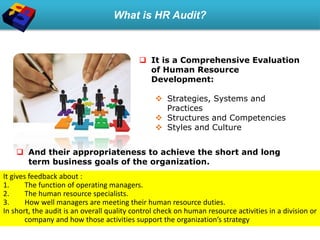
 It is a Comprehensive Evaluation
of Human Resource
Development:
 Strategies, Systems and
Practices
 Structures and Competencies
 Styles and Culture
 And their appropriateness to achieve the short and long
term business goals of the organization.
It gives feedback about :
1. The function of operating managers.
2. The human resource specialists.
3. How well managers are meeting their human resource duties.
In short, the audit is an overall quality control check on human resource activities in a division or
company and how those activities support the organization’s strategy
Purpose
 To assess the effectiveness of the Human Resources
function to ensure regulatory compliance
 To look for potentially serious problems
 To find areas needing improvement
 To document processes for use in merger, inspection
 To address compliance issues
Benefits
 Streamline HR work processes
 Monitor compliance with established
regulations and procedures
 Develop user-friendly HR systems
 Identifies the contribution of the
personnel departments to the
organization
 Improves professional image of the
personnel department
 Encourages greater responsibility and
professionalism among members of
the personnel department
 Clarifies the personnel department’s
duties and responsibilities
 Finds critical personnel problems
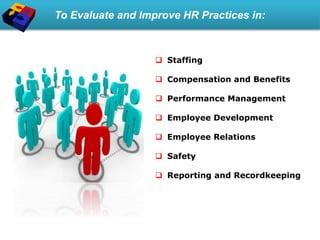
To Evaluate and Improve HR Practices in:
 Staffing
 Compensation and Benefits
 Performance Management
 Employee Development
 Employee Relations
 Safety
 Reporting and Recordkeeping
Reasons for HR Audit
 For expanding, diversifying and entering into a fast growth
phase
 For promoting more professionalism and professional
management
 Bench-marking for improving HRD practices
 Dissatisfaction with any component
 Change of leadership
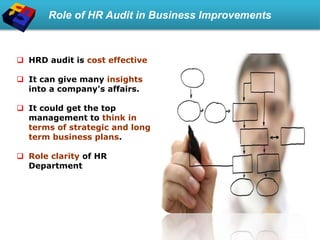
Role of HR Audit in Business Improvements
 HRD audit is cost effective
 It can give many insights
into a company's affairs.
 It could get the top
management to think in
terms of strategic and long
term business plans.
 Role clarity of HR
Department
Role of HR Audit in Business Improvements
 Improvements in HRD systems
 Increased focus on human resources and human
competencies
 Better recruitment policies and more professional staff
 More planning and more cost effective training
 Strengthening accountabilities through appraisal systems
and other mechanisms
 TQM Interventions
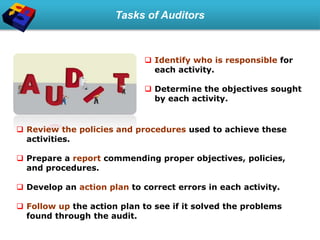
Tasks of Auditors
 Review the policies and procedures used to achieve these
activities.
 Prepare a report commending proper objectives, policies,
and procedures.
 Develop an action plan to correct errors in each activity.
 Follow up the action plan to see if it solved the problems
found through the audit.
 Identify who is responsible for
each activity.
 Determine the objectives sought
by each activity.
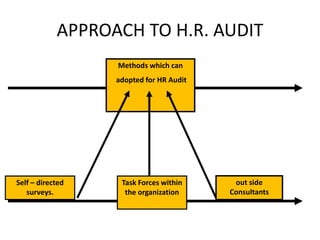
APPROACH TO H.R. AUDIT
out side
Consultants
Methods which can
adopted for HR Audit
Task Forces within
the organization
Self – directed
surveys.
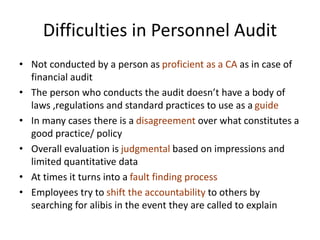
Difficulties in Personnel Audit
• Not conducted by a person as proficient as a CA as in case of
financial audit
• The person who conducts the audit doesn’t have a body of
laws ,regulations and standard practices to use as a guide
• In many cases there is a disagreement over what constitutes a
good practice/ policy
• Overall evaluation is judgmental based on impressions and
limited quantitative data
• At times it turns into a fault finding process
• Employees try to shift the accountability to others by
searching for alibis in the event they are called to explain
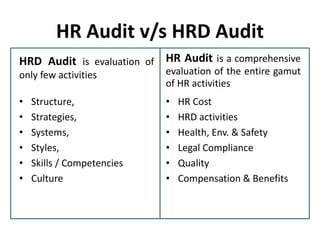
HR Audit v/s HRD Audit
HRD Audit is evaluation of
only few activities
• Structure,
• Strategies,
• Systems,
• Styles,
• Skills / Competencies
• Culture
HR Audit is a comprehensive
evaluation of the entire gamut
of HR activities
• HR Cost
• HRD activities
• Health, Env. & Safety
• Legal Compliance
• Quality
• Compensation & Benefits
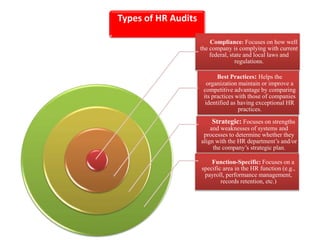
Types of HR Audits
Compliance: Focuses on how well
the company is complying with current
federal, state and local laws and
regulations.
Best Practices: Helps the
organization maintain or improve a
competitive advantage by comparing
its practices with those of companies
identified as having exceptional HR
practices.
Strategic: Focuses on strengths
and weaknesses of systems and
processes to determine whether they
align with the HR department’s and/or
the company’s strategic plan.
Function-Specific: Focuses on a
specific area in the HR function (e.g.,
payroll, performance management,
records retention, etc.)
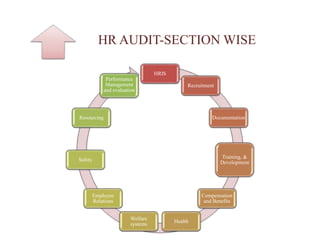
HR AUDIT-SECTION WISE
HRIS
Recruitment
Documentation
Training, &
Development
Compensation
and Benefits
Health
Welfare
systems
Employee
Relations
Safety
Resourcing
Performance
Management
and evaluation
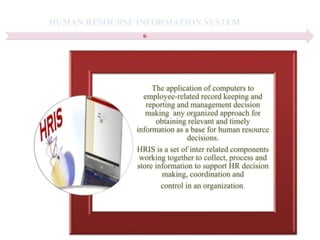
HUMAN RESOURSE INFORMATION SYSTEM
The application of computers to
employee-related record keeping and
reporting and management decision
making any organized approach for
obtaining relevant and timely
information as a base for human resource
decisions.
HRIS is a set of inter related components
working together to collect, process and
store information to support HR decision
making, coordination and
control in an organization.
Need and Objective for HRIS
NEED:
Large Organization
Organizations Geographically Dispersed
Complexities in Salary Packages
Decision Making
OBJECTIVE:
Right form of information at the right time
Make the information available at reasonable cost
Processing the data by using most efficient method
Provide necessary security and secrecy
Keep the information up to date
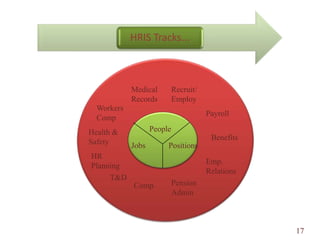
HRIS Tracks...
17
People
PositionsJobs
Workers
Comp
HR
Planning
Medical
Records
Recruit/
Employ
Benefits
Payroll
Pension
Admin
Emp.
Relations
T&D
Comp.
Health &
Safety
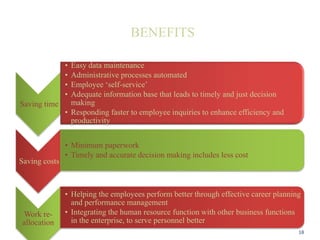
BENEFITS
Saving time
• Easy data maintenance
• Administrative processes automated
• Employee ‘self-service’
• Adequate information base that leads to timely and just decision
making
• Responding faster to employee inquiries to enhance efficiency and
productivity
Saving costs
• Minimum paperwork
• Timely and accurate decision making includes less cost
Work re-
allocation
• Helping the employees perform better through effective career planning
and performance management
• Integrating the human resource function with other business functions
in the enterprise, to serve personnel better
18
ABOUT HR CONTROL CENTRE
HR Control Centre 6.0 is a program software that tracks
employee information, employee status, records
regarding business progress and employee
performances. As such, with this software HR managers
can perform various functions that they need to run an
organization. This software basically fulfills the Human
Resource Information needs for a business unit by acting
as a support system in quality and flawless decision
making. It therefore is sophisticated and delicate yet
user-friendly for companies irrespective of size and type.
CONCLUSION
“By automating Human Resource
practices, HRIS saves time and money,
effectively reallocates work
processes and thus provides
competitive advantage and to the
organization.”

Personnel Audit: Hr audit

  • 1.
  • 2.
    What is HRAudit?  It is a Comprehensive Evaluation of Human Resource Development:  Strategies, Systems and Practices  Structures and Competencies  Styles and Culture  And their appropriateness to achieve the short and long term business goals of the organization. It gives feedback about : 1. The function of operating managers. 2. The human resource specialists. 3. How well managers are meeting their human resource duties. In short, the audit is an overall quality control check on human resource activities in a division or company and how those activities support the organization’s strategy
  • 3.
    Purpose  To assessthe effectiveness of the Human Resources function to ensure regulatory compliance  To look for potentially serious problems  To find areas needing improvement  To document processes for use in merger, inspection  To address compliance issues
  • 4.
    Benefits  Streamline HRwork processes  Monitor compliance with established regulations and procedures  Develop user-friendly HR systems  Identifies the contribution of the personnel departments to the organization  Improves professional image of the personnel department  Encourages greater responsibility and professionalism among members of the personnel department  Clarifies the personnel department’s duties and responsibilities  Finds critical personnel problems
  • 5.
    To Evaluate andImprove HR Practices in:  Staffing  Compensation and Benefits  Performance Management  Employee Development  Employee Relations  Safety  Reporting and Recordkeeping
  • 6.
    Reasons for HRAudit  For expanding, diversifying and entering into a fast growth phase  For promoting more professionalism and professional management  Bench-marking for improving HRD practices  Dissatisfaction with any component  Change of leadership
  • 7.
    Role of HRAudit in Business Improvements  HRD audit is cost effective  It can give many insights into a company's affairs.  It could get the top management to think in terms of strategic and long term business plans.  Role clarity of HR Department
  • 8.
    Role of HRAudit in Business Improvements  Improvements in HRD systems  Increased focus on human resources and human competencies  Better recruitment policies and more professional staff  More planning and more cost effective training  Strengthening accountabilities through appraisal systems and other mechanisms  TQM Interventions
  • 9.
    Tasks of Auditors Review the policies and procedures used to achieve these activities.  Prepare a report commending proper objectives, policies, and procedures.  Develop an action plan to correct errors in each activity.  Follow up the action plan to see if it solved the problems found through the audit.  Identify who is responsible for each activity.  Determine the objectives sought by each activity.
  • 10.
    APPROACH TO H.R.AUDIT out side Consultants Methods which can adopted for HR Audit Task Forces within the organization Self – directed surveys.
  • 11.
    Difficulties in PersonnelAudit • Not conducted by a person as proficient as a CA as in case of financial audit • The person who conducts the audit doesn’t have a body of laws ,regulations and standard practices to use as a guide • In many cases there is a disagreement over what constitutes a good practice/ policy • Overall evaluation is judgmental based on impressions and limited quantitative data • At times it turns into a fault finding process • Employees try to shift the accountability to others by searching for alibis in the event they are called to explain
  • 12.
    HR Audit v/sHRD Audit HRD Audit is evaluation of only few activities • Structure, • Strategies, • Systems, • Styles, • Skills / Competencies • Culture HR Audit is a comprehensive evaluation of the entire gamut of HR activities • HR Cost • HRD activities • Health, Env. & Safety • Legal Compliance • Quality • Compensation & Benefits
  • 13.
    Types of HRAudits Compliance: Focuses on how well the company is complying with current federal, state and local laws and regulations. Best Practices: Helps the organization maintain or improve a competitive advantage by comparing its practices with those of companies identified as having exceptional HR practices. Strategic: Focuses on strengths and weaknesses of systems and processes to determine whether they align with the HR department’s and/or the company’s strategic plan. Function-Specific: Focuses on a specific area in the HR function (e.g., payroll, performance management, records retention, etc.)
  • 14.
    HR AUDIT-SECTION WISE HRIS Recruitment Documentation Training,& Development Compensation and Benefits Health Welfare systems Employee Relations Safety Resourcing Performance Management and evaluation
  • 15.
    HUMAN RESOURSE INFORMATIONSYSTEM The application of computers to employee-related record keeping and reporting and management decision making any organized approach for obtaining relevant and timely information as a base for human resource decisions. HRIS is a set of inter related components working together to collect, process and store information to support HR decision making, coordination and control in an organization.
  • 16.
    Need and Objectivefor HRIS NEED: Large Organization Organizations Geographically Dispersed Complexities in Salary Packages Decision Making OBJECTIVE: Right form of information at the right time Make the information available at reasonable cost Processing the data by using most efficient method Provide necessary security and secrecy Keep the information up to date
  • 17.
  • 18.
    BENEFITS Saving time • Easydata maintenance • Administrative processes automated • Employee ‘self-service’ • Adequate information base that leads to timely and just decision making • Responding faster to employee inquiries to enhance efficiency and productivity Saving costs • Minimum paperwork • Timely and accurate decision making includes less cost Work re- allocation • Helping the employees perform better through effective career planning and performance management • Integrating the human resource function with other business functions in the enterprise, to serve personnel better 18
  • 19.
    ABOUT HR CONTROLCENTRE HR Control Centre 6.0 is a program software that tracks employee information, employee status, records regarding business progress and employee performances. As such, with this software HR managers can perform various functions that they need to run an organization. This software basically fulfills the Human Resource Information needs for a business unit by acting as a support system in quality and flawless decision making. It therefore is sophisticated and delicate yet user-friendly for companies irrespective of size and type.
  • 20.
    CONCLUSION “By automating HumanResource practices, HRIS saves time and money, effectively reallocates work processes and thus provides competitive advantage and to the organization.”