Ms. Anubha Rastogi
Astt. Prof, Vidya School Of Business
2017-18
What is a Search Engine?
• An internet-based tool that searches an index of documents for a particular term,
phrase or text specified by the user. Commonly used to refer to large web-based
search engines that search through billions of pages on the internet.
• Different than a Directory
• Common Characteristics:
• Spider, Indexer, Database, Algorithm
• Find matching documents and display them according to relevance
• Frequent updates to documents searched and ranking algorithm
• Strive to produce “better”, more relevant results than competitors
Anubha Rastogi | VSB
Why Search Engine Marketing?
• 85% of all traffic on the internet is referred from a search engine
• 90% of all users don’t look past the first 30 results (most only view top 10)
• Many websites aren’t even indexed, most are poorly optimized and get very little
traffic from the search engines
• Cost-effective advertising
• Clear and measurable ROI
• Operates under this assumption:
More (relevant) traffic + Good Conv. Rate = More Sales/Leads
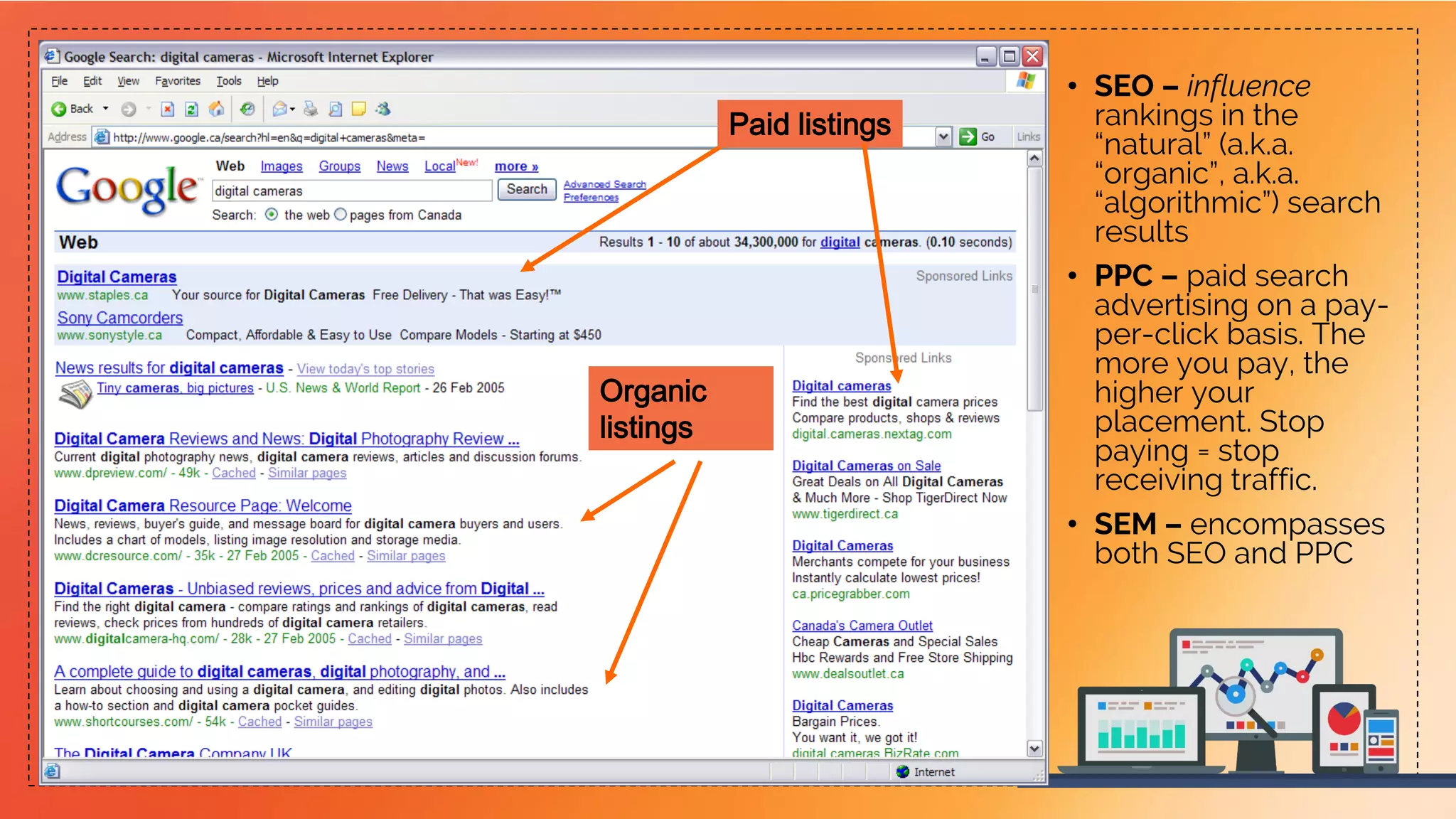
Organic
listings
Paid listings
• SEO – influence
rankings in the
“natural” (a.k.a.
“organic”, a.k.a.
“algorithmic”) search
results
• PPC – paid search
advertising on a pay-
per-click basis. The
more you pay, the
higher your
placement. Stop
paying = stop
receiving traffic.
• SEM – encompasses
both SEO and PPC
A Search Engine’s Goals & Objectives
• Accumulate large index (database) of web documents to search
• Provide highly-relevant results to users (better than competitors)
• Generate revenue via paid advertising and related business ventures that typically
leverage large amount of traffic
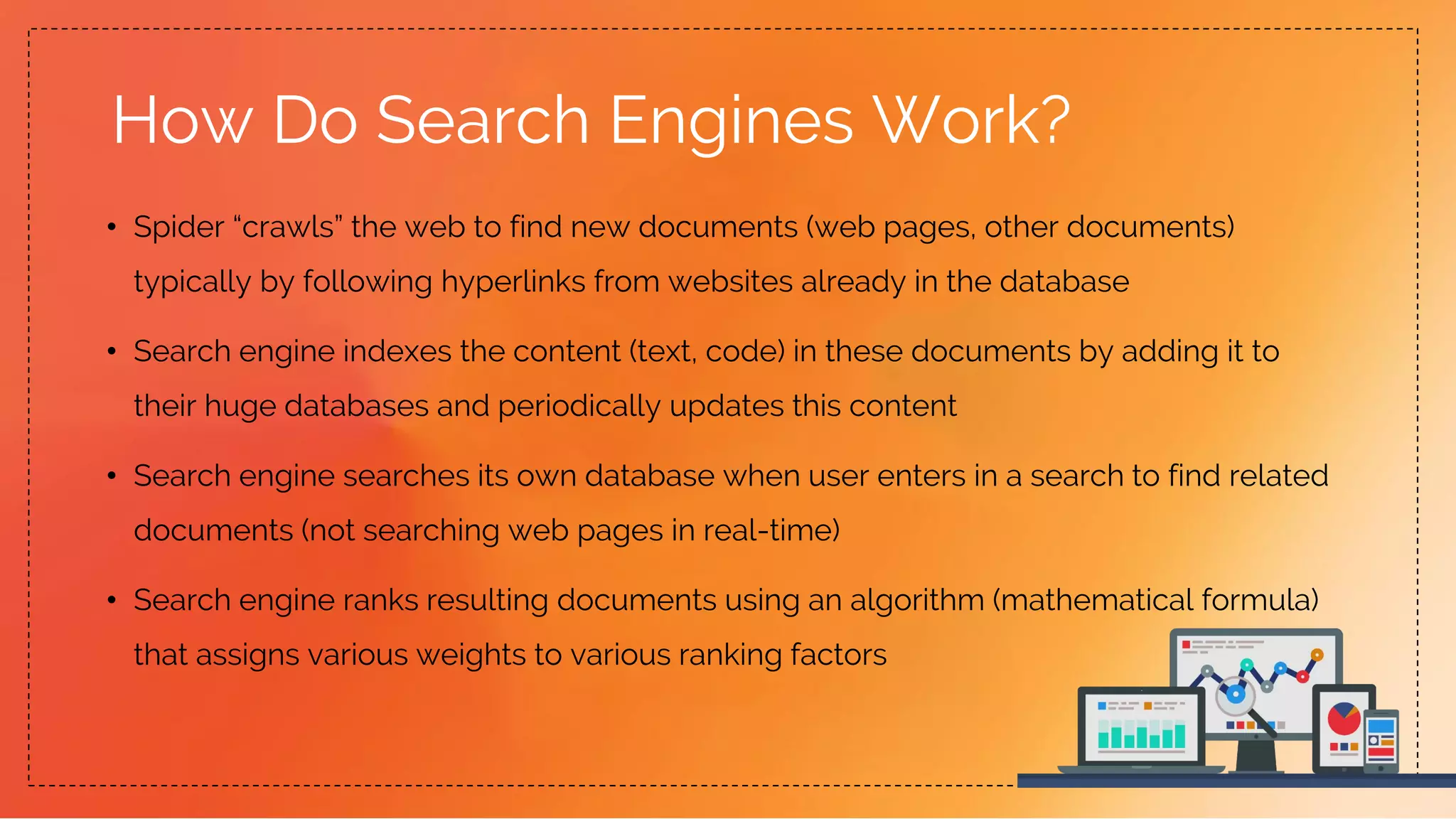
How Do Search Engines Work?
• Spider “crawls” the web to find new documents (web pages, other documents)
typically by following hyperlinks from websites already in the database
• Search engine indexes the content (text, code) in these documents by adding it to
their huge databases and periodically updates this content
• Search engine searches its own database when user enters in a search to find related
documents (not searching web pages in real-time)
• Search engine ranks resulting documents using an algorithm (mathematical formula)
that assigns various weights to various ranking factors
Ranking factors
• On-Page Factors (Code & Content)
• #3 - Title tags <title>
• #5 - Header tags <h1>
• #4 - ALT image tags
• #1 - Content, Content, Content (Body text) <body>
• #6 - Hyperlink text
• #2 - Keyword frequency & density
• Off-Page Factors
• #1 Anchor text
• #2 - Link Popularity (“votes” for your site) – adds credibility
What’s an SEO?
SEO = Search Engine Optimization
• Refers to the process of “optimizing” both the on-page and off-page ranking factors in
order to achieve high search engine rankings for targeted search terms.
• Refers to the “industry” that revolves around obtaining high rankings in the search
engines for desirable keyword search terms as a means of increasing the relevant
traffic to a given website.
• Refers to an individual or company that optimizes websites for its clientele.
• Has a number of related meanings, and usually refers to an individual/firm that
focuses on optimizing for “organic” search engine rankings
What Does a (good) SEO Do?
• Researches desirable keywords and search phrases
(WordTracker, Overture, Google AdWords)
• Identifies search phrases to target (should be relevant to business/market, obtainable
and profitable)
• “Cleans” and optimizes a website’s HTML code for appropriate keyword density, title
tag optimization, internal linking structure, headings and subheadings, etc.
• Helps in writing copy to appeal to both search engines and actual website visitors
• Studies competitors (competing websites) and search engines
• Implements a quality link building campaign
• Pushes for more content!
• Monitors rankings for targeted search terms
What SEO is NOT
• Search Engine Submission only
• “Submit your website to 5,000 search engines”
• An overnight process (typically takes 3-4 months to show
significant results)
• A one-time process (in many cases requires a continual, long-
term focus for best results)
• A $29.95 one-time fee!
Some INSIGHTS
• Optimizing the web page CODE for search engine spiders
• “Keywords” or “key terms” are the search terms people type into search engines and it
works on Relevancy ranking algorithms
 Find out what search terms your target audience uses in search engines from your log file analysis
 Try out keywords from generators eg. Overture’s or Google’s
 Look at current search trends Yahoo Buzz, Google Zeitgeist
 Real-time search from MetaCrawler
• Search engines love simple web site design
 Lots Of Text (Optimized For Keywords)
 Spiders Don’t Have To Sift Through Code To Find Keywords
• Web design elements that impede search
engine indexing
 Frames
 Flash
 Graphics, Image maps and multimedia files
 JavaScript (can trap spiders)
 Dynamic web pages
 Misspellings, or HTML errors (validate your code)
• Optimizing page elements in html code
 Page body text: content / page copy
 Title tag
 Heading tags
 Graphics: alt tags
 Hypertext links
 Meta tags
• Page copy - make sure your keywords
are well represented
 Higher in the page the better (definitely in
the first 25 words)
 Use your customer’s language: not all
marketing copy uses the words that your
customers use
• Relationship of a keyword phrase to
the total number of words on a page =
keyword density
 Keyword density is a good indication of
relevancy
 But remember balance: higher is not always
better (boring for users and penalized as
spam!)
• Title tag
 Most important and Should always contain your most important keywords or key terms
 Each page of your site should have a different title tag
 Example of a good TITLE tag that will generate traffic from people searching for “da Vinci”:
<TITLE>Leonardo da Vinci</TITLE> (absolute relevance)
 This example is less relevant (but contains other useful info – remember to balance marketing needs)
<TITLE>Artefacts: Leonardo da Vinci</TITLE>
 This one will put you out of business:
<TITLE>Welcome to Artefacts.com: Your Number One Online Resource for Wall Art Solutions!!!</TITLE>
• Use Heading tags when coding rather than just making the text bigger using font size
• Graphics: alt tags
 Spiders can’t see or read graphics
 Make sure all graphics have relevant and descriptive ALT tags (not photo34643)
 Use your keywords – especially in places like the alt tags for your logo
 Especially important for navigation graphics
(you don’t want a spider to get stuck on a page)
• Meta tags (description and keyword tags)
 No longer useful as sole tactic to influence rankings
 Keywords used in meta tags should match those in the visible body text
 BUT search engines often use title and description in the listings themselves
• Link popularity
 Strongly influences relevance ranking (for Google, the most important factor)
 Number and quality of other sites that link to yours (inbound links)
− must be content relevant (don’t spam!)
− request links from relevant high-ranking sites
− get a listing in a directory
 Find out who links to you link:www.mala.ca
 Choose a relevant landing page
 Remember individual pages are competing - not your entire site
• Getting indexed and listed
 It is free to submit pages to most search engines (Google, Ask)
 However, some engines charge a fee in return for a guarantee of indexing (Yahoo)
SEM & PPC
• “Paid placement” - practiced by all major search engines (it provides the major
revenue stream)
• Paying the search engines to get the results you want
• Priced on a Pay Per Click basis
• Web site design or coding has NO impact on position
• Position is purchased as part of an advertising campaign - guarantees instant visibility
• The website owner has control over:
 Position in search results
 Keyword choice
 Ad listing copy
 Landing page
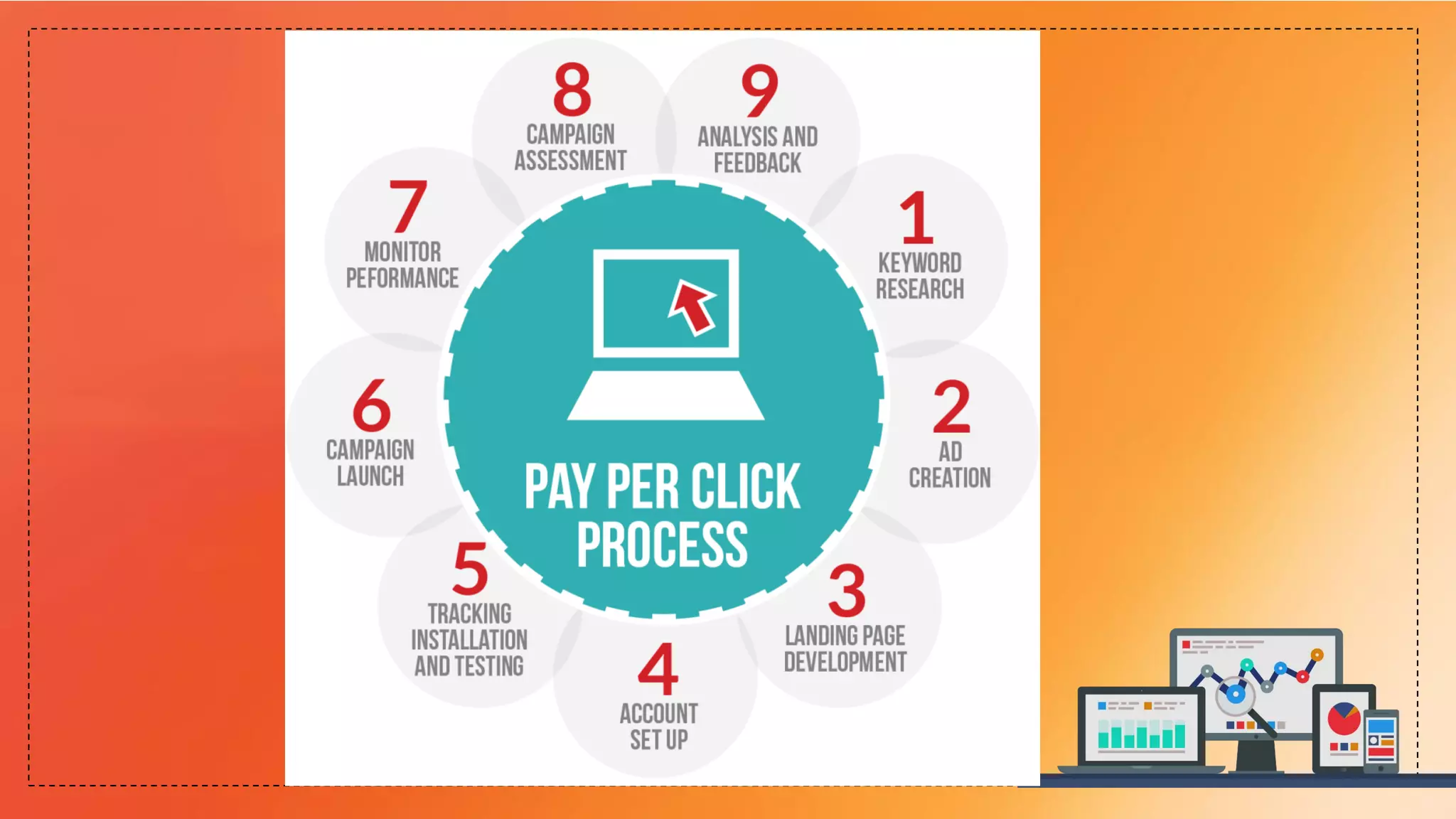
• Keyword bid advertising works on a cost per click (CPC) basis
• Advertisers pay only when consumers click on their link.
• Sponsored links in search results
• The company bidding higher on the keyword is ranked higher in keyword search
results. Example: Google Adwords in action
• Contextual advertisements Google Adsense
• Served to partner/affiliate content sites
• Effective form of advertising because your target market qualifies itself
• Tools to check popularity of keyword searches
 Overture’s Keyword Selector Tool (http://inventory.overture.com)
 WordTracker.com
 Trellian’s KeywordDiscovery.com
 Google’s Keyword Tool
 Google Trends
 Google Suggest
PPC vs. “Organic” SEO
Pay-per-click “Organic” SEO
• Results In 1-2 Days
• Easier For A Novice Or One Without Much Knowledge
Of SEO
• Ability To Turn On And Off At Any Moment
• Generally More Costly Per Visitor And Per Conversion
•Fewer Impressions And Exposure
• Easy To Compete In Highly Competitive Market Space
(But It Will Cost You)
• Can Generate Exposure On Related Sites (Adsense)
• Ability To Target “Local” Markets
• Better For Short-term And High-margin Campaigns
• Results Take 2 Weeks To 4 Months
• Requires Ongoing Learning And Experience To Reap Results
•Very Difficult To Control Flow Of Traffic
• Generally More Cost-effective, Doesn’t Penalize For More
Traffic
• Serps Are More Popular Than Sponsored Ads
• Very Difficult To Compete In Highly Competitive Market
Space
• Can Generate Exposure On Related Websites And Directories
• More Difficult To Target Local Markets
• Better For Long-term And Lower Margin Campaigns
Farms, Black Hats & “Ethics”
•Black Hat SEO – refers to various “tricks of the trade” that are often questioned as “ethical” by some
SEOs. Typically refers to a tactic intended to misrepresent a website by displaying different information
to the search engine versus the user. >> hidden text, redirects, etc.
•“Ethical SEO” – refers to methods used to improve rankings while still presenting the same information
to both users and search engines.
•Link Farms – sites/pages that may have thousands of links, often to unrelated sites. Typically they
provide these links in exchange for links to their site in an attempt to improve their rankings. Reciprocal
linking is common and generally accepted when not excessive and an attempt is made to provide value
to the site visitor.
•Google Bombing – establishing links with certain anchor text in order to achieve a high
ranking for that term. Again, this becomes questionable when an attempt is made to
misrepresent the website. (Miserable Failure example)
SEM and the Buying Cycle • Campaign Goals
and Objectives
should line up
with the profile of
the searcher.
• While longer
phrases tend to
be further down
the cycle, short
ones may be as
well, brands,
products, etc.
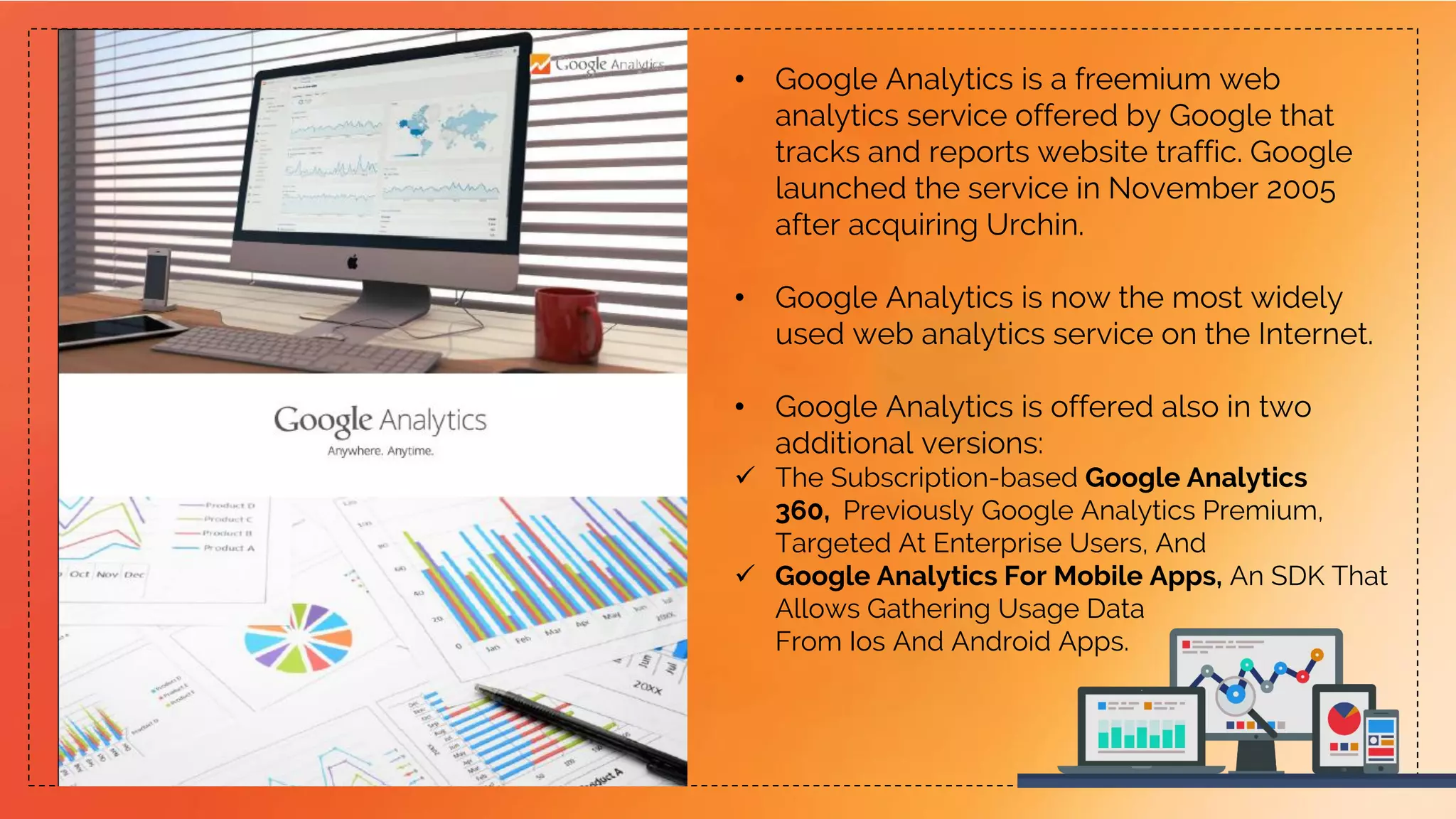
• Google Analytics is a freemium web
analytics service offered by Google that
tracks and reports website traffic. Google
launched the service in November 2005
after acquiring Urchin.
• Google Analytics is now the most widely
used web analytics service on the Internet.
• Google Analytics is offered also in two
additional versions:
 The Subscription-based Google Analytics
360, Previously Google Analytics Premium,
Targeted At Enterprise Users, And
 Google Analytics For Mobile Apps, An SDK That
Allows Gathering Usage Data
From Ios And Android Apps.
Refer Google Tool Book & Live Class Demo for complete details
Campaign
Management
Measuring Campaign Effectiveness
Get Better Online Results
Having a strategy is mandatory it’s not optional !

Understanding Search Marketing :SEO & SEM

  • 1.
    Ms. Anubha Rastogi Astt.Prof, Vidya School Of Business 2017-18
  • 2.
    What is aSearch Engine? • An internet-based tool that searches an index of documents for a particular term, phrase or text specified by the user. Commonly used to refer to large web-based search engines that search through billions of pages on the internet. • Different than a Directory • Common Characteristics: • Spider, Indexer, Database, Algorithm • Find matching documents and display them according to relevance • Frequent updates to documents searched and ranking algorithm • Strive to produce “better”, more relevant results than competitors Anubha Rastogi | VSB
  • 4.
    Why Search EngineMarketing? • 85% of all traffic on the internet is referred from a search engine • 90% of all users don’t look past the first 30 results (most only view top 10) • Many websites aren’t even indexed, most are poorly optimized and get very little traffic from the search engines • Cost-effective advertising • Clear and measurable ROI • Operates under this assumption: More (relevant) traffic + Good Conv. Rate = More Sales/Leads
  • 5.
    Organic listings Paid listings • SEO– influence rankings in the “natural” (a.k.a. “organic”, a.k.a. “algorithmic”) search results • PPC – paid search advertising on a pay- per-click basis. The more you pay, the higher your placement. Stop paying = stop receiving traffic. • SEM – encompasses both SEO and PPC
  • 6.
    A Search Engine’sGoals & Objectives • Accumulate large index (database) of web documents to search • Provide highly-relevant results to users (better than competitors) • Generate revenue via paid advertising and related business ventures that typically leverage large amount of traffic
  • 7.
    How Do SearchEngines Work? • Spider “crawls” the web to find new documents (web pages, other documents) typically by following hyperlinks from websites already in the database • Search engine indexes the content (text, code) in these documents by adding it to their huge databases and periodically updates this content • Search engine searches its own database when user enters in a search to find related documents (not searching web pages in real-time) • Search engine ranks resulting documents using an algorithm (mathematical formula) that assigns various weights to various ranking factors
  • 8.
    Ranking factors • On-PageFactors (Code & Content) • #3 - Title tags <title> • #5 - Header tags <h1> • #4 - ALT image tags • #1 - Content, Content, Content (Body text) <body> • #6 - Hyperlink text • #2 - Keyword frequency & density • Off-Page Factors • #1 Anchor text • #2 - Link Popularity (“votes” for your site) – adds credibility
  • 9.
    What’s an SEO? SEO= Search Engine Optimization • Refers to the process of “optimizing” both the on-page and off-page ranking factors in order to achieve high search engine rankings for targeted search terms. • Refers to the “industry” that revolves around obtaining high rankings in the search engines for desirable keyword search terms as a means of increasing the relevant traffic to a given website. • Refers to an individual or company that optimizes websites for its clientele. • Has a number of related meanings, and usually refers to an individual/firm that focuses on optimizing for “organic” search engine rankings
  • 10.
    What Does a(good) SEO Do? • Researches desirable keywords and search phrases (WordTracker, Overture, Google AdWords) • Identifies search phrases to target (should be relevant to business/market, obtainable and profitable) • “Cleans” and optimizes a website’s HTML code for appropriate keyword density, title tag optimization, internal linking structure, headings and subheadings, etc. • Helps in writing copy to appeal to both search engines and actual website visitors • Studies competitors (competing websites) and search engines • Implements a quality link building campaign • Pushes for more content! • Monitors rankings for targeted search terms
  • 11.
    What SEO isNOT • Search Engine Submission only • “Submit your website to 5,000 search engines” • An overnight process (typically takes 3-4 months to show significant results) • A one-time process (in many cases requires a continual, long- term focus for best results) • A $29.95 one-time fee!
  • 12.
    Some INSIGHTS • Optimizingthe web page CODE for search engine spiders • “Keywords” or “key terms” are the search terms people type into search engines and it works on Relevancy ranking algorithms  Find out what search terms your target audience uses in search engines from your log file analysis  Try out keywords from generators eg. Overture’s or Google’s  Look at current search trends Yahoo Buzz, Google Zeitgeist  Real-time search from MetaCrawler • Search engines love simple web site design  Lots Of Text (Optimized For Keywords)  Spiders Don’t Have To Sift Through Code To Find Keywords
  • 13.
    • Web designelements that impede search engine indexing  Frames  Flash  Graphics, Image maps and multimedia files  JavaScript (can trap spiders)  Dynamic web pages  Misspellings, or HTML errors (validate your code) • Optimizing page elements in html code  Page body text: content / page copy  Title tag  Heading tags  Graphics: alt tags  Hypertext links  Meta tags • Page copy - make sure your keywords are well represented  Higher in the page the better (definitely in the first 25 words)  Use your customer’s language: not all marketing copy uses the words that your customers use • Relationship of a keyword phrase to the total number of words on a page = keyword density  Keyword density is a good indication of relevancy  But remember balance: higher is not always better (boring for users and penalized as spam!)
  • 14.
    • Title tag Most important and Should always contain your most important keywords or key terms  Each page of your site should have a different title tag  Example of a good TITLE tag that will generate traffic from people searching for “da Vinci”: <TITLE>Leonardo da Vinci</TITLE> (absolute relevance)  This example is less relevant (but contains other useful info – remember to balance marketing needs) <TITLE>Artefacts: Leonardo da Vinci</TITLE>  This one will put you out of business: <TITLE>Welcome to Artefacts.com: Your Number One Online Resource for Wall Art Solutions!!!</TITLE> • Use Heading tags when coding rather than just making the text bigger using font size • Graphics: alt tags  Spiders can’t see or read graphics  Make sure all graphics have relevant and descriptive ALT tags (not photo34643)  Use your keywords – especially in places like the alt tags for your logo  Especially important for navigation graphics (you don’t want a spider to get stuck on a page)
  • 15.
    • Meta tags(description and keyword tags)  No longer useful as sole tactic to influence rankings  Keywords used in meta tags should match those in the visible body text  BUT search engines often use title and description in the listings themselves • Link popularity  Strongly influences relevance ranking (for Google, the most important factor)  Number and quality of other sites that link to yours (inbound links) − must be content relevant (don’t spam!) − request links from relevant high-ranking sites − get a listing in a directory  Find out who links to you link:www.mala.ca  Choose a relevant landing page  Remember individual pages are competing - not your entire site • Getting indexed and listed  It is free to submit pages to most search engines (Google, Ask)  However, some engines charge a fee in return for a guarantee of indexing (Yahoo)
  • 17.
    SEM & PPC •“Paid placement” - practiced by all major search engines (it provides the major revenue stream) • Paying the search engines to get the results you want • Priced on a Pay Per Click basis • Web site design or coding has NO impact on position • Position is purchased as part of an advertising campaign - guarantees instant visibility • The website owner has control over:  Position in search results  Keyword choice  Ad listing copy  Landing page
  • 18.
    • Keyword bidadvertising works on a cost per click (CPC) basis • Advertisers pay only when consumers click on their link. • Sponsored links in search results • The company bidding higher on the keyword is ranked higher in keyword search results. Example: Google Adwords in action • Contextual advertisements Google Adsense • Served to partner/affiliate content sites • Effective form of advertising because your target market qualifies itself • Tools to check popularity of keyword searches  Overture’s Keyword Selector Tool (http://inventory.overture.com)  WordTracker.com  Trellian’s KeywordDiscovery.com  Google’s Keyword Tool  Google Trends  Google Suggest
  • 20.
    PPC vs. “Organic”SEO Pay-per-click “Organic” SEO • Results In 1-2 Days • Easier For A Novice Or One Without Much Knowledge Of SEO • Ability To Turn On And Off At Any Moment • Generally More Costly Per Visitor And Per Conversion •Fewer Impressions And Exposure • Easy To Compete In Highly Competitive Market Space (But It Will Cost You) • Can Generate Exposure On Related Sites (Adsense) • Ability To Target “Local” Markets • Better For Short-term And High-margin Campaigns • Results Take 2 Weeks To 4 Months • Requires Ongoing Learning And Experience To Reap Results •Very Difficult To Control Flow Of Traffic • Generally More Cost-effective, Doesn’t Penalize For More Traffic • Serps Are More Popular Than Sponsored Ads • Very Difficult To Compete In Highly Competitive Market Space • Can Generate Exposure On Related Websites And Directories • More Difficult To Target Local Markets • Better For Long-term And Lower Margin Campaigns
  • 21.
    Farms, Black Hats& “Ethics” •Black Hat SEO – refers to various “tricks of the trade” that are often questioned as “ethical” by some SEOs. Typically refers to a tactic intended to misrepresent a website by displaying different information to the search engine versus the user. >> hidden text, redirects, etc. •“Ethical SEO” – refers to methods used to improve rankings while still presenting the same information to both users and search engines. •Link Farms – sites/pages that may have thousands of links, often to unrelated sites. Typically they provide these links in exchange for links to their site in an attempt to improve their rankings. Reciprocal linking is common and generally accepted when not excessive and an attempt is made to provide value to the site visitor. •Google Bombing – establishing links with certain anchor text in order to achieve a high ranking for that term. Again, this becomes questionable when an attempt is made to misrepresent the website. (Miserable Failure example)
  • 22.
    SEM and theBuying Cycle • Campaign Goals and Objectives should line up with the profile of the searcher. • While longer phrases tend to be further down the cycle, short ones may be as well, brands, products, etc.
  • 23.
    • Google Analyticsis a freemium web analytics service offered by Google that tracks and reports website traffic. Google launched the service in November 2005 after acquiring Urchin. • Google Analytics is now the most widely used web analytics service on the Internet. • Google Analytics is offered also in two additional versions:  The Subscription-based Google Analytics 360, Previously Google Analytics Premium, Targeted At Enterprise Users, And  Google Analytics For Mobile Apps, An SDK That Allows Gathering Usage Data From Ios And Android Apps.
  • 25.
    Refer Google ToolBook & Live Class Demo for complete details
  • 26.
  • 27.
  • 29.
    Get Better OnlineResults Having a strategy is mandatory it’s not optional !