
Human Resource Management
Unit 1
Introduction
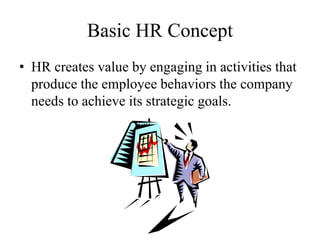
Basic HR Concept
• HR creates value by engaging in activities that
produce the employee behaviors the company
needs to achieve its strategic goals.
Introduction to HRM
• Management process:
The five basic functions of planning, organizing,
staffing, leading, and controlling.
• Human resource management (HRM):
The policies and practices involved in carrying out
the “people” or human resource aspects of a
management position, including recruiting,
screening, training, rewarding, and appraising.
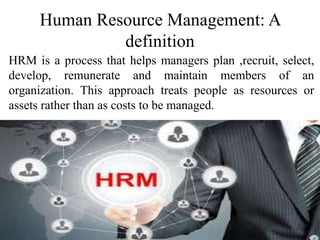
Human Resource Management: A
definition
HRM is a process that helps managers plan ,recruit, select,
develop, remunerate and maintain members of an
organization. This approach treats people as resources or
assets rather than as costs to be managed.
Nature of HRM
• To staff and manage organizations.
• Involves application of management functions and
principles like: acquiring, developing,
maintaining, and remunerating employees.
• To integrate all the decisions related to employees.
• Decisions must influence organizational
effectiveness.
• HRM functions go across business boundaries like
education, health care, hospitality.
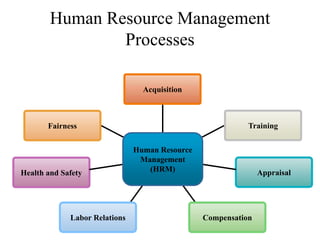
Human Resource Management
Processes
Acquisition
Training
Appraisal
CompensationLabor Relations
Health and Safety
Fairness
Human Resource
Management
(HRM)
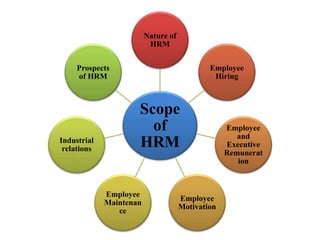
Scope
of
HRM
Nature of
HRM
Employee
Hiring
Employee
and
Executive
Remunerat
ion
Employee
Motivation
Employee
Maintenan
ce
Industrial
relations
Prospects
of HRM
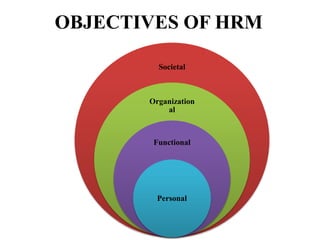
Societal
Organization
al
Functional
Personal
OBJECTIVES OF HRM
1. Legal compliance.
2. Benefits.
3. Industrial
relations
1. H R Planning.
2. Employee Rel.
3. Selection
4. Training & Dev.
5. Appraisal
6. Placement
7. Assessment
1. Appraisal
2. Placement
3. Assessment
1. Training and dev.
2. Appraisal.
3. Placement.
4. Compensation.
5. Assessment.
Human Resource
Management
Objectives & Functions
• Societal Objectives • Organizational
Objectives
• Functional
Objectives
• Personal
Objectives
HRM Policies
• Policies for hiring people
• Policies of remuneration, promotion, transfer, and
layoff
• Policy for medical assistance
• Policy regarding housing, transport, uniform and
allowances
• Policy for training and development
• Policy regarding industrial relations
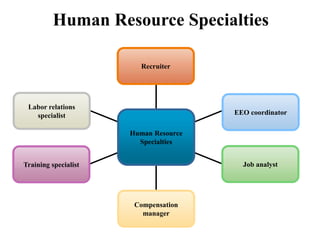
Human Resource Specialties
Recruiter
EEO coordinator
Labor relations
specialist
Training specialist Job analyst
Compensation
manager
Human Resource
Specialties
New Approaches to Organizing HR
Transactional HR
group
Corporate
HR group
Embedded
HR unit
New HR Services Groups
Centers of
Expertise
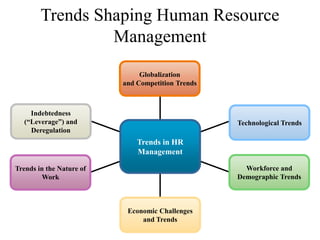
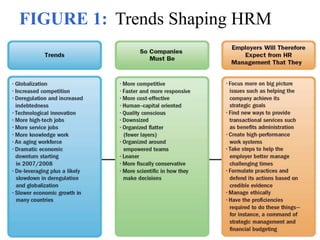
Trends Shaping Human Resource
Management
Globalization
and Competition Trends
Technological Trends
Indebtedness
(“Leverage”) and
Deregulation
Trends in the Nature of
Work
Workforce and
Demographic Trends
Economic Challenges
and Trends
Trends in HR
Management
FIGURE 1: Trends Shaping HRM
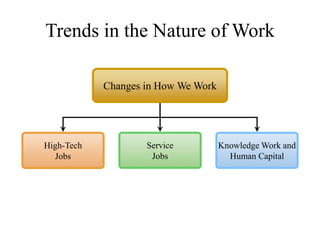
Trends in the Nature of Work
High-Tech
Jobs
Service
Jobs
Changes in How We Work
Knowledge Work and
Human Capital
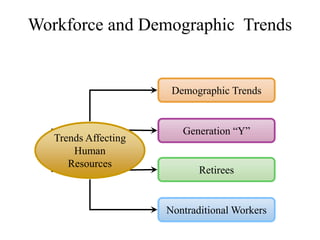
Workforce and Demographic Trends
Demographic Trends
Generation “Y”
Retirees
Nontraditional Workers
Trends Affecting
Human
Resources
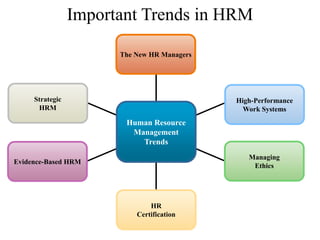
Important Trends in HRM
The New HR Managers
High-Performance
Work Systems
Strategic
HRM
Evidence-Based HRM
Managing
Ethics
HR
Certification
Human Resource
Management
Trends
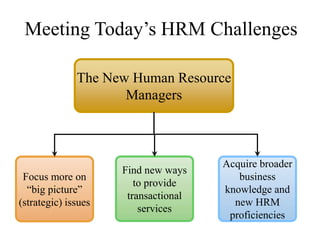
Meeting Today’s HRM Challenges
Focus more on
“big picture”
(strategic) issues
Find new ways
to provide
transactional
services
The New Human Resource
Managers
Acquire broader
business
knowledge and
new HRM
proficiencies
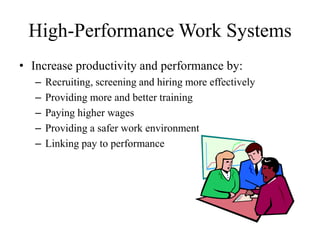
High-Performance Work Systems
• Increase productivity and performance by:
– Recruiting, screening and hiring more effectively
– Providing more and better training
– Paying higher wages
– Providing a safer work environment
– Linking pay to performance
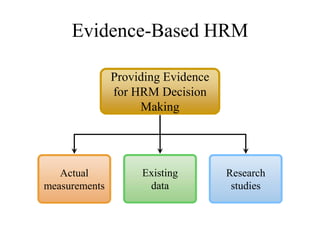
Evidence-Based HRM
Actual
measurements
Existing
data
Providing Evidence
for HRM Decision
Making
Research
studies
Managing Ethics
• Ethics
– Standards that someone uses to decide what his or her
conduct should be
• HRM-related Ethical Issues
– Workplace safety
– Security of employee records
– Employee theft
– Affirmative action
– Comparable work
– Employee privacy rights
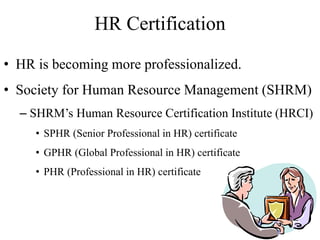
HR Certification
• HR is becoming more professionalized.
• Society for Human Resource Management (SHRM)
– SHRM’s Human Resource Certification Institute (HRCI)
• SPHR (Senior Professional in HR) certificate
• GPHR (Global Professional in HR) certificate
• PHR (Professional in HR) certificate
HRM in globally competitive
environment
• Globalization refers to the tendency of firms to extend
their sales, ownership, and/or manufacturing to new
markets abroad.
• It has triggered changes in how companies organize,
manage, and use their HR departments.
• More globalization means more competition, and
more competition means more pressure to lower
costs, make employees more productive, and do
things better and less expensively.
Strategic HRM
• Strategic HRM refers to the process of
developing practices, programmes and policies
to achieve organizational objectives.
• Strategic HRM considers the implications of
business strategy for all HR systems within the
firm by translating company objectives into
specific people management systems.
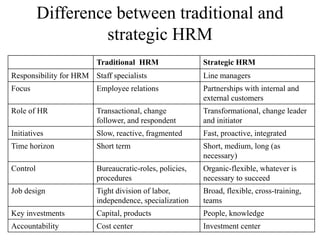
Difference between traditional and
strategic HRM
Traditional HRM Strategic HRM
Responsibility for HRM Staff specialists Line managers
Focus Employee relations Partnerships with internal and
external customers
Role of HR Transactional, change
follower, and respondent
Transformational, change leader
and initiator
Initiatives Slow, reactive, fragmented Fast, proactive, integrated
Time horizon Short term Short, medium, long (as
necessary)
Control Bureaucratic-roles, policies,
procedures
Organic-flexible, whatever is
necessary to succeed
Job design Tight division of labor,
independence, specialization
Broad, flexible, cross-training,
teams
Key investments Capital, products People, knowledge
Accountability Cost center Investment center
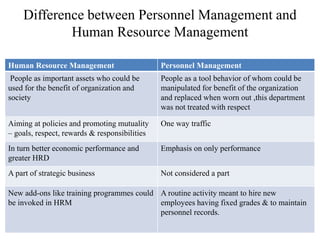
Difference between Personnel Management and
Human Resource Management
Human Resource Management Personnel Management
People as important assets who could be
used for the benefit of organization and
society
People as a tool behavior of whom could be
manipulated for benefit of the organization
and replaced when worn out ,this department
was not treated with respect
Aiming at policies and promoting mutuality
– goals, respect, rewards & responsibilities
One way traffic
In turn better economic performance and
greater HRD
Emphasis on only performance
A part of strategic business Not considered a part
New add-ons like training programmes could
be invoked in HRM
A routine activity meant to hire new
employees having fixed grades & to maintain
personnel records.
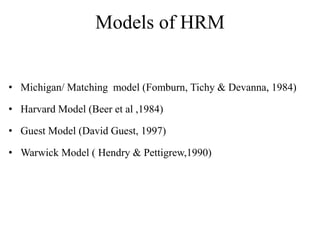
Models of HRM
• Michigan/ Matching model (Fomburn, Tichy & Devanna, 1984)
• Harvard Model (Beer et al ,1984)
• Guest Model (David Guest, 1997)
• Warwick Model ( Hendry & Pettigrew,1990)
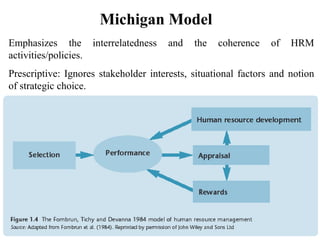
Michigan Model
Emphasizes the interrelatedness and the coherence of HRM
activities/policies.
Prescriptive: Ignores stakeholder interests, situational factors and notion
of strategic choice.
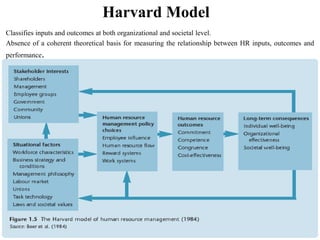
Harvard Model
Classifies inputs and outcomes at both organizational and societal level.
Absence of a coherent theoretical basis for measuring the relationship between HR inputs, outcomes and
performance.
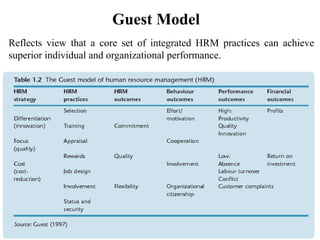
Guest Model
Reflects view that a core set of integrated HRM practices can achieve
superior individual and organizational performance.
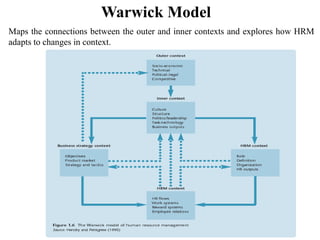
Warwick Model
Maps the connections between the outer and inner contexts and explores how HRM
adapts to changes in context.
Human resource management unit 1

Human resource management unit 1

  • 1.
  • 2.
    Basic HR Concept •HR creates value by engaging in activities that produce the employee behaviors the company needs to achieve its strategic goals.
  • 3.
    Introduction to HRM •Management process: The five basic functions of planning, organizing, staffing, leading, and controlling. • Human resource management (HRM): The policies and practices involved in carrying out the “people” or human resource aspects of a management position, including recruiting, screening, training, rewarding, and appraising.
  • 4.
    Human Resource Management:A definition HRM is a process that helps managers plan ,recruit, select, develop, remunerate and maintain members of an organization. This approach treats people as resources or assets rather than as costs to be managed.
  • 5.
    Nature of HRM •To staff and manage organizations. • Involves application of management functions and principles like: acquiring, developing, maintaining, and remunerating employees. • To integrate all the decisions related to employees. • Decisions must influence organizational effectiveness. • HRM functions go across business boundaries like education, health care, hospitality.
  • 6.
    Human Resource Management Processes Acquisition Training Appraisal CompensationLaborRelations Health and Safety Fairness Human Resource Management (HRM)
  • 7.
  • 8.
  • 9.
    1. Legal compliance. 2.Benefits. 3. Industrial relations 1. H R Planning. 2. Employee Rel. 3. Selection 4. Training & Dev. 5. Appraisal 6. Placement 7. Assessment 1. Appraisal 2. Placement 3. Assessment 1. Training and dev. 2. Appraisal. 3. Placement. 4. Compensation. 5. Assessment. Human Resource Management Objectives & Functions • Societal Objectives • Organizational Objectives • Functional Objectives • Personal Objectives
  • 10.
    HRM Policies • Policiesfor hiring people • Policies of remuneration, promotion, transfer, and layoff • Policy for medical assistance • Policy regarding housing, transport, uniform and allowances • Policy for training and development • Policy regarding industrial relations
  • 11.
    Human Resource Specialties Recruiter EEOcoordinator Labor relations specialist Training specialist Job analyst Compensation manager Human Resource Specialties
  • 12.
    New Approaches toOrganizing HR Transactional HR group Corporate HR group Embedded HR unit New HR Services Groups Centers of Expertise
  • 13.
    Trends Shaping HumanResource Management Globalization and Competition Trends Technological Trends Indebtedness (“Leverage”) and Deregulation Trends in the Nature of Work Workforce and Demographic Trends Economic Challenges and Trends Trends in HR Management
  • 14.
    FIGURE 1: TrendsShaping HRM
  • 15.
    Trends in theNature of Work High-Tech Jobs Service Jobs Changes in How We Work Knowledge Work and Human Capital
  • 16.
    Workforce and DemographicTrends Demographic Trends Generation “Y” Retirees Nontraditional Workers Trends Affecting Human Resources
  • 17.
    Important Trends inHRM The New HR Managers High-Performance Work Systems Strategic HRM Evidence-Based HRM Managing Ethics HR Certification Human Resource Management Trends
  • 18.
    Meeting Today’s HRMChallenges Focus more on “big picture” (strategic) issues Find new ways to provide transactional services The New Human Resource Managers Acquire broader business knowledge and new HRM proficiencies
  • 19.
    High-Performance Work Systems •Increase productivity and performance by: – Recruiting, screening and hiring more effectively – Providing more and better training – Paying higher wages – Providing a safer work environment – Linking pay to performance
  • 20.
  • 21.
    Managing Ethics • Ethics –Standards that someone uses to decide what his or her conduct should be • HRM-related Ethical Issues – Workplace safety – Security of employee records – Employee theft – Affirmative action – Comparable work – Employee privacy rights
  • 22.
    HR Certification • HRis becoming more professionalized. • Society for Human Resource Management (SHRM) – SHRM’s Human Resource Certification Institute (HRCI) • SPHR (Senior Professional in HR) certificate • GPHR (Global Professional in HR) certificate • PHR (Professional in HR) certificate
  • 23.
    HRM in globallycompetitive environment • Globalization refers to the tendency of firms to extend their sales, ownership, and/or manufacturing to new markets abroad. • It has triggered changes in how companies organize, manage, and use their HR departments. • More globalization means more competition, and more competition means more pressure to lower costs, make employees more productive, and do things better and less expensively.
  • 24.
    Strategic HRM • StrategicHRM refers to the process of developing practices, programmes and policies to achieve organizational objectives. • Strategic HRM considers the implications of business strategy for all HR systems within the firm by translating company objectives into specific people management systems.
  • 25.
    Difference between traditionaland strategic HRM Traditional HRM Strategic HRM Responsibility for HRM Staff specialists Line managers Focus Employee relations Partnerships with internal and external customers Role of HR Transactional, change follower, and respondent Transformational, change leader and initiator Initiatives Slow, reactive, fragmented Fast, proactive, integrated Time horizon Short term Short, medium, long (as necessary) Control Bureaucratic-roles, policies, procedures Organic-flexible, whatever is necessary to succeed Job design Tight division of labor, independence, specialization Broad, flexible, cross-training, teams Key investments Capital, products People, knowledge Accountability Cost center Investment center
  • 26.
    Difference between PersonnelManagement and Human Resource Management Human Resource Management Personnel Management People as important assets who could be used for the benefit of organization and society People as a tool behavior of whom could be manipulated for benefit of the organization and replaced when worn out ,this department was not treated with respect Aiming at policies and promoting mutuality – goals, respect, rewards & responsibilities One way traffic In turn better economic performance and greater HRD Emphasis on only performance A part of strategic business Not considered a part New add-ons like training programmes could be invoked in HRM A routine activity meant to hire new employees having fixed grades & to maintain personnel records.
  • 27.
    Models of HRM •Michigan/ Matching model (Fomburn, Tichy & Devanna, 1984) • Harvard Model (Beer et al ,1984) • Guest Model (David Guest, 1997) • Warwick Model ( Hendry & Pettigrew,1990)
  • 28.
    Michigan Model Emphasizes theinterrelatedness and the coherence of HRM activities/policies. Prescriptive: Ignores stakeholder interests, situational factors and notion of strategic choice.
  • 29.
    Harvard Model Classifies inputsand outcomes at both organizational and societal level. Absence of a coherent theoretical basis for measuring the relationship between HR inputs, outcomes and performance.
  • 30.
    Guest Model Reflects viewthat a core set of integrated HRM practices can achieve superior individual and organizational performance.
  • 31.
    Warwick Model Maps theconnections between the outer and inner contexts and explores how HRM adapts to changes in context.

Editor's Notes

  • #13 Copyright © 2011 Pearson Education
  • #14 Copyright © 2011 Pearson Education
  • #15 Copyright © 2011 Pearson Education
  • #16 Copyright © 2011 Pearson Education
  • #19 Copyright © 2011 Pearson Education
  • #20 Copyright © 2011 Pearson Education
  • #21 Copyright © 2011 Pearson Education
  • #22 Copyright © 2011 Pearson Education
  • #23 Copyright © 2011 Pearson Education