Ms. Anubha Rastogi
Astt. Prof, Vidya School Of Business
2017-18
Anubha Rastogi | VSB
T
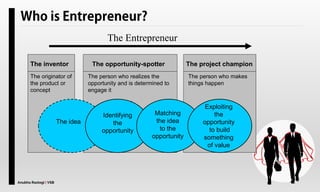
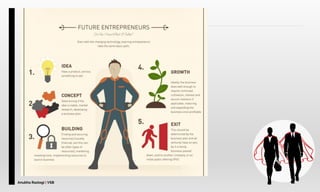
The Entrepreneur
The opportunity-spotter The project championThe inventor
The person who realizes the
opportunity and is determined to
engage it
The person who makes
things happen
The originator of
the product or
concept
The idea
Identifying
the
opportunity
Matching
the idea
to the
opportunity
Exploiting
the
opportunity
to build
something
of value
Anubha Rastogi | VSB
‱ Entrepreneurship
‱ The process whereby an individual or group of individuals use organized efforts to
pursue opportunities
‱ To create value and grow by fulfilling wants and needs through innovation and uniqueness
‱ regardless of personal resource situation.
‱ Entrepreneurship is the process of identifying opportunities in the market place, and
arranging resources required to exploit the opportunities for long term gains.
‱ It is creating wealth by bringing together resources in new ways to start and operate an
enterprise.
‱ It is the process of planning, organizing, operating and assuming the risk of a business
venture.
‱ It is the ability to take risk independently to make more earnings in market-oriented
economy.
Anubha Rastogi | VSB
‱ The process of improving the skills and knowledge of entrepreneurs through various training
and classroom programs.
‱ A program designed to help a person in strengthening his entrepreneurial motive, and in
acquiring skills and capabilities necessary for playing his entrepreneurial role effectively.
‱ These programmes provide immense information to the potential entrepreneurial regarding
new business ideas, how to set-up a new venture, how to prepare project report, how to fulfill
legal formalities, sources of raising finance etc.
‱ A programme which seeks to do all this shall qualify to be called an entrepreneurship
development programme.
Anubha Rastogi | VSB
‱ Myth 1: Entrepreneurs Are Doers, Not Thinkers
‱ Myth 2: Entrepreneurs Are Born, Not Made
‱ Myth 3: Entrepreneurs Are Always Inventors
‱ Myth 4: Entrepreneurs Are Academic and Social Misfits
‱ Myth 5: Entrepreneurs Must Fit the “Profile”
‱ Myth 6: All Entrepreneurs Need Is Money
‱ Myth 7: All Entrepreneurs Need Is Luck
‱ Myth 8: Ignorance Is Bliss For Entrepreneurs
‱ Myth 9: Entrepreneurs Seek Success But Experience High Failure Rates
‱ Myth 10: Entrepreneurs Are Extreme Risk Takers (Gamblers)
‱ Myth 11: Successful entrepreneurship needs only a great idea
‱ Myth 12: Entrepreneurship is easy.
‱ Myth 13 : You have to be young to be an entrepreneur.
‱ Myth 14: You must have a degree in business to be an entrepreneur.
Anubha Rastogi | VSB
1. Increases national production.
2. Balanced area development.
3. Reinvestment of profit for the welfare of the area of profit generation.
4. Development is a function of motivation and human resource.
5. Entrepreneurial awareness.
6. Growing employment opportunity.
7. Increasing productivity.
8. Optimum use of local resources.
9. Continued innovation in techno – managerial practices.
10. Improving in international competitiveness.
Anubha Rastogi | VSB
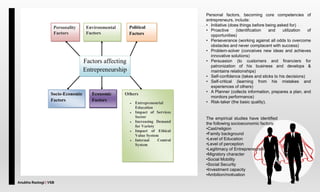
Personal factors, becoming core competencies of
entrepreneurs, include:
‱ Initiative (does things before being asked for)
‱ Proactive (identification and utilization of
opportunities)
‱ Perseverance (working against all odds to overcome
obstacles and never complacent with success)
‱ Problem-solver (conceives new ideas and achieves
innovative solutions)
‱ Persuasion (to customers and financiers for
patronization of his business and develops &
maintains relationships)
‱ Self-confidence (takes and sticks to his decisions)
‱ Self-critical (learning from his mistakes and
experiences of others)
‱ A Planner (collects information, prepares a plan, and
monitors performance)
‱ Risk-taker (the basic quality).
The empirical studies have identified
the following socioeconomic factors:
‱Cast/religion
‱Family background
‱Level of Education
‱Level of perception
‱Legitimacy of Entrepreneurship
‱Migratory character
‱Social Mobility
‱Social Security
‱Investment capacity
‱Ambition/motivation
Anubha Rastogi | VSB
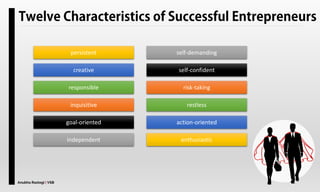
persistent
creative
responsible
inquisitive
goal-oriented
independent
self-demanding
self-confident
risk-taking
restless
action-oriented
enthusiastic
Anubha Rastogi | VSB
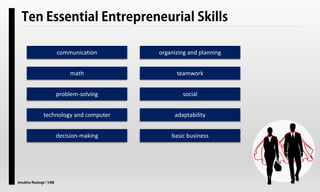
communication
math
problem-solving
technology and computer
decision-making
organizing and planning
teamwork
social
adaptability
basic business
Anubha Rastogi | VSB
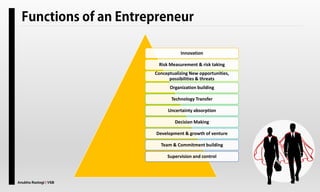
Innovation
Risk Measurement & risk taking
Conceptualizing New opportunities,
possibilities & threats
Organization building
Technology Transfer
Uncertainty absorption
Decision Making
Development & growth of venture
Team & Commitment building
Supervision and control
Anubha Rastogi | VSB
‱ Novice Entrepreneur
‱ Has no prior business ownership experiences as a business founder, inheritor, or purchaser
‱ Habitual Entrepreneur
‱ Has prior business ownership experience
‱ Nascent Entrepreneur
‱ In the process of starting a new business
‱ Can be either a novice or a habitual entrepreneur
‱ Serial Entrepreneur
‱ Has sold or closed an original business and establishes another new business
‱ Continues the cycle of selling/closing and establishing
‱ Portfolio Entrepreneur
‱ Retains an original business and builds a portfolio of additional businesses
‱ Through inheriting, establishing, and purchasing the businesses
Anubha Rastogi | VSB
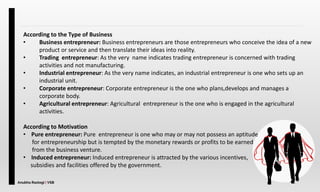
According to the Type of Business
‱ Business entrepreneur: Business entrepreneurs are those entrepreneurs who conceive the idea of a new
product or service and then translate their ideas into reality.
‱ Trading entrepreneur: As the very name indicates trading entrepreneur is concerned with trading
activities and not manufacturing.
‱ Industrial entrepreneur: As the very name indicates, an industrial entrepreneur is one who sets up an
industrial unit.
‱ Corporate entrepreneur: Corporate entrepreneur is the one who plans,develops and manages a
corporate body.
‱ Agricultural entrepreneur: Agricultural entrepreneur is the one who is engaged in the agricultural
activities.
According to Motivation
‱ Pure entrepreneur: Pure entrepreneur is one who may or may not possess an aptitude
for entrepreneurship but is tempted by the monetary rewards or profits to be earned
from the business venture.
‱ Induced entrepreneur: Induced entrepreneur is attracted by the various incentives,
subsidies and facilities offered by the government.
Anubha Rastogi | VSB
According to the Use of Technology
‱ Technical entrepreneur: The strength of a technical entrepreneur is in his skill in production techniques. He
concentrates more on production than on marketing.
‱ Non-technical entrepreneur: Unlike technical entrepreneur, non-technical entrepreneur is not concerned
with the technical aspect of the product rather he spends more time in developing alternative strategies of
the marketing and distribution to promote his business.
‱ Professional entrepreneur: Professional entrepreneur means an entrepreneur who is interested in floating
a business but does not want to manage or operate it.
According to stages of Development
‱ First generation entrepreneur: First generation entrepreneur are those entrepreneur who do not possess
any entrepreneurial background.
‱ Second generation entrepreneur: Second generation entrepreneur are those entrepreneurs
who inherit the family business firms and pass it from one generation to another.
‱ Classical entrepreneur: A classical entrepreneur is a stereotype entrepreneur whose
aim is to maximize his economic returns at a level consistent with the survival of
the unit but with or without an element of growth.
Anubha Rastogi | VSB
Classification Given by Danhof
‱ Innovating entrepreneur: Innovative entrepreneurs are generally aggressive and possess the art of
cleverly putting the attractive possibilities into practice.
‱ Imitative entrepreneurs: Imitative entrepreneurs are characterized by readiness to adopt successful
innovations inaugurated by successful innovating entrepreneurs.
‱ Fabian entrepreneur: Fabian entrepreneurs are cautions and skeptical in experimenting change in their
enterprises. Such entrepreneurs are shy, lazy and lethargic.
‱ Drone entrepreneur: Drone entrepreneurs are characterized by a refusal to adopt opportunities to make
changes in production formulae even at the cost of severely reduced returns.
According to Capital ownership
‱ Private entrepreneur: When an individual or a group of individuals set up an enterprise, arrange finance,
bear the risk and adopt the latest techniques in the business with the intention to earn profits, he or the
group is called as private entrepreneur/entrepreneurs.
‱ State entrepreneur: As the name indicates, state entrepreneur means the trading or industrial venture
undertaken by the state or the government itself.
‱ Joint entrepreneur: Joint entrepreneur means the combination of private entrepreneur and state
entrepreneur who join hands.
Anubha Rastogi | VSB
According to Gender and Age
‱ Man entrepreneur
‱ Woman entrepreneur
‱ Young entrepreneur
‱ Old entrepreneur
‱ Middle-aged entrepreneur
According to Area
‱ Urban entrepreneur
‱ Rural entrepreneur
According to Scale
‱ Large scale industry entrepreneur
‱ Medium scale industry entrepreneur
‱ Small scale industry entrepreneur
‱ Tiny industry entrepreneur
Anubha Rastogi | VSB
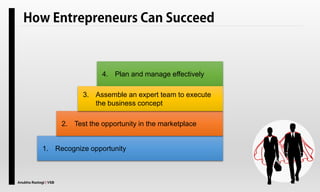
4. Plan and manage effectively
1. Recognize opportunity
2. Test the opportunity in the marketplace
3. Assemble an expert team to execute
the business concept
Anubha Rastogi | VSB
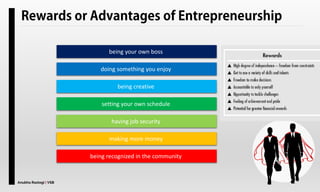
being your own boss
doing something you enjoy
being creative
setting your own schedule
having job security
making more money
being recognized in the community
Anubha Rastogi | VSB
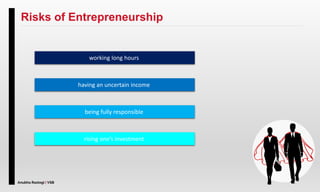
Risks of Entrepreneurship
working long hours
having an uncertain income
being fully responsible
rising one’s investment
Entrepreneur & Entrepreneurship Development

Entrepreneur & Entrepreneurship Development

  • 1.
    Ms. Anubha Rastogi Astt.Prof, Vidya School Of Business 2017-18
  • 2.
  • 3.
    Anubha Rastogi |VSB T The Entrepreneur The opportunity-spotter The project championThe inventor The person who realizes the opportunity and is determined to engage it The person who makes things happen The originator of the product or concept The idea Identifying the opportunity Matching the idea to the opportunity Exploiting the opportunity to build something of value
  • 4.
    Anubha Rastogi |VSB ‱ Entrepreneurship ‱ The process whereby an individual or group of individuals use organized efforts to pursue opportunities ‱ To create value and grow by fulfilling wants and needs through innovation and uniqueness ‱ regardless of personal resource situation. ‱ Entrepreneurship is the process of identifying opportunities in the market place, and arranging resources required to exploit the opportunities for long term gains. ‱ It is creating wealth by bringing together resources in new ways to start and operate an enterprise. ‱ It is the process of planning, organizing, operating and assuming the risk of a business venture. ‱ It is the ability to take risk independently to make more earnings in market-oriented economy.
  • 5.
    Anubha Rastogi |VSB ‱ The process of improving the skills and knowledge of entrepreneurs through various training and classroom programs. ‱ A program designed to help a person in strengthening his entrepreneurial motive, and in acquiring skills and capabilities necessary for playing his entrepreneurial role effectively. ‱ These programmes provide immense information to the potential entrepreneurial regarding new business ideas, how to set-up a new venture, how to prepare project report, how to fulfill legal formalities, sources of raising finance etc. ‱ A programme which seeks to do all this shall qualify to be called an entrepreneurship development programme.
  • 6.
    Anubha Rastogi |VSB ‱ Myth 1: Entrepreneurs Are Doers, Not Thinkers ‱ Myth 2: Entrepreneurs Are Born, Not Made ‱ Myth 3: Entrepreneurs Are Always Inventors ‱ Myth 4: Entrepreneurs Are Academic and Social Misfits ‱ Myth 5: Entrepreneurs Must Fit the “Profile” ‱ Myth 6: All Entrepreneurs Need Is Money ‱ Myth 7: All Entrepreneurs Need Is Luck ‱ Myth 8: Ignorance Is Bliss For Entrepreneurs ‱ Myth 9: Entrepreneurs Seek Success But Experience High Failure Rates ‱ Myth 10: Entrepreneurs Are Extreme Risk Takers (Gamblers) ‱ Myth 11: Successful entrepreneurship needs only a great idea ‱ Myth 12: Entrepreneurship is easy. ‱ Myth 13 : You have to be young to be an entrepreneur. ‱ Myth 14: You must have a degree in business to be an entrepreneur.
  • 7.
  • 8.
    Anubha Rastogi |VSB 1. Increases national production. 2. Balanced area development. 3. Reinvestment of profit for the welfare of the area of profit generation. 4. Development is a function of motivation and human resource. 5. Entrepreneurial awareness. 6. Growing employment opportunity. 7. Increasing productivity. 8. Optimum use of local resources. 9. Continued innovation in techno – managerial practices. 10. Improving in international competitiveness.
  • 9.
    Anubha Rastogi |VSB Personal factors, becoming core competencies of entrepreneurs, include: ‱ Initiative (does things before being asked for) ‱ Proactive (identification and utilization of opportunities) ‱ Perseverance (working against all odds to overcome obstacles and never complacent with success) ‱ Problem-solver (conceives new ideas and achieves innovative solutions) ‱ Persuasion (to customers and financiers for patronization of his business and develops & maintains relationships) ‱ Self-confidence (takes and sticks to his decisions) ‱ Self-critical (learning from his mistakes and experiences of others) ‱ A Planner (collects information, prepares a plan, and monitors performance) ‱ Risk-taker (the basic quality). The empirical studies have identified the following socioeconomic factors: ‱Cast/religion ‱Family background ‱Level of Education ‱Level of perception ‱Legitimacy of Entrepreneurship ‱Migratory character ‱Social Mobility ‱Social Security ‱Investment capacity ‱Ambition/motivation
  • 10.
    Anubha Rastogi |VSB persistent creative responsible inquisitive goal-oriented independent self-demanding self-confident risk-taking restless action-oriented enthusiastic
  • 11.
    Anubha Rastogi |VSB communication math problem-solving technology and computer decision-making organizing and planning teamwork social adaptability basic business
  • 12.
  • 14.
  • 15.
  • 16.
  • 17.
  • 18.
  • 19.
  • 20.
  • 21.
    Anubha Rastogi |VSB Innovation Risk Measurement & risk taking Conceptualizing New opportunities, possibilities & threats Organization building Technology Transfer Uncertainty absorption Decision Making Development & growth of venture Team & Commitment building Supervision and control
  • 22.
    Anubha Rastogi |VSB ‱ Novice Entrepreneur ‱ Has no prior business ownership experiences as a business founder, inheritor, or purchaser ‱ Habitual Entrepreneur ‱ Has prior business ownership experience ‱ Nascent Entrepreneur ‱ In the process of starting a new business ‱ Can be either a novice or a habitual entrepreneur ‱ Serial Entrepreneur ‱ Has sold or closed an original business and establishes another new business ‱ Continues the cycle of selling/closing and establishing ‱ Portfolio Entrepreneur ‱ Retains an original business and builds a portfolio of additional businesses ‱ Through inheriting, establishing, and purchasing the businesses
  • 23.
    Anubha Rastogi |VSB According to the Type of Business ‱ Business entrepreneur: Business entrepreneurs are those entrepreneurs who conceive the idea of a new product or service and then translate their ideas into reality. ‱ Trading entrepreneur: As the very name indicates trading entrepreneur is concerned with trading activities and not manufacturing. ‱ Industrial entrepreneur: As the very name indicates, an industrial entrepreneur is one who sets up an industrial unit. ‱ Corporate entrepreneur: Corporate entrepreneur is the one who plans,develops and manages a corporate body. ‱ Agricultural entrepreneur: Agricultural entrepreneur is the one who is engaged in the agricultural activities. According to Motivation ‱ Pure entrepreneur: Pure entrepreneur is one who may or may not possess an aptitude for entrepreneurship but is tempted by the monetary rewards or profits to be earned from the business venture. ‱ Induced entrepreneur: Induced entrepreneur is attracted by the various incentives, subsidies and facilities offered by the government.
  • 24.
    Anubha Rastogi |VSB According to the Use of Technology ‱ Technical entrepreneur: The strength of a technical entrepreneur is in his skill in production techniques. He concentrates more on production than on marketing. ‱ Non-technical entrepreneur: Unlike technical entrepreneur, non-technical entrepreneur is not concerned with the technical aspect of the product rather he spends more time in developing alternative strategies of the marketing and distribution to promote his business. ‱ Professional entrepreneur: Professional entrepreneur means an entrepreneur who is interested in floating a business but does not want to manage or operate it. According to stages of Development ‱ First generation entrepreneur: First generation entrepreneur are those entrepreneur who do not possess any entrepreneurial background. ‱ Second generation entrepreneur: Second generation entrepreneur are those entrepreneurs who inherit the family business firms and pass it from one generation to another. ‱ Classical entrepreneur: A classical entrepreneur is a stereotype entrepreneur whose aim is to maximize his economic returns at a level consistent with the survival of the unit but with or without an element of growth.
  • 25.
    Anubha Rastogi |VSB Classification Given by Danhof ‱ Innovating entrepreneur: Innovative entrepreneurs are generally aggressive and possess the art of cleverly putting the attractive possibilities into practice. ‱ Imitative entrepreneurs: Imitative entrepreneurs are characterized by readiness to adopt successful innovations inaugurated by successful innovating entrepreneurs. ‱ Fabian entrepreneur: Fabian entrepreneurs are cautions and skeptical in experimenting change in their enterprises. Such entrepreneurs are shy, lazy and lethargic. ‱ Drone entrepreneur: Drone entrepreneurs are characterized by a refusal to adopt opportunities to make changes in production formulae even at the cost of severely reduced returns. According to Capital ownership ‱ Private entrepreneur: When an individual or a group of individuals set up an enterprise, arrange finance, bear the risk and adopt the latest techniques in the business with the intention to earn profits, he or the group is called as private entrepreneur/entrepreneurs. ‱ State entrepreneur: As the name indicates, state entrepreneur means the trading or industrial venture undertaken by the state or the government itself. ‱ Joint entrepreneur: Joint entrepreneur means the combination of private entrepreneur and state entrepreneur who join hands.
  • 26.
    Anubha Rastogi |VSB According to Gender and Age ‱ Man entrepreneur ‱ Woman entrepreneur ‱ Young entrepreneur ‱ Old entrepreneur ‱ Middle-aged entrepreneur According to Area ‱ Urban entrepreneur ‱ Rural entrepreneur According to Scale ‱ Large scale industry entrepreneur ‱ Medium scale industry entrepreneur ‱ Small scale industry entrepreneur ‱ Tiny industry entrepreneur
  • 27.
    Anubha Rastogi |VSB 4. Plan and manage effectively 1. Recognize opportunity 2. Test the opportunity in the marketplace 3. Assemble an expert team to execute the business concept
  • 28.
    Anubha Rastogi |VSB being your own boss doing something you enjoy being creative setting your own schedule having job security making more money being recognized in the community
  • 29.
    Anubha Rastogi |VSB Risks of Entrepreneurship working long hours having an uncertain income being fully responsible rising one’s investment