CAREER PLANNING
AND DEVELOPMENT
Asst. Prof. Parasmani Jangid
SDJ International College
CAREER
The term 'career denotes all the jobs that are held during one's
working life. It is viewed as a sequence of positions held by an
individual during the course of his lifetime.
Edwin B. Flippo defined a career as a sequence of separate but
related work activities that provide continuity, order and meaning in
a person's life.
Yet in another way, it may be defined as a succession of related
jobs, arranged in hierarchical order, through which a person moves
in an organization.
It is a proper sequence of job-related activities. Such job related
activities vis-a-vis experience include roles and experiences at
different hierarchical levels of an organization held by an individual,
which lead to an increasing level of responsibilities, status, power,
achievements and rewards.
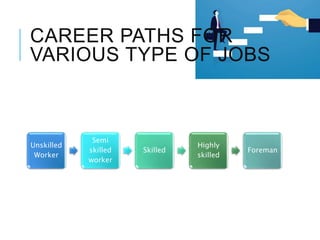
CAREER PATHS FOR
VARIOUS TYPE OF JOBS
Unskilled
Worker
Semi
skilled
worker
Skilled
Highly
skilled
Foreman
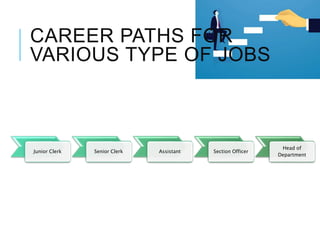
CAREER PATHS FOR
VARIOUS TYPE OF JOBS
Junior Clerk Senior Clerk Assistant Section Officer
Head of
Department
CAREER PLANNING
“Career planning is concerned with identifying personnel
today and preparing them by training for the future
vacancies that are likely to arise”.
“It is the process of setting ones career goals and to
determine the course of action of career paths to achieve
these goals, keeping in view ones own strengths and
weakness.”
CAREER PLANNING
According to Schermerborn, Hunt, and Osborn, ‘Career planning is
a process of systematically matching career goals and individual
capabilities with opportunities for their fulfillment’.
Career planning is the process of enhancing an employee’s future
value. It lays down the career ladder of vertical movement of
employee’s career path.
A career plan is an individual’s choice of occupation, organization
and career path, the organization helps the employee in this
respect as it derives a lot of benefits from the same.
Career planning encourages individuals to explore and gather
information, which enables them to synthesize, gain competencies,
make decisions, set goals and take action. It is a crucial phase of
human resource development that helps the employees in making
strategy for work-life balance.
The major focus of career planning is on assisting the employees
achieve a better match between personal goals and the
opportunities that are realistically available in the organization.
FEATURES OF CAREER
PLANNING
1. It is an ongoing organizational process.
2.it is concerned with identifying employees and
preparing them for higher positions
3. It helps individuals develop skills required to fulfill
different career roles.
4. It strengthens work-related activities in the
organization.
5. It fulfils their aspirations for future progress
6. give professional directions- through counseling
centers, training programs etc
7.It aims at achieving employee development together
with organization's goals
NEED/OBJECTIVES OF
CAREER PLANNING
1.stability of work force
2 correcting wrong placement
3. preparing employees for promotion
4. preparing employees for challenges
5. to attract competent persons
6. to utilize the managerial reserves
7. to improve motivation and morale
8. to determine the role of employees
9. achieve organizational objectives
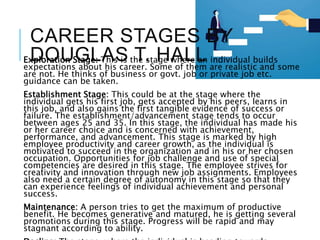
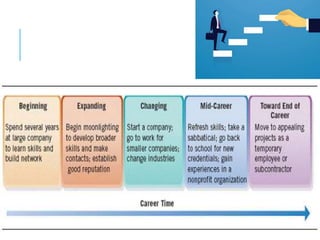
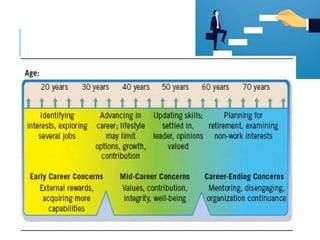
CAREER STAGES BY
DOUGLAS T. HALLExploration Stage: This is the stage where an individual builds
expectations about his career. Some of them are realistic and some
are not. He thinks of business or govt. job or private job etc.
guidance can be taken.
Establishment Stage: This could be at the stage where the
individual gets his first job, gets accepted by his peers, learns in
this job, and also gains the first tangible evidence of success or
failure. The establishment/advancement stage tends to occur
between ages 25 and 35. In this stage, the individual has made his
or her career choice and is concerned with achievement,
performance, and advancement. This stage is marked by high
employee productivity and career growth, as the individual is
motivated to succeed in the organization and in his or her chosen
occupation. Opportunities for job challenge and use of special
competencies are desired in this stage. The employee strives for
creativity and innovation through new job assignments. Employees
also need a certain degree of autonomy in this stage so that they
can experience feelings of individual achievement and personal
success.

Maintenance: A person tries to get the maximum of productive
benefit. He becomes generative and matured, he is getting several
promotions during this stage. Progress will be rapid and may
stagnant according to ability.
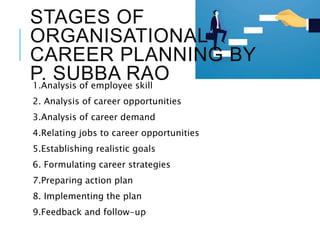
STAGES OF
ORGANISATIONAL
CAREER PLANNING BY
P. SUBBA RAO1.Analysis of employee skill
2. Analysis of career opportunities
3.Analysis of career demand
4.Relating jobs to career opportunities
5.Establishing realistic goals
6. Formulating career strategies
7.Preparing action plan
8. Implementing the plan
9.Feedback and follow-up
ADVANTAGES(IMPORTAN
CE OF CAREER
PLANNING AND
DEVELOPMENT)1. knowledge of career opportunities
2. selecting proper career
3 identifying employees for promotion
4. Motivates the employees
5. loyalty to the company
6. lowers employee turnover
7. improvement in performance
8. satisfies sense of pride
9. useful for manpower planning
10.Useful to the society
LIMITATIONS OF
CAREER PLANNING
1. dual career families
2.Low ceiling careers
3. declining career opportunities
4. changing needs
5. contingencies
6. attitudes of management
LIMITATIONS
It is not possible for small units due to limited promotion
opportunities.
At times legal provisions, demands of trade unions, and
govt. policies come in way of career planning
Caste based reservation policy- is yet another problem
If organization is inattentive to the problems of various
career stages it may not be very effective.
Changing environment may make it difficult to align the
organizational and individual needs
It does not guarantee productivity and efficiency
Assessment centre is required to shape career planning and
development.
PRE-REQUISITES OF
SUCCESS OF CAREER
PLANNING
1. Commitment of Top management
2. Development in a phased manner
3. Clarity of corporate goals
4. Loyal and Hardworking employees
5. Scientific recruitment
6. Proper age-composition of employees
7. Steps to reduce career stress
8. Promotion opportunities
9. Publicity of Career planning programmes
SUCCESSION PLANNING
It refers to the process and actions that aim at
identifying and developing a pool of potential successors
for senior or key jobs I the future.
It is an ongoing dynamic process that helps an
organization to align its business goals and its human
capital needs
SUCCESSION PLANNING
INCLUDE THESE
ACTIVITIES-
1. Analysis of the demand for managers and professional by
company level, function and skill.
2. Audit for existing executives and projection of likely future
supply from internal & external sources.
3. Planning of individual career paths based on objective
estimates of future needs and drawing on reliable
performance appraisals and assessment of potential.
4. Career counselling undertaken in the context of a realistic
understanding of the future needs of the firm as well as
those of the individuals.
CONT….
5. Accelerated promotions, targeted against the future
needs of the business
6. Performance related training and development to
prepare individuals for future roles as well as current
responsibilities
7. Planned strategic recruitment not only to fill short
term needs but also future needs
8. The actual activities by which openings are filled.
PROCESS OF
SUCCESSION PLANNING
1. Identify leadership competencies
2. Develop a comprehensive database for the target group
3. Review the strengths and weaknesses of the candidates to
determine their promotability
4. Provide feedback to the potential candidates in order to match
the company’s succession plans with the candidates career
aspirations
5. Measure developmental progress of the candidates.
CAREER DEVELOPMENT
MEANING OF CAREER
DEVELOPMENT
Career development is the series of activities or the on-
going/lifelong process of developing one’s career. It
usually refers to managing one’s career in an intra-
organizational or inter-organizational scenario.
CAREER DEVELOPMENT
According to Middlemist, Hill and Greer, "Career
development is a process of planning the series of
possible jobs one may hold in an organization over time
and development strategies designed to provide
necessary job skills as the opportunities arise".
ELEMENTS OF CAREER
DEVELOPMENT
PROGRAMME
1.Career need assessment-assisting employees in
assessing their own internal career needs.
2.Career opportunities information -developing and
publicizing available career opportunities in the
organisation
3.Need opportunity alignment-aligning employee needs
and abilities with career opportunities
THANK YOU

Career planning and Development

  • 1.
    CAREER PLANNING AND DEVELOPMENT Asst.Prof. Parasmani Jangid SDJ International College
  • 2.
    CAREER The term 'careerdenotes all the jobs that are held during one's working life. It is viewed as a sequence of positions held by an individual during the course of his lifetime. Edwin B. Flippo defined a career as a sequence of separate but related work activities that provide continuity, order and meaning in a person's life. Yet in another way, it may be defined as a succession of related jobs, arranged in hierarchical order, through which a person moves in an organization. It is a proper sequence of job-related activities. Such job related activities vis-a-vis experience include roles and experiences at different hierarchical levels of an organization held by an individual, which lead to an increasing level of responsibilities, status, power, achievements and rewards.
  • 3.
    CAREER PATHS FOR VARIOUSTYPE OF JOBS Unskilled Worker Semi skilled worker Skilled Highly skilled Foreman
  • 4.
    CAREER PATHS FOR VARIOUSTYPE OF JOBS Junior Clerk Senior Clerk Assistant Section Officer Head of Department
  • 5.
    CAREER PLANNING “Career planningis concerned with identifying personnel today and preparing them by training for the future vacancies that are likely to arise”. “It is the process of setting ones career goals and to determine the course of action of career paths to achieve these goals, keeping in view ones own strengths and weakness.”
  • 6.
    CAREER PLANNING According toSchermerborn, Hunt, and Osborn, ‘Career planning is a process of systematically matching career goals and individual capabilities with opportunities for their fulfillment’. Career planning is the process of enhancing an employee’s future value. It lays down the career ladder of vertical movement of employee’s career path. A career plan is an individual’s choice of occupation, organization and career path, the organization helps the employee in this respect as it derives a lot of benefits from the same. Career planning encourages individuals to explore and gather information, which enables them to synthesize, gain competencies, make decisions, set goals and take action. It is a crucial phase of human resource development that helps the employees in making strategy for work-life balance. The major focus of career planning is on assisting the employees achieve a better match between personal goals and the opportunities that are realistically available in the organization.
  • 7.
    FEATURES OF CAREER PLANNING 1.It is an ongoing organizational process. 2.it is concerned with identifying employees and preparing them for higher positions 3. It helps individuals develop skills required to fulfill different career roles. 4. It strengthens work-related activities in the organization. 5. It fulfils their aspirations for future progress 6. give professional directions- through counseling centers, training programs etc 7.It aims at achieving employee development together with organization's goals
  • 8.
    NEED/OBJECTIVES OF CAREER PLANNING 1.stabilityof work force 2 correcting wrong placement 3. preparing employees for promotion 4. preparing employees for challenges 5. to attract competent persons 6. to utilize the managerial reserves 7. to improve motivation and morale 8. to determine the role of employees 9. achieve organizational objectives
  • 9.
    CAREER STAGES BY DOUGLAST. HALLExploration Stage: This is the stage where an individual builds expectations about his career. Some of them are realistic and some are not. He thinks of business or govt. job or private job etc. guidance can be taken. Establishment Stage: This could be at the stage where the individual gets his first job, gets accepted by his peers, learns in this job, and also gains the first tangible evidence of success or failure. The establishment/advancement stage tends to occur between ages 25 and 35. In this stage, the individual has made his or her career choice and is concerned with achievement, performance, and advancement. This stage is marked by high employee productivity and career growth, as the individual is motivated to succeed in the organization and in his or her chosen occupation. Opportunities for job challenge and use of special competencies are desired in this stage. The employee strives for creativity and innovation through new job assignments. Employees also need a certain degree of autonomy in this stage so that they can experience feelings of individual achievement and personal success. Maintenance: A person tries to get the maximum of productive benefit. He becomes generative and matured, he is getting several promotions during this stage. Progress will be rapid and may stagnant according to ability.
  • 12.
    STAGES OF ORGANISATIONAL CAREER PLANNINGBY P. SUBBA RAO1.Analysis of employee skill 2. Analysis of career opportunities 3.Analysis of career demand 4.Relating jobs to career opportunities 5.Establishing realistic goals 6. Formulating career strategies 7.Preparing action plan 8. Implementing the plan 9.Feedback and follow-up
  • 13.
    ADVANTAGES(IMPORTAN CE OF CAREER PLANNINGAND DEVELOPMENT)1. knowledge of career opportunities 2. selecting proper career 3 identifying employees for promotion 4. Motivates the employees 5. loyalty to the company 6. lowers employee turnover 7. improvement in performance 8. satisfies sense of pride 9. useful for manpower planning 10.Useful to the society
  • 14.
    LIMITATIONS OF CAREER PLANNING 1.dual career families 2.Low ceiling careers 3. declining career opportunities 4. changing needs 5. contingencies 6. attitudes of management
  • 15.
    LIMITATIONS It is notpossible for small units due to limited promotion opportunities. At times legal provisions, demands of trade unions, and govt. policies come in way of career planning Caste based reservation policy- is yet another problem If organization is inattentive to the problems of various career stages it may not be very effective. Changing environment may make it difficult to align the organizational and individual needs It does not guarantee productivity and efficiency Assessment centre is required to shape career planning and development.
  • 16.
    PRE-REQUISITES OF SUCCESS OFCAREER PLANNING 1. Commitment of Top management 2. Development in a phased manner 3. Clarity of corporate goals 4. Loyal and Hardworking employees 5. Scientific recruitment 6. Proper age-composition of employees 7. Steps to reduce career stress 8. Promotion opportunities 9. Publicity of Career planning programmes
  • 17.
    SUCCESSION PLANNING It refersto the process and actions that aim at identifying and developing a pool of potential successors for senior or key jobs I the future. It is an ongoing dynamic process that helps an organization to align its business goals and its human capital needs
  • 18.
    SUCCESSION PLANNING INCLUDE THESE ACTIVITIES- 1.Analysis of the demand for managers and professional by company level, function and skill. 2. Audit for existing executives and projection of likely future supply from internal & external sources. 3. Planning of individual career paths based on objective estimates of future needs and drawing on reliable performance appraisals and assessment of potential. 4. Career counselling undertaken in the context of a realistic understanding of the future needs of the firm as well as those of the individuals.
  • 19.
    CONT…. 5. Accelerated promotions,targeted against the future needs of the business 6. Performance related training and development to prepare individuals for future roles as well as current responsibilities 7. Planned strategic recruitment not only to fill short term needs but also future needs 8. The actual activities by which openings are filled.
  • 20.
    PROCESS OF SUCCESSION PLANNING 1.Identify leadership competencies 2. Develop a comprehensive database for the target group 3. Review the strengths and weaknesses of the candidates to determine their promotability 4. Provide feedback to the potential candidates in order to match the company’s succession plans with the candidates career aspirations 5. Measure developmental progress of the candidates.
  • 21.
  • 22.
    MEANING OF CAREER DEVELOPMENT Careerdevelopment is the series of activities or the on- going/lifelong process of developing one’s career. It usually refers to managing one’s career in an intra- organizational or inter-organizational scenario.
  • 23.
    CAREER DEVELOPMENT According toMiddlemist, Hill and Greer, "Career development is a process of planning the series of possible jobs one may hold in an organization over time and development strategies designed to provide necessary job skills as the opportunities arise".
  • 24.
    ELEMENTS OF CAREER DEVELOPMENT PROGRAMME 1.Careerneed assessment-assisting employees in assessing their own internal career needs. 2.Career opportunities information -developing and publicizing available career opportunities in the organisation 3.Need opportunity alignment-aligning employee needs and abilities with career opportunities
  • 27.