Population basics
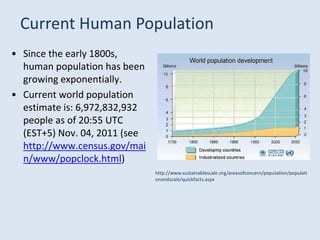
• Since the early 1800s,
human population has been
growing exponentially.
• Current world population
estimate is: 6,972,832,932
people as of 20:55 UTC
(EST+5) Nov. 04, 2011 (see
http://www.census.gov/mai
n/www/popclock.html)
Current Human Population
http://www.sustainablescale.org/areasofconcern/population/populati
onandscale/quickfacts.aspx
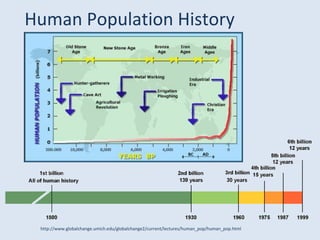
Human Population History
http://www.globalchange.umich.edu/globalchange2/current/lectures/human_pop/human_pop.html
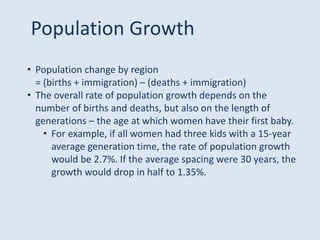
• Population change by region
= (births + immigration) – (deaths + immigration)
• The overall rate of population growth depends on the
number of births and deaths, but also on the length of
generations – the age at which women have their first baby.
• For example, if all women had three kids with a 15-year
average generation time, the rate of population growth
would be 2.7%. If the average spacing were 30 years, the
growth would drop in half to 1.35%.
Population Growth
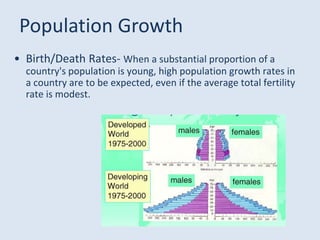
• Birth/Death Rates- When a substantial proportion of a
country's population is young, high population growth rates in
a country are to be expected, even if the average total fertility
rate is modest.
Population Growth
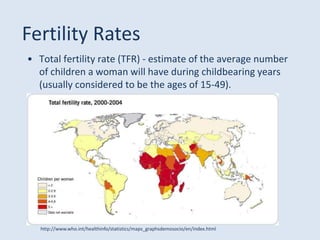
• Total fertility rate (TFR) - estimate of the average number
of children a woman will have during childbearing years
(usually considered to be the ages of 15-49).
Fertility Rates
http://www.who.int/healthinfo/statistics/maps_graphsdemosocio/en/index.html
• Replacement fertility is the total fertility rate at which newborn girls
would have an average of exactly one daughter over their lifetimes. That
is, women have just enough female babies to replace themselves (or,
equivalently, adults have just enough total babies to replace themselves).
• If there were no mortality in the female population until the end of the
childbearing years then the replacement level of TFR would be very close
to 2.0 (actually slightly higher because of the excess of boy over girl births
in human populations).
• However, the replacement level is also affected by mortality, especially
childhood mortality.
• The replacement fertility rate is roughly 2.1 births per woman for most
industrialized countries, but ranges from 2.5 to 3.3 in developing countries
because of higher mortality rates.
Replacement Rates
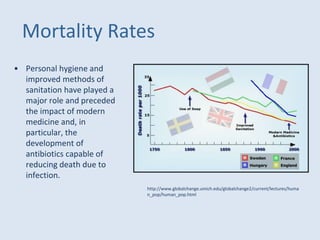
• Personal hygiene and
improved methods of
sanitation have played a
major role and preceded
the impact of modern
medicine and, in
particular, the
development of
antibiotics capable of
reducing death due to
infection.
http://www.globalchange.umich.edu/globalchange2/current/lectures/huma
n_pop/human_pop.html
Mortality Rates
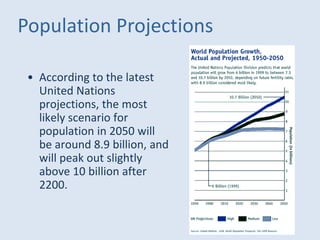
• According to the latest
United Nations
projections, the most
likely scenario for
population in 2050 will
be around 8.9 billion, and
will peak out slightly
above 10 billion after
2200.
Population Projections
Carrying capacity
• Is there a Carrying Capacity for humans?
• Experience with other species tells us that, ultimately,
resource limitations and/or habitat degradation will force
the human population curves to approach an upper limit
or asymptote - the carrying capacity, often symbolized as
" K" by ecologists.
• It is very natural to ask :
– does humanity have a carrying capacity and,
– if so, what is it - and when will we reach or overshoot this limit?
adapted from:
http://www.globalchange.umich.edu/globalchange2/current/lectures/human_pop/human_pop.html#Past
Carrying capacity
• One strand of thought discards the notion of a human
carrying capacity altogether, claiming that the additional
people will provide sufficient creativity and innovation to
break through any possible natural barriers to human
population growth.
• Most of the serious estimates of K for humans, however,
lie in the range 10 -20 billion people.
• Potential solutions:
– Make a bigger pie: Increase human productive capacities through
technology and innovation
– Put fewer forks on the table: Reduce numbers and expectations
of people through such means as family planning
adapted from:
http://www.globalchange.umich.edu/globalchange2/current/lectures/human_pop/human_pop.html#Past
Carrying capcity
• Is there a Carrying Capacity for Homo
sapiens?
• As we have seen, the human population
growth curve is currently following an
exponential curve or a "J-shape" (fig. 1).
Common sense tells us that such growth
cannot continue - otherwise within a few
hundred years every square foot of the
Earth's surface would be taken up by a

Human population

  • 1.
  • 2.
    • Since theearly 1800s, human population has been growing exponentially. • Current world population estimate is: 6,972,832,932 people as of 20:55 UTC (EST+5) Nov. 04, 2011 (see http://www.census.gov/mai n/www/popclock.html) Current Human Population http://www.sustainablescale.org/areasofconcern/population/populati onandscale/quickfacts.aspx
  • 3.
  • 4.
    • Population changeby region = (births + immigration) – (deaths + immigration) • The overall rate of population growth depends on the number of births and deaths, but also on the length of generations – the age at which women have their first baby. • For example, if all women had three kids with a 15-year average generation time, the rate of population growth would be 2.7%. If the average spacing were 30 years, the growth would drop in half to 1.35%. Population Growth
  • 5.
    • Birth/Death Rates-When a substantial proportion of a country's population is young, high population growth rates in a country are to be expected, even if the average total fertility rate is modest. Population Growth
  • 6.
    • Total fertilityrate (TFR) - estimate of the average number of children a woman will have during childbearing years (usually considered to be the ages of 15-49). Fertility Rates http://www.who.int/healthinfo/statistics/maps_graphsdemosocio/en/index.html
  • 7.
    • Replacement fertilityis the total fertility rate at which newborn girls would have an average of exactly one daughter over their lifetimes. That is, women have just enough female babies to replace themselves (or, equivalently, adults have just enough total babies to replace themselves). • If there were no mortality in the female population until the end of the childbearing years then the replacement level of TFR would be very close to 2.0 (actually slightly higher because of the excess of boy over girl births in human populations). • However, the replacement level is also affected by mortality, especially childhood mortality. • The replacement fertility rate is roughly 2.1 births per woman for most industrialized countries, but ranges from 2.5 to 3.3 in developing countries because of higher mortality rates. Replacement Rates
  • 8.
    • Personal hygieneand improved methods of sanitation have played a major role and preceded the impact of modern medicine and, in particular, the development of antibiotics capable of reducing death due to infection. http://www.globalchange.umich.edu/globalchange2/current/lectures/huma n_pop/human_pop.html Mortality Rates
  • 9.
    • According tothe latest United Nations projections, the most likely scenario for population in 2050 will be around 8.9 billion, and will peak out slightly above 10 billion after 2200. Population Projections
  • 10.
    Carrying capacity • Isthere a Carrying Capacity for humans? • Experience with other species tells us that, ultimately, resource limitations and/or habitat degradation will force the human population curves to approach an upper limit or asymptote - the carrying capacity, often symbolized as " K" by ecologists. • It is very natural to ask : – does humanity have a carrying capacity and, – if so, what is it - and when will we reach or overshoot this limit? adapted from: http://www.globalchange.umich.edu/globalchange2/current/lectures/human_pop/human_pop.html#Past
  • 11.
    Carrying capacity • Onestrand of thought discards the notion of a human carrying capacity altogether, claiming that the additional people will provide sufficient creativity and innovation to break through any possible natural barriers to human population growth. • Most of the serious estimates of K for humans, however, lie in the range 10 -20 billion people. • Potential solutions: – Make a bigger pie: Increase human productive capacities through technology and innovation – Put fewer forks on the table: Reduce numbers and expectations of people through such means as family planning adapted from: http://www.globalchange.umich.edu/globalchange2/current/lectures/human_pop/human_pop.html#Past
  • 12.
    Carrying capcity • Isthere a Carrying Capacity for Homo sapiens? • As we have seen, the human population growth curve is currently following an exponential curve or a "J-shape" (fig. 1). Common sense tells us that such growth cannot continue - otherwise within a few hundred years every square foot of the Earth's surface would be taken up by a