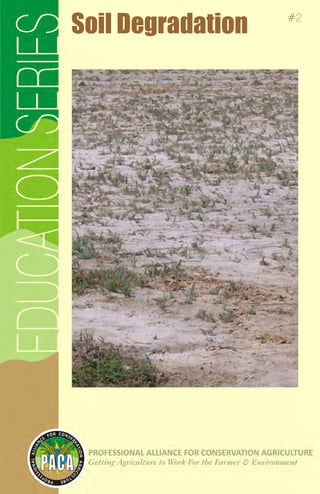
Soil Degradation #2
PACA Education Series Soil Degradation #2
Professional Alliance for Conservation Agriculture Page 1 of 8
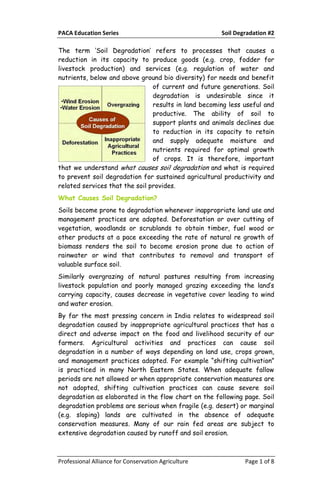
The term ‘Soil Degradation’ refers to processes that causes a
reduction in its capacity to produce goods (e.g. crop, fodder for
livestock production) and services (e.g. regulation of water and
nutrients, below and above ground bio diversity) for needs and benefit
of current and future generations. Soil
degradation is undesirable since it
results in land becoming less useful and
productive. The ability of soil to
support plants and animals declines due
to reduction in its capacity to retain
and supply adequate moisture and
nutrients required for optimal growth
of crops. It is therefore, important
that we understand what causes soil degradation and what is required
to prevent soil degradation for sustained agricultural productivity and
related services that the soil provides.
What Causes Soil Degradation?
Soils become prone to degradation whenever inappropriate land use and
management practices are adopted. Deforestation or over cutting of
vegetation, woodlands or scrublands to obtain timber, fuel wood or
other products at a pace exceeding the rate of natural re growth of
biomass renders the soil to become erosion prone due to action of
rainwater or wind that contributes to removal and transport of
valuable surface soil.
Similarly overgrazing of natural pastures resulting from increasing
livestock population and poorly managed grazing exceeding the land’s
carrying capacity, causes decrease in vegetative cover leading to wind
and water erosion.
By far the most pressing concern in India relates to widespread soil
degradation caused by inappropriate agricultural practices that has a
direct and adverse impact on the food and livelihood security of our
farmers. Agricultural activities and practices can cause soil
degradation in a number of ways depending on land use, crops grown,
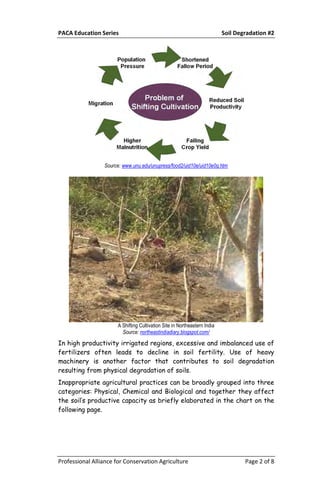
and management practices adopted. For example “shifting cultivation”
is practiced in many North Eastern States. When adequate fallow
periods are not allowed or when appropriate conservation measures are
not adopted, shifting cultivation practices can cause severe soil
degradation as elaborated in the flow chart on the following page. Soil
degradation problems are serious when fragile (e.g. desert) or marginal
(e.g. sloping) lands are cultivated in the absence of adequate
conservation measures. Many of our rain fed areas are subject to
extensive degradation caused by runoff and soil erosion.
PACA Education Series Soil Degradation #2
Professional Alliance for Conservation Agriculture Page 2 of 8
Source: www.unu.edu/unupress/food2/uid10e/uid10e0q.htm
A Shifting Cultivation Site in Northeastern India
Source: northeastindiadiary.blogspot.com/
In high productivity irrigated regions, excessive and imbalanced use of
fertilizers often leads to decline in soil fertility. Use of heavy
machinery is another factor that contributes to soil degradation
resulting from physical degradation of soils.
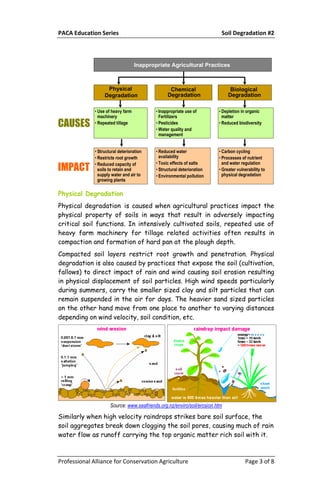
Inappropriate agricultural practices can be broadly grouped into three
categories: Physical, Chemical and Biological and together they affect
the soil’s productive capacity as briefly elaborated in the chart on the
following page.
PACA Education Series Soil Degradation #2
Professional Alliance for Conservation Agriculture Page 3 of 8
Physical Degradation
Physical degradation is caused when agricultural practices impact the
physical property of soils in ways that result in adversely impacting
critical soil functions. In intensively cultivated soils, repeated use of
heavy farm machinery for tillage related activities often results in
compaction and formation of hard pan at the plough depth.
Compacted soil layers restrict root growth and penetration. Physical
degradation is also caused by practices that expose the soil (cultivation,
fallows) to direct impact of rain and wind causing soil erosion resulting
in physical displacement of soil particles. High wind speeds particularly
during summers, carry the smaller sized clay and silt particles that can
remain suspended in the air for days. The heavier sand sized particles
on the other hand move from one place to another to varying distances
depending on wind velocity, soil condition, etc.
Source: www.seafriends.org.nz/enviro/soil/erosion.htm
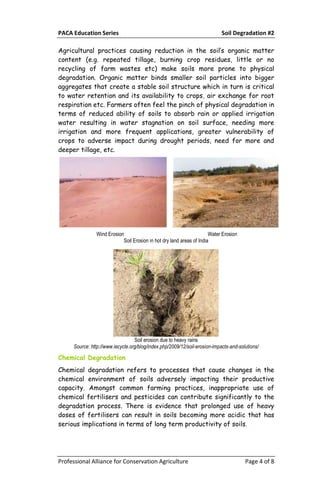
Similarly when high velocity raindrops strikes bare soil surface, the
soil aggregates break down clogging the soil pores, causing much of rain
water flow as runoff carrying the top organic matter rich soil with it.
Inappropriate Agricultural Practices
Physical
Degradation
Chemical
Degradation
Biological
Degradation
• Use of heavy farm
machinery
• Repeated tillage
• Inappropriate use of
Fertilizers
• Pesticides
• Water quality and
management
• Depletion in organic
matter
• Reduced biodiversity
• Structural deterioration
• Restricts root growth
• Reduced capacity of
soils to retain and
supply water and air to
growing plants
• Carbon cycling
• Processes of nutrient
and water regulation
• Greater vulnerability to
physical degradation
• Reduced water
availability
• Toxic effects of salts
• Structural deterioration
• Environmental pollution
CAUSES
IMPACT
PACA Education Series Soil Degradation #2
Professional Alliance for Conservation Agriculture Page 4 of 8
Agricultural practices causing reduction in the soil’s organic matter
content (e.g. repeated tillage, burning crop residues, little or no
recycling of farm wastes etc) make soils more prone to physical
degradation. Organic matter binds smaller soil particles into bigger
aggregates that create a stable soil structure which in turn is critical
to water retention and its availability to crops, air exchange for root
respiration etc. Farmers often feel the pinch of physical degradation in
terms of reduced ability of soils to absorb rain or applied irrigation
water resulting in water stagnation on soil surface, needing more
irrigation and more frequent applications, greater vulnerability of
crops to adverse impact during drought periods, need for more and
deeper tillage, etc.
Wind Erosion Water Erosion
Soil Erosion in hot dry land areas of India
Soil erosion due to heavy rains
Source: http://www.iecycle.org/blog/index.php/2009/12/soil-erosion-impacts-and-solutions/
Chemical Degradation
Chemical degradation refers to processes that cause changes in the
chemical environment of soils adversely impacting their productive
capacity. Amongst common farming practices, inappropriate use of
chemical fertilisers and pesticides can contribute significantly to the
degradation process. There is evidence that prolonged use of heavy
doses of fertilisers can result in soils becoming more acidic that has
serious implications in terms of long term productivity of soils.
PACA Education Series Soil Degradation #2
Professional Alliance for Conservation Agriculture Page 5 of 8
Inappropriate, viz. imbalanced or excessive, use of fertilisers is a
major cause of pollution of ground waters or surface water bodies
resulting from inefficient use of applied nutrients.
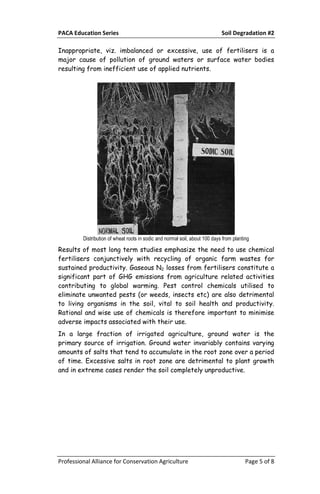
Distribution of wheat roots in sodic and normal soil, about 100 days from planting
Results of most long term studies emphasize the need to use chemical
fertilisers conjunctively with recycling of organic farm wastes for
sustained productivity. Gaseous N2 losses from fertilisers constitute a
significant part of GHG emissions from agriculture related activities
contributing to global warming. Pest control chemicals utilised to
eliminate unwanted pests (or weeds, insects etc) are also detrimental
to living organisms in the soil, vital to soil health and productivity.
Rational and wise use of chemicals is therefore important to minimise
adverse impacts associated with their use.
In a large fraction of irrigated agriculture, ground water is the
primary source of irrigation. Ground water invariably contains varying
amounts of salts that tend to accumulate in the root zone over a period
of time. Excessive salts in root zone are detrimental to plant growth
and in extreme cases render the soil completely unproductive.
PACA Education Series Soil Degradation #2
Professional Alliance for Conservation Agriculture Page 6 of 8
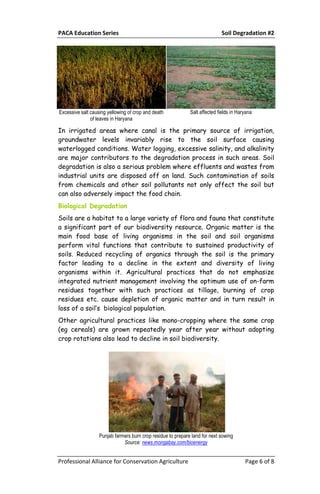
Excessive salt causing yellowing of crop and death
of leaves in Haryana
Salt affected fields in Haryana
In irrigated areas where canal is the primary source of irrigation,
groundwater levels invariably rise to the soil surface causing
waterlogged conditions. Water logging, excessive salinity, and alkalinity
are major contributors to the degradation process in such areas. Soil
degradation is also a serious problem where effluents and wastes from
industrial units are disposed off on land. Such contamination of soils
from chemicals and other soil pollutants not only affect the soil but
can also adversely impact the food chain.
Biological Degradation
Soils are a habitat to a large variety of flora and fauna that constitute
a significant part of our biodiversity resource. Organic matter is the
main food base of living organisms in the soil and soil organisms
perform vital functions that contribute to sustained productivity of
soils. Reduced recycling of organics through the soil is the primary
factor leading to a decline in the extent and diversity of living
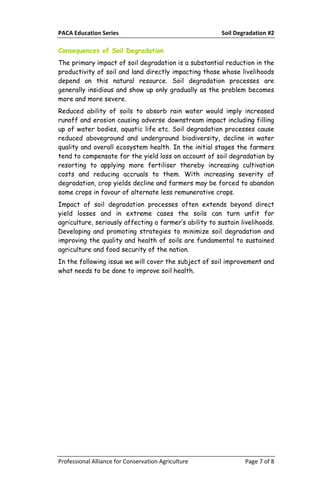
organisms within it. Agricultural practices that do not emphasize
integrated nutrient management involving the optimum use of on-farm
residues together with such practices as tillage, burning of crop
residues etc. cause depletion of organic matter and in turn result in
loss of a soil’s biological population.
Other agricultural practices like mono-cropping where the same crop
(eg cereals) are grown repeatedly year after year without adopting
crop rotations also lead to decline in soil biodiversity.
Punjab farmers burn crop residue to prepare land for next sowing
Source: news.mongabay.com/bioenergy
PACA Education Series Soil Degradation #2
Professional Alliance for Conservation Agriculture Page 7 of 8
Consequences of Soil Degradation
The primary impact of soil degradation is a substantial reduction in the
productivity of soil and land directly impacting those whose livelihoods
depend on this natural resource. Soil degradation processes are
generally insidious and show up only gradually as the problem becomes
more and more severe.
Reduced ability of soils to absorb rain water would imply increased
runoff and erosion causing adverse downstream impact including filling
up of water bodies, aquatic life etc. Soil degradation processes cause
reduced aboveground and underground biodiversity, decline in water
quality and overall ecosystem health. In the initial stages the farmers
tend to compensate for the yield loss on account of soil degradation by
resorting to applying more fertiliser thereby increasing cultivation
costs and reducing accruals to them. With increasing severity of
degradation, crop yields decline and farmers may be forced to abandon
some crops in favour of alternate less remunerative crops.
Impact of soil degradation processes often extends beyond direct
yield losses and in extreme cases the soils can turn unfit for
agriculture, seriously affecting a farmer’s ability to sustain livelihoods.
Developing and promoting strategies to minimize soil degradation and
improving the quality and health of soils are fundamental to sustained
agriculture and food security of the nation.
In the following issue we will cover the subject of soil improvement and
what needs to be done to improve soil health.
PACA Education Series Soil Degradation #2
Professional Alliance for Conservation Agriculture Page 8 of 8
About PACA
Professional Alliance for Conservation Agriculture (PACA) is a platform
that has emerged from concerns surrounding agriculture, given its
increasing importance and diminishing interest in today’s world. Recent
discussions surrounding food security, diversion of croplands for other
applications, impact on climate change, and diminishing returns to
farmers are all adding to heightening worry for farmers and policy
makers alike. PACA will endeavour to be an agent of change working
within the agriculture system, to contribute to improved food security
for benefit of humans and environment. It will take a professional
approach through a collaborative mechanism to address needs in a
participative manner based on sound scientific and social principles.
PACA is promoted by Centre for Advancement of Sustainable
Agriculture (CASA) and Society for Strategy Technology & Delivery for
Development (SocietySTADD) as a platform to motivate concerned
stakeholders involved with agriculture who wish to address the
deteriorating situation. It hopes to function as a catalyst to incubate an
alliance of concerned and well meaning professionals for the cause of
agriculture.
Professional Alliance for Conservation Agriculture
1st Floor, NASC Complex, DPS Marg, Pusa, New Delhi - 110 012 INDIA
Tel.: +91-11-45132119 / +91-98101-12773
Website: www.conserveagri.org
Email: info@conserveagri.org
About the Education Series
The Conservation Agriculture Education Series is part of our effort to
contribute to capacity building in conservation agriculture efforts being
undertaken by PACA. It will deal with chosen subjects from a
conceptual and application perspective. It’s handy size and easy to read
format with a pictorial approach will help reach it to many farmers as
we hope to make these available in local languages. Efforts have been
made to make information available in a manner suiting conditions in
India and progressively PACA hopes to cover other topics of
importance.
Other publications in the series that can be downloaded from our web
site www.conserveagri.org/content.htm are:
• Our Soil Resource #1
• हमारी भिमू और िमĘी #1 (Hindi translation of Our Soil Resource #1)
MARCH 2010

Edu soil 2

  • 1.
  • 2.
    PACA Education SeriesSoil Degradation #2 Professional Alliance for Conservation Agriculture Page 1 of 8 The term ‘Soil Degradation’ refers to processes that causes a reduction in its capacity to produce goods (e.g. crop, fodder for livestock production) and services (e.g. regulation of water and nutrients, below and above ground bio diversity) for needs and benefit of current and future generations. Soil degradation is undesirable since it results in land becoming less useful and productive. The ability of soil to support plants and animals declines due to reduction in its capacity to retain and supply adequate moisture and nutrients required for optimal growth of crops. It is therefore, important that we understand what causes soil degradation and what is required to prevent soil degradation for sustained agricultural productivity and related services that the soil provides. What Causes Soil Degradation? Soils become prone to degradation whenever inappropriate land use and management practices are adopted. Deforestation or over cutting of vegetation, woodlands or scrublands to obtain timber, fuel wood or other products at a pace exceeding the rate of natural re growth of biomass renders the soil to become erosion prone due to action of rainwater or wind that contributes to removal and transport of valuable surface soil. Similarly overgrazing of natural pastures resulting from increasing livestock population and poorly managed grazing exceeding the land’s carrying capacity, causes decrease in vegetative cover leading to wind and water erosion. By far the most pressing concern in India relates to widespread soil degradation caused by inappropriate agricultural practices that has a direct and adverse impact on the food and livelihood security of our farmers. Agricultural activities and practices can cause soil degradation in a number of ways depending on land use, crops grown, and management practices adopted. For example “shifting cultivation” is practiced in many North Eastern States. When adequate fallow periods are not allowed or when appropriate conservation measures are not adopted, shifting cultivation practices can cause severe soil degradation as elaborated in the flow chart on the following page. Soil degradation problems are serious when fragile (e.g. desert) or marginal (e.g. sloping) lands are cultivated in the absence of adequate conservation measures. Many of our rain fed areas are subject to extensive degradation caused by runoff and soil erosion.
  • 3.
    PACA Education SeriesSoil Degradation #2 Professional Alliance for Conservation Agriculture Page 2 of 8 Source: www.unu.edu/unupress/food2/uid10e/uid10e0q.htm A Shifting Cultivation Site in Northeastern India Source: northeastindiadiary.blogspot.com/ In high productivity irrigated regions, excessive and imbalanced use of fertilizers often leads to decline in soil fertility. Use of heavy machinery is another factor that contributes to soil degradation resulting from physical degradation of soils. Inappropriate agricultural practices can be broadly grouped into three categories: Physical, Chemical and Biological and together they affect the soil’s productive capacity as briefly elaborated in the chart on the following page.
  • 4.
    PACA Education SeriesSoil Degradation #2 Professional Alliance for Conservation Agriculture Page 3 of 8 Physical Degradation Physical degradation is caused when agricultural practices impact the physical property of soils in ways that result in adversely impacting critical soil functions. In intensively cultivated soils, repeated use of heavy farm machinery for tillage related activities often results in compaction and formation of hard pan at the plough depth. Compacted soil layers restrict root growth and penetration. Physical degradation is also caused by practices that expose the soil (cultivation, fallows) to direct impact of rain and wind causing soil erosion resulting in physical displacement of soil particles. High wind speeds particularly during summers, carry the smaller sized clay and silt particles that can remain suspended in the air for days. The heavier sand sized particles on the other hand move from one place to another to varying distances depending on wind velocity, soil condition, etc. Source: www.seafriends.org.nz/enviro/soil/erosion.htm Similarly when high velocity raindrops strikes bare soil surface, the soil aggregates break down clogging the soil pores, causing much of rain water flow as runoff carrying the top organic matter rich soil with it. Inappropriate Agricultural Practices Physical Degradation Chemical Degradation Biological Degradation • Use of heavy farm machinery • Repeated tillage • Inappropriate use of Fertilizers • Pesticides • Water quality and management • Depletion in organic matter • Reduced biodiversity • Structural deterioration • Restricts root growth • Reduced capacity of soils to retain and supply water and air to growing plants • Carbon cycling • Processes of nutrient and water regulation • Greater vulnerability to physical degradation • Reduced water availability • Toxic effects of salts • Structural deterioration • Environmental pollution CAUSES IMPACT
  • 5.
    PACA Education SeriesSoil Degradation #2 Professional Alliance for Conservation Agriculture Page 4 of 8 Agricultural practices causing reduction in the soil’s organic matter content (e.g. repeated tillage, burning crop residues, little or no recycling of farm wastes etc) make soils more prone to physical degradation. Organic matter binds smaller soil particles into bigger aggregates that create a stable soil structure which in turn is critical to water retention and its availability to crops, air exchange for root respiration etc. Farmers often feel the pinch of physical degradation in terms of reduced ability of soils to absorb rain or applied irrigation water resulting in water stagnation on soil surface, needing more irrigation and more frequent applications, greater vulnerability of crops to adverse impact during drought periods, need for more and deeper tillage, etc. Wind Erosion Water Erosion Soil Erosion in hot dry land areas of India Soil erosion due to heavy rains Source: http://www.iecycle.org/blog/index.php/2009/12/soil-erosion-impacts-and-solutions/ Chemical Degradation Chemical degradation refers to processes that cause changes in the chemical environment of soils adversely impacting their productive capacity. Amongst common farming practices, inappropriate use of chemical fertilisers and pesticides can contribute significantly to the degradation process. There is evidence that prolonged use of heavy doses of fertilisers can result in soils becoming more acidic that has serious implications in terms of long term productivity of soils.
  • 6.
    PACA Education SeriesSoil Degradation #2 Professional Alliance for Conservation Agriculture Page 5 of 8 Inappropriate, viz. imbalanced or excessive, use of fertilisers is a major cause of pollution of ground waters or surface water bodies resulting from inefficient use of applied nutrients. Distribution of wheat roots in sodic and normal soil, about 100 days from planting Results of most long term studies emphasize the need to use chemical fertilisers conjunctively with recycling of organic farm wastes for sustained productivity. Gaseous N2 losses from fertilisers constitute a significant part of GHG emissions from agriculture related activities contributing to global warming. Pest control chemicals utilised to eliminate unwanted pests (or weeds, insects etc) are also detrimental to living organisms in the soil, vital to soil health and productivity. Rational and wise use of chemicals is therefore important to minimise adverse impacts associated with their use. In a large fraction of irrigated agriculture, ground water is the primary source of irrigation. Ground water invariably contains varying amounts of salts that tend to accumulate in the root zone over a period of time. Excessive salts in root zone are detrimental to plant growth and in extreme cases render the soil completely unproductive.
  • 7.
    PACA Education SeriesSoil Degradation #2 Professional Alliance for Conservation Agriculture Page 6 of 8 Excessive salt causing yellowing of crop and death of leaves in Haryana Salt affected fields in Haryana In irrigated areas where canal is the primary source of irrigation, groundwater levels invariably rise to the soil surface causing waterlogged conditions. Water logging, excessive salinity, and alkalinity are major contributors to the degradation process in such areas. Soil degradation is also a serious problem where effluents and wastes from industrial units are disposed off on land. Such contamination of soils from chemicals and other soil pollutants not only affect the soil but can also adversely impact the food chain. Biological Degradation Soils are a habitat to a large variety of flora and fauna that constitute a significant part of our biodiversity resource. Organic matter is the main food base of living organisms in the soil and soil organisms perform vital functions that contribute to sustained productivity of soils. Reduced recycling of organics through the soil is the primary factor leading to a decline in the extent and diversity of living organisms within it. Agricultural practices that do not emphasize integrated nutrient management involving the optimum use of on-farm residues together with such practices as tillage, burning of crop residues etc. cause depletion of organic matter and in turn result in loss of a soil’s biological population. Other agricultural practices like mono-cropping where the same crop (eg cereals) are grown repeatedly year after year without adopting crop rotations also lead to decline in soil biodiversity. Punjab farmers burn crop residue to prepare land for next sowing Source: news.mongabay.com/bioenergy
  • 8.
    PACA Education SeriesSoil Degradation #2 Professional Alliance for Conservation Agriculture Page 7 of 8 Consequences of Soil Degradation The primary impact of soil degradation is a substantial reduction in the productivity of soil and land directly impacting those whose livelihoods depend on this natural resource. Soil degradation processes are generally insidious and show up only gradually as the problem becomes more and more severe. Reduced ability of soils to absorb rain water would imply increased runoff and erosion causing adverse downstream impact including filling up of water bodies, aquatic life etc. Soil degradation processes cause reduced aboveground and underground biodiversity, decline in water quality and overall ecosystem health. In the initial stages the farmers tend to compensate for the yield loss on account of soil degradation by resorting to applying more fertiliser thereby increasing cultivation costs and reducing accruals to them. With increasing severity of degradation, crop yields decline and farmers may be forced to abandon some crops in favour of alternate less remunerative crops. Impact of soil degradation processes often extends beyond direct yield losses and in extreme cases the soils can turn unfit for agriculture, seriously affecting a farmer’s ability to sustain livelihoods. Developing and promoting strategies to minimize soil degradation and improving the quality and health of soils are fundamental to sustained agriculture and food security of the nation. In the following issue we will cover the subject of soil improvement and what needs to be done to improve soil health.
  • 9.
    PACA Education SeriesSoil Degradation #2 Professional Alliance for Conservation Agriculture Page 8 of 8 About PACA Professional Alliance for Conservation Agriculture (PACA) is a platform that has emerged from concerns surrounding agriculture, given its increasing importance and diminishing interest in today’s world. Recent discussions surrounding food security, diversion of croplands for other applications, impact on climate change, and diminishing returns to farmers are all adding to heightening worry for farmers and policy makers alike. PACA will endeavour to be an agent of change working within the agriculture system, to contribute to improved food security for benefit of humans and environment. It will take a professional approach through a collaborative mechanism to address needs in a participative manner based on sound scientific and social principles. PACA is promoted by Centre for Advancement of Sustainable Agriculture (CASA) and Society for Strategy Technology & Delivery for Development (SocietySTADD) as a platform to motivate concerned stakeholders involved with agriculture who wish to address the deteriorating situation. It hopes to function as a catalyst to incubate an alliance of concerned and well meaning professionals for the cause of agriculture. Professional Alliance for Conservation Agriculture 1st Floor, NASC Complex, DPS Marg, Pusa, New Delhi - 110 012 INDIA Tel.: +91-11-45132119 / +91-98101-12773 Website: www.conserveagri.org Email: info@conserveagri.org About the Education Series The Conservation Agriculture Education Series is part of our effort to contribute to capacity building in conservation agriculture efforts being undertaken by PACA. It will deal with chosen subjects from a conceptual and application perspective. It’s handy size and easy to read format with a pictorial approach will help reach it to many farmers as we hope to make these available in local languages. Efforts have been made to make information available in a manner suiting conditions in India and progressively PACA hopes to cover other topics of importance. Other publications in the series that can be downloaded from our web site www.conserveagri.org/content.htm are: • Our Soil Resource #1 • हमारी भिमू और िमĘी #1 (Hindi translation of Our Soil Resource #1) MARCH 2010