BACKGROUND INFORMATION:
The HumanGenome Project (HGP) is a project which has as its ultimate goal the
identification and location of the positions of all genes of the human species. The
actual sequence of the nucleotides making up the genes will also be another part of
the project.
Nobel laureate Walter Gilbert described the human genome as the Holy Grail of
biology. The concept of developing this project began to take shape during the late
1960's and throughout the 1970’s.
When the first maps of genes were conceived, these maps were based on direct
observation of chromosomes. Patterns of familial inheritance of genetic based
disorders such as Huntington's disease were studied to deduce the possible mode of
inheritance.
3.
CONT…
The HGP isnot only collecting information about the human genome; some
researchers are also working on the genomes of other organisms.
Some of the organisms being used in the HGP include Escherichia coli, a bacterium,
Saccharomyces cerevisiae, a yeast, Drosophila melanogaster, the fruit fly,
Caenorhabditis elegans, a nematode, and Mus musculus, the mouse.
More sophisticated techniques related to gene identification and DNA sequencing is
being developed by many research laboratories as the project progresses.
4.
WHAT IS THEHUMAN GENOME PROJECT?
Begun formally in 1990, the U.S. Human Genome Project was a 13-year effort
coordinated by the U.S. Department of Energy and the National Institutes of Health.
The project originally was planned to last 15 years, but rapid technological advances
accelerated the completion date to 2003. Project goals were to identify all the
approximately 20,000-25,000 genes in human DNA, determine the sequences of
the 3 billion chemical base pairs that make up human DNA, store this information in
databases, improve tools for data analysis, transfer related technologies to the
private sector, and Address the ethical, legal, and social issues (ELSI) that may arise
from the project.
5.
CONT…
A unique aspectof the U.S. Human Genome Project is that it was the first large
scientific undertaking to address potential ELSI implications arising from project data.
DNA is made up of four similar chemicals (called bases and
abbreviated A, T, C, and G) that are repeated millions or billions of
times throughout a genome. The human genome, for example, has
3 billion pairs of bases.
6.
WHAT ARE SOMEPRACTICAL BENEFITS TO
LEARNING ABOUT DNA?
Knowledge about the effects of DNA variations among individuals
can lead to revolutionary new ways to diagnose, treat, and someday
prevent the thousands of disorders that affect us. Besides providing
clues to understanding human biology, learning about nonhuman
organisms' DNA sequences can lead to an understanding of their
natural capabilities that can be applied toward solving challenges in
health care, agriculture, energy production, environmental
remediation, and carbon sequestration.
8.
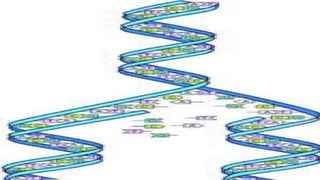
DNA REPLICATION
The HumanGenome Project (HGP) was an international scientific research project with
a primary goal to determine the sequence of chemical base pairs which make up
DNA and to identify and map the approximately 20,000-25,000 genes of the human
genome from both a physical and functional standpoint.
9.
CONT…
The objective ofthe Human Genome Project is to understand the genetic makeup of
the human species, the project also has focused on several other nonhuman organisms
such as E. coli, the fruit fly, and the laboratory mouse. It remains one of the largest
single investigational projects in modern science.
The HGP originally aimed to map the nucleotides contained in a haploid reference
human genome (more than three billion).
There are multiple definitions of the "complete sequence of the human genome".
According to some of these definitions, the genome has already been completely
sequenced, and according to other definitions, the genome has yet to be completely
sequenced.
10.
KEY FINDINGS OFGENOME PROJECT:
1. There are approx. 30,000 genes in human beings, the same range as in mice and
twice that of roundworms. Understanding how these genes express themselves will
provide clues to how diseases are caused.
2. All human races are 99.99 % alike, so racial differences are genetically
insignificant. This could mean all humans are descended from a single original mother.
3. Most genetic mutation occurs in the male of the species and as such are agents of
change. They are also more likely to be responsible for genetic disorders.
4. Genomics has led to advances in genetic archaeology and has improved our
understanding of how we evolved as humans and diverged from apes 25 million
years
11.
HUMAN GENOME PROJECTIS CALLED A MEGA
PROJECT BECAUSE OF THE FOLLOWING FACTS:
1. The human genome has approx. 3.3 x 10⁹ base-pairs; if the cost of sequencing is
US $3 per base-pair, then the approx. cost will be US $10 billion.
2. If the sequence obtained were to be stored in a typed form in books and if each
page contains 1000 letters and each book contains 1000 pages, then 3300 such
books would be needed to store the complete information.
3. The enormous quantity of data expected to be generated also necessitates the use
of high speed computer hard-drives for data storage and super-computers for
retrieval and analysis.
12.
METHODS
The IHGSC usedpair-end sequencing plus whole-genome shotgun mapping of large
(≈100 Kbp) plasmid clones and shotgun sequencing of smaller plasmid sub-clones
plus a variety of other mapping data to orient and check the assembly of each
human chromosome.
The Celera group emphasized the importance of the whole-genome shotgun
― ‖
sequencing method, relying on sequence information to orient and locate their
fragments within the chromosome.
However they used the publicly available data from HGP to assist in the assembly
and orientation process, raising concerns that the Celera sequence was not
independently derived
13.
GENOME DONORS:
In theIHGSC international public-sector Human Genome Project (HGP), researchers
collected blood (female) or sperm (male) samples from a large number of donors.
Only a few of many collected samples were processed as DNA resources.
Thus the donor identities were protected so neither donors nor scientists could know
whose DNA was sequenced.
DNA clones from many different libraries were used in the overall project, with most
of those libraries being created by Dr. Pieter J. de Jong.
It has been informally reported, and is well known in the genomics community, that
much of the DNA for the public HGP came from a single anonymous male donor
14.
BENEFITS
The work oninterpretation of genome data is still in its initial stages.
It is anticipated that detailed knowledge of the human genome will provide new
avenues for advances in medicine and biotechnology.
Clear practical results of the project emerged even before the work was finished. For
example, a number of companies, such as Myriad Genetics started offering easy
ways to administer genetic tests that can show predisposition to a variety of illnesses,
including breast cancer, disorders of hemostasis, cystic fibrosis, liver diseases and
many others.
15.
ADVANTAGES OF HUMANGENOME PROJECT
1. Knowledge of the effects of variation of DNA among individuals can revolutionize
the ways to diagnose, treat and even prevent a number of diseases that affects the
human beings.
2. It provides clues to the understanding of human biology.
WHY DO THEHUMAN GENOME PROJECT
Most inherited diseases are rare, but taken together; the more than 3,000 disorders
known to result from single altered genes rob millions of healthy and productive lives.
Today, little can be done to treat, let alone cure, most of these diseases.
But having a gene in hand allows scientists to study its structure and characterize the
molecular alterations, or mutations that result in disease.
Progress in understanding the causes of cancer, for example, has taken a leap forward
by the recent discovery of cancer genes.
The goal of the Human Genome Project is to provide scientists with powerful new tools to
help them clear the research hurdles that now keep them from understanding the
molecular essence of other tragic and devastating illnesses, such as schizophrenia,
alcoholism, Alzheimer's disease, and manic depression.
18.
CONT…
Finally, Human GenomeProject research will help solve one of the greatest mysteries
of life:
How does one fertilized egg "know" to give rise to so many different specialized
cells, such as those making up muscles, brain, heart, eyes, skin, blood, and so on?
For a human being or any organism to develop normally, a specific gene or sets of
genes must be switched on in the right place in the body at exactly the right moment
in development. Information generated by the Human Genome Project will shed light
on how this intimate dance of gene activity is choreographed into the wide variety of
organs and tissues that make up a human being.
19.
SOME TECHNIQUES USEDIN THE GENOME
PROJECT:
Restriction Fragment Length Polymorphisms (RFLPs):
Each restriction enzyme is specific to a certain base sequence (" restriction site")
and will cut DNA at all such sites to produce a number of "restriction
fragments".
No two individuals will have exactly the same base sequence unless they are
identical twins.
Because of this DNA variability, restriction fragments from a given region of an
individual's genome can be separated using gel electrophoresis to reveal a
unique pattern ("fingerprint"). Inheritance of RFLPs can be followed through
families. By using RFLPs scientists are able to construct linkage maps
20.
CONT…
Automated DNA Sequencing:
LloydSmith and Leroy Hood of Caltech developed an automated sequencing process
that is used to speed up the task of DNA sequencing.
The technique makes use of at least four different fluorescent dyes that attach
specifically to adenine, thymine, guanine or cytosine.
Restriction fragments are tagged with dye.
The dyed fragments are passed through a glass tube that is filled with a special
transport gel.
Small DNA fragments move through the gel more rapidly than larger fragments.
21.
CONT…
Polymerase Chain Reaction(PCR):
Using the polymerase chain reaction (PCR), millions of copies of a specific DNA
segment can be made in a test tube. PCR is also an automated process.
Many physical mapping strategies depend on creating an array of linear DNA
overlaps.
Multiple copies of DNA fragments are needed to complete the mapping process. PCR
can be applied for forensic purposes as well.
From a very tiny amount of DNA, the polymerase chain reaction can be used to
produce more copies of the DNA for analysis
22.
BIBLIOGRAPHY
1. ^ Barnhart,Benjamin J. (1989). "DOE Human Genome Program". Human Genome
Quarterly 1: 1.
http://www.ornl.gov/sci/techresources/Human_Genome/publicat/hgn/v1n1/01doehgp.shtm
l. Retrieved 2005-02-03.
2. ^ DeLisi, Charles (2001). "Genomes: 15 Years Later A Perspective by Charles DeLisi, HGP
Pioneer". Human Genome News 11: 3–4.
http://genome.gsc.riken.go.jp/hgmis/publicat/hgn/v11n3/05delisi.html. Retrieved 2005-02-
03.
3. ^ "White House Press Release".
http://www.ornl.gov/sci/techresources/Human_Genome/project/clinton1.shtml. Retrieved on
2006-07-22. 5. ^ "BBC NEWS". http://news.bbc.co.uk/1/hi/sci/tech/2940601.stm.
Retrieved on 2006-07-22. 6. ^ "Guardian Unlimited".
http://www.guardian.co.uk/uklatest/story/0,,-5829253,00.html. Retrieved on 2006-07-22.






![Human genome project [autosaved]](https://cdn.slidesharecdn.com/ss_thumbnails/humangenomeprojectautosaved-210929062307-thumbnail.jpg?width=640&height=640&fit=bounds)


![Genetic counselling.pptx [M.Sc Nursing I y]](https://cdn.slidesharecdn.com/ss_thumbnails/geneticcounselling-250311060616-f1112afb-thumbnail.jpg?width=640&height=640&fit=bounds)


![Chromosomes.pptx(Nursing) M.Sc [ Advance health Nurisng]](https://cdn.slidesharecdn.com/ss_thumbnails/chromosomes-250311055126-ad865c01-thumbnail.jpg?width=640&height=640&fit=bounds)


![NURSING CARE PLAN.doc [PSYCHATRIC PATIENT]](https://cdn.slidesharecdn.com/ss_thumbnails/nursingcareplan-250325094815-f3ace806-thumbnail.jpg?width=640&height=640&fit=bounds)


![nursing care plan.docx [MHN] PSYCHATRIC PATIENT](https://cdn.slidesharecdn.com/ss_thumbnails/nursingcareplan-250325094427-b1d61f11-thumbnail.jpg?width=640&height=640&fit=bounds)
![process 2.docx (FORMAT )[MENTAL HEALTH NURISNG ASSIGNMENT]](https://cdn.slidesharecdn.com/ss_thumbnails/process2-250325092750-d08f0852-thumbnail.jpg?width=640&height=640&fit=bounds)


![Hypothalamus short notes on location, function and disorders by Dr. Neha [PT]...](https://cdn.slidesharecdn.com/ss_thumbnails/hypothalamusbydr-260124142231-2b48143d-thumbnail.jpg?width=640&height=640&fit=bounds)


