INTRODUCTION
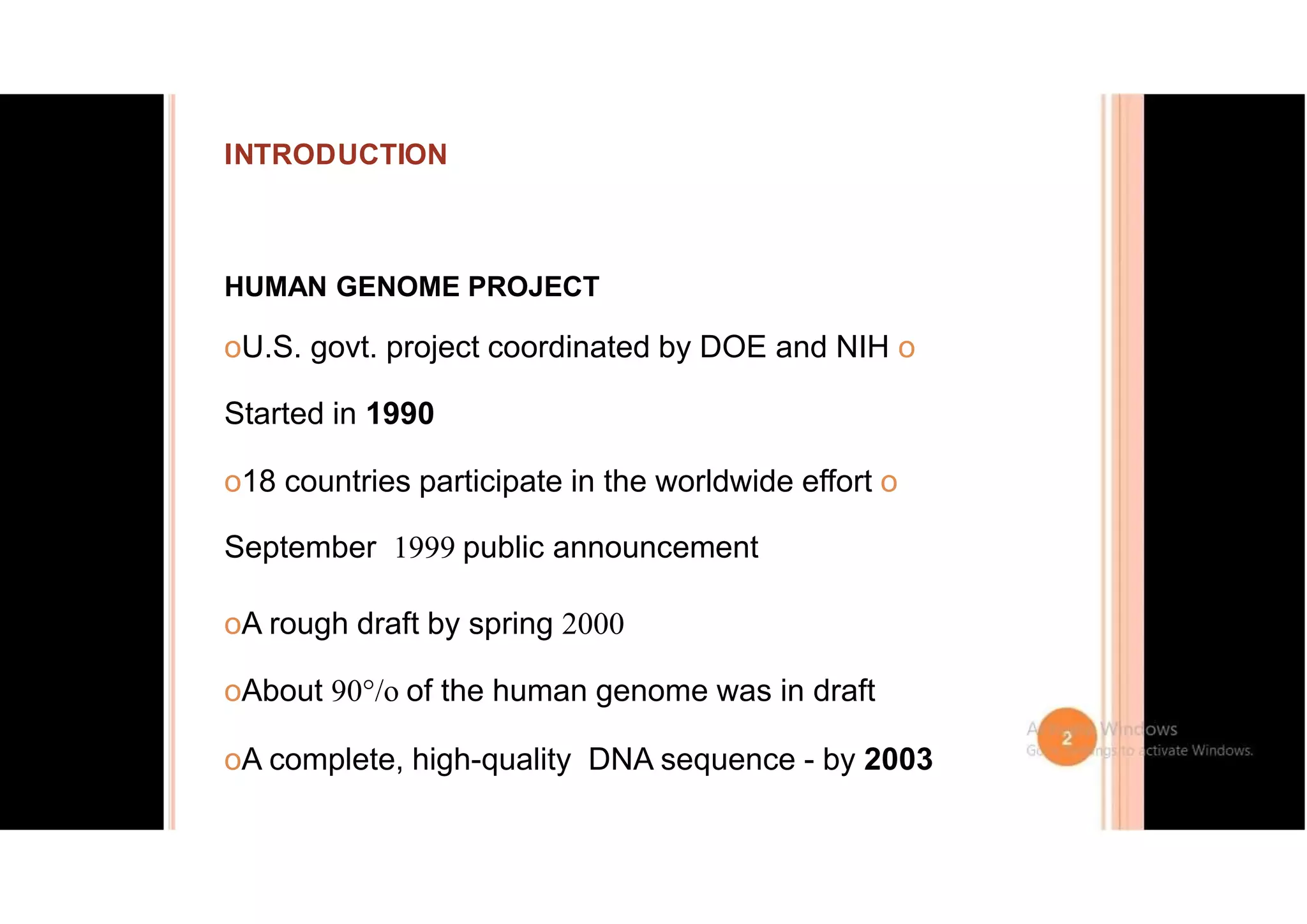
HUMAN GENOME PROJECT
oU.S. govt. project coordinated by DOE and NIH o
Started in 1990
o18 countries participate in the worldwide effort o
September 1999 public announcement
oA rough draft by spring 2000
oAbout 90°/o of the human genome was in draft
oA complete, high-quality DNA sequence - by 2003
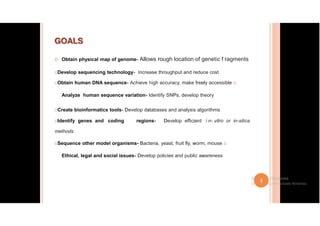
o Obtain physical map of genome- Allows rough location of genetic f ragments
oDevelop sequencing technology- Increase throughput and reduce cost
oObtain human DNA sequence- Achieve high accuracy, make freely accessible o
Analyze human sequence variation- Identify SNPs, develop theory
oCreate bioinformatics tools- Develop databases and analysis algorithms
oIdentify genes and coding regions- Develop efficient i n- vitro or in-silica
methods
oSequence other model organisms- Bacteria, yeast, fruit fly, worm, mouse o
Ethical, legal and social issues- Develop policies and public awareness
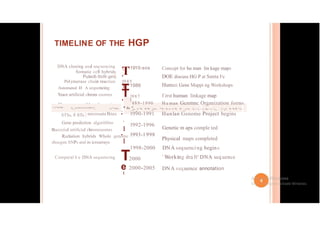
TIMELINE OF THE HGP
T
I 1910-sos
•
19 85
T
I 1986
T1987
Automated D A sequencing
Yeast artificial chrom osomes
Fluorescence i11 sm1 mapping
• I
89-1990
9 Hu man Gcnmnc Organization forms
..··
-·-..
.. -·
- ·
-·
·
·
-..
-- ··- ·
-- -·
- ·
- ..·
-·
- ·-·- ·- ·
-- ·
- -.. -·
..- ·
-·
·
-·
-·-
. microsate llites • 1990-1991 Hun1an Genome Project begins
Gene prediction algoritllins '
Bacccrial artificial chromosomes I
Radiation hybrids Whole genome
shocgun SNPs and m icroarrays
1992-1996
Genetic m aps comple ted
Physical maps completed
• 1993-1998
I
1998-2000 DNA sequencing begins
' Working draft' DNA sequence
Comparal h c DNA sequencing T2000
e 2000-2005
I
DNA sequence annotation
DNA cloning and sequencing
Somatic cell hybrids
Pulscll-tlcltl gels
Polymerase chain reaction
Concept for hu man lin kage maps
DOE discuss HG P at Santa Fe
Human Gene Mappi ng Workshops
f irst human linkage map
·-··-··--
· ·
-..--·
----·
-·-·
-·-·
.. -··-·
·-
STSs, F.STs
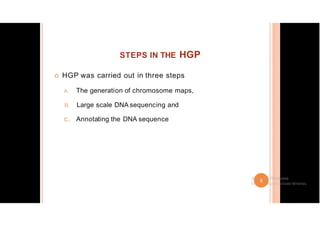
STEPS IN THE HGP
o HGP was carried out in three steps
A. The generation of chromosome maps,
B. Large scale DNA sequencing and
c. Annotating the DNA sequence
A. CHROMOSOME MAPS
Types of chromosome maps:
1. Physical maps
2. Genetic maps
1. PHYSICAL MAPPING
o It uses a variety of methods
o assign genes and DNA
markers locations along a
chromosome,
o so the actual distances
between
to particular
the genes
(measured in nucleotide base pairs) are known
•
2. GENETIC MAPPING
o The arrangement of genes based on the
relationship of their linkage
oDNA markers or probes can
also be used in the construction of
genetic Maps
oif they detect sequence changes (polymorphism)
among different individuals
8. DNA SEQUENCING
1. cDNA Sequencing
2. Systematic Mapping and DNA Sequencing of
Human Chromosomes
3. Whole Genome Shotgun
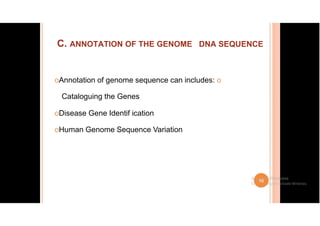
C. ANNOTATION OF THE GENOME DNA SEQUENCE
oAnnotation of genome sequence can includes: o
Cataloguing the Genes
oDisease Gene Identif ication
oHuman Genome Sequence Variation
APPL ICATIONS OF HUMAN GENOME
PROJECT
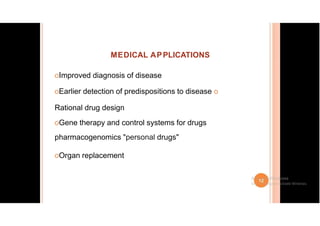
MEDICAL APPLICATIONS
oImproved diagnosis of disease
oEarlier detection of predispositions to disease o
Rational drug design
oGene therapy and control systems for drugs
pharmacogenomics "personal drugs"
oOrgan replacement
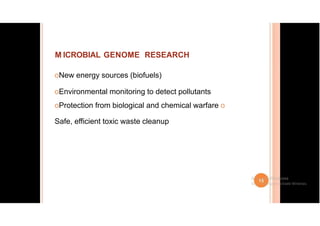
M ICROBIAL GENOME RESEARCH
oNew energy sources (biofuels)
oEnvironmental monitoring to detect pollutants
oProtection from biological and chemical warfare o
Safe, efficient toxic waste cleanup
DNA FORENSICS
oIdentify potential suspects at crime scenes o
Exonerate wrongly accused persons
oEstablish paternity and other family relations
oIdentify endangered and protected species as an
aid to wildlife off icial
AGRICULTURE AND LIVESTOCK
o Disease, insect and drought-resistant crops
o Healthier, more productive, disease-resistant farm
animals
o More nutritious produce o Biopesticides
o Edible vaccines incorporated into food products
asd.ppt

asd.ppt

  • 1.
    INTRODUCTION HUMAN GENOME PROJECT oU.S.govt. project coordinated by DOE and NIH o Started in 1990 o18 countries participate in the worldwide effort o September 1999 public announcement oA rough draft by spring 2000 oAbout 90°/o of the human genome was in draft oA complete, high-quality DNA sequence - by 2003
  • 2.
    o Obtain physicalmap of genome- Allows rough location of genetic f ragments oDevelop sequencing technology- Increase throughput and reduce cost oObtain human DNA sequence- Achieve high accuracy, make freely accessible o Analyze human sequence variation- Identify SNPs, develop theory oCreate bioinformatics tools- Develop databases and analysis algorithms oIdentify genes and coding regions- Develop efficient i n- vitro or in-silica methods oSequence other model organisms- Bacteria, yeast, fruit fly, worm, mouse o Ethical, legal and social issues- Develop policies and public awareness
  • 3.
    TIMELINE OF THEHGP T I 1910-sos • 19 85 T I 1986 T1987 Automated D A sequencing Yeast artificial chrom osomes Fluorescence i11 sm1 mapping • I 89-1990 9 Hu man Gcnmnc Organization forms ..·· -·-.. .. -· - · -· · · -.. -- ··- · -- -· - · - ..· -· - ·-·- ·- · -- · - -.. -· ..- · -· · -· -·- . microsate llites • 1990-1991 Hun1an Genome Project begins Gene prediction algoritllins ' Bacccrial artificial chromosomes I Radiation hybrids Whole genome shocgun SNPs and m icroarrays 1992-1996 Genetic m aps comple ted Physical maps completed • 1993-1998 I 1998-2000 DNA sequencing begins ' Working draft' DNA sequence Comparal h c DNA sequencing T2000 e 2000-2005 I DNA sequence annotation DNA cloning and sequencing Somatic cell hybrids Pulscll-tlcltl gels Polymerase chain reaction Concept for hu man lin kage maps DOE discuss HG P at Santa Fe Human Gene Mappi ng Workshops f irst human linkage map ·-··-··-- · · -..--· ----· -·-· -·-· .. -··-· ·- STSs, F.STs
  • 4.
    STEPS IN THEHGP o HGP was carried out in three steps A. The generation of chromosome maps, B. Large scale DNA sequencing and c. Annotating the DNA sequence
  • 5.
    A. CHROMOSOME MAPS Typesof chromosome maps: 1. Physical maps 2. Genetic maps
  • 6.
    1. PHYSICAL MAPPING oIt uses a variety of methods o assign genes and DNA markers locations along a chromosome, o so the actual distances between to particular the genes (measured in nucleotide base pairs) are known •
  • 7.
    2. GENETIC MAPPING oThe arrangement of genes based on the relationship of their linkage oDNA markers or probes can also be used in the construction of genetic Maps oif they detect sequence changes (polymorphism) among different individuals
  • 8.
    8. DNA SEQUENCING 1.cDNA Sequencing 2. Systematic Mapping and DNA Sequencing of Human Chromosomes 3. Whole Genome Shotgun
  • 9.
    C. ANNOTATION OFTHE GENOME DNA SEQUENCE oAnnotation of genome sequence can includes: o Cataloguing the Genes oDisease Gene Identif ication oHuman Genome Sequence Variation
  • 10.
    APPL ICATIONS OFHUMAN GENOME PROJECT
  • 11.
    MEDICAL APPLICATIONS oImproved diagnosisof disease oEarlier detection of predispositions to disease o Rational drug design oGene therapy and control systems for drugs pharmacogenomics "personal drugs" oOrgan replacement
  • 12.
    M ICROBIAL GENOMERESEARCH oNew energy sources (biofuels) oEnvironmental monitoring to detect pollutants oProtection from biological and chemical warfare o Safe, efficient toxic waste cleanup
  • 13.
    DNA FORENSICS oIdentify potentialsuspects at crime scenes o Exonerate wrongly accused persons oEstablish paternity and other family relations oIdentify endangered and protected species as an aid to wildlife off icial
  • 14.
    AGRICULTURE AND LIVESTOCK oDisease, insect and drought-resistant crops o Healthier, more productive, disease-resistant farm animals o More nutritious produce o Biopesticides o Edible vaccines incorporated into food products