HGP
HUMAN
GENOME
PROJECT….
HUMAN GENOME PROJECT
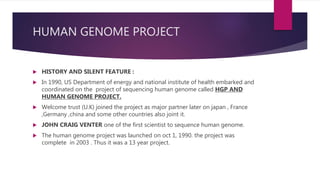
 HISTORY AND SILENT FEATURE :
 In 1990, US Department of energy and national institute of health embarked and
coordinated on the project of sequencing human genome called HGP AND
HUMAN GENOME PROJECT.
 Welcome trust (U.K) joined the project as major partner later on japan , France
,Germany ,china and some other countries also joint it.
 JOHN CRAIG VENTER one of the first scientist to sequence human genome.
 The human genome project was launched on oct 1, 1990. the project was
complete in 2003 . Thus it was a 13 year project.
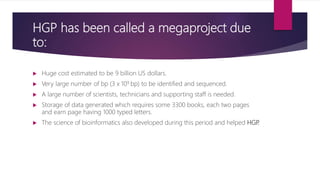
HGP has been called a megaproject due
to:
 Huge cost estimated to be 9 billion US dollars.
 Very large number of bp (3 x 10⁹ bp) to be identified and sequenced.
 A large number of scientists, technicians and supporting staff is needed.
 Storage of data generated which requires some 3300 books, each two pages
and earn page having 1000 typed letters.
 The science of bioinformatics also developed during this period and helped HGP.
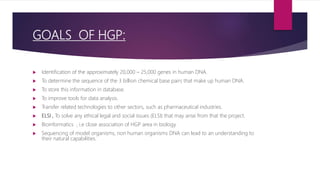
GOALS OF HGP:
 Identification of the approximately 20,000 – 25,000 genes in human DNA.
 To determine the sequence of the 3 billion chemical base pairs that make up human DNA.
 To store this information in database.
 To improve tools for data analysis.
 Transfer related technologies to other sectors, such as pharmaceutical industries.
 ELSI , To solve any ethical legal and social issues (ELSI) that may arise from that the project.
 Bioinformatics , i.e close association of HGP area in biology.
 Sequencing of model organisms, non human organisms DNA can lead to an understanding to
their natural capabilities.
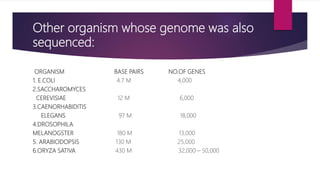
Other organism whose genome was also
sequenced:
ORGANISM BASE PAIRS NO.OF GENES
1. E.COLI 4.7 M 4,000
2.SACCHAROMYCES
CEREVISIAE 12 M 6,000
3.CAENORHABIDITIS
ELEGANS 97 M 18,000
4.DROSOPHILA
MELANOGSTER 180 M 13,000
5. ARABIODOPSIS 130 M 25,000
6.ORYZA SATIVA 430 M 32,000 – 50,000
METHODOGIES:
 There are two approaches foe sequencing human genome:
1. Expressed sequence tags (ESTs)
2. Sequence annotation (or define)
 The whole DNA h the cell is isolated and broken randomly into fragments.
 They are inserted into specialized vectors like BAC ( bacterial artificial
chromosome) and YAC (yeast artificial chromosome).
 The fragment are closed in suitable hosts like bacterial and yeast.
 The PCR (polymerase chain reaction) can also be used for cloning or making
copies of DNA fragments .
In HGP, sequence annotation has been
carried out which involves following
steps:
 The fragment are sequenced as annotated DNA sequence (as shown of methodology)
developed by double novel LAUREATE FRIEDRICK SANGER.
 The sequence were then arranged on the basis of some overlapping regions . It
necessitated the generation of overlapping fragments for sequencing.
 Computer based programming were used to align the sequences.
 The sequence were than annotated and assigned to different chromosome . All the
human chromosome have been sequenced , 22 autosome X and Y.
 With the help of polymorphism In microsatellite and restriction endonuclease
recognition sites , the genetic and physical maps of the genome have also prepared.
Salient features of HGP:
 The human genome contains 3164.7 million nucleotide bases.
 The average gene consist of 3000 bases, but size vary greatly with the largest
known human gene being dystrophin at 2.4 million bases.
 The total number of genes is estimates of 80,000 to 1,40,000 genes. Almost all
(99.9 percent) nucleotide bases are exactly the same in all people.
 The functions are unknown for over 50 percent of discovered genes.
 Less than 2 percent of the genome codes for proteins.
 Repeated sequences make up very large portion of the human genome.
 Repetitive sequences that are respected stretches of DNA sequences that are
thought to have no direct coding functions, but they shed light on chromosome
structure , dynamics and evolution.
 Chromosome 1 has most genes (2968) and Y Has the fewest (231).
 Scientist have identified about 1.4 million locations where single base DNA
differences (SNPs single nucleotide polymorphism) pronounced as ‘snips’ ) occur
in humans this information promises to revolutionise the processes of finding
chromosomal for diseases light on chromosome structure associated sequence
and tracing human history.
Application and future challenges:
1. DISORDERS – More than 1200 genes are responsible for commom human
cardiovascular diseases, endocrine disesases (like diabetes) neurological
disorders (like Alzheimer’s) diseases cancers and many more.
2. CANCER – efforts are in progress to determine genes that will change cancerous
cells to normal.
3. HEALTHCASE- it will indicate prospects for a healthier living, designer drugs ,
genetically modified diets and finally our genetic identify.
4. INTERACTIONS- It will be possible to study how various genes and proteins work
together in an interconnected network.
5. Study of tissues- all the genes or transcripts in a particular tissue , organ or
Tumor can be analysed to known the cause of effect produced in it.
6. NON HUMAN ORGANISMS- used I meeting challenges in health care ,
agriculture energy production and environmental remediation.
THANKYOU…
PRESENTED BY ANSHIKA CHAUHAN

Hgp

  • 1.
  • 2.
    HUMAN GENOME PROJECT HISTORY AND SILENT FEATURE :  In 1990, US Department of energy and national institute of health embarked and coordinated on the project of sequencing human genome called HGP AND HUMAN GENOME PROJECT.  Welcome trust (U.K) joined the project as major partner later on japan , France ,Germany ,china and some other countries also joint it.  JOHN CRAIG VENTER one of the first scientist to sequence human genome.  The human genome project was launched on oct 1, 1990. the project was complete in 2003 . Thus it was a 13 year project.
  • 3.
    HGP has beencalled a megaproject due to:  Huge cost estimated to be 9 billion US dollars.  Very large number of bp (3 x 10⁹ bp) to be identified and sequenced.  A large number of scientists, technicians and supporting staff is needed.  Storage of data generated which requires some 3300 books, each two pages and earn page having 1000 typed letters.  The science of bioinformatics also developed during this period and helped HGP.
  • 4.
    GOALS OF HGP: Identification of the approximately 20,000 – 25,000 genes in human DNA.  To determine the sequence of the 3 billion chemical base pairs that make up human DNA.  To store this information in database.  To improve tools for data analysis.  Transfer related technologies to other sectors, such as pharmaceutical industries.  ELSI , To solve any ethical legal and social issues (ELSI) that may arise from that the project.  Bioinformatics , i.e close association of HGP area in biology.  Sequencing of model organisms, non human organisms DNA can lead to an understanding to their natural capabilities.
  • 5.
    Other organism whosegenome was also sequenced: ORGANISM BASE PAIRS NO.OF GENES 1. E.COLI 4.7 M 4,000 2.SACCHAROMYCES CEREVISIAE 12 M 6,000 3.CAENORHABIDITIS ELEGANS 97 M 18,000 4.DROSOPHILA MELANOGSTER 180 M 13,000 5. ARABIODOPSIS 130 M 25,000 6.ORYZA SATIVA 430 M 32,000 – 50,000
  • 6.
    METHODOGIES:  There aretwo approaches foe sequencing human genome: 1. Expressed sequence tags (ESTs) 2. Sequence annotation (or define)  The whole DNA h the cell is isolated and broken randomly into fragments.  They are inserted into specialized vectors like BAC ( bacterial artificial chromosome) and YAC (yeast artificial chromosome).  The fragment are closed in suitable hosts like bacterial and yeast.  The PCR (polymerase chain reaction) can also be used for cloning or making copies of DNA fragments .
  • 7.
    In HGP, sequenceannotation has been carried out which involves following steps:  The fragment are sequenced as annotated DNA sequence (as shown of methodology) developed by double novel LAUREATE FRIEDRICK SANGER.  The sequence were then arranged on the basis of some overlapping regions . It necessitated the generation of overlapping fragments for sequencing.  Computer based programming were used to align the sequences.  The sequence were than annotated and assigned to different chromosome . All the human chromosome have been sequenced , 22 autosome X and Y.  With the help of polymorphism In microsatellite and restriction endonuclease recognition sites , the genetic and physical maps of the genome have also prepared.
  • 8.
    Salient features ofHGP:  The human genome contains 3164.7 million nucleotide bases.  The average gene consist of 3000 bases, but size vary greatly with the largest known human gene being dystrophin at 2.4 million bases.  The total number of genes is estimates of 80,000 to 1,40,000 genes. Almost all (99.9 percent) nucleotide bases are exactly the same in all people.  The functions are unknown for over 50 percent of discovered genes.  Less than 2 percent of the genome codes for proteins.  Repeated sequences make up very large portion of the human genome.
  • 9.
     Repetitive sequencesthat are respected stretches of DNA sequences that are thought to have no direct coding functions, but they shed light on chromosome structure , dynamics and evolution.  Chromosome 1 has most genes (2968) and Y Has the fewest (231).  Scientist have identified about 1.4 million locations where single base DNA differences (SNPs single nucleotide polymorphism) pronounced as ‘snips’ ) occur in humans this information promises to revolutionise the processes of finding chromosomal for diseases light on chromosome structure associated sequence and tracing human history.
  • 10.
    Application and futurechallenges: 1. DISORDERS – More than 1200 genes are responsible for commom human cardiovascular diseases, endocrine disesases (like diabetes) neurological disorders (like Alzheimer’s) diseases cancers and many more. 2. CANCER – efforts are in progress to determine genes that will change cancerous cells to normal. 3. HEALTHCASE- it will indicate prospects for a healthier living, designer drugs , genetically modified diets and finally our genetic identify. 4. INTERACTIONS- It will be possible to study how various genes and proteins work together in an interconnected network. 5. Study of tissues- all the genes or transcripts in a particular tissue , organ or Tumor can be analysed to known the cause of effect produced in it. 6. NON HUMAN ORGANISMS- used I meeting challenges in health care , agriculture energy production and environmental remediation.
  • 11.