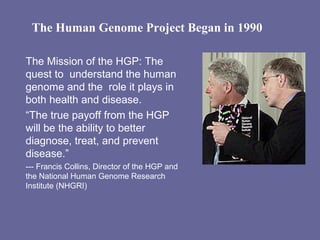
The Human Genome Project Began in 1990
The Mission of the HGP: The
quest to understand the human
genome and the role it plays in
both health and disease.
“The true payoff from the HGP
will be the ability to better
diagnose, treat, and prevent
disease.”
--- Francis Collins, Director of the HGP and
the National Human Genome Research
Institute (NHGRI)
What is the Human Genome
Project?
- U.S. govt. project coordinated by the Department of Energy and the National
Institutes of Health, launched in 1986 by Charles DeLisi.
Definition: GENOME – the whole hereditary information of an organism that is encoded
in the DNA.
- Aims of the project:
– Identify sequence of bases on all 23 human chromosomes (3 billion bases)
– Identify genes within those sequences (~30 000 genes)
– Locate the position of the genes on the chromosomes
• $6 billion dollars, 1000 scientists, 50 countries, completed 2000!
• Only ~3% of genome codes for protein
– Remainder is regulatory or of unknown function (junk) e.g repetitive sequence,
possibly viral DNA
- store this information in databases.
- develop tools for data analysis.
- address the ethical, legal, and social issues that arise from genome research.
Whose genome is being
sequenced?
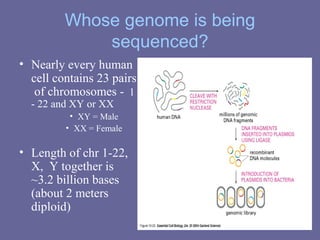
• Nearly every human
cell contains 23 pairs
of chromosomes - 1
- 22 and XY or XX
• XY = Male
• XX = Female
• Length of chr 1-22,
X, Y together is
~3.2 billion bases
(about 2 meters
diploid)
THE BEGINNING OF THE PROJECT
Most the first 10 years of the project were spent
improving the technology to sequence and analyze
DNA.
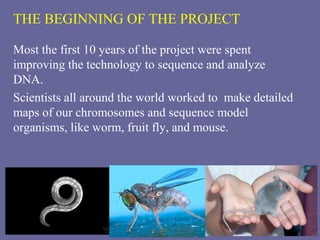
Scientists all around the world worked to make detailed
maps of our chromosomes and sequence model
organisms, like worm, fruit fly, and mouse.
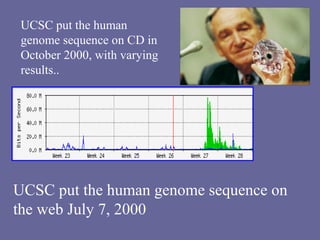
UCSC put the human
genome sequence on CD in
October 2000, with varying
results..
UCSC put the human genome sequence on
the web July 7, 2000
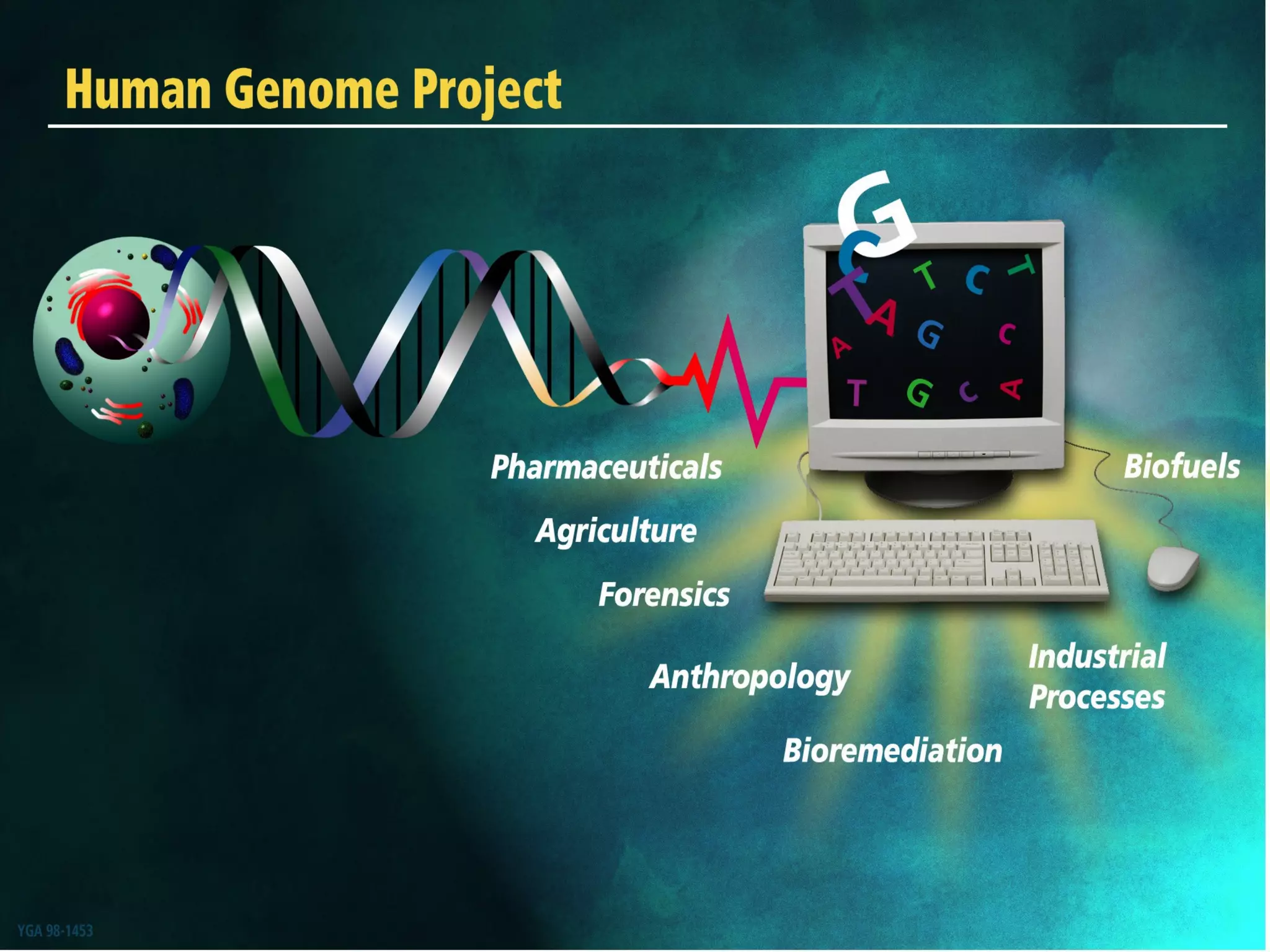
Benefits of Human Genome Project
research
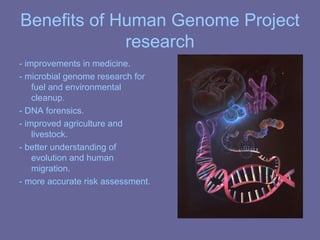
- improvements in medicine.
- microbial genome research for
fuel and environmental
cleanup.
- DNA forensics.
- improved agriculture and
livestock.
- better understanding of
evolution and human
migration.
- more accurate risk assessment.
How is each area benefited specifically
by the Human Genome Project?
- Improvements in medicine:
improved diagnosis of disease.
- Microbial research: new
energy sources, bio fuels.
- DNA forensics: identifying
potential suspects at a crime
scene.
- Agriculture: more nutritious
produce.
- Evolution and human
migration: study migration of
different population groups
based on female genetic
inheritance.
- Risk assessment: reduce the
likelihood of heritable
mutations.
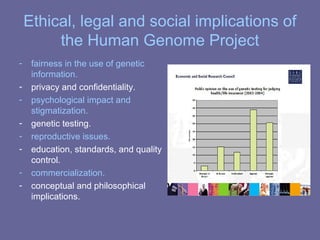
Ethical, legal and social implications of
the Human Genome Project
- fairness in the use of genetic
information.
- privacy and confidentiality.
- psychological impact and
stigmatization.
- genetic testing.
- reproductive issues.
- education, standards, and quality
control.
- commercialization.
- conceptual and philosophical
implications.
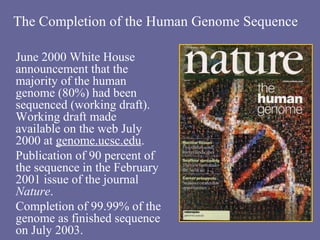
The Completion of the Human Genome Sequence
June 2000 White House
announcement that the
majority of the human
genome (80%) had been
sequenced (working draft).
Working draft made
available on the web July
2000 at genome.ucsc.edu.
Publication of 90 percent of
the sequence in the February
2001 issue of the journal
Nature.
Completion of 99.99% of the
genome as finished sequence
on July 2003.

The human genome project

  • 2.
    The Human GenomeProject Began in 1990 The Mission of the HGP: The quest to understand the human genome and the role it plays in both health and disease. “The true payoff from the HGP will be the ability to better diagnose, treat, and prevent disease.” --- Francis Collins, Director of the HGP and the National Human Genome Research Institute (NHGRI)
  • 3.
    What is theHuman Genome Project? - U.S. govt. project coordinated by the Department of Energy and the National Institutes of Health, launched in 1986 by Charles DeLisi. Definition: GENOME – the whole hereditary information of an organism that is encoded in the DNA. - Aims of the project: – Identify sequence of bases on all 23 human chromosomes (3 billion bases) – Identify genes within those sequences (~30 000 genes) – Locate the position of the genes on the chromosomes • $6 billion dollars, 1000 scientists, 50 countries, completed 2000! • Only ~3% of genome codes for protein – Remainder is regulatory or of unknown function (junk) e.g repetitive sequence, possibly viral DNA - store this information in databases. - develop tools for data analysis. - address the ethical, legal, and social issues that arise from genome research.
  • 4.
    Whose genome isbeing sequenced? • Nearly every human cell contains 23 pairs of chromosomes - 1 - 22 and XY or XX • XY = Male • XX = Female • Length of chr 1-22, X, Y together is ~3.2 billion bases (about 2 meters diploid)
  • 5.
    THE BEGINNING OFTHE PROJECT Most the first 10 years of the project were spent improving the technology to sequence and analyze DNA. Scientists all around the world worked to make detailed maps of our chromosomes and sequence model organisms, like worm, fruit fly, and mouse.
  • 6.
    UCSC put thehuman genome sequence on CD in October 2000, with varying results.. UCSC put the human genome sequence on the web July 7, 2000
  • 7.
    Benefits of HumanGenome Project research - improvements in medicine. - microbial genome research for fuel and environmental cleanup. - DNA forensics. - improved agriculture and livestock. - better understanding of evolution and human migration. - more accurate risk assessment.
  • 8.
    How is eacharea benefited specifically by the Human Genome Project? - Improvements in medicine: improved diagnosis of disease. - Microbial research: new energy sources, bio fuels. - DNA forensics: identifying potential suspects at a crime scene. - Agriculture: more nutritious produce. - Evolution and human migration: study migration of different population groups based on female genetic inheritance. - Risk assessment: reduce the likelihood of heritable mutations.
  • 9.
    Ethical, legal andsocial implications of the Human Genome Project - fairness in the use of genetic information. - privacy and confidentiality. - psychological impact and stigmatization. - genetic testing. - reproductive issues. - education, standards, and quality control. - commercialization. - conceptual and philosophical implications.
  • 10.
    The Completion ofthe Human Genome Sequence June 2000 White House announcement that the majority of the human genome (80%) had been sequenced (working draft). Working draft made available on the web July 2000 at genome.ucsc.edu. Publication of 90 percent of the sequence in the February 2001 issue of the journal Nature. Completion of 99.99% of the genome as finished sequence on July 2003.