
WHAT IS HUMAN DEVELOPMENT INDEX?
• It is a tool used to measure country’s overall achievement in its social and economic
dimensions.
• It is a composite statistic of life expectancy, education and per capital income
indicators which are used to rank countries.
• It is also implies whether a country is developed, developing, or underdeveloped.
• The (HDI) is a number from 0 to 1 (higher is better) used to compare different countries.
HISTORY OF HUMAN DEVELOPMENT INDEX
• The concept of human development was introduced by Pakistani economist Dr.
Mahbub-ul-Haq in 1990
• Amartya Sen and Mahbub–ul-Haq worked upon the capabilities and functioning
which provided conceptual framework
• Published by United Nations Development Programme (UNDP).
• Dr. Haq has described human development as development that enlarges
people’s choices and improves theirlives.
HOW THE UNDP MEASURES HUMAN DEVELOPMENT
The HDI consists of three equally weighted components:
1. “A long and healthy life” (Health)
2. “Knowledge” (Education)
3. “A decent standard of living” (Wealth)
LIFE EXPECTANCY INDEX (HEALTH)
• The life expectancy factor helps to determine
 How long the average citizen lives?
 How healthy he/she can remain during his/her life?
 How he/she can contribute in his/her working life?
• The HDI measures life expectancy from 25 to 85 years.
• Countries with longer life expectancy receive higher HDI scores than those in which people die
at younger age.
• For example;
There is a country “XYZ” the life expectancy ate birth is 70 years. Then life expectancy index will be:
70−20
85−20
= 0.77
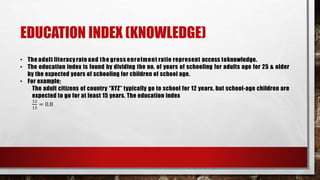
EDUCATION INDEX (KNOWLEDGE)
• The adult literacyrate and the gross enrolment ratio represent access toknowledge.
• The education index is found by dividing the no. of years of schooling for adults age for 25 & older
by the expected years of schooling for children of school age.
• For example;
The adult citizens of country “XYZ” typically go to school for 12 years, but school-age children are
expected to go for at least 15 years. The education index
12
15
= 0.8
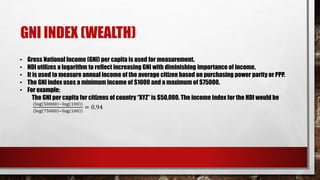
GNI INDEX (WEALTH)
• Gross National Income (GNI) per capita is used for measurement.
• HDI utilizes a logarithm to reflect increasing GNI with diminishing importance of income.
• It is used to measure annual income of the average citizen based on purchasing power parity or PPP.
• The GNI index uses a minimum income of $1000 and a maximum of $75000.
• For example;
The GNI per capita for citizens of country “XYZ” is $50,000. The income index for the HDI would be
(log 50000 −log 100 )
(log 75000 −log 100 )
= 0.94
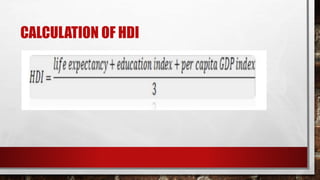
CALCULATION OF HDI
FACTOR CONSIDERED FOR HDI
• FAFA
HDI REPORT
• The Human Development Report (HDR) is an annual milestone published by the Human
Development Report Office of the United Nations Development Programme (UNDP).
• As of 2013 the last decade saw convergence in human development indicators (HDI)
values globally, although progress was uneven within and between regions.
HDI ACCORDING TO PAKISTAN
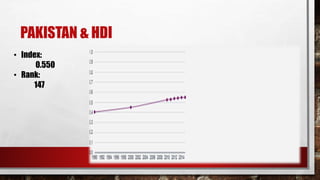
PAKISTAN & HDI
• Index:
0.550
• Rank:
147
(CONTD…)
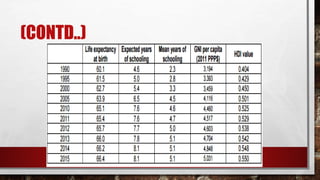
• Pakistan's HDI value for 2015 is 0.550
• Which put the country in the medium human development category—positioning
it at 147 out of 188 countries and territories.
• Between 1990 and 2015,
Pakistan's HDI value increased from 0.404 to 0.550, an increase of 36.2
percent.
(CONTD..)
WHY PAKISTAN IS LOW ON HUMAN
DEVELOPMENT?
(CONTD…)
1) The demand pull from peoples and communities at the local level is neither well organized through
community organisation, nor is it strong enough to get the bureaucracy at the district level and the
political bosses at provincial and federal levels sensitive to basic human needs.
2) The second important reason is lack of accountability of the bureaucracy at the district and higher levels
in every field that is used for measurement for the human development index, like education, health and
other services
3) The areas that are the core of human development — education and health — have poor political and
administrative leadership both at the higher level as well as at the local institutional level
INEQUALITY-ADJUSTED HDI (IHDI)
• The HDI is an average measure of basic human development achievements in a country.
• Like all averages, the HDI masks inequality in the distribution of human development across the
population at the country level.
• Pakistan’s HDI for 2012 is 0.515.
• However, when the value is discounted for inequality, the HDI falls to 0.356, a loss of 30.9 percent due to
inequality in the distribution of the dimension indices.
• India and Bangladesh, show losses due to inequality of 29.3 percent and 27.4 percent respectively.
• The average loss due to inequality for low HDI countries is 33.5 percent and for South Asia it is 29.1
percent.
GENDER DEVELOPMENT INDEX (GDI)
• In the 2014 HDR, HDRO introduced a new measure, the GDI, based on the inter-gender
disaggregated Human Development Index, defined as a ratio of the female to the male
HDI.
• The female HDI value for Pakistan is 0.452 in contrast with 0.610 for males, resulting in a
GDI value of 0.742, which places the country into Group 5.
• In comparison, GDI values for Bangladesh and India are 0.927 and 0.819 respectively
GENDER INEQUALITY INDEX (GII)
• The 2010 HDR introduced the GII, which reflects gender-based inequalities in three dimensions –
 Reproductive health -- is measured by maternal mortality and adolescent birth rates
 Empowerment -- is measured by the share of parliamentary seats held by women and attainment in secondary and higher
education by each gender
 Economic activity -- is measured by the labor market participation rate for women and men
• Pakistan has a GII value of 0.567, ranking it 123 out of 148 countries in the 2012 index.
• In Pakistan, 21.1 percent of parliamentary seats are held by women.
• And 18.3 percent of adult women have reached a secondary or higher level of education compared to 43.1
percent of their male counterparts.
• For every 100,000 live births, 260 women die from pregnancy related causes; and the adolescent fertility rate is
28.1 births per 1000 live births.
• Female participation in the labor market is 22.7 percent compared to 83.3 for men.
MULTIDIMENSIONAL POVERTY INDEX (MPI)
• The 2010 HDR introduced the MPI, which identifies multiple overlapping deprivations suffered
by households in 3 dimensions:
 Education
 Health
 Living standards
• The most recent data collected in a survey for estimating MPI in Pakistan were in 2006/2007.
• In Pakistan 49.4 percent of the population lived in multidimensional poverty.
• An additional 11 percent were vulnerable to multiple deprivations.
• The value adjusted in MPI for Pakistan was 0.264.
MEASURES THAT CAN BE TAKEN
• Should be sensitising people and communities about their rights and energise them enough to question the
quality of services at the local level.
• They are supposed to serve the political purposes of their provinces’ bosses more than looking after the
interests of the citizens of the districts.
• Our public representatives and governments expend their energies and resources on physical projects for very
obvious reasons and very little on human development initiatives.
Human development index (HDI)

Human development index (HDI)

  • 2.
    WHAT IS HUMANDEVELOPMENT INDEX? • It is a tool used to measure country’s overall achievement in its social and economic dimensions. • It is a composite statistic of life expectancy, education and per capital income indicators which are used to rank countries. • It is also implies whether a country is developed, developing, or underdeveloped. • The (HDI) is a number from 0 to 1 (higher is better) used to compare different countries.
  • 3.
    HISTORY OF HUMANDEVELOPMENT INDEX • The concept of human development was introduced by Pakistani economist Dr. Mahbub-ul-Haq in 1990 • Amartya Sen and Mahbub–ul-Haq worked upon the capabilities and functioning which provided conceptual framework • Published by United Nations Development Programme (UNDP). • Dr. Haq has described human development as development that enlarges people’s choices and improves theirlives.
  • 4.
    HOW THE UNDPMEASURES HUMAN DEVELOPMENT The HDI consists of three equally weighted components: 1. “A long and healthy life” (Health) 2. “Knowledge” (Education) 3. “A decent standard of living” (Wealth)
  • 5.
    LIFE EXPECTANCY INDEX(HEALTH) • The life expectancy factor helps to determine  How long the average citizen lives?  How healthy he/she can remain during his/her life?  How he/she can contribute in his/her working life? • The HDI measures life expectancy from 25 to 85 years. • Countries with longer life expectancy receive higher HDI scores than those in which people die at younger age. • For example; There is a country “XYZ” the life expectancy ate birth is 70 years. Then life expectancy index will be: 70−20 85−20 = 0.77
  • 6.
    EDUCATION INDEX (KNOWLEDGE) •The adult literacyrate and the gross enrolment ratio represent access toknowledge. • The education index is found by dividing the no. of years of schooling for adults age for 25 & older by the expected years of schooling for children of school age. • For example; The adult citizens of country “XYZ” typically go to school for 12 years, but school-age children are expected to go for at least 15 years. The education index 12 15 = 0.8
  • 7.
    GNI INDEX (WEALTH) •Gross National Income (GNI) per capita is used for measurement. • HDI utilizes a logarithm to reflect increasing GNI with diminishing importance of income. • It is used to measure annual income of the average citizen based on purchasing power parity or PPP. • The GNI index uses a minimum income of $1000 and a maximum of $75000. • For example; The GNI per capita for citizens of country “XYZ” is $50,000. The income index for the HDI would be (log 50000 −log 100 ) (log 75000 −log 100 ) = 0.94
  • 8.
  • 9.
  • 10.
    HDI REPORT • TheHuman Development Report (HDR) is an annual milestone published by the Human Development Report Office of the United Nations Development Programme (UNDP). • As of 2013 the last decade saw convergence in human development indicators (HDI) values globally, although progress was uneven within and between regions.
  • 11.
  • 12.
    PAKISTAN & HDI •Index: 0.550 • Rank: 147
  • 13.
    (CONTD…) • Pakistan's HDIvalue for 2015 is 0.550 • Which put the country in the medium human development category—positioning it at 147 out of 188 countries and territories. • Between 1990 and 2015, Pakistan's HDI value increased from 0.404 to 0.550, an increase of 36.2 percent.
  • 14.
  • 15.
    WHY PAKISTAN ISLOW ON HUMAN DEVELOPMENT?
  • 16.
    (CONTD…) 1) The demandpull from peoples and communities at the local level is neither well organized through community organisation, nor is it strong enough to get the bureaucracy at the district level and the political bosses at provincial and federal levels sensitive to basic human needs. 2) The second important reason is lack of accountability of the bureaucracy at the district and higher levels in every field that is used for measurement for the human development index, like education, health and other services 3) The areas that are the core of human development — education and health — have poor political and administrative leadership both at the higher level as well as at the local institutional level
  • 17.
    INEQUALITY-ADJUSTED HDI (IHDI) •The HDI is an average measure of basic human development achievements in a country. • Like all averages, the HDI masks inequality in the distribution of human development across the population at the country level. • Pakistan’s HDI for 2012 is 0.515. • However, when the value is discounted for inequality, the HDI falls to 0.356, a loss of 30.9 percent due to inequality in the distribution of the dimension indices. • India and Bangladesh, show losses due to inequality of 29.3 percent and 27.4 percent respectively. • The average loss due to inequality for low HDI countries is 33.5 percent and for South Asia it is 29.1 percent.
  • 18.
    GENDER DEVELOPMENT INDEX(GDI) • In the 2014 HDR, HDRO introduced a new measure, the GDI, based on the inter-gender disaggregated Human Development Index, defined as a ratio of the female to the male HDI. • The female HDI value for Pakistan is 0.452 in contrast with 0.610 for males, resulting in a GDI value of 0.742, which places the country into Group 5. • In comparison, GDI values for Bangladesh and India are 0.927 and 0.819 respectively
  • 19.
    GENDER INEQUALITY INDEX(GII) • The 2010 HDR introduced the GII, which reflects gender-based inequalities in three dimensions –  Reproductive health -- is measured by maternal mortality and adolescent birth rates  Empowerment -- is measured by the share of parliamentary seats held by women and attainment in secondary and higher education by each gender  Economic activity -- is measured by the labor market participation rate for women and men • Pakistan has a GII value of 0.567, ranking it 123 out of 148 countries in the 2012 index. • In Pakistan, 21.1 percent of parliamentary seats are held by women. • And 18.3 percent of adult women have reached a secondary or higher level of education compared to 43.1 percent of their male counterparts. • For every 100,000 live births, 260 women die from pregnancy related causes; and the adolescent fertility rate is 28.1 births per 1000 live births. • Female participation in the labor market is 22.7 percent compared to 83.3 for men.
  • 20.
    MULTIDIMENSIONAL POVERTY INDEX(MPI) • The 2010 HDR introduced the MPI, which identifies multiple overlapping deprivations suffered by households in 3 dimensions:  Education  Health  Living standards • The most recent data collected in a survey for estimating MPI in Pakistan were in 2006/2007. • In Pakistan 49.4 percent of the population lived in multidimensional poverty. • An additional 11 percent were vulnerable to multiple deprivations. • The value adjusted in MPI for Pakistan was 0.264.
  • 21.
  • 22.
    • Should besensitising people and communities about their rights and energise them enough to question the quality of services at the local level. • They are supposed to serve the political purposes of their provinces’ bosses more than looking after the interests of the citizens of the districts. • Our public representatives and governments expend their energies and resources on physical projects for very obvious reasons and very little on human development initiatives.