Human Development
Index
Iñaki Goyarzu Rodriguez del Campo
Instituto Tecnológico de Saltillo
Sustainable Development
18/03/18
Human Development Index
“The Human Development Index (HDI) was developed
by the United Nations as a metric to assess the social
and economic development levels of countries. Four
principal areas of examination are used to rank
countries: mean years of schooling, expected years of
schooling, life expectancy at birth and gross national
income per capita” 1(Investopedia, 2016)
Fig. 1 Human Development Index, United Nations Development Program, http://hdr.undp.org/en/content/human-development-index-hdi
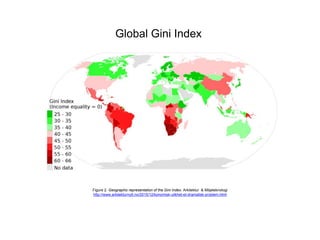
The Gini Index
“The Gini index is a statistical measure of distribution
developed by the Italian statistician Corrado Gini in
1912. It is often used as a gauge of economic
inequality, measuring income distribution or wealth
distribution among a population. The coefficient
ranges from 0 (or 0%) to 1 (or 100%), with 0
representing perfect equality and 1 representing
perfect inequality. Values over 1 are theoretically
possible due to negative income or wealth.”
2(Investopedia, 2016)
Global Gini Index
Figure 2. Geographic representation of the Gini Index. Arkitektur & Miljøteknologi
http://www.arkitekturnytt.no/2015/12/konomisk-ulikhet-et-dramatisk-problem.html
Inequality-adjusted human
development index (IHDI)
“The IHDI combines a country’s average
achievements in health, education and income with
how those achievements are distributed among
country’s population by “discounting” each
dimension’s average value according to its level of
inequality. Thus, the IHDI is distribution-sensitive
average level of HD. Two countries with different
distributions of achievements can have the same
average HDI value. Under perfect equality the IHDI is
equal to the HDI, but falls below the HDI when
inequality rises.” 3 (UN, 2015)
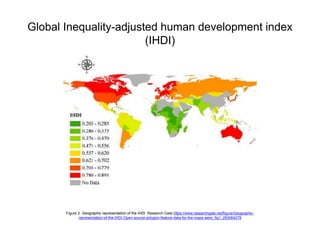
Global Inequality-adjusted human development index
(IHDI)
Figure 3. Geographic representation of the IHDI. Research Gate.https://www.researchgate.net/figure/Geographic-
representation-of-the-IHDI-Open-source-polygon-feature-data-for-the-maps-were_fig1_283064279
Mexico and its HDI
Mexico holds the 77th position in the world in the HDI
(United Nations Development Program, 2015) and
has an index of 0.762
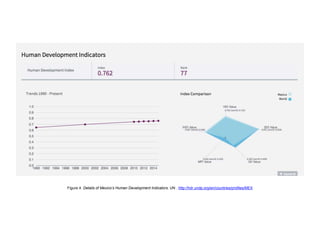
Figure 4. Details of Mexico’s Human Development Indicators. UN . http://hdr.undp.org/en/countries/profiles/MEX
Mexico and its HDI
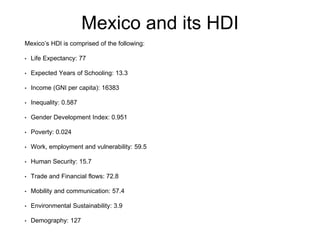
Mexico’s HDI is comprised of the following:
• Life Expectancy: 77
• Expected Years of Schooling: 13.3
• Income (GNI per capita): 16383
• Inequality: 0.587
• Gender Development Index: 0.951
• Poverty: 0.024
• Work, employment and vulnerability: 59.5
• Human Security: 15.7
• Trade and Financial flows: 72.8
• Mobility and communication: 57.4
• Environmental Sustainability: 3.9
• Demography: 127
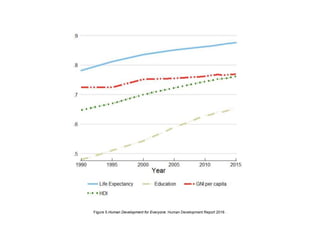
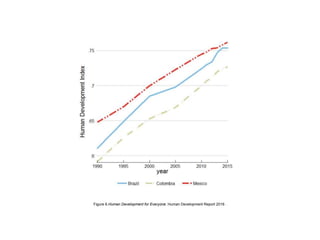
Figure 5.Human Development for Everyone. Human Development Report 2016 .
Mexico and its HDI
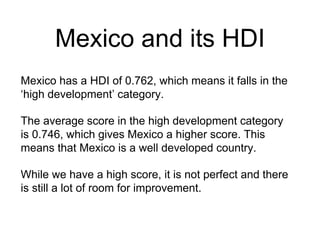
Mexico has a HDI of 0.762, which means it falls in the
‘high development’ category.
The average score in the high development category
is 0.746, which gives Mexico a higher score. This
means that Mexico is a well developed country.
While we have a high score, it is not perfect and there
is still a lot of room for improvement.
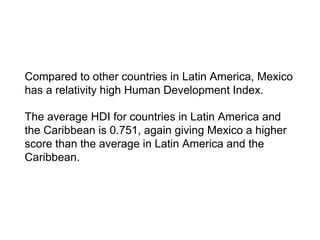
Compared to other countries in Latin America, Mexico
has a relativity high Human Development Index.
The average HDI for countries in Latin America and
the Caribbean is 0.751, again giving Mexico a higher
score than the average in Latin America and the
Caribbean.
Figure 6.Human Development for Everyone. Human Development Report 2016 .
In conclusion, Mexico has a relativity high HDI, which
means that it is a well developed country. However,
there are still many factors which need further
development, to help improve the quality of life for all
citizens. It needs to improve its access to higher
education, inequality, poverty and security in particular
to improve its overall score. It is however strong in
other areas such as healthcare and environmental
sustainability.
Bibliography
1 (N.A.) (2016) Human Development Index. Ivestopedia. Recovered from:
https://www.investopedia.com/terms/h/human-development-index-hdi.asp (18 March 2018)
1 (N.A.) (2016) Gini Index. Ivestopedia. Recovered from: https://www.investopedia.com/terms/g/gini-
index.asp (18 March 2018)
3 (2015) Inequality-adjusted Human Development Index (IHDI). United Nations Development Program.
Recovered from: http://hdr.undp.org/en/content/inequality-adjusted-human-development-index-ihdi (18
March 2018)
(N.A.) (2015) Human Development Reports. United Nations Development Program. Recovered from:
http://hdr.undp.org/en/countries/profiles/MEX (18 March 2018)

Human development index

  • 1.
    Human Development Index Iñaki GoyarzuRodriguez del Campo Instituto Tecnológico de Saltillo Sustainable Development 18/03/18
  • 2.
    Human Development Index “TheHuman Development Index (HDI) was developed by the United Nations as a metric to assess the social and economic development levels of countries. Four principal areas of examination are used to rank countries: mean years of schooling, expected years of schooling, life expectancy at birth and gross national income per capita” 1(Investopedia, 2016)
  • 3.
    Fig. 1 HumanDevelopment Index, United Nations Development Program, http://hdr.undp.org/en/content/human-development-index-hdi
  • 4.
    The Gini Index “TheGini index is a statistical measure of distribution developed by the Italian statistician Corrado Gini in 1912. It is often used as a gauge of economic inequality, measuring income distribution or wealth distribution among a population. The coefficient ranges from 0 (or 0%) to 1 (or 100%), with 0 representing perfect equality and 1 representing perfect inequality. Values over 1 are theoretically possible due to negative income or wealth.” 2(Investopedia, 2016)
  • 5.
    Global Gini Index Figure2. Geographic representation of the Gini Index. Arkitektur & Miljøteknologi http://www.arkitekturnytt.no/2015/12/konomisk-ulikhet-et-dramatisk-problem.html
  • 6.
    Inequality-adjusted human development index(IHDI) “The IHDI combines a country’s average achievements in health, education and income with how those achievements are distributed among country’s population by “discounting” each dimension’s average value according to its level of inequality. Thus, the IHDI is distribution-sensitive average level of HD. Two countries with different distributions of achievements can have the same average HDI value. Under perfect equality the IHDI is equal to the HDI, but falls below the HDI when inequality rises.” 3 (UN, 2015)
  • 7.
    Global Inequality-adjusted humandevelopment index (IHDI) Figure 3. Geographic representation of the IHDI. Research Gate.https://www.researchgate.net/figure/Geographic- representation-of-the-IHDI-Open-source-polygon-feature-data-for-the-maps-were_fig1_283064279
  • 8.
    Mexico and itsHDI Mexico holds the 77th position in the world in the HDI (United Nations Development Program, 2015) and has an index of 0.762
  • 9.
    Figure 4. Detailsof Mexico’s Human Development Indicators. UN . http://hdr.undp.org/en/countries/profiles/MEX
  • 10.
    Mexico and itsHDI Mexico’s HDI is comprised of the following: • Life Expectancy: 77 • Expected Years of Schooling: 13.3 • Income (GNI per capita): 16383 • Inequality: 0.587 • Gender Development Index: 0.951 • Poverty: 0.024 • Work, employment and vulnerability: 59.5 • Human Security: 15.7 • Trade and Financial flows: 72.8 • Mobility and communication: 57.4 • Environmental Sustainability: 3.9 • Demography: 127
  • 11.
    Figure 5.Human Developmentfor Everyone. Human Development Report 2016 .
  • 12.
    Mexico and itsHDI Mexico has a HDI of 0.762, which means it falls in the ‘high development’ category. The average score in the high development category is 0.746, which gives Mexico a higher score. This means that Mexico is a well developed country. While we have a high score, it is not perfect and there is still a lot of room for improvement.
  • 13.
    Compared to othercountries in Latin America, Mexico has a relativity high Human Development Index. The average HDI for countries in Latin America and the Caribbean is 0.751, again giving Mexico a higher score than the average in Latin America and the Caribbean.
  • 14.
    Figure 6.Human Developmentfor Everyone. Human Development Report 2016 .
  • 15.
    In conclusion, Mexicohas a relativity high HDI, which means that it is a well developed country. However, there are still many factors which need further development, to help improve the quality of life for all citizens. It needs to improve its access to higher education, inequality, poverty and security in particular to improve its overall score. It is however strong in other areas such as healthcare and environmental sustainability.
  • 16.
    Bibliography 1 (N.A.) (2016)Human Development Index. Ivestopedia. Recovered from: https://www.investopedia.com/terms/h/human-development-index-hdi.asp (18 March 2018) 1 (N.A.) (2016) Gini Index. Ivestopedia. Recovered from: https://www.investopedia.com/terms/g/gini- index.asp (18 March 2018) 3 (2015) Inequality-adjusted Human Development Index (IHDI). United Nations Development Program. Recovered from: http://hdr.undp.org/en/content/inequality-adjusted-human-development-index-ihdi (18 March 2018) (N.A.) (2015) Human Development Reports. United Nations Development Program. Recovered from: http://hdr.undp.org/en/countries/profiles/MEX (18 March 2018)