MANAGEMENT INFORMATION
SYSTEM
Chapter 8
Information In Action
1
OVERVIEW
 Information as a critical Success Factor
 Transaction Processing Systems
 Organizational Information Systems
 Marketing IS
 Human Resource IS
 Financial IS
 Executive IS
 Data Warehouse
 OLAP 2
INFORMATION AS A CRITICAL SUCCESS FACTOR
 Critical success factor (CSF)
 was coined by Ronald Daniel to identify a few
key activities that spell success or failure for
any type of organization.
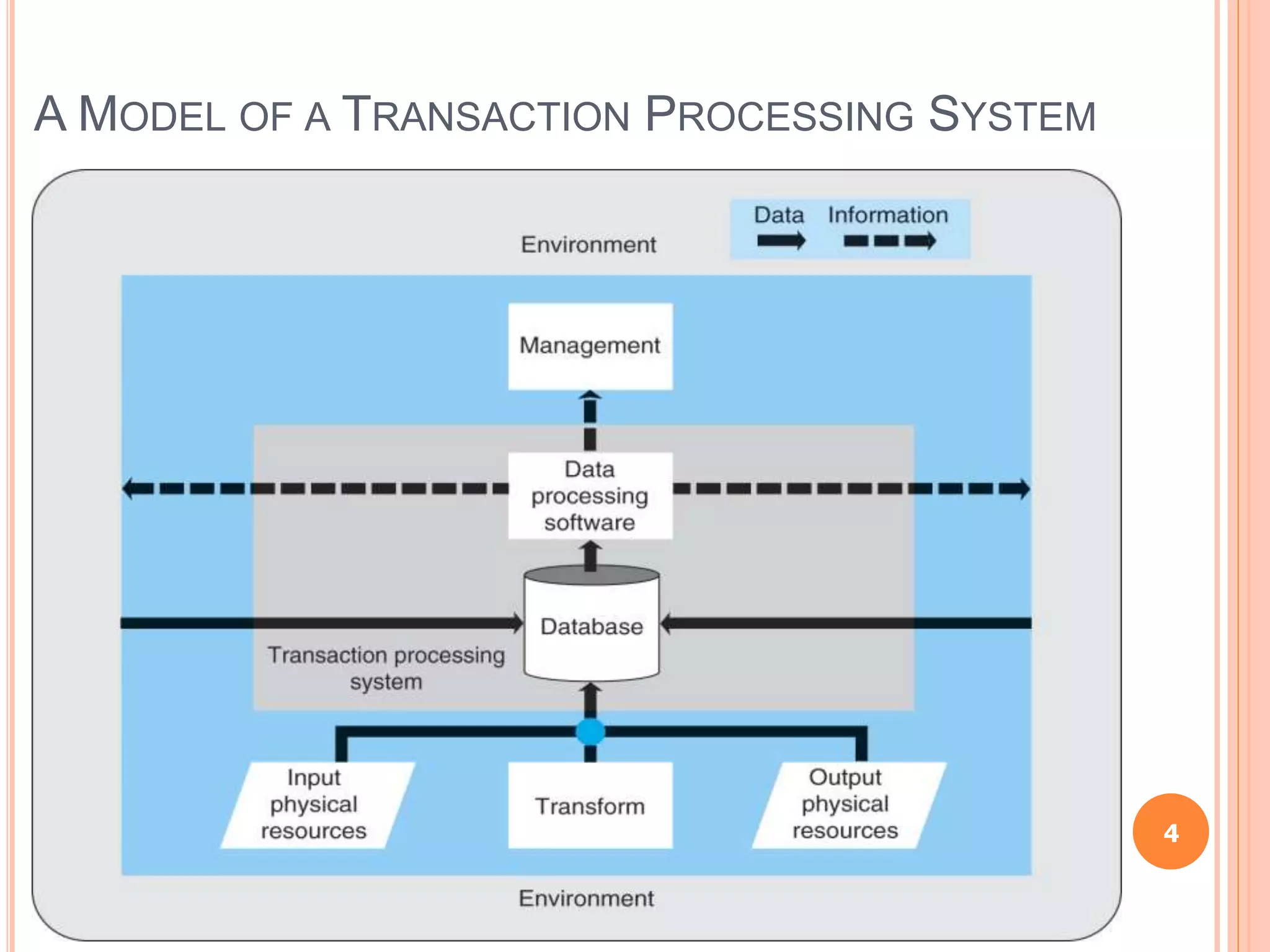
 Transaction processing system (TPS)
 is the information system that gathers data
describing the firm’s activities, transforms the
data into information, and makes the
information available to users both inside and
outside the firm.
 1st business application to be installed on
computers.
 Also electronic data processing (EDP) system and
accounting information system. 3
A MODEL OF A TRANSACTION PROCESSING SYSTEM
4
SYSTEM OVERVIEW
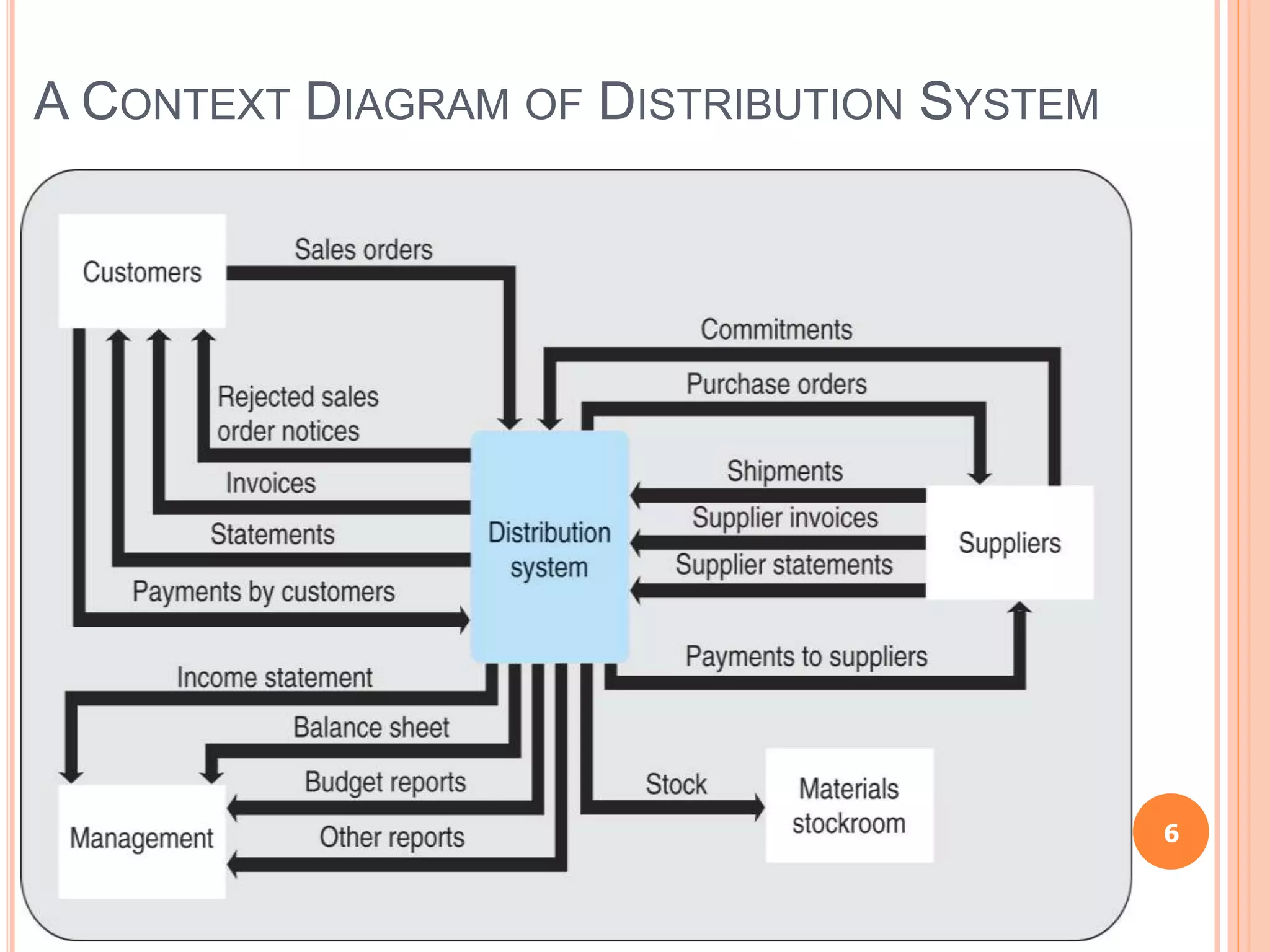
 Distribution system
 is a TPS used by distribution firms.
 Distribution firms distribute products or services to
their customers.
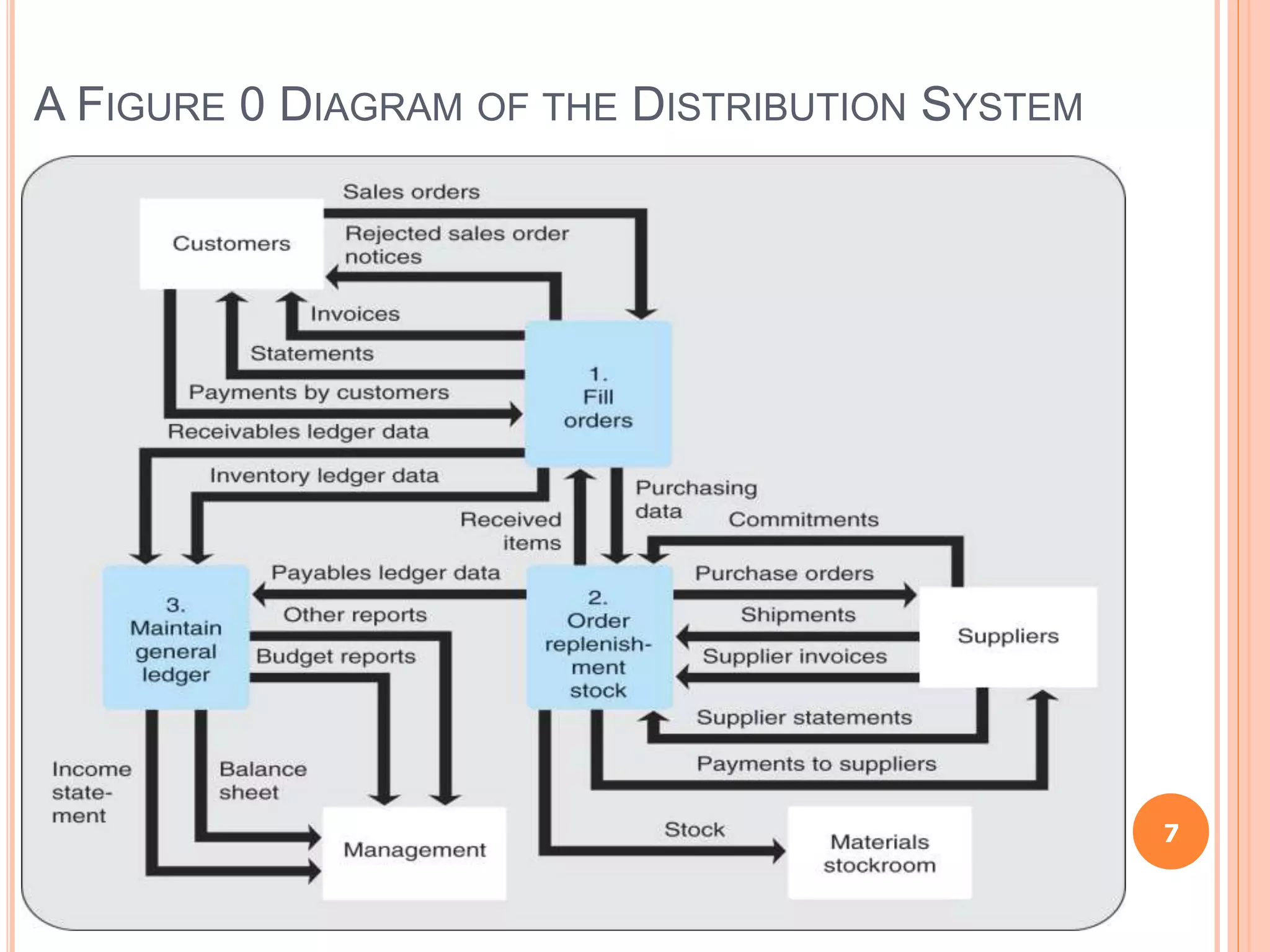
 We will use data flow diagrams, or DFDs, to
document the system.
 Figure slide 6
 represents the highest level.
 Figure slide 7
 identifies the three major subsystems.
5
A CONTEXT DIAGRAM OF DISTRIBUTION SYSTEM
6
A FIGURE 0 DIAGRAM OF THE DISTRIBUTION SYSTEM
7
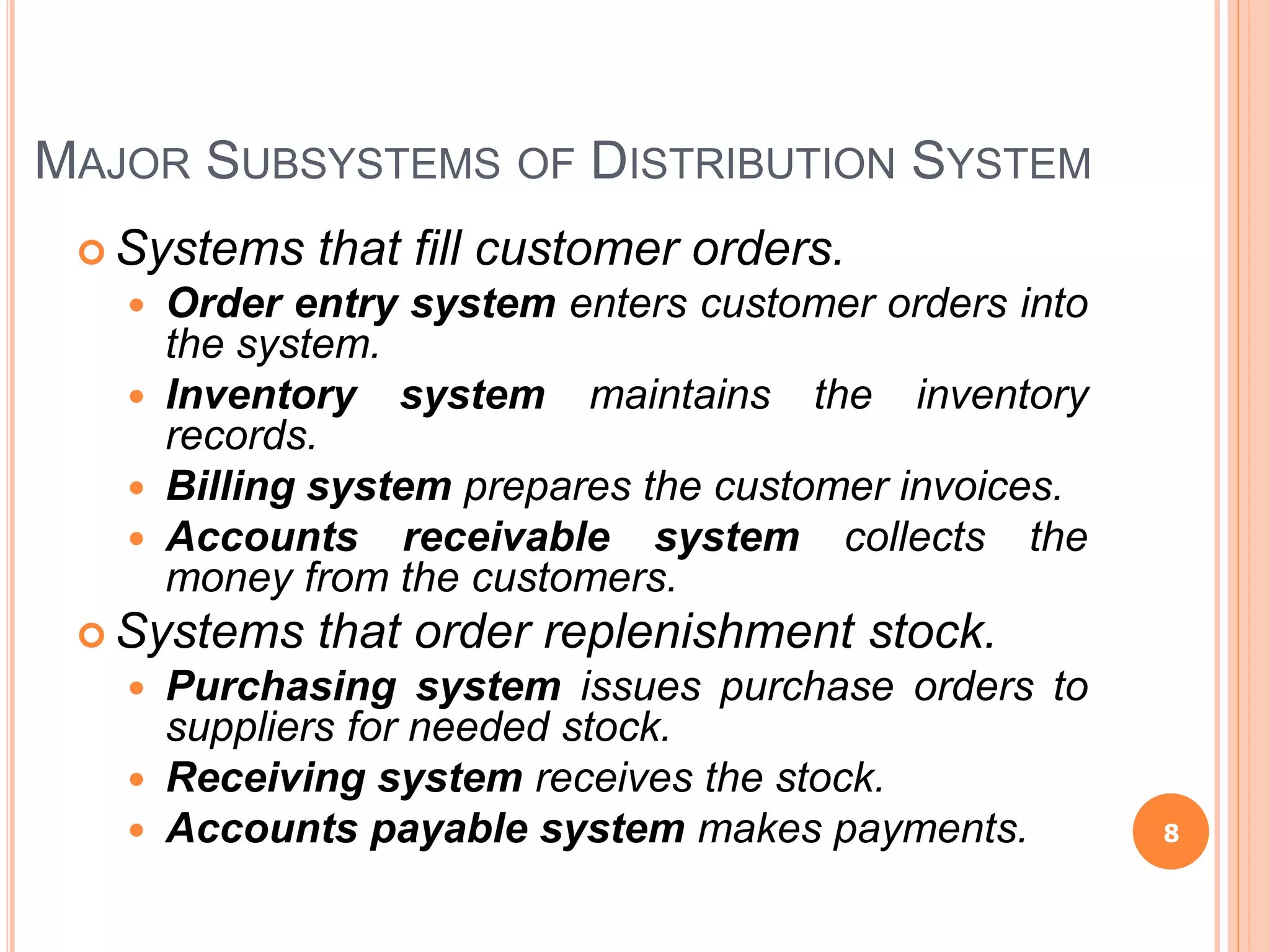
MAJOR SUBSYSTEMS OF DISTRIBUTION SYSTEM
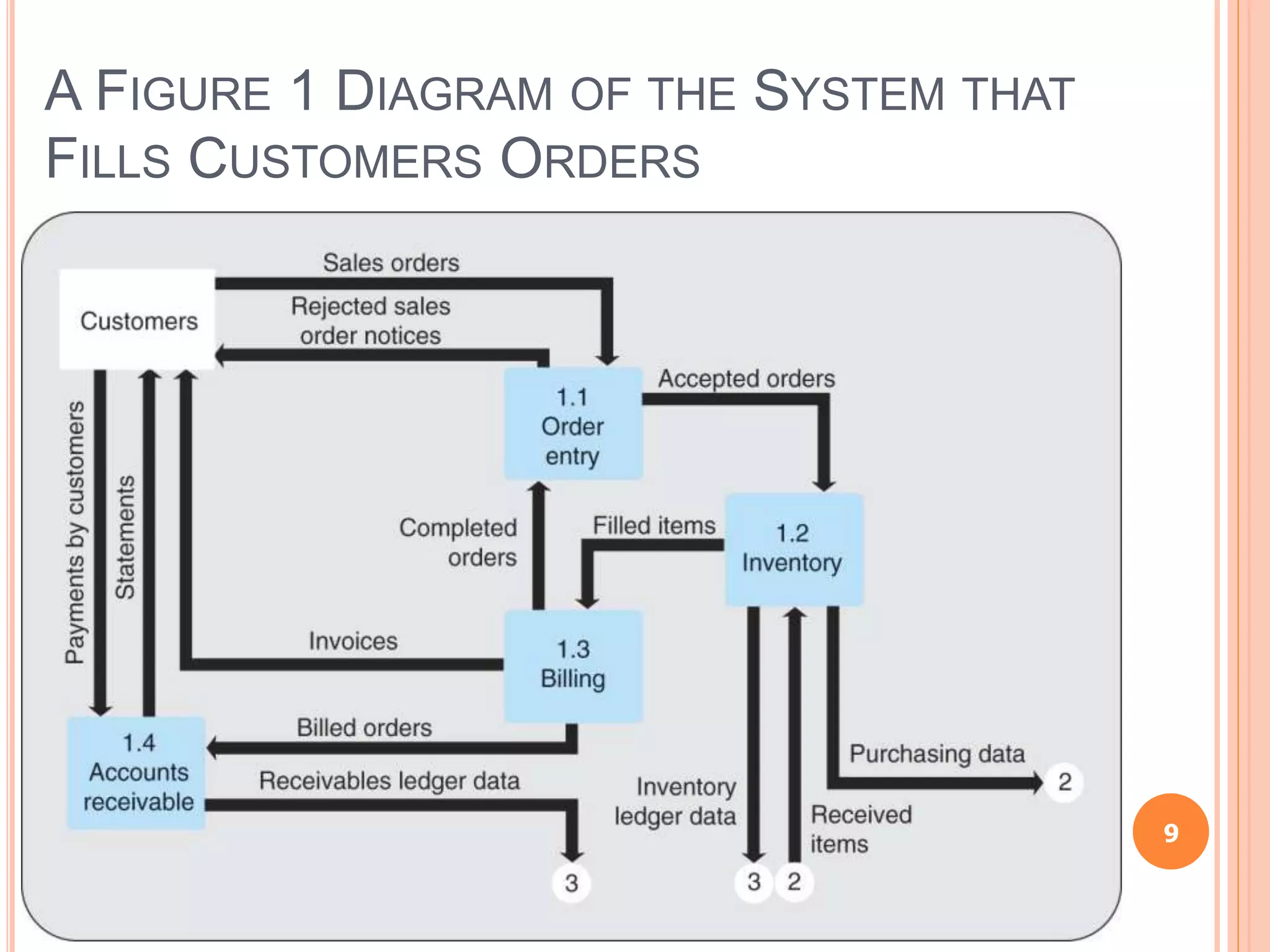
 Systems that fill customer orders.
 Order entry system enters customer orders into
the system.
 Inventory system maintains the inventory
records.
 Billing system prepares the customer invoices.
 Accounts receivable system collects the
money from the customers.
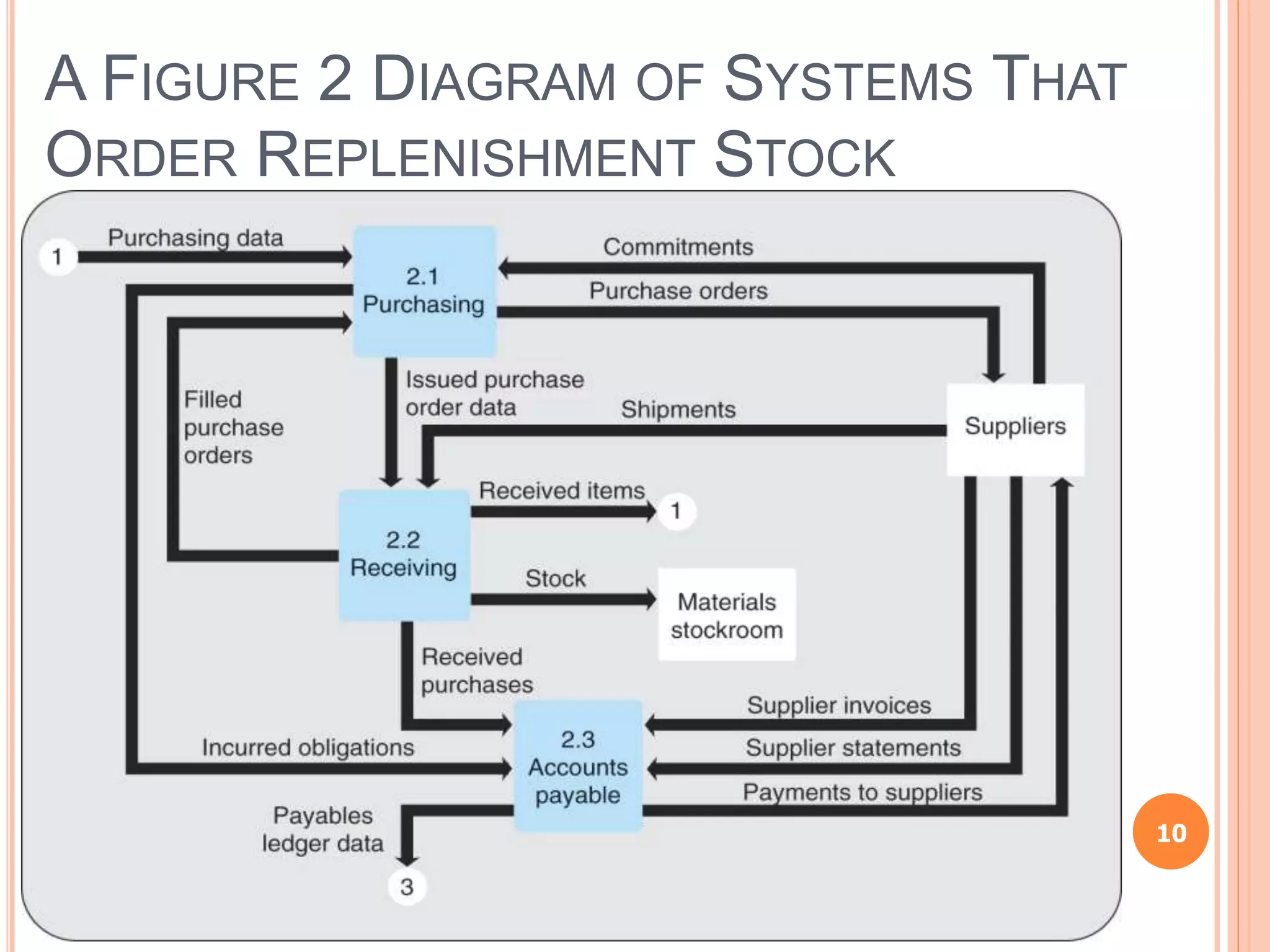
 Systems that order replenishment stock.
 Purchasing system issues purchase orders to
suppliers for needed stock.
 Receiving system receives the stock.
 Accounts payable system makes payments. 8
A FIGURE 1 DIAGRAM OF THE SYSTEM THAT
FILLS CUSTOMERS ORDERS
9
A FIGURE 2 DIAGRAM OF SYSTEMS THAT
ORDER REPLENISHMENT STOCK
10
MAJOR SUBSYSTEMS OF DISTRIBUTION
SYSTEM (CONT’D)
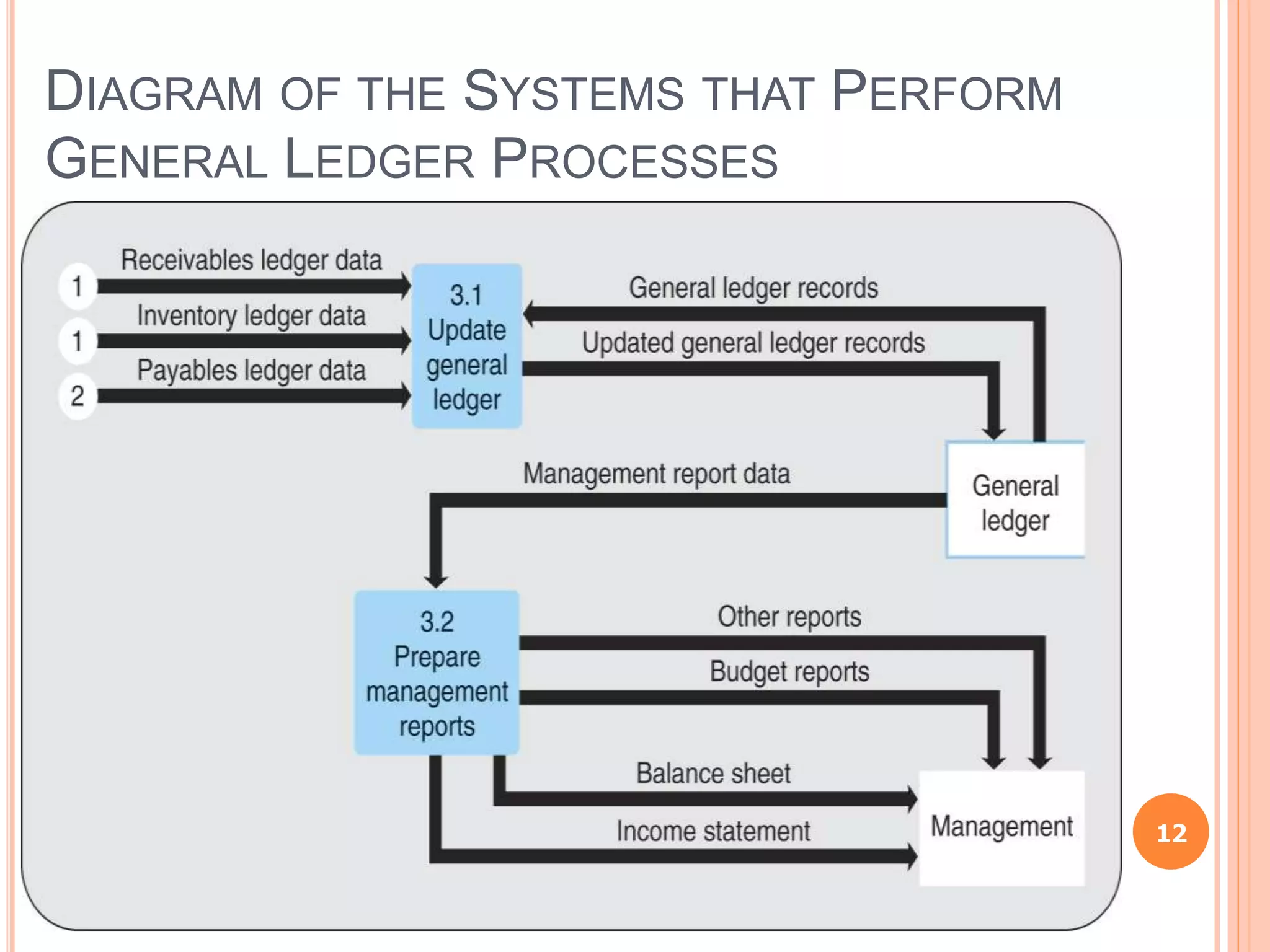
 Systems that perform general ledger
processes.
 General ledger system is the accounting
system that combines data from other
accounting systems for the purpose of
presenting a composite financial picture of the
firm’s operations.
 General ledger is the file that contains the
combined accounting data.
 Updated general ledger system posts records
that describe various actions and transactions to
the general ledger.
 Prepare management reports system uses the
contents of the general ledger to prepare the
balance sheet, income statement, and other
reports. 11
DIAGRAM OF THE SYSTEMS THAT PERFORM
GENERAL LEDGER PROCESSES
12
ORGANIZATIONAL INFORMATION SYSTEMS
 Organizational information systems
 are developed to meet the needs for information
relating to those particular parts of the organization.
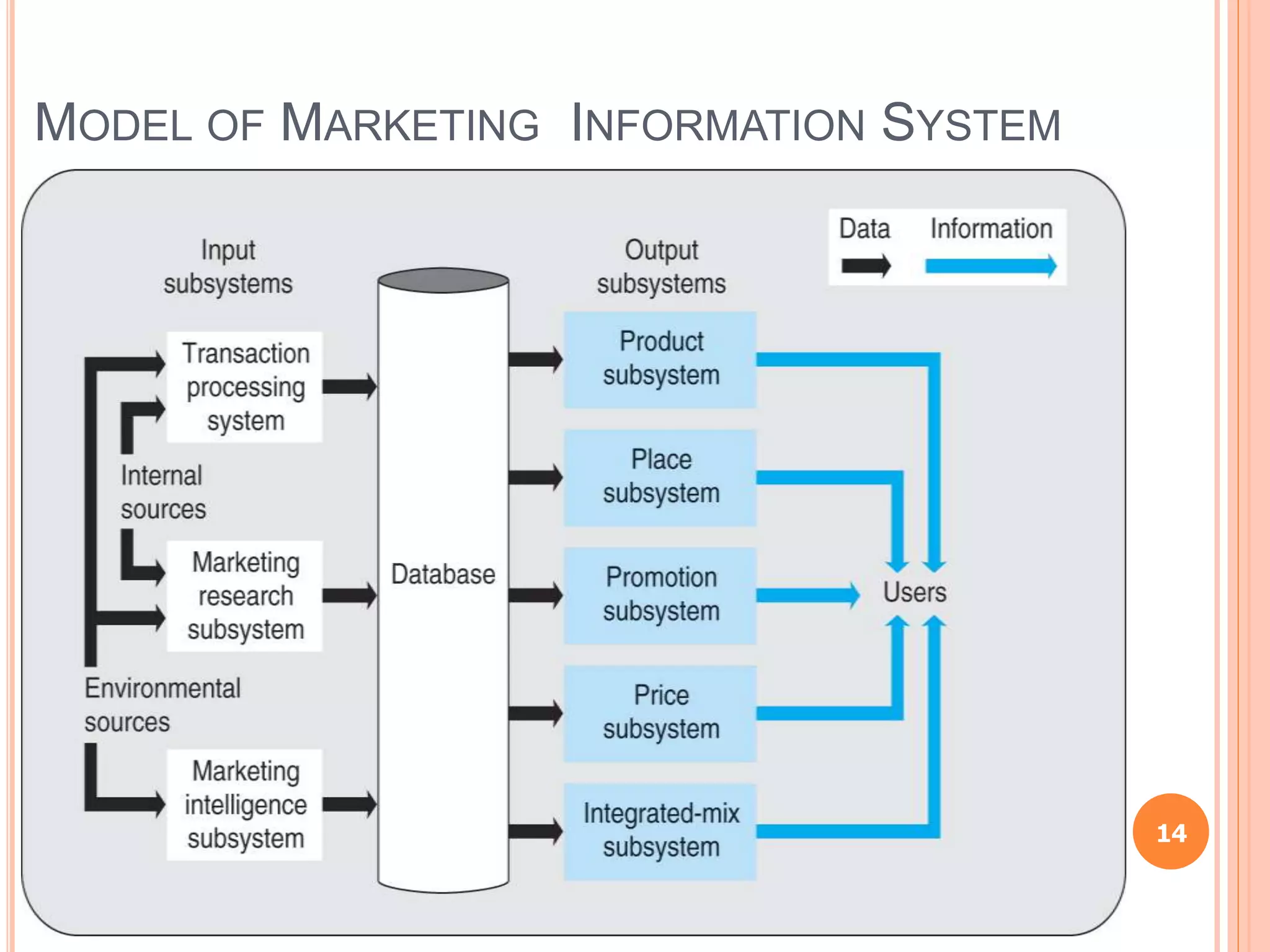
 Marketing information system (MKIS)
 provides information that relates to the firm’s marketing
activities.
 Consists of a combination of input and output
subsystems connected by a database.
13
MODEL OF MARKETING INFORMATION SYSTEM
14
MARKETING INFORMATION SYSTEM
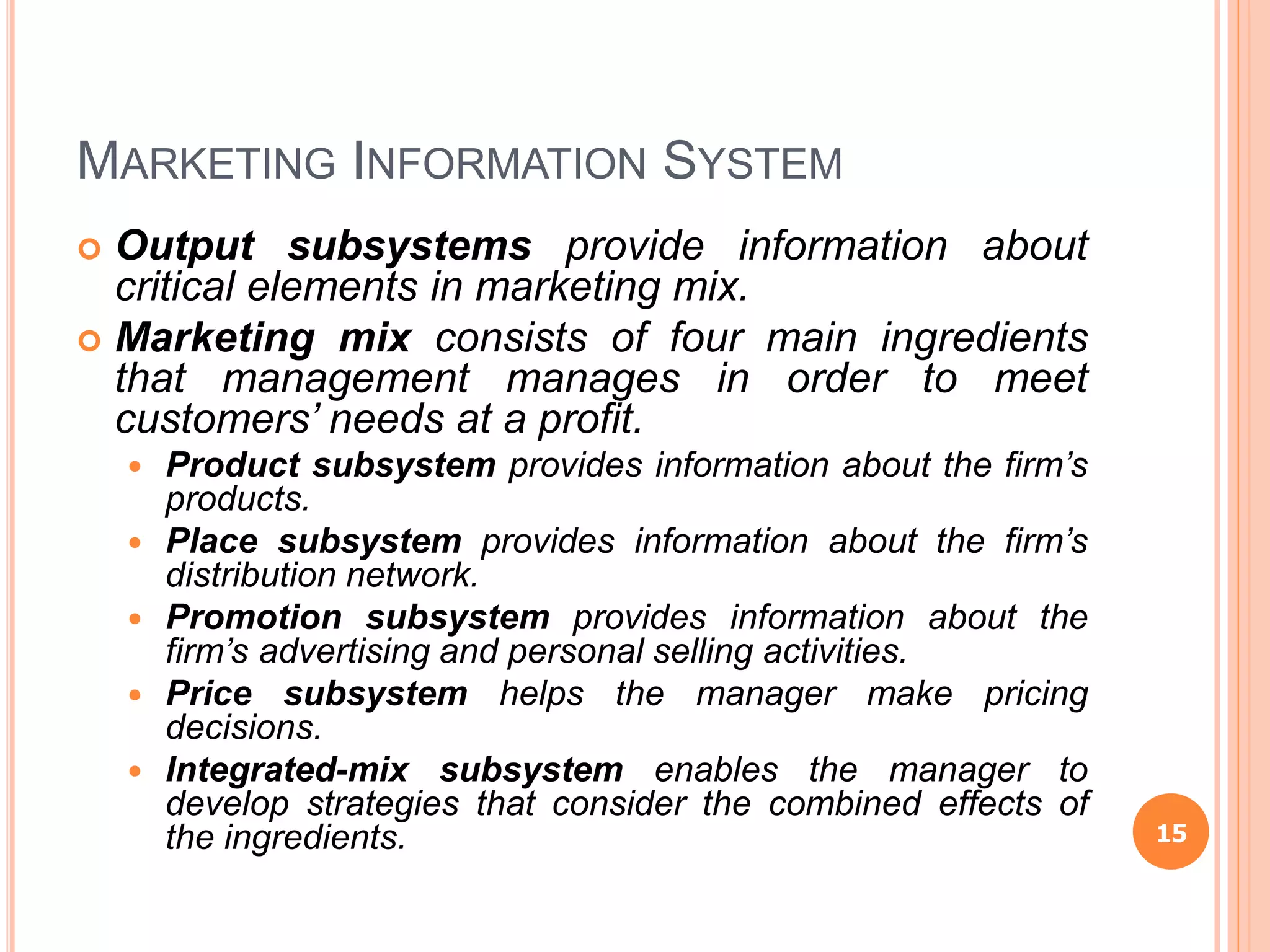
 Output subsystems provide information about
critical elements in marketing mix.
 Marketing mix consists of four main ingredients
that management manages in order to meet
customers’ needs at a profit.
 Product subsystem provides information about the firm’s
products.
 Place subsystem provides information about the firm’s
distribution network.
 Promotion subsystem provides information about the
firm’s advertising and personal selling activities.
 Price subsystem helps the manager make pricing
decisions.
 Integrated-mix subsystem enables the manager to
develop strategies that consider the combined effects of
the ingredients. 15
MARKETING INFORMATION SYSTEM (CONT’D)
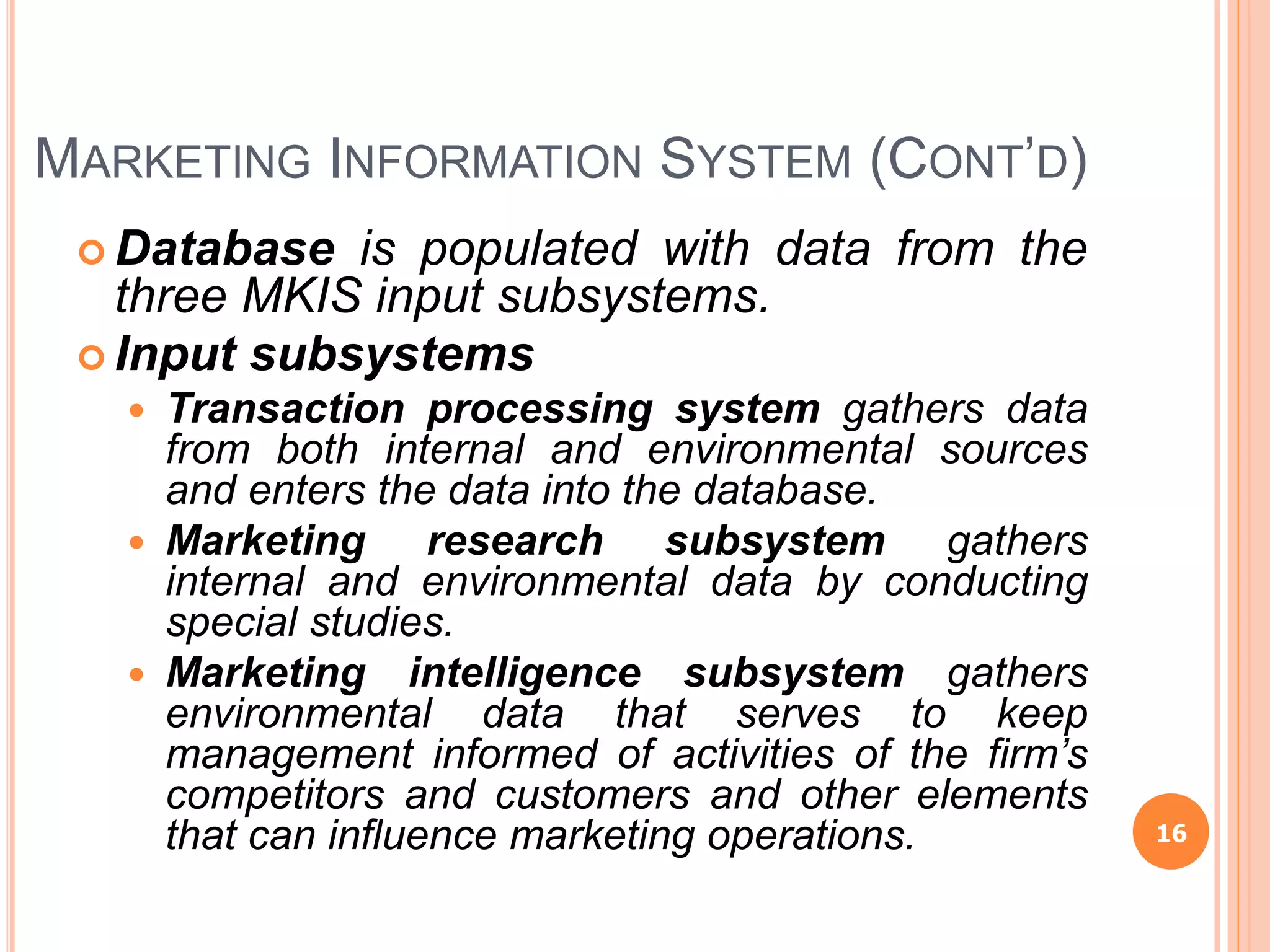
 Database is populated with data from the
three MKIS input subsystems.
 Input subsystems
 Transaction processing system gathers data
from both internal and environmental sources
and enters the data into the database.
 Marketing research subsystem gathers
internal and environmental data by conducting
special studies.
 Marketing intelligence subsystem gathers
environmental data that serves to keep
management informed of activities of the firm’s
competitors and customers and other elements
that can influence marketing operations. 16
OTHER ORGANIZATIONAL INFORMATION
SYSTEM
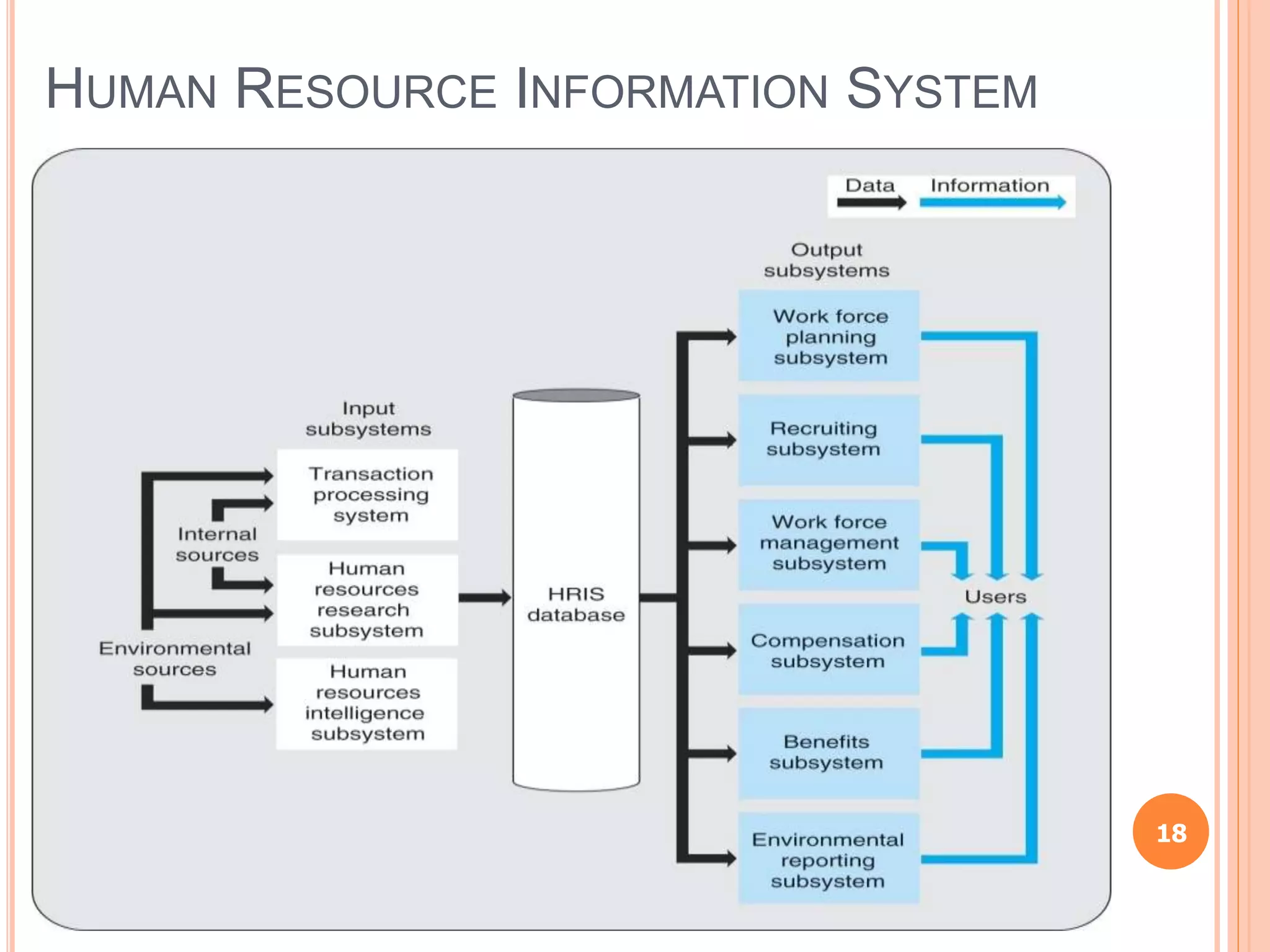
 Human Resources information system
(HRIS)
 provides information to managers throughout
the firm concerning the firm’s human resources.
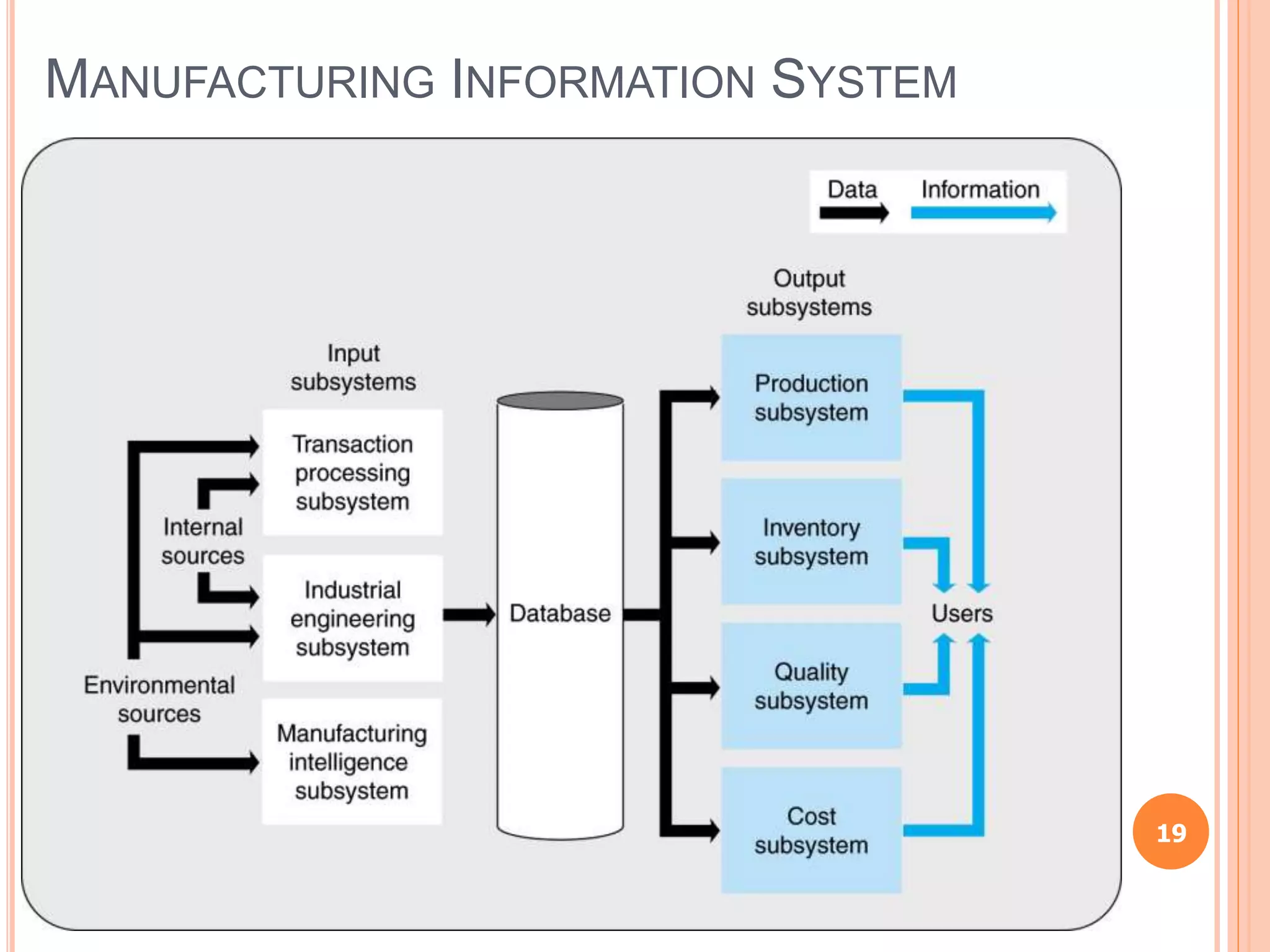
 Manufacturing information system
 provides information to managers throughout
the firm concerning the firm’s manufacturing
operations.
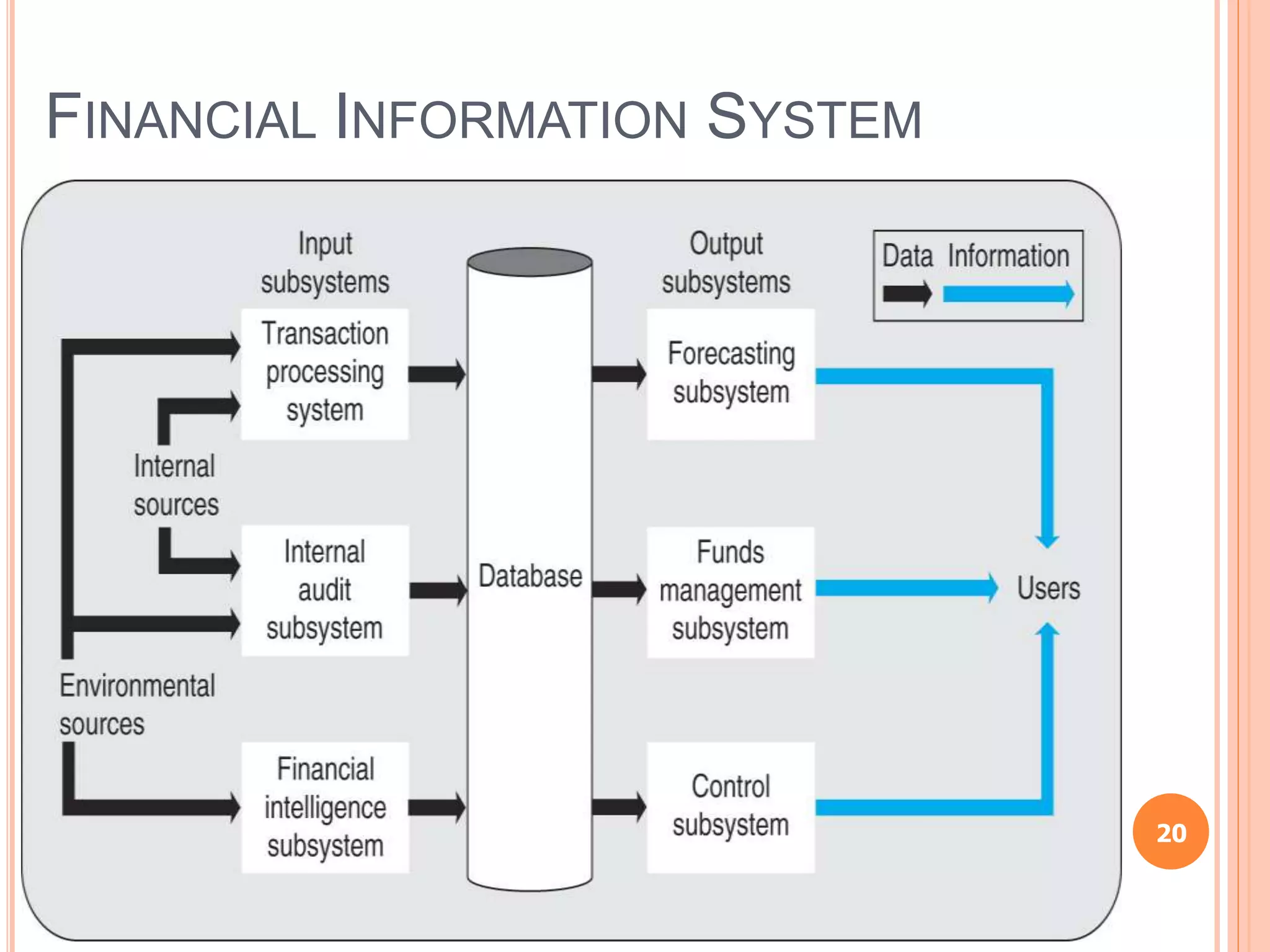
 Financial information system
 provides information to managers throughout
the firm concerning the firm’s financial activities.
17
HUMAN RESOURCE INFORMATION SYSTEM
18
MANUFACTURING INFORMATION SYSTEM
19
FINANCIAL INFORMATION SYSTEM
20
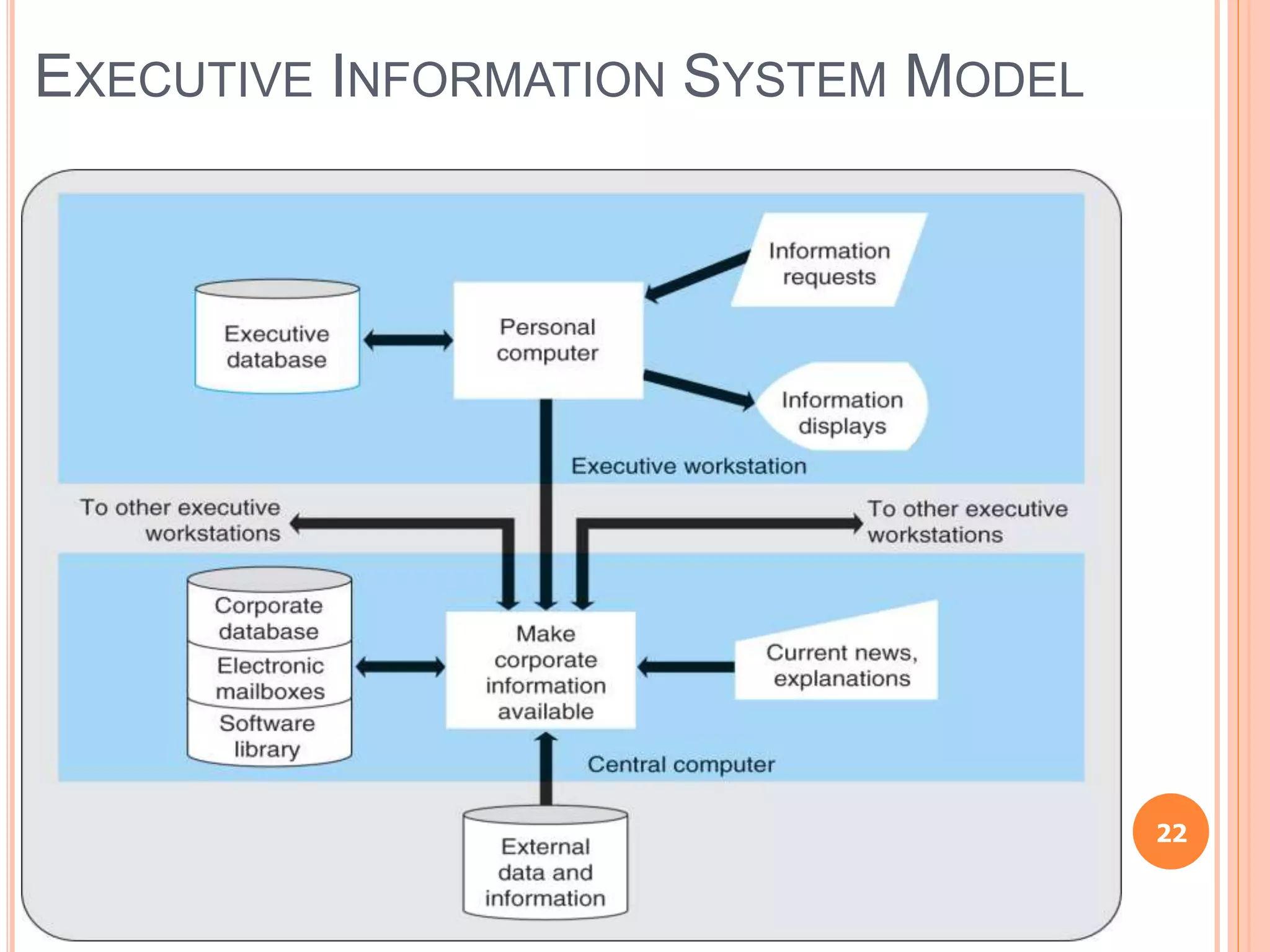
THE EXECUTIVE INFORMATION SYSTEM
 Executive information system (EIS)
 is a system that provides information to upper-
level managers on the overall performance of
the firm; also called Executive support
system (ESS).
 Drill-down capability
 allows for executives to bring up a summary
display and then successively display lower
levels of detail until executives are satisfied
that they have obtained as much detail as is
necessary. 21
EXECUTIVE INFORMATION SYSTEM MODEL
22
CUSTOMER RELATIONSHIP MANAGEMENT
 Customer relationship management
(CRM)
 is the management of the relationships
between the firm and its customers so that
both the firm and its customers receive
maximum value from the relationship.
 CRM system
 accumulates customer data over a long term–5
years, 10 years, or more-and uses that data to
produce information for users.
 Uses a data warehouse. 23
DATA WAREHOUSING
 Data warehouse
 describes data storage that has the following
characteristics:
 Storage capacity is very large.
 Data are accumulated by adding new records, as
opposed to being kept current by updating existing
records with new information.
 Date are easily retrievable.
 Date are used solely for decision making, not for use in
the firm’s daily operations.
 Data mart
 is a database that contains data describing
only a segment of the firm’s operations. 24
THE DATA WAREHOUSING SYSTEM
 Data warehousing
 is the creation and use of a data warehouse or
data mart.
 Primary data sources are TPS and data obtained
from other sources, both internal and
environmental; any data identified as having
potential value in decision making.
 Staging area is where the data undergoes
extraction, transformation, and loading
(abbreviated as ETL process)
25
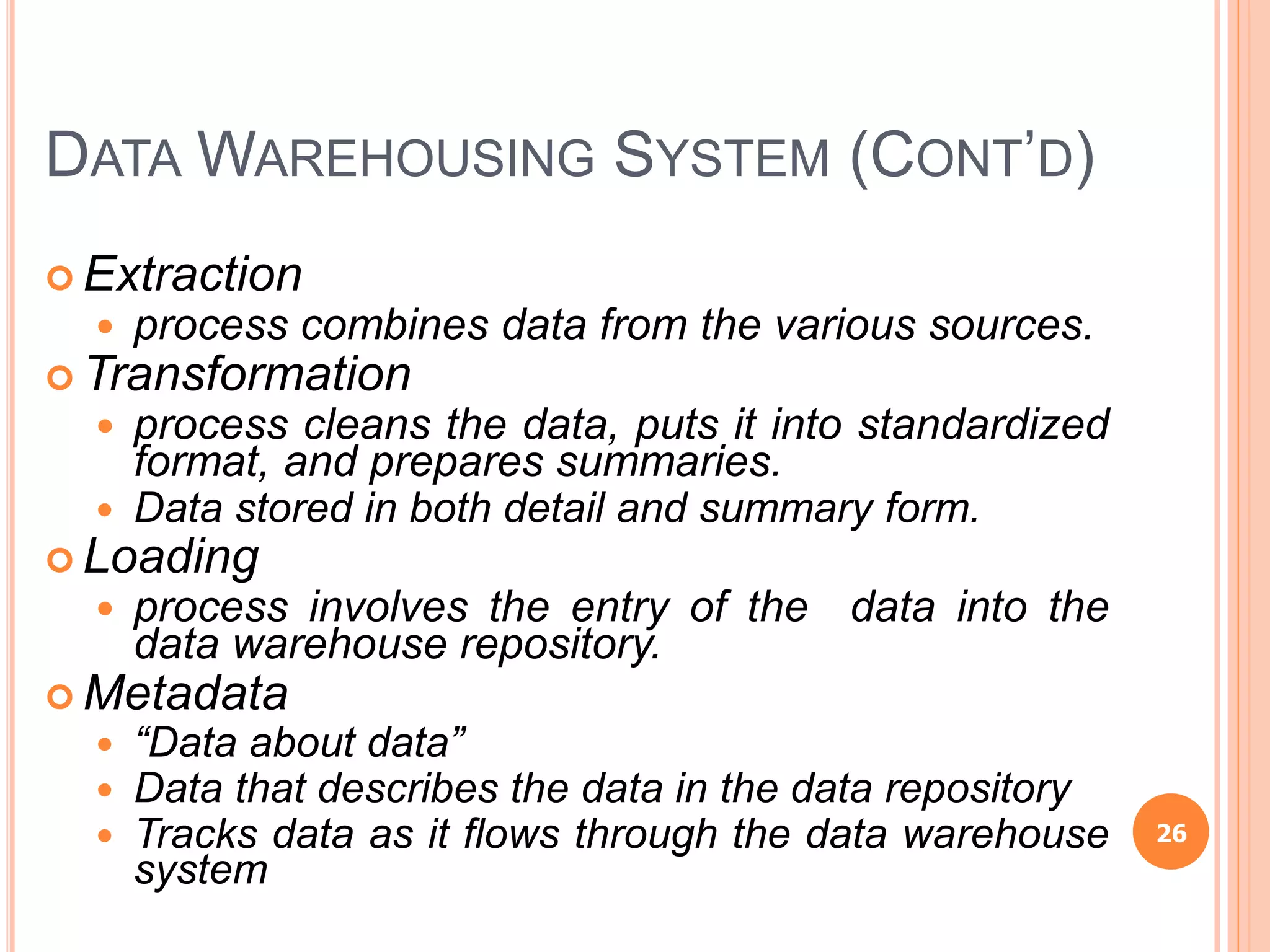
DATA WAREHOUSING SYSTEM (CONT’D)
 Extraction
 process combines data from the various sources.
 Transformation
 process cleans the data, puts it into standardized
format, and prepares summaries.
 Data stored in both detail and summary form.
 Loading
 process involves the entry of the data into the
data warehouse repository.
 Metadata
 “Data about data”
 Data that describes the data in the data repository
 Tracks data as it flows through the data warehouse
system
26
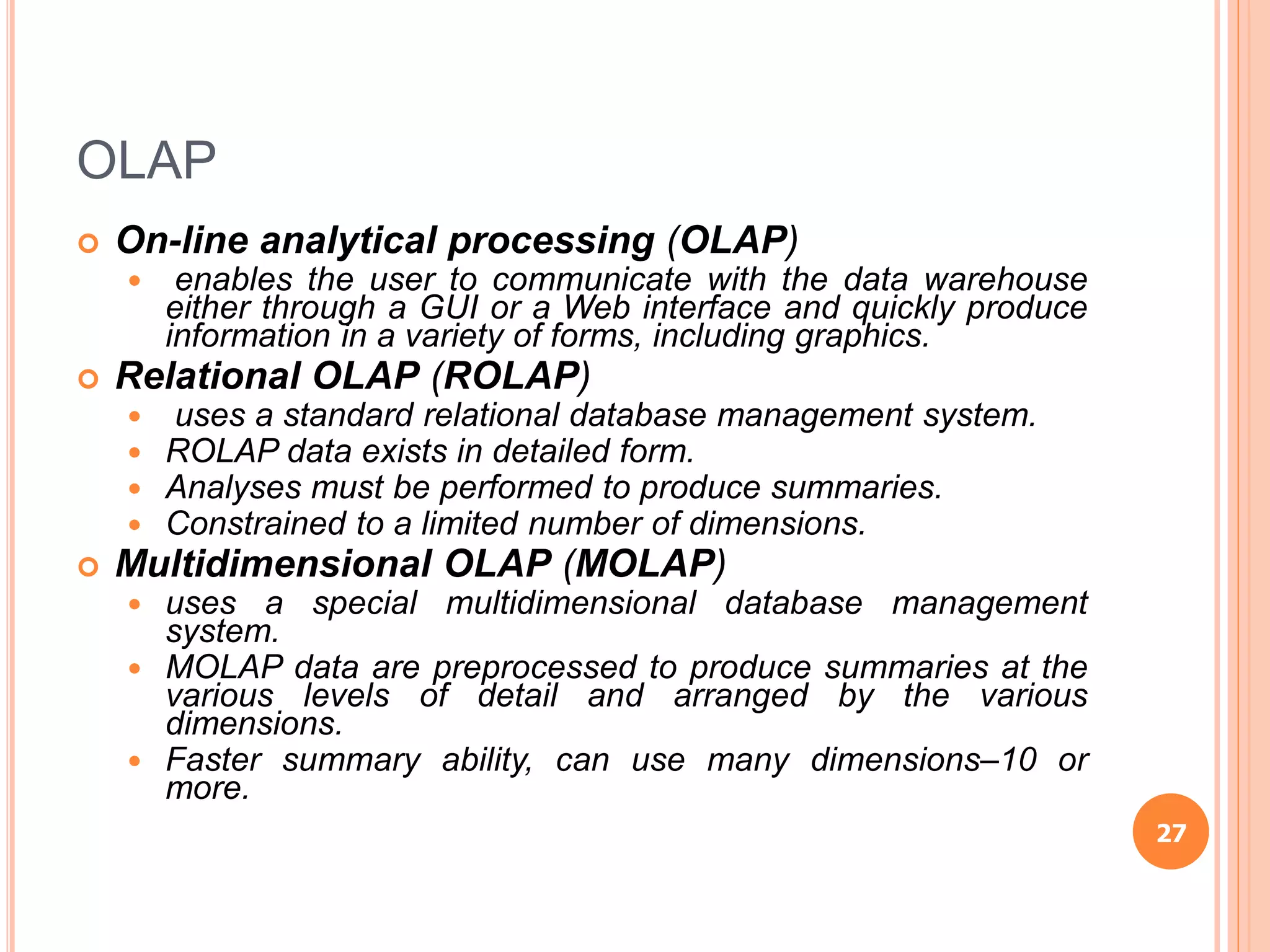
OLAP
 On-line analytical processing (OLAP)
 enables the user to communicate with the data warehouse
either through a GUI or a Web interface and quickly produce
information in a variety of forms, including graphics.
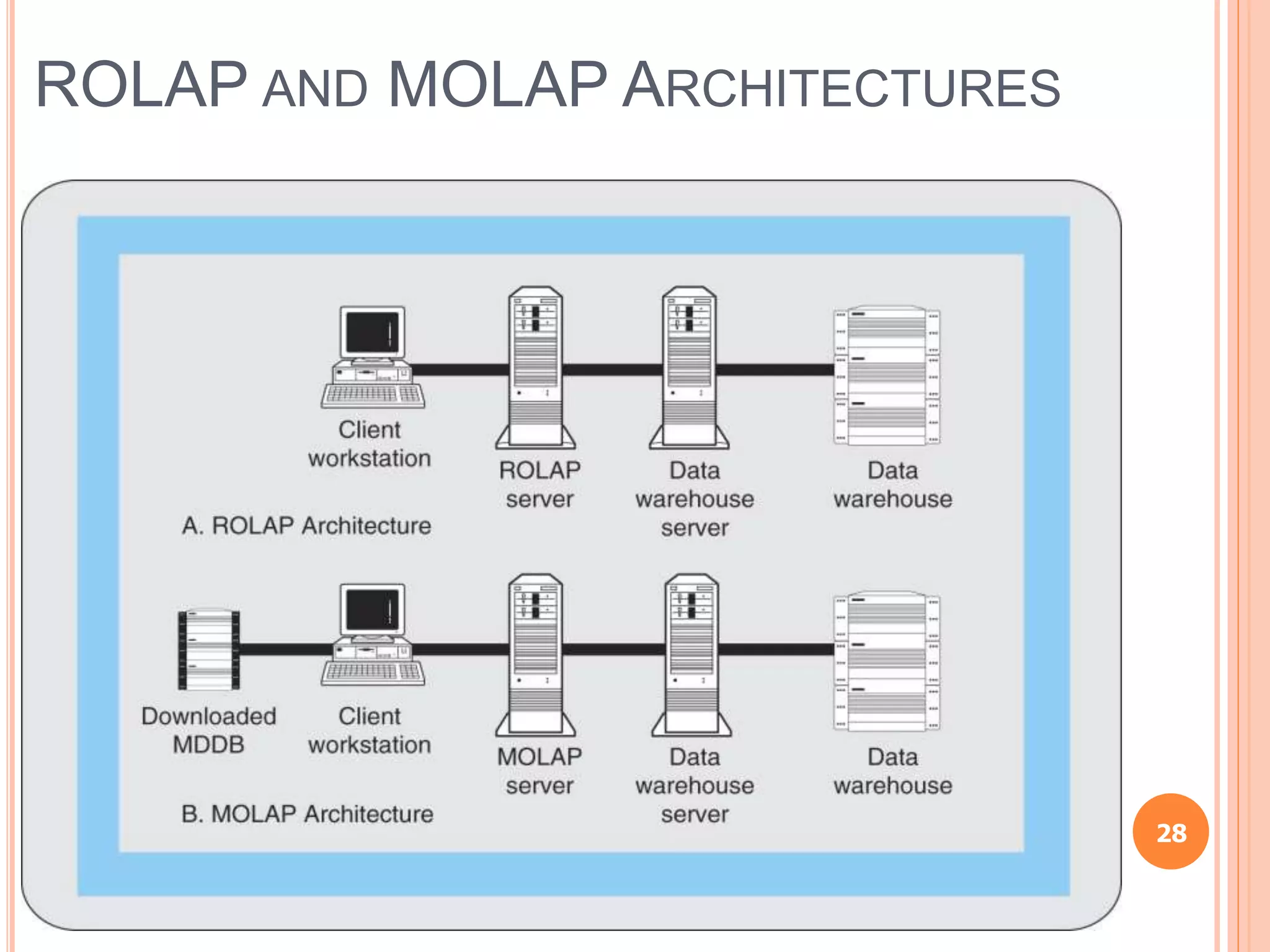
 Relational OLAP (ROLAP)
 uses a standard relational database management system.
 ROLAP data exists in detailed form.
 Analyses must be performed to produce summaries.
 Constrained to a limited number of dimensions.
 Multidimensional OLAP (MOLAP)
 uses a special multidimensional database management
system.
 MOLAP data are preprocessed to produce summaries at the
various levels of detail and arranged by the various
dimensions.
 Faster summary ability, can use many dimensions–10 or
more.
27
ROLAP AND MOLAP ARCHITECTURES
28
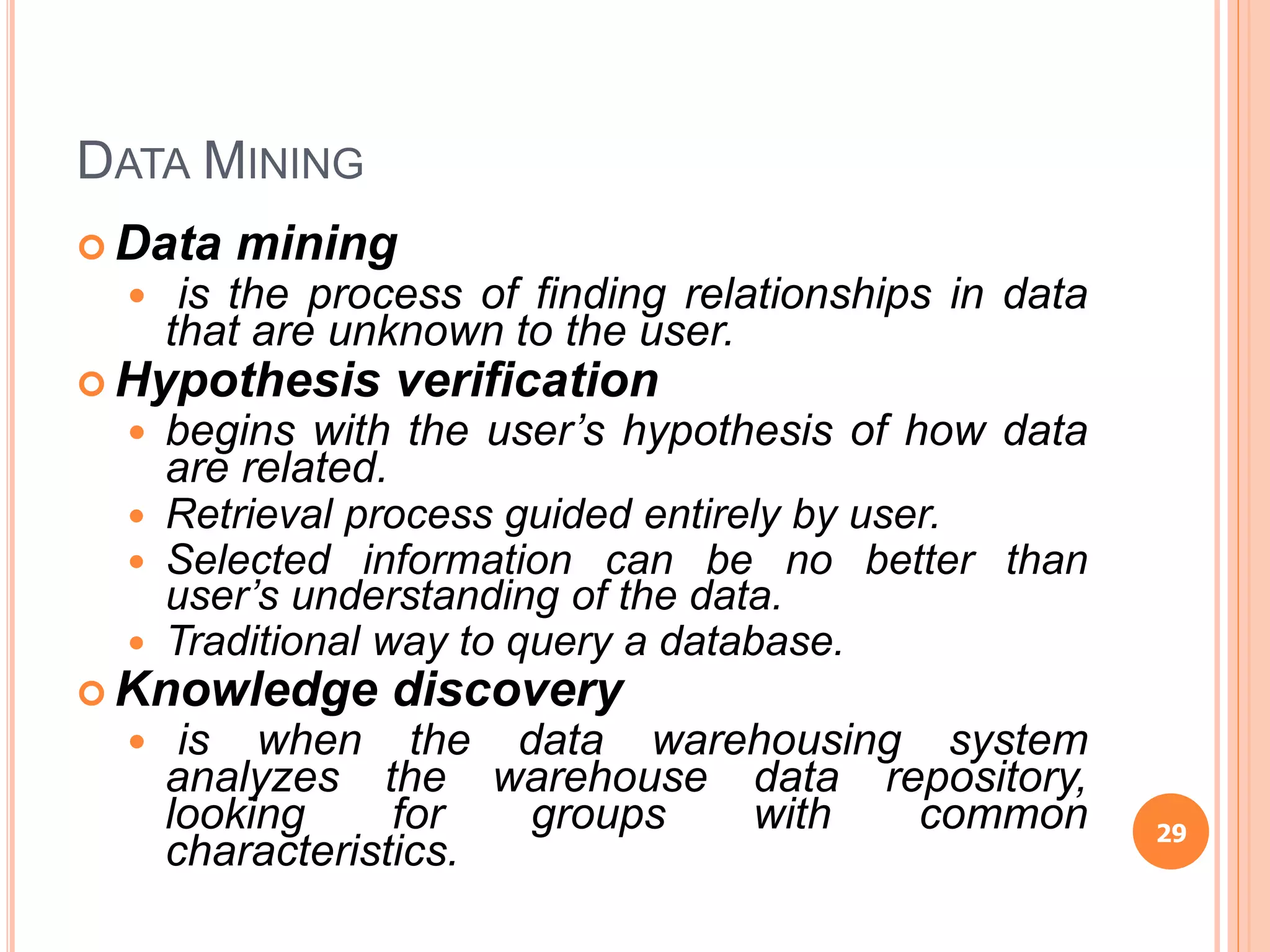
DATA MINING
 Data mining
 is the process of finding relationships in data
that are unknown to the user.
 Hypothesis verification
 begins with the user’s hypothesis of how data
are related.
 Retrieval process guided entirely by user.
 Selected information can be no better than
user’s understanding of the data.
 Traditional way to query a database.
 Knowledge discovery
 is when the data warehousing system
analyzes the warehouse data repository,
looking for groups with common
characteristics.
29

MIS chap # 8.....

  • 1.
  • 2.
    OVERVIEW  Information asa critical Success Factor  Transaction Processing Systems  Organizational Information Systems  Marketing IS  Human Resource IS  Financial IS  Executive IS  Data Warehouse  OLAP 2
  • 3.
    INFORMATION AS ACRITICAL SUCCESS FACTOR  Critical success factor (CSF)  was coined by Ronald Daniel to identify a few key activities that spell success or failure for any type of organization.  Transaction processing system (TPS)  is the information system that gathers data describing the firm’s activities, transforms the data into information, and makes the information available to users both inside and outside the firm.  1st business application to be installed on computers.  Also electronic data processing (EDP) system and accounting information system. 3
  • 4.
    A MODEL OFA TRANSACTION PROCESSING SYSTEM 4
  • 5.
    SYSTEM OVERVIEW  Distributionsystem  is a TPS used by distribution firms.  Distribution firms distribute products or services to their customers.  We will use data flow diagrams, or DFDs, to document the system.  Figure slide 6  represents the highest level.  Figure slide 7  identifies the three major subsystems. 5
  • 6.
    A CONTEXT DIAGRAMOF DISTRIBUTION SYSTEM 6
  • 7.
    A FIGURE 0DIAGRAM OF THE DISTRIBUTION SYSTEM 7
  • 8.
    MAJOR SUBSYSTEMS OFDISTRIBUTION SYSTEM  Systems that fill customer orders.  Order entry system enters customer orders into the system.  Inventory system maintains the inventory records.  Billing system prepares the customer invoices.  Accounts receivable system collects the money from the customers.  Systems that order replenishment stock.  Purchasing system issues purchase orders to suppliers for needed stock.  Receiving system receives the stock.  Accounts payable system makes payments. 8
  • 9.
    A FIGURE 1DIAGRAM OF THE SYSTEM THAT FILLS CUSTOMERS ORDERS 9
  • 10.
    A FIGURE 2DIAGRAM OF SYSTEMS THAT ORDER REPLENISHMENT STOCK 10
  • 11.
    MAJOR SUBSYSTEMS OFDISTRIBUTION SYSTEM (CONT’D)  Systems that perform general ledger processes.  General ledger system is the accounting system that combines data from other accounting systems for the purpose of presenting a composite financial picture of the firm’s operations.  General ledger is the file that contains the combined accounting data.  Updated general ledger system posts records that describe various actions and transactions to the general ledger.  Prepare management reports system uses the contents of the general ledger to prepare the balance sheet, income statement, and other reports. 11
  • 12.
    DIAGRAM OF THESYSTEMS THAT PERFORM GENERAL LEDGER PROCESSES 12
  • 13.
    ORGANIZATIONAL INFORMATION SYSTEMS Organizational information systems  are developed to meet the needs for information relating to those particular parts of the organization.  Marketing information system (MKIS)  provides information that relates to the firm’s marketing activities.  Consists of a combination of input and output subsystems connected by a database. 13
  • 14.
    MODEL OF MARKETINGINFORMATION SYSTEM 14
  • 15.
    MARKETING INFORMATION SYSTEM Output subsystems provide information about critical elements in marketing mix.  Marketing mix consists of four main ingredients that management manages in order to meet customers’ needs at a profit.  Product subsystem provides information about the firm’s products.  Place subsystem provides information about the firm’s distribution network.  Promotion subsystem provides information about the firm’s advertising and personal selling activities.  Price subsystem helps the manager make pricing decisions.  Integrated-mix subsystem enables the manager to develop strategies that consider the combined effects of the ingredients. 15
  • 16.
    MARKETING INFORMATION SYSTEM(CONT’D)  Database is populated with data from the three MKIS input subsystems.  Input subsystems  Transaction processing system gathers data from both internal and environmental sources and enters the data into the database.  Marketing research subsystem gathers internal and environmental data by conducting special studies.  Marketing intelligence subsystem gathers environmental data that serves to keep management informed of activities of the firm’s competitors and customers and other elements that can influence marketing operations. 16
  • 17.
    OTHER ORGANIZATIONAL INFORMATION SYSTEM Human Resources information system (HRIS)  provides information to managers throughout the firm concerning the firm’s human resources.  Manufacturing information system  provides information to managers throughout the firm concerning the firm’s manufacturing operations.  Financial information system  provides information to managers throughout the firm concerning the firm’s financial activities. 17
  • 18.
  • 19.
  • 20.
  • 21.
    THE EXECUTIVE INFORMATIONSYSTEM  Executive information system (EIS)  is a system that provides information to upper- level managers on the overall performance of the firm; also called Executive support system (ESS).  Drill-down capability  allows for executives to bring up a summary display and then successively display lower levels of detail until executives are satisfied that they have obtained as much detail as is necessary. 21
  • 22.
  • 23.
    CUSTOMER RELATIONSHIP MANAGEMENT Customer relationship management (CRM)  is the management of the relationships between the firm and its customers so that both the firm and its customers receive maximum value from the relationship.  CRM system  accumulates customer data over a long term–5 years, 10 years, or more-and uses that data to produce information for users.  Uses a data warehouse. 23
  • 24.
    DATA WAREHOUSING  Datawarehouse  describes data storage that has the following characteristics:  Storage capacity is very large.  Data are accumulated by adding new records, as opposed to being kept current by updating existing records with new information.  Date are easily retrievable.  Date are used solely for decision making, not for use in the firm’s daily operations.  Data mart  is a database that contains data describing only a segment of the firm’s operations. 24
  • 25.
    THE DATA WAREHOUSINGSYSTEM  Data warehousing  is the creation and use of a data warehouse or data mart.  Primary data sources are TPS and data obtained from other sources, both internal and environmental; any data identified as having potential value in decision making.  Staging area is where the data undergoes extraction, transformation, and loading (abbreviated as ETL process) 25
  • 26.
    DATA WAREHOUSING SYSTEM(CONT’D)  Extraction  process combines data from the various sources.  Transformation  process cleans the data, puts it into standardized format, and prepares summaries.  Data stored in both detail and summary form.  Loading  process involves the entry of the data into the data warehouse repository.  Metadata  “Data about data”  Data that describes the data in the data repository  Tracks data as it flows through the data warehouse system 26
  • 27.
    OLAP  On-line analyticalprocessing (OLAP)  enables the user to communicate with the data warehouse either through a GUI or a Web interface and quickly produce information in a variety of forms, including graphics.  Relational OLAP (ROLAP)  uses a standard relational database management system.  ROLAP data exists in detailed form.  Analyses must be performed to produce summaries.  Constrained to a limited number of dimensions.  Multidimensional OLAP (MOLAP)  uses a special multidimensional database management system.  MOLAP data are preprocessed to produce summaries at the various levels of detail and arranged by the various dimensions.  Faster summary ability, can use many dimensions–10 or more. 27
  • 28.
    ROLAP AND MOLAPARCHITECTURES 28
  • 29.
    DATA MINING  Datamining  is the process of finding relationships in data that are unknown to the user.  Hypothesis verification  begins with the user’s hypothesis of how data are related.  Retrieval process guided entirely by user.  Selected information can be no better than user’s understanding of the data.  Traditional way to query a database.  Knowledge discovery  is when the data warehousing system analyzes the warehouse data repository, looking for groups with common characteristics. 29