GROWTH AND DEVELOPMENT
 Both growth and development refer tochangesovera period of time.
 Growth :-
 Quantitative and value neutral change.
 Positive or a negativesign.
 Development :-
 Qualitative changewhich is alwaysvalue positive.
 Developmentoccurs when positive growth takes place.
 For example, if the population of a city grows from one lakh to two lakhs over a
period of time, wesay thecity hasgrown.
 However, if facilities like housing, provision of basic services and other characteristics
remain the same, then this growth has not been accompanied by development.
 The quality of life people enjoy in a country, the
opportunities they have and freedoms they enjoy, are
important aspects ofdevelopment.
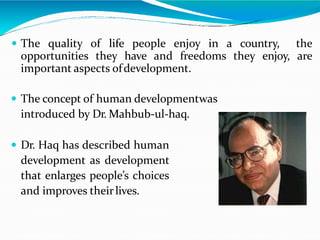
 The concept of human developmentwas
introduced by Dr. Mahbub-ul-haq.
 Dr. Haq has described human
development as development
that enlarges people’s choices
and improves theirlives.
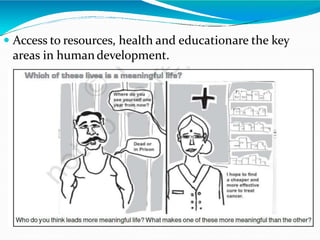
 Access to resources, health and educationare the key
areas in humandevelopment.
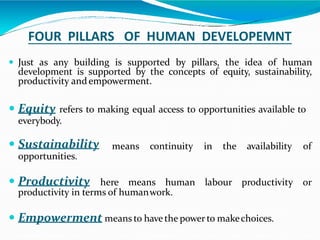
FOUR PILLARS OF HUMAN DEVELOPEMNT
 Just as any building is supported by pillars, the idea of human
development is supported by the concepts of equity, sustainability,
productivity andempowerment.
 Equity refers to making equal access to opportunities available to
everybody.
means continuity in the availability of
 Sustainability
opportunities.
 Productivity here means human labour productivity or
productivity in terms of humanwork.
 Empowerment means to havethe powerto makechoices.
WHAT IS HDI ?
It is a tool used to measure a country's overall
achievement in its social and economicdimensions.
Definition:-
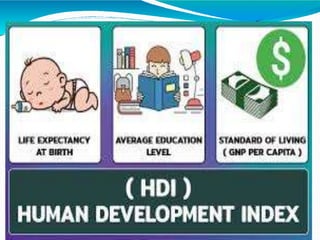
The human development index (HDI) is a
composite statistic of life expectancy, education, and per
capita income indicators, which is used to rank countries
into four tiers of humandevelopment.
The human development index is a measure of economic
development and economicwelfare.
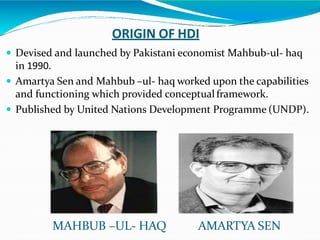
ORIGIN OF HDI
 Devised and launched by Pakistani economist Mahbub-ul- haq
in 1990.
 Amartya Sen and Mahbub –ul- haq worked upon the capabilities
and functioning which provided conceptualframework.
 Published by United Nations Development Programme (UNDP).
MAHBUB –UL- HAQ AMARTYA SEN
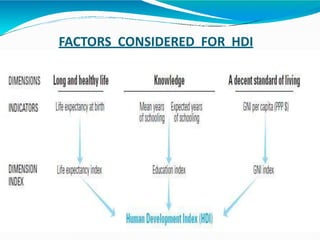
FACTORS CONSIDERED FOR HDI
 The human development indexexamines three importantcriteriaof economic
development
1) Life expectancy
2) Education
3) Income levels
 Create an overall score between 0 and1.
 1 - indicates a high level of economicdevelopment.
 0- a very lowlevel.
MEASURING HUMAN DEVELOPMENT
 The human development index (HDI) ranks the
countries based on their performance in the key areas
of health, education and access toresources.
 Health :-
 The indicator chosen to assess health is the life
expectancy atbirth.
 A higher life expectancy means that people have a
greater chance of living longer and healthierlives.
 Education :-
 The adult literacyrate and thegrossenrolmentratio
represent access toknowledge.
 The numberof adults who areable to read and writeand the
number of children enrolled in schools show how easy or
difficult it is toaccess knowledge in a particularcountry.
 Access to resources is measured in termsof
purchasing power (in U.S. Dollars).
INTERNATIONAL COMPARISONS
 Often smallercountries havedone betterthan larger
ones in humandevelopment.
 Similarly, relatively poorer nations have beenranked
higher than richer neighbours in terms of human
development.
 For example, Sri Lanka, Trinidad and Tobago havea
higher rank than India in the human development
index despite having smallereconomies.
 Similarly, within India, Kerala performs muchbetter
than Punjab and Gujarat in human development
despite having lower per capitaincome.
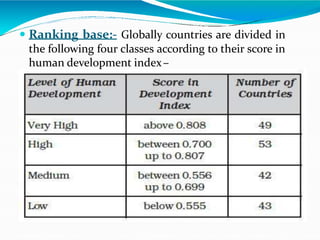
 Ranking base:- Globally countries are divided in
the following four classes according to their score in
human development index–
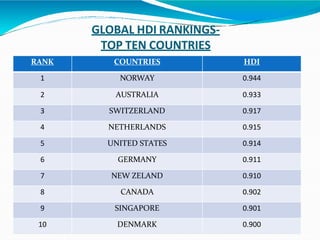
GLOBAL HDI RANKINGS-
TOP TEN COUNTRIES
RANK COUNTRIES HDI
1 NORWAY 0.944
2 AUSTRALIA 0.933
3 SWITZERLAND 0.917
4 NETHERLANDS 0.915
5 UNITED STATES 0.914
6 GERMANY 0.911
7 NEW ZELAND 0.910
8 CANADA 0.902
9 SINGAPORE 0.901
10 DENMARK 0.900
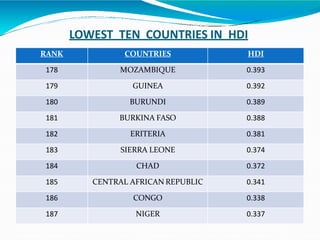
LOWEST TEN COUNTRIES IN HDI
RANK COUNTRIES HDI
178 MOZAMBIQUE 0.393
179 GUINEA 0.392
180 BURUNDI 0.389
181 BURKINA FASO 0.388
182 ERITERIA 0.381
183 SIERRA LEONE 0.374
184 CHAD 0.372
185 CENTRAL AFRICAN REPUBLIC 0.341
186 CONGO 0.338
187 NIGER 0.337
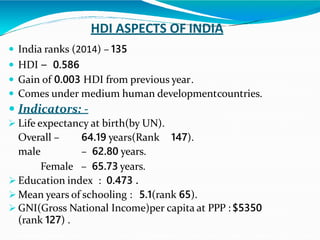
HDI ASPECTS OF INDIA
 India ranks (2014) – 135
 HDI – 0.586
 Gain of 0.003 HDI from previous year.
 Comes under medium human developmentcountries.
 Indicators: -
 Life expectancy at birth(by UN).
Overall – 64.19 years(Rank 147).
male – 62.80 years.
Female – 65.73 years.
 Education index : 0.473 .
 Mean years of schooling : 5.1(rank 65).
 GNI(Gross National Income)per capita at PPP :$5350
(rank 127) .
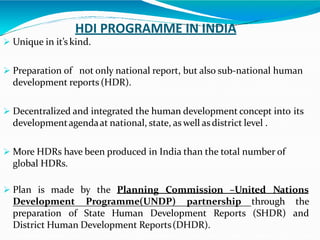
HDI PROGRAMME IN INDIA
 Unique in it’skind.
 Preparation of not only national report, but also sub-national human
development reports (HDR).
 Decentralized and integrated the human development concept into its
developmentagendaat national, state, as well asdistrict level .
 More HDRs have been produced in India than the total number of
global HDRs.
 Plan is made by the Planning Commission –United Nations
Development Programme(UNDP) partnership through the
and
preparation of State Human Development Reports (SHDR)
District Human Development Reports(DHDR).
8th five year
 Human development programme started in
plan(1992-1997).
 First state - Madhya Pradesh.
 The world’s first state HDR was published in Madhya Pradesh
in 1995 .
 Computation of the state’s HDI as well as HDI for all the
districts in the state made bystategovt.
 So far 21 states have preparedHDRs.
 State governments have initiated the work on district HDRs for
80 districts of which 23 HDRs have been released tilldate,
 2009 -The first city HDR (Mumbai) waslaunched.
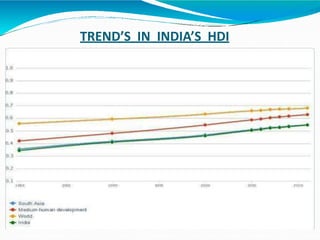
TREND’S IN INDIA’S HDI
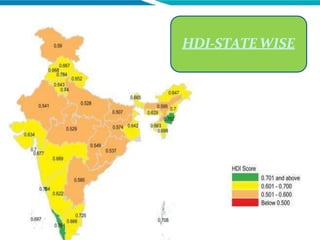
HDI of different states in India
HDI-STATE WISE
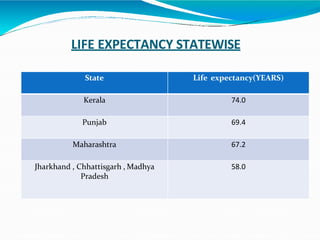
LIFE EXPECTANCY STATEWISE
State Life expectancy(YEARS)
Kerala 74.0
Punjab 69.4
Maharashtra 67.2
Jharkhand , Chhattisgarh , Madhya
Pradesh
58.0
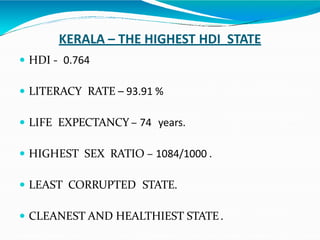
KERALA – THE HIGHEST HDI STATE
 HDI - 0.764
 LITERACY RATE – 93.91 %
 LIFE EXPECTANCY – 74 years.
 HIGHEST SEX RATIO – 1084/1000 .
 LEAST CORRUPTED STATE.
 CLEANEST AND HEALTHIEST STATE.
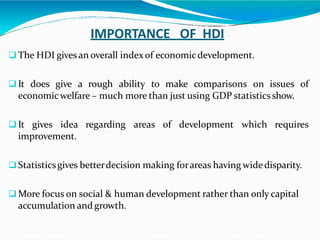
IMPORTANCE OF HDI
 The HDI gives an overall indexof economicdevelopment.
 It does give a rough ability to make comparisons on issues of
economicwelfare – much more than just using GDP statisticsshow.
 It gives idea regarding areas of development which requires
improvement.
 Statisticsgives betterdecision making forareas having wide disparity.
 More focus on social & human development rather than only capital
accumulation and growth.
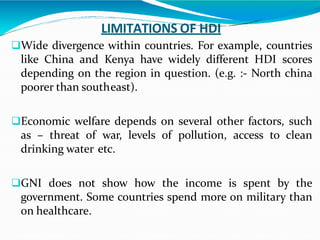
LIMITATIONS OF HDI
Wide divergence within countries. For example, countries
like China and Kenya have widely different HDI scores
depending on the region in question. (e.g. :- North china
poorer than southeast).
Economic welfare depends on several other factors, such
as – threat of war, levels of pollution, access to clean
drinking water etc.
GNI does not show how the income is spent by the
government. Some countries spend more on military than
on healthcare.
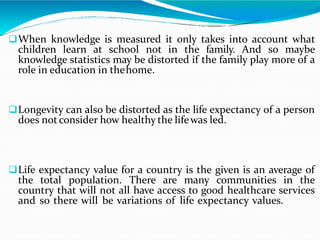
When knowledge is measured it only takes into account what
children learn at school not in the family. And so maybe
knowledge statistics may be distorted if the family play more of a
role in education in thehome.
Longevity can also be distorted as the life expectancy of a person
does not consider how healthy the lifewas led.
Life expectancy value for a country is the given is an average of
the total population. There are many communities in the
country that will not all have access to good healthcare services
and so there will be variations of life expectancy values.
CONCLUSION
an overall index of economic
The HDI gives
development.
There are certain differences among different states
development conditions so there must be equal
opportunities fordevelopment forall.
Some important issues are missing in HDI such as
infrastructure and some economicfactors.
Thank you..!!

human-development-index.pptx

  • 2.
    GROWTH AND DEVELOPMENT Both growth and development refer tochangesovera period of time.  Growth :-  Quantitative and value neutral change.  Positive or a negativesign.  Development :-  Qualitative changewhich is alwaysvalue positive.  Developmentoccurs when positive growth takes place.  For example, if the population of a city grows from one lakh to two lakhs over a period of time, wesay thecity hasgrown.  However, if facilities like housing, provision of basic services and other characteristics remain the same, then this growth has not been accompanied by development.
  • 3.
     The qualityof life people enjoy in a country, the opportunities they have and freedoms they enjoy, are important aspects ofdevelopment.  The concept of human developmentwas introduced by Dr. Mahbub-ul-haq.  Dr. Haq has described human development as development that enlarges people’s choices and improves theirlives.
  • 4.
     Access toresources, health and educationare the key areas in humandevelopment.
  • 5.
    FOUR PILLARS OFHUMAN DEVELOPEMNT  Just as any building is supported by pillars, the idea of human development is supported by the concepts of equity, sustainability, productivity andempowerment.  Equity refers to making equal access to opportunities available to everybody. means continuity in the availability of  Sustainability opportunities.  Productivity here means human labour productivity or productivity in terms of humanwork.  Empowerment means to havethe powerto makechoices.
  • 6.
    WHAT IS HDI? It is a tool used to measure a country's overall achievement in its social and economicdimensions. Definition:- The human development index (HDI) is a composite statistic of life expectancy, education, and per capita income indicators, which is used to rank countries into four tiers of humandevelopment. The human development index is a measure of economic development and economicwelfare.
  • 7.
    ORIGIN OF HDI Devised and launched by Pakistani economist Mahbub-ul- haq in 1990.  Amartya Sen and Mahbub –ul- haq worked upon the capabilities and functioning which provided conceptualframework.  Published by United Nations Development Programme (UNDP). MAHBUB –UL- HAQ AMARTYA SEN
  • 8.
  • 9.
     The humandevelopment indexexamines three importantcriteriaof economic development 1) Life expectancy 2) Education 3) Income levels  Create an overall score between 0 and1.  1 - indicates a high level of economicdevelopment.  0- a very lowlevel.
  • 10.
    MEASURING HUMAN DEVELOPMENT The human development index (HDI) ranks the countries based on their performance in the key areas of health, education and access toresources.  Health :-  The indicator chosen to assess health is the life expectancy atbirth.  A higher life expectancy means that people have a greater chance of living longer and healthierlives.
  • 11.
     Education :- The adult literacyrate and thegrossenrolmentratio represent access toknowledge.  The numberof adults who areable to read and writeand the number of children enrolled in schools show how easy or difficult it is toaccess knowledge in a particularcountry.  Access to resources is measured in termsof purchasing power (in U.S. Dollars).
  • 12.
    INTERNATIONAL COMPARISONS  Oftensmallercountries havedone betterthan larger ones in humandevelopment.  Similarly, relatively poorer nations have beenranked higher than richer neighbours in terms of human development.  For example, Sri Lanka, Trinidad and Tobago havea higher rank than India in the human development index despite having smallereconomies.  Similarly, within India, Kerala performs muchbetter than Punjab and Gujarat in human development despite having lower per capitaincome.
  • 13.
     Ranking base:-Globally countries are divided in the following four classes according to their score in human development index–
  • 14.
    GLOBAL HDI RANKINGS- TOPTEN COUNTRIES RANK COUNTRIES HDI 1 NORWAY 0.944 2 AUSTRALIA 0.933 3 SWITZERLAND 0.917 4 NETHERLANDS 0.915 5 UNITED STATES 0.914 6 GERMANY 0.911 7 NEW ZELAND 0.910 8 CANADA 0.902 9 SINGAPORE 0.901 10 DENMARK 0.900
  • 15.
    LOWEST TEN COUNTRIESIN HDI RANK COUNTRIES HDI 178 MOZAMBIQUE 0.393 179 GUINEA 0.392 180 BURUNDI 0.389 181 BURKINA FASO 0.388 182 ERITERIA 0.381 183 SIERRA LEONE 0.374 184 CHAD 0.372 185 CENTRAL AFRICAN REPUBLIC 0.341 186 CONGO 0.338 187 NIGER 0.337
  • 16.
    HDI ASPECTS OFINDIA  India ranks (2014) – 135  HDI – 0.586  Gain of 0.003 HDI from previous year.  Comes under medium human developmentcountries.  Indicators: -  Life expectancy at birth(by UN). Overall – 64.19 years(Rank 147). male – 62.80 years. Female – 65.73 years.  Education index : 0.473 .  Mean years of schooling : 5.1(rank 65).  GNI(Gross National Income)per capita at PPP :$5350 (rank 127) .
  • 17.
    HDI PROGRAMME ININDIA  Unique in it’skind.  Preparation of not only national report, but also sub-national human development reports (HDR).  Decentralized and integrated the human development concept into its developmentagendaat national, state, as well asdistrict level .  More HDRs have been produced in India than the total number of global HDRs.  Plan is made by the Planning Commission –United Nations Development Programme(UNDP) partnership through the and preparation of State Human Development Reports (SHDR) District Human Development Reports(DHDR).
  • 18.
    8th five year Human development programme started in plan(1992-1997).  First state - Madhya Pradesh.  The world’s first state HDR was published in Madhya Pradesh in 1995 .  Computation of the state’s HDI as well as HDI for all the districts in the state made bystategovt.  So far 21 states have preparedHDRs.  State governments have initiated the work on district HDRs for 80 districts of which 23 HDRs have been released tilldate,  2009 -The first city HDR (Mumbai) waslaunched.
  • 19.
  • 20.
    HDI of differentstates in India HDI-STATE WISE
  • 21.
    LIFE EXPECTANCY STATEWISE StateLife expectancy(YEARS) Kerala 74.0 Punjab 69.4 Maharashtra 67.2 Jharkhand , Chhattisgarh , Madhya Pradesh 58.0
  • 22.
    KERALA – THEHIGHEST HDI STATE  HDI - 0.764  LITERACY RATE – 93.91 %  LIFE EXPECTANCY – 74 years.  HIGHEST SEX RATIO – 1084/1000 .  LEAST CORRUPTED STATE.  CLEANEST AND HEALTHIEST STATE.
  • 23.
    IMPORTANCE OF HDI The HDI gives an overall indexof economicdevelopment.  It does give a rough ability to make comparisons on issues of economicwelfare – much more than just using GDP statisticsshow.  It gives idea regarding areas of development which requires improvement.  Statisticsgives betterdecision making forareas having wide disparity.  More focus on social & human development rather than only capital accumulation and growth.
  • 24.
    LIMITATIONS OF HDI Widedivergence within countries. For example, countries like China and Kenya have widely different HDI scores depending on the region in question. (e.g. :- North china poorer than southeast). Economic welfare depends on several other factors, such as – threat of war, levels of pollution, access to clean drinking water etc. GNI does not show how the income is spent by the government. Some countries spend more on military than on healthcare.
  • 25.
    When knowledge ismeasured it only takes into account what children learn at school not in the family. And so maybe knowledge statistics may be distorted if the family play more of a role in education in thehome. Longevity can also be distorted as the life expectancy of a person does not consider how healthy the lifewas led. Life expectancy value for a country is the given is an average of the total population. There are many communities in the country that will not all have access to good healthcare services and so there will be variations of life expectancy values.
  • 26.
    CONCLUSION an overall indexof economic The HDI gives development. There are certain differences among different states development conditions so there must be equal opportunities fordevelopment forall. Some important issues are missing in HDI such as infrastructure and some economicfactors.
  • 27.