INDICATORS OF
ECONOMIC
DEVELOPMENT
MEANING OF INDICATOR
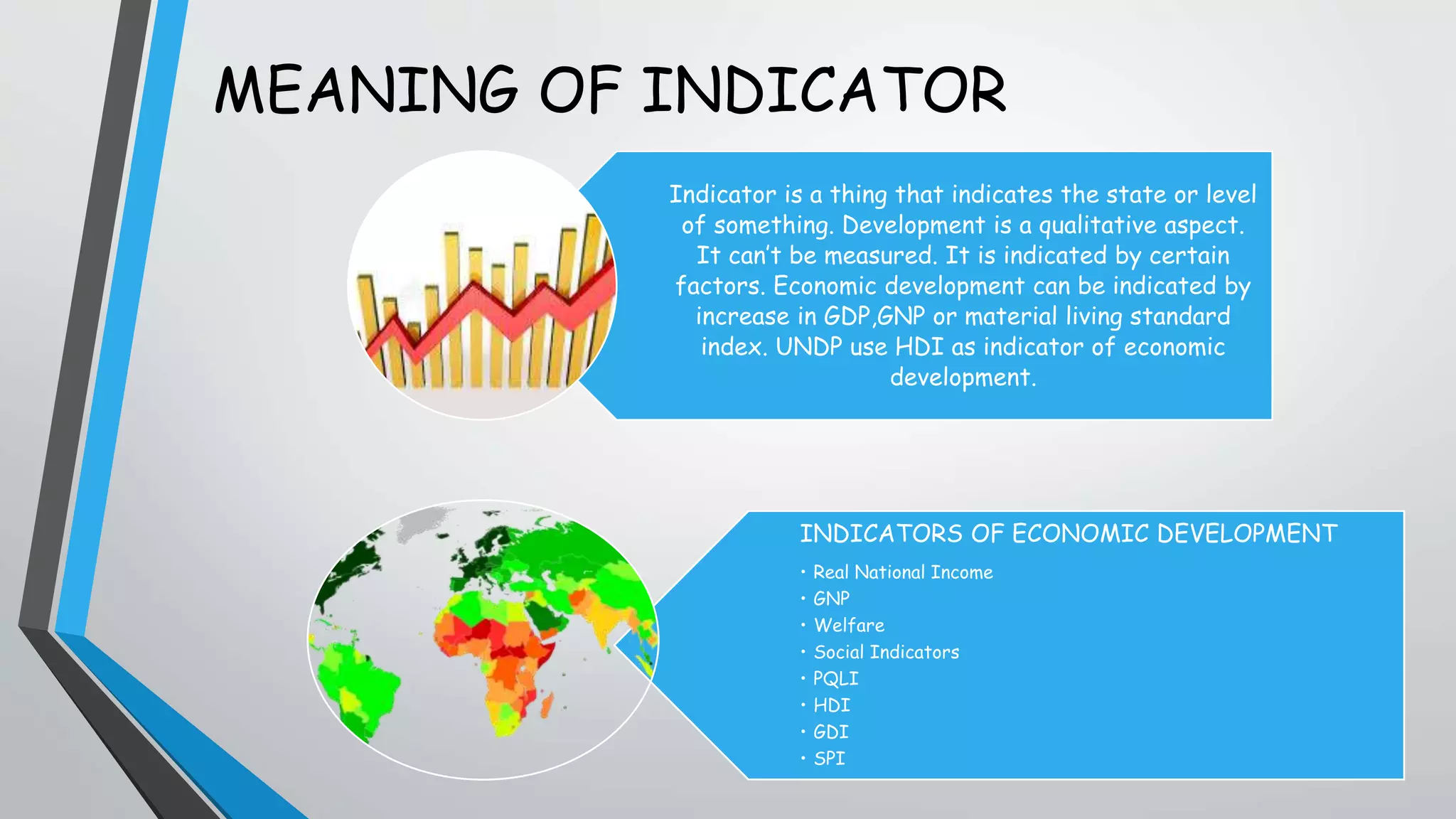
Indicator is a thing that indicates the state or level
of something. Development is a qualitative aspect.
It can’t be measured. It is indicated by certain
factors. Economic development can be indicated by
increase in GDP,GNP or material living standard
index. UNDP use HDI as indicator of economic
development.
INDICATORS OF ECONOMIC DEVELOPMENT
• Real National Income
• GNP
• Welfare
• Social Indicators
• PQLI
• HDI
• GDI
• SPI
1.GNP PER CAPITA
It is the dollar value of country's final output of goods and services
in year divided by total population. It reflects the average income of
a country's citizens. When per capita income of a country increases
for long period of time continuously, it can be said that economic
development has taken place. Economists have taken per capita as an
economic development indicator. It shows an increase in growth rate
of country rather development.
Economic development includes change in spheres beside rise in
per capita. There is economic development if rate of increase in real
per capita is higher than rate of growth of population. There is no
sign of development if growth rate is less than population. Per capita
indicates income for an individual.
PER CAPITA INCOME = Total Income
Total population
LIMITATIONS:
 Per capita income is not actual income of citizen
 Increase in per capita income may not raise real standard
of living of masses
 Per capita income shows only averages
 Only estimates
 Masses will be poor if distribution of income is more
unequal
 Difficulty in comparison due to nominal exchange value
(Exchange value between two currencies) which do not
reflect relative purchasing power of different currencies.
 Fails to take into account problems associated with basic
needs. Improvement in living standards by providing basic
needs can't be measured by increase in per capita income
2.REAL NATIONAL INCOME
National income is the total market value of all final goods and
services produced by all sectors of an economy during a fiscal year.
It is a macroeconomic concept. It is expressed in form of money
since modern economy is a money economy. The division of global
economy is based on real national income.
Y = C+I+G+[x-m]
Y = National Income
C = Consumption by households
I = Investments
G = Government expenditure
X = Exports
M = Imports
National income is also an indicator of economic development.
Higher income indicates higher economic development. Robert
McNamara , Governor of world Bank revealed in February 1930,
failure of GNP growth rate as an index of development.
LIMITATIONS:
 Price changes should be eliminated while calculating national
income. But Price variations are unavoidable. Short period rise in
income does not constitute economic development
 Fails to take changes in population. If rise in income is
accompanied with rise in population there is no development, but
retardation.
 Doesn't reveal social costs to society.
 Doesn't explain distribution of income in economy
 Certain conceptual difficulties in measurement
3.WELFARE
The nation's development and social welfare are also considered to
measure nation's prosperity. Economic development is increase in
consumption of goods and services of individuals.
“ A sustained, secular improvement in material well-being, which
we may consider to be reflected in an increasing flow of goods and
services “
- OKUN AND RICHARDSON
LIMITATIONS :
 giving some importance on consumption of different individuals in p
welfare index is not correct. Because consumption depends on
taste and preference of individual. It differs from person to
person.
 Caution has to be exercised with regard to composition and
valuation of total output.
 Welfare view fails to account methods of production. It sets what
is produced and how much but how it is produce is not take into
consideration. The expansion of output might have raised the real
costs and social costs in economy. The increase in income is
considerable but what if it is at cost of poor working conditions.
 It is not essential that with increased national income, economic
welfare has gone up. Economic development is reflected in equal
distribution.
4. SOCIAL INDICATORS
Economists were dissatisfied by taking GNP/GNP per capita as an
indicator of economic development. Economists tried to measure
development in terms of social indicators.
Social Indicators
Basic needs for
development
Basic needs leads
to higher level of
productivity and
income through
human
development in
form of educated
and healthy
people
Basic needs focus
on reduction of
poverty by
providing basic
human needs to
poor
GNP/GNP per capita taken into consideration, development takes long
period of time. But if basic reeds are provided, it takes short period of
time.
GNP/GNP per capita long period improvement in poverty.
Education, sanitation etc → short period affects poverty.
BASIC NEEDS INDICATOR
1. HEALTH Life expectancy rate
2.EDUCATION Literacy signifying primary enrolment as % of
population
3.FOOD Calorie supply per head
4.WATER SUPPLY Infant mortality rate and % of population with
respect to potable water
5.SANITATION Infant mortality and % of population with respect
to access to sanitation
UNITED NATIONS DEVELOPMENT PROGRAMME
UNDP in it's first human development report defined human
development as "a process of enlarging people's choices”. Human
development is broad and comprehensive concept. There is no automatic
link between growth and development. Economic growth is essential for
human development. Human development is equally important because it
is healthy and educated people who contribute to growth by productive
employment and increase in income.
LIMITATIONS:
 Problems arise in constructing composite index based on rational
weighing system.
 No unanimity among economists as to no of and type of item to be
included in such index. They involve value judgements.
 Social, economic and political set-up of a country will play a role in
assignment of weights namely poverty, education nutrition, health
 Social indicators are talking about current period & do not talk about
future products
INDICATORS OF
CONSTRUCTING
COMPOSITE INDICES OF
HUMAN DEVELOPMENT
• PQLI
• HDI
• SPI
• GNH
• GDI
PHYSICAL QUALITY OF LIFE INDEX
PQLI was discovered by M.D. Morris in 1949. PQLI possess many
challenges to GNI per Capita as a measure of development. It s a non-
income indicator because it uses physical quality of life as index. PQLI
is constructed relating to 23 countries for comparative Study. It is
based on:
I. Life expectancy rate
II. Infant mortality rate
III.Basic Literacy
It measures performance in meeting basic needs
such as health, nutrition, sanitation etc. PQLI is better indicator and
the best than per capita income. It measures quality of life indirectly
and points towards that indicator which requires immediate action.
PQLI is
increasing in
country when:
Increase in life
expectancy rate
Fall in infant
mortality rate
Rise in literacy
rate
PQLI
Life expectancy
Infant mortality
rate
Literacy
LIFE EXPECTANCY: Average no of years a person is expected to live
INFANT MORTALITY RATE : Ratio of no of deaths per 1000 born
children in a year
LITERACY : Any person above age 7 years who can read and write
any one of language
IMR = DEATH LESS THAN ONE YEAR
NO OF LIVE BIRTHS [1000]
TABLE SHOWING DATA RELATED TO IMR, LITERACY AND LIFE EXPECTANCY
YEAR IMR LIFE
EXPECTANCY
LITERACY
2011 47/1000 66.8 YEARS 74.04%
2019 30/1000 68.7 YEARS 64.7%[RURAL]
79.5%[URBAN]
LIMITATIONS:
 Limited measure of basic needs
 Doesn't explain changing structure of economic and social
organization
 Doesn't measure total welfare
 Equal weights given to three variables of PQLI
HUMAN DEVELOPMENT INDEX
HDI is a modern indicator of economic development. It is a
statistical tool used to measure a country's overall achievement
in its social and economic dimensions. It was developed by
Mahbub – Ul - Haq , Pakistan economist. UNDP incorporated in its
first Human Development Report in 1990 and follows the same
year after year from 1990 for measurement of human
development.
HDI is composite index of three social indicators:
 Life expectancy
 Adult literacy, combined gross enrolment ratio
 Years of schooling
 Real GDP per capita based on purchasing power parity
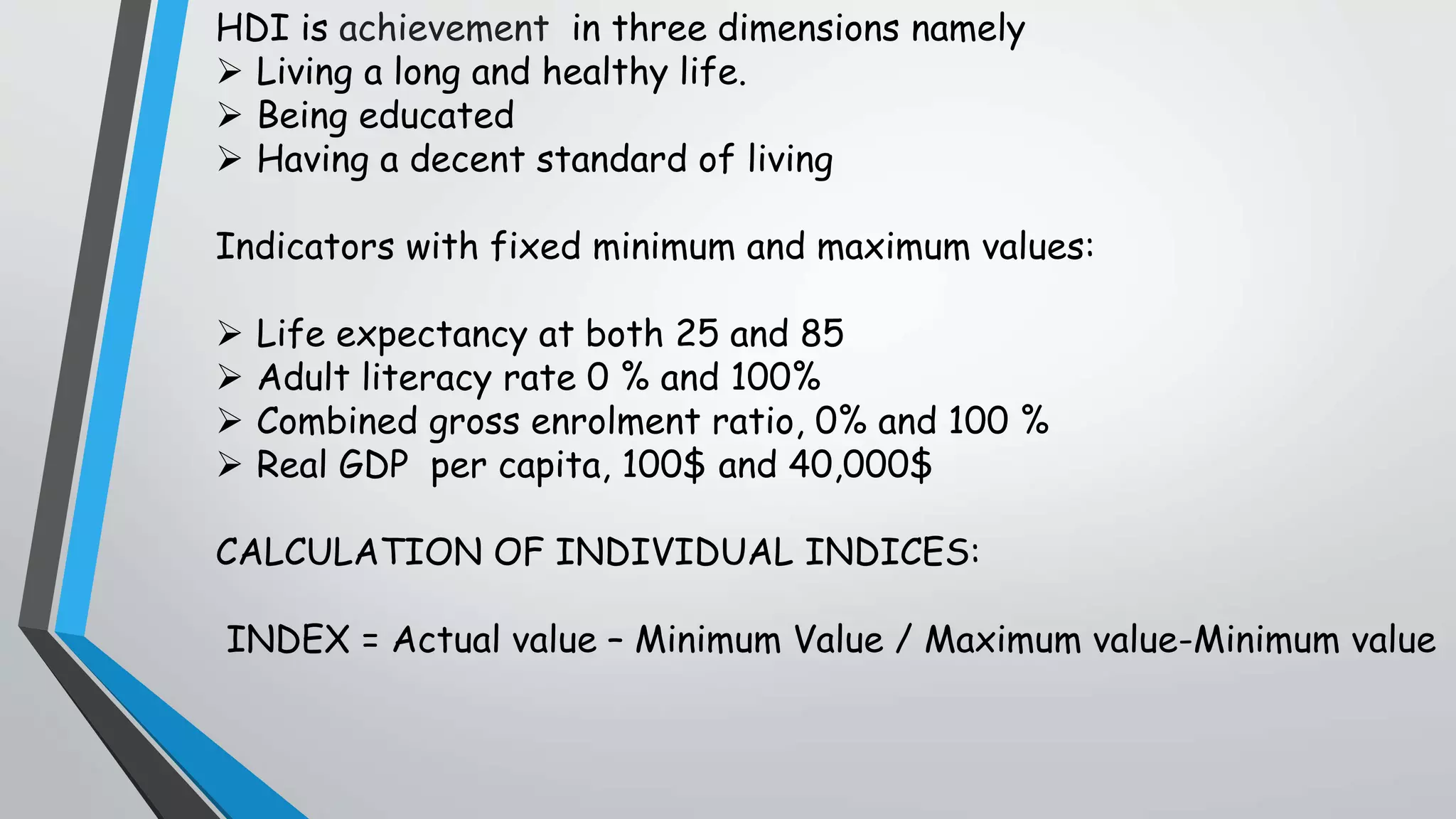
HDI is achievement in three dimensions namely
 Living a long and healthy life.
 Being educated
 Having a decent standard of living
Indicators with fixed minimum and maximum values:
 Life expectancy at both 25 and 85
 Adult literacy rate 0 % and 100%
 Combined gross enrolment ratio, 0% and 100 %
 Real GDP per capita, 100$ and 40,000$
CALCULATION OF INDIVIDUAL INDICES:
INDEX = Actual value – Minimum Value / Maximum value-Minimum value
HDI is simple average of three dimension indices. It's value
range from 0 to 1. HDI takes GNP per capita in to
consideration for measurement of development. HDI
measures relative rather than absolute human development.
No importance is given to social and political freedom and
gender inequalities. HDI provides better picture of
country's development than its income alone.
COUNTRY’S HDI MEASUREMNT[HDI
2013]
Below 0.5 and 0.8 - Medium level human development
Below 0.5 - Low level human development
Above 0.8 - High level human development
INDIA’S HDI VALUE
YEAR HDI VALUE
1990 0.427
1995 0.546
2001 0.472
2002 0.595
2007 0.612
2010 0.519
2013 0.586
INDIA’S RANK IN HDI
2018 – 131 out of 189 countries
2019 – 129 out of 189 countries
2020 – 131 out of 189 countries
GENDER RELATED DEVELOPMENT
INDEX[ GDI]
GDI is an indicator of economic development. It is an index
designed to measure gender inequality. GDI together with
gender empowerment measure introduced in 1995 in Human
development Report published by UNDP. So GDI introduced in
1990 and GEM introduced in 1995.
GDI is composite index which measures development of a country
according to their standard of living. It measures same as HDI but
also includes gender inequalities in level of achievement in basic
aspects of human development. It is same as HDI but separated
by gender.
HIGHLIGHTS INEQUALITIES IN AREAS OF :
 Long and healthy life between men and women
 Knowledge between men and women
 Standard of living between men and women
GDI is ratio of HDI's calculated separately females and males
using same methodology as in measure of gender gap. It addresses
gender gaps in life expectancy, education and incomes. The aim is
to add gender sensitive dimension to HDI.
If there is greater inequality, GDI is less than HDI, greater
difference is more inequality. Efforts are being made to reduce
gender inequality. Women movements are promoting and working
for gender inequality.
GENDER EMPOWERMENT MEASURE
Gender Empowerment Measure is measure of
inequalities between men's & women's opportunities in a country.
It combines inequalities in three areas:
• Political participation
• Decision making and economic
participation
• Power over economic resources
GEM
A. Measured by men’s and women’s participation and shares in
parliament seats
B. Measured by men’s and women’s percentage shares of position as
senior officials, managers, professionals
C. Measured by men’s and women’s estimated earned income
SOCIAL PROGRESSIVE INDEX
This indicator measures well-being of society by observing
social and environmental outcomes rather than economic factors. It
based on writings of Amartya Sen, Douglass North, Joseph Stiglitz.
It focuses on development indicators beyond GDP. SPI measures
extent to which country provides for social and environmental needs
of citizens. 54 indicators are taken to show relative performance of
nation. It includes wellness, equality, inclusion, sustainability and
personal freedom and safety.
• [ A] BASIC HUMAN NEEDS
• Nutrition
• Basic medical care
• Water
• Sanitation
• Shelter
• Personal safety
• [B]Foundation of well being
• Basic knowledge
• Information
• Communication
• Health
• Wellness
• Environmental quality
• [C] Opportunity
• Personal rights
• Personal freedom
• Inclusion
• Access to advanced education
SOCIAL
PROGRESSIVE
INDEX
MULTI-DIMENSIONAL
POVERTY INDEX[MPI]
It was introduced in 2010 and
designed to illustrate many
deprivations faced by most severely
disadvantaged in their daily life such
as poor health, lack of education, low
living standard. It requires household
to be deprived in multiple indicators
at same time. A person in multi-
dimensionally poor if weighted
indicators add up to 33%.
TEN COMPONENTS
OF MILLENIUM
DEVELOPMENT
GOALS
• Possession of some assets
• Nutrition
• Child mortality
• Access to drinking water
• Access to safe room
• Access to electricity
• Years of schooling
• Access to improved cooking oil
• Access to sanitation
• Children enrolled in school

INDICATORS OF ECONOMIC DEVELOPMENT.pptx

  • 1.
  • 2.
    MEANING OF INDICATOR Indicatoris a thing that indicates the state or level of something. Development is a qualitative aspect. It can’t be measured. It is indicated by certain factors. Economic development can be indicated by increase in GDP,GNP or material living standard index. UNDP use HDI as indicator of economic development. INDICATORS OF ECONOMIC DEVELOPMENT • Real National Income • GNP • Welfare • Social Indicators • PQLI • HDI • GDI • SPI
  • 3.
    1.GNP PER CAPITA Itis the dollar value of country's final output of goods and services in year divided by total population. It reflects the average income of a country's citizens. When per capita income of a country increases for long period of time continuously, it can be said that economic development has taken place. Economists have taken per capita as an economic development indicator. It shows an increase in growth rate of country rather development. Economic development includes change in spheres beside rise in per capita. There is economic development if rate of increase in real per capita is higher than rate of growth of population. There is no sign of development if growth rate is less than population. Per capita indicates income for an individual. PER CAPITA INCOME = Total Income Total population
  • 4.
    LIMITATIONS:  Per capitaincome is not actual income of citizen  Increase in per capita income may not raise real standard of living of masses  Per capita income shows only averages  Only estimates  Masses will be poor if distribution of income is more unequal  Difficulty in comparison due to nominal exchange value (Exchange value between two currencies) which do not reflect relative purchasing power of different currencies.  Fails to take into account problems associated with basic needs. Improvement in living standards by providing basic needs can't be measured by increase in per capita income
  • 5.
    2.REAL NATIONAL INCOME Nationalincome is the total market value of all final goods and services produced by all sectors of an economy during a fiscal year. It is a macroeconomic concept. It is expressed in form of money since modern economy is a money economy. The division of global economy is based on real national income. Y = C+I+G+[x-m] Y = National Income C = Consumption by households I = Investments G = Government expenditure X = Exports M = Imports
  • 6.
    National income isalso an indicator of economic development. Higher income indicates higher economic development. Robert McNamara , Governor of world Bank revealed in February 1930, failure of GNP growth rate as an index of development. LIMITATIONS:  Price changes should be eliminated while calculating national income. But Price variations are unavoidable. Short period rise in income does not constitute economic development  Fails to take changes in population. If rise in income is accompanied with rise in population there is no development, but retardation.  Doesn't reveal social costs to society.  Doesn't explain distribution of income in economy  Certain conceptual difficulties in measurement
  • 7.
    3.WELFARE The nation's developmentand social welfare are also considered to measure nation's prosperity. Economic development is increase in consumption of goods and services of individuals. “ A sustained, secular improvement in material well-being, which we may consider to be reflected in an increasing flow of goods and services “ - OKUN AND RICHARDSON LIMITATIONS :  giving some importance on consumption of different individuals in p welfare index is not correct. Because consumption depends on taste and preference of individual. It differs from person to person.  Caution has to be exercised with regard to composition and valuation of total output.
  • 8.
     Welfare viewfails to account methods of production. It sets what is produced and how much but how it is produce is not take into consideration. The expansion of output might have raised the real costs and social costs in economy. The increase in income is considerable but what if it is at cost of poor working conditions.  It is not essential that with increased national income, economic welfare has gone up. Economic development is reflected in equal distribution. 4. SOCIAL INDICATORS Economists were dissatisfied by taking GNP/GNP per capita as an indicator of economic development. Economists tried to measure development in terms of social indicators.
  • 9.
    Social Indicators Basic needsfor development Basic needs leads to higher level of productivity and income through human development in form of educated and healthy people Basic needs focus on reduction of poverty by providing basic human needs to poor
  • 10.
    GNP/GNP per capitataken into consideration, development takes long period of time. But if basic reeds are provided, it takes short period of time. GNP/GNP per capita long period improvement in poverty. Education, sanitation etc → short period affects poverty. BASIC NEEDS INDICATOR 1. HEALTH Life expectancy rate 2.EDUCATION Literacy signifying primary enrolment as % of population 3.FOOD Calorie supply per head 4.WATER SUPPLY Infant mortality rate and % of population with respect to potable water 5.SANITATION Infant mortality and % of population with respect to access to sanitation
  • 11.
    UNITED NATIONS DEVELOPMENTPROGRAMME UNDP in it's first human development report defined human development as "a process of enlarging people's choices”. Human development is broad and comprehensive concept. There is no automatic link between growth and development. Economic growth is essential for human development. Human development is equally important because it is healthy and educated people who contribute to growth by productive employment and increase in income. LIMITATIONS:  Problems arise in constructing composite index based on rational weighing system.  No unanimity among economists as to no of and type of item to be included in such index. They involve value judgements.  Social, economic and political set-up of a country will play a role in assignment of weights namely poverty, education nutrition, health  Social indicators are talking about current period & do not talk about future products
  • 12.
    INDICATORS OF CONSTRUCTING COMPOSITE INDICESOF HUMAN DEVELOPMENT • PQLI • HDI • SPI • GNH • GDI
  • 13.
    PHYSICAL QUALITY OFLIFE INDEX PQLI was discovered by M.D. Morris in 1949. PQLI possess many challenges to GNI per Capita as a measure of development. It s a non- income indicator because it uses physical quality of life as index. PQLI is constructed relating to 23 countries for comparative Study. It is based on: I. Life expectancy rate II. Infant mortality rate III.Basic Literacy It measures performance in meeting basic needs such as health, nutrition, sanitation etc. PQLI is better indicator and the best than per capita income. It measures quality of life indirectly and points towards that indicator which requires immediate action.
  • 14.
    PQLI is increasing in countrywhen: Increase in life expectancy rate Fall in infant mortality rate Rise in literacy rate PQLI Life expectancy Infant mortality rate Literacy LIFE EXPECTANCY: Average no of years a person is expected to live INFANT MORTALITY RATE : Ratio of no of deaths per 1000 born children in a year LITERACY : Any person above age 7 years who can read and write any one of language IMR = DEATH LESS THAN ONE YEAR NO OF LIVE BIRTHS [1000]
  • 15.
    TABLE SHOWING DATARELATED TO IMR, LITERACY AND LIFE EXPECTANCY YEAR IMR LIFE EXPECTANCY LITERACY 2011 47/1000 66.8 YEARS 74.04% 2019 30/1000 68.7 YEARS 64.7%[RURAL] 79.5%[URBAN] LIMITATIONS:  Limited measure of basic needs  Doesn't explain changing structure of economic and social organization  Doesn't measure total welfare  Equal weights given to three variables of PQLI
  • 16.
    HUMAN DEVELOPMENT INDEX HDIis a modern indicator of economic development. It is a statistical tool used to measure a country's overall achievement in its social and economic dimensions. It was developed by Mahbub – Ul - Haq , Pakistan economist. UNDP incorporated in its first Human Development Report in 1990 and follows the same year after year from 1990 for measurement of human development. HDI is composite index of three social indicators:  Life expectancy  Adult literacy, combined gross enrolment ratio  Years of schooling  Real GDP per capita based on purchasing power parity
  • 17.
    HDI is achievementin three dimensions namely  Living a long and healthy life.  Being educated  Having a decent standard of living Indicators with fixed minimum and maximum values:  Life expectancy at both 25 and 85  Adult literacy rate 0 % and 100%  Combined gross enrolment ratio, 0% and 100 %  Real GDP per capita, 100$ and 40,000$ CALCULATION OF INDIVIDUAL INDICES: INDEX = Actual value – Minimum Value / Maximum value-Minimum value
  • 18.
    HDI is simpleaverage of three dimension indices. It's value range from 0 to 1. HDI takes GNP per capita in to consideration for measurement of development. HDI measures relative rather than absolute human development. No importance is given to social and political freedom and gender inequalities. HDI provides better picture of country's development than its income alone. COUNTRY’S HDI MEASUREMNT[HDI 2013] Below 0.5 and 0.8 - Medium level human development Below 0.5 - Low level human development Above 0.8 - High level human development
  • 19.
    INDIA’S HDI VALUE YEARHDI VALUE 1990 0.427 1995 0.546 2001 0.472 2002 0.595 2007 0.612 2010 0.519 2013 0.586
  • 20.
    INDIA’S RANK INHDI 2018 – 131 out of 189 countries 2019 – 129 out of 189 countries 2020 – 131 out of 189 countries GENDER RELATED DEVELOPMENT INDEX[ GDI] GDI is an indicator of economic development. It is an index designed to measure gender inequality. GDI together with gender empowerment measure introduced in 1995 in Human development Report published by UNDP. So GDI introduced in 1990 and GEM introduced in 1995.
  • 21.
    GDI is compositeindex which measures development of a country according to their standard of living. It measures same as HDI but also includes gender inequalities in level of achievement in basic aspects of human development. It is same as HDI but separated by gender. HIGHLIGHTS INEQUALITIES IN AREAS OF :  Long and healthy life between men and women  Knowledge between men and women  Standard of living between men and women GDI is ratio of HDI's calculated separately females and males using same methodology as in measure of gender gap. It addresses gender gaps in life expectancy, education and incomes. The aim is to add gender sensitive dimension to HDI.
  • 22.
    If there isgreater inequality, GDI is less than HDI, greater difference is more inequality. Efforts are being made to reduce gender inequality. Women movements are promoting and working for gender inequality. GENDER EMPOWERMENT MEASURE Gender Empowerment Measure is measure of inequalities between men's & women's opportunities in a country. It combines inequalities in three areas: • Political participation • Decision making and economic participation • Power over economic resources GEM
  • 23.
    A. Measured bymen’s and women’s participation and shares in parliament seats B. Measured by men’s and women’s percentage shares of position as senior officials, managers, professionals C. Measured by men’s and women’s estimated earned income SOCIAL PROGRESSIVE INDEX This indicator measures well-being of society by observing social and environmental outcomes rather than economic factors. It based on writings of Amartya Sen, Douglass North, Joseph Stiglitz. It focuses on development indicators beyond GDP. SPI measures extent to which country provides for social and environmental needs of citizens. 54 indicators are taken to show relative performance of nation. It includes wellness, equality, inclusion, sustainability and personal freedom and safety.
  • 24.
    • [ A]BASIC HUMAN NEEDS • Nutrition • Basic medical care • Water • Sanitation • Shelter • Personal safety • [B]Foundation of well being • Basic knowledge • Information • Communication • Health • Wellness • Environmental quality • [C] Opportunity • Personal rights • Personal freedom • Inclusion • Access to advanced education SOCIAL PROGRESSIVE INDEX
  • 25.
    MULTI-DIMENSIONAL POVERTY INDEX[MPI] It wasintroduced in 2010 and designed to illustrate many deprivations faced by most severely disadvantaged in their daily life such as poor health, lack of education, low living standard. It requires household to be deprived in multiple indicators at same time. A person in multi- dimensionally poor if weighted indicators add up to 33%.
  • 26.
    TEN COMPONENTS OF MILLENIUM DEVELOPMENT GOALS •Possession of some assets • Nutrition • Child mortality • Access to drinking water • Access to safe room • Access to electricity • Years of schooling • Access to improved cooking oil • Access to sanitation • Children enrolled in school