HUMAN DEVELOPMENT INDEX(HDI)
IN INDIA
PRESENTED BY
Sagar Patel
Jamnalal Bajaj Institute Of
Management
MMM- 2nd Year
Roll No- 14 M 508
It is a tool used to measure a country's overall achievement in
its social and economic dimensions.
• Definition:-
The human development index (HDI) is a
composite statistic of life expectancy, education, and per
capita income indicators, which is used to rank countries into
four tiers of human development.
The human development index is a measure of economic
development and economic welfare.
• Devised and launched by Pakistani economist Mahbub-ul- haq in 1990.
• Amartya Sen and Mahbub –ul- haq worked upon the capabilities and
functioning which provided conceptual framework.
• Published by United Nations Development Programme (UNDP).
MAHBUB –UL- HAQ AMARTYA SEN
Both growth and development refer to changes over a period of time.
• Growth :
 Quantitative and value neutral change .
 Positive or a negative sign.
• Development :-
 Qualitative change which is always value positive.
 Development occurs when positive growth takes place.
For example, if the population of a city grows from one lakh to two
lakhs over a period of time, we say the city has grown.
However, if facilities like housing, provision of basic services and other
characteristics remain the same, then this growth has not been
accompanied by development.
• The quality of life people enjoy in a country, the
opportunities they have and freedoms they enjoy, are
important aspects of development.
• The concept of human development was
introduced by Dr. Mahbub-ul-haq.
• Dr. Haq has described human
development as development
that enlarges people’s choices
and improves their lives.
Just as any building is supported by pillars, the idea of human
development is supported by the concepts of equity,
sustainability, productivity and empowerment.
• Equity refers to making equal access to opportunities available
to everybody.
• Sustainability means continuity in the availability of
opportunities.
• Productivity here means human labour productivity or
productivity in terms of human work.
• Empowerment means to have the power to make choices.
The HDI consists of three equally weighted components:
• (1) “A long and healthy life” (Health)
• (2) “Knowledge” (Education)
• (3) “A decent standard of living” (Wealth)
Each component of the HDI is measured in the following way:
• Health
Measured by life expectancy at birth.
• Education
Measured as a combination of adult literacy (with two-
thirds weight) and gross enrollment (with one-third
weight).
• Wealth
Measured by GDP per capita.
• In the United States, in 2005:
• The average life expectancy was 77.9.
• The adult literacy rate was 99%.
• The gross enrollment rate was 93.3%.
• The GDP per capita was $41,890.
• The HDI was .951.
• The HDI ranking was 12th.
1) Validity: It tells how well does the index actually
measure what it is supposed to be measuring?
2) Reliability: It indicates if you or someone else were
to try to replicate the index would you end up with
more or less the same results?
3) Parsimony: It shows does the index rely upon as few
indicators as reasonably possible without
undermining its validity?
Inequality-adjusted
Human Development
Index(IHDI)
Knowledge
Meanyears Expectedyears of
schooling ofschooling
EducationindexLife expectancyindex
HumanDevelopmentIndex (HDI)
Life expectancyat birth
GNIindex
GNIpercapita(PPP $)
DIMENSIONS
INDICATORS
DIMENSION
INDEX
Long and healthy life A decent standard oflivingHuman Development
Index(HDI)
KnowledgeLong and healthy life A decent standard ofliving
Mean years Expectedyears of
schooling of schooling
YearsofschoolingLifeexpectancy
Inequality-adjusted HumanDevelopmentIndex (IHDI)
Life expectancyat birth
Income/consumption
GNIpercapita(PPP $)
Health Education
Years Children of
schooling enrolled
Intensity Headcount
of poverty ratio
Multidimensional Poverty Index(MPI)
Standardofliving
Nutrition Child mortality Cookingfuel Toilet Water Electricity Floor Assets
DIMENSIONS
INDICATORS
POVERTY
MEASURES
Multidimensional
Poverty Index (MPI)
DIMENSIONS
INDICATORS
DIMENSION
INDEX
Health Empowerment
Female andmalesharesof
parliamentaryseats
Female and male population with
atleast
secondaryeducation
Female andmale
labour force
participation rates
Femalelabour
marketindex
Labourmarket
Maternal Adolescent
mortality fertility
ratio rate
DIMENSIONS
INDICATORS
Gender Inequality
Index(GII)
Gender InequalityIndex (GII)
Femaleempowerment
index
Female gender index Male gender index
Male labour
marketindex
Maleempowerment
index
Femalereproductive
healthindex
DIMENSION
INDEX
Inequality-adjusted
educationindex
Inequality-adjusted life
expectancyindex
Inequality-adjusted
incomeindex
INEQUALITY-
ADJUSTED
INDEX
Steps tocalculate the Human Development Index
There are two stepsto calculatingthe HDI.
Step 1.Creating thedimension indices
Indicator Observed maximum Minimum
Life expectancy (years) 83.6
(Japan, 2012)
20.0
Mean years of schooling 13.3
(United States, 2010)
0
Expected years of
schooling
18.0
(capped at)
0
Combined education
index
0.971
(New Zealand, 2010)
0
GNI per capita (PPP $) 87,478
(Qatar, 2012)
100
Having defined the minimum and maximum values, the subindices are calculated as
follows:
maximum value – minimum value
Dimension index = actual value – minimum value .
The Human Development Index (HDI) is a summary measure of key dimensions
of human development - a long and healthy life, access to knowledge and a decent
standard of living.
Step 2. Aggregating thesubindices toproducetheHuman Development Index
Indicator Value
Life expectancy at birth (years) 64.6
Mean years of schooling 7.0
Expected years of schooling 11.4
GNI per capita (PPP $) 1,684
Life expectancy index = 83.6 – 20 = 0.701
64.6 – 20
Education index = 0.527 . 0.634 – 0 = 0.596
0.971 – 0
Income index = ln(1,684) – ln(100) = 0.417
ln(87,478) – ln(100)
Human Development Index = 3
0.701 . 0.596 . 0.417 = 0.558
7.0 – 0
Mean years of schooling index = 13.3 – 0 = 0.527
Expected yearsof schooling index= = 0.634
18.0 – 0
11.4 – 0
The HDI is the geometric mean of the three dimension indices:
1/3. I 1/3. I1/3).(ILife Education Income
0.000
0.100
0.200
0.300
0.400
0.500
0.600
0.700
1990 2000 2010 2011 2012 2013 2014
Year 1990 2000 2010 2011 2012 2013 2014
HDI 0.428 0.496 0.586 0.597 0.600 0.604 0.609
Gender Inequality Index
Proportion of Seats
Held by Women in
National Parliament
Human Development
Index for SCHuman Development
Index for ST
Proportion of Land Area
Covered by Forest
Adult Literacy Rate
India has been placed at 130th position in the 2015 Human Development Index
(HDI) among the 188 countries. It was unveiled in the recently released Human
Development Report 2015 by the United Nations Development Programme
(UNDP).
• India has been placed at 130th position with 0.609 score in the medium human
development category. In 2014 report country’s rank was 135 with 0.586
score.
• Improvement in India’s 2015 HDI from previous year has been attributed to
rise in life expectancy and per capita income.
• India’s Life expectancy at birth: It has increased to 68 years in 2014 from
67.6 in the previous year and 53.9 in 1980. Gross National Income (GNI) per
capita: It has increased to $5,497 in 2014 from $5,180 in 2013 and $1,255 in
1980. India’s GNI per capita increased by about 338 per cent between 1980
and 2014.
• Gender Inequality Index (GII): India rank at 130th position with value of
0.563 out of 155 countries in the 2014.
• India’s HDI value increased from 0.362 to 0.609 between 1980 and 2014. It
indicates an increase of 68.1 per cent or an average annual increase of about
1.54 per cent.
• India’s life expectancy at birth increased by 14.1 years between 1980 and
2014. The mean years of schooling has increased by 3.5 years and expected
years of schooling increased by 5.3 years in the same period.
• Top Three Countries: Norway (1st rank), Australia (2nd) and Switzerland
(3rd). India’s Neighbours: Sri Lanka (73 rank), China (90), Bhutan (132),
Bangladesh (142), Nepal (145), Pakistan (147) and Afghanistan (171).
• BRICS Nations: Russia (50 rank), Brazil (75), China (90), South Africa (116)
and India (130).
• Strong Economic Growth
The economy grew at an average annual rate of 7.26 percent over the past five years. Between 2014 and 2015, the
manufacturing sector grew by 8.4 percent, up from 4.4 percent a year ago. Between 2014 and 2015, the Indian
manufacturing sector grew by a substantial 8.4 percent, up from 4.4 percent a year ago. India has also firmly
established itself as a lucrative foreign investment destination, with foreign capital inflows of over US$ 31 billion in
2015 - surpassing the US and China. India’s dynamic services sector, second only to China in terms of growth rate,
clocked an impressive double-digit growth rate of 10.6 percent in 2015, up from 9.1 percent in 2014.
• Leadership in South-South Collaboration
By sharing its knowledge and development experience with other developing countries in bilateral, regional and
multilateral frameworks, India has become a critical player in regional organisations such as SAARC, as well as in
international forums such as BRICS. In 2015, BRICS states came together to establish the multilateral New
Development Bank, as an alternative to the existing US-dominated World Bank and International Monetary Fund. The
Bank has been set up to foster greater financial and development cooperation among the five emerging markets which
account for nearly 42 percent of the worlds’ population and 25 percent of global GDP.
IBSA, the forum for India, Brazil and South Africa cooperation, is another such initiative operationalised in 2005,
following the establishment of a Trust Fund in partnership with UNDP. The Fund, with an initial corpus of US$ 3
million, today has an accumulated capital of more than US$ 30 million, with various success stories implemented and
several others ongoing.
• Progressive Rights-based Legislations
Over the past decade, India has introduced some of the world’s most far-reaching and progressive rights-based
legislations in the world aimed at reducing poverty. Some of these ambitious legislations include, the Mahatma Gandhi
National Rural Employment Guarantee Act (MGNREGA), Right to Education, Right to Information and Right to Food
(National Food Security Act) which have emerged as cornerstones of poverty reduction strategies. MGNREGA has
improved the average wage rate per day, which has increased from US$ 1.79 in 2009-2010 to US$ 2.83 in 2015.
• Persistent Inequality
Persistent inequality is reflected in the low human development attainments of the country’s most marginalized
groups including scheduled castes, tribal and rural populations, women, transgenders, people living with HIV and
migrants.
• Gender Inequality Despite Economic Growth
Gender inequality in India persists despite high rates of economic growth, and is particularly apparent among
marginalized groups. Women participate in employment and decision making much less, than men. This disparity is
not likely to be eliminated soon. India’s poor performance on women’s empowerment and gender equality is reflected
in many indicators, particularly, the low sex ratio.
The government has launched several commendable schemes to save and educate the girl child and the national
average has risen from 943 females per 1000 males. However, in many parts of India it continues to remains low.
Gender inequality is also reflected in India’s low rank on UNDP’s Gender Inequality Index. In 2014, the country ranked
127 out of 146 countries with a value of 0.563.
• Implementation Challenges of Rights-based Schemes
The effectiveness of rights-based legislations such as the Mahatma Gandhi National Rural Employment Guarantee Act,
the Forest Rights Act and Panchayat Extension to Scheduled Areas has been hampered by weak implementation.
Reducing corruption is a key priority for India’s government.
• Rising Vulnerability to Climate Change and Disaster
Around 68 percent of cultivable land in India is prone to drought of varying intensities and around 12 percent of total
land is flood prone. Diverse factors, natural and human induced, adverse geo-climatic conditions, topographic features,
environmental degradation, population growth, urbanization and industrialization play a huge role in accelerating the
intensity and frequency of disasters resulting in huge economic losses and human casualties. With close to 533 million
or 40 percent of the population expected to live in urban areas by 2025, the vulnerability of India’s cities to hazards is
also likely to increase.
• The HDI gives an overall index of economic development.
• It does give a rough ability to make comparisons on issues of
economic welfare – much more than just using GDP statistics show.
• It gives idea regarding areas of development which requires
improvement.
• Statistics aid better decision making for areas having wide disparity.
• More focus on social & human development rather than only capital
accumulation and growth.
• HDI helps set national priorities
• Identifies the areas that need priority policy attention
• Identifies potential for growth of a country
• Disaggregated HDI becomes a powerful tool for compassionate
governance
• Acts as an early warning system
• Allows countries to track their performance over time
• Spurs construction of other indexes
• Wide divergence within countries. For example, countries like China and
Kenya have widely different HDI scores depending on the region in question.
(e.g. :- North china poorer than south east).
• Economic welfare depends on several other factors, such as – threat of war,
levels of pollution, access to clean drinking water etc.
• GNI does not show how the income is spent by the government. Some
countries spend more on military than on healthcare
• Longevity can also be distorted as the life expectancy of a person does not
consider how healthy the life was led
• Life expectancy value for a country is the given is an average of the total
population. There are many communities in the country that will not have
access to good healthcare services and so there will be variations of life
expectancy values.
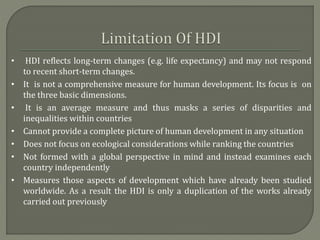
• HDI reflects long-term changes (e.g. life expectancy) and may not respond
to recent short-term changes.
• It is not a comprehensive measure for human development. Its focus is on
the three basic dimensions.
• It is an average measure and thus masks a series of disparities and
inequalities within countries
• Cannot provide a complete picture of human development in any situation
• Does not focus on ecological considerations while ranking the countries
• Not formed with a global perspective in mind and instead examines each
country independently
• Measures those aspects of development which have already been studied
worldwide. As a result the HDI is only a duplication of the works already
carried out previously
HDI

HDI

  • 1.
    HUMAN DEVELOPMENT INDEX(HDI) ININDIA PRESENTED BY Sagar Patel Jamnalal Bajaj Institute Of Management MMM- 2nd Year Roll No- 14 M 508
  • 2.
    It is atool used to measure a country's overall achievement in its social and economic dimensions. • Definition:- The human development index (HDI) is a composite statistic of life expectancy, education, and per capita income indicators, which is used to rank countries into four tiers of human development. The human development index is a measure of economic development and economic welfare.
  • 3.
    • Devised andlaunched by Pakistani economist Mahbub-ul- haq in 1990. • Amartya Sen and Mahbub –ul- haq worked upon the capabilities and functioning which provided conceptual framework. • Published by United Nations Development Programme (UNDP). MAHBUB –UL- HAQ AMARTYA SEN
  • 4.
    Both growth anddevelopment refer to changes over a period of time. • Growth :  Quantitative and value neutral change .  Positive or a negative sign. • Development :-  Qualitative change which is always value positive.  Development occurs when positive growth takes place. For example, if the population of a city grows from one lakh to two lakhs over a period of time, we say the city has grown. However, if facilities like housing, provision of basic services and other characteristics remain the same, then this growth has not been accompanied by development.
  • 5.
    • The qualityof life people enjoy in a country, the opportunities they have and freedoms they enjoy, are important aspects of development. • The concept of human development was introduced by Dr. Mahbub-ul-haq. • Dr. Haq has described human development as development that enlarges people’s choices and improves their lives.
  • 7.
    Just as anybuilding is supported by pillars, the idea of human development is supported by the concepts of equity, sustainability, productivity and empowerment. • Equity refers to making equal access to opportunities available to everybody. • Sustainability means continuity in the availability of opportunities. • Productivity here means human labour productivity or productivity in terms of human work. • Empowerment means to have the power to make choices.
  • 9.
    The HDI consistsof three equally weighted components: • (1) “A long and healthy life” (Health) • (2) “Knowledge” (Education) • (3) “A decent standard of living” (Wealth)
  • 10.
    Each component ofthe HDI is measured in the following way: • Health Measured by life expectancy at birth. • Education Measured as a combination of adult literacy (with two- thirds weight) and gross enrollment (with one-third weight). • Wealth Measured by GDP per capita.
  • 11.
    • In theUnited States, in 2005: • The average life expectancy was 77.9. • The adult literacy rate was 99%. • The gross enrollment rate was 93.3%. • The GDP per capita was $41,890. • The HDI was .951. • The HDI ranking was 12th.
  • 12.
    1) Validity: Ittells how well does the index actually measure what it is supposed to be measuring? 2) Reliability: It indicates if you or someone else were to try to replicate the index would you end up with more or less the same results? 3) Parsimony: It shows does the index rely upon as few indicators as reasonably possible without undermining its validity?
  • 13.
    Inequality-adjusted Human Development Index(IHDI) Knowledge Meanyears Expectedyearsof schooling ofschooling EducationindexLife expectancyindex HumanDevelopmentIndex (HDI) Life expectancyat birth GNIindex GNIpercapita(PPP $) DIMENSIONS INDICATORS DIMENSION INDEX Long and healthy life A decent standard oflivingHuman Development Index(HDI) KnowledgeLong and healthy life A decent standard ofliving Mean years Expectedyears of schooling of schooling YearsofschoolingLifeexpectancy Inequality-adjusted HumanDevelopmentIndex (IHDI) Life expectancyat birth Income/consumption GNIpercapita(PPP $) Health Education Years Children of schooling enrolled Intensity Headcount of poverty ratio Multidimensional Poverty Index(MPI) Standardofliving Nutrition Child mortality Cookingfuel Toilet Water Electricity Floor Assets DIMENSIONS INDICATORS POVERTY MEASURES Multidimensional Poverty Index (MPI) DIMENSIONS INDICATORS DIMENSION INDEX Health Empowerment Female andmalesharesof parliamentaryseats Female and male population with atleast secondaryeducation Female andmale labour force participation rates Femalelabour marketindex Labourmarket Maternal Adolescent mortality fertility ratio rate DIMENSIONS INDICATORS Gender Inequality Index(GII) Gender InequalityIndex (GII) Femaleempowerment index Female gender index Male gender index Male labour marketindex Maleempowerment index Femalereproductive healthindex DIMENSION INDEX Inequality-adjusted educationindex Inequality-adjusted life expectancyindex Inequality-adjusted incomeindex INEQUALITY- ADJUSTED INDEX
  • 14.
    Steps tocalculate theHuman Development Index There are two stepsto calculatingthe HDI. Step 1.Creating thedimension indices Indicator Observed maximum Minimum Life expectancy (years) 83.6 (Japan, 2012) 20.0 Mean years of schooling 13.3 (United States, 2010) 0 Expected years of schooling 18.0 (capped at) 0 Combined education index 0.971 (New Zealand, 2010) 0 GNI per capita (PPP $) 87,478 (Qatar, 2012) 100 Having defined the minimum and maximum values, the subindices are calculated as follows: maximum value – minimum value Dimension index = actual value – minimum value . The Human Development Index (HDI) is a summary measure of key dimensions of human development - a long and healthy life, access to knowledge and a decent standard of living.
  • 15.
    Step 2. Aggregatingthesubindices toproducetheHuman Development Index Indicator Value Life expectancy at birth (years) 64.6 Mean years of schooling 7.0 Expected years of schooling 11.4 GNI per capita (PPP $) 1,684 Life expectancy index = 83.6 – 20 = 0.701 64.6 – 20 Education index = 0.527 . 0.634 – 0 = 0.596 0.971 – 0 Income index = ln(1,684) – ln(100) = 0.417 ln(87,478) – ln(100) Human Development Index = 3 0.701 . 0.596 . 0.417 = 0.558 7.0 – 0 Mean years of schooling index = 13.3 – 0 = 0.527 Expected yearsof schooling index= = 0.634 18.0 – 0 11.4 – 0 The HDI is the geometric mean of the three dimension indices: 1/3. I 1/3. I1/3).(ILife Education Income
  • 18.
    0.000 0.100 0.200 0.300 0.400 0.500 0.600 0.700 1990 2000 20102011 2012 2013 2014 Year 1990 2000 2010 2011 2012 2013 2014 HDI 0.428 0.496 0.586 0.597 0.600 0.604 0.609
  • 19.
    Gender Inequality Index Proportionof Seats Held by Women in National Parliament Human Development Index for SCHuman Development Index for ST Proportion of Land Area Covered by Forest Adult Literacy Rate
  • 23.
    India has beenplaced at 130th position in the 2015 Human Development Index (HDI) among the 188 countries. It was unveiled in the recently released Human Development Report 2015 by the United Nations Development Programme (UNDP). • India has been placed at 130th position with 0.609 score in the medium human development category. In 2014 report country’s rank was 135 with 0.586 score. • Improvement in India’s 2015 HDI from previous year has been attributed to rise in life expectancy and per capita income. • India’s Life expectancy at birth: It has increased to 68 years in 2014 from 67.6 in the previous year and 53.9 in 1980. Gross National Income (GNI) per capita: It has increased to $5,497 in 2014 from $5,180 in 2013 and $1,255 in 1980. India’s GNI per capita increased by about 338 per cent between 1980 and 2014.
  • 24.
    • Gender InequalityIndex (GII): India rank at 130th position with value of 0.563 out of 155 countries in the 2014. • India’s HDI value increased from 0.362 to 0.609 between 1980 and 2014. It indicates an increase of 68.1 per cent or an average annual increase of about 1.54 per cent. • India’s life expectancy at birth increased by 14.1 years between 1980 and 2014. The mean years of schooling has increased by 3.5 years and expected years of schooling increased by 5.3 years in the same period. • Top Three Countries: Norway (1st rank), Australia (2nd) and Switzerland (3rd). India’s Neighbours: Sri Lanka (73 rank), China (90), Bhutan (132), Bangladesh (142), Nepal (145), Pakistan (147) and Afghanistan (171). • BRICS Nations: Russia (50 rank), Brazil (75), China (90), South Africa (116) and India (130).
  • 25.
    • Strong EconomicGrowth The economy grew at an average annual rate of 7.26 percent over the past five years. Between 2014 and 2015, the manufacturing sector grew by 8.4 percent, up from 4.4 percent a year ago. Between 2014 and 2015, the Indian manufacturing sector grew by a substantial 8.4 percent, up from 4.4 percent a year ago. India has also firmly established itself as a lucrative foreign investment destination, with foreign capital inflows of over US$ 31 billion in 2015 - surpassing the US and China. India’s dynamic services sector, second only to China in terms of growth rate, clocked an impressive double-digit growth rate of 10.6 percent in 2015, up from 9.1 percent in 2014. • Leadership in South-South Collaboration By sharing its knowledge and development experience with other developing countries in bilateral, regional and multilateral frameworks, India has become a critical player in regional organisations such as SAARC, as well as in international forums such as BRICS. In 2015, BRICS states came together to establish the multilateral New Development Bank, as an alternative to the existing US-dominated World Bank and International Monetary Fund. The Bank has been set up to foster greater financial and development cooperation among the five emerging markets which account for nearly 42 percent of the worlds’ population and 25 percent of global GDP. IBSA, the forum for India, Brazil and South Africa cooperation, is another such initiative operationalised in 2005, following the establishment of a Trust Fund in partnership with UNDP. The Fund, with an initial corpus of US$ 3 million, today has an accumulated capital of more than US$ 30 million, with various success stories implemented and several others ongoing. • Progressive Rights-based Legislations Over the past decade, India has introduced some of the world’s most far-reaching and progressive rights-based legislations in the world aimed at reducing poverty. Some of these ambitious legislations include, the Mahatma Gandhi National Rural Employment Guarantee Act (MGNREGA), Right to Education, Right to Information and Right to Food (National Food Security Act) which have emerged as cornerstones of poverty reduction strategies. MGNREGA has improved the average wage rate per day, which has increased from US$ 1.79 in 2009-2010 to US$ 2.83 in 2015.
  • 26.
    • Persistent Inequality Persistentinequality is reflected in the low human development attainments of the country’s most marginalized groups including scheduled castes, tribal and rural populations, women, transgenders, people living with HIV and migrants. • Gender Inequality Despite Economic Growth Gender inequality in India persists despite high rates of economic growth, and is particularly apparent among marginalized groups. Women participate in employment and decision making much less, than men. This disparity is not likely to be eliminated soon. India’s poor performance on women’s empowerment and gender equality is reflected in many indicators, particularly, the low sex ratio. The government has launched several commendable schemes to save and educate the girl child and the national average has risen from 943 females per 1000 males. However, in many parts of India it continues to remains low. Gender inequality is also reflected in India’s low rank on UNDP’s Gender Inequality Index. In 2014, the country ranked 127 out of 146 countries with a value of 0.563. • Implementation Challenges of Rights-based Schemes The effectiveness of rights-based legislations such as the Mahatma Gandhi National Rural Employment Guarantee Act, the Forest Rights Act and Panchayat Extension to Scheduled Areas has been hampered by weak implementation. Reducing corruption is a key priority for India’s government. • Rising Vulnerability to Climate Change and Disaster Around 68 percent of cultivable land in India is prone to drought of varying intensities and around 12 percent of total land is flood prone. Diverse factors, natural and human induced, adverse geo-climatic conditions, topographic features, environmental degradation, population growth, urbanization and industrialization play a huge role in accelerating the intensity and frequency of disasters resulting in huge economic losses and human casualties. With close to 533 million or 40 percent of the population expected to live in urban areas by 2025, the vulnerability of India’s cities to hazards is also likely to increase.
  • 27.
    • The HDIgives an overall index of economic development. • It does give a rough ability to make comparisons on issues of economic welfare – much more than just using GDP statistics show. • It gives idea regarding areas of development which requires improvement. • Statistics aid better decision making for areas having wide disparity. • More focus on social & human development rather than only capital accumulation and growth.
  • 28.
    • HDI helpsset national priorities • Identifies the areas that need priority policy attention • Identifies potential for growth of a country • Disaggregated HDI becomes a powerful tool for compassionate governance • Acts as an early warning system • Allows countries to track their performance over time • Spurs construction of other indexes
  • 29.
    • Wide divergencewithin countries. For example, countries like China and Kenya have widely different HDI scores depending on the region in question. (e.g. :- North china poorer than south east). • Economic welfare depends on several other factors, such as – threat of war, levels of pollution, access to clean drinking water etc. • GNI does not show how the income is spent by the government. Some countries spend more on military than on healthcare • Longevity can also be distorted as the life expectancy of a person does not consider how healthy the life was led • Life expectancy value for a country is the given is an average of the total population. There are many communities in the country that will not have access to good healthcare services and so there will be variations of life expectancy values.
  • 30.
    • HDI reflectslong-term changes (e.g. life expectancy) and may not respond to recent short-term changes. • It is not a comprehensive measure for human development. Its focus is on the three basic dimensions. • It is an average measure and thus masks a series of disparities and inequalities within countries • Cannot provide a complete picture of human development in any situation • Does not focus on ecological considerations while ranking the countries • Not formed with a global perspective in mind and instead examines each country independently • Measures those aspects of development which have already been studied worldwide. As a result the HDI is only a duplication of the works already carried out previously