Introduction
to Anatomy
Outline
❖ Definition
❖ Subdivisions of anatomy
❖ Approaches to studying Anatomy
❖ Levels of Structural Complexity of the body
❖ The Language of Anatomy
❖ Body Planes and Sections
❖ Body Cavities
❖ Regions of the body
2
Objectives
At the end of the session you will be able to
• Define anatomy
• List subdivision of anatomy
• Discuss on study approaches of anatomy
• Explain different anatomic terminology and
body plains and sections
• Divide body cavities
3
Definition :
Anatomy
• is the study of the structures of the body and their
interrelationships.
• describes the scientific names, composition, and
location of the structures of the body and
associated structures.
• Ana= apart and tome= to cut
• cutting up, divide or dissect the body for determining the
character and arrangement of its parts
• Similar to morphology, the science of form
4
DIVISIONS OF ANATOMY
1.Gross anatomy
2.Microscopic anatomy
3.Developmental
anatomy
5
DIVISIONS OF ANATOMY
• Gross (macroscopic) anatomy: The study of
body structures that can be examined by the
unaided eye
• An important technique for studying gross
anatomy is dissection
• Surface anatomy-the study of the shapes and
markings on the surface of the body that reveal the
underlying organs.
• Special anatomy – anatomy of certain definite
organs or groups of organs involved in the
performance of a special function
6
• Microscopic anatomy: the study of structures that
are so small and can be seen only with the help of
light microscope
• Cytology –the study of cells
• Histology –the study of tissues
• Ultrastructural anatomy: the ultramicroscopic study
of structures that are small to be seen with light
microscope.
• Developmental anatomy: the study of structural
changes that occur in the body throughout the
lifespan
• Embryology-the study of how body structures form and
develop before birth
• Teratology – studies birth defects
7
• Comparative anatomy- is the comparative study of
structures with regard to homologues organs or
parts.
• Descriptive anatomy: deals with description of the
physical structure of the man.
• Pathological anatomy: deals with the structural
changes in cells , tissues and organs caused by disease
• Radiographic anatomy: the study of internal body
structures by the help of radiograph.
• Physiological (functional) anatomy: anatomy studied
in relation to function.
• Applied anatomy: practical application of anatomical
knowledge to the diagnosis and treatment of diseases.
8
APPROACHES TO STUDYING
ANATOMY
• Study of anatomy can be approached in :
• Regional anatomy- the study of groups of
structures in specific body regions
• Systemic anatomy –all the organs with related
functions are studied together
• Clinical (or applied) - emphasizes aspects of
bodily structure and function important in the
practice of medicine, dentistry, and the allied
health sciences
9
Systemic approach
Studies specific systems of the body.
• about 11 systems are found in human body
• integumentary
• skeletal
• muscular
• nervous
• endocrine
• cardiovascular
• lymphatic
• respiratory
• digestive
• urinary
• reproductive
10
Cardiovascular
Digestive
Endocrine
Execratory/Urinary
Integumentary
Lymphatic/Immune
Muscular
Nervous
Reproductive
Respiratory
Skeletal
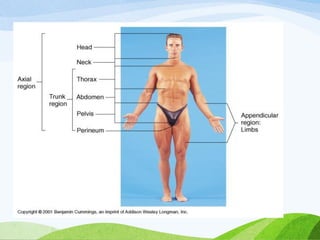
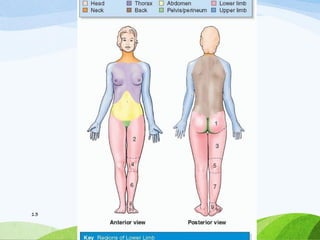
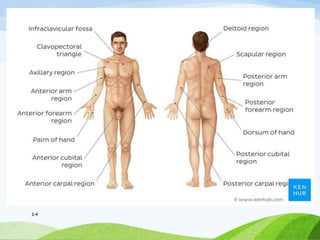
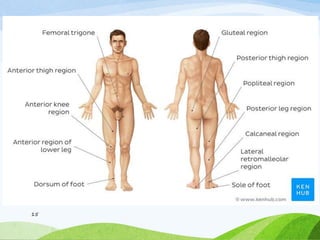
2. Regional approach
• Deals with several systems located in a particular
region of the body.
• Six regions
• limb (upper and lower)
• back
• thorax
• abdomen
• pelvis and perineum
• head and neck
• Used mostly in dissection room and useful to
physicians and surgeons.
11
12
13
14
15
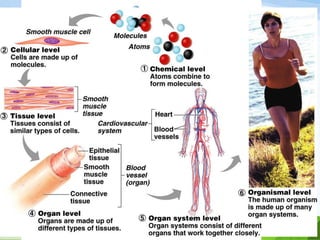
Levels of structural organization
• The human body has many levels of structural
complexity.
• The levels of organization of living things, from smallest
to largest, are:
• Chemical level
• Atoms(C, H, O, N P, S, Na, K, )combine to form molecules and
( Proteins, Carbohydrates, Fats, Nucleic acids) the building
blocks of the structures at the cellular level
• Cellular level
• Organelles, specialized structures/subunits within a cell.
• Cells are the smallest living units in the body and we have
trillions of them
• Tissue level,
• a group of similar cells that work together to perform a
common function.
16
• Organ level
• A discrete structure made up of more than one
tissue
• Complex physiological processes occur at the
organ level
• Systems level
• two or more organs working together to
accomplish a common purpose
• Organismic level
-Is the result of all of the simpler levels working in
union to sustain life.
17
18
The Language of Anatomy
• ANATOMICOMEDICAL TERMINOLOGY
• To be understood, you must express
yourself clearly, using the proper terms in
the correct way.
19
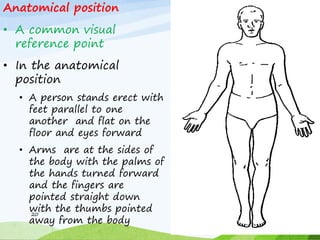
Anatomical position
• A common visual
reference point
• In the anatomical
position
• A person stands erect with
feet parallel to one
another and flat on the
floor and eyes forward
• Arms are at the sides of
the body with the palms of
the hands turned forward
and the fingers are
pointed straight down
with the thumbs pointed
away from the body
20
Directional and regional terms
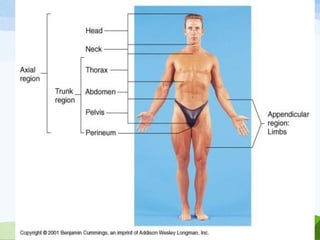
• The fundamental divisions of the body are the
axial and appendicular regions
• Used to explain precisely where one body
structure lies in relation to another
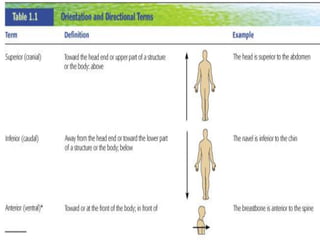
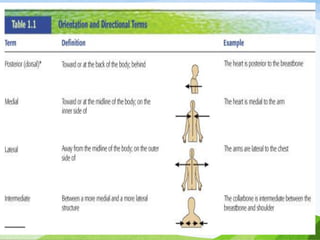
• Paired terms: superior/inferior, anterior (ventral)
/posterior (dorsal), medial/lateral, and
superficial/deep.
21
22
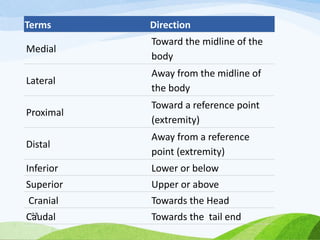
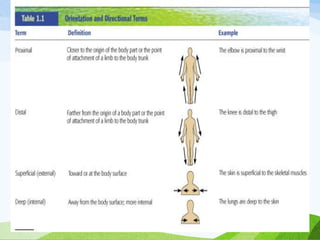
Terms Direction
Medial
Toward the midline of the
body
Lateral
Away from the midline of
the body
Proximal
Toward a reference point
(extremity)
Distal
Away from a reference
point (extremity)
Inferior Lower or below
Superior Upper or above
Cranial Towards the Head
Caudal Towards the tail end
23
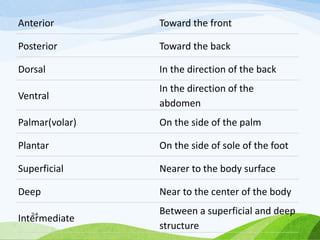
Anterior Toward the front
Posterior Toward the back
Dorsal In the direction of the back
Ventral
In the direction of the
abdomen
Palmar(volar) On the side of the palm
Plantar On the side of sole of the foot
Superficial Nearer to the body surface
Deep Near to the center of the body
Intermediate
Between a superficial and deep
structure
24
25
26
27
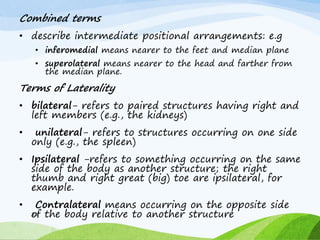
Combined terms
• describe intermediate positional arrangements: e.g
• inferomedial means nearer to the feet and median plane
• superolateral means nearer to the head and farther from
the median plane.
Terms of Laterality
• bilateral- refers to paired structures having right and
left members (e.g., the kidneys)
• unilateral- refers to structures occurring on one side
only (e.g., the spleen)
• Ipsilateral -refers to something occurring on the same
side of the body as another structure; the right
thumb and right great (big) toe are ipsilateral, for
example.
• Contralateral means occurring on the opposite side
of the body relative to another structure
28
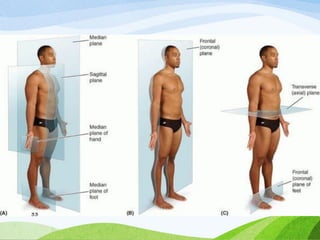
Anatomical Planes and sections
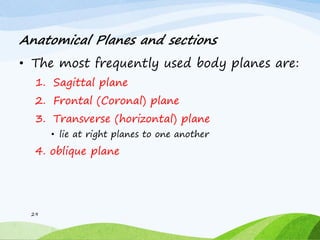
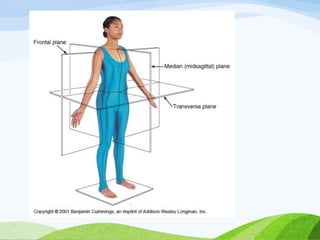
• The most frequently used body planes are:
1. Sagittal plane
2. Frontal (Coronal) plane
3. Transverse (horizontal) plane
• lie at right planes to one another
4. oblique plane
29
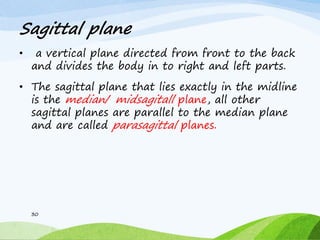
Sagittal plane
• a vertical plane directed from front to the back
and divides the body in to right and left parts.
• The sagittal plane that lies exactly in the midline
is the median/ midsagitall plane, all other
sagittal planes are parallel to the median plane
and are called parasagittal planes.
30
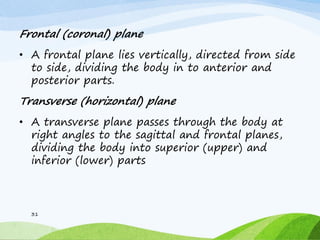
Frontal (coronal) plane
• A frontal plane lies vertically, directed from side
to side, dividing the body in to anterior and
posterior parts.
Transverse (horizontal) plane
• A transverse plane passes through the body at
right angles to the sagittal and frontal planes,
dividing the body into superior (upper) and
inferior (lower) parts
31
32
33
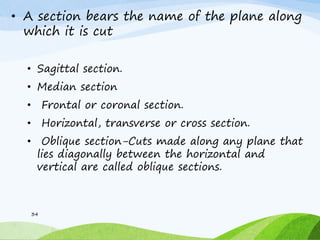
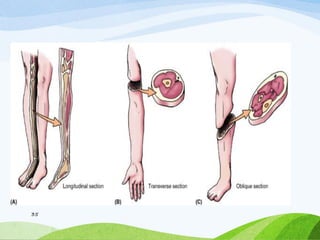
• A section bears the name of the plane along
which it is cut
• Sagittal section.
• Median section
• Frontal or coronal section.
• Horizontal, transverse or cross section.
• Oblique section-Cuts made along any plane that
lies diagonally between the horizontal and
vertical are called oblique sections.
34
35
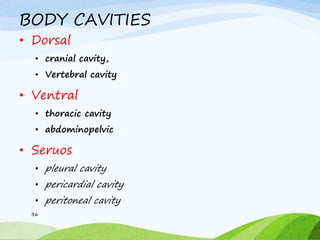
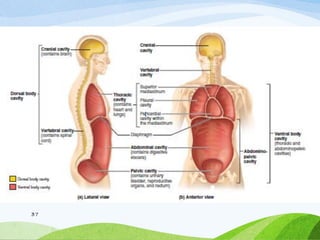
BODY CAVITIES
• Dorsal
• cranial cavity,
• Vertebral cavity
• Ventral
• thoracic cavity
• abdominopelvic
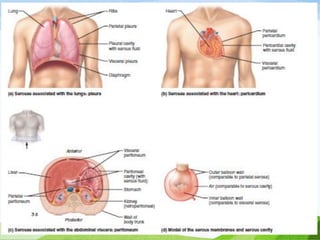
• Seruos
• pleural cavity
• pericardial cavity
• peritoneal cavity
36
37
38

1 Introduction to Anatomy.pdf

  • 1.
  • 2.
    Outline ❖ Definition ❖ Subdivisionsof anatomy ❖ Approaches to studying Anatomy ❖ Levels of Structural Complexity of the body ❖ The Language of Anatomy ❖ Body Planes and Sections ❖ Body Cavities ❖ Regions of the body 2
  • 3.
    Objectives At the endof the session you will be able to • Define anatomy • List subdivision of anatomy • Discuss on study approaches of anatomy • Explain different anatomic terminology and body plains and sections • Divide body cavities 3
  • 4.
    Definition : Anatomy • isthe study of the structures of the body and their interrelationships. • describes the scientific names, composition, and location of the structures of the body and associated structures. • Ana= apart and tome= to cut • cutting up, divide or dissect the body for determining the character and arrangement of its parts • Similar to morphology, the science of form 4
  • 5.
    DIVISIONS OF ANATOMY 1.Grossanatomy 2.Microscopic anatomy 3.Developmental anatomy 5
  • 6.
    DIVISIONS OF ANATOMY •Gross (macroscopic) anatomy: The study of body structures that can be examined by the unaided eye • An important technique for studying gross anatomy is dissection • Surface anatomy-the study of the shapes and markings on the surface of the body that reveal the underlying organs. • Special anatomy – anatomy of certain definite organs or groups of organs involved in the performance of a special function 6
  • 7.
    • Microscopic anatomy:the study of structures that are so small and can be seen only with the help of light microscope • Cytology –the study of cells • Histology –the study of tissues • Ultrastructural anatomy: the ultramicroscopic study of structures that are small to be seen with light microscope. • Developmental anatomy: the study of structural changes that occur in the body throughout the lifespan • Embryology-the study of how body structures form and develop before birth • Teratology – studies birth defects 7
  • 8.
    • Comparative anatomy-is the comparative study of structures with regard to homologues organs or parts. • Descriptive anatomy: deals with description of the physical structure of the man. • Pathological anatomy: deals with the structural changes in cells , tissues and organs caused by disease • Radiographic anatomy: the study of internal body structures by the help of radiograph. • Physiological (functional) anatomy: anatomy studied in relation to function. • Applied anatomy: practical application of anatomical knowledge to the diagnosis and treatment of diseases. 8
  • 9.
    APPROACHES TO STUDYING ANATOMY •Study of anatomy can be approached in : • Regional anatomy- the study of groups of structures in specific body regions • Systemic anatomy –all the organs with related functions are studied together • Clinical (or applied) - emphasizes aspects of bodily structure and function important in the practice of medicine, dentistry, and the allied health sciences 9
  • 10.
    Systemic approach Studies specificsystems of the body. • about 11 systems are found in human body • integumentary • skeletal • muscular • nervous • endocrine • cardiovascular • lymphatic • respiratory • digestive • urinary • reproductive 10 Cardiovascular Digestive Endocrine Execratory/Urinary Integumentary Lymphatic/Immune Muscular Nervous Reproductive Respiratory Skeletal
  • 11.
    2. Regional approach •Deals with several systems located in a particular region of the body. • Six regions • limb (upper and lower) • back • thorax • abdomen • pelvis and perineum • head and neck • Used mostly in dissection room and useful to physicians and surgeons. 11
  • 12.
  • 13.
  • 14.
  • 15.
  • 16.
    Levels of structuralorganization • The human body has many levels of structural complexity. • The levels of organization of living things, from smallest to largest, are: • Chemical level • Atoms(C, H, O, N P, S, Na, K, )combine to form molecules and ( Proteins, Carbohydrates, Fats, Nucleic acids) the building blocks of the structures at the cellular level • Cellular level • Organelles, specialized structures/subunits within a cell. • Cells are the smallest living units in the body and we have trillions of them • Tissue level, • a group of similar cells that work together to perform a common function. 16
  • 17.
    • Organ level •A discrete structure made up of more than one tissue • Complex physiological processes occur at the organ level • Systems level • two or more organs working together to accomplish a common purpose • Organismic level -Is the result of all of the simpler levels working in union to sustain life. 17
  • 18.
  • 19.
    The Language ofAnatomy • ANATOMICOMEDICAL TERMINOLOGY • To be understood, you must express yourself clearly, using the proper terms in the correct way. 19
  • 20.
    Anatomical position • Acommon visual reference point • In the anatomical position • A person stands erect with feet parallel to one another and flat on the floor and eyes forward • Arms are at the sides of the body with the palms of the hands turned forward and the fingers are pointed straight down with the thumbs pointed away from the body 20
  • 21.
    Directional and regionalterms • The fundamental divisions of the body are the axial and appendicular regions • Used to explain precisely where one body structure lies in relation to another • Paired terms: superior/inferior, anterior (ventral) /posterior (dorsal), medial/lateral, and superficial/deep. 21
  • 22.
  • 23.
    Terms Direction Medial Toward themidline of the body Lateral Away from the midline of the body Proximal Toward a reference point (extremity) Distal Away from a reference point (extremity) Inferior Lower or below Superior Upper or above Cranial Towards the Head Caudal Towards the tail end 23
  • 24.
    Anterior Toward thefront Posterior Toward the back Dorsal In the direction of the back Ventral In the direction of the abdomen Palmar(volar) On the side of the palm Plantar On the side of sole of the foot Superficial Nearer to the body surface Deep Near to the center of the body Intermediate Between a superficial and deep structure 24
  • 25.
  • 26.
  • 27.
  • 28.
    Combined terms • describeintermediate positional arrangements: e.g • inferomedial means nearer to the feet and median plane • superolateral means nearer to the head and farther from the median plane. Terms of Laterality • bilateral- refers to paired structures having right and left members (e.g., the kidneys) • unilateral- refers to structures occurring on one side only (e.g., the spleen) • Ipsilateral -refers to something occurring on the same side of the body as another structure; the right thumb and right great (big) toe are ipsilateral, for example. • Contralateral means occurring on the opposite side of the body relative to another structure 28
  • 29.
    Anatomical Planes andsections • The most frequently used body planes are: 1. Sagittal plane 2. Frontal (Coronal) plane 3. Transverse (horizontal) plane • lie at right planes to one another 4. oblique plane 29
  • 30.
    Sagittal plane • avertical plane directed from front to the back and divides the body in to right and left parts. • The sagittal plane that lies exactly in the midline is the median/ midsagitall plane, all other sagittal planes are parallel to the median plane and are called parasagittal planes. 30
  • 31.
    Frontal (coronal) plane •A frontal plane lies vertically, directed from side to side, dividing the body in to anterior and posterior parts. Transverse (horizontal) plane • A transverse plane passes through the body at right angles to the sagittal and frontal planes, dividing the body into superior (upper) and inferior (lower) parts 31
  • 32.
  • 33.
  • 34.
    • A sectionbears the name of the plane along which it is cut • Sagittal section. • Median section • Frontal or coronal section. • Horizontal, transverse or cross section. • Oblique section-Cuts made along any plane that lies diagonally between the horizontal and vertical are called oblique sections. 34
  • 35.
  • 36.
    BODY CAVITIES • Dorsal •cranial cavity, • Vertebral cavity • Ventral • thoracic cavity • abdominopelvic • Seruos • pleural cavity • pericardial cavity • peritoneal cavity 36
  • 37.
  • 38.